Sovereignty Without Rupture: Qatar's Two-Front Squeeze
Qatar’s most consequential new signal in the August 15-16 window is a calibrated Iran posture: defend sovereignty, reject coercion in Hormuz, and rebut Tehran-linked narratives without closing the diplomatic channel. A second development sharpens the picture: public friction between Doha and Tehran is rising on the eve of the August 17 expiry of the sixty-day period set out in the Islamabad memorandum, and it is rising while Israeli targeted strikes resume in Gaza. Both files on which Qatar’s mediation model rests are under stress at the same time. This post summarizes our Qatar Watch report for August 16.
The Pilots File
The cycle is led by Qatar’s effort to control the political meaning of its confrontation with Iran. The sequence matters, and the report insists the order itself is the finding. Between August 14 and 15, Iran attacked two UAE ADNOC tankers in the strait. On August 15, Qatar’s Foreign Ministry condemned the attack, naming Iran and invoking Security Council Resolution 2817, Doha’s most direct public criticism of Tehran in the current cycle. The same day, Fars published a letter from Brigadier General Mohammad Bagherzadeh, head of the Armed Forces General Staff’s Missing in Action Search Committee, to the ICRC president, asserting for the first time that three Iranian pilots from the March 2 mission against Al Udeid are alive in Qatari custody, naming them; Mehr and Iran International amplified the claim. By evening, Foreign Ministry spokesman Majed Al Ansari categorically denied it, restated the airspace-violation account, defended the legality of Qatar’s military response, described the search-and-rescue and humanitarian handling of the pilots’ remains, and noted that Iran never answered Qatar’s April invitation to review the operation. And the same day, Foreign Minister Abbas Araghchi said Tehran is exchanging messages with Qatar and Pakistan on the negotiating track.
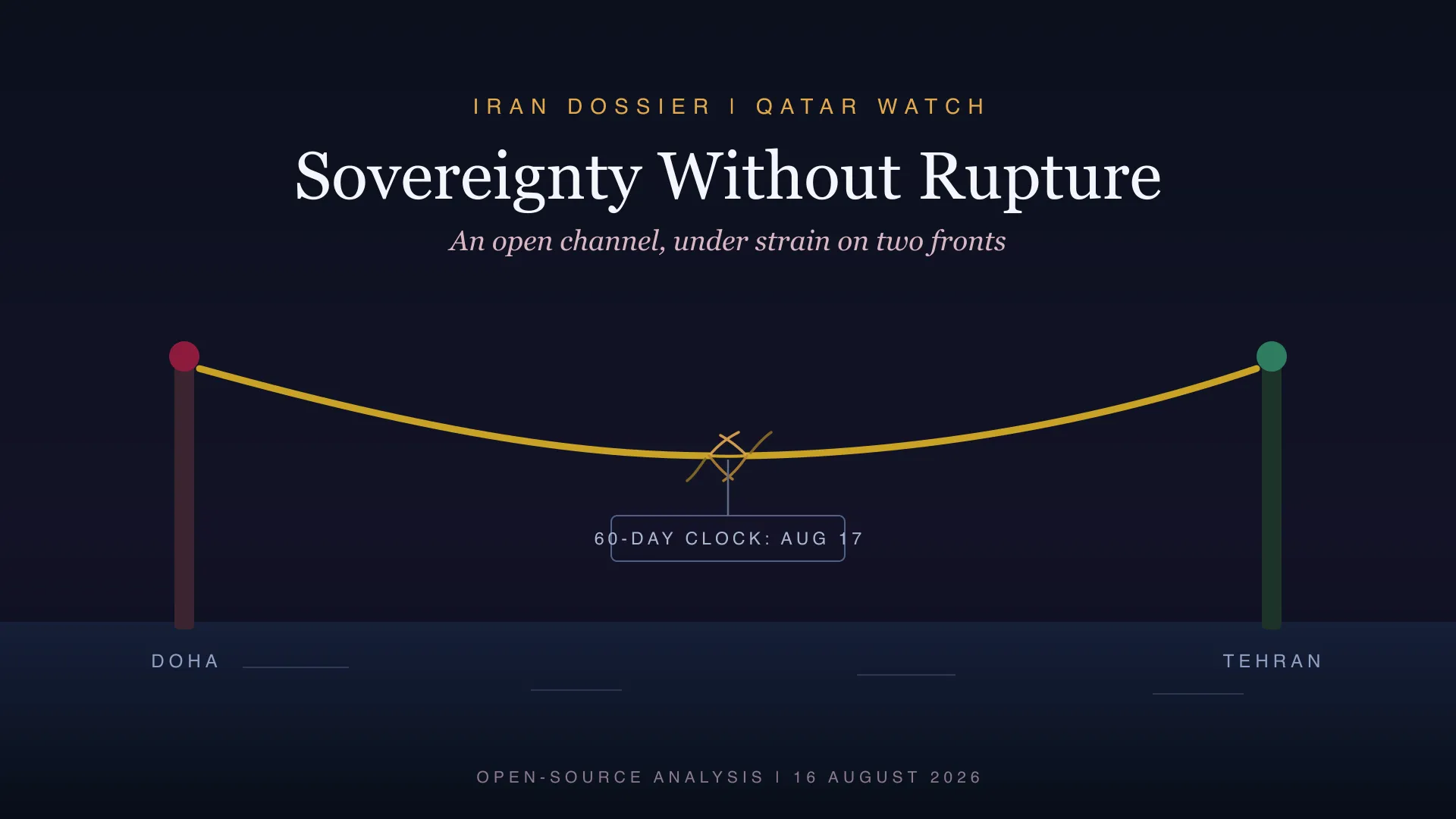
The report’s reading is disciplined. Whether the Iranian disclosure was a direct answer to the tanker condemnation or a pre-planned pressure move cannot be established from open sources, and the letter’s August 15 date allows either; what can be established is the effect. Within a single day, each side placed on the public record its most damaging available claim against the other while explicitly keeping the channel open. Al Ansari’s phrasing was deliberately dual-track, hard on substance, soft on the frame: Doha wants this handled as a sovereignty question, not a rupture. The calendar gives the friction its weight. The sixty-day period in the Islamabad memorandum expires on August 17, the Iranian press treats that deadline as the organizing fact of the week, and Doha’s mediation value peaks exactly when the ceasefire clock runs out. A public prisoner-of-war dispute with Tehran at that moment is a structural problem, not a news-cycle problem.
The Squeeze on the Other Front
The pressure operates on the Gaza file as well. Israeli targeted strikes resumed on August 12 with the killing of a Hamas cell commander in Beit Lahia, the first Israeli airstrike in Gaza in more than a week, and drone strikes on August 13 killed two more people. Inside the current window, Middle East Monitor reported a further drone strike in central Gaza that injured three, together with artillery fire east of Zeitoun; the report flags that item as single-source and not yet corroborated. A mediator whose Iranian channel is under public strain, at the same time as the Gaza ceasefire it helped broker is fraying, faces pressure on both of the files that define its regional utility.
There was no new Qatari mediation announcement in the window; the more useful signal came from the Arabic press, and its register sharpened. Al-Sharq’s editorial voice, published at 00:14 on August 16, says escalating attacks in the occupied West Bank demonstrate that Israeli violence did not end with the destruction in Gaza, connects settler attacks, displacement, land confiscation and settlement expansion to a deliberate effort to undermine Palestinian statehood, and states its Gaza line directly: at a time when efforts should focus on consolidating peace and implementing the peace plan, the Israeli government is continuing to place obstacles in the way. The report notes what the editorial omits as carefully as what it says: the United States is not attacked, and Iran, Türkiye, Hamas and intra-Palestinian actors are absent, a construction that concentrates responsibility on Israel alone. Less than an hour later, Al-Sharq published a signed opinion column by Sheikh Dr. Saud bin Nasser Al Thani, “Freedom for Palestine,” that operates in a markedly harder register: Palestine placed inside an Arab-Islamic civilizational frame, “the Zionist entity” in place of Israel, British Mandate policy portrayed as the construction of a Zionist state apparatus, and the United States framed as its patron. The distinction between the institutional editorial and the signed column matters, and together they show the spectrum of rhetoric a leading Qatari Arabic outlet chose to foreground in the first hour of the day. Gulf Times, meanwhile, made West Bank violence its top regional story in language leaning on WAFA and “occupation forces,” while its English-language presentation of the pilots file stayed institutional and defensive: establish the factual record, protect the legal position, prevent an Iranian information claim from contaminating de-escalation.
For Israel, the report’s assessment of the mechanism is unchanged but sharper: the principal information risk is definitional and reputational. If the Qatar-based media environment fixes the proposition that the plan exists, Hamas is inside the political process, and Israel is the actor blocking implementation, then pressure can be applied in Washington without Qatar ever opposing President Trump’s initiative directly. A signed Al Jazeera Arabic opinion by Jordanian former minister Samir Habashneh extends the argument into electoral terrain: Netanyahu rejected Trump’s Gaza plan to demonstrate independence from Washington, and forthcoming elections in Israel and the United States, read through Zohran Mamdani’s and Abdul El-Sayed’s successes and AIPAC’s position, could constrain the president’s war powers and change US policy toward Iran and Palestine.
The Turkish Voice, In House
Al Jazeera Arabic added a separate strategic layer, and the byline is the point: Kamal Ozturk writes as Al Jazeera Net’s own correspondent in Türkiye, so the network handed the argument to one of its staff voices rather than a hosted guest. His essay treats the Mecca defence agreement and Türkiye’s domestic PKK-disarmament legislation as parts of a single geopolitical transformation in which Muslim states build new security structures with greater strategic autonomy. The register travels far beyond a technical reading of the pact: a collective Muslim “we,” external powers associated with oppression, exploitation, invasion and genocide, certainty that many other states will join the agreement, and the closing reminder that Gaza was the catalyst for all of it. Al Jazeera English carried no comparable Qatar, Gaza, Iran or Türkiye opinion item in the same window, an absence of emphasis rather than evidence of a coordinated split, and no major new Qatar-Türkiye bilateral agreement was identified; the signal is the information environment, not a policy adoption. It nevertheless fits Qatar’s strategic comfort zone: retain US military protection, preserve diplomatic flexibility with Iran, and normalize a more autonomous role for Türkiye and other Muslim regional powers.
One small item completes the picture on the slow clock: Qatar Charity inaugurated a QR1.065 million science-laboratory building at a Muslim college in Sri Lanka, serving more than 1,500 students, opened with Qatari embassy participation alongside Sri Lankan political figures. The report is explicit that this is legitimate development activity, not evidence of political interference; its analytic relevance is the durable local access, institutional relationships and national brand equity such projects accumulate outside formal diplomacy.
Key Points
- Qatar’s Iran posture is sovereignty without rupture: defend the airspace-violation record, name Iranian coercion in Hormuz, rebut the pilots claim categorically, and keep the channel open, a narrow middle in which too soft a response erodes sovereignty and GCC solidarity while too hard a response destroys the access that makes Doha valuable to Washington.
- The August 15 sequence, tanker condemnation, pilots claim, categorical denial and confirmed messaging track within one day, is rising public friction managed inside an open channel; whether the Iranian disclosure was retaliation or pre-planned cannot be established, and the report holds both readings apart.
- The timing is the structural problem: the sixty-day Islamabad-memorandum period expires August 17, Doha’s mediation value peaks as the clock runs out, and Israeli targeted strikes have resumed in Gaza, so both pillars of Qatar’s mediation model are under simultaneous stress.
- The Arabic register on Israel sharpened: Al-Sharq’s institutional editorial names Israel the active spoiler of the peace plan while a signed column an hour later reaches for the Zionist entity and a civilizational anti-Zionist frame, the spectrum a leading Qatari daily chose to foreground; English-language output stays institutional.
- The repeated Gaza mechanism is reassignment of responsibility, not rejection of the framework: fix the proposition that Israel is blocking implementation, and pressure follows in Washington without Doha opposing Trump’s initiative.
- The Ozturk essay shows Al Jazeera platforming, in a staff voice, a Türkiye-centered reading in which the Mecca pact is the first tangible manifestation of Muslim strategic agency and Gaza its catalyst, an information-environment indicator consistent with Qatar’s preference for a less US-exclusive order it has not formally joined.
What to Watch
- Whether the Foreign Ministry issues a fuller stand-alone statement on the pilots dispute or treats Al Ansari’s rebuttal as sufficient, and whether Iranian official media answer Qatar’s account, especially the unanswered April invitation.
- How Iranian state media handle the pilots file after the August 17 expiry of the sixty-day memorandum period: intensification, or letting it recede once its leverage value is spent.
- Whether further tanker attacks push Doha from freedom-of-navigation language toward explicit deterrence or collective GCC security commitments.
- Whether Al-Sharq and the other Arabic dailies continue describing Israel as the actor obstructing implementation of Trump’s framework, and whether resumed Israeli strikes push Qatari framing from incident reporting toward ceasefire-collapse framing.
- Whether Al Jazeera English begins carrying the Mecca-pact and Muslim strategic-autonomy argument now prominent in Arabic opinion, and whether Qatari officials move from media interest to any practical political, military or observer role.
- Whether Qatar Charity, QFFD or QRCS publish new Gaza reconstruction activity linking humanitarian delivery to postwar governance or verification mechanisms, and whether new US congressional, Treasury or DOJ/FARA material connects Qatar to Brotherhood, Hamas, university or lobbying networks with document-level evidence.
This post summarizes the Iran Dossier Qatar Watch report for August 16, 2026, prepared from material published inside a hard window of August 15, 07:30 to August 16, 11:30: the Al Ansari rebuttal and Hormuz condemnation as carried by The Peninsula, Gulf Times and QNA, the Fars, Mehr and Daily Sabah records of the Bagherzadeh letter, the Al-Sharq editorial and signed column, the Al Jazeera Arabic opinion set, and Qatar Charity’s Sri Lanka inauguration, with international wires used only for cross-checking. Confidence is high on the characterization of the statements and articles, moderate on the sovereignty-without-rupture assessment as an analytical interpretation, and moderate on reading the August 15 Iran-Qatar sequence as reciprocal public pressure, since a pre-planned disclosure landing the same day cannot be excluded.