One Channel, Two Agendas: Doha Carries the U.S.-Iran Exchange as Qatari LNG Edges Back Through Hormuz
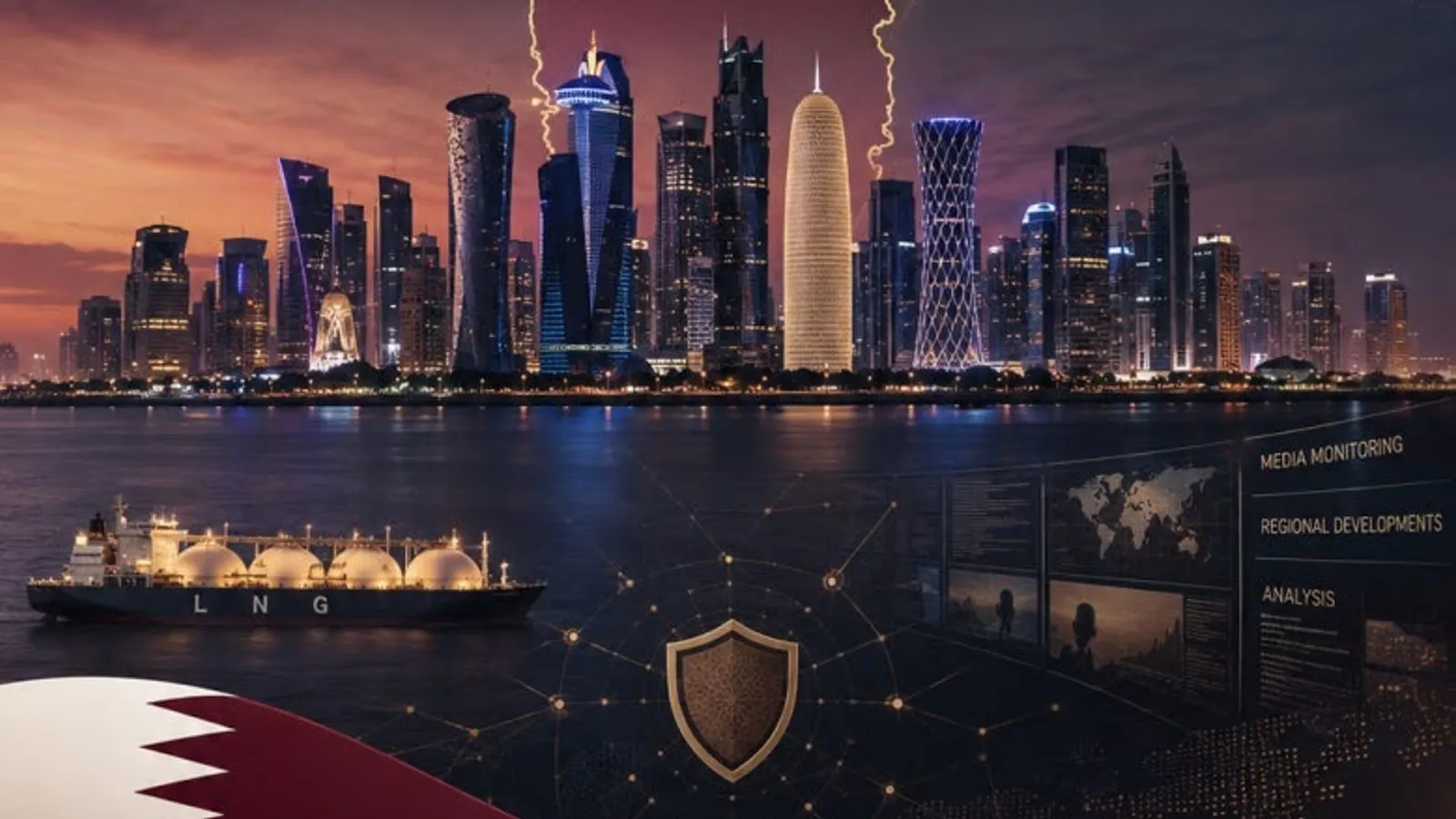
Qatar is now the working channel between Washington and Tehran, but the channel is not narrowing the gap. The U.S. reply to Iran’s seven-day plan reached Tehran through Qatari mediation, and Iran has sent its answer back the same way. Washington wants to settle the nuclear file first, while Tehran wants to start with Hormuz and sanctions. Doha is also widening its access in Washington. The Amir received Senator Chris Murphy on October 4, four weeks before the U.S. midterms. The Section 117 case produced no new filing, and Qatari officials stayed silent on it. Meanwhile, more Qatari LNG cargoes cleared the strait over the weekend, an improvement that remains real but easily reversed.
The U.S. Reply Moves Through Doha
Iran’s Foreign Ministry spokesman, Esmaeil Baghaei, said the U.S. proposal that reached Tehran through Qatari mediation resembles earlier offers and centers on the nuclear file. Iran wants the talks to focus on Hormuz. Baghaei said Tehran has already conveyed its views through the mediators and has further points to pass on. He added that the return of IAEA inspectors did not come up in the New York talks between Foreign Minister Abbas Araghchi and Qatari mediators, and he tied stability in the strait to the full lifting of U.S. sanctions. Report.az, citing Baghaei, says Iran’s response has already gone back to Washington through Qatar.
Parliament Speaker Mohammad Bagher Qalibaf took a harder line. He told an open session of parliament that Tehran had received new U.S. proposals through intermediaries and that Hormuz will stay closed until seven conditions drawn from the Islamabad understandings are met. These include an end to military operations on all fronts, an end to the blockade, the release of frozen assets, and the withdrawal of U.S. forces from Iran’s periphery. Araghchi told foreign ambassadors that Iran is ready for a fair settlement through diplomacy. President Trump and Defense Secretary Pete Hegseth, for their part, warned Iran that the nuclear file could be settled by force.
The report’s assessment is that the channel works, but the positions have not moved closer. Both sides publicly route the exchange through Doha. That gives Qatar standing in both capitals, and it also ties Qatar’s reputation to an outcome it does not control. For Qatar’s own economy, the Hormuz-first sequencing that Tehran demands is the one that matters most, because it governs whether LNG can move. Iran’s side of the same exchange, and the widening Yemen front, are covered in our October 5 daily intelligence update.
Congressional Access and a Quiet Court Calendar
The Amir received Senator Murphy and a U.S. delegation at Lusail Palace on October 4. QNA and the Amiri Diwan described the talks in broad terms, covering friendship, strategic cooperation, and regional developments. Murphy’s own account adds detail that the Qatari readouts leave out. He told The National News Desk that he was the first Democrat to visit the region since the war began, a claim the report has not verified. He said his first meeting in Qatar was a dinner with Ali Al Thawadi, whom he described as a diplomat involved in U.S.-Iran shuttle diplomacy and who urged Washington to pursue a deal with Iran instead of renewed strikes. Murphy also said he had heard concerns about war profiteering, including by U.S. companies, and that a Democratic Congress should examine the issue. In a separate video, he lamented Qatar’s reduced LNG exports during the war and accused the trading firm Vitol of profiting from the war in ways that benefited President Trump.
Nothing in the readouts suggests congressional support for Qatar’s university-funding model. The visit fits Doha’s long-standing practice of building dense, bipartisan relationships in Washington across defense, diplomacy, investment, and education. The report judges, with moderate confidence, that Doha is deliberately cultivating Democratic as well as Republican access ahead of the November 3 midterms, and that the Thawadi dinner shows Qatar using congressional visits to argue its mediation case directly.
On Section 117, no new ruling, filing, or Qatari official response appeared on October 4 or 5. Judge Tanya Chutkan’s temporary restraining order still bars the Education Department from publishing previously confidential donor and counterparty identities reported by AAU member universities. The order runs through October 29 unless extended. The government’s response is due October 13, and AAU’s reply is due October 20. The 92 foreign entities published in July remain outside the order. We examined the order in detail in our Section 117 special report.
The analytical point is unchanged. Non-disclosure makes it harder for journalists, lawmakers, and researchers to connect specific foreign counterparties to specific contracts and programs. Qatar has a clear interest in limiting politically charged readings of its academic ties, and the universities have privacy and fundraising interests of their own. No public evidence shows that Qatar Foundation or its U.S. representatives directed or financed the AAU lawsuit. The supportable assessment is a convergence of interests, with coordination unproven.
Al-Araby’s Cumulative Israel Frame
Al-Araby Al-Jadeed’s Qatar edition (issue 4417) built its front page around Al-Aqsa under the headline “Alienation in Al-Aqsa.” The report on pages 6 and 7 describes a growing sense of estrangement among Palestinian and Muslim visitors amid a larger settler presence, Jewish religious rituals, and heavier Israeli security deployment. It cites Jerusalem governorate figures of 27,830 settler entries to the compound in the third quarter, together with 139 demolitions, 357 arrests, and 73 exclusion orders. A page 18 report on the Rafah crossing frames medical evacuation as systemic restriction and attributes 1,929 deaths to the closure.
The opinion pages were sharper. A guest column marked three years since the October 7 attack as a historical turning point that reshaped the Middle East. A regular columnist portrayed Washington’s failure to impose its aims on Iran as a military and political defeat. A researcher writing on page 16 described the strait as Iran’s “geopolitical nuclear weapon.” Online, Lebanese writer Gerard Dib’s column, “Qatar Also Resists… Ask Lebanon,” cast Qatari aid in Lebanon and Gaza as resistance to Israeli expansion. That framing gives U.S. critics of Qatar language they can quote directly.
The paper’s cartoons carried the same themes. A wordless print cartoon set the outline of the Gulf over a merchant ship inside a no-entry road sign, presenting Hormuz as closed water for commerce. Online, Emad Hajjaj’s “The Oil Barrel” tied the Iran and Yemen fronts to both chokepoints, and Qatari cartoonist Saad Al-Muhannadi drew the dispatch of a third U.S. aircraft carrier to the region. The report stresses that signed opinion is attributed commentary and does not set Qatari state policy. However, it judges with high confidence that the cumulative effect across news, opinion, and cartoons sustains a hostile register toward Israel and toward U.S. primacy in the Qatar-linked media space.
The Qatari state press carried related themes in official form. Al-Raya combined Palestinian rights coverage with the Foreign Ministry’s October 4 condemnation of Israel’s completion of the “Sufa 53” line in Quneitra as a violation of Syrian sovereignty and of the 1974 disengagement agreement. Jordan and Kuwait issued parallel statements.
Al Jazeera, and No Brotherhood Signal on France
Al Jazeera’s Arabic and English output for October 4 and 5 paired Israel-critical items with Iran war coverage in which Qatar’s mediation is a standing reference. The Arabic service reported an Israeli strike in Gaza that killed four women, an incursion into rural Quneitra, and the UK Green Party’s vote defining Zionism as racism. The English service led its Greens story with Israel’s reaction. An English-language panel of former Iranian and U.S. diplomats expected the war to worsen in the coming weeks, a bearish signal for Doha’s mediation. The familiar pattern held: the Arabic service is more expansive and interpretive, and the English service is more selective and oriented to international policy.
Both Al-Araby and Al Jazeera Arabic covered the French student protests as an education, social, and policing crisis and criticized the French government’s security framing. Al-Araby reported more than 5,000 arrests over five days, with minors making up 85 percent of the 824 detained in the Paris region. Al Jazeera Arabic described the movement as a crisis spanning education, security, justice, and the state’s relations with young people. In both outlets, the visible political actors are La France Insoumise, students, and unions.
The report found no explicit reference to the Muslim Brotherhood, Brotherhood-affiliated associations, mosque networks, or an Islamist agenda in the Qatar-linked coverage it reviewed, and no coded language that appears to stand in for one. It holds this finding with moderate confidence and notes its limits. A nil return in Qatar-linked coverage does not rule out a role for Islamist actors in the wider protest environment.
Soft Power Alongside Political Access
Qatar continued to pair political access with commercial, educational, sport, and media platforms. The Qatar Businessmen Association hosted Maryland Commerce Secretary Harry Coker to discuss investment ties. The Government Communications Office and the Qatari Embassy held a Washington event to promote Web Summit Qatar 2027 to U.S. companies and investors. Qatar Foundation remains the central vehicle for educational influence, and Carnegie Mellon University in Qatar is hosting hackathons in Education City this week. The report notes that the more U.S. institutions have direct educational experience in Qatar, the harder it becomes to reduce the relationship to a single foreign-funding statistic.
Qatar received the Olympic Council of Asia flag for the 2030 Asian Games at the closing ceremony in Aichi-Nagoya, which gives Doha a fixed international calendar through 2030 regardless of the war. CNN’s Global Perspectives summit, with Media City Qatar as host partner, is set for Rosewood Doha on October 29, with QIA chief executive Mohammed Saif Al-Sowaidi among the announced speakers. The report sees no sign of editorial control. The value to Doha lies in reputation, because the event places Qatari institutions inside CNN-branded discussions distributed across the network’s platforms.
LNG Transits Improve, Vulnerability Persists
Reuters reported that several cargoes loaded at Ras Laffan over the weekend were later observed beyond the Strait of Hormuz. This strengthens the evidence that a managed transit regime is working more often than it did during the summer. It does not yet amount to normal commercial passage, because security risk, escort requirements, irregular AIS behavior, and high insurance costs persist. The September baseline remains the best month of the war, with S&P Global counting 19 LNG shipments through Hormuz, 13 of them from Qatar. The Qatar index rose about 0.5 percent in early trading on October 5 as energy-supply fears eased.
The wider energy market is increasingly a logistics story. Gulf producers have shipped 60 to 80 percent of normal volumes in recent months, and the seven core OPEC+ producers pumped 25 million barrels per day in August, about 5 million below prewar levels. War-risk premiums for Saudi-linked tankers have risen to 3 percent of hull value at Yanbu and up to 7 percent at southern ports. Al-Araby reported that Aramco is studying new overland pipeline routes, including one to Oman’s Duqm complex, and one economist suggested such a route could someday carry Qatari LNG. That idea has no project behind it. Today, unlike Saudi crude, Qatari LNG has no large-scale bypass around Hormuz. Brent traded near $101 to $102 a barrel on October 5, with WTI near $90.
The report concludes that Qatar’s war economy is improving at the margin while its strategic vulnerability is unchanged. The test is no longer whether a single Qatari carrier can pass. It is whether repeatable, insurable, and transparent passage becomes normal enough to reduce force-majeure risk and keep customers from building permanent alternatives. Qalibaf’s insistence on all seven conditions is the main political risk to the transit trend. The previous day’s picture is in our October 4 brief.
On human rights, the standing tracker moved from baseline to event monitoring. The second Doha Dialogue on GCC-Africa labor mobility opened on October 5 in Dar es Salaam under Qatari sponsorship. African governments arrived with 16 common recommendations and a demand for a joint secretariat and a roadmap with milestones. Because the African side has set its own yardstick, a vague outcome will be easier to measure as a shortfall. A non-binding declaration without enforcement metrics would add reputational value but little evidence of better outcomes for workers. No new Qatar-specific case on expression, religious freedom, or due process appeared in the review window.
Key Points
- Qatar remains the working channel between Washington and Tehran. The positions remain far apart, with Washington putting the nuclear file first and Tehran putting Hormuz first, so Doha carries exposure if the talks collapse (high confidence).
- Doha is cultivating Democratic as well as Republican access in Washington, and its interlocutors pressed Senator Murphy for a deal with Iran ahead of the midterms (moderate confidence).
- Section 117 exposure is frozen and unresolved. The order holds to October 29, the government responds on October 13, and the 92 entities published in July stay outside it (high confidence).
- Qatar-linked media sustain a hostile register toward Israel across news, opinion, and cartoons. Signed opinion is attributed commentary and does not set state policy (high confidence).
- Qatar-linked coverage of the French protests shows no Muslim Brotherhood signal and names La France Insoumise and unions as the visible actors (moderate confidence).
- The recovery in LNG transits is real and reversible, given Iran’s seven conditions and war-risk premiums of 3 to 7 percent of hull value (moderate confidence).
- Qatar’s labor-mobility diplomacy faces a measurable test this week, and a non-binding text without metrics would add reputational value only (moderate confidence).
What to Watch
- Whether Iran’s further points reach Washington through Doha this week, any briefing by Foreign Ministry spokesman Majed Al-Ansari on the exchange, and any shift by either side on sequencing.
- Follow-up from Senator Murphy or other U.S. lawmakers after the Doha visit, especially on Iran, Gaza, universities, war profiteering, or influence concerns.
- Any Section 117 filing before the October 13 government response, any intervention by an individual university, or U.S. media reports tying named Qatari counterparties to specific programs.
- Whether QNA, Qatar Foundation, or the Qatari Arabic press begins to address the Chutkan order directly.
- Any shift in French coverage toward Islamist, Brotherhood, or foreign-influence allegations, notably around the October 6 protest day.
- Daily Qatari LNG transits, AIS-off behavior, insurance terms, force majeure, and any renewed Iranian restrictions on Hormuz.
- Concrete outputs from the October 5-6 Doha Dialogue, including whether the joint secretariat and roadmap are adopted.
- Whether Qatar-linked outlets keep presenting Qatari aid as resistance, a framing that merges humanitarian funding with the vocabulary of armed struggle.
This post summarizes the Qatar Watch daily intelligence report for October 5, 2026. The report draws on QNA and the Amiri Diwan; Al-Raya, Qatar Tribune, and The Peninsula; Al-Araby Al-Jadeed’s October 5 print issue (4417) and its online opinion and cartoon pages; Al Jazeera Arabic and English; France 24 Arabic and Report.az; The National News Desk; the AAU court materials and PJ Media; Reuters, S&P Global, Kpler, and Trading Economics energy and market data; CNN, Gulf Times, and Arab News; and Human Rights Watch, the ILO, IGAD, and Tanzanian press coverage of the Doha Dialogue. Senator Murphy’s claim to be the first Democrat to visit the region since the war began is unverified, and his remarks on war profiteering are his own allegations. The Muslim Brotherhood finding is a nil return limited to the Qatar-linked coverage reviewed. Section 117 figures are reported transactions and do not show influence or wrongdoing. Earlier posts in the series are collected on the Qatar Watch hub.