Iranian Press Monitor - Sunday, 4 October 2026 (Day 215)
Sunday, 4 October 2026 · یکشنبه ۱۲ مهر ۱۴۰۵ · 22 Rabi’ al-Thani 1448 - Nine Persian front pages and one English front page of 12 Mehr 1405, read alongside six outlet channels and three agency wires; Kayhan is reconstructed from its own channel, and Tehran Times was not available this cycle.
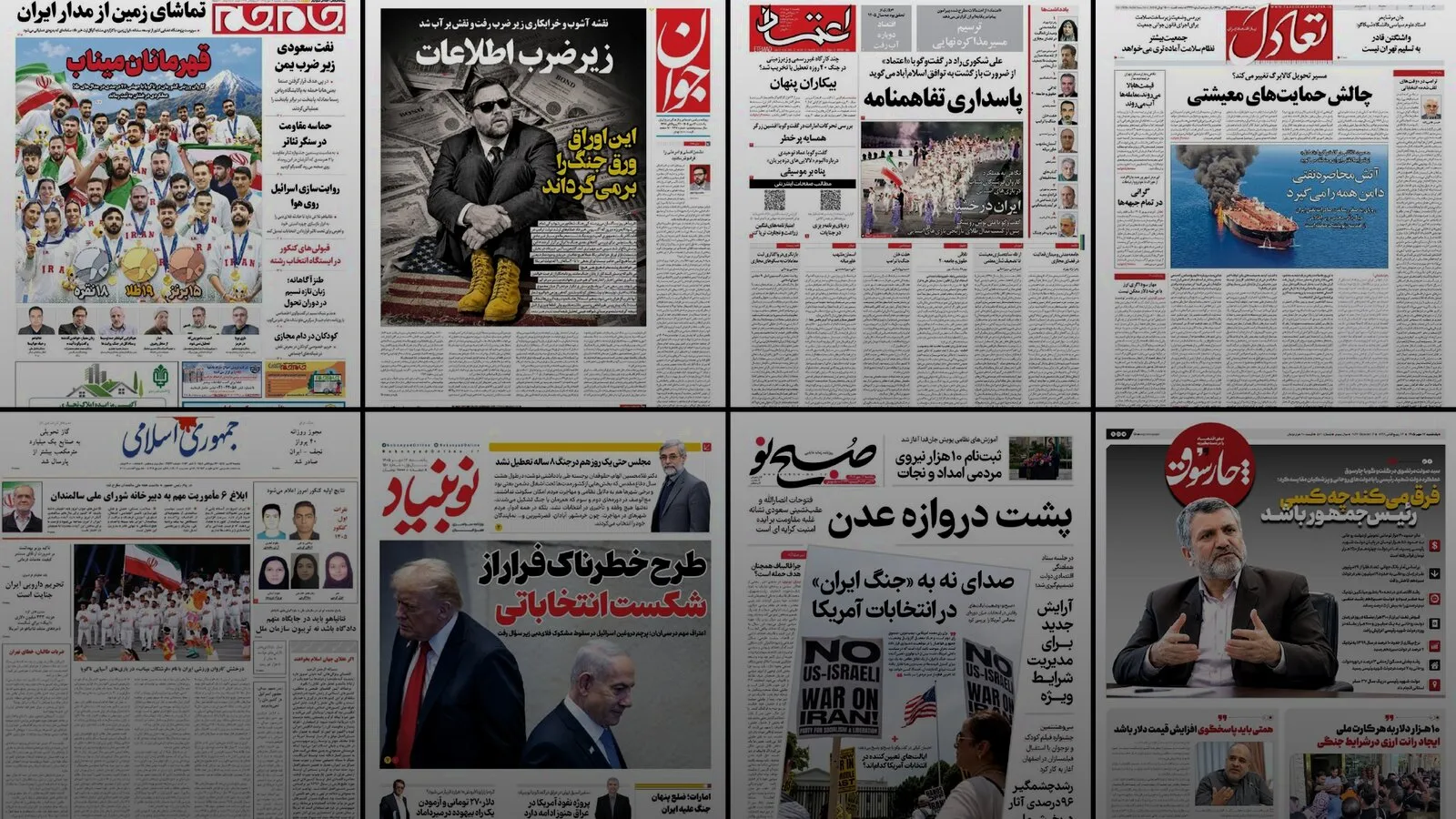
Bottom line: On the morning after a fire at Aramco’s Riyadh refinery, every part of the Iranian press from the state broadcaster’s daily to the reformist party paper printed the Saudi capital burning and none printed an Iranian hand in it, while the Leader’s own newspaper handed its signed editorial to an official of the previous government to indict the sitting one over the currency and a principlist cover reported that the Supreme National Security Council has finally released the deferred council elections.
Executive Summary
The lead judgment of this edition is that Saudi Arabia entered the Iranian front pages this morning as a target rather than as a mediator, and that it did so across the entire factional spectrum in a single cycle. Jam-e Jam, published by the state broadcaster, gave the strike its own standing headline, «نفت سعودی زیر ضرب یمن», Saudi oil under Yemen’s blow, and supplied the doctrine in the deck: following the targeting of Sanaa, the Yemenis struck the Riyadh refinery and thereby «رسما معادله پایتخت در برابر پایتخت را عملیاتی کردند», formally operationalised the capital-for-capital equation. Kayhan printed «آرامکو در آتش یمن پاسخ جنایات سعودی را داد», Aramco in Yemen’s fire answered Saudi crimes. Sazandegi, a reformist party daily with no reason to share Kayhan’s framing, led its top bar with «آتش در قلب عربستان», fire in the heart of Saudi Arabia. Sobh-e No converted the same material into a strategic argument addressed to the Gulf capitals under the banner «پشت دروازه عدن», at the gate of Aden, holding that Ansar Allah’s conquests and the Saudi retreat prove the failure of «امنیت کرایهای», rented security. Four titles across four factions, one morning, one target, and in none of them an Iranian hand.
The independent record supports the fire and not the attribution. A blaze at Aramco’s Riyadh refinery south of the capital was observed on the ground by an AFP journalist on 3 October; Saudi authorities had not confirmed an attack and Aramco had not commented on the cause. The claim of responsibility belongs to the Yemeni armed forces spokesman Yahya Saree and is carried on the Fars News channel at 22:46 as a ballistic missile and drone strike on Aramco facilities in Riyadh, alongside further claims of severe disruption to Riyadh’s airspace with eleven aircraft refusing to land and of satellite imagery showing the fire burning at 205 megawatts of radiative intensity. This file reproduces all of that as claim and none of it as fact. What is not in dispute is the direction of the campaign: the Houthi offensive against the Saudi-backed government that began on 3 September ended the truce, Saudi airstrikes have resumed on Sanaa, and Defa Press today carries Saudi-aligned forces claiming ninety-seven precision targeting operations on the Taiz axis. The Iranian press is not reporting a single incident; it is reporting the opening of a second war in which an Arab capital is now a target set.
The second finding of this edition is domestic, and it is the clearest institutional signal in the batch. Kayhan’s «یادداشت روز», the signed daily editorial that is customarily the managing editor’s own instrument, today carries the byline of Davoud Manzour, identified on the page as head of the Plan and Budget Organization of the martyred Raisi government. The text argues that the rise in the dollar is not a speculative fluctuation but the point at which several large disequilibria intersect, and that «نظام مالی و سیستم اقتصادی کشور آنگونه که در شرایط جنگی و تحریمی لازم است، بازآرایی و آماده نشده», the country’s financial and economic system has not been rearranged and prepared as wartime and sanctions conditions require, and that the policies of the resistance economy have not in practice been seriously implemented. The charge of failing to implement «اقتصاد مقاومتی» is a charge of doctrinal non-compliance issued from the newspaper published under the Leader’s office. On the same morning the economic daily Charsoogh gives its entire lead to another Raisi-government minister, Seyyed Sowlat Mortazavi, under the headline «فرق میکند چه کسی رئیسجمهور باشد», it makes a difference who the president is. Two former officials of the same administration, two front pages, one target, and the target is no longer the Islamabad memorandum.
The third finding is the electoral one, and it runs through this batch from Tehran to Washington to Tel Aviv. Nobonyad reports under «زنگ انتخابات شورا به صدا درآمد» that «پس از چند ماه انتظار، بالاخره شورای عالی امنیت ملی با برگزاری انتخابات شوراها موافقت کرد», after months of waiting the Supreme National Security Council has finally agreed to the holding of the council elections, with officials indicating the first half of Aban. The same cover carries a signed note by the jurist Gholam-Hossein Elham establishing that parliament never closed for a single day during the eight-year war and that displaced residents of Khorramshahr, Abadan and Qasr-e Shirin still elected their representatives, which is a jurisprudential clearance for holding a vote under bombardment. And the same cover’s lead, «طرح خطرناک فرار از شکست انتخاباتی», the dangerous plan to escape electoral defeat, runs across photographs of Trump and Netanyahu. Sobh-e No’s main feature is a map analysis of the American midterms built on a photograph of a demonstration outside the White House. Sazandegi’s exclusive is a federal lawsuit seeking a declaration that the war is unconstitutional. Ta’adol’s op-ed places Trump in electoral stoppage time. Jomhouri Eslami prints Sanders on AIPAC money against Netanyahu’s critics. The deferred Iranian ballot and the adversary’s ballots are being argued on the same pages.
Two convergences in this batch are worth more than the arguments that produce them. The first is that the reformist and principlist estates, which agree on almost nothing, have arrived at the same theory of how the war ends: not at a table but inside the American political system. Sazandegi routes it through the courts and Sobh-e No through the midterm map, and neither mentions the Islamabad memorandum. The second is that Etemad and Nobonyad, a reformist broadsheet and a principlist daily, both devote front-page space on the same morning to the United Arab Emirates as a hostile actor, Etemad under «همسایه پر خطر», a high-risk neighbour, and Nobonyad under «امارات؛ ضلع پنهان جنگ علیه ایران», the Emirates, the hidden flank of the war against Iran. A new regional antagonist being named simultaneously across the factional line is a better indicator of an official line than either paper’s own editorial position.
The memorandum itself is where it was, and weaker. Etemad’s lead is an interview with Ali Shakourirad on «ضرورت بازگشت به توافق اسلامآباد», the necessity of returning to the Islamabad agreement, and its banner reports on the possibilities surrounding America’s message under «ترسیم مسیر مذاکره نهایی», charting the route to the final negotiation. The verb «بازگشت», return, concedes drift. Twenty-four hours ago a principlist cover was narrowing the dispute to a calendar; today the reformist cover is arguing for a return to the principle, and no principlist title in this batch mentions the document at all. In the English-language estate the ask has changed again, for the third consecutive cycle: Iran Daily’s banner is “Russia, China emphasize Iran’s right to pursue nuclear program”, an assertion of principle made in two other states’ voices after a demand for guarantees on 3 October and an offer of reassurance on 1 October.
Net assessment: this is a widening edition, not an escalating one. Nothing in the batch reports an Iranian engagement; the only kinetic claims on any Persian cover are an air defence interception at Qeshm and the destruction of a monarchist-linked cell in Fars, both on Vatan-e Emrooz and both unverifiable here. What has changed is the perimeter. A second Arab capital is burning and the Iranian press has a doctrine ready for it. The Red Sea approaches have replaced the Strait of Hormuz as the venue in which Sobh-e No makes its coercive case, while Kayhan maintains the Strait as a lock that is working and Ta’adol prints a burning tanker captioned as a blockade imposed on Iran rather than by it. Lebanon returned to the wires with Israeli artillery at Baarishit and two Israeli soldiers acknowledged wounded, and reached no front page. At home the ballot has been released and the president is under attack again, from the Leader’s own platform, on the one subject where the evidence is in every market. An edition in which the enemy list grows while the fronts stay quiet is the condition in which a single verified Iranian action would carry disproportionate weight, and it is also the condition in which a settlement is prepared.
Key Judgments
- KJ-1 [HIGH] Saudi Arabia has entered the Iranian front pages as a target set rather than as a mediator, and the conversion took one cycle and crossed every factional line. This is the edition’s highest-significance finding. The evidence is the distribution. Jam-e Jam, the state broadcaster’s daily, gives the strike its own headline, «نفت سعودی زیر ضرب یمن», and supplies the doctrine in the deck: after Sanaa was targeted the Yemenis struck the Riyadh refinery and «رسما معادله پایتخت در برابر پایتخت را عملیاتی کردند», formally operationalised the capital-for-capital equation. Kayhan prints it as retribution, «آرامکو در آتش یمن پاسخ جنایات سعودی را داد». Sazandegi, a reformist party daily, leads its top bar with «آتش در قلب عربستان». Sobh-e No banners «پشت دروازه عدن» and argues that the Saudi retreat proves the failure of rented security. Four titles, four factions, one morning. The significance is that a reciprocal-targeting doctrine naming Arab capitals has been published in Iran as accomplished fact rather than as a threat, which changes what the Gulf states must plan against and which also, by locating the act entirely with Ansar Allah, preserves Iranian deniability for it. Confidence is high on the press convergence, which is documentary, and is not extended to the strike’s authorship: a fire at Aramco’s Riyadh refinery was independently observed, Riyadh and Aramco had confirmed nothing about its cause, and the claim of responsibility is the Yemeni spokesman’s.
- KJ-2 [HIGH] The domestic campaign against the president has resumed after one quiet cycle, it has been moved from the Islamabad memorandum to the currency, and it is being run from the Leader’s own newspaper by officials of the previous administration. The evidence is a pairing of bylines. Kayhan’s «یادداشت روز», the signed slot that has carried Hossein Shariatmadari’s name in every edition this file has examined this month, today carries Davoud Manzour’s, bylined on the page as «رئیس سازمان برنامه و بودجه دولت شهید رئیسی», and the text holds that the financial and economic system «آنگونه که در شرایط جنگی و تحریمی لازم است، بازآرایی و آماده نشده» and that resistance-economy policy «در عمل بهصورت جدی و همهجانبه پیاده نشده است». On the same morning Charsoogh gives its whole lead to the Raisi-government minister Seyyed Sowlat Mortazavi under «فرق میکند چه کسی رئیسجمهور باشد». The significance is threefold: the charge is doctrinal non-compliance with the Leader’s own economic programme rather than mere incompetence; it is issued from a platform that cannot be dismissed as factional noise; and the chosen ground is one where the executive cannot win, because the exchange rate publishes a verdict every day. This file revises its 3 October reading that the attack was in abeyance: it was being re-aimed. Calibration runs both ways: treating one editorial as a coordinated campaign would overstate it, and treating two former ministers of the same government appearing on two front pages on one morning as coincidence would understate it.
- KJ-3 [MODERATE-HIGH] The deferred city and village council elections have been released by the Supreme National Security Council, and the jurisprudential clearance for holding a vote under bombardment was published on the same page on the same morning. The evidence is one cover carrying both halves. Nobonyad reports under «زنگ انتخابات شورا به صدا درآمد» that «پس از چند ماه انتظار، بالاخره شورای عالی امنیت ملی با برگزاری انتخابات شوراها موافقت کرد», with officials indicating the first half of Aban, which runs from roughly 23 October to 6 November. Directly above it the jurist Gholam-Hossein Elham argues that parliament never closed for a day in the eight-year war and that displaced residents of Khorramshahr, Abadan and Qasr-e Shirin elected their representatives throughout. The independently established background is that the seventh-period elections were deferred from 1 May 2026, that the interior ministry made them contingent on the council’s approval, and that a proposed 16 October date had not received it. The significance is that the one security body with a veto over the domestic political calendar has released it mid-war, which is a confidence signal about internal control and creates a fixed date around which both the negotiation and the factional contest will now organise. Confidence is held below high because the report is single-sourced in this batch and because Nour News, which is linked to the council, carried nothing on it; the discriminating test is whether a date is formally published within the week.
- KJ-4 [MODERATE-HIGH] The reformist and principlist estates have converged on a single theory of how the war ends, and it is not the Islamabad memorandum. The evidence is two covers from opposite factions arguing the same mechanism. Sazandegi’s exclusive is «شکایت ایرانیان آمریکا از ترامپ به دادگاه فدرال», with plaintiffs telling the paper the president went to war by circumventing the law and without congressional authorisation; the independent record identifies the filing as NIAC Action’s suit in federal court in Washington on 1 October seeking declaratory relief that the campaign, including the naval blockade and months of airstrikes, is unconstitutional under Article I. Sobh-e No’s main feature is «صدای نه به «جنگ ایران» در انتخابات آمریکا» with a decisive-states analysis of the midterms. Ta’adol adds John Mearsheimer of the University of Chicago saying Washington cannot force Tehran’s surrender, and an op-ed placing Trump in electoral stoppage time. Jomhouri Eslami adds Sanders on AIPAC spending against Netanyahu’s critics. Not one of these covers mentions the memorandum. The significance is that the Iranian press is preparing its readership for an outcome delivered by the adversary’s own institutions rather than by an Iranian concession, which is the frame a government adopts when it expects to have to accept terms and wants them to read as the enemy’s defeat. Confidence is moderate-high: the convergence is documentary across one cycle, and reading it as coordinated rather than as independent opportunism would go beyond the evidence.
- KJ-5 [MODERATE-HIGH] The Minab school strike is functioning as national infrastructure rather than as commemoration, and this edition is the clearest instance of it this file has recorded. The evidence is the spread. Five titles carry the Nagoya medal result and all of them carry it under the delegation’s name: «فرشتگان میناب», the Angels of Minab, in Kayhan and Jomhouri Eslami, «قهرمانان میناب» as Jam-e Jam’s whole front-page lead. Iran Daily’s photograph of boarding passengers shows the decal #Minab168 on the fuselage of the aircraft opening the Najaf corridor. The referent is the 28 February 2026 strike on the Shajareh Tayyebeh elementary school at Minab in Hormozgan, in which the dead were overwhelmingly schoolchildren; counts differ, with a prosecutor’s verified list of 156 identified and 168 in commemorative use. The significance is operational rather than sentimental: Tehran has attached a single atrocity to the national carrier, to its international sporting delegation and to the lead of the state broadcaster’s daily, which gives it a symbol that travels into venues where political argument cannot, and which will be difficult to retire if a settlement requires a change of register. Confidence is moderate-high on the characterisation, which is a direct reading of five covers plus an aircraft livery, and the inference about settlement constraint is held open.
- KJ-6 [MODERATE-HIGH] Negative evidence, filed as a finding: Lebanon produced an acknowledged Israeli casualty this cycle and reached no Iranian front page, for the third consecutive cycle in which the northern front is live on the wires and absent from the covers. The evidence is the split. The Jam-e Jam channel carries, at 04:29, the Israeli military acknowledging two soldiers wounded in operations in southern Lebanon, and at 05:52 Israeli artillery targeting areas around Baarishit; Nour News carries Israeli artillery attacks on southern Lebanon independently. Across ten front pages, nothing. An acknowledged adversary casualty is exactly the item a wartime press prints, and this one was available on the paper’s own channel hours before the presses ran. The significance is that the omission is now better explained as a standing editorial decision than as a print-deadline artefact, and that whatever is happening on the northern front, Tehran is not currently using it to address its own public. Confidence is moderate-high: three cycles is a pattern rather than a trend, and the one-cycle propagation lag this file established on 3 October has been allowed for and does not cover a third consecutive absence.
- KJ-7 [MODERATE-HIGH] The coercive maritime argument has shifted venue from the Strait of Hormuz to the Red Sea approaches, and the three-lock denial doctrine should now be moved off active tracking. The evidence is the sponsoring title’s own behaviour. Sobh-e No published «قفل مقرراتی», «قفل نظامی» and «قفل انرژی» on 30 September with a signed editorial whose stated objective was that in practice no tanker should pass, and has not restated the formula in three cycles. Today its banner is «پشت دروازه عدن» and its argument is that Ansar Allah’s conquests and the Saudi retreat prove the failure of «امنیت کرایهای», rented security, which is the same proposition addressed to the same Gulf audience about a different waterway. Kayhan meanwhile maintains «قفل ایران روی تنگه هرمز کار میکند», the lock is working, for a fifth cycle without printing anything that enforces it. The significance is that Iranian strategic messaging about shipping is migrating to a chokepoint Iran does not control and does not have to be seen to act at, which lowers the attribution cost of pressure on the same traffic. Confidence is moderate-high: the migration is visible in one title’s successive covers, and a formula that is not restated is not thereby withdrawn, so the three locks stay on the tracker at reduced weight.
- KJ-8 [MODERATE] The United Arab Emirates is being prepared as a named belligerent, and the preparation is running on both sides of the factional line simultaneously. The evidence is the coincidence of placement. Etemad, reformist, runs «بررسی تحرکات امارات در گفتوگو با افشین زرگر» under «همسایه پر خطر», a high-risk neighbour. Nobonyad, principlist, runs «امارات؛ ضلع پنهان جنگ علیه ایران», the Emirates, the hidden flank of the war against Iran, signed by the journalist Hossein Nouri. These two titles do not share a regional threat list, and neither has given the UAE front-page space in this file’s recent record. In the background sits the flydubai material, concerning an Emirates-based carrier and a suspect transferred into Emirati custody, which two other covers are working on the same morning. The significance is that an official line usually becomes visible first as simultaneous appearance across factions rather than as an announcement, and this is what that looks like at the first observation. Confidence is moderate: two pieces in one cycle is a coincidence worth recording and not yet a campaign, and the discriminating test is whether a third title names the UAE within the week.
- KJ-9 [MODERATE] Burning shipping became publishable on an Iranian front page the moment it could be captioned as a blockade imposed on Iran rather than by it, and the mechanism is the usable finding. The evidence is the contrast across two cycles in the same file. On 3 October a tanker struck off Oman reached four channels and not one of eleven covers, while Kayhan led on the proposition that the American president cannot reopen the waterway. Today Ta’adol gives its centre to a full-colour photograph of a tanker ablaze under «آتش محاصره نفتی دامن همه را میگیرد», the fire of the oil blockade engulfs everyone, with a deck holding that the dream of zeroing Iran’s oil exports is a vain fantasy. The image class is identical; the caption’s direction is reversed. The significance is predictive rather than descriptive: it tells this file that maritime imagery will appear on Iranian covers when and only when the victim can be presented as Iranian commerce, which means front-page absence of such imagery is evidence about framing capacity rather than about events. Confidence is moderate: this is an inference from two cycles in one file and from a single economic daily’s editorial choice, and Ta’adol is the title in this batch most exposed to the oil trade’s own interests.
- KJ-10 [MODERATE] Javan is building a theory of American defeat out of financial-market data rather than battlefield events, and the construction method matters more than the claim. The evidence is the cover. «این اوراق ورق جنگ را برمیگرداند», these bonds will turn the page of the war, is set over a photo-illustration of a suited figure seated on US Treasury paper and an American flag, and the text rests on two unverified second-hand items: a British newspaper’s report of a highly unusual secret meeting at Camp David chaired by Vance to examine the next steps of the war with Iran, and a Goldman Sachs report said to show effectively no buying demand for 10 to 20 year US debt, rendered as «هیچ یعنی هیچ!», nothing means nothing. Neither is corroborated anywhere in this batch. The paper’s actual front-page lead, «زیر ضرب اطلاعات», is an announced internal-security success with no location, no detainee count and no casualty figure. The significance is that the Guard-affiliated daily has gone four consecutive cycles without printing an Iranian engagement and is filling the space with adversary-collapse arguments drawn from finance, which is the register an outlet adopts when it must explain why victory is coming without being able to show it arriving. Confidence is moderate: the characterisation is a direct reading of the cover, and this file cannot establish from one edition whether the editorial choice reflects an absence of operations or an instruction not to report them.
- KJ-11 [MODERATE] Jomhouri Eslami has published the batch’s only front-page admission of an Iranian failure, and it names a vector no other title in this edition mentions. The evidence is a signed piece in the paper’s left column, «ضربات طالبان، خطای تهران», the Taliban’s blows, Tehran’s error, arguing that strikes were mounted against Iran from Afghan geography during the war while Afghanistan was under Taliban control, that a state owes its neighbour the duty of preventing this, and that the explanation lies in the depth of Iranian intelligence penetration in Iraq, Pakistan and Afghanistan. No other cover in the batch mentions Afghanistan at all; Vatan-e Emrooz’s internal-security claim concerns a monarchist-linked cell in Fars and Javan’s concerns an unlocated sabotage plot. The significance is that the clerical establishment press retains the licence to name an operational failure in public, and that the failure it has chosen to name is on the eastern border rather than the western front, which is where the entire rest of the batch is looking. Confidence is moderate: this is one title’s argument, the scan’s body text is at the edge of legibility, and this file cannot corroborate the underlying claim about attacks launched from Afghan territory.
Macro Trends
- Saudi Arabia became a target set on the Iranian front pages, and the doctrine arrived with it. Jam-e Jam’s deck is the sentence to keep: following the targeting of Sanaa, the Yemenis struck the Riyadh refinery and «رسما معادله پایتخت در برابر پایتخت را عملیاتی کردند», formally operationalised the capital-for-capital equation. That is a reciprocal-targeting doctrine published as accomplished rather than threatened, and it is published by the state broadcaster’s own daily. Kayhan frames the same event as retribution, «آرامکو در آتش یمن پاسخ جنایات سعودی را داد». Sazandegi, from the opposite end of the spectrum, leads its top bar with «آتش در قلب عربستان». The independent record supports a fire at Aramco’s Riyadh refinery observed by an AFP journalist on 3 October and supports no attribution: Saudi authorities had not confirmed an attack and Aramco had not commented on the cause. What the Iranian press has done is claim the result for the Resistance while keeping Iranian hands entirely out of the frame, which is the same construction it used on the Strait of Hormuz and is now applying to a Gulf Arab capital.
- The coercive argument moved from the Strait to the Red Sea approaches. Sobh-e No published the three-lock total-tanker-denial formula on 30 September and has not restated it in three cycles. In its place is «پشت دروازه عدن», at the gate of Aden, with the kicker holding that «فتوحات انصارالله و عقبنشینی سعودی نشانه غلبه مقاومت بر ایده امنیت کرایهای است», Ansar Allah’s conquests and the Saudi retreat are a sign of the Resistance’s victory over the idea of rented security. «فتوحات», conquests, is a term of religious warfare rather than of military reporting, and «امنیت کرایهای», rented security, is addressed to the Gulf capitals about what their protection arrangements are worth. The proposition is unchanged, that the Gulf states cannot buy safety from the United States, but the venue has moved from a strait Iran controls to approaches Iran does not, which is a cheaper place to make the same threat.
- The attack on the president resumed, from the Leader’s own platform, on the currency. This file recorded on 3 October that the domestic veto on the Islamabad memorandum was not re-asserted and that Kayhan’s cover carried no memorandum, no American answer and no negotiation. It does not today either. What it carries instead is a signed «یادداشت روز» by Davoud Manzour, bylined as head of the Plan and Budget Organization of the Raisi government, charging that the financial system has not been rearranged for war and sanctions conditions and that «سیاستهای اقتصاد مقاومتی نیز در عمل بهصورت جدی و همهجانبه پیاده نشده است», the resistance-economy policies have not in practice been seriously and comprehensively implemented. On the same morning Charsoogh leads with the Raisi-era minister Seyyed Sowlat Mortazavi under «فرق میکند چه کسی رئیسجمهور باشد». The campaign has not been withdrawn; it has been moved to ground where the executive cannot win the argument, because the market publishes the scoreboard daily.
- The deferred ballot was released, and the jurisprudence for it was published on the same page. Nobonyad reports that after several months of waiting the Supreme National Security Council has finally agreed to the holding of the city and village council elections, with officials indicating the first half of Aban. The independently established background is that the seventh-period elections were deferred from 1 May 2026, that the interior ministry said holding them depended on the council’s approval, and that a proposed 16 October date had not received it. Directly above that item on the same cover, the jurist Gholam-Hossein Elham argues that parliament did not close for one day during the eight-year war and that displaced residents of Khorramshahr, Abadan and Qasr-e Shirin elected their representatives throughout. Placing the legal clearance and the operational decision on one page is not a coincidence of layout; it is how a contested decision is introduced to a readership that may not welcome it. The item is single-sourced in this batch, and Nour News, which is linked to the council, carried nothing on it.
- Both factions now argue that the war ends inside the American political system. Sazandegi’s exclusive is a federal lawsuit: «شکایت ایرانیان آمریکا از ترامپ به دادگاه فدرال», with plaintiffs telling the paper that the president entered the war by circumventing the law and without congressional authorisation and that the court must declare its continuation unconstitutional. The independent record names the plaintiff the paper does not, NIAC Action, filing in Washington on 1 October for declaratory relief covering the naval blockade and the airstrike campaign, without initially seeking an injunction. Sobh-e No’s main feature, from the opposite faction, is «صدای نه به «جنگ ایران» در انتخابات آمریکا» over a demonstration outside the White House, with a deck asking which states will decide the midterms. Ta’adol places Trump in electoral stoppage time and runs John Mearsheimer of the University of Chicago saying Washington cannot force Tehran’s surrender. Neither estate mentions the Islamabad memorandum. The exit being argued on the Iranian front pages today is the American voter and the American court, not the Pakistani document.
- The United Arab Emirates was named as a belligerent across the factional line. Etemad runs «بررسی تحرکات امارات در گفتوگو با افشین زرگر» under «همسایه پر خطر», a high-risk neighbour. Nobonyad runs «امارات؛ ضلع پنهان جنگ علیه ایران», the Emirates, the hidden flank of the war against Iran, signed by the journalist Hossein Nouri. A reformist broadsheet and a principlist daily naming the same Gulf state as a party to the war on the same morning is a stronger indicator than either piece’s content, because the two titles do not normally share a regional threat list. Read with the flydubai material, which concerns an Emirates-based carrier and a suspect transferred to Emirati custody, the Iranian press appears to be building a case against Abu Dhabi that it has not yet made explicit.
- The flydubai incident completed its conversion, and the conversion is now about elections. On 1 October the conservative press was split on the cockpit assault aboard the Dubai to Tel Aviv service; on 3 October Jomhouri Eslami printed eleven reasons the Israeli account was fabricated. Today Jam-e Jam prints «روایتسازی اسرائیل روی هوا» with the deck that Netanyahu is trying to turn the incident into an instrument for rebuilding his security image and a lever for influencing the elections, and Nobonyad makes it the cover lead, «طرح خطرناک فرار از شکست انتخاباتی», over photographs of Trump and Netanyahu, with a deck claiming an important admission on CNN. Two corrections are owed to the reader. The aircraft did not crash; it diverted and landed in Saudi Arabia after one pilot stabbed the other and the aircraft lost about 17,400 feet in under two minutes. And the CNN admission is a second-hand rendering carried in a deck, not a quotation this file can verify. The finished product is no longer a denial of the incident but an explanation of its purpose, and the purpose assigned is electoral.
- The tanker war entered the front pages once it could be captioned as something done to Iran. On 3 October eleven covers carried the Strait of Hormuz as a political fact and not one carried the strikes that enforce it. Today Ta’adol gives a full-colour photograph of a burning tanker the centre of its front page under «آتش محاصره نفتی دامن همه را میگیرد», the fire of the oil blockade engulfs everyone, with a deck holding that the dream of reducing Iran’s oil exports to zero is a vain fantasy. The image is the same kind of image the batch has been refusing for a week; what has changed is the caption. Printed as the consequence of a blockade imposed on Iran, burning shipping becomes publishable; printed as the consequence of one imposed by Iran, it was not. Kayhan on the same morning prints «قفل ایران روی تنگه هرمز کار میکند», Iran’s lock on the Strait of Hormuz is working, for a fifth consecutive cycle without an enforcing event on the cover.
- The Iraq corridor is being banked as a settlement dividend. Three titles carry the same opening on one morning. Jomhouri Eslami: «مجوز روزانه ۴۰ پرواز نجف - ایران صادر شد», a permit for forty daily Najaf to Iran flights has been issued. Iran Daily, in English: “Iranian airlines set to resume flights to Najaf”, photographed at the aircraft steps. Javan: «مقاومت عراق: همه فرودگاهها باید به روی ایران باز شوند», the Iraqi Resistance demanding all airports be opened. Jomhouri Eslami adds the Baghdad Friday prayer leader’s claim that the Resistance forced America out of Iraq, while Nobonyad interviews a former ambassador who says the American infiltration project in Iraq still continues. The pilgrimage corridor is reopening and the Iranian press is simultaneously banking it as a victory and warning that the ground it reopens into is not yet secure.
- The Minab school strike has become the national brand on which this edition is carried. Five titles in this batch carry the Nagoya medal haul, and every one of them carries it under the delegation’s name rather than the country’s: «فرشتگان میناب», the Angels of Minab, in Jomhouri Eslami and Kayhan, «قهرمانان میناب» in Jam-e Jam. Iran Daily’s photograph of passengers boarding the Najaf service shows the decal #Minab168 on the aircraft’s fuselage. The referent is the 28 February 2026 strike on the Shajareh Tayyebeh elementary school at Minab in Hormozgan, in which the dead were overwhelmingly children; published counts differ, with a prosecutor’s verified list of 156 identified and the figure 168 in general commemorative use. What this edition shows is the atrocity functioning as infrastructure: it is on the national carrier’s aircraft, on the Asian Para Games delegation, and on five front pages, carried by titles that agree on nothing else. The sports result is the vehicle; Minab is the cargo.
- Lebanon is live on the wires and absent from the covers for a third consecutive cycle. The Jam-e Jam channel carries Israeli artillery targeting areas around Baarishit in southern Lebanon at 05:52 and, at 04:29, the Israeli military acknowledging two soldiers wounded in operations in southern Lebanon; Nour News carries Israeli artillery attacks on southern Lebanon as well. Across nine Persian front pages and one English front page, none of it appears. This file rated the northern front a live flashpoint and has now recorded three cycles in which the only Lebanon material is on wires. An acknowledged adversary casualty is the kind of item a wartime press normally prints, and its absence from every cover on the morning it is available is a selection decision rather than a deadline artefact.
- The Leader is absent from every front page in the batch, and his last message was wholly devotional. No Leader message, photograph or citation appears on any of the ten front pages gathered for 12 Mehr 1405, and none appears in the Kayhan headline list for the same morning. His most recent published message, signed «سید مجتبی حسینی خامنهای» and dated 9 Mehr 1405, is addressed to the 33rd National Prayer Conference; it refers to the predecessor only as «رهبر شهید والامقام», our exalted martyred Leader, and mentions neither the war, nor the United States, nor Israel, nor the war dead. Its one political move is scriptural, the citation of Qur’an 22:41 to make prayer «the first outcome and sign of righteous governance». This file files the combination as a continuing tracker entry on the new Leader’s public profile and draws no inference about his position from it, because this batch supports none.
Front-Page Snapshot
- Jam-e Jam - “Saudi oil under Yemen’s blow: the capital-for-capital equation operationalised” (State broadcaster (IRIB)) - Yemen strikes the Riyadh refinery; reciprocal capital-targeting doctrine [HIGH]
- Kayhan - “Iran’s lock on the Strait of Hormuz is working / Aramco in Yemen’s fire answered Saudi crimes” (Hardline, published under the Supreme Leader’s office) - Chokepoint maintained; a Raisi-era official indicts the executive on the currency [HIGH]
- Sobh-e No - “At the gate of Aden” (Principlist) - Gulf security guarantees declared void; the US midterms as the exit [HIGH]
- Ta’adol - “The challenge of livelihood support / the fire of the oil blockade engulfs everyone” (Economic daily) - Burning tanker printed as an imposed blockade; livelihood and currency policy [MODERATE-HIGH]
- Nobonyad - “The dangerous plan to escape electoral defeat” (Conservative / principlist) - Council elections released by the security council; flydubai framed as electoral manufacture [MODERATE-HIGH]
- Jomhouri Eslami - “Six important missions conveyed to the National Elderly Council secretariat” (Traditional clerical establishment) - Eastern-border self-criticism; the Iraq air corridor; Netanyahu accountability [MODERATE-HIGH]
- Javan - “Under the Intelligence Ministry’s blow” (Hardline, IRGC-affiliated) - Internal security claim; American fiscal collapse as a theory of victory [MODERATE]
- Iran Daily - “Russia, China emphasize Iran’s right to pursue nuclear program” (English-language state daily) - Nuclear right asserted in third-party voices; Najaf flights resume [MODERATE]
- Etemad - “Guarding the memorandum” (Reformist) - Return to the Islamabad agreement urged; the UAE named a high-risk neighbour [LOW-MODERATE]
- Sazandegi - “Iranians in America take Trump to federal court” (Reformist, Kargozaran party) - War powers litigation as the exit; the Aramco fire carried across the factional line [LOW-MODERATE]
- Charsoogh - “It makes a difference who the president is” (Economic daily, principlist editorial line) - Raisi-era minister attacks the executive; 10,000 dollars per national ID card called wartime rent [LOW]
Full report
The complete edition - per-paper front-page analysis and full translation appendices - is available as a PDF: Download the full report.
Compiled from Iranian front pages and outlet channels via open-source monitoring. Translations are editorial; named-figure attributions are verified against the source pages where possible.