Iranian Press Monitor - Wednesday, 30 September 2026 (Day 211)
Wednesday, 30 September 2026 · چهارشنبه ۸ مهر ۱۴۰۵ · 19 Rabi’ al-Thani 1448 - Nine Persian front pages and one English front page of 8 Mehr 1405, read alongside six outlet channels and three agency wires; Kayhan is reconstructed from its own channel, and Tehran Times was not available at the time of compilation.
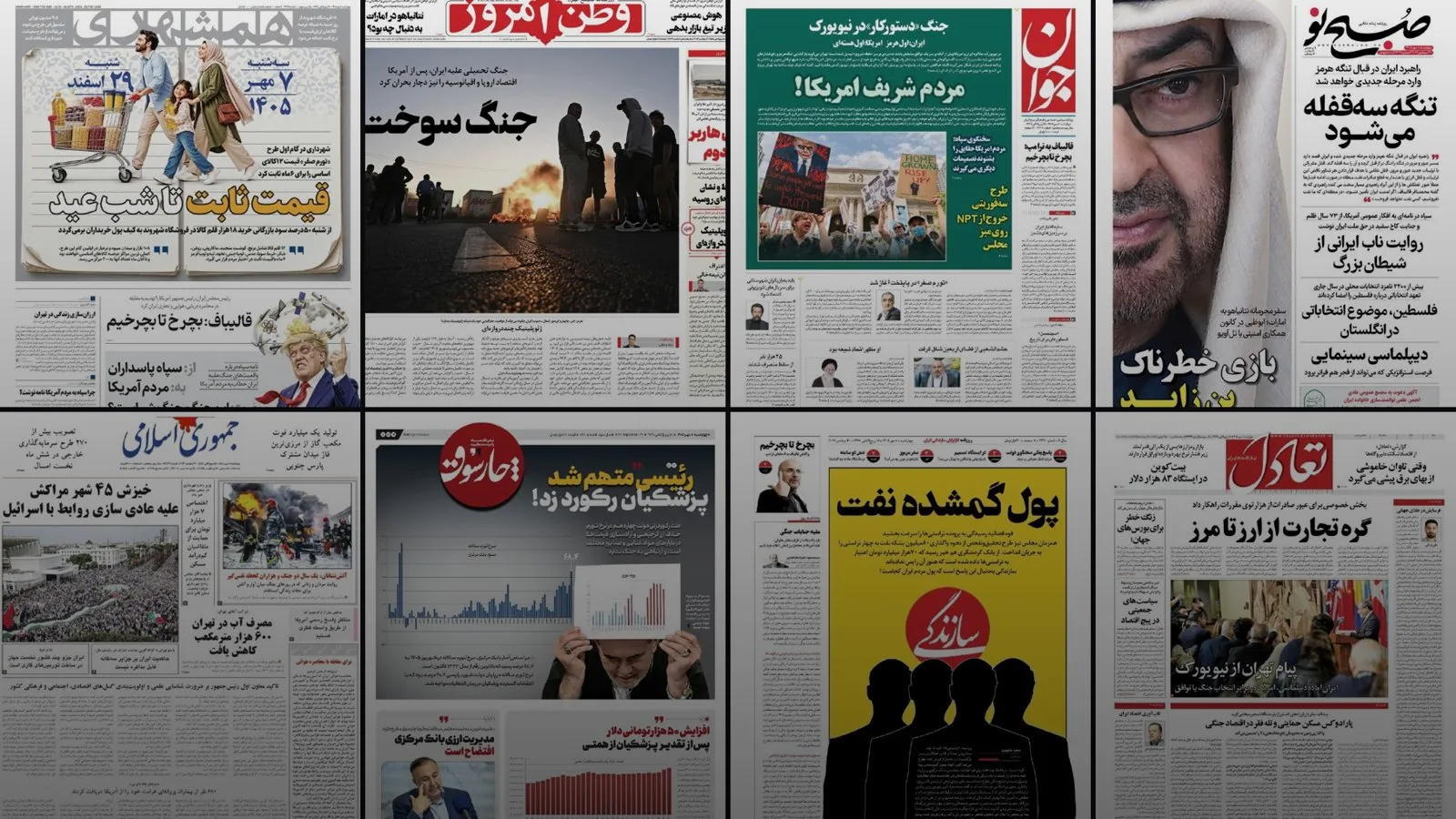
Bottom line: The decision window this file opened yesterday closed without an answer: Abbas Araghchi left New York still waiting for Washington’s reply through the Qatari mediator, independent reporting put the mediation at a standstill over enforcement rather than substance, and on the same morning Sobh-e No published a three-part doctrine whose stated objective is that no tanker passes through the Strait of Hormuz at all.
Executive Summary
The lead judgment of this edition is that the deadline recorded here on 29 September expired without an answer, and that the Iranian press printed the fact in rail type. Jomhouri Eslami’s front page carries «عراقچی پیش از ترک نیویورک: منتظر پاسخ رسمی آمریکا از طریق واسطه قطری هستیم», Araghchi before leaving New York: we are waiting for America’s official answer through the Qatari mediator. Javan’s banner adds that he left the city the previous evening rather than stay for it. Iran Daily’s interview standfirst states that «Tehran has also put forward a draft memorandum of understanding and is awaiting Washington’s response». Independent reporting fills in what the Iranian pages do not: the Qatari mediator Ali al-Thawadi spent several hours with the Iranian delegation over a two-page compromise text, then took it to Jared Kushner in Washington with Vice President Vance attending part of the meeting, and the exchange produced no significant movement, with one source characterising the impasse as the Iranians asking for things the United States cannot accept while the United States believes it is winning and need not compromise.
The second finding is that the Strait of Hormuz has been restated, for the first time on any front page this file has read, as an objective rather than a status. Sobh-e No’s cover sets out three locks: «قفل مقرراتی» through new transit arrangements, «قفل نظامی» by targeting every vessel that violates them, and «قفل انرژی» by threatening to cut the region’s oil exports if pressure continues. Its editorial, signed by Mahboubeh Niavarani, is more explicit than the cover: conditions of passage will tighten «تا جایی که عملاً عبور هیچ نفتکشی از این آبراه ممکن نباشد», to the point that in practice no tanker can pass. The political sponsor is named on the page: «به گفته محمدباقر قالیباف، اگر امنیت ایران تأمین نشود، در منطقهای که ما نفت نفروشیم، کسی نفت نخواهد فروخت». That is the same statement Iran Daily banners in English for foreign readers as Speaker: if Iran’s security not guaranteed, no infrastructure will be safe in region, and that Hamshahri, Javan and Sazandegi all carry in its Persian idiom, «بچرخ تا بچرخیم». Five titles across three factional positions printed one man’s formula on one morning, which indicates centrally guided message discipline rather than organic editorial convergence.
The third finding is that the Islamic Revolutionary Guard Corps addressed the American electorate directly and the entire batch carried it, reformist titles included. The twenty-five-page open letter published on 29 September appears on Hamshahri as a memorandum, «از: سپاه پاسداران / به: مردم آمریکا / موضوع: این جنگ، جنگ شماست؟»; on Javan as the whole upper page under «مردم شریف امریکا!» over a photograph of American street protesters; on Sobh-e No as «روایت ناب ایرانی از شیطان بزرگ»; on Etemad, neutrally, as «نامه سپاه به امریکاییان»; and on Kayhan as the injunction «اداره آمریکا را از اراذل بگیرید و به اندیشمندان بسپارید», take the running of America from the thugs and hand it to the thinkers. External reporting establishes that the letter is timed to the American midterm elections. What this file records is not the letter’s content but its distribution: an IRGC influence product reached every faction’s front page in a single cycle.
The fourth finding is an absence with a date attached. The American military completed its withdrawal from Iraq on 30 September, closing its last main base after more than two decades, and the Iraqi defence ministry spokesman stated that no international-coalition forces remain on Iraqi soil. This is the largest claimable strategic gain of the war for Tehran and its allies, and it reached no front page in the batch. The Wall Street Journal account was on the Etemad and Vatan-e Emrooz channels before dawn; the front pages carry instead the Iraqi airport campaign, in Kayhan’s rendering as the Islamic Resistance in Iraq demanding that all Iraqi airports be opened to Iran and that politicians close to America be punished. A print deadline is the innocent explanation and this file weights it; the discriminating test is the 1 October batch.
The fifth finding is that the serving Leader vanished from the newsstand after one cycle. On 29 September this file counted his photograph on six of the ten pages it read, twenty-four hours after his own foreign minister had attributed the absence of his image to «ملاحظات امنیتی و تهدیدات مستقیم آمریکا». On 30 September he appears on none of them, in no headline, and in no printed passage. His message of 28 September is still operative and is still being invoked, but by an IRGC spokesman on a wire rather than by an editor on a page: Sardar Hossein Mohebbi told Tasnim that American vessels have withdrawn at least 500 kilometres from the Strait’s mouth and grounded his forecast in «همانطور که حضرت آقا در پیام دیروز خود فرمودند، آمریکا بهزودی از دریای عرب نیز عقبنشینی خواهد کرد».
Net assessment. This edition reads as a coercion doctrine published on the morning its diplomatic alternative stalled, and the two facts belong together. The Iranian state has an offer on the table that its own English-language paper describes, through the analyst Hanif Ghaffari, as «essentially a time-compressed version of the Islamabad understanding» differing from it not in substance but in enforceability. That offer has gone unanswered. In the same cycle the principlist press published an objective, total tanker denial, that no previous edition in this file has printed, and a threat to regional energy infrastructure that external reporting calls the broadest since the war began. Against that, the civilian denominator was printed by the regime-aligned economic press itself: 68.4 percent annual inflation, the highest since 1993, and a dollar moving from about 233,000 to about 242,000 toman in a day. What the file takes forward is the enforcement question. Both sides now agree on what a settlement would contain; neither will move first on how it would be guaranteed, and the instrument Tehran has reached for while waiting is the one that makes the guarantee harder to give.
Key Judgments
- KJ-1 [HIGH] The decision point this file placed within one day on 29 September expired without an American answer, and the mediation is blocked on enforcement rather than on terms. The evidence is three-sided. Jomhouri Eslami’s front-page rail prints Araghchi on departure: «منتظر پاسخ رسمی آمریکا از طریق واسطه قطری هستیم». Javan’s banner records that he left New York the previous evening rather than wait, and that the dispute is a sequencing fight, «ایران: اول هرمز امریکا: اول هستهای». Independent reporting has the Qatari mediator Ali al-Thawadi meeting the Iranian delegation for several hours over a two-page compromise, then taking it to Jared Kushner in Washington with Vice President Vance attending part, to no significant movement. Iran Daily’s own interviewee says the Iranian proposal does not differ in substance from the Islamabad understanding and that the earlier framework collapsed for want of guarantees. The significance is that the file can now retire the question of what a settlement would contain and replace it with a narrower one: what either side would accept as an enforcement mechanism. Confidence is high on the state of the channel and is deliberately not extended to any forecast of collapse or agreement.
- KJ-2 [HIGH] Iranian front-page policy on the Strait of Hormuz has moved from a claim about the present to a published objective for the future, and the objective is total tanker denial. The evidence is Sobh-e No’s cover of 8 Mehr, which sets out «قفل مقرراتی», «قفل نظامی» and «قفل انرژی» as an integrated instrument, and its signed editorial, which states that passage will be tightened «تا جایی که عملاً عبور هیچ نفتکشی از این آبراه ممکن نباشد». No previous edition in this file records an Iranian front page printing an intention to stop all traffic; the register until now has been control, closure, or conditional reopening. The significance is that an Iranian outlet has published a terminal state for the waterway while its government is negotiating over reopening it, which narrows the space in which any Qatari-brokered text could be sold domestically. Calibration runs both ways: this is one outlet’s editorial and no armed-forces body has adopted the three-lock formula, so overstating it would promote a newspaper argument to a military order; understating it would miss that the formula’s energy component is a verbatim restatement of the parliament speaker’s own words in open session.
- KJ-3 [HIGH] The extraterritorial energy threat is not an outlet’s flourish; it is the stated position of Iran’s chief negotiator, published simultaneously in Persian idiom and in English plain text. The evidence is Qalibaf’s 29 September statement in open session, externally reported as the broadest Iranian threat to Gulf energy infrastructure since the war began, reaching the batch in five forms: Sobh-e No’s quote block, «در منطقهای که ما نفت نفروشیم، کسی نفت نخواهد فروخت»; Hamshahri’s banner «قالیباف: بچرخ تا بچرخیم» over a kicker naming reciprocity against the naval, air and trade blockade; Javan’s rail addressing it to Trump; Sazandegi’s corner framing it as a reaction; and Iran Daily’s English banner, «If Iran’s security not guaranteed, no infrastructure will be safe in region». The significance is that the threat is being addressed to Gulf producers as much as to Washington, and that it is carried in the language each audience reads. The man making it led Iran’s delegation at the Islamabad talks and is described in external reporting as its chief negotiator for ending the war, which is why this is recorded as policy rather than as rhetoric.
- KJ-4 [MODERATE-HIGH] Negative evidence, filed as a finding: the completion of the American military withdrawal from Iraq reached no Iranian front page on the morning it happened. The evidence is that the withdrawal completed on 30 September with the closure of the last main American base after more than two decades, that the Iraqi defence ministry spokesman stated no international-coalition forces remain on Iraqi soil, and that the Wall Street Journal account was carried on the Etemad channel at 04:10 UTC and the Vatan-e Emrooz channel at 04:36 UTC, before the papers reached the street. What the front pages carry instead is the airport campaign, in Kayhan’s rendering as the Islamic Resistance in Iraq demanding that Iraqi airports be opened and pro-American politicians punished. The significance is that the largest claimable strategic gain of the war for Tehran’s alignment went unclaimed in print in the cycle it occurred, while a grievance about civil aviation held the space. Calibration: print deadlines are a sufficient innocent explanation for a single cycle and this judgment is held below high confidence for that reason; the discriminating test is whether the 1 October batch leads on it. A second caveat belongs on the substance, not the coverage: external reporting places American forces still at Harir air base in the Kurdistan region, so the Iraqi spokesman’s formulation is broader than the facts support.
- KJ-5 [MODERATE-HIGH] The serving Leader’s front-page visibility, which spiked to six of ten pages on 29 September, fell to zero of ten in a single cycle, and no outlet noted either the appearance or the disappearance. The evidence is the batch itself: no photograph, no headline mention, no printed passage of his message on any of the ten pages read. His 28 September message remains operative and is still being invoked, but on a wire rather than on a page, by the IRGC spokesman Sardar Hossein Mohebbi citing it to forecast an American withdrawal from the Arabian Sea. The significance is that the 29 September spike is best read as occasion-bound, tied to Sacred Defence Week and the Nasrallah anniversary, rather than as a sustained change in leadership visibility, which weakens but does not overturn this file’s 29 September reading that the state’s stated security rationale had been falsified. Confidence is held below high because one cycle either way is a thin base and because a commemorative spike followed by a return to baseline is consistent with both readings.
- KJ-6 [MODERATE-HIGH] The Saudi-Yemeni war is now a second kinetic front in the Iranian press’s own accounting, and it has acquired a treaty dimension that reaches one of Iran’s mediators. The evidence is Yahya Saree’s cumulative count of 1,158 Saudi air and missile attacks with 35 in twenty-four hours flown from Khamis Mushait and Taif; a reported six-missile Saudi strike on Marran in Saada; a downed Saudi ScanEagle; Javan’s front-page assertion that Ansarallah drone fire reaches from Riyadh to Yanbu; Kayhan’s claim that Yemen has turned the world’s largest oil company into a fuel importer; and, on the Etemad channel, Pakistan’s defence minister stating that Pakistan’s capabilities will be at Riyadh’s disposal under the Mecca joint defence pact with Saudi Arabia and Turkey. The significance is twofold: Bab al-Mandab now sits beside Hormuz in the same threat picture, and a nuclear-armed state that mediated the Islamabad talks has publicly committed military capability to a party at war with Iran’s closest armed partner. Confidence is moderate-high because the Yemeni and Iranian figures are all claims by belligerents, though external reporting independently establishes the Saudi-Houthi escalation since early September and places roughly thirty tankers near Yanbu within Houthi range.
- KJ-7 [MODERATE] The Iranian press campaign on Iraq has shifted its demand from flight schedules to the removal of named officials, and the contradicting evidence again stayed off every front page. The evidence for the shift is Kayhan’s front-page item carrying the Islamic Resistance in Iraq’s demand that Iraqi airports be opened and «سیاستمداران نزدیک به آمریکا تنبیه شوند», that politicians close to America be punished, and Nujaba’s Ali al-Asadi warning of popular mobilisation if the decision is not reversed. The evidence against the campaign’s premise is Ammar Hakim, leader of Iraq’s National Wisdom Movement, telling ISNA in remarks the Etemad channel carried at 05:12 UTC that the understanding with America is what secured Iraq’s exemption from sanctions on Iranian airlines. The significance is that the campaign’s object is the composition of the Iraqi government rather than the restoration of flights, and that it survived a second consecutive cycle in which its stated trigger was contradicted by material the Iranian press itself distributed. Confidence is moderate because Hakim is a political actor with his own stake in the American relationship and his account is not independently established here.
- KJ-8 [MODERATE] The Abu Dhabi coordination narrative this file recorded on 29 September lost one of its legs overnight, and no front page recorded the loss. The evidence is a senior Saudi official’s denial, carried on the Etemad channel, that any Saudi figure met Netanyahu during his Abu Dhabi visit, against Israeli Channel 14 reporting that he met representatives of several regional states including Saudi Arabia. Sobh-e No nonetheless gives its photo lead to Mohammed bin Zayed under «بازی خطرناک بن زاید» with two named analysts, Jafar Qannadbashi and Seyyed Hadi Afghahi, arguing respectively that Netanyahu is recruiting a regional bloc and that such meetings do not frighten Iran; Vatan-e Emrooz asks what he was after; Jomhouri Eslami answers with a territorial reflex, that Iranian sovereignty over the three islands is not negotiable. The significance is that the Iranian press is holding a coordination frame whose Saudi component is now denied by Riyadh, and that its analytic output on the visit is a verdict on the host rather than an assessment of what was agreed. Confidence is moderate because an official denial is not a disproof.
- KJ-9 [MODERATE] The war’s civilian cost is now being contested inside the regime-aligned press as a question of blame rather than of magnitude, which is a legitimation problem being managed in public. The evidence is Charsoogh’s cover: a central bank series putting annual inflation at 68.4 percent in Shahrivar 1405, described as the highest since 1993 and set against 40.7 percent at the end of the Raisi government, under a deck asserting that the record «ارتباطی به جنگ ندارد», has no connection to the war. Beside it, Fars reports the unofficial dollar moving from about 233,000 to about 242,000 toman in a day and attributes the move to the American Treasury Secretary’s threat, while Kayhan files the same move as «آرایش جنگی آمریکا در بازار ارز ایران» and adds an accusation of official negligence. The significance is that the two available explanations for the same number, enemy economic warfare and governmental incompetence, are being printed by outlets on the same side of the factional line, which is how an inflation figure becomes a political instrument. This file records the figures as the denominator against which every coercion doctrine in the batch should be read.
- KJ-10 [LOW-MODERATE] Negative evidence, filed as a set to be tested against the next three cycles rather than relied on now. Six things this file expected in this batch did not reach any front page. The completion of the American withdrawal from Iraq, treated separately above. The Saudi denial of a meeting with Netanyahu. Ammar Hakim’s account of the Iraqi airline exemption. Rafael Grossi’s repeated offer, carried on the Etemad and Vatan-e Emrooz channels, to send inspectors back to Iran «فورا. اگر از ما خواسته شود، حتی فردا», immediately, even tomorrow if asked, which no cover engaged despite the nuclear file being the American first condition. The Axios account of the mediation’s failure, which reached the Vatan-e Emrooz and Defa Press channels, the latter dismissing it as targeted psychological warfare, and no page. And the three-lock formula itself, which appeared on exactly one cover and was not picked up by the four other titles that carried Qalibaf’s energy threat. A seventh item belongs here as a positive absence: Kayhan’s own denied-news register lists Iranian nuclear flexibility and an extension of the foreign minister’s New York stay among the previous day’s false reports, which is the Leader’s paper pre-emptively closing the two doors the Axios account says the mediators were trying to open. Confidence is deliberately low: each absence has an innocent explanation and the set is filed as a tracker, not as a conclusion.
Macro Trends
- The answer did not come, and the impasse is about enforcement rather than terms. Araghchi left New York on the evening of 29 September still waiting for Washington’s reply through Qatar, and said so on the record before departing. Independent reporting has the Qatari mediator Ali al-Thawadi carrying a two-page compromise between the Iranian delegation and Jared Kushner’s team without significant movement. Iran Daily’s own interviewee, the international-affairs analyst Hanif Ghaffari, states that Iran’s latest proposal is a time-compressed version of the Islamabad understanding that «does not differ from it in substance», and that the Islamabad framework collapsed because it rested on commitments rather than guarantees. Both sides now know the shape of a deal; the dispute is over what would make it enforceable.
- From a claim of control to a published objective of total denial. On 29 September this file recorded four incompatible Iranian accounts of the Strait: complete military domination, outright closure, an American blockade of Iranian ports, and a conditional reopening. On 30 September one of them hardened into a programme. Sobh-e No’s three locks, regulatory, military and energy, are a taxonomy rather than a boast, and its editorial states the objective in words no previous front page in this file has used: no tanker passing at all. The energy lock is explicitly extraterritorial, threatening the region’s exports rather than Iran’s, and its named sponsor is the speaker of parliament who also led Iran’s delegation at the Islamabad talks.
- One man’s formula on five front pages across three factional positions. Qalibaf’s reciprocity line appears as a banner on Hamshahri, as a rail item on Javan addressed personally to Trump, as a top-corner item on the reformist Sazandegi framed as a reaction to a Trump claim, as the quote block of Sobh-e No’s cover doctrine, and as the English banner of Iran Daily for foreign readers. Five titles, four factional positions, one formulation, published the morning after it was spoken in open session. This is the clearest instance of centrally guided message discipline this file has recorded in a fortnight, and it is worth noting that the reformist rendering is the only one that treats the formula as a response rather than as policy.
- An IRGC influence product reached every faction’s front page. The twenty-five-page open letter to the American people, timed by external reporting to the American midterms, is on Hamshahri as correspondence, on Javan as the lead, on Sobh-e No as an analytic piece, on Kayhan as an injunction to American voters, and on Etemad as a straight news item. The Iran newspaper channel published the full text. That a reformist daily carried it neutrally rather than critically is the datum: the distribution was total and no title in the batch treated the letter as a subject for domestic argument.
- Yemen is a full second front and it now has a treaty dimension. The Yemeni armed forces spokesman Yahya Saree puts the cumulative Saudi air and missile campaign at 1,158 strikes with 35 in twenty-four hours from Khamis Mushait and Taif; local sources report six Saudi missiles on Marran in Saada; a Saudi ScanEagle was reported downed over Saada. Javan asserts Ansarallah drone fire reaching from Riyadh to Yanbu, Saudi Arabia’s principal Red Sea crude terminal, and Kayhan asserts that Yemen has turned the world’s largest oil company into a fuel importer. Separately, Pakistan’s defence minister said on the Etemad channel that Pakistan’s military capabilities will be placed at Riyadh’s disposal under the Mecca joint defence pact with Saudi Arabia and Turkey. Iran is mediating through Qatar and was mediated for in Islamabad; one of those mediators has now publicly committed capabilities to a state at war with Iran’s closest armed partner.
- The Iraq campaign has moved from flights to personnel. Kayhan’s front page carries the Islamic Resistance in Iraq demanding that all Iraqi airports be opened to Iran and that politicians close to America be punished. Nujaba’s Ali al-Asadi calls the flight decision submission to American bullying and warns of popular mobilisation to reverse it. Jomhouri Eslami runs a column on countering the air blockade, and Iran Daily reported an international legal track a cycle earlier. Against all of it, the Etemad channel carries Ammar Hakim saying that Iraq’s understanding with Washington is precisely what exempted Iranian airlines from sanctions. The object of the pressure is the composition of the Iraqi government, and the counter-evidence stayed off every front page.
- The economic denominator was printed by the regime-aligned press itself. Charsoogh gives its cover to a central bank series showing 68.4 percent annual inflation in Shahrivar 1405, the highest since 1993, against 40.7 percent at the end of the Raisi government, and argues in its own deck that this «ارتباطی به جنگ ندارد», has no connection to the war. Fars reports the unofficial dollar moving from about 233,000 to about 242,000 toman in a day and attributes it to the American Treasury Secretary’s economic threat; Kayhan calls the same move «آرایش جنگی آمریکا در بازار ارز ایران». Ta’adol’s page carries the cost of blackouts outrunning the price of electricity and the poverty trap in a war economy. The country’s inflation is now being fought over as a question of blame, not of magnitude.
- The war’s costs are being priced outward. Vatan-e Emrooz gives its whole cover to «جنگ سوخت», arguing the imposed war has now pushed the economies of Europe and Oceania into crisis after America’s. Its channel carries the Financial Times on a White House discussion of a diesel export ban before the midterms, and Brent falling below 97 dollars after a further 40-million-barrel American strategic reserve release that economists on the same feed call suicidal. This is the economic form of the coercion Sobh-e No states militarily: if third parties are paying, third parties should press Washington.
Front-Page Snapshot
- Sobh-e No - “The Strait is being triple-locked” (Principlist) - Regulatory, military and energy locks aimed at stopping every tanker [SEVERE]
- Hamshahri - “Fixed prices until the eve of Nowruz” (Tehran municipality, centrist) - Qalibaf’s reciprocity threat bannered above a municipal price freeze [HIGH]
- Javan - “Noble people of America!” (Hardline, IRGC-affiliated) - The IRGC letter, the sequencing deadlock, and a triple-urgency NPT withdrawal bill [HIGH]
- Kayhan - “America is lying: Iran’s missiles have made the Strait of Hormuz hell and taken heavy casualties” (Hardline, published under the Leader’s office) - Verified American casualty reporting weaponised; Iraqi resistance demands personnel change [HIGH]
- Iran Daily - “Speaker: If Iran’s security not guaranteed, no infrastructure will be safe in region” (State English-language daily) - The infrastructure threat in English over an admission that the proposal is not new [HIGH]
- Vatan-e Emrooz - “Fuel war” (Hardline principlist) - The war’s fuel shock priced as a European and Oceanian crisis; Russia’s nuclear warning in the rail [MODERATE-HIGH]
- Etemad - “The geography of birth” (Reformist) - The IRGC letter reported neutrally; the batch’s contradicting evidence kept on the channel [MODERATE]
- Jomhouri Eslami - “Forty-five Moroccan cities rise against normalisation of relations with Israel” (Traditional clerical establishment) - Third-party legitimation above the rail line that the American answer had not arrived [MODERATE]
- Charsoogh - “Raisi was blamed, Pezeshkian set the record!” (Economic, principlist framing) - 68.4 percent annual inflation argued to have no connection to the war [MODERATE]
- Sazandegi - “The missing oil money” (Reformist, Kargozaran party) - Eighty million barrels to four trustee entities; a judiciary and Majlis inquiry [LOW-MODERATE]
- Ta’adol - “The trade knot, from the currency to the border” (Economic, chamber of commerce) - Tehran’s message from New York framed as war or agreement; export regulation as the real knot [LOW-MODERATE]
Full report
The complete edition - per-paper front-page analysis and full translation appendices - is available as a PDF: Download the full report.
Compiled from Iranian front pages and outlet channels via open-source monitoring. Translations are editorial; named-figure attributions are verified against the source pages where possible.