Iranian Press Monitor - Monday, 28 September 2026 (Day 209)
Monday, 28 September 2026 · دوشنبه ۶ مهر ۱۴۰۵ · 16 Rabi’ al-Thani 1448 - Nine Persian front pages and one English front page of 6 Mehr 1405, read alongside six outlet channels and three agency wires; Kayhan is reconstructed from its own channel, and Tehran Times was not available at the time of compilation.
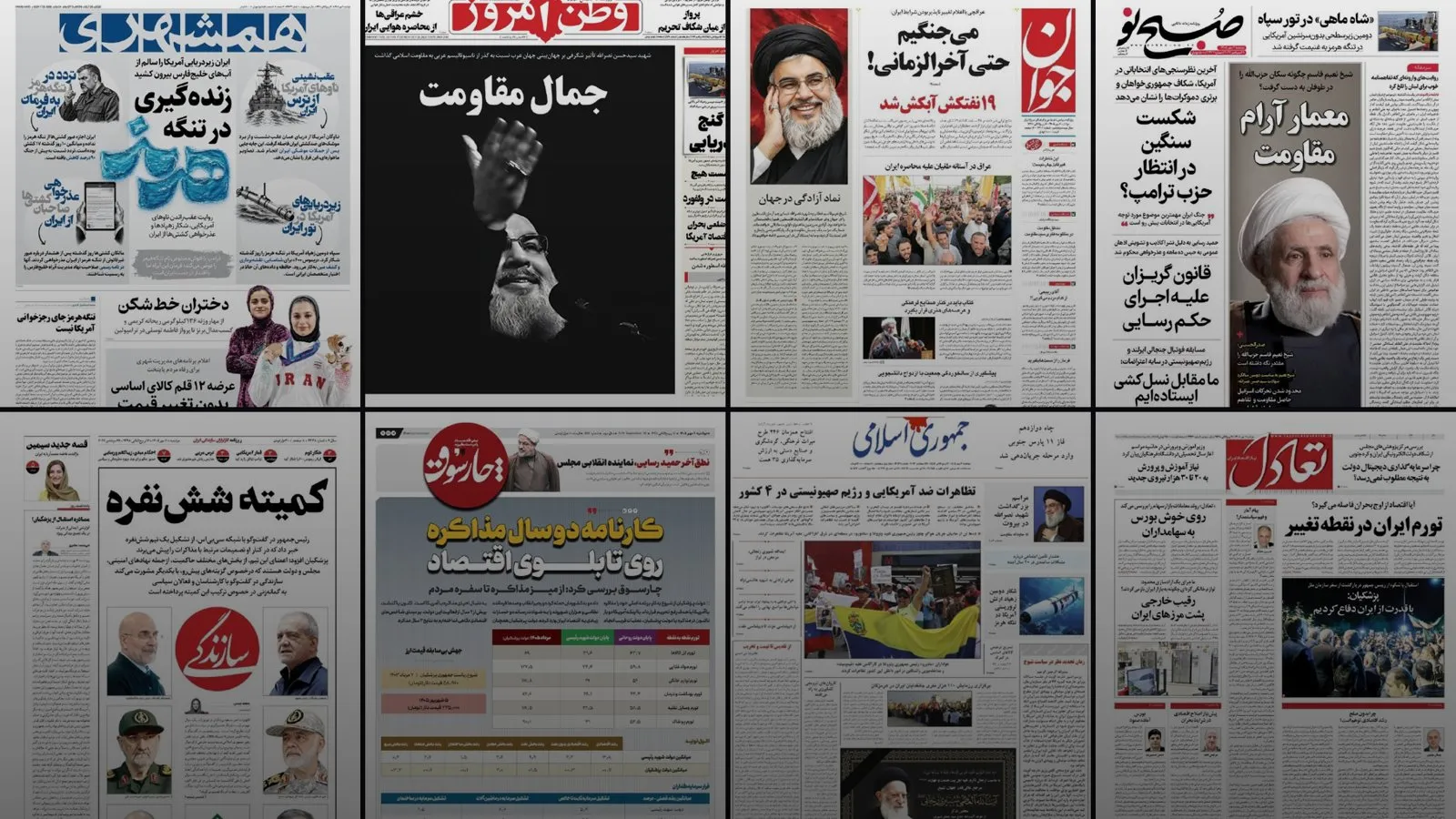
Bottom line: On the morning the foreign minister told New York that the Leader is fully in command, the president told American television that a six-member committee decides, a Tehran daily filled a front page guessing who sits on it, and the newspaper published under the Leader’s own office attacked the foreign ministry in print for negotiating at all.
Executive Summary
The lead judgment of this edition is that the Iranian state published three mutually incompatible answers to the question of where war-and-peace authority sits, in one cycle, and did so on foreign television and on its own front pages rather than in private. Sazandegi leads with «کمیته ششنفره», reporting that Pezeshkian told CBS’s 60 Minutes of a six-member team drawn from the security institutions, the parliament and the government that advances negotiation decisions alongside him. The paper’s accompanying column records what was actually asked: the president was questioned about the role of the Leader of the Islamic Republic in foreign policy and answered by describing a collective rather than the individual. Sazandegi then reconstructed the committee from expert guesswork across six captioned portraits, and could not fill one of the frames, printing the Ministry of Intelligence crest with the caption «سرپرست یا نماینده وزارت اطلاعات» in place of a name. The Etemad channel published a parallel roster the same morning that differs on one seat. Against both, the foreign minister told reporters in New York that «رهبر ایران کاملاً بر امور مسلط هستند» and that security considerations and direct American threats are what prevent the publication of the Leader’s image.
This file has spent five weeks recording the Leader’s absence from the commemorative and directive surfaces where a sitting Leader would ordinarily appear, and has repeatedly noted that no arbitration has issued from his office on the interdepartmental disputes it has documented. That absence is now being answered for. The foreign minister’s explanation is the first on-record official account of it this monitor has found, and its existence is the finding: the state has judged the gap conspicuous enough to require a public explanation. But the explanation and the president’s answer do not sit together. One says a single office commands continuously; the other says a committee consults and decides; the reformist press says nobody outside the room knows who is in it. An external analyst reading the Iranian press on 28 September cannot establish from it who would have to agree to a ceasefire.
The second finding concerns the Strait, and it is quantitative. Kayhan’s lead article, distributed at channel post 85246 with a kayhan.ir permalink, opens «مذاکره جواب نداد» and prescribes total closure: zeroing energy commerce and severing what it calls the petrodollar artery with missile fire, on the argument that American debt financing runs through Gulf sovereign wealth and that the White House understands only cost. On the same morning Hamshahri, the municipal daily and the largest-circulation title in the country, gives its front page to the opposite proposition: that traffic is flowing under Iranian licence, at an average of 17 ships a day over the past ten days, a 90 percent reduction rather than a closure, with ship owners apologising in writing and recognising the authority of the Persian Gulf waterway management body. These are not factional opponents arguing. They are two establishment titles publishing incompatible objectives for the same waterway, and the difference is not decorative: a permission regime and a total blockade require different force postures, different legal footings and different exit terms.
Neither Iranian number survives contact with external tracking, and they fail in opposite directions. Independent vessel tracking reports one commercial transit on 20 September against a pre-crisis baseline near 85 a day, and nine commodity vessels on 24 September when American officials were reported to have claimed roughly 60, putting throughput near one percent of normal. Hamshahri’s 17 a day overstates traffic; Kayhan’s zero, borrowed from a quoted American economist, understates it. Each error serves the argument the paper is making. This file reads that convergence of error with interest as evidence that neither figure is a traffic measurement, and treats both as advocacy.
Third, the day’s most-carried operational claim is a second American underwater vehicle taken in the Strait, and it is unusually well specified for an Iranian claim. Hamshahri names the platform a REMUS 600; Defa Press names it a Mk 18 Mod 2 Kingfish, which is the US Navy designation for a variant built on the REMUS 600 hull, so the two renderings agree rather than conflict. Sobh-e No’s banner is the most technically careful formulation in the batch, «دومین زیرسطحی بدون سرنشین آمریکایی در تنگه هرمز به غنیمت گرفته شد», an unmanned undersea vehicle rather than a submarine. Iran Daily gives the foreign reader the photograph. The capture was reported externally on 27 September and denied by CENTCOM, whose spokesman said the United States retains positive control of all its operational drone assets. The consistency of the Iranian identification does not make the claim true; it makes it checkable, which is rarer.
Fourth, Javan supplies the batch’s clearest measurable distortion. Its lead prints «میجنگیم حتی آخرالزمانی!» under the kicker that Araghchi has declared Iran’s conditions unchangeable. What the foreign minister is reported on the wires to have said is «حتی اگر کار به جنگ آخرالزمانی کشیده شود، استوار خواهیم ایستاد», delivered alongside a statement that Iran came to New York to establish the conditions for peace and remains ready for genuine diplomacy. The IRGC-affiliated daily converted a conditional about standing firm into a pledge to fight and dropped the diplomacy half, then set the tanker tally immediately beneath it. This is the mechanism to apply whenever Iranian escalation language is read as evidence of decision: today it is demonstrably evidence of presentation, because the underlying statement is on the record and says something else.
Fifth, two items that belong on front pages are not on them. The Majlis National Security Commission completed its review of the Strait of Hormuz security bill on 27 September with the approval of its final article, which makes that statute the governing framework for the Strait and repeals contrary provisions: the codification of the permission regime into law, carried on the Sobh-e No channel and on no cover in the batch. Hamshahri’s front-page note is written by Mohammad-Esmail Kowsari, the IRGC general and committee member driving that bill, and it argues about American bravado rather than about the law he is passing. Separately, the arrest of five men near RAF Fairford on suspicion of preparing a terrorist act, with an Iran-linked motive among the lines of inquiry, appears on exactly one cover, in the rail of Vatan-e Emrooz, headlined «وحشت در ولفورد» and framed as enemy panic rather than as an allegation against Iran.
Net assessment: this is a cycle in which the Iranian press documented its own state’s indecision more clearly than its adversaries could have. The coercion machinery is working and expanding, with a codified legal framework moving through parliament, a second undersea capture, a nineteen-vessel two-night engagement tally and a front-page demand for total closure. What is not working is the account of who controls it. The gap between the foreign minister’s single commanding office, the president’s consultative committee and the reformist press’s open question is not a factional dispute that arbitration would settle; it is the absence of an authority willing to settle it, now visible in print on both sides of the factional line. For an external reader the practical consequence is that Iranian escalation and Iranian de-escalation signals should be attributed to the institution that issued them rather than to a unified state, and that no signal from any one of them should be read as a national position until a second institution confirms it.
Key Judgments
- KJ-1 [HIGH] KJ-1: The locus of Iranian war-and-peace decision authority is now publicly contested inside the Iranian press, and the contest is documented rather than inferred. The evidence is three accounts published within one cycle: the foreign minister’s «رهبر ایران کاملاً بر امور مسلط هستند», the president’s CBS answer describing a six-member team from the security institutions, the parliament and the government when he was asked about the Leader’s role in foreign policy, and Sazandegi’s front page reconstructing that committee from expert speculation with one of six frames left unnamed. The Etemad channel’s roster differs from Sazandegi’s on a seat, so even the guesswork does not converge. The significance is operational for any party assessing Iranian commitments: a negotiated undertaking is only as good as the authority that gives it, and on the evidence of 28 September no Iranian institution can be assumed to speak for the others. Calibration runs both ways. Overstating this would treat ordinary consultative government as a crisis of legitimacy; understating it would miss that a head of state, asked on camera about his Leader, answered with a committee, and that his own country’s press could not identify its members.
- KJ-2 [HIGH] KJ-2: The establishment published two incompatible objectives for the Strait of Hormuz on the same morning, and the incompatibility is not factional. Kayhan, published under the Leader’s office, prescribes «صفر کردن تجارت انرژی», total closure, with American debt financing through Gulf sovereign wealth as the named mechanism and the midterm elections as the timing. Hamshahri, the municipal daily and the country’s largest-circulation title, gives its whole front page to a functioning permission regime: 17 ships a day, a 90 percent reduction rather than a stoppage, and a reproduced letter in which ship owners apologise and recognise the waterway authority’s competence. A hardline organ and a municipal one are not opponents in Iranian factional terms, so this is an unsettled objective rather than an argument. The significance is that a permission regime is a bargaining instrument and a blockade is not, and the two imply different exit terms from any negotiation over the Strait.
- KJ-3 [HIGH] KJ-3: Neither Iranian transit figure is a measurement, and both err in the direction their publisher requires. Kayhan, quoting the Johns Hopkins economist Steve Hanke, reports zero tankers on 25 September against 45 a year earlier. Hamshahri reports a ten-day average of 17 ships and a 90 percent fall. Independent vessel tracking for the same window reports one commercial transit on 20 September against a pre-crisis baseline near 85 a day, nine commodity vessels on 24 September when American officials were reported claiming roughly 60, and throughput near one percent of normal. Hamshahri overstates traffic to make the licence regime look real; Kayhan understates it to make the coercion look total. The significance is methodological and should be applied forward: Iranian front-page traffic figures in this conflict are arguments about the Strait, not counts of it, and this file will source transit numbers to independent tracking rather than to any Iranian cover.
- KJ-4 [MODERATE-HIGH] KJ-4: The succession’s legitimation is now being supplied from outside Iran, and the outlet closest to the Leader’s office declined to carry it. Hamshahri prints «شیخ نعیم قاسم: با رهبری آیتالله سید مجتبی خامنهای، پیشرفتها ادامه خواهد داشت», the only naming of the serving Leader in an endorsing register anywhere in the batch. Kayhan billed the same Qassem address with a different passage, about Nasrallah as the lamp of the path until Israel’s complete expulsion, and did not print the leadership line. External reporting of the same speech leads on neither, foregrounding instead Qassem’s demand that Lebanon suspend direct negotiations with Israel. On 27 September this file recorded that Kayhan filled the Leader’s commemorative slot from the 2024 archive under the attribution «رهبر شهید انقلاب»; today it declined a live endorsement of the serving Leader that a centrist municipal daily chose to print. The significance is that the legitimation deficit is now visible in editorial selection and not only in silence. Calibration: a single omission on a single day is weak evidence of policy, and this judgment rests on its consistency with the archive-sourced commemoration recorded yesterday rather than on today’s page alone.
- KJ-5 [MODERATE-HIGH] KJ-5: Iran is converting the Hormuz permission regime from wartime practice into permanent domestic law, and its press did not lead on it. On 27 September the Majlis National Security and Foreign Policy Commission approved the final article of the Strait of Hormuz security bill, which establishes that statute as the governing framework for the Strait and repeals all contrary provisions. The item reached the Sobh-e No channel and no front page in the batch. Mohammad-Esmail Kowsari, the IRGC brigadier general and committee member driving the bill, occupies the front-page note slot in Hamshahri on the same morning and writes about American bravado rather than about the law. The significance is that a legal framework outlasts an operational posture: a ceasefire can end strikes on shipping without repealing a statute that claims jurisdiction over the waterway, and the bill’s passage through the full chamber is the indicator to watch. Absence is part of the finding here: the codification was the cycle’s most durable act and the least covered.
- KJ-6 [MODERATE-HIGH] KJ-6: Javan’s lead is a measurable distortion of an on-record statement, and it establishes a test this file can reuse. The foreign minister is reported on the wires saying «حتی اگر کار به جنگ آخرالزمانی کشیده شود، استوار خواهیم ایستاد», alongside statements that Iran came to New York to establish the conditions for peace and is ready for genuine diplomacy. Javan printed «میجنگیم حتی آخرالزمانی!», converting a conditional about endurance into a pledge to fight, and omitted the diplomacy. Because both the source text and the rendering are available, the gap can be measured rather than inferred. The significance is that escalation language from IRGC-affiliated titles should not be treated as evidence of a decision without recovering the underlying statement, and on this occasion the underlying statement points the other way.
- KJ-7 [MODERATE] KJ-7: The second undersea capture is the best-specified Iranian operational claim of the month, which raises its testability without establishing it. Five Iranian outlets converge on one platform: Hamshahri names a REMUS 600, Defa Press a Mk 18 Mod 2 Kingfish, which is the US Navy designation for a variant built on the REMUS 600 hull, Sobh-e No describes an unmanned undersea vehicle rather than a submarine, Vatan-e Emrooz dates the interval at less than three weeks from the first, and Iran Daily publishes the photograph. The earlier September claim was of a different platform, an Anduril Dive-LD. External outlets reported the claim on 27 September and CENTCOM’s spokesman denied it, saying the United States retains positive control of all its operational drone assets. The significance is that Iranian claims of data exploitation, «حافظه و دادههای آن حالا در اختیار متخصصان ایرانی است», cannot be assessed from open sources and should be treated as unverified regardless of how well the hull is identified. Confidence is held at moderate because identification accuracy and possession are separate questions, and only the first is corroborated.
- KJ-8 [MODERATE] KJ-8: An alleged Iranian plot on British soil, against the base used to strike Iran, reached exactly one Iranian front page and was inverted there. Five men were arrested near RAF Fairford in Gloucestershire on 27 September on suspicion of preparing a terrorist act and explosives offences, with an Iran-linked motive among the lines of inquiry and the American president saying the suspects sought to do major damage. Vatan-e Emrooz carried it in its rail as «وحشت در ولفورد», the discovery of explosives at what it calls America’s strategic base in Britain and the emergency footing there, printing the alarm rather than the allegation. No other cover in the batch carried it at all. The significance is that the Iranian press treated a direct accusation of external operations as an enemy-panic story rather than as something to deny, which is a different handling from the detailed rebuttals this file has seen on maritime and nuclear allegations. Calibration: a one-cycle absence from nine other covers is weak evidence on its own, and on this file’s own 27 September finding a second consecutive cycle is required before treating any such silence as policy. The 29 September batch is the test.
- KJ-9 [MODERATE] KJ-9: Kayhan’s attack on Iran’s own diplomats places the dispute over authority inside the establishment’s most senior press organ. The lead article states that «نمایش شور و شوق برای مذاکره» in New York «ارسال سیگنال ضعف به ترامپ بود», and addresses «عزیزان دیپلمات در دستگاه خارجه» directly. The paper published under the Leader’s office has told the president’s delegation in print that its conduct at the United Nations damaged Iran’s position. Read alongside the six-member committee story, the two are the same dispute observed from opposite ends: one institution publicly disputing another’s exercise of authority it claims not to hold alone. The significance is that Iranian diplomatic signals out of New York should be weighted against the possibility that they lack domestic backing, and the indicator to watch is whether the foreign ministry answers Kayhan or absorbs the attack in silence.
- KJ-10 [LOW-MODERATE] KJ-10: Negative evidence, filed as a finding. Three things this file expected to see did not appear. There was no message from the serving Leader on any of the ten front pages or nine channels, a fifth consecutive cycle; khamenei.ir was not reachable at compilation, so this is an absence on the Iranian press surface and not a global one. There was no Kayhan «یادداشت روز» for a second consecutive cycle, though the paper published an unsigned front-page lead in its place. And no cover carried the Hormuz bill’s committee passage. Against these, Jomhouri Eslami’s front page carried a paid memorial notice for Grand Ayatollah Seyyed Mousa Shubairi Zanjani, who died in Qom on 20 September aged 98: this file does not read an advertisement as an editorial statement, and records only the juxtaposition, that on the morning the press openly speculated about who exercises the Leader’s authority, the paper closest to the clerical establishment gave prominent space to the passing of a marja’ whose religious standing was never in question. Confidence is deliberately low: each absence has innocent explanations, and the judgment is filed to be tested against the next three cycles rather than relied on now.
Macro Trends
- Three incompatible accounts of where decision authority sits, published in one cycle. Araghchi in New York: «رهبر ایران کاملاً بر امور مسلط هستند و دستورات و دیدگاههای ایشان بهطور مستمر دریافت و اجرا میشود». Pezeshkian on CBS’s 60 Minutes, asked specifically about the Leader’s role in foreign policy: a six-member team from the security institutions, the parliament and the government that advances negotiation decisions alongside him. Sazandegi, unable to reconcile the two, devoted its front page to guessing the membership and left one of six frames filled by a ministry crest because it could not name the occupant. The Etemad channel’s parallel roster differs on a seat. On 27 September this file recorded that three titles had published incompatible accounts of whether negotiations exist at all; the incompatibility has now moved up a level, from whether anyone is talking to who would have to agree.
- The Leader’s absence has acquired an official explanation, and a foreign endorsement. For the fifth consecutive cycle no message from the serving Leader reached any front page or channel read for this edition. What is new is that the state has begun answering for it: the foreign minister attributed the absence of the Leader’s image to «ملاحظات امنیتی و تهدیدات مستقیم آمریکا». What is also new is where his name appears. Hamshahri’s lower front page prints «شیخ نعیم قاسم: با رهبری آیتالله سید مجتبی خامنهای، پیشرفتها ادامه خواهد داشت», the only explicit printed endorsement of the serving Leader by name anywhere in the batch, and it comes from Hezbollah’s secretary-general rather than from Qom or from Tehran. Kayhan, published under the Leader’s own office, billed the same speech with a different passage and did not print that line. External coverage of the same speech leads instead on Qassem’s demand that Lebanon suspend direct negotiations with Israel, which the Iranian press did not carry.
- The establishment published two incompatible objectives for the Strait on the same morning. Kayhan’s lead prescribes «صفر کردن تجارت انرژی», total closure, naming American debt financing through Gulf sovereign wealth as the mechanism and the midterm elections as the timing. Hamshahri’s front page advertises a functioning licence regime: 17 ships a day over ten days, a 90 percent reduction rather than a stoppage, and ship owners apologising in writing and recognising the waterway authority’s competence. A permission regime and a blockade are not the same policy and cannot be pursued with the same posture. Neither figure matches external tracking, which reports roughly one percent of normal throughput, and the two Iranian errors run in opposite directions, each in the direction its paper’s argument requires.
- The permission regime is being written into statute, and no front page carried it. On 27 September the Majlis National Security and Foreign Policy Commission approved the final article of the Strait of Hormuz security bill, which makes that law the governing framework for the Strait and repeals all contrary provisions. The item appeared on the Sobh-e No channel and on none of the ten covers. Hamshahri’s front-page note is written by Mohammad-Esmail Kowsari, the IRGC brigadier general and committee member who has been driving the bill, and it argues about American bravado instead. The most durable act of the cycle, the conversion of a wartime practice into permanent domestic law, was the one the press chose not to lead on.
- Araghchi’s conditional was printed as a pledge, and the distortion is measurable. The wire text has the foreign minister saying «حتی اگر کار به جنگ آخرالزمانی کشیده شود، استوار خواهیم ایستاد» while stating that Iran came to New York to establish the conditions for peace and remains ready for genuine diplomacy. Javan printed «میجنگیم حتی آخرالزمانی!» and dropped the diplomacy. Because the underlying remarks are on the record, this is one of the few cases where the gap between what an Iranian official said and what an Iranian front page reports him saying can be measured rather than inferred, and it should govern how escalation language from this title is weighted.
- The second undersea capture is the best-specified Iranian claim of the month. Hamshahri names a REMUS 600; Defa Press names a Mk 18 Mod 2 Kingfish, the US Navy designation for a variant built on the same hull; Sobh-e No describes it correctly as an unmanned undersea vehicle rather than a submarine; Vatan-e Emrooz dates the interval, «در کمتر از ۳ هفته دومین زهپاد آمریکایی»; Iran Daily supplies the photograph for the foreign reader. The earlier September capture was of a different platform, an Anduril Dive-LD. The claim was reported externally on 27 September and denied by CENTCOM. Consistency of identification across five Iranian outlets does not establish the capture, but it does make the claim testable in a way that Iranian battle-damage claims usually are not.
- Kayhan turned its fire on Iran’s own diplomats. The lead article’s sharpest passage is not aimed at Washington: «آنچه بیش از همه تعجبآور است، رفتار و مواضع شتابزده دستگاه دیپلماسی در نیویورک بود. نمایش شور و شوق برای مذاکره… ارسال سیگنال ضعف به ترامپ بود». The paper published under the Leader’s office has accused the delegation the president had just led to the United Nations of signalling weakness. Read with the six-member committee story, this is the same dispute seen from the other end: one institution is being told publicly by another that it does not have the authority it is exercising.
- Wartime securitisation of the domestic legal order surfaced on two covers of opposite alignment. Etemad’s rail reports that certain factions are pressing the counter-infiltration bill («طرح مقابله با نفوذ») over the objections of society, the government and the judiciary alike. Sobh-e No’s cover attacks those resisting enforcement of the 15-month sentence handed to the hardline MP Hamid Rasaei for spreading falsehoods, and Sazandegi’s top strip files the Zibakalam and Rasaei sentences together. A reformist daily and a principlist daily are reporting the same phenomenon from opposite sides: the internal legal order is being reshaped under wartime pressure, and the disagreement is over who it should be aimed at.
- The two economic dailies disagreed about whether the cost is cresting or compounding. Ta’adol leads «تورم ایران در نقطه تغییر» and asks whether the economy is moving away from the peak of the crisis, illustrating it with the president’s airport homecoming. Charsoogh gives its entire front page to a comparative table: 89 percent overall goods inflation and 137.5 percent food inflation for Mordad 1405 against end-of-term figures of 31.6 and 34.4 percent under Raisi, and a dollar rate moving from 58,960 toman at the start of the Pezeshkian presidency to 335,000 toman, a rise of roughly 5.7 times. Charsoogh’s framing is factional, blaming two years of negotiation rather than seven months of war, and it pairs the table with Hamid Rasaei’s valedictory speech. The magnitude, printed without qualification on an Iranian front page, is the part that matters to an external reader.
- Lebanon split three ways across the anniversary covers. Vatan-e Emrooz gave its whole front to a black portrait of Nasrallah under «جمال مقاومت» and printed no news above the fold. Sobh-e No profiled the living secretary-general as «معمار آرام مقاومت» and ran an editorial defending the Islamabad memorandum as good for Lebanon, «روایتهای وارونهای که تفاهمنامه خوب برای لبنان را تلخ کرد». Hamshahri mined the same speech for its succession line. Meanwhile Qassem himself, in external coverage of the same address, demanded that Lebanon suspend direct negotiations with Israel and conditioned any disarmament dialogue on liberation of the south. A principlist Tehran daily defending the memorandum on the morning Hezbollah’s leader attacks the diplomacy it enables is the widest daylight between Tehran’s press and Beirut’s leadership this file has recorded.
Front-Page Snapshot
- Sazandegi - “The six-member committee” (Reformist, Executives of Construction) - The president substitutes a committee for the Leader on American television [MODERATE-HIGH - publicly unresolved locus of decision authority]
- Kayhan (channel) - “The way to tame Trump is to zero out commerce in the Strait” (Hardline, the Leader’s office) - Total closure as declared strategy, and an attack on Iran’s own diplomats [SEVERE - front-page advocacy of zero traffic and of widening targets]
- Hamshahri - “Taken alive in the Strait” (Tehran municipality, centrist) - Hormuz coercion package, and the first named endorsement of the serving Leader [HIGH - the permission regime consolidated on a front page]
- Javan - “We will fight, even an apocalyptic war!” (Hardline, IRGC-affiliated) - Araghchi’s conditional printed as a fighting pledge, over a 19-vessel tally [HIGH - apocalyptic framing manufactured from a conditional]
- Vatan-e Emrooz - “The beauty of the resistance” (Hardline) - Nasrallah commemoration, with the Whelford arrests inverted in the rail [MODERATE-HIGH - an alleged plot on UK soil reframed as enemy alarm]
- Sobh-e No - “The quiet architect of the resistance” (Principlist) - Qassem as manager, and a principlist defence of the Islamabad memorandum [MODERATE - commemorative cover carrying a de-escalatory Lebanon line]
- Jomhouri Eslami - “Anti-American and anti-Zionist-regime demonstrations in four countries” (Traditional establishment) - Global protest as the frame, and a grand marja’s memorial [LOW-MODERATE - externalised framing, clerical establishment turned inward]
- Etemad - “A cry of approval” (Reformist) - The president’s homecoming, and the counter-infiltration bill [LOW-MODERATE - diplomacy-forward abroad, securitisation flagged at home]
- Ta’adol - “Iran’s inflation at a turning point” (Economic) - A claim that the economic crisis has crested [LOW - economic optimism keyed to the diplomatic cycle]
- Charsoogh - “The report card of two years of negotiation, on the economy’s board” (Economic) - The negotiation track audited in inflation and currency data [LOW - domestic indictment aimed at the negotiation track]
- Iran Daily - “US president will dream of wiping Iran off the map: Pezeshkian” (English-language government daily) - The drone capture for the foreign reader, aviation sanctions as a legal breach [LOW - defiance for export, legal argument on aviation]
Full report
The complete edition - per-paper front-page analysis and full translation appendices - is available as a PDF: Download the full report.
Compiled from Iranian front pages and outlet channels via open-source monitoring. Translations are editorial; named-figure attributions are verified against the source pages where possible.