Iranian Press Monitor - Sunday, 27 September 2026 (Day 208)
Sunday, 27 September 2026 · یکشنبه ۵ مهر ۱۴۰۵ · 15 Rabi’ al-Thani 1448 - Nine Persian front pages and one English front page of 5 Mehr 1405, read alongside six outlet channels and three agency wires; Kayhan is reconstructed from its own channel, and Tehran Times was not available at the time of compilation.
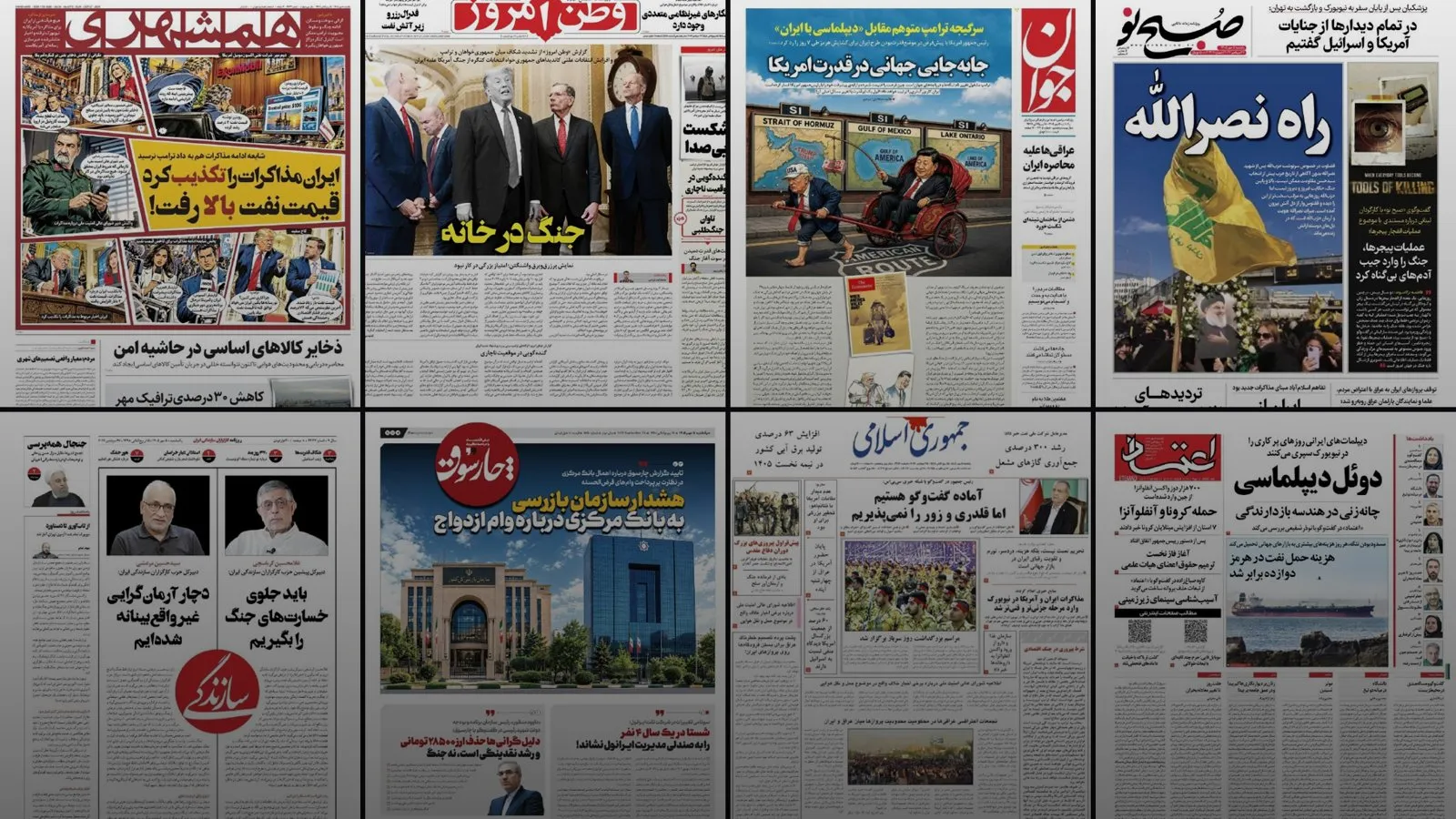
Bottom line: Iran’s press published the American rejection of the seven-day plan within one cycle, as this file predicted it would, but the batch’s most consequential disclosure came from the president rather than from the adversary: he told Al Jazeera he has met the serving Leader exactly twice, which supplies a mechanism for the arbitration failure this file has been recording for a week.
Executive Summary
The lead judgment of this edition is that the answer arrived, on schedule, and that the Iranian press handled it by distributing it rather than by suppressing it. On 26 September this file recorded that the Wall Street Journal report of the American president rejecting Iran’s seven-day plan sat on three Iranian channels and no front page, judged that the 23 to 24 September precedent argued for deadline rather than concealment, and named the 27 September batch as the test. The test resolves for deadline. Javan leads the batch with «سرگیجه ترامپ متوهم مقابل «دیپلماسی با ایران»» and states in its standfirst that the American president rejected Iran’s plan to open Hormuz within seven days. Vatan-e Emrooz carries the same fact as a rail item under «گندهگویی در موقعیت ناچاری», big talk from a position of helplessness. The underlying event also upgraded overnight: what was a leaked report on 25 September became an on-record statement to reporters at the White House on 26 September, in which the American president said the deal would not be acceptable and that Iran wanted it because they are losing so badly. An Iranian front page can decline to print a newspaper’s sourcing; it cannot easily decline to print a head of state speaking on camera.
What the titles do with the refusal is the day’s real variance, and it is not a hardline-versus-reformist split. Javan and Vatan-e Emrooz, both hardline, print the rejection and neutralise it inside a decline narrative: Javan’s cover cartoon has a barefoot Trump pulling a rickshaw carrying Xi Jinping past waterways relabelled Trump Strait, Gulf of America and Lake America, which answers the renaming map that reached only the Etemad channel yesterday. Hamshahri, the centrist municipal daily, does something none of the others do and leads on «ایران مذاکرات را تکذیب کرد», Iran denied the negotiations, sourced to the Secretary of the Supreme National Security Council. Jomhouri Eslami, on the same morning, leads on «مذاکرات ایران و آمریکا در نیویورک وارد مرحله جزئیتر و فنیتر شد», the talks entering a more detailed and technical phase, attributed to an Al Jazeera correspondent. Ta’adol prints «بازگشت گمانهزنیها درباره مذاکره». Three positions on whether negotiations exist were published in one cycle by papers that are not factional opposites, which is a coordination failure rather than a disagreement.
The most consequential item in the batch was volunteered by the president and has nothing to do with the Americans. In his Al Jazeera interview, carried on the Iran newspaper channel at post 508018, he said «من دو بار با رهبر انقلاب دیدار کردم. بار اول حدود سه ساعت و بار دوم هفت ساعت و نیم», I have met the Leader of the Revolution twice, the first for about three hours and the second for seven and a half, and paired it with the formulation that the leadership structure sets policy while execution is the government’s responsibility. This file has recorded the serving Leader’s absence from the Iranian press surface across most of the past fortnight and judged on 26 September that the office whose function is to arbitrate had issued nothing on a question its own agencies had split over. The president has now supplied the mechanism: access is rare, scheduled and long. Two meetings, measured in hours rather than in frequency, is the access pattern of a head of government who consults an authority rather than one who works alongside one.
Lebanon returned to a Persian front page for the first time in this file’s recent record, and the manner of the return matters more than the fact. On 26 September this file judged that Lebanon had completed its conversion from a theatre into a contract term, held across six cycles, and named a Lebanon story reaching a Persian cover on its own merits as the earliest indicator of reversal. Sobh-e No leads today with «راه نصرالله» over the second anniversary of Hassan Nasrallah’s killing on 27 September 2024. The occasion, however, is a fixed date rather than an event: this is a scheduled commemoration, not a re-preparation of the front, and the accompanying material is a documentary interview about the pager operation rather than anything operational. The indicator has fired on a technicality, and this file records it as such.
Iraq, not Lebanon, is where the batch shows movement. The air blockade acquired a name. Sobh-e No prints «الزیدی زیر تیغ», al-Zaidi under the blade, and the Kayhan channel leads its own front page on widespread Iraqi protest at the prime minister’s conduct toward Trump, describing clerics, resistance factions and the public calling the suspension of Iranian flights a violation of sovereignty and a capitulation. Ali al-Zaidi has been Iraq’s prime minister since 14 May 2026, arrived as a compromise non-politician, and has courted Washington openly. Until this cycle the Iranian press filed the airport closures as an American sanctions mechanism; today two titles converted it into an Iraqi loyalty question attached to a named head of government. The English-language Iran Daily, on the same morning, reports that Iraq is seeking an American exemption for Iranian carriers.
Net assessment: this is an edition in which the Iranian press did its reporting job and its coordination failed. The refusal was published within a cycle, a checkable American casualty figure was rendered exactly right by the hardline title that reported it, and a Foreign Ministry economic deputy was allowed to say on a front page that sanctions are a cost rather than a blessing. Against that, three incompatible accounts of whether talks exist were printed on one morning, the Leader’s commemorative slot on the resistance movement’s most significant anniversary was filled from the 2024 archive under the label ‘the martyred Leader of the Revolution’, and the head of government disclosed that he has met the serving Leader twice. The system’s information output is functioning better than its command arrangements, and the gap between the two is the finding of this edition.
Key Judgments
- KJ-1 [HIGH] KJ-1: The prediction this file recorded on 26 September resolves for deadline rather than concealment, and the mechanism is now documented twice in five days. Javan leads the 27 September batch with the American rejection of the seven-day Hormuz plan, stating in its standfirst that the American president rejected Iran’s plan to open Hormuz within seven days; Vatan-e Emrooz carries the same fact in its rail as «گندهگویی در موقعیت ناچاری». Yesterday the report sat on the Vatan-e Emrooz, Etemad and Jam-e Jam channels and on no front page, and this file judged, against the 23 to 24 September precedent, that the silence was a production deadline and named today’s batch as the test. A second factor reinforced it: the rejection hardened overnight from a Wall Street Journal report into an on-record statement to reporters at the White House on 26 September. The significance is methodological and should be applied forward: a single-cycle absence of adverse news from Iranian covers is weak evidence of suppression, and this file will require a second consecutive cycle before treating any such silence as policy.
- KJ-2 [HIGH] KJ-2: The Iranian state published three incompatible accounts of whether negotiations exist, in one cycle, across titles that are not factional opponents. Hamshahri leads «ایران مذاکرات را تکذیب کرد», sourced to the Secretary of the Supreme National Security Council. Jomhouri Eslami leads «مذاکرات ایران و آمریکا در نیویورک وارد مرحله جزئیتر و فنیتر شد», sourced to an Al Jazeera correspondent with Tehran sources cited in support. Ta’adol prints «بازگشت گمانهزنیها درباره مذاکره», while Javan and Vatan-e Emrooz print an American rejection of a specific proposal, which presupposes one was live. On 26 September this file judged that two offices had published incompatible positions on the sequencing of the Strait and that the distinguishing evidence would be an arbitration from the Leader’s office. No arbitration has appeared and the incompatibility has widened from the terms of the talks to their existence. The significance is that an American negotiator reading the Iranian press on 27 September cannot establish from it whether a channel is open, which is a condition that damages Iran’s own position and is therefore more likely to be disorder than design.
- KJ-3 [HIGH] KJ-3: The president has disclosed the frequency of his access to the serving Leader, and it is low enough to explain the arbitration failure this file has been recording. On the Iran newspaper channel at post 508018 he is quoted from his Al Jazeera interview: «من دو بار با رهبر انقلاب دیدار کردم. بار اول حدود سه ساعت و بار دوم هفت ساعت و نیم.» The video restatement at post 508112 repeats it, and post 508007 quotes him describing a seven-hour session held seated on the floor; the Kayhan channel independently carried an account of a seven-hour presidential meeting at post 81923. In the same interview he said the leadership structure sets policy while execution falls to the government. The serving Leader’s printed name, in post 498357 from the same channel, is Ayatollah Seyyed Mojtaba Hosseini Khamenei, and that post dates a meeting to the start of the third year of the presidency, placing it around late July or August 2026. The significance is that this file has repeatedly asked why the office whose function is to settle interdepartmental disputes has settled none; the head of government has now described a consultation pattern, rare and long rather than frequent and short, in which settling them would be structurally slow. Calibration: the phrase «دو بار» is not accompanied in the available text by an explicit period, so the judgment rests on the access pattern being rare and scheduled rather than on a precise count since February.
- KJ-4 [HIGH] KJ-4: On the second anniversary of Nasrallah’s killing, the Leader’s commemorative slot was filled from the 2024 archive and labelled as the assassinated predecessor’s. Kayhan channel post 85122 carries «سید مقاومت یک شخص نبود؛ یک راه و یک مکتب بود و این راه همچنان ادامه خواهد یافت» under the attribution line «رهبر شهید انقلاب | ۱۴۰۳/۰۷/۰۳», the martyred Leader of the Revolution, dated 24 September 2024. No current message from the serving Leader reached any of the ten front pages or any of the nine channels read for this edition, and no Kayhan «یادداشت روز» was posted for this cycle. This is the strongest instance of the standing absence this file has recorded, because it is not a quiet news day: Sobh-e No leads its front page with «راه نصرالله», so the occasion plainly warranted a Leader’s voice and the outlet closest to the Leader’s office reached for a dead man’s words to supply it. khamenei.ir was not reachable at the time of compilation, so this is an absence on the Iranian press surface and not a global one. The significance is that the succession’s legitimation problem is now visible in the archive it draws on rather than only in the silences between editions.
- KJ-5 [MODERATE-HIGH] KJ-5: The air blockade has been converted from an American mechanism into an Iraqi loyalty question attached to a named head of government, and that names a target set. Sobh-e No prints «الزیدی زیر تیغ» over Iraqi public, clerical and parliamentary protest demanding the flights return; the Kayhan front page leads on widespread Iraqi protest at the prime minister’s conduct toward Trump and post 85138 describes the suspension as a sovereignty violation and a capitulation. Javan reports Iraqi groups threatening an airport sit-in, Jomhouri Eslami runs «پشت پرده تصمیم خطرناک عراق برای بستن فرودگاهها», and Defa Press and Vatan-e Emrooz carry Iraqi council and seminary statements that breaking the blockade is obligatory. Ali al-Zaidi has been prime minister since 14 May 2026, arrived as a non-politician compromise candidate and has courted Washington publicly. On 26 September this file judged that because Iran does not control the air chokepoint, its doctrine of symmetrical denial could only be enforced against the states that complied. The pressure campaign has now arrived, personalised, and it is running through Iraqi domestic politics rather than through Iranian military options. Iraqi aviation infrastructure and the al-Zaidi government’s stability are the indicators to watch.
- KJ-6 [MODERATE-HIGH] KJ-6: Iran is manufacturing documentary evidence of compliance with a Hormuz permission regime that external tracking reports is not working, and the manufactured item is single-sourced. The Persian Gulf Strait Authority’s 26 September warning that charterers are forcing vessels onto illegal routes is externally reported and appears on the Kayhan, Etemad and Defa Press channels, so the warning itself is solid. What is not solid is what the Etemad channel added at posts 535925 and 535926: an apology from ship owners for an unauthorised Strait transit, published in full text. No external corroboration for that letter was found. Against it, external tracking of the authority’s three blacklists, 77 vessels by 14 September, reports the listed ships used the unauthorised southern corridor or transited without paying and were not deterred. The significance is that publishing an apology is a claim about authority rather than a use of it, and a state that is enforcing a regime successfully does not need to print the confessions. The letter should be treated as an Iranian information product until a shipowner or registry confirms it.
- KJ-7 [MODERATE-HIGH] KJ-7: Negative evidence on a distortion this file has been tracking, cutting in Iran’s favour. On 24 and 26 September this file recorded an American casualty figure being altered as it moved from Iranian channels to a mainstream front page, with the centrist Hamshahri printing eight Abraham Lincoln suicides against a source document reporting eight attempted suicides and no deaths, while the hardline Vatan-e Emrooz rendered it correctly. Today Vatan-e Emrooz prints «شکست بیصدا» over the line that the Washington Post reported the lights-off addition of 37 more service members to the American wounded figures. The Washington Post reported on 25 September that the Pentagon quietly raised its tally by 37, comprising 29 sailors and eight Marines, to 861. The figure is exact and ‘lights-off’ is a fair rendering of ‘quietly’. The Kayhan channel carries the same 37. The distortion did not recur and no title inflated the number. The significance is that this strengthens the 26 September judgment that the alteration mechanism is aggregation rather than hardline intent, and it is filed here as a finding because an analytic file that records only the failures of an adversary press will mis-estimate the reliability of the rest of it.
- KJ-8 [MODERATE] KJ-8: Lebanon returned to a Persian front page, but on a fixed date rather than on its own merits, so the reversal indicator has fired on a technicality. On 26 September this file judged that Lebanon had completed its conversion from a theatre into a contract term across six cycles and named a Lebanon story reaching a Persian cover on its own merits as the earliest warning of reversal. Sobh-e No leads today with «راه نصرالله» over the second anniversary of Hassan Nasrallah’s killing on 27 September 2024, with a commemorative text arguing that Hezbollah has survived harder days, alongside a Lebanese director’s documentary interview on the pager operation. Jam-e Jam’s channel carries the Beirut commemoration at posts 29165 and 29166. Nothing on the page is operational, and the Sobh-e No channel carried no Lebanon content at all despite its own cover leading on it. The significance is that a scheduled anniversary is the weakest possible form of this indicator, and the judgment of the theatre-to-clause conversion stands: the test remains a Lebanon story on a Persian cover on a date nobody could have entered in a diary in advance.
- KJ-9 [MODERATE] KJ-9: Two named front-page interventions moved the Iranian economic argument off the war, in opposite directions, and both are politically load-bearing. Jomhouri Eslami quotes the Foreign Ministry’s economic deputy that «تحریم نعمت نیست، بلکه هزینه، دردسر، تورم و تقویت رقبای ایران در بازار جهانی است», which is an explicit repudiation on a front page of the sanctions-as-blessing formula that has underwritten resistance-economy argument for years, and it makes the blockade expensive enough to be worth trading. Charsoogh quotes Davoud Manzour, Raisi’s Plan and Budget Organization head, that «دلیل گرانیها حذف ارز ۲۸۵۰۰ تومانی و رشد نقدینگی است، نه جنگ», which removes the blockade from the explanation of Iranian prices and simultaneously indicts the sitting government’s currency reform. The significance is that the economic case for and against settlement is now being argued by named officials of two administrations on the front pages of two different papers, which is a more durable form of the dispute than editorial polemic and a better forward indicator of whether a deal can be sold domestically.
- KJ-10 [MODERATE] KJ-10: The maritime threat register expanded geographically while the political register moved toward de-escalation, in the same cycle. The Etemad channel at post 535928 carries an IRGC Navy deputy saying that in a new war enemy vessels in the Indian Ocean will have no security, which extends the threatened area well beyond the Strait and the Gulf. Jam-e Jam post 29147 carries the armed forces spokesman saying Iran will not let Trump, Netanyahu and the other killers of the martyred Imam pass, and Defa Press post 68624 carries him saying America will be slapped if it interferes in Hormuz. Against this, the Supreme National Security Council secretariat issued a statement on untrue news about air transport, bannered by Vatan-e Emrooz under «راهکارهای غیرنظامی متعددی وجود دارد», there are multiple non-military solutions, and carried in Jomhouri Eslami’s rail. The significance is that the council damping expectations of a military response to the air blockade, on the same morning that uniformed spokesmen widen the maritime threat to the Indian Ocean, is the clearest instance yet of the civil-military divergence this file has been tracking, and the council’s line is the one attached to the office that would have to authorise action.
- KJ-11 [MODERATE] KJ-11: Iranian domestic argument has moved from positions to named individuals and private addresses. Sazandegi devotes its cover to two signed interviews with the Executives of Construction leadership, and the sharper of them, from the party’s serving secretary-general Seyyed Hossein Marashi, locates the war’s damage in «آرمانگرایی غیرواقعبینانه», unrealistic idealism, which is an Iranian property rather than an American action. The same cover reports hardliners gathering outside former president Hassan Rouhani’s home over a referendum proposal. Charsoogh’s satirical strip runs a senior official fleeing an embassy reception clutching invitations while an aide protests that the country is officially hostile, the third cycle of the reception dispute after the Fars News rebuke of 25 September and Shariatmadari’s Kayhan editorial of 26 September, and its arrival as a cartoon on an economic daily shows the affair has become general newsroom shorthand. The significance is that a system which conducts its disputes against named people at named addresses has fewer ways to settle them quietly, and the escalation from editorial to doorstep is the indicator to track.
- KJ-12 [MODERATE] KJ-12: The Iranian press segmented its audiences systematically, and the foreign-facing surface received the settleable version of every contested fact. Iran Daily leads on «Tehran ready for talks with Washington but rejects ‘bullying’» and banners sanctions as economic terrorism, carrying neither the American rejection that Javan and Vatan-e Emrooz print nor the denial of talks that Hamshahri prints. Its Iraq item reports Baghdad seeking an American exemption for Iranian airlines; the Persian titles report al-Zaidi under the blade and a dangerous decision with something behind the curtain. Its aviation interview argues that the sanctions are a contest over the limits of American power rather than an operational grievance. The significance, and the reason this is filed as a judgment rather than an observation, is that the segmentation is consistent rather than incidental: on every contested item in the batch the English edition takes the version compatible with a negotiated outcome. That is evidence that someone is curating the foreign-facing surface toward a settlement even while the Persian surface cannot agree on whether a negotiation exists.
Macro Trends
- The refusal was printed within one cycle, and the prediction made on 26 September resolves for deadline.. This file judged yesterday that the absence of the Wall Street Journal rejection report from all ten covers was most probably a production deadline rather than a decision to conceal, cited the 23 to 24 September precedent in which an identical silence resolved the next morning, and explicitly recorded the prediction rather than the conclusion. Javan leads today’s batch with the rejection and Vatan-e Emrooz carries it in its rail. The event itself also hardened overnight from a leaked report into an on-record White House statement, which removes the sourcing objection an Iranian editor might have raised on Saturday. The mechanism is now documented twice in five days and should be treated as the working assumption for future one-cycle silences on adverse news.
- Three incompatible accounts of whether negotiations exist were published on one morning, and not along factional lines.. Hamshahri leads on a denial of the talks sourced to the Secretary of the Supreme National Security Council. Jomhouri Eslami leads on the talks entering a more detailed and technical phase, sourced to an Al Jazeera correspondent. Ta’adol prints the return of speculation about negotiation. Javan and Vatan-e Emrooz print an American rejection of a specific Iranian proposal, which presupposes a proposal was live. The centrist municipal daily, the traditional establishment daily and an economic daily are not factional opponents, so this is not an argument being conducted in public: it is the absence of a common authoritative account. On 26 September the incompatibility was about the sequencing of the Strait; it has now spread to the prior question of whether anyone is talking.
- The president disclosed the frequency of his access to the serving Leader, and it is low.. In his Al Jazeera interview the president said he has met the Leader of the Revolution twice, for about three hours and for seven and a half hours, and described the leadership structure as setting policy while execution falls to the government. The Kayhan channel independently carried an account of a seven-hour presidential meeting. The same channel that reported the meetings prints the serving Leader’s name as Ayatollah Seyyed Mojtaba Hosseini Khamenei and dated one of them to the start of the third year of the presidency. This file has spent a week recording an arbitration that never arrives; the president has now described a consultation pattern in which arbitration would be structurally slow. The quotation does not carry an explicit period in the available text, and that caveat is preserved, but the disclosure is voluntary, on a foreign network, and specific to the half hour.
- On the resistance movement’s most significant anniversary, the Leader’s slot was filled from the archive.. Sobh-e No leads on «راه نصرالله» for the second anniversary of Nasrallah’s killing. The Kayhan channel marks it at post 85122 with «سید مقاومت یک شخص نبود؛ یک راه و یک مکتب بود», attributed in the post’s own line to «رهبر شهید انقلاب», the martyred Leader of the Revolution, and dated 1403, which is 2024. No current message from the serving Leader appeared on any front page or channel read for this edition, and no Kayhan «یادداشت روز» was posted for this cycle. The commemorative surface on which a sitting Leader would ordinarily speak was supplied by his assassinated predecessor, two years after the fact.
- The air blockade acquired a named Iraqi owner.. Sobh-e No prints «الزیدی زیر تیغ» and the Kayhan front page leads on Iraqi protest at the prime minister’s conduct toward Trump, with clerics, resistance factions and the public quoted calling the flight suspension a sovereignty violation and a capitulation. Javan reports Iraqi groups threatening an airport sit-in; Jomhouri Eslami runs «پشت پرده تصمیم خطرناک عراق برای بستن فرودگاهها» and Iraqi protest gatherings; Defa Press and Vatan-e Emrooz carry Iraqi council and seminary statements that breaking the blockade is obligatory. Until this cycle the closures were filed as an American mechanism. Ali al-Zaidi, prime minister since May 2026 and openly courting Washington, is now the addressee. Iran does not control this chokepoint, so pressure that cannot reach Washington is being directed at the Iraqi government that complied.
- Iran is documenting compliance with a Hormuz permission regime that external tracking says is not working.. The Persian Gulf Strait Authority warned ship owners on 26 September that some charterers are forcing vessels onto illegal routes, a warning carried on the Kayhan, Etemad and Defa Press channels and reported externally. The Etemad channel went further and published, at posts 535925 and 535926, an apology from ship owners for an unauthorised transit, with the full text. Publishing an apology is an assertion that the permission regime has authority. Against it, external tracking of the authority’s three published blacklists, totalling 77 vessels by mid-September, reports that the listed ships used the unauthorised southern corridor or transited without paying and were not deterred. The Iranian surface is being used to manufacture evidence of a compliance that the traffic data does not show, and the apology letter is uncorroborated outside Iranian channels.
- Three papers across the factional range published the same theory that the blockade’s cost is transmissible to European publics.. Etemad prints «هزینه حمل نفت در هرمز دوازده برابر شد» directly under its diplomacy lead. Ta’adol runs «وقتی شعلههای خاورمیانه زمستان اروپا را منجمد میکند», when the flames of the Middle East freeze Europe’s winter. Vatan-e Emrooz devotes a stamped special to «تاوان جنگطلبی», the price of warmongering, on European protests against unprecedented fuel prices. A reformist daily, an economic daily and a hardline daily published the same coercion theory on the same morning. External reporting confirms extreme dislocation on these routes, with Middle East tanker rates up close to 500 percent year on year, though not Etemad’s specific multiple. This is the commercial argument for holding the Strait running directly underneath the diplomatic argument for trading it away.
- Two front-page interventions moved Iranian economic argument off the war.. Jomhouri Eslami quotes the Foreign Ministry’s economic deputy on its front page: «تحریم نعمت نیست، بلکه هزینه، دردسر، تورم و تقویت رقبای ایران در بازار جهانی است», sanctions are not a blessing but a cost, a nuisance, inflation and the strengthening of Iran’s competitors. Charsoogh quotes Davoud Manzour, the Plan and Budget Organization head under Raisi, saying «دلیل گرانیها حذف ارز ۲۸۵۰۰ تومانی و رشد نقدینگی است، نه جنگ», the cause of price rises is the removal of the 28,500-toman rate and liquidity growth, not the war. The two cut in opposite directions: the first makes the blockade expensive and so makes a settlement purchasable; the second removes the blockade from the explanation of Iranian prices and so makes the war affordable while indicting the sitting government. Both are front-page, both are named, and they cannot both be operative.
- Domestic argument is being conducted against named individuals rather than positions.. Sazandegi gives its whole cover to two signed interviews with the Executives of Construction leadership, Karbaschi on stopping the war’s damages and Marashi on «آرمانگرایی غیرواقعبینانه», unrealistic idealism, the second of which places the cause inside Iranian doctrine. The same cover reports hardliners gathering outside Hassan Rouhani’s home over a referendum proposal. Charsoogh’s satirical strip runs a senior official fleeing an embassy reception with a fistful of invitations while an aide protests that the country is officially hostile, which is the third cycle of the reception dispute this file has tracked after the Fars News rebuke and Shariatmadari’s Kayhan editorial. Figures in caricature are not named here from likeness. The trend is that the dispute now has addresses and doorsteps.
- The English-language surface was given the negotiable version of the same facts.. Iran Daily leads on «Tehran ready for talks with Washington but rejects ‘bullying’» and banners the foreign minister on sanctions as economic terrorism. It carries neither the American rejection that two Persian covers carry nor the denial that a third carries. Its Iraq item reports Baghdad seeking an American exemption for Iranian airlines, where the Persian titles report al-Zaidi under the blade and a dangerous decision with something behind the curtain. The same fact set is arranged as grievance for the domestic readership and as a negotiable administrative problem for the foreign one, and the segmentation is consistent across every contested item in the batch.
Front-Page Snapshot
- Javan - “A global shift in America’s power; the delusional Trump’s vertigo before ‘diplomacy with Iran’” (Hardline, IRGC-affiliated) - American rejection of the seven-day plan [MODERATE-HIGH - rejection absorbed into a decline frame]
- Vatan-e Emrooz - “War at home” (Hardline) - American domestic rift over the war [MODERATE - SNSC banner is de-escalatory]
- Kayhan (channel) - “Widespread Iraqi protests over al-Zaidi’s compliance with Trump” (Hardline, Leader’s office) - Iraqi air blockade and Hormuz transit enforcement [HIGH - sovereignty framing against Iraq’s government]
- Hamshahri - “Iran denied the negotiations - the oil price went up!” (Tehran municipality, centrist) - Denial that talks exist [MODERATE - denial plus supply reassurance]
- Jomhouri Eslami - “We are ready for dialogue but we do not accept bullying and force” (Traditional establishment) - Talks entering a technical phase [LOW-MODERATE - negotiation-forward, sanctions costs conceded]
- Sobh-e No - “Nasrallah’s path” (Principlist) - Nasrallah anniversary and the Iraqi air blockade [MODERATE-HIGH - first personalised targeting of Iraq’s prime minister]
- Etemad - “The diplomacy duel; the cost of oil transport in Hormuz has risen twelvefold” (Reformist) - New York diplomacy and the price of the closed Strait [LOW-MODERATE - blockade costed as leverage to spend]
- Sazandegi - “We must stop the damages of the war / We have fallen into unrealistic idealism” (Reformist, Executives of Construction) - Reformist reckoning with the war’s costs [LOW-MODERATE - domestic coercion at a former president’s residence]
- Ta’adol - “Export currency on the road back” (Economic) - Export earnings and the transmissible cost of the blockade [LOW-MODERATE - coercion framed as reaching European publics]
- Charsoogh - “Inspection Organization warns the Central Bank over the marriage loan” (Economic) - Inflation blamed on monetary policy, not the war [LOW - domestic economic and factional content]
- Iran Daily - “Tehran ready for talks with Washington but rejects ‘bullying’: Pezeshkian” (English-language government daily) - Conditional readiness for talks and ‘economic terrorism’ [LOW - conciliatory foreign-facing framing]
Compiled from Iranian front pages and outlet channels via open-source monitoring. Translations are editorial; named-figure attributions are verified against the source pages where possible.