Iranian Press Monitor - Wednesday, 23 September 2026 (Day 204)
Wednesday, 23 September 2026 · چهارشنبه ۱ مهر ۱۴۰۵ · 11 Rabi’ al-Thani 1448 - Ten Persian front pages and one English front page of 1 Mehr 1405, read alongside six outlet channels and three agency wires; Tehran Times was not available at the time of compilation.
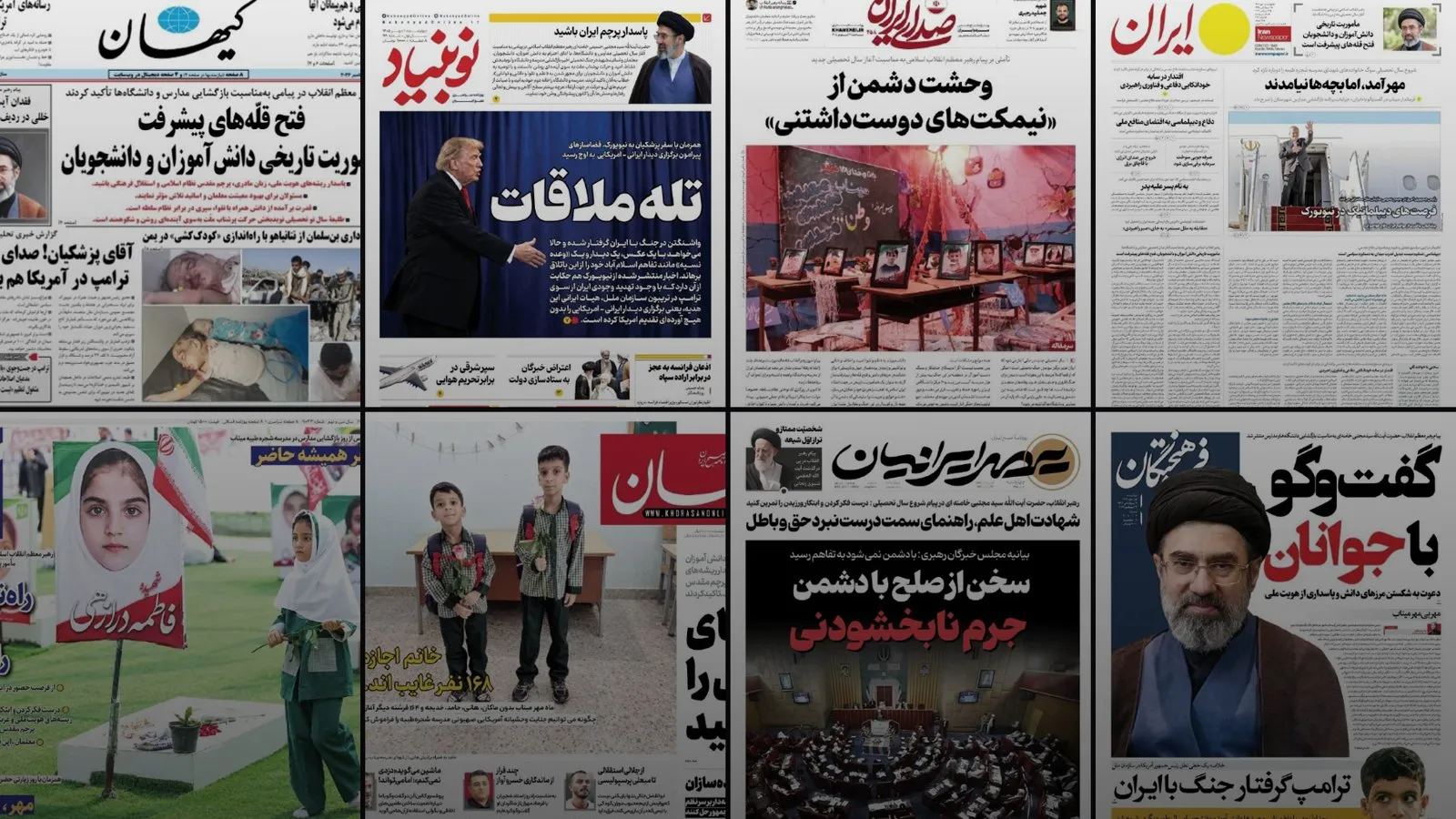
Bottom line: On the morning Iran’s foreign minister met the American envoy in New York and Iran’s president landed to address the General Assembly, the Iranian front pages printed neither, and gave their lead instead to the first message from the serving Leader this monitor has recorded in eight cycles, wrapped around the empty desks of a school struck seven months ago.
Executive Summary
The lead judgment of this edition is that the serving Leader’s eight-cycle silence has ended, and that it ended on a school bell rather than on the war. Every one of the ten Persian covers in the batch, and the English cover as well, carries a message issued in the name of «حضرت آیتالله سید مجتبی حسینی خامنهای» for the reopening of schools and universities, printed in that full form by Nobonyad, Asr-e Iranian and Farhikhtegan. A second message, on the death of Grand Ayatollah Shobeiri Zanjani, runs on the same pages. Across every passage any paper displays, there is no reference to the United States, to Israel, to the negotiations or to the war: the register is pedagogic throughout, built on four repeated points about identity, the mother tongue, teachers’ livelihoods and the pairing of knowledge with piety. The uniformity of the display type across nine competing titles indicates a distributed text rather than editorial convergence, and the content of that text is the finding. Having been absent from this file for eight consecutive cycles, and absent from his own newspaper’s authority claims on 22 September, the serving Leader has re-entered Iranian public life on the safest available subject.
The second finding is that the day’s actual diplomacy happened and reached no front page. On 22 September in New York, Iran’s foreign minister met the American special envoy and the president’s son-in-law on the sidelines of the General Assembly, with Qatar’s prime minister and foreign minister present for most of the session, and conveyed Iran’s conditions for reopening the Strait of Hormuz: the immediate lifting of the naval blockade, the release of frozen assets and an end to the war on all fronts, including Lebanon. The American envoy called the talks constructive and promising; Trump, who had told the Assembly hours earlier that he faces a decision whether to make a deal or to annihilate the Islamic Republic, said his people had a very good meeting. On the Iranian side, the meeting exists on four channels, Kayhan’s own among them, and on none of the eleven covers. The covers were printed before Tehran morning, so deadline explains part of it and the next cycle is the test of the rest. What deadline does not explain is what the covers did with the time they had: Nobonyad gave its entire front page to declaring an Iranian-American meeting a trap, and Kayhan told the president that the White House’s insistence on one is the laying of a political and propaganda trap. The hardline argument against the meeting was set in type before the meeting was confirmed.
The third finding closes a tracking cue this monitor set one cycle ago. On 22 September a concrete proposal to reopen the Strait, under the byline of a journalist the state has repeatedly imprisoned, reached a reformist front page, and this file said that a principlist rebuttal would establish the proposal as live and silence would not. The rebuttal arrived in a single cycle and came from the Assembly of Experts. Asr-e Iranian gives its whole cover to «سخن از صلح با دشمن، جرم نابخشودنی», to speak of peace with the enemy is an unforgivable crime, over «با دشمن نمیشود به تفاهم رسید». Sobh-e No’s channel names what is being ruled out: a referendum, and a «صلح شرافتمندانه», an honourable peace. The body that selects and supervises the Leader has not argued that a settlement would be unwise; it has classified arguing for one as a crime, in the same week the state’s own negotiators were conveying terms through a Qatari mediator.
The fourth finding concerns how the Iranian reader is being kept from evaluating any of this. Trump’s threat to annihilate the Islamic Republic, delivered from the General Assembly podium, appears on no Iranian surface in this batch in any form. Farhikhtegan reduces the entire speech to one line, «ترامپ گرفتار جنگ با ایران», Trump is trapped in the war with Iran. Jam-e Jam’s channel calls it the gambler’s outlandish lies. Sedaye Iran, Iran’s channel and Jam-e Jam’s channel carry the General Staff’s response, which characterises the remarks as «استیصال راهبردی», strategic desperation. An existential threat is being processed as evidence of the adversary’s weakness. Separately, the same mechanism operates on a smaller and cleaner case: the American Secretary of State said on 22 September that Washington is open to meeting Iran at the United Nations and that nothing is scheduled at this point. Iran Daily’s front page prints the opening. Vatan-e Emrooz’s channel prints the absence of a schedule. Each half is accurate, neither surface prints the whole, and no fabrication is required for two Iranian audiences to receive incompatible impressions of the same American position.
The fifth finding is that the most powerful material in this edition required no construction at all. Today is the first day of the Iranian school year, seven months less five days after the strike that killed 168 people at the Shajareh Tayyebeh elementary school in Minab, about 120 of them children. Iran, the government’s own daily, leads on «مهر آمد، اما بچهها نیامدند», Mehr came but the children did not. Qods sent a correspondent to the school and headlines the piece «۱۶۸ نفر همیشه حاضر», 168 permanently present, over a photograph of a schoolgirl walking past a memorial banner planted among graves on the schoolyard. Khorasan simply reprinted the photograph it took on the first day of school last year, of two brothers at their desks holding roses, and captioned it with their names and the fact that both were killed. The figure 168 matches the external record, which attributes the strike, in Amnesty International’s finding, to a precision-guided American weapon. Iran Daily states the purpose of this coverage in English, in a box on its own front page: the Minab tragedy is to become a national and global cultural narrative.
Net assessment: this is the most internally contradictory edition this monitor has recorded. The state is negotiating through a Qatari mediator in New York while its clerical apex declares advocacy of peace a crime; it prints its Leader’s return in a wholly civilian register while its hardline titles pre-emptively criminalise a meeting that had already occurred; it reports the adversary’s offer accurately in English and its refusal accurately in Persian. The unifying logic is not a policy but a sequence of audiences, and the material holding the whole thing together is the grief of Minab, which is the one element of the edition that is documentary, checkable and not the product of any editorial decision at all. That is what makes it effective, and it is why the argument against a settlement is being carried on the backs of 168 dead rather than on any claim about the terms.
Key Judgments
- KJ-1 [HIGH] The serving Leader’s silence has ended, and the register chosen for the return is civilian. Across ten Persian front pages and one English front page, every title carries a message issued for the reopening of schools and universities in the name of «حضرت آیتالله سید مجتبی حسینی خامنهای», printed in full by Nobonyad, Asr-e Iranian and Farhikhtegan and in short form elsewhere; a second message, on the death of Grand Ayatollah Shobeiri Zanjani, runs on the same covers. The evidence for the character of the message is the display text itself: four repeated points on national identity and the mother tongue, the flag, teachers’ livelihoods, and knowledge joined to piety, with no reference on any page to the United States, Israel, the blockade or the negotiations. On the eight preceding cycles this monitor recorded no statement, speech or quoted remark from him on any surface, and on 22 September recorded his own newspaper grounding its authority in the martyred predecessor instead. The significance is twofold: the succession now rests on printed pages rather than on inference, and the office has chosen to re-enter public life on the one subject that commits it to nothing about the war.
- KJ-2 [HIGH] Iran and the United States met at envoy level in New York, and no Iranian front page in the batch says so. Iran’s foreign minister met the American special envoy and the president’s son-in-law on the General Assembly’s sidelines on 22 September, with Qatar’s prime minister and foreign minister present for most of the session, and conveyed Iran’s conditions for reopening the Strait of Hormuz: immediate lifting of the naval blockade, release of frozen assets, and an end to the war on all fronts including Lebanon. The American envoy described the talks as constructive and promising. Four Iranian channels carry it, including Kayhan’s (post 84716), the government daily’s (507649), the state broadcaster’s (28633) and the security council’s news agency (396662), the last under a headline stating that Tehran’s conditions for reopening the Strait have been announced; the Foreign Ministry spokesman confirms the Qatari mediation on two channels. Eleven front pages carry none of it. The covers were printed before Tehran morning, so deadline accounts for part of the gap and the next cycle is the test of the remainder. The significance is that the three conditions are now identical across Persian and English Iranian surfaces and have been delivered in a room rather than published at an audience, which makes them a negotiating position with a mediator attached rather than a broadcast demand.
- KJ-3 [HIGH] The Assembly of Experts has answered a de-escalation proposal by criminalising the category of speech it belongs to, one cycle after this monitor set that as the test. On 22 September Sazandegi printed Emadeddin Baghi’s argument for a conditional reopening of the Strait, and this file judged that a principlist rebuttal would establish the proposal as live while silence would not. Today Asr-e Iranian gives its entire front page to «بیانیه مجلس خبرگان رهبری: با دشمن نمیشود به تفاهم رسید» over «سخن از صلح با دشمن، جرم نابخشودنی»; Sobh-e No’s channel (116157) supplies the specifics, that divisive wartime speech is a crime and that proposals for a referendum and for a «صلح شرافتمندانه» are destabilising; Jam-e Jam and Nobonyad carry other clauses of the same statement. The statement is corroborated across four Iranian surfaces and was not available outside the Iranian press at compile time, so it is reported as an Iranian-press item. The significance is the issuing body and the move it makes: the organ that selects and supervises the Leader has not contested the proposal’s merits but reclassified advocating it, and it has done so in the same week Iranian diplomats were conveying terms through a Qatari mediator.
- KJ-4 [HIGH] Two hardline covers went to press pre-attacking a meeting that had already taken place. Nobonyad gives its whole front page to «تله ملاقات», the meeting trap, over a photograph of Trump’s extended hand, arguing that Washington is trapped in the war and wants to escape the quagmire «با یک عکس، یک دیدار و یک «وعده نسیه» مانند تفاهم اسلامآباد», with one photograph, one meeting and one promissory pledge like the Islamabad understanding. Kayhan’s analytical report tells the president to be the voice of a victorious Iran and calls the White House push for a meeting «پهنکردن یک دام سیاسی-تبلیغاتی». Both were printed before their own channels reported the envoy-level meeting. The significance is the precedent Nobonyad selects: «تفاهم اسلامآباد» is the same Islamabad framework that Sobh-e No’s channel presented on 22 September as the basis on which Iran’s seven conditions were built. In two cycles the same arrangement has been the foundation of Iran’s terms on one principlist surface and the byword for a worthless American promise on another, which indicates that the hardline position is being assembled against outcomes rather than derived from a settled reading of the file.
- KJ-5 [HIGH] Trump’s threat to annihilate the Islamic Republic reached no Iranian surface in this batch, in any form. The speech is established: on 22 September he told the General Assembly he faces a decision whether to make a deal or to annihilate the Islamic Republic and drive it into hell, called Iran the number one sponsor of terror, said he would never allow it a nuclear weapon and predicted a deal after the 3 November midterms. Farhikhtegan’s whole treatment is a one-line summary, «ترامپ گرفتار جنگ با ایران»; Jam-e Jam’s channel renders it as the gambler’s outlandish lies; Sedaye Iran’s front page and two channels carry the General Staff and Khatam al-Anbiya response characterising the remarks as «استیصال راهبردی», strategic desperation. No cover quotes, paraphrases or rebuts the threat itself. The significance is informational rather than rhetorical: the population being asked to endorse refusal of a settlement has not been told what the alternative was stated to be, which removes the one piece of information needed to price the terms its own foreign minister was conveying in New York the same day.
- KJ-6 [MODERATE-HIGH] A single accurate American statement was split in half and each half printed as a separate Iranian story, with no fabrication required. The American Secretary of State said on 22 September that Washington is open to meeting Iranian officials at the United Nations and that nothing is scheduled at this point. Iran Daily’s front page runs «US open to meeting Iran at United Nations: Rubio» as its subhead. Vatan-e Emrooz’s channel (post 26004) runs the statement that no meeting with Iranian officials is planned. Each is an accurate rendering of one clause; neither surface carries the other. The same partition operates on the Assembly of Experts statement, where Asr-e Iranian, Jam-e Jam and Nobonyad each print a different clause and none prints another’s. The significance is methodological and applies beyond today: this is a cheaper and more durable technique than the assembled isolation list recorded on 20 and 21 September, because every published fragment survives verification, and it establishes that an item’s presence on one Iranian surface proves the clause exists and never that it is the whole of what was said.
- KJ-7 [MODERATE-HIGH] The Minab anniversary is the edition’s organising instrument, its numbers are correct, and one title has stated its purpose in writing. Today is the first day of the Iranian school year; on 28 February a strike on the Shajareh Tayyebeh elementary school in Minab killed 168 people, about 120 of them children, a toll the external record supports and which Amnesty International attributes to a precision-guided American weapon. Iran leads on «مهر آمد، اما بچهها نیامدند»; Qods sent a correspondent and headlines «۱۶۸ نفر همیشه حاضر» over a photograph of a schoolgirl passing a memorial banner among graves on the schoolyard; Khorasan runs «خانم اجازه؟ ۱۶۸ نفر غایباند…» over its own photograph from the first day of school last year, captioned «حامد به همراه برادرش هانی، از شهدای مدرسه میناب، روز اول مهر ۱۴۰۴»; Farhikhtegan converts the day into «نمیبخشیم، انتقام میگیریم». Iran Daily’s front-page box states the objective in English: the Minab tragedy is to become a national and global cultural narrative. The significance is that this is the strongest material the Iranian press has deployed in this series precisely because none of it is manufactured, and the analytic caution required is therefore the opposite of the usual one: the facts are sound and the inference being built on them, that no settlement can be discussed, does not follow from them.
- KJ-8 [MODERATE-HIGH] The conservative press is divided on the New York trip, and the division runs through institutions rather than along the usual factional line. Kayhan instructs the president and calls the meeting a trap; Nobonyad gives a whole cover to the same argument; Khorasan warns against the New York prescription of the simplifiers; Farhikhtegan demands revenge. Against that, Qods, the Astan Quds Razavi foundation’s daily, runs its rail on experts framing the president’s presence as an opportunity to defend Iranian rights and as «خط بطلان بر سناریو انزوای ایران», a line drawn through the isolation scenario; the government daily prints the trip as diplomatic opportunity; Shargh calls it a time of hard choices; and Sobh-e No’s channel carries the Majlis speaker defining diplomacy as an instrument that converts battlefield power into political gain. The significance is that the case against engagement is being made by a bloc, not by the conservative press as such, and that a shrine-foundation daily is on the other side of it. Watch whether Qods holds that position after the Assembly of Experts statement circulates.
- KJ-9 [MODERATE] Negative evidence: Lebanon has been converted from a front into a clause. For the second time in three cycles not one front page in the batch carries a Lebanese item, and the Levant appears in this edition in exactly one place, as the third of the three conditions conveyed to the American envoy, an end to the war on all fronts including Lebanon, carried on four channels. On 21 September this monitor recorded the first complete batch with no Lebanese item and filed it as a change of shape; on 22 September Lebanon returned only as a channel item. The trajectory is now consistent across three cycles. The significance is that a theatre which has disappeared from a state’s front pages and reappeared as a term in its negotiating position has changed status in a specific and consequential way: fronts are defended, terms are traded.
- KJ-10 [MODERATE] The claimed anti-carrier capability advanced by one step of specificity and by no step of evidence. Kayhan’s rail carries the IRGC spokesman announcing «تست موفق سلاح جدید سپاه برای هدف قرار دادن ناو هواپیمابر آمریکا», a successful test of a new IRGC weapon for targeting the American aircraft carrier. External reporting carries the same spokesman, Hossein Mohebbi, whose identity this file resolved on 22 September, making the claim in the same terms and expressly declining to give details. On 22 September the same official promised weapons that would astonish the world; today the promise has a target and still no evidence. There is no independent confirmation of a test or of any carrier being struck. The significance is the timing rather than the claim: the specificity arrives in the week Iranian diplomats are conveying conditions in New York, which is consistent with a deterrent signal calibrated to a negotiation rather than with a battlefield development.
- KJ-11 [MODERATE] The government’s English daily has moved its analytical weight from Iran-US diplomacy to the American-Chinese relationship. On 22 September Iran Daily used its front page to publish Iran’s three negotiating conditions, the deferral of the nuclear file, the Iran-Oman mechanism and the Salalah venue. Today, on the morning Iran’s president lands in New York and its foreign minister meets the American envoy, its exclusive analysis slot goes to the Trump-Xi summit: the personal greeting at Joint Base Andrews, the arrival ceremony, the state dinner attended by technology executives, the tariff truce expiring in November 2026 with Beijing seeking one to two years and Washington three to six months, and the 21 percent August fall in rare-earth export licences read as a retained card. Its banner simultaneously tells the same readership that the Persian Gulf Arab states are pivoting toward Tehran as their security reliance on Washington wanes, on days when those states’ leaders were meeting Trump in New York about the war with Iran. The significance is that the English surface has switched from disclosure to positioning within one cycle, and the two claims it now advances to foreign readers, a thinning American coalition and a decisive Washington-Beijing contest, should be tracked separately, because the first is contradicted by the same week’s record.
- KJ-12 [MODERATE] The reformist press is not contesting the war frame; it is declining to enter it, and pointing at what is moving while attention is elsewhere. Shargh is the only title in the batch that does not lead on the Leader’s message: its front page is given to «بررسی چراغ خاموش «طرح نفوذ» در مجلس», the lights-off review of the infiltration bill in the Majlis, framed as an account of the bill’s opaque path and the effort to activate it against a wave of warnings. Its largest photograph is Mohammad-Reza Shajarian, on the anniversary of his birth on 1 Mehr, a singer the state broadcaster banned, printed on the morning the Assembly of Experts commends that broadcaster. Its rail carries «زمان انتخابهای سخت در نیویورک», the economy in the shadow of the war, and an item on reducing the Gulf’s dependence on the Strait. The significance is that the reformist objection in this edition is procedural rather than diplomatic: while the front pages argue about a meeting, legislation with surveillance implications is moving quietly, and one cover says so.
Macro Trends
- The Leader returns, and returns on schools. Eight consecutive cycles of this monitor recorded no statement, speech or quoted remark from the serving Leader across the whole surface of the Iranian press, and on 22 September recorded his own newspaper sourcing its operative rule to the martyred predecessor rather than to him. Today he is on every cover in the batch, twice: a message for the reopening of schools and universities, and a condolence message for Grand Ayatollah Shobeiri Zanjani. The content is the point. Across all the passages the nine Persian titles display there is not one word about the United States, Israel, the negotiations, the blockade or the war. The Leader has been reintroduced to Iranian public life through the mother tongue, the flag, teachers’ pay and the pairing of knowledge with piety. Three titles print his full name, which is the strongest documentary support for the succession this file has carried. Whether the next appearance carries war content is now the single most informative thing the coming cycles can produce.
- The negotiation happened on the channels and not on the covers. Iran’s foreign minister met the American envoy and the president’s son-in-law in New York with the Qatari prime minister in the room, and conveyed three conditions for reopening the Strait of Hormuz. Kayhan’s channel carries it, the government daily’s channel carries it, the state broadcaster’s channel carries it, the security council’s news agency carries it under the headline that Tehran’s conditions for reopening the Strait have been announced, and the reformist channel names the mediator and the spokesman. Eleven front pages carry none of it. The covers closed before Tehran morning, so part of this is deadline and the next cycle will separate the two. But the pattern this file has been tracking has now changed shape twice in three days: on 22 September the terms were published in English and withheld in Persian; today they are published in Persian and withheld from print. The variable is no longer language, it is surface.
- The clerical apex criminalised the proposal it was asked about. One cycle after Emadeddin Baghi’s front-page argument for a conditional reopening of the Strait appeared in Sazandegi, the Assembly of Experts for the Leadership issued a statement that Asr-e Iranian gives an entire front page to: no understanding can be reached with the enemy, and to speak of peace with the enemy is an unforgivable crime. Sobh-e No’s channel names the two proposals rejected, a referendum and an honourable peace. This is not a rebuttal on the merits and it is not an argument about terms. It is a change in the category of the speech act, issued by the body that selects and supervises the Leader, and it lands in the same week the state’s own diplomats were conveying terms through Qatar. The tracking cue set on 22 September is closed: the proposal was live enough to require an answer at that level.
- One statement, partitioned by outlet interest, twice in one morning. The American Secretary of State said Washington is open to meeting Iran at the United Nations and that nothing is scheduled. Iran Daily’s front page prints the first clause as its subhead; Vatan-e Emrooz’s channel prints the second as its story. The Assembly of Experts statement receives the same treatment from the other direction: Asr-e Iranian prints the clause criminalising peace advocacy, Jam-e Jam prints the clause commending the national broadcaster, Nobonyad prints the clause objecting to the government’s campaign machinery, and no surface prints another’s. This is a more economical mechanism than the fabricated isolation list this monitor recorded on 20 and 21 September, and it is harder to answer, because every published fragment survives fact-checking. The operational rule for this file follows: the appearance of an item on one Iranian surface establishes that the clause exists, never that it is the whole of what was said.
- The threat of annihilation is absent from every Iranian surface. Trump told the General Assembly that he faces a decision whether to make a deal with Iran or to annihilate the Islamic Republic and drive it into hell, called Iran the number one sponsor of terror, and predicted an agreement after the November midterms. None of this language appears anywhere in the batch. Farhikhtegan prints a one-line summary saying Trump is trapped in the war. Jam-e Jam’s channel calls the speech the gambler’s outlandish lies. The General Staff’s response, carried by Sedaye Iran and two channels, characterises the remarks as strategic desperation. The consistent move is to treat the threat as a symptom of the adversary’s weakness rather than as a statement of intent. The consequence is specific: an Iranian reader of these covers cannot know what was threatened from the podium, and therefore cannot assess the conditions Iran’s own foreign minister was conveying in the same city on the same day.
- The conservative press split on New York, and the split is real. Kayhan tells the president to be the voice of a victorious Iran and calls the meeting a trap. Nobonyad gives its whole cover to «تله ملاقات». Khorasan’s foot of page warns against the simplifiers’ New York prescription. Farhikhtegan demands revenge. But Qods, a shrine-foundation daily and no reformist outlet, runs its rail on experts describing the president’s presence as an opportunity to defend Iranian rights and as a line drawn through the isolation scenario. Shargh, from the other side, calls New York a time of hard choices. The government daily prints the trip as diplomatic opportunity beneath a grief lead. This is the clearest division this monitor has recorded inside the conservative press on the negotiation question, and it means the hardline position is a position rather than a consensus.
- Minab is the argument, and it is the one thing in the edition that is not constructed. The school year opened today; the strike that killed 168 people at the Shajareh Tayyebeh school killed about 120 children on 28 February. Iran leads on the children who did not come. Qods reports from the school. Khorasan reprints last year’s first-day photograph of two brothers who were killed there, names them and states the fact. Farhikhtegan turns the same day into «نمیبخشیم، انتقام میگیریم». Sedaye Iran stages a classroom of framed portraits. Iran Daily states the intention in English, in a box: the Minab tragedy is to become a national and global cultural narrative. The material is documentary, the figure matches the external record, and the attribution to an American precision-guided weapon is Amnesty International’s finding rather than a Tehran assertion. That is precisely what makes it the most effective instrument in the edition, and why the case against a settlement is currently being carried on it rather than on any claim about the terms on offer.
- Lebanon has become a clause in a negotiating position. For the second time in three cycles no front page in the batch carries a Lebanese item. Lebanon survives in this edition in exactly one place: the third of Iran’s three conditions, an end to the war on all fronts including Lebanon, as conveyed to the American envoy and reported on four Iranian channels. The front reorganisation this monitor first recorded on 21 September has now completed a further step. The Levant is no longer covered as a theatre or even carried as feed; it has become a term in a transaction, which is a status from which a front can be traded.
- The claimed capability advanced one step and acquired no evidence. On 22 September the IRGC spokesman promised weapons that would astonish the world. Today Kayhan’s rail carries the same spokesman announcing a successful test of a new weapon for targeting the American aircraft carrier. External reporting carries the claim in the same terms and records his explicit refusal to give details. Nothing has been added between the two cycles except specificity of target. There is no independent evidence of a carrier being struck or of a test occurring. The pattern is the one this file has repeatedly recorded: escalation of claim without escalation of evidence, timed, in this instance, to the week the state is conveying terms in New York.
- The English paper turned its analysis slot toward Beijing. On the morning Iran’s president landed in New York and its foreign minister met the American envoy, the government’s English daily gave its exclusive analysis page not to Iran-US diplomacy but to the Trump-Xi summit: the personal greeting at Joint Base Andrews, the South Lawn ceremony, the state dinner with the technology executives, the tariff truce expiring in November and the rare-earth licences as Beijing’s retained card. Its banner tells the same readership that the Persian Gulf Arab states are pivoting toward Tehran as American security reliance wanes, on days when those states’ leaders were in fact meeting Trump in New York about the war with Iran. Read together, the page is a positioning document for a foreign readership rather than a news page: the argument is that the centre of gravity is the American-Chinese contest and that Washington’s regional coalition is thinning. Only the first of those claims is checkable today.
Front-Page Snapshot
- Asr-e Iranian - “Statement of the Assembly of Experts: no understanding can be reached with the enemy. To speak of peace with the enemy is an unforgivable crime” (Principlist) - The clerical apex criminalises settlement advocacy [SEVERE]
- Kayhan - “The Leader: conquering the peaks of progress is the historic mission of schoolchildren and students” (Hardline, supervised by the Leader’s office) - Leader’s message, the meeting as a trap, a claimed anti-carrier weapon test [HIGH]
- Farhikhtegan - “A conversation with the young” (Principlist, Azad University) - Trump’s speech reduced to one line; Minab converted into a revenge demand [HIGH]
- Nobonyad - “The meeting trap” (Conservative / principlist) - Any Iranian-American meeting framed as American escape from the quagmire [MODERATE-HIGH]
- Khorasan - “Break the frontiers of knowledge” (Conservative, Mashhad) - 168 absent at Minab, documented from the paper’s own archive [MODERATE]
- Sedaye Iran - “The enemy’s terror of the lovable school benches” (Carries the khamenei.ir mark) - The predecessor’s 1987 UN photograph set against today’s trip [MODERATE]
- Jam-e Jam - “Knowledge, piety, ethics: the power-making triad” (State broadcaster (IRIB)) - The Assembly statement read as a commendation of the broadcaster [MODERATE]
- Qods - “Travellers of knowledge along the path of the martyrs” (Conservative, Astan Quds Razavi) - Minab reported from the site; support for the New York platform [MODERATE]
- Iran - “Mehr came, but the children did not” (Official government daily) - The empty desks as the lead; the president’s trip as the photograph [LOW-MODERATE]
- Iran Daily - “Pezeshkian vows to firmly defend Iran’s positions at UNGA; US open to meeting Iran at United Nations: Rubio” (English-language government daily) - The American opening printed in English; the analysis slot given to Trump and Xi [LOW-MODERATE]
- Shargh - “The lights-off review of the infiltration bill in the Majlis” (Reformist) - The only cover not led by the Leader’s message; legislation moving quietly [LOW]
- Sobh-e No (channel) - “Assembly of Experts: proposals for a referendum and for an honourable peace are wartime division-making” (Principlist) - Names the two proposals the Assembly rules out [HIGH]
- Vatan-e Emrooz (channel) - “Rubio: no meeting with Iranian officials is planned” (Hardline) - The negative half of the American statement [MODERATE]
- Etemad (channel) - “Baghaei: the engagement with the American side went through a Qatari mediator and Iran’s conditions were conveyed” (Reformist) - The attribution work the front pages do not do [LOW]
Full report
The complete edition - per-paper front-page analysis and full translation appendices - is available as a PDF: Download the full report.
Compiled from Iranian front pages and outlet channels via open-source monitoring. Translations are editorial; named-figure attributions are verified against the source pages where possible.