Iranian Press Monitor - Saturday, 15 August 2026 (Day 165)
Saturday, 15 August 2026 · 24 Mordad 1405 · 2 Rabi al-Awwal 1448 - 13 daily front pages surveyed: nine Persian print titles and Iran Daily (English) read from scan, with Kayhan, Iran and Jam-e Jam from their own channels; Defa Press, Fars News and Nour News monitored for corroboration; Tehran Times was unavailable at the time.
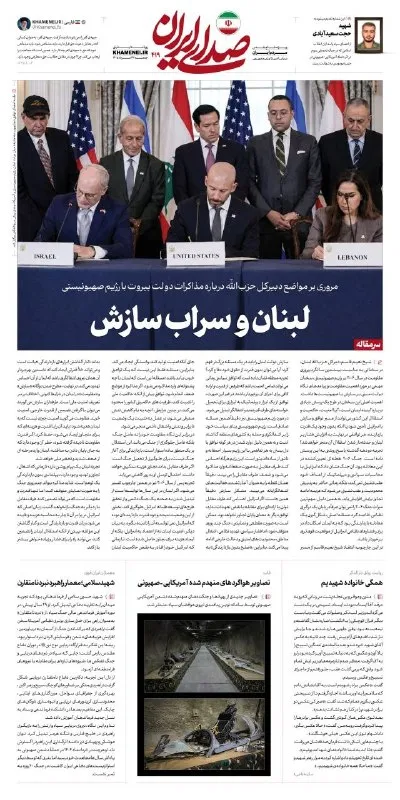
Bottom line: On the morning after Washington floated declaring the Strait of Hormuz ‘American territory’, the Iranian front pages closed ranks to assert full Iranian control of the waterway and to recast the war as an American economic and diplomatic defeat, while Lebanon returned to the front pages as Tehran quietly worked, and disciplined, a Beirut settlement its hardliners publicly deride as a mirage.
Executive Summary
The lead development of the 15 August edition is a coordinated hardening of the Strait of Hormuz file from a transit negotiation into a sovereignty contest. The trigger, carried on the wires this monitor watches, is a Trump remark that he would declare the strait ‘American territory’ once the war ends (a line the White House then characterized as a joke) and a parallel US claim that Hormuz traffic is normal. The English-facing state daily Iran Daily answered both directly on its centre front: ‘Iran rejects US claims of normal traffic in Strait of Hormuz, asserts full control.’ Nour News carried the Deputy Foreign Minister’s warning that ‘this waterway cannot be seized through military threats or political decree’. From the hardline side, Vatan-e Emrooz’s editorial ‘the memorandum of understanding is not enough’ argued that the ceasefire understanding does not by itself secure the strait, while Javan sequenced Tehran’s war aims through an attributed Vance quotation, ‘first the strait, then the nuclear file’. The strait is no longer being sold as a traffic scheme, as it was on 11 August, but as territory.
The most consequential shift beneath that frame is doctrinal. Iran Daily’s opinion column, the batch’s most deliberate foreign-facing statement, reads the Leader’s post-war military-security appointments as a move ‘toward offensive deterrence’, an explicit step beyond the defensive-deterrence language of previous cycles. It ties the doctrine to the reshuffle this monitor has tracked since 10 August: the appointments issued in the name of Ayatollah Seyyed Mojtaba Khamenei, with the IRGC commander Ahmad Vahidi now corroborated across three channels (Iran, Jam-e Jam, Defa Press) in a uniform victory register, ‘the most armed army in world history brought to its knees’. Sazandegi’s cross-check counts nine military-security figures in the decrees, larger than the ‘six commanders’ most titles printed on 11 August, indicating the appointment wave reached into the security ranks. The individual names below the IRGC-commander post appear only in a single channel preview and the Iran Daily column, are only partially consistent between them, and are recorded here as reported, not verified.
Lebanon returned to the front pages after its near-total absence on 11 August, and it returned as a contest inside the Iranian camp rather than a simple cheer. The principlist Sobh-e No led with an attributed Naim Qassem claim that ‘300,000 Lebanese returned to their homes after the Islamabad accord’, presenting the memorandum as already delivering, and ran a shaded note, ‘do not be more Hezbollahi than Hezbollah’, disciplining domestic hardliners tempted to reject any Beirut-Israel arrangement Hezbollah itself tolerates. The hardline Seda-ye Iran, closest to the Leader’s office, printed the counter-frame as its editorial, ‘Lebanon and the mirage of compromise’, over a photograph of an Israel-United States-Lebanon signing tableau, casting a negotiated settlement as a US-brokered trap. The kinetic file stayed live underneath: Kayhan reported six Lebanese killed in an Israeli strike at Ansariyeh and Jam-e Jam reported large explosions at al-Mansouri. The split, promote-the-dividend versus warn-of-the-mirage, is the edition’s clearest internal fault line and marks Tehran managing, not merely applauding, the Lebanese track.
The war’s American cost was worked hard across the aisle and largely in non-kinetic terms. The reformist Etemad led with ‘the hunting of America’s MQ-9s’, citing a Washington Post report attributed to US officials that Washington lost 45 Reaper drones, put at about a quarter of the fleet, an unusually hard war-metric for a reformist title to headline, and paired it with a self-aware editorial naming ‘the binary of siege and resistance at Hormuz’. The economic daily Ta’adol converted the war into a US balance-sheet problem, ‘a cost to the US economy beyond its military budget’, while its record-breaking bourse and Iran Daily’s OPEC-data note of oil output rising to 2.47 million barrels per day projected post-war normalization. Vatan-e Emrooz’s sidebar (‘the tired warships’, ‘America in the whirlpool of a war of attrition’, ‘Trump on Carter’s path’) and Kayhan’s items (a Jerusalem Post-attributed missile-rebuild boast, a decaying USS Abraham Lincoln) completed a uniform ‘Iran ascendant, America exhausted’ construction. Every one of these figures is a single-outlet or second-hand claim, logged behind the attribution firewall; their coordination, not their veracity, is the signal.
Domestically, a single controversy set the tone: a botched gasoline-pricing episode in Kerman, which Vatan-e Emrooz blamed on ‘rogue elements’ and Kayhan on ‘the missing prudence in fuel-consumption management’, with Sobh-e No and Jomhouri Eslami reassuring that any price increase is ‘ruled out’ and that there is ‘no resolution to change the gasoline price’. The hardline Chaharsoo turned the moment into a broader assault on the technocratic economic school, naming Masoud Nili and ‘currency shocks and price liberalization’, while First Vice-President Aref (in Jomhouri Eslami) held the executive’s unity line, ‘we no longer have time for internal quarrels’, and Foreign Minister Araghchi (in the government daily Iran) cooled expectations of near-term US talks, ‘no decision yet… the previous channels are no longer effective’. Net assessment: this is an escalation-of-framing edition, not of combat. No new battlefield event is confirmed on the fronts; instead Tehran raised the Hormuz stakes rhetorically from transit to sovereignty, hardened its declared doctrine to ‘offensive deterrence’ for foreign readers, and re-opened the Lebanon file as a settlement it is managing from both sides. The two threads to watch are whether the ‘offensive deterrence’ language is matched by any posture change rather than only opinion-column doctrine, and whether the promote-versus-reject split over the Lebanon accord resolves toward Tehran tolerating a Beirut deal or vetoing it.
Key Points
- KJ-1 [HIGH] Tehran has escalated the Strait of Hormuz from a transit negotiation to a sovereignty claim, in coordinated response to a US ‘American territory’ remark and a ‘normal traffic’ claim. Iran Daily asserted Iran holds ‘full control’ and rejected the normal-traffic claim; Nour News relayed the Deputy Foreign Minister that the strait ‘cannot be seized by threats or decree’; Vatan-e Emrooz editorialized that ‘the memorandum of understanding is not enough’; Javan sequenced war aims as ‘first the strait, then the nuclear file’. Significance: this is the edition’s dominant, cross-title frame and a rhetorical hardening of the standing Hormuz-leverage thread, though it is a claim about sovereignty and posture, not a documented operational change, and the triggering Trump remark was itself walked back as a joke.
- KJ-2 [MODERATE-HIGH] The regime’s foreign-facing message has shifted to an explicit ‘offensive deterrence’ doctrine tied to the post-succession command reshuffle. Iran Daily’s opinion column names the shift from defensive to offensive deterrence and links it to the Leader’s decrees; Vahidi as IRGC commander is corroborated across Iran, Jam-e Jam and Defa Press in a uniform victory register; Sazandegi counts nine appointees, up from six on 11 August. Significance: the appearance of ‘offensive deterrence’ language in the diplomat-facing English daily is a notable escalation of declared posture and continues the command-consolidation thread, but it currently rests on an opinion column and channel corroboration rather than any observed change in force posture.
- KJ-3 [MODERATE-HIGH] Lebanon has returned to the Iranian front pages as a contest Tehran is managing from both sides. Sobh-e No promoted an attributed Naim Qassem claim of ‘300,000 Lebanese returned after the Islamabad accord’ and disciplined hardliners (‘do not be more Hezbollahi than Hezbollah’); Seda-ye Iran countered with ‘Lebanon and the mirage of compromise’; Kayhan and Jam-e Jam reported Israeli strikes at Ansariyeh and al-Mansouri. Significance: the reversal of 11 August’s Lebanon silence, and the visible promote-versus-reject split, indicate Tehran is neither simply endorsing nor vetoing a Beirut-Israel settlement but positioning to shape it; the direction this split resolves is the thread to watch. The 300,000 figure is Qassem’s attributed claim, unverified.
- KJ-4 [MODERATE-HIGH] The Iranian press is intensifying a cross-factional construction of the war as an American economic and attritional defeat. Reformist Etemad headlined ‘45 lost US MQ-9s’ (Washington Post-attributed); economic Ta’adol framed the war as ‘a cost to the US economy beyond its military budget’ beside a record bourse; hardline Vatan-e Emrooz and Kayhan ran ‘tired warships’, ‘Trump on Carter’s path’, a decaying US carrier and a missile-rebuild boast. Significance: the convergence of reformist, economic and hardline titles on ‘Iran ascendant, America exhausted’ indicates centrally-congenial message discipline rather than organic agreement, and it carries the 11 August ‘post-war, US-as-demandeur’ thread forward; confidence attaches to the coordinated framing, not to the underlying single-outlet figures.
- KJ-5 [MODERATE] The executive is holding a managed, expectation-lowering line on the United States while the hardline lane presses economic delegitimation. Foreign Minister Araghchi (government daily Iran) said ‘no decision yet’ on resuming US talks and that ‘the previous channels are no longer effective’; First VP Aref urged ‘no time for internal quarrels’; Speaker Ghalibaf reasserted ‘the ruling is the ruling of the Leadership’. Against this, Chaharsoo assailed the technocratic economic school by name and the fuel-pricing scandal pressured the government’s competence. Significance: the gap between the administration’s cautious diplomacy and the fronts’ ‘US-is-the-demandeur’ triumphalism is a real internal tension worth tracking, as is the hardline shift of pressure onto economic legitimacy rather than the war’s terms.
- KJ-6 [MODERATE] Negative finding: this is an escalation of framing, not of confirmed events, and its loudest specifics are uncorroborated. No new battlefield action is verified on the fronts; the Hormuz ‘sovereignty’ contest rests on a walked-back Trump remark and Iranian rebuttals; the reshuffle names below the IRGC-commander post come from a single channel preview and a partially inconsistent opinion column; and the Qassem returnee figure, the 45 MQ-9s, the IRGC downed-aircraft display and the US-basing tallies are all single-source claims, with Tehran Times and khamenei.ir unavailable. Significance: the edition’s certainty about American defeat and Iranian control again runs ahead of its documentation, and the absence of any standalone Leader message on a mobilization-heavy day is itself a marker of a leadership still governing by decree and iconography rather than direct address.
Macro Trends
- From transit scheme to sovereignty contest at Hormuz. The strait, framed on 11 August as a transit negotiation, is now framed as contested sovereignty. Trump’s remark that he would declare Hormuz ‘American territory’ (walked back by the White House as a joke) and a US claim of ‘normal traffic’ were answered head-on: Iran Daily asserted Iran holds ‘full control’, Nour News relayed the Deputy Foreign Minister that the waterway ‘cannot be seized by threats or decree’, and Vatan-e Emrooz’s editorial insisted ‘the memorandum of understanding is not enough’. This is a rhetorical escalation of the standing Hormuz-as-leverage thread from a traffic arrangement to a territorial claim, even as no operational change is documented.
- An explicit turn to ‘offensive deterrence’. Iran Daily’s opinion column names a doctrinal shift from defensive toward ‘offensive deterrence’ and ties it to the Leader’s post-war military-security appointments, with IRGC commander Vahidi corroborated across three channels in a uniform ‘brought the world’s most armed army to its knees’ register. Sazandegi counts nine figures in the Leader’s decrees, up from the ‘six commanders’ of 11 August. This hardens the command-consolidation thread this monitor has tracked since the succession into a stated posture change, though for now it is doctrine on an opinion page rather than an observed deployment.
- Lebanon returns, as an intra-camp contest. After near-absence on 11 August, Lebanon is back across the batch, and split. Sobh-e No promotes an attributed Naim Qassem claim of ‘300,000 Lebanese returned after the Islamabad accord’ and cautions hardliners ‘do not be more Hezbollahi than Hezbollah’; Seda-ye Iran counters that a Beirut-Israel settlement is a ‘mirage of compromise’ and a US trap; Kayhan and Jam-e Jam keep the kinetic file live with strikes at Ansariyeh and al-Mansouri. The promote-versus-reject divide indicates Tehran is managing the Lebanese settlement from both sides, not simply endorsing or vetoing it.
- The war as America’s economic and attritional defeat. The American cost of the war was worked across the aisle in non-kinetic terms: Etemad’s Washington Post-sourced ‘45 lost MQ-9s’, Ta’adol’s ‘a cost to the US economy beyond its military budget’, Vatan-e Emrooz’s ‘tired warships’ and ‘Trump on Carter’s path’, Kayhan’s decaying USS Abraham Lincoln and missile-rebuild boast. Set against a record Iranian bourse and rising oil output, this is the 11 August ‘post-war, US-as-demandeur’ construction carried forward and intensified. The underlying figures are single-outlet or second-hand claims; the cross-factional coordination is the signal.
- A fuel-pricing scandal drives the domestic story. A mishandled gasoline-pricing episode in Kerman dominated the home front: Vatan-e Emrooz blamed ‘rogue elements’, Kayhan ‘the missing prudence in fuel-consumption management’, while Sobh-e No and Jomhouri Eslami reassured that a price rise is ‘ruled out’. Chaharsoo widened it into an attack on the technocratic ‘currency-shock and price-liberalization’ school (naming Masoud Nili), and Aref held the executive’s ‘no time for internal quarrels’ unity line. This continues the standing ‘unity above, delegitimation below’ fault line, now fought on fuel policy.
Front-Page Snapshot
- Iran Daily - “Iran rejects US claims of normal traffic in Strait of Hormuz, asserts full control” (State English-language) - Hormuz sovereignty rebuttal and an ‘offensive deterrence’ doctrine for foreign readers [HIGH]
- Vatan-e Emrooz - “The rogue elements are at work!” (Hardline / principlist) - Fuel scandal lead; ‘the MoU is not enough’, tired US warships, Trump-on-Carter’s-path in the sidebar [MODERATE-HIGH]
- Etemad - “The hunting of America’s MQ-9s” (Reformist) - Washington Post-sourced US drone attrition; the siege-vs-resistance Hormuz binary [MODERATE-HIGH]
- Seda-ye Iran - “Lebanon and the mirage of compromise” (Hardline (Leader’s office)) - Rejectionist framing of a Beirut-Israel settlement as a US trap; martyr memory-politics [MODERATE-HIGH]
- Sobh-e No - “300,000 Lebanese returned home after the Islamabad accord” (Principlist) - Lebanon accord dividend (Naim Qassem) and intra-camp discipline on the settlement [MODERATE-HIGH]
- Jam-e Jam - “Lavrov: America is far more deeply involved in Ukraine’s strikes on Russia” (State broadcaster (IRIB)) - US-overextension framing; Lebanon strikes at al-Mansouri; the Trump nuclear boast [MODERATE]
- Javan - “How every Iranian becomes a Basiji” (Hardline (IRGC)) - Basij mobilization doctrine; ‘first the strait, then the nuclear file’ war-aim sequencing [HIGH]
- Kayhan - “The missing prudence in fuel-consumption management” (Ultra-hardline flagship (channel)) - Fuel-management critique; velayat-e faqih editorial; ‘US-exhausted’ war items and Lebanese casualties [MODERATE-HIGH]
- Iran - “No decision yet to resume talks with America” (Official government daily (channel)) - Executive line on US talks (none yet); Canada-Hormuz sanctions; Vahidi victory message [MODERATE]
- Jomhouri Eslami - “We have no resolution to change the gasoline price” (Traditional / establishment) - Fuel-price denial and executive unity, over an IRGC air-defence trophy claim [MODERATE]
- Sazandegi - “The end of an era” (Reformist (Kargozaran)) - National mourning (the singer Iraj); reformist ‘exit from war’ argument; nine-figure reshuffle cross-check [LOW-MODERATE]
- Ta’adol - “The bourse breaks records over the holiday” (Economic / business) - War as a US economic burden; record bourse and fuel-subsidy economics [LOW-MODERATE]
- Chaharsoo - “The architect of the economic shocks” (Principlist / hardline) - Hardline economic-legitimacy assault on the technocratic government (naming Masoud Nili) [LOW]
Full report
The complete edition - per-paper front-page analysis and full translation appendices - is available as a PDF: Download the full report.
Compiled from Iranian front pages and outlet channels via open-source monitoring. Translations are editorial; named-figure attributions are verified against the source pages where possible.