Iranian Press Monitor - Sunday, 9 August 2026 (Day 159)
Sunday, 9 August 2026 · 18 Mordad 1405 · 25 Safar 1448 - 12 daily front pages surveyed: 9 Persian print titles and Iran Daily (English) read from scan, with Vatan-e Emrooz and Sobh-e No from their own channels; Jam-e Jam, Nour News, Fars and Defa Press monitored for corroboration
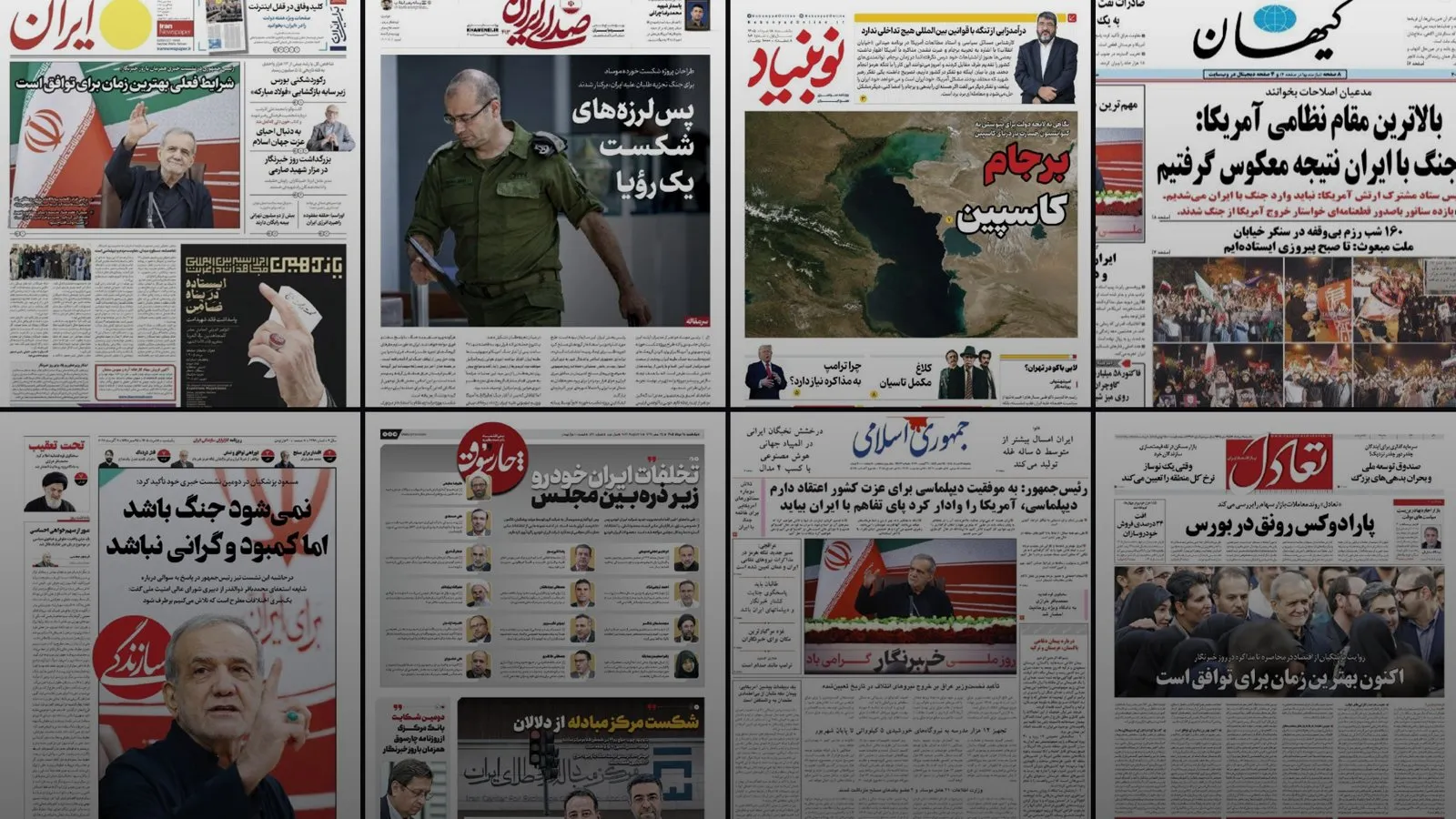
Bottom line: On the morning after Journalist Day the Iranian fronts stage a single unresolved argument: the president tells the country this is the best moment to close a Hormuz deal while his security-council secretary insists Iran will yield nothing in war or negotiation, and the flagship press works to make any settlement that resembles the pre-war normal politically unaffordable.
Executive Summary
The lead judgment of the 9 August edition is a contradiction the system is publishing openly. On one side, the president’s second press conference dominates the fronts with a pro-settlement message rendered in five registers: the government daily Iran (“the current conditions are the best time for an agreement”), the economic Ta’adol (“now is the best time”, read through “an economy under siege”), the clerical Jomhuri-e Eslami (“diplomacy forced America to come to an understanding with Iran”), the reformist Sazandegi (“you cannot have war yet no shortage and no inflation”) and the reformist Etemad (“the concern is the people’s livelihood”, in an atmosphere of “neither war nor peace”). On the other side, the principlist Sobh-e No carries Supreme National Security Council secretary Mohammad-Baqer Zolqadr’s red line: the strait stays closed “until America corrects its behaviour”, and the council “will not yield, whether in war or negotiation”. The negotiator says close it now; the security chief says concede nothing. Both lines ran on Iranian front pages on the same morning.
The press-conference cluster is not one message but a factional contest over how to sell the same negotiation. Iran and Ta’adol stake the deal as, respectively, a national achievement and an economic necessity; Jomhuri-e Eslami sells it as a diplomatic victory won by forcing Washington to the table, pairing that with hardline delegitimation (“Trump is like Saddam”); Sazandegi and Etemad, from the reformist lane, use the president’s own words to admit the war’s cost and to argue for interest over emotion. The register is the tell: the same event is achievement, necessity, victory or sober accounting depending on the masthead, which is the achievement-versus-surrender split this monitor has tracked since 6 August, now routed through a single presidential appearance.
Against the negotiators, the flagship hardline titles run a coordinated victory-and-vengeance construction. Kayhan leads with a claimed admission by “the highest US military authority” that Washington “got the reverse result from the war with Iran”, sources it to a CNN rendering rather than a direct statement, and stacks it with an “eleven senators” exit resolution, a claim that Saudi oil exports collapsed from nine million barrels a day to one million, and the front-page line “Iran has passed beyond survival and now seeks revenge”. Seda-ye Iran turns the single-sourced Mossad regime-change-failure story into a full-page thesis that Israel’s covert war has collapsed, anchored to a khamenei.ir martyr banner. Vatan-e Emrooz, from its channel, runs the mirror image: US leadership “seeking an escape route”. Three hardline mastheads converging on “the enemy is in retreat” on one morning reads as centrally-congenial message discipline rather than independent judgement, and its function is domestic: to make any Hormuz text resembling the pre-war normal look like surrender.
On Hormuz specifically, the file advanced in rhetoric and stalled in text. The maximalist read (Vatan-e Emrooz: Iran holds the geopolitical upper hand; the Jam-e Jam channel: an army spokesman calls Iran’s control “irreversible” and says America must accept the situation or pay “heavier costs”) sits against the measured read (Etemad: markets show only “temporary optimism” about a reopening on a still-unsigned Iran-Oman agreement) and the US-contingent read (Iran Daily, in English: “the Strait of Hormuz reopening hinges on US actions”). The Jam-e Jam channel additionally reports US Vice-President Vance describing efforts to build “a secure navigation system” with exports returning to pre-war levels, and Sobh-e No cites a University of Chicago analysis that US forces cannot force the strait open before the November elections. No jointly published Iran-Oman text, map or notice to mariners appeared in the window; “close it now” and “we will not yield” are both being asserted over an arrangement that is still unsigned.
Two secondary threads carry real weight. First, the economy: beneath the victory narrative the economic and reformist titles document strain the fronts otherwise avoid, from Ta’adol’s “paradox of a boom in the bourse” and 34-percent collapse in car sales, to Charsu’s “the Exchange Centre’s defeat by the brokers” and the Central Bank’s second lawsuit against the paper on Journalist Day, to Sazandegi letting the president concede that war means shortage and inflation. Second, a new dissent frame: No-Bonyad brands the government’s Caspian Sea legal-convention bill a “Caspian JCPOA”, extending the sovereignty-right’s surrender-charge from Hormuz to the northern waters while demanding transit tolls as sovereign revenue and naming the government the “unity-breaker”. The Mecca defence pact, dominant on 8 August, has receded to analysis and inside pages (Iran Daily treats it seriously as eroding trust in the US security role; Jomhuri-e Eslami and the Nour News wire now float Egypt joining, Iranian-press projection over a pact publicly signed only by Saudi Arabia, Turkey and Pakistan).
Net assessment: this is a contradiction-in-public edition. The system is simultaneously preaching cohesion (Sobh-e No’s “political solidarity in a difficult year”, Iran Daily’s “no interest above preserving unity”) and displaying its central fracture on the newsstand, with the president and the security-council secretary describing the same Hormuz endgame in opposite terms and the flagship press pricing any compromise as defeat. The reformist lane is answering with unusual candour, admitting the war’s economic cost and running an editorial explicitly against the vengeance register; the sovereignty right is opening a second front (the Caspian) even as it demands more on the first. The signals to watch are whether a joint Iran-Oman text actually publishes, whether Zolqadr’s “won’t yield” line or Pezeshkian’s “best time” line becomes the settled leadership position, and whether the “Caspian JCPOA” frame spreads from No-Bonyad to the flagship fronts.
Key Points
- KJ-1 [HIGH] The system is publishing its central fracture rather than concealing it. On the same morning the president tells the country “now is the best time for an agreement” (Iran, Ta’adol) while the security-council secretary declares Iran “will not yield, in war or negotiation” and keeps the strait closed “until America corrects its behaviour” (Sobh-e No, via Zolqadr). Significance: this is not spin variance but two incompatible leadership positions on the war’s endgame, printed side by side, and the president’s admission of “disagreements” at the council (Sazandegi) confirms the split is now acknowledged internally.
- KJ-2 [HIGH] The flagship hardline press is pricing any Hormuz compromise as defeat, using claims that are largely single-sourced or second-hand. Kayhan’s “reverse result” admission is its own CNN-sourced rendering, its “eleven senators” line reshapes a real war-powers fight, and its Saudi export-collapse figure is uncorroborated; Seda-ye Iran’s “failed dream” rests on the single-sourced Mossad story. Significance: the evidentiary weakness does not blunt the political function, which is to make a settlement resembling the pre-war normal domestically unaffordable, and the vengeance line (“Iran now seeks revenge”) shows the register is re-armed, not receding.
- KJ-3 [MODERATE-HIGH] Hormuz remains announced-but-not-sealed, and the rhetoric outran the paperwork this cycle. No jointly published Iran-Oman text, map or notice to mariners appeared in the window; what circulated was assertion (Iran’s control “irreversible”) on one side and hedge (“temporary optimism”, reopening “hinges on US actions”) on the other. Significance: “close it now” and “yield nothing” are both being argued over an arrangement that does not yet exist on paper, which is where the factional fight, not the negotiators’ progress, will decide the outcome.
- KJ-4 [MODERATE-HIGH] The president’s press conference is functioning as the pro-settlement camp’s main instrument, and it is being answered, not echoed. Six mastheads reshaped one appearance into achievement, necessity, victory, candour, livelihood and unity; the hardline fronts either minimized it (Kayhan reduced it to “livelihood”) or drowned it in victory framing. Significance: the executive is spending its own visibility to legitimize a deal, and the contest over the framing is the contest over whether the settlement can be sold at all.
- KJ-5 [MODERATE] A pragmatic counter-register is consolidating with unusual candour in the reformist and economic lanes. Sazandegi lets the president concede that war means shortage and inflation and runs Fereydoun Majlesi’s editorial against “emotional” vengeance politics; Etemad tags the Hormuz optimism “temporary”; Ta’adol and Charsu document a bourse paradox, collapsing car sales and an FX mechanism losing to speculators. Significance: a bloc arguing that the war must end and the economy be governed for it is speaking more plainly than in prior editions, though its purchase on the leadership decision is still unmeasured.
- KJ-6 [MODERATE] The sovereignty right is opening a second front while pressing the first. No-Bonyad’s “Caspian JCPOA” recasts a technical Caspian Sea convention as a fresh capitulation and adds a “Baku lobby” insinuation, even as it demands Hormuz transit tolls as lawful revenue and brands the government the “unity-breaker”. Significance: the camp most able to block a soft Hormuz text is broadening its surrender-narrative to a second dossier, a pattern to watch for migration onto the flagship fronts.
- KJ-7 [MODERATE] Negative finding: no verified Leader’s-office message and no independent confirmation of the day’s loudest external claims surfaced in the window. khamenei.ir was unreachable, so the office’s signal is inferred from a martyr banner and the vengeance register rather than a retrieved text; the Mossad-sackings story, the Saudi export collapse, the “reverse result” admission and Egypt’s Mecca-pact accession are all uncorroborated or projected. Significance: the edition’s triumphalism runs well ahead of its documentation, and the gap should temper any read of these items as events rather than messaging.
Macro Trends
- One press conference, six factional readings. The president’s second press conference is the day’s shared event, and every lane reshapes it: a national achievement (Iran), an economic necessity (Ta’adol), a diplomatic victory that “forced America to the table” (Jomhuri-e Eslami), a candid admission that war brings shortage and inflation (Sazandegi), a livelihood-first conversation in “neither war nor peace” (Etemad), and a unity appeal for foreign readers (Iran Daily). The uniform event and the divergent framings are the clearest available map of where each masthead stands on ending the war.
- Negotiate-now versus yield-nothing. The edition’s load-bearing contradiction is printed openly: the president’s “now is the best time for an agreement” against SNSC secretary Zolqadr’s “we will not yield, in war or negotiation; the strait stays closed until America corrects its behaviour” (Sobh-e No). Sazandegi’s reporting that the president admits “disagreements exist” at the security council, softening the prior “resignation refused” line, confirms the split is now acknowledged inside the system rather than denied. This continues, and sharpens, the achievement-versus-surrender thread carried since 6 August.
- The coordinated enemy-in-retreat register. Three hardline mastheads run the same storyline on one morning: America “got the reverse result” and its top general regrets the war (Kayhan), Israel’s covert war has “failed” and its architects are sacked (Seda-ye Iran), and US leadership is “seeking an escape route” (Vatan-e Emrooz). The convergence, plus a claimed Saudi export collapse and an “eleven senators” exit vote, indicates centrally-congenial message discipline; its purpose is to raise the domestic price of any Hormuz settlement that looks like the pre-war normal. Key items are single-sourced or second-hand and flagged as such.
- Hormuz: louder rhetoric, still-unsigned text. The maximalist read (Iran holds the upper hand; control is “irreversible”, per Vatan-e Emrooz and the Jam-e Jam channel) sits against the measured read (Etemad’s “temporary optimism” on an unsigned Iran-Oman agreement) and the US-contingent read (Iran Daily: reopening “hinges on US actions”). Reported US positions (Vance on a “secure navigation system”; a US-election-timing constraint cited via Sobh-e No) circulate as attributed claims. No joint text, map or notice to mariners appeared in the window: both “close it now” and “yield nothing” are being asserted over an arrangement that does not yet exist on paper.
- The economy the victory narrative omits. The economic and reformist titles document the strain the triumphalist fronts avoid: a “paradox of a boom in the bourse” and a 34-percent fall in car sales (Ta’adol), the official exchange centre’s “defeat by the brokers” and a second Central Bank lawsuit against a newspaper on Journalist Day (Charsu), the National Development Fund’s debt strain, and the president’s own concession that war means shortage and inflation (Sazandegi). Read together they form the pragmatic case that a settlement is required, not merely well-timed.
- A new surrender-frame: the “Caspian JCPOA”. No-Bonyad extends the sovereignty-right’s surrender-charge from Hormuz to the north, branding the government’s Caspian Sea legal-convention bill a “Caspian JCPOA” and insinuating a “Baku lobby” behind it, while separately demanding Hormuz transit tolls as lawful sovereign revenue and naming the government the “unity-breaker”. Meanwhile the Mecca pact recedes to analysis (Iran Daily) and to Iranian-press speculation about Egypt joining (Jomhuri-e Eslami, Nour News), a projection over a pact publicly signed only by Saudi Arabia, Turkey and Pakistan.
Front-Page Snapshot
- Kayhan - “The highest US military authority: We got the reverse result from the war with Iran” (Ultra-hardline flagship) - US “regret” and Iranian revenge [HIGH]
- Seda-ye Iran - “The aftershocks of a dream’s defeat” (Hardline, pro-Leader’s-office) - Israel’s failed covert war (single-sourced) [MODERATE-HIGH]
- Vatan-e Emrooz - “Seeking an escape route” (Hardline / principlist (channel)) - US “wants out”; Hormuz upper hand [MODERATE]
- Sobh-e No - “A narrative of political solidarity in a difficult year” (Principlist (channel)) - Unity plus Zolqadr’s “won’t yield” red line [MODERATE-HIGH]
- Iran - “The current conditions are the best time for an agreement” (Official government daily) - Deal timing as achievement [LOW-MODERATE]
- Jomhuri-e Eslami - “Diplomacy forced America to come to an understanding with Iran” (Clerical / traditional) - Diplomacy-as-victory; Trump-as-Saddam [LOW-MODERATE]
- Ta’adol - “Now is the best time for an agreement” (Economic / business) - Deal as economic necessity [LOW]
- Sazandegi - “You cannot have war yet no shortage and no inflation” (Reformist / Kargozaran) - War’s cost admitted; anti-vengeance [LOW-MODERATE]
- Etemad - “The concern is the people’s livelihood” (Reformist) - “Neither war nor peace”; temporary Hormuz optimism [LOW]
- No-Bonyad - “Caspian JCPOA” (Hardline-critical) - New surrender-frame; Hormuz tolls [MODERATE]
- Charsu - “Iran Khodro’s violations under the Majlis magnifying glass” (Economic) - FX dysfunction; press pressure [LOW]
- Iran Daily - “President: No interest above preserving unity, cohesion in current situation” (State English-language) - Unity; Hormuz hinges on US [LOW-MODERATE]
Full report
The complete edition - per-paper front-page analysis and full translation appendices - is available as a PDF: Download the full report.
Compiled from Iranian front pages and outlet channels via open-source monitoring. Translations are editorial; named-figure attributions are verified against the source pages where possible.