Iranian Press Monitor - Saturday, 8 August 2026 (Day 158)
Saturday, 8 August 2026 · 17 Mordad 1405 · 24 Safar 1448 - 16 front pages surveyed: 14 Persian print titles plus Al-Wifaq (Arabic) and Tehran Times (English)
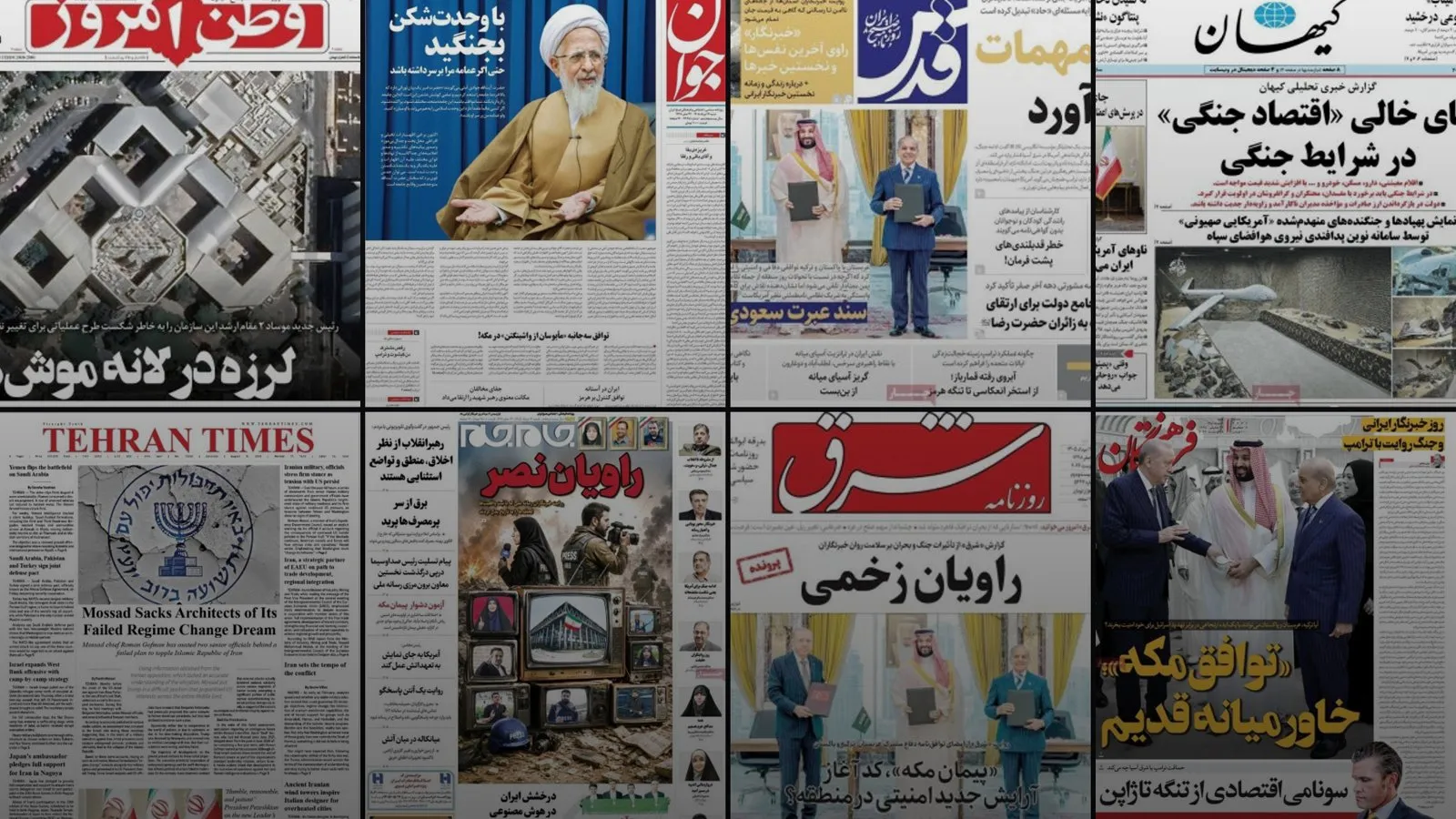
Bottom line: On the day Sunni powers formalized a hedge against both Iran and an unreliable Washington, Tehran’s press worked hard to make the hedge look weightless while the leadership quietly braced its own ranks for a Hormuz compromise it has not yet admitted it is making: the external confidence and the internal caution are the same story told from two directions.
Executive Summary
The 8 August front pages carry two stories at once. One is loud and external: the Mecca Joint Defence Agreement that Saudi Arabia, Turkey and Pakistan signed the previous day, committing in public to treat an armed attack on one as an attack on all. The other is quieter and internal: a system working to hold itself together on the eve of a Hormuz arrangement that its own hardliners read as surrender. The press meets the pact with a studied contempt that does not quite cover the unease beneath it: Vatan-e Emrooz reduces it to “Paper Coalition!”; Javan brands the signatories as men “who despair of Washington”; Shariatmadari’s Kayhan column mocks Shehbaz Sharif for lavishing praise on Trump while signing a pact that, in his telling, exists to shield American and Israeli interests. Only Shargh (a possible new regional security architecture) and Farhikhtegan (the old Middle East reassembling around a reactionary idea) treat it as an event worth analyzing. The dismissive chorus is worth reading as a tell: when eight of sixteen fronts spend their energy explaining why an agreement does not matter, the agreement has landed.
Tehran’s counter-frame runs on three claims: the pact is hollow because it published no command structure or force commitment; it is illegitimate because its members stayed silent on Gaza; and it is unreliable because large parts of the Turkish and Pakistani officer corps supposedly sympathize with Iran and the Axis, an assertion no outlet substantiates. The pact is not yet an operational alliance, but it is a structural response to doubts about American guarantees and to the demonstrated Iranian ability to threaten Gulf energy from several directions at once. Its danger to Tehran is not this week’s combat power; it is the platform it creates for joint air defence, maritime patrol and defence-industrial work over the coming years.
Beneath the external story, the papers show a leadership managing its own cohesion. Ayatollah Javadi Amoli’s appeal runs across Javan, Hamshahri and, in softer form, Jomhuri-e Eslami: fight the divider, he says, even if the man wears my own turban, a senior marja’s warning against the factional splintering the Hormuz question has exposed. Pezeshkian, in the third instalment of his televised conversation with the public, promises to defend the Oman memorandum “with power” and insists reform will not stop; No-Bonyad answers that his was a “performance report without a single statistic.” Sazandegi reports that the president has refused the resignation of Mohammad-Baqer Zolqadr, keeping a hardline hand on the Supreme National Security Council. The public performance of unity sits directly on an unresolved argument about whether the coming Hormuz deal is a national achievement or a capitulation dressed as one.
The Hormuz file itself advanced and did not close. Iran and Oman have converged on a traffic-management formula, with inbound vessels routed through Iranian-side waters and outbound traffic on the Omani side, but no jointly published text, map or notice to mariners existed in the window. Washington’s position hardened into conditional reciprocity: a US official told Reuters that once an arrangement restores commercial shipping “without impediments,” the United States will lift its blockade of Iranian ports, and not before. The unresolved fault lines are the ones that matter: Iran has floated transit-related service charges reported at 5 to 7 percent of cargo value, which Oman wants lower and Washington rejects as a toll; Reuters counted only 33 vessels crossing Hormuz Monday through Thursday against roughly 130 to 140 in a normal pre-war week; and oil eased as traders priced in a settlement (all figures as reported, unverified here). None of that is normalization: it is a negotiation that is advanced, coerced and unfinished. Running under it is the register of victory: Quds leads with “America ran short of munitions,” Hamshahri reports “the Pentagon’s big secret leaked,” Tehran Times and Vatan-e Emrooz carry the single-sourced claim that Mossad’s new chief sacked the architects of a failed regime-change plan, and from the Leader’s office comes an hourglass draining blood over pictures of Trump, captioned “the reverse countdown of revenge.” Because 8 August is Iranian Journalist Day, the state papers fold the press into the same story: Jam-e Jam’s “Narrators of Victory,” Shargh’s answering “Wounded Narrators,” the war correspondent inducted into the martyr-canon.
Net assessment: this is a dismissal-as-confession edition. The triumphalism is not decoration: it raises the domestic price of any Hormuz text that can be read as a return to the status quo ante, and it keeps maximalism and victory speaking with one voice, most explicitly in Aarabi’s Kayhan column demanding tolls now and strikes on host-state facilities in place of “a few pieces of paper.” Against that, a pragmatic counter-narrative is forming in the reformist lane (Etemad’s currency-crisis warning, No-Bonyad’s question asked from the opposite direction), and the sharpest internal dissent comes from Kayhan’s own economic desk, which accuses the government of running a peacetime economy in wartime. The signals to watch are whether a joint Iran-Oman text actually publishes, whether the IRGC camp’s sovereignty bar migrates from No-Bonyad to the flagship fronts, and whether the vengeance register escalates if the sign-off stalls.
Key Points
- KJ-1 [HIGH] The Mecca pact is the window’s most consequential development, and the dismissals prove it. Saudi Arabia, Turkey and Pakistan committed in public to treat an armed attack on one as an attack on all; the Iranian answer arrived as ridicule rather than analysis: a “paper coalition,” a club of the disappointed, a Sunni bloc whose soldiers secretly favour the Resistance. Significance: ridicule on this scale, across this many mastheads, is what a serious strategic surprise looks like when a press system has decided in advance how it must feel about it.
- KJ-2 [MODERATE-HIGH] The pact is not yet an alliance, but its trajectory is what should worry Tehran. The public text disclosed no standing command, force package, basing rights or nuclear umbrella, and Turkish and Saudi officials stressed its defensive, non-sectarian character; its weight today is political and deterrent. Significance: the consequential horizon is longer: a framework that could acquire integrated missile defence, maritime patrol, intelligence sharing and joint production, steadily reducing Iran’s ability to pick off Gulf states one bilateral vulnerability at a time.
- KJ-3 [HIGH] Hormuz is close to an arrangement but was unsigned in the window, and that gap is analytically load-bearing. The Iran-Oman formula is real, yet no joint text, navigational map or binding notice to mariners had appeared; Washington’s line is sequenced and conditional: restore unimpeded commercial shipping first, lift the blockade second, with every US step tied to observed Iranian performance. Significance: “deal expected soon” is not an implemented reopening; this extends the announced-but-not-sealed judgment carried from the 6 August edition.
- KJ-4 [MODERATE-HIGH] The IRGC remains the internal brake on a rapid settlement. Mediator reporting has the Guard-linked camp holding out for firmer recognition of Iranian control, transit fees, sanctions relief and removal of the US naval blockade before the draft clears the Supreme National Security Council; no standalone IRGC endorsement of the emerging text surfaced in the window, a negative finding recorded as such. Significance: the Guard’s posture, and not the negotiators’ progress, remains the decisive variable in whether the announced arrangement becomes an operative one.
- KJ-5 [MODERATE-HIGH] The leadership is visibly bracing its own ranks for a compromise it has not yet named. Javadi Amoli’s warning against “dividers,” the refusal of Zolqadr’s SNSC resignation and Pezeshkian’s pledge to defend the memorandum “with power” are three moves in a single effort: keeping the hardline and pragmatic wings inside the tent through a decision each distrusts. Significance: elite-unity messaging at this volume usually precedes a contested choice, not a settled one.
- KJ-6 [MODERATE] Victory framing and Hormuz maximalism are the same message aimed at the same audience. The munitions-depletion story, the Mossad-failure story and the Leader’s office “reverse countdown of revenge” all raise the political cost, at home, of any strait arrangement that looks like the pre-war normal; Aarabi’s Kayhan column makes the link explicit, cataloguing claimed Trump climbdowns as proof that Iran can now dictate terms and should start charging tolls at once rather than sign “a few pieces of paper.” Significance: the vengeance register that had receded from the fronts on 6 August has been re-armed through the Leader’s office imagery, and it is now working in tandem with the anti-memorandum camp.
- KJ-7 [MODERATE] A cautious pragmatic counter-narrative is forming in the reformist press. No-Bonyad asks whether the deal is a “temporary agreement or a gradual surrender”; Etemad warns that a strait left closed turns an energy crisis into a global currency crisis and casts Iran as the “architect of a new Hormuz order” that still needs a functioning economy behind it; Sazandegi’s “economy of fear” registers the same constituency. Significance: a bloc is consolidating that wants the war ended and the corridor opened, and is willing to call an over-sold victory by its name; its purchase on the sign-off is unmeasured, so the judgment is held at moderate.
Macro Trends
- The Mecca pact and the manufacture of weightlessness. The organizing task across most of the fronts is to make a real event feel like nothing: “paper coalition,” “Islamic NATO” as a sneer, “a Saudi cautionary document,” a trilateral of those who “despair of Washington.” The argument has three moves, each with its own weakness: the pact is hollow because it named no command or forces (true today, silent about tomorrow); illegitimate because its members abandoned Gaza (a moral charge, not a strategic rebuttal); and doomed because the Pakistani and Turkish rank and file allegedly love the Resistance (asserted, never substantiated). The intensity of the dismissal is the real signal: a bloc that mattered less would have earned less front-page space.
- Hormuz: achievement or surrender. The same underlying event, an Iran-Oman route arrangement edging toward announcement, splits the press along the system’s main fault line. Jomhuri-e Eslami frames a framework Iran is finalizing on its own terms; Javan puts Iran “on the threshold of a Hormuz-control agreement”; against them No-Bonyad asks whether “temporary” is a euphemism for “gradual surrender” and reframes the question from lane coordinates to the degree of sovereignty Iran actually exercises; Etemad occupies the middle, crediting Iran as the strait’s new architect while warning that leaving it closed boomerangs into a currency crisis at home. The disagreement is not about facts on the water: it is a proxy for the factional contest over the war’s endgame, continuing the announced-but-not-sealed thread this monitor has tracked since 6 August.
- Cohesion under strain. Three items that look unrelated point the same way: a marja tells the public to fight “dividers” even at his own expense; a president refuses to let his security-council secretary resign; a head of state promises to defend a contested memorandum “with power” while a critic dismisses his account as statistics-free. Read together, they describe a leadership spending political capital to keep its wings aligned through a decision that could fracture them. The Zolqadr story matters most as a marker: keeping a hardline security figure in place is a concession to the camp most likely to reject a soft Hormuz text, and a hedge by a president who needs that camp’s acquiescence.
- The economy the victory narrative does not mention. Kayhan’s own economic desk supplies the sharpest dissent on any front page, and it comes from the right, not the reformists: the 14th government is behaving as though conditions were normal, freeing exports of sugar, eggs and chicken while a naval blockade holds (“exporting from the people’s table”), with 111 billion euros of export earnings unreturned and price shocks traced to the abrupt removal of preferential foreign exchange (the paper’s figures, unverified). The demand is a “war footing”: halt essential-goods exports, force repatriation, prosecute profiteers. That a flagship hardline paper is this scathing about economic management, on a day the rest of the press celebrates military victory, is the most revealing internal signal in the file.
- The martyr-press and Journalist Day. Because the survey falls on Iranian Journalist Day, the war correspondent is folded into the martyr-canon across the state titles: Jam-e Jam’s “Narrators of Victory” and Shargh’s “Wounded Narrators” frame the same figure from opposite moods, one triumphal and one traumatized, with Quds, Iran and Jahan-e Sanat running the theme. The subtext is a claim on the war’s meaning: the press did not merely report the fight, it fought it, and its dead belong beside the military’s. Jahan-e Sanat’s counterpoint, journalism in the age of high prices, quietly reads the same day through economic hardship rather than glory.
- The triumphalist register and its purpose. Munitions depletion, Mossad’s claimed regime-change failure, US warships that “fear approaching,” and the Leader’s office blood-hourglass all serve a single domestic function: they convert the war’s ambiguous outcome into a settled victory and make any Hormuz text that resembles the old normal politically expensive to sign. The claims travel from the hardline core outward: Kayhan asserts the Pentagon depletion is “real” and stages photographs of downed drones, Aarabi builds the TACO chronology of claimed Trump climbdowns, and the wire of it reaches even the reformist mastheads as ambient background. Victory is being locked in as a premise so that the negotiation cannot be judged against it.
Front-Page Snapshot
- Vatan-e Emrooz - “Tremor in the rats’ nest; Paper Coalition!” (Hardline / principlist) - Mossad-failure claim; Mecca pact dismissed [HIGH]
- Javan - “Fight the divider even if he wears my turban (Javadi Amoli)” (Hardline / IRGC-affiliated) - Clerical unity appeal; Hormuz maximalism [MODERATE-HIGH]
- Quds - “America ran short of munitions” (Hardline religious (Mashhad)) - US munitions depletion; pact as weakness [MODERATE-HIGH]
- Kayhan - “The empty place of a war economy in wartime conditions” (Ultra-hardline flagship) - War-economy indictment; escalation advocacy [HIGH]
- Tehran Times - “Mossad sacks architects of its failed regime-change dream” (State (English)) - Mossad claim for foreign readers; tempo framing [MODERATE]
- Jam-e Jam - “Narrators of Victory (Journalist Day)” (State broadcaster (IRIB)) - Journalist Day martyr-canon; hedged pact test [MODERATE]
- Shargh - “The Mecca Pact: code for a new security order in the region?” (Reformist) - Pact as new security order; wounded narrators [LOW-MODERATE]
- Farhikhtegan - “The Mecca Agreement? The old Middle East” (Principlist-intellectual) - Pact as reactionary relic; Hormuz leverage [MODERATE]
- Jomhuri-e Eslami - “We defend the memorandum with power (Pezeshkian)” (Clerical / traditional) - Memorandum defended; Oman framework near [LOW-MODERATE]
- No-Bonyad - “A temporary agreement, or a gradual surrender?” (Hardline-critical) - Hormuz deal as possible surrender [MODERATE-HIGH]
- Etemad - “Reforms will not stop; Iran, architect of the new Hormuz order” (Reformist) - Reform continuity; currency-crisis warning [LOW-MODERATE]
- Iran - “I stand and speak to the people against the sabotage (Pezeshkian)” (State / government) - Presidential dialogue; memorandum as pride [LOW-MODERATE]
- Al-Wifaq - “Relations with neighbours are far better than before (Pezeshkian)” (State (Arabic)) - Neighbourhood reassurance; resilience claim [LOW]
- Hamshahri - “Completing the corridors is more essential than bread (Pezeshkian)” (Municipal / conservative) - Corridors over bread; depletion echo [MODERATE]
- Sazandegi - “Still the Secretary (Zolqadr’s resignation refused)” (Reformist / Kargozaran) - Zolqadr kept at SNSC; elite cohesion [LOW-MODERATE]
- Jahan-e Sanat - “Journalism in the age of high prices; Military coalition in Mecca” (Economic / centrist) - Journalist Day as economic hardship [LOW]
Full report
The complete edition - per-paper front-page analysis and full translation appendices - is available as a PDF: Download the full report.
Compiled from Iranian front pages and outlet channels via open-source monitoring. Translations are editorial; named-figure attributions are verified against the source pages where possible.