Iranian Press Monitor - Monday, 3 August 2026 (Day 153)
Monday, 3 August 2026 · 12 Mordad 1405 · 19 Safar 1448 - Front pages published the morning of 3 August 2026, reflecting events through late 2 August local. Coverage: 20 front pages (18 Persian dailies plus the English-language Tehran Times and Kayhan International).
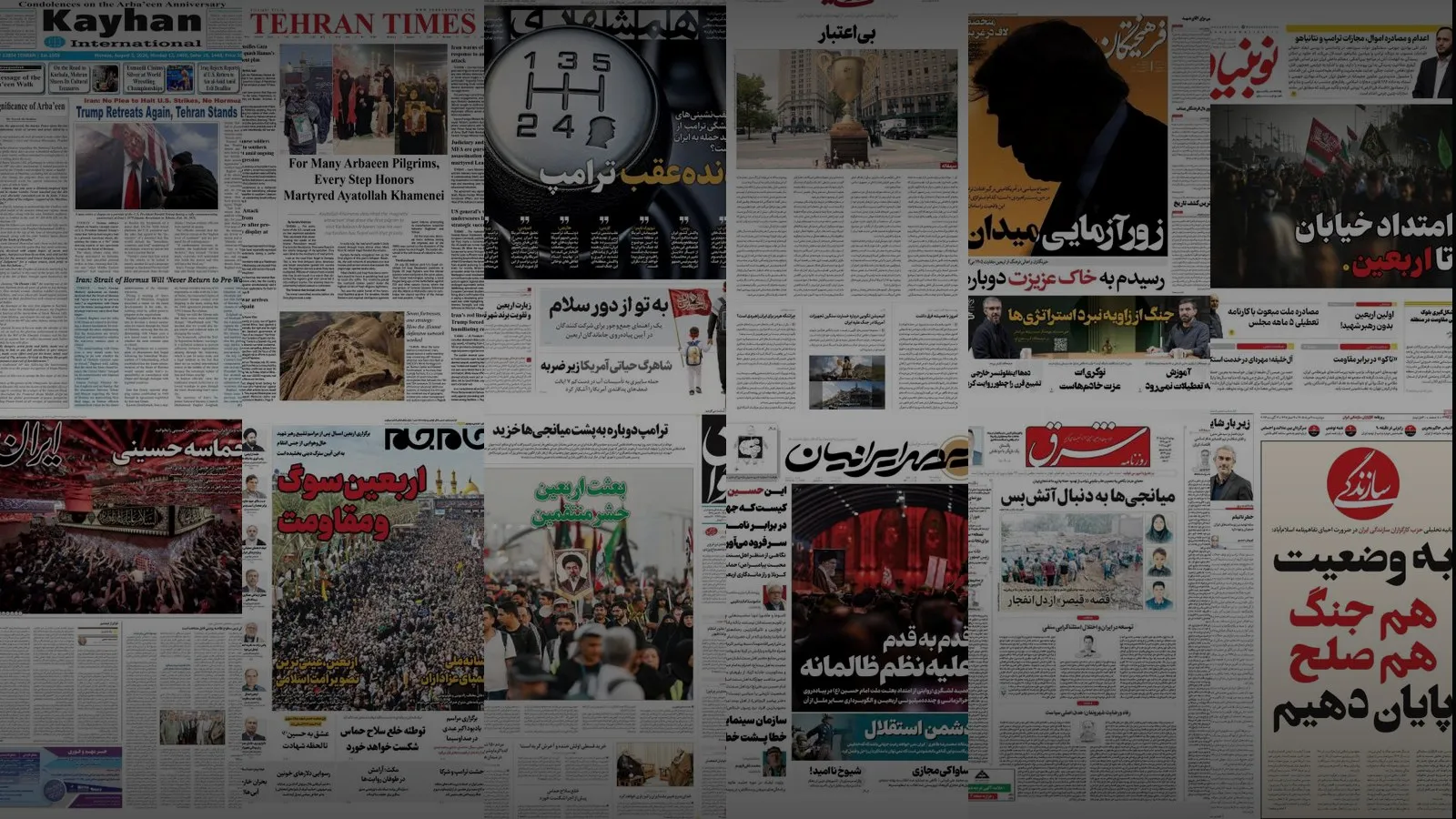
Bottom line: Day 153 is organized around a claimed American climb-down rather than an Iranian action: across factional lines the fronts converge on Trump having retreated from a threatened strike, reframe it almost uniformly as a serial, repeatable retreat that proves structural American weakness, harden the Strait of Hormuz “never return to its pre-war state” line into doctrinal policy language deliberately incompatible with Washington’s reopening demand, and fuse Arba’een, marked for the first time since the martyred Leader’s death, to his cult as a rehearsal for vengeance, while a reformist and economic counter-lane presses for an exit from the both-war-and-peace limbo.
Executive Summary
The lead judgment of Day 153 is that the edition is built on a claimed adversary climb-down, not an Iranian action. The assessed picture is that the pause was over-determined. President Trump moved from a maximalist threat of force to a flexible negotiating posture: he said talks with Iran would take place on Monday, declined to set a deadline, and stated he preferred a deal because military action kills people. Iranian officials and state-aligned media converted that reversal into evidence that coercive resistance and Hormuz leverage had forced Washington to back down. The analytic caution is structural: reporting attributes the cancellation to Gulf pressure from Saudi Arabia, Qatar and the United Arab Emirates, to US cost-and-risk calculus, and to an available diplomatic track, with the strike option retained rather than abandoned, so the retreat reading functions as a vindication frame every faction can claim rather than as an established de-escalation.
The serial-retreat frame is the organizing device, applied with near-identical wording across otherwise competitive titles: Etemad’s “tenth retreat”, Hamshahri’s “Trump in reverse gear”, Quds’s “new episode of the threat-and-retreat serial”, Kayhan’s “Trump took back his gross blunder”, and No-Bonyad’s “TACO”. Near-identical framing across factional lines indicates centrally-guided message discipline rather than organic editorial convergence, converting a single event into a claim about structural American weakness. The device is documented here strictly for defensive assessment; nothing in it is adopted as fact.
Beneath the triumph, the Hormuz coercion doctrine hardens into policy language. Foreign Ministry spokesman Esmail Baghaei insists the Strait will never return to its pre-war state and denies that Iran requested any pause; Kazem Gharibabadi reasserts permanent Iranian control over Strait shipping; both reframe final-stage transit talks with Oman as institutionalizing a post-war maritime order under Iranian supervision, distinct from Washington’s demand for immediate, complete and total reopening. Supreme National Security Council secretary Mohammad Bagher Zolghadr’s warning that a continued blockade would widen closures beyond Hormuz extends the doctrine to Bab el-Mandeb. The chokepoint-as-coercion thread this monitor has tracked across editions is now expressed as doctrine, leaving the maritime file, not the nuclear file, as the near-term point of rupture or ambiguous compromise.
Arba’een, held for the first time since the martyred Leader’s death, is fused to his cult and a vengeance register. The state broadcaster Jam-e Jam and the IRGC-affiliated Javan code the pilgrimage as a rehearsal for retribution and a drill for the promised deliverer, binding sacral mobilization to the deterrence posture and to the assassination-case memorandum between the Judiciary and the Foreign Ministry. The Leader, Mojtaba Khamenei, conveyed a message of appreciation to the Arba’een servants at the Shalamcheh border with Iraq. The government daily Iran keeps a quieter, governance-tilted version centered on service delivery and Pezeshkian’s remedy for weak performance.
Against the triumphalism, a reformist and technocratic counter-lane contests the victory narrative, and the economic register surfaces the war’s bill. Sazandegi’s named party statement against the both-war-and-peace limbo urges reviving the Islamabad framework; Etemad reads an internal US rift; Shargh frames mediation. Donya-e Eqtesad and Taadol read the standoff through logistics disruption, gold and fuel pricing and pension erosion, and even the hardline Quds links the port blockade to tea-price inflation, an early sign of economic strain entering the sacral-military frame.
Net assessment: this is a claimed-climb-down edition, defined less by any battlefield event than by an adversary-retreat narrative the whole press amplifies and by the fusion of Arba’een mobilization to the deterrence posture. The offensive register is real in rhetoric but unconfirmed in action: no new US strike inside Iran was confirmed during the reporting window, Hormuz had not reopened on Washington’s terms, and no signed agreement, verified maritime reopening or nuclear settlement existed at the cut-off. The highest-significance finding is the hardening of the Hormuz never-return line into a load-bearing, deliberately incompatible negotiating position; the signals to watch are whether Monday’s talks convene and their participants are named, whether Iran describes any Hormuz arrangement as reopening or as a new regulated route, and whether the reformist exit-from-limbo argument gains ground.
Key Points
- KJ-1 [HIGH] The front-page consensus is a coordinated retreat-under-pressure narrative, not a neutral account of events. The uniformity of the serial-retreat framing across otherwise competitive titles (tenth retreat, reverse gear, threat-and-retreat serial, TACO) indicates message discipline around a single theme: that Iranian endurance and Hormuz leverage repeatedly deter Washington. Significance: the narrative is a deterrence instrument aimed at regional audiences and should be read as information operation as much as commentary; the calibration is bidirectional, since the pause was real, and the cue is whether any American action, not statement, confirms a stand-down.
- KJ-2 [HIGH] The Hormuz never-return-to-pre-war line is now the load-bearing doctrinal claim, and it is deliberately incompatible with the US reopening demand. Baghaei and Gharibabadi convert a maritime deconfliction talk with Oman into a sovereignty claim; the wording preserves an Iranian supervisory role that Washington’s demand for immediate, complete and total reopening cannot accept. Significance: the maritime file, not the nuclear file, is the near-term point of rupture or ambiguous compromise, and ambiguous terminology may enable an interim deal while creating substantial enforcement risk.
- KJ-3 [MODERATE-HIGH] The cancellation was over-determined; the resistance-victory reading is only one input. Gulf pressure from Saudi Arabia, Qatar and the United Arab Emirates, US cost-and-risk calculus, and an available diplomatic track jointly explain the pause; Iranian pressure was a contributor, not the sole cause. Significance: over-crediting deterrence risks Iranian miscalculation if Tehran assumes each future threat will similarly collapse.
- KJ-4 [HIGH] Arba’een has been operationalized as a mobilization and vengeance frame tied to the martyred Leader. The state broadcaster and IRGC titles explicitly cast the pilgrimage as a rehearsal for retribution, and the state links sacral turnout to the deterrence posture and to the assassination-case memorandum. Significance: expect continued fusion of religious commemoration with escalation-signaling through the mourning period.
- KJ-5 [MODERATE] A credible domestic counter-narrative is consolidating around the both-war-and-peace critique. Sazandegi’s named party statement, together with Etemad and Shargh, argues the limbo endangers infrastructure and the economy and urges reviving the Islamabad framework. Significance: a reformist-technocratic coalition is positioning diplomacy as the responsible exit, creating an internal contest over the war’s political meaning; the cue is whether any principlist title concedes reciprocal terms.
- KJ-6 [MODERATE] Economic strain is beginning to surface even on hardline pages. The port blockade is now linked to consumer prices such as tea and fuel, and the business dailies foreground logistics disruption, gold and Bitcoin volatility, OPEC+ signaling and household costs. Significance: the durability of the triumphalist frame depends on containing visible economic pain.
- KJ-7 [MODERATE] Negative evidence: no fresh formal Iranian escalation on Lebanon, and no new confirmed Houthi or Iraqi-militia attack, was identified inside the reporting window. No new Foreign Ministry, IRGC or Leader statement on Lebanon and no confirmed Hezbollah action appeared, and the pause across the Axis is consistent with preserving negotiating space before the expected Monday talks. Significance: this is best read as tactical restraint rather than demobilization, since Tehran retains these actors as deniable pressure if talks fail; the cue is whether attacks resume to influence the negotiations.
Macro Trends
- The serial retreat as the organizing frame. Nearly every hardline and state front page converts the cancelled strike into a numbered, repeatable pattern: the tenth retreat, reverse gear, the new episode of a serial, TACO. The device transforms a single event into a claim about structural American weakness and Iranian deterrence, and it is applied even by titles whose analysis otherwise diverges, the signature of centrally-guided message discipline.
- The Hormuz coercion doctrine hardens into policy language. Baghaei’s never-return-to-the-pre-war-state and Gharibabadi’s permanent-Iranian-control reframe the final-stage Oman transit talks as institutionalizing a post-war maritime order under Iranian supervision, distinct from Washington’s demand for unconditional reopening. Zolghadr’s warning that a continued blockade would widen closures beyond Hormuz extends the doctrine to Bab el-Mandeb and other chokepoints, documented for defensive assessment; the tracking cues remain shipping, insurance and transit data rather than the front-page declarations.
- Arba’een fused with the martyred Leader’s cult and a vengeance register. The state broadcaster and IRGC titles code the pilgrimage as a rehearsal for retribution and a drill for the promised deliverer, binding sacral mobilization to the deterrence posture and to the assassination-case memorandum. The government daily keeps a quieter, governance-tilted version centered on service delivery.
- Western and pan-Arab outlets marshaled as external corroboration. Hamshahri, Kayhan, Asr-e Iranian and the English titles stack CNN, Reuters, the New York Times, the Financial Times, the Guardian, Haaretz, Al-Mayadeen, the Wall Street Journal and the Economist to source the American-defeat verdict outward, while accompanying poll figures (opposition of sixty-four to seventy-six percent) and war-cost figures (one hundred billion to one trillion dollars) remain unverified and are carried strictly as the outlets’ own claims.
- A reformist and technocratic counter-lane contests the victory narrative, and the mediation architecture shows beneath it. Sazandegi’s party statement, Etemad’s internal-US-rift read and Shargh’s mediation frame argue for reviving the Islamabad framework and foreground infrastructure risk over triumph, while Jomhuri-ye Eslami’s lead on Araghchi’s calls to Turkey, Saudi Arabia and Pakistan, and Javan’s “Trump hides behind mediators”, concede the very Gulf and Islamabad channel that the assessment identifies as the actual driver of de-escalation.
- The economic register surfaces the war’s real bill. Donya-e Eqtesad and Taadol read the standoff through logistics disruption, gold and Bitcoin volatility, OPEC+ signaling, fuel pricing and pension erosion, and even the hardline Quds links the port blockade to tea-price inflation, an early sign of strain entering the sacral-military frame; the durability of the triumphalist line depends on containing that visible pain.
Front-Page Snapshot
- Kayhan - “Neither Hormuz nor Bab al-Mandab opened: Trump took back his gross blunder / Iran’s power answered” (Ultra-hardline flagship, editor Hossein Shariatmadari) - Retreat framing and the Hormuz never-return doctrine [HIGH]
- Kayhan International - “Trump Retreats Again, Tehran Stands Ready / No plea, no Hormuz deal” (English-language state-aligned daily) - Outward-facing retreat and Hormuz doctrine [HIGH]
- Tehran Times - “Iran’s red line holds: Trump forced into humiliating retreat / Every step honors the martyred Leader” (English-language state-aligned daily) - Retreat fused to Arba’een and the Leader’s cult [MODERATE-HIGH]
- Javan - “The resurrection of Arba’een, the gathering of the avengers / Trump hides behind mediators” (Hardline, IRGC-affiliated) - Eschatological mobilization and vengeance register [HIGH]
- Jam-e Jam - “Arba’een of mourning and resistance: an atmosphere of vengeance” (State broadcaster daily) - Arba’een coded as a rehearsal for vengeance [MODERATE-HIGH]
- No-Bonyad - “The street’s extension all the way to Arba’een / Execution as the penalty for Trump and Netanyahu” (Hardline) - Punitive-legal framing and Arba’een mobilization [HIGH]
- Hamshahri - “Trump in reverse gear: the secret of his perpetual retreats” (Conservative, Tehran municipality) - Retreat spectacle [MODERATE]
- Quds - “The new episode of the threat-and-retreat serial / An Arba’een with the martyred Leader” (Conservative) - Serial-retreat frame and Arba’een [MODERATE]
- Farhikhtegan - “Trial of strength in the field: Trump trapped in a strategic impasse” (Principlist) - Strategic-impasse frame [MODERATE]
- Watan-e Emruz - “War Frustration: polls of intensifying opposition among Trump’s own base” (Hardline) - Retreat read through US domestic politics [MODERATE]
- Iran - “The Husseini epic / Pezeshkian on remedying weak performance” (Official government daily) - Arba’een governance and service-delivery message [LOW-MODERATE]
- Jomhuri-ye Eslami - “Turkey, Pakistan and the Arab states consult to reduce regional tension” (Traditional conservative / establishment) - Regional mediation [LOW-MODERATE]
- Etemad - “The tenth retreat: a rift inside America’s structure” (Reformist) - Internal-US-rift counter-read [LOW-MODERATE]
- Sazandegi - “Let us end the both-war-and-peace state: revive the Islamabad Memorandum” (Reformist / technocratic) - Diplomatic counter-doctrine [LOW-MODERATE]
- Donya-e Eqtesad - “The test of economic governance: openings without reform” (Economic, pro-market) - The war’s economic bill [LOW-MODERATE]
Compiled from Iranian front pages and outlet channels via open-source monitoring. Hostile content is documented for defensive assessment only; nothing herein endorses or amplifies it. Translations are editorial; named-figure attributions are verified against the source pages where possible. Iranian military, casualty and battle-damage claims, and the poll and cost figures cited above, are carried strictly as the originating outlets’ own claims and are not to be reproduced as verified fact without primary-source confirmation.