Iranian Press Monitor - Sunday, 2 August 2026 (Day 152)
Sunday, 2 August 2026 · 11 Mordad 1405 · 18 Safar 1448 - Front pages published the morning of 2 August 2026, reflecting events through late 1 August local
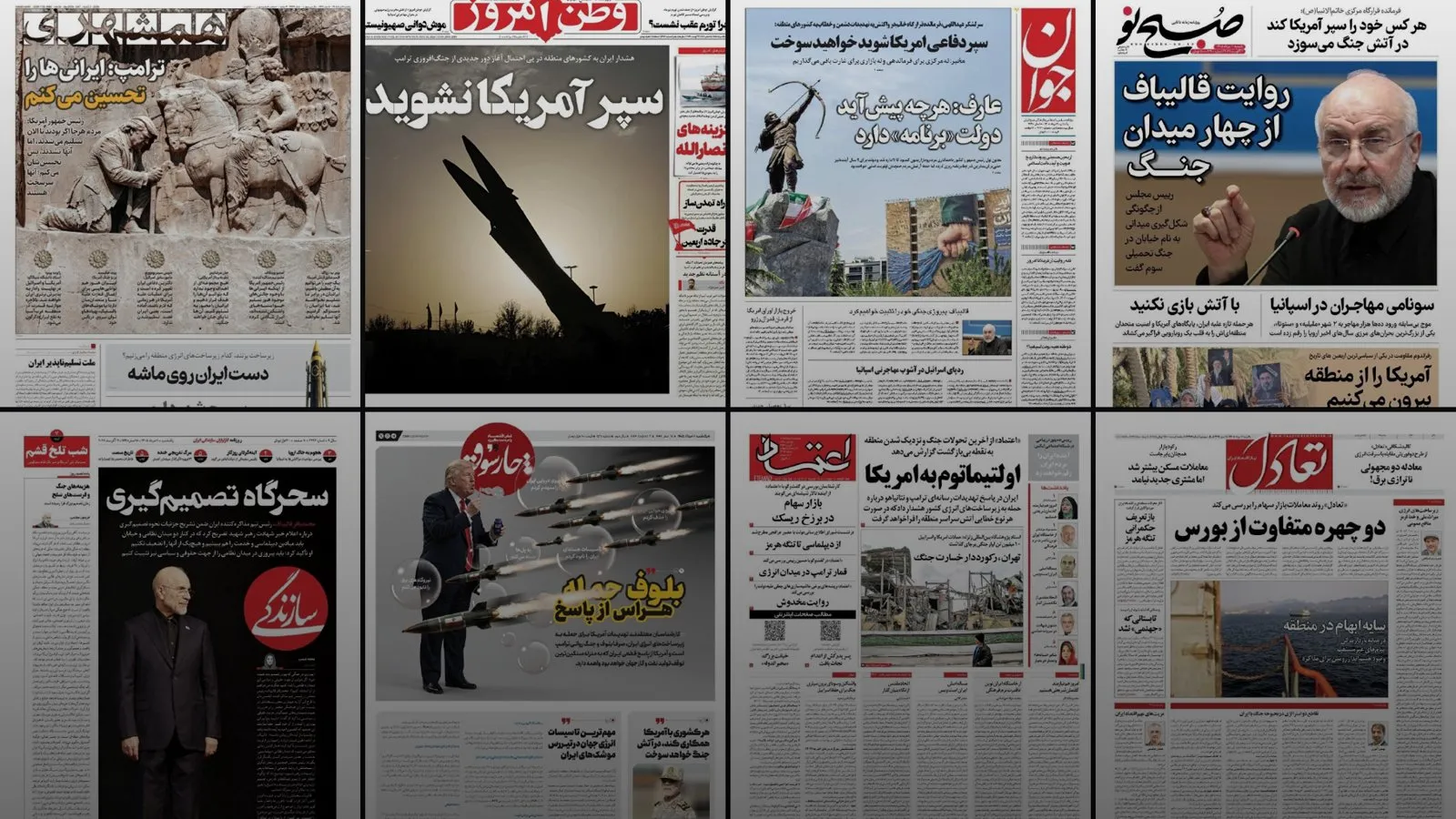
Bottom line: Day 152 is organized around a claim rather than an event: the Iranian fronts converge on Trump having backed away from striking Iran, and the hardline apparatus answers not by celebrating quietly but by broadcasting a near-verbatim warning across at least six titles that any regional state serving as America’s shield will burn, while its flagship editorial polices Iran’s own officials against so much as acknowledging negotiations, and the reformist and economic titles keep pricing the war’s cost that the mobilization fronts want spoken of only in victory.
Executive Summary
The lead judgment of Day 152 is that the edition is built on a claimed adversary climb-down, not an Iranian action. Across factional lines the fronts converge on the same story: the government daily Iran leads on Trump’s Truth Social claim that he ‘cancelled the attack on Iran’; Kayhan frames him as having ‘backed away’ after a week of threats; Etemad and the Nour News and Fars wires carry the same retreat, conditioned in the telling on a quick agreement to open the Strait of Hormuz. Two days after the prior edition documented the negotiation question breaking onto the front pages, the fronts now price the adversary as having blinked. The analytic caution is structural: this narrative is assembled from Trump’s own ambiguous statements and from Iranian amplification of them, not from any verified US action, so it functions as a vindication frame every faction can claim rather than as an established fact.
The hardline apparatus answers that claimed retreat not with quiet but with a single, coordinated deterrent line. ‘Regional states serving as a US shield will burn in the fire of war’, attributed to the commander of Khatam al-Anbia Central Headquarters (printed on Javan as Sarlashkar Abdollahi), runs near-verbatim across at least six titles: Vatan-e Emrooz (‘Do not become America’s shield’), Javan, the principlist Sobh-e No, the economic Charso, the establishment Jomhouri Eslami, and the English Iran Daily. Near-identical wording across the principlist, state and even business press is the signature of centrally-guided message discipline rather than organic editorial convergence, and its audience has shifted: the threat is now aimed at Gulf and Arab states, warning them off hosting US operations, as much as at Washington itself.
Beneath the outward threat, the machinery is again turned inward. Kayhan’s lead editorial, ‘Break Trump’s Game’, urges Iranian officials to preemptively and flatly deny any negotiation track, arguing that acknowledgment is precisely the lever Trump uses to manipulate energy markets and claim leverage. That an editorial has to instruct officials not to acknowledge talks is itself evidence that the off-ramp question, surfaced onto the fronts in the prior edition, remains live enough inside the system to require suppression. It sits directly against the reformist Sazandegi, which reads Qalibaf toward a ‘field of diplomacy and service’ beside the military field and runs a named peace-opportunity op-ed, and against the government daily’s diplomacy-and-power balance. The intra-elite argument over whether to admit an exit is not resolved; it is being fought on the fronts.
The Hormuz-and-energy fulcrum hardens rather than recedes. Charso frames a US strike on Iran’s energy infrastructure as a bluff and psychological warfare, against which Iran’s ‘decisive response’ would amount to the heaviest halt of world oil-and-gas output; Kayhan carries an analysis mapping explicit regional energy counter-targets, naming Saudi Ghawar, Emirati refineries and Qatari LNG; and Trump’s reported precondition for standing down is itself the opening of Hormuz. The chokepoint-as-coercion thread this monitor has tracked across editions is now expressed as a named target list, documented here strictly for defensive assessment.
Against the triumphal register, the cost-accounting counter-lane not only holds but surfaces on a state title. The IRIB-aligned Jam-e Jam prints a quantified domestic-damage claim - roughly 4,200 megawatts of grid capacity lost across 2,000-plus points after enemy strikes; the reformist Etemad calls Tehran the record-holder of war damage and reads Hormuz and energy as risk rather than triumph; Ta’adol prices the war as market ambiguity and recession; and Sazandegi’s un-elaborated ‘Qeshm’s bitter night’ kicker points to a costly overnight incident near the Strait. That a state broadcaster’s paper quantifies damage on a day the hardline fronts sell as an adversary retreat is the sharpest available proxy for the durability of elite reservations about the mobilization line.
The outward-facing and regional-diplomacy signals tilt, notably, toward settling. The English Iran Daily leads with the deterrent warning and Pezeshkian’s ‘real heroes’ unity line and platforms an Egypt-as-mediator interview - Cairo positioned as wanting to stay out and defuse Gulf tensions at their source - and it carries no fresh kinetic claim, a marked change from the prior edition’s Kuwait base-strike splash. Jomhouri Eslami claims a gradual US drawdown from Iraqi Kurdistan; Jam-e Jam notes Iraq’s premier tilting toward Washington. These regional items price a settling, not an escalation.
Net assessment: this is a claimed-climb-down edition, defined less by any battlefield event than by an adversary-retreat narrative the whole press amplifies and by the hardline apparatus mobilizing - outward at regional states, inward at Iran’s own officials - to keep that retreat from being read as an opening for talks. The offensive register is thinner than in recent editions: no fresh Iranian strike claim leads any front, the energy threat is explicitly cast as deterrence rather than action, and the outward-facing product platforms mediation. The highest-significance finding is the coordinated shield-and-burn warning to third states; the signals to watch are whether any US action confirms the claimed climb-down, whether Egypt’s mediation or the Iraqi-Kurdistan drawdown is corroborated, and whether the hardline editorial line succeeds in driving the negotiation question back off the fronts.
Key Points
- KJ-1 [MODERATE-HIGH] The edition is organized around a claimed adversary climb-down rather than an Iranian action. The government daily Iran leads on Trump’s Truth Social claim that he ‘cancelled the attack’; Kayhan frames him as having ‘backed away after a week of threats’; Etemad and the Nour News and Fars wires carry the same, conditioned on a quick opening of Hormuz. Significance: because the narrative is built from Trump’s own ambiguous statements and Iranian amplification, not from a verified US action, it should be read as a vindication frame every faction can claim rather than as an established de-escalation; the calibration is bidirectional, since the story could reflect real US hesitation or merely Iranian packaging of Trump’s mixed signals, and the cue is whether any American action, not statement, confirms a stand-down.
- KJ-2 [HIGH] A single deterrent line is being broadcast at regional states with the fingerprints of central coordination. ‘Regional states serving as a US shield will burn in the fire of war’, sourced to the Khatam al-Anbia commander, runs near-verbatim across at least six titles spanning the hardline, principlist, state and business press. Significance: near-identical wording across factional lines indicates centrally-guided message discipline rather than organic convergence, and the shift of audience from Washington to Gulf and Arab states widens the coercive perimeter to third parties, aiming to deter them from hosting US operations; the escalation marker to track is whether any named state is singled out beyond the generic warning.
- KJ-3 [MODERATE-HIGH] The hardline apparatus is policing the off-ramp from within, disciplining Iran’s own officials against acknowledging negotiations. Kayhan’s lead editorial ‘Break Trump’s Game’ urges officials to preemptively and flatly deny any negotiation track so Trump cannot use talk of a deal to manipulate energy markets. Significance: an instruction to officials not to acknowledge talks is evidence the negotiation question surfaced in the prior edition remains live enough inside the system to require suppression, continuing the inward-turn thread; the cue is whether any official publicly floats or denies a track in the coming editions, and whether the hardline line succeeds in driving the question back off the fronts.
- KJ-4 [MODERATE] A visible intra-elite split over admitting diplomacy persists, held open only in the reformist and government registers. Reformist Sazandegi reads Qalibaf toward a ‘field of diplomacy and service’ beside the military field and runs a named peace-opportunity op-ed by Fereydoun Majlesi; the government daily keeps a diplomacy-and-power balance (Hamzeh Safavi); the hardline fronts foreclose. Significance: the off-ramp lane survives but only outside the principlist bloc, and no principlist or hardline title conceded reciprocal Iranian terms today, so this is contested terms-setting rather than demonstrated flexibility; the cue is any principlist title that prices a reciprocal concession.
- KJ-5 [MODERATE] Hormuz and energy remain the coercive fulcrum and are now expressed as an explicit target list. Charso frames a US energy strike as a bluff against Iran’s ‘decisive response’ halting world oil-and-gas output; Kayhan’s analysis names Saudi Ghawar, Emirati refineries and Qatari LNG as counter-targets; Trump’s reported precondition for standing down is the opening of Hormuz. Significance: the chokepoint-as-coercion thread this monitor tracks has hardened from general threat into named targets, which is documented strictly for defensive assessment and raises the signalling ceiling; the tracking cues remain shipping, insurance and transit data rather than the front-page declarations.
- KJ-6 [MODERATE] Negative evidence: the cost-accounting counter-lane holds and, unusually, surfaces on a state title. The IRIB-aligned Jam-e Jam prints a roughly 4,200-megawatt grid-loss claim across 2,000-plus points; Etemad calls Tehran the war-damage record-holder; Ta’adol prices recession; Sazandegi’s ‘Qeshm’s bitter night’ flags an un-elaborated overnight cost. Significance: quantified domestic damage on a state broadcaster’s paper, on a day the hardline fronts sell as an adversary retreat, is the sharpest available proxy for the durability of elite reservations about the mobilization line; the figures are treated as Iranian claims pending corroboration, and the cue is whether official pressure narrows this cost-accounting in coming editions.
- KJ-7 [MODERATE] The outward-facing and regional-diplomacy signals tilt de-escalatory, diverging from the domestic banners. The English Iran Daily leads with the deterrent warning and Pezeshkian’s unity line but carries no fresh kinetic claim - unlike the prior edition’s Kuwait base-strike splash - and platforms an Egypt-as-mediator interview; Jomhouri Eslami claims a gradual US drawdown from Iraqi Kurdistan; Jam-e Jam notes Iraq tilting toward Washington. Significance: the outward and regional register prices a settling rather than an escalation, the clearest divergence in the edition between the domestic mobilization frame and the diplomacy frame; the cue is whether Egypt’s mediation or the Iraqi-Kurdistan drawdown is corroborated by any second source.
Macro Trends
- The organizing story is a claimed adversary climb-down, not an Iranian action. For the first time in this stretch the fronts converge on the enemy having blinked: Iran (‘Trump cancelled the attack’), Kayhan (‘backed away after a week of threats’), Etemad, and the Nour News and Fars wires all carry Trump’s reported stand-down, conditioned in the telling on a quick opening of Hormuz. The narrative is assembled from Trump’s own Truth Social claims and Iranian amplification, not from a verified US action, which makes it a vindication frame every faction can invoke; the calibration cue is whether any American action, not statement, confirms it.
- A single coordinated deterrent line is broadcast at regional states. ‘Regional states serving as a US shield will burn’, sourced to the Khatam al-Anbia commander, runs near-verbatim across Vatan-e Emrooz, Javan, Sobh-e No, Charso, Jomhouri Eslami and the English Iran Daily. Near-identical wording across principlist, state and business titles indicates centrally-guided message discipline, and its audience has shifted from Washington to Gulf and Arab states, deterring them from hosting US operations. The threat is now directed at third parties, which widens the coercive perimeter.
- The off-ramp is policed from within. Kayhan’s editorial ‘Break Trump’s Game’ instructs officials to preemptively deny negotiations so Trump cannot manipulate markets with talk of a deal. That the hardline flagship must discipline Iran’s own officials against acknowledging talks confirms the negotiation question raised in the prior edition is live inside the system; it runs directly against Sazandegi’s diplomacy-and-service reading of Qalibaf and the government daily’s diplomacy-and-power balance. The inward-turn thread from the prior edition continues and sharpens.
- Hormuz and energy harden into a named target list. The chokepoint-as-coercion thread does not recede: Charso frames a US energy strike as a bluff against Iran’s world-halting ‘decisive response’; Kayhan’s analysis names Saudi Ghawar, Emirati refineries and Qatari LNG as counter-targets; and Trump’s reported precondition for standing down is the opening of Hormuz itself. The coercion is now expressed as explicit targets rather than general threat, documented for defensive assessment; the tracking cues remain shipping, insurance and transit data rather than the declarations.
- The cost-accounting counter-lane surfaces on a state title. Against a triumphal edition the counter-lane holds and, unusually, appears on the state broadcaster’s own paper: Jam-e Jam quantifies a roughly 4,200-megawatt grid loss; Etemad calls Tehran the war-damage record-holder and reads Hormuz as risk; Ta’adol prices recession; Sazandegi’s ‘Qeshm’s bitter night’ points to an un-elaborated overnight cost. Quantified domestic damage on a state front, on a day sold as an adversary retreat, is the sharpest proxy for the durability of elite reservations; the figures are treated as claims.
- The outward-facing and regional signals tilt toward settling. The English Iran Daily leads with deterrence and unity rather than any kinetic claim - a change from the prior edition’s Kuwait base-strike splash - and platforms an Egypt-as-mediator interview seeking to defuse Gulf tensions at their source; Jomhouri Eslami claims a gradual US drawdown from Iraqi Kurdistan; Jam-e Jam notes Iraq tilting toward Washington. The outward and regional register prices a settling that cuts against the domestic shield-and-burn banners, the clearest divergence in the edition between the mobilization frame and the diplomacy frame.
Front-Page Snapshot
- Iran - “Trump ‘cancels the attack’; Rubio concedes Iran keeps its missiles” (Official government daily (channel)) - The authoritative ‘Washington retreated’ frame, with a diplomacy-and-power balance [LOW-MODERATE]
- Kayhan - “Enemy in disarray: Trump ‘backs away’ from striking Iran” (Hardline flagship (Leader’s office / IRGC; channel)) - Enemy-disarray triumph, an energy counter-target list, and anti-negotiation discipline [HIGH]
- Vatan-e Emrooz - “Do not become America’s shield” (Hardline / principlist) - Coordinated deterrent warning to regional states, with a Red Sea/Ansarallah lever [HIGH]
- Javan - “‘Become America’s defense shield and you will burn’: Khatam al-Anbia commander” (Hardline, IRGC-affiliated) - Deterrent threat plus government-cohesion messaging (Aref, Qalibaf) [HIGH]
- Sobh-e No - “Qalibaf’s account of the four battlefields” (Principlist) - Domestic mobilization (‘third imposed war’) plus the shield warning [MODERATE-HIGH]
- Iran Daily - “Regional states serving as US shield will ‘burn in fire of war’: Top commander” (English-language state daily) - Outward deterrent and unity messaging, plus an Egypt-as-mediator interview [MODERATE]
- Jomhouri Eslami - “In the hard days, the real heroes were the people; the people will shape Iran’s future” (Traditional / establishment) - People-first unity, enemy-disarray, and a claimed US drawdown from Iraqi Kurdistan [MODERATE]
- Hamshahri - “Trump: I admire the Iranians” (Tehran municipality, centrist) - Trump’s reported retreat reframed as validation of Iranian steadfastness [MODERATE]
- Charso - “The bluff of an attack, fear of the response” (Economic / business) - US energy-strike threat read as a bluff; Iranian mutual-destruction deterrent [MODERATE-HIGH]
- Etemad - “Ultimatum to America” (Reformist) - Deterrent ultimatum framed alongside war-cost and market-risk accounting [MODERATE]
- Jam-e Jam - “National power grid down some 4,200 MW after enemy strikes (claim)” (State broadcaster (IRIB) daily (channel)) - Quantified domestic grid-damage claim amid an escalation assessment [MODERATE]
- Sazandegi - “The dawn of decision-making” (Reformist (Kargozaran)) - Diplomacy-and-service counter-frame; an un-elaborated ‘Qeshm’s bitter night’ cost kicker [LOW-MODERATE]
- Ta’adol - “Two different faces of the bourse” (Economic / business) - War priced as market ambiguity and recession, not mobilization [LOW]
Full report
The complete edition - per-paper front-page analysis and full translation appendices - is available as a PDF: Download the full report.
Compiled from Iranian front pages and outlet channels via open-source monitoring. Translations are editorial; named-figure attributions are verified against the source pages where possible.