Iranian Press Monitor - Thursday, 30 July 2026 (Day 149)
Thursday, 30 July 2026 · 8 Mordad 1405 · 15 Safar 1448 - Nine Persian kiosk scans read by vision plus four daily titles and three agency wires read by channel; the English kiosk scan was a stale prior-week Iran Daily and Tehran Times was unavailable at the time
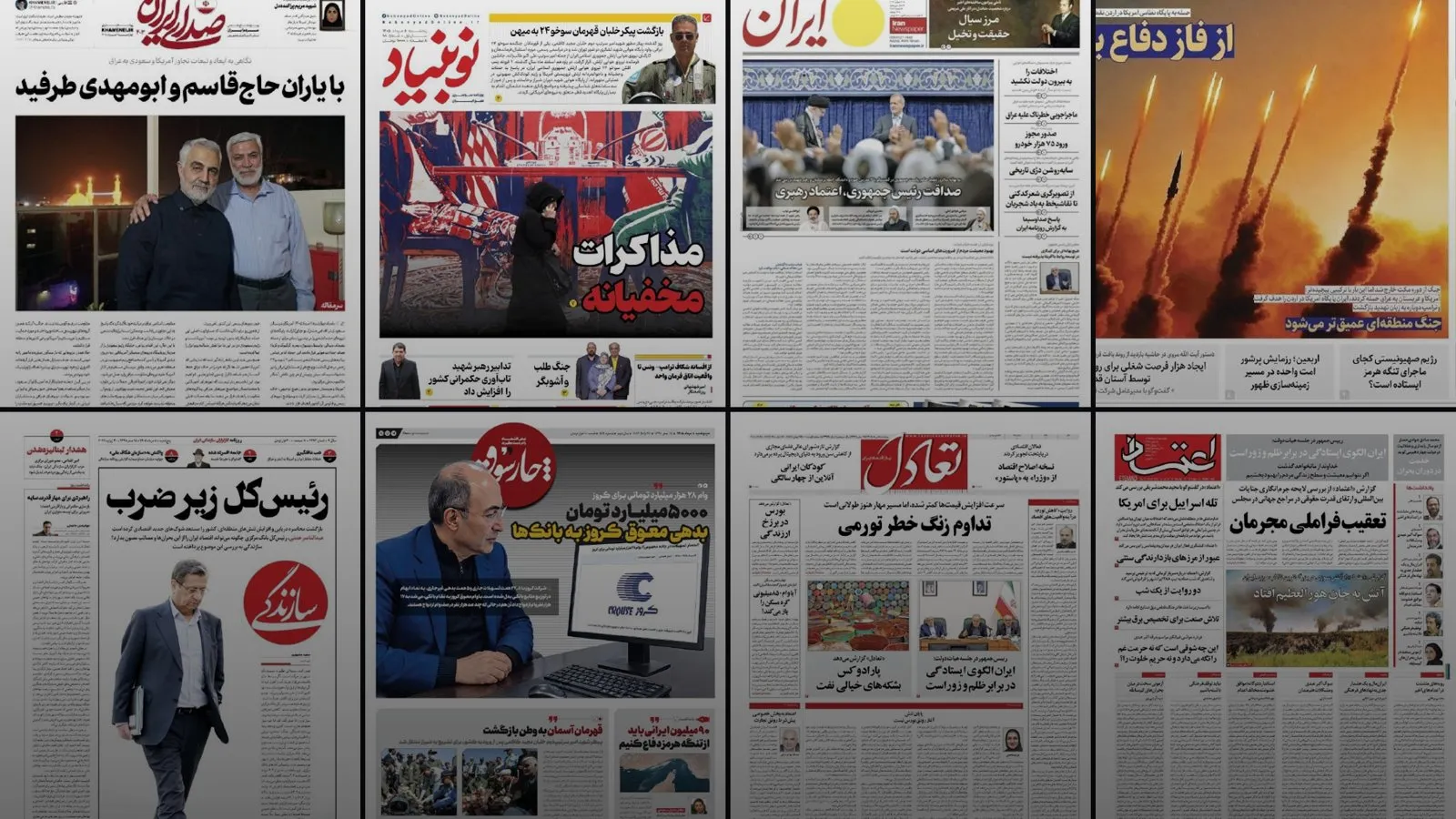
Bottom line: Day 149 documents the effective collapse of the June ceasefire into open, multi-front kinetic exchange whose core is corroborated rather than merely claimed: CENTCOM confirms a fresh wave of US strikes on Iranian soil in retaliation for Iranian missile attacks on US forces, joint US-Saudi strikes hit Iraq’s Popular Mobilization across seven provinces in the first Saudi-claimed operation inside Iraq, and Iran asserts a missile strike on the al-Muwaffaq al-Salti base in Jordan, while the hardline fronts recast the moment as an offensive strategic turn and police against any negotiating off-ramp, the state broadcaster keeps pricing the war’s domestic cost, and the reformist and economic titles refuse the mobilisation frame outright.
Executive Summary
Day 149 is the edition on which the standing ‘fragile ceasefire’ thread has to be retired. The June memorandum has given way to open multi-front kinetic exchange, and unusually for this monitor the core of the escalation is corroborated by non-Iranian sources rather than resting on the wires alone. CENTCOM’s own public releases and Western reporting confirm a fresh wave of US strikes on Iranian targets, including Qeshm Island and the Abadan area, launched late Wednesday in explicit retaliation for Iranian missile attacks on US forces; the principlist Sobh-e No front-pages the CENTCOM announcement itself under its ‘terrorist military’ epithet. In parallel, joint US-Saudi strikes hit Iraq’s Popular Mobilization (Hashd al-Shaabi) across seven provinces, killing roughly twenty fighters, in what external reporting describes as the first strikes Saudi Arabia has publicly claimed inside Iraq since the war began; Baghdad condemned the attacks as a sovereignty violation and the prime minister postponed a Riyadh trip. Iran, for its part, claims a ballistic-missile strike on the al-Muwaffaq al-Salti base in Jordan, which Jordan says it intercepted. The significance is that this is a two-way, multi-front reopening, not another one-sided claim cycle, and the tracking task shifts from ‘is anything happening’ to ‘how far does it widen’.
The joint US-Saudi strikes on Iraq are the edition’s organising event and its most consequential regional development. Jomhouri Eslami gives its whole front to the ‘widespread reactions’ to the strikes on Hashd al-Shaabi bases; Kayhan frames Riyadh as Washington’s instrument in ‘Trump deploys his Saudi ally’; Vatan-e Emrooz brands the operation ‘crime and folly’; and the office-aligned Seda-ye Iran sacralises the Iraqi casualties into the Soleimani-Muhandis martyr lineage under ‘he joined the companions of Haj Qasem and Abu Mahdi’. The corroborated facts, twenty PMF dead across Baghdad, Wasit, Nineveh, Basra, Kirkuk, Karbala and Diyala and an open Saudi role, matter more than the framing: they draw Saudi Arabia visibly into the Iraq theatre and put the Iraqi government between Washington and its own resistance factions, which have issued a retaliation ultimatum on the agency wires. This is the widening to watch.
The reciprocal Iranian claim, a missile strike on the US base in Jordan, is being elevated from a wire assertion into declared doctrine. Qods leads on ‘from the defensive phase to attack’, calling the Jordan strike ‘a turning point in Iran’s war strategy’ and running a mass ballistic-launch photograph; Charso banners the same claim on an economic front, and Jomhouri Eslami and Sobh-e No both carry it. The doctrinal reframing raises rather than settles the verification burden: Jordan claims interception of five missiles, and nothing on the pages or in accessible external reporting confirms an impact. The Strait of Hormuz thread hardens alongside it into a declared control-and-closure posture, IRGC statement number fifty-four warning that countries assisting ‘the aggressor’ face harsh consequences and describing the strait as non-navigable, with Charso’s ‘90 million Iranians must defend Hormuz’ and Vatan-e Emrooz’s ‘Hormuz has no price’ carrying the line onto the fronts, while Jam-e Jam logs six explosions near Sirik on the strait’s approaches and continued LNG-export cuts.
Against the mobilisation pole, the message-discipline apparatus is now aimed squarely at foreclosing a diplomatic off-ramp. Kayhan’s lead editorial, attributed to Shariatmadari, attacks the ‘hardliner versus moderate’ vocabulary as ‘foreign-made’ and invokes the founder’s warning against the enemy’s political language; Nobonyad’s two-word ‘secret negotiations’ front insinuates covert back-channels at the moment strikes resume and its op-ed dismisses a Trump-Vance rift as myth in favour of a ‘unified command room’; Vatan-e Emrooz keeps the Netanyahu-as-weak thread alive with ‘despised in the White House’ and US polling; and even the reformist Etemad’s ‘Israel’s trap for America’ sustains the reading that Netanyahu is manoeuvring Washington into a wider war. Etemad also adds a distinctly reformist answer to the kinetic front, leading not on the strikes but on a parliamentary lawfare bill to criminalise international crimes in global forums, and running a Hoor al-Azim wetland fire.
The calibration counter-signals that this monitor has tracked for a fortnight hold, and on a day of confirmed strikes on Iranian soil that is itself the finding. The state broadcaster’s own daily, Jam-e Jam, again supplies the least triumphalist front, restating grid capacity down 4,200 megawatts, more than 2,000 network points damaged and losses above 60 trillion tomans, and logging the Sirik-area explosions the mobilisation titles fold into offence. The economic titles refuse the war frame: Ta’adol cools from the prior edition’s ‘inflation halved’ to ‘the alarm bell persists’ and dissects ‘the paradox of imaginary oil barrels’; Charso leads on the Crouse corporate-debt scandal; and the reformist Sazandegi carries the sharpest dissent of the day, Gholam-Hossein Karbaschi’s signed ‘warning of Lebanonization’ and a ‘shadow power’ critique that recasts the war as a governance and survival crisis. The government daily Iran, meanwhile, answers the reopened war with a president-Leader concord front, ‘the president’s honesty, the Leader’s trust’, files the Iraq strikes below the fold as ‘dangerous adventurism’, and runs a ‘do not take disputes outside the government’ discipline line matched by Jomhouri Eslami’s editorial, even as a visible IRIB-versus-Iran spat betrays the fault line being managed.
Net assessment: this is a ceasefire-collapse edition whose distinguishing feature is corroboration. The verifiable developments, a fresh CENTCOM-confirmed wave of US strikes on Iranian territory and the first openly Saudi-claimed strikes on Iraqi soil, are of a different evidentiary order than the Iranian offensive claims that ride alongside them, the Jordan-base strike, the Hormuz closure, the Kuwait-launch and Damietta-LNG assertions, all of which remain attributed and uncorroborated. The highest-significance finding is the two-way, multi-front reopening itself, with the Saudi entry into Iraq the widening most likely to draw new actors in; the signal most worth watching is whether the Iraqi resistance factions execute their retaliation ultimatum and whether any external source substantiates the Jordan-base and Hormuz-closure claims. The durable negative-evidence findings, the state broadcaster’s damage accounting and the reformist and economic titles’ refusal of the mobilisation frame even under live strikes, remain the sharpest checks on the guided narrative.
Key Points
- KJ-1 [HIGH] The June ceasefire has effectively collapsed into open, multi-front kinetic exchange, and unusually the core of the escalation is corroborated rather than merely claimed. CENTCOM’s own releases and Western reporting confirm a fresh wave of US strikes on Iranian targets (Qeshm and the Abadan area) retaliating for Iranian missile attacks on US forces; joint US-Saudi strikes hit Iraq’s Popular Mobilization across seven provinces; and Iran claims a missile strike on the Jordan base. Significance: the standing ‘fragile ceasefire’ framing must be retired, and the analytic task shifts from establishing that exchange is under way to gauging how far it widens; the US strikes on Iranian soil and the Saudi entry into Iraq are of a higher evidentiary order than the Iranian offensive claims riding alongside them.
- KJ-2 [HIGH] The joint US-Saudi strikes on Iraq’s Hashd al-Shaabi are the edition’s organising event and a genuine regional widening. Jomhouri Eslami leads on the reaction wave, Kayhan frames ‘Trump deploys his Saudi ally’, Vatan-e Emrooz brands it ‘crime and folly’, and Seda-ye Iran sacralises the casualties into the Soleimani-Muhandis martyr lineage; externally the strikes are reported across seven provinces with roughly twenty killed, an open Saudi role for the first time, and a Baghdad sovereignty-violation condemnation with the prime minister postponing a Riyadh visit. Significance: the operation brings Saudi Arabia visibly into the Iraq theatre and puts the Iraqi government between Washington and its own resistance factions, which have issued a retaliation ultimatum; the cue is whether those factions execute it and pull Iraq further in.
- KJ-3 [MODERATE-HIGH] Iran’s claimed missile strike on the US al-Muwaffaq al-Salti base in Jordan is being elevated from a wire assertion into declared offensive doctrine. Qods’s ‘from the defensive phase to attack’ calls it ‘a turning point in Iran’s war strategy’ over a mass-launch image, and Charso, Jomhouri Eslami and Sobh-e No carry it; Jordan claims it intercepted five missiles. Significance: the doctrinal reframing raises rather than settles the verification burden, and nothing on the pages or in accessible external reporting confirms an impact; the item to watch is any external substantiation of an actual incident at the base, absent which this stays a declared posture rather than a demonstrated capability.
- KJ-4 [MODERATE-HIGH] The Strait of Hormuz thread has hardened from the prior edition’s claimed interdiction into a declared control-and-closure posture with an explicit third-party warning. IRGC statement number fifty-four warns countries assisting ‘the aggressor’ of harsh consequences and describes the strait as non-navigable; Charso runs ‘90 million Iranians must defend Hormuz’, Vatan-e Emrooz ‘Hormuz has no price’, and Jam-e Jam logs six explosions near Sirik on the strait’s approaches with continued LNG-export cuts. Significance: the chokepoint is now welded to the kinetic resumption as a declared instrument of coercion, but the closure claim is an Iranian assertion; the tracking cues are shipping, insurance and transit data rather than the front-page declarations.
- KJ-5 [MODERATE] Cross-spectrum message discipline persists and has turned to foreclosing a diplomatic off-ramp under fire. Kayhan’s Shariatmadari editorial attacks the ‘hardliner versus moderate’ vocabulary as ‘foreign-made’, Nobonyad’s ‘secret negotiations’ front insinuates covert back-channels and dismisses a Trump-Vance rift as myth in favour of a ‘unified command room’, Vatan-e Emrooz keeps ‘despised in the White House’ running, and reformist Etemad’s ‘Israel’s trap for America’ sustains the Netanyahu-manoeuvres-Washington reading. Significance: the near-uniform carriage indicates guided discipline aimed at preventing a moderate track, but the underlying material is inference about US-Israel friction rather than a demonstrated outcome; the cue is whether any concrete US or Israeli decision validates or refutes the framing.
- KJ-6 [MODERATE] Negative evidence: the state broadcaster’s damage accounting and the reformist and economic titles’ distance from the mobilisation frame hold even on a day of confirmed strikes on Iranian soil. Jam-e Jam restates grid capacity down 4,200 megawatts, over 2,000 network points damaged and losses above 60 trillion tomans; Ta’adol cools to ‘the inflation alarm bell persists’ and dissects ‘imaginary oil barrels’; Charso leads on the Crouse corporate-debt scandal; and Sazandegi carries Karbaschi’s signed ‘Lebanonization’ warning and a ‘shadow power’ critique. Significance: that the IRIB paper and the non-hardline titles refuse the triumphalist frame while strikes land is a first-class calibration check on the guided narrative and a proxy for the durability of elite reservations about the mobilisation line.
- KJ-7 [MODERATE] The government is answering the reopened war with a projection of internal concord and discipline rather than mobilisation, while managing a visible intra-establishment fault line. The government daily Iran leads on ‘the president’s honesty, the Leader’s trust’ over a Pezeshkian-Leader meeting, files the Iraq strikes below the fold as ‘dangerous adventurism’, and runs a ‘do not take disputes outside the government’ line matched by Jomhouri Eslami’s editorial, even as an IRIB-versus-Iran-newspaper spat surfaces on the same page. Significance: the administration is keeping the war off its own lead and prioritising a ‘close ranks’ message, which indicates management of an elite tension over the war’s conduct and the government’s record rather than confidence; the cue is whether the concord framing survives the strikes’ domestic cost.
Macro Trends
- The June ceasefire collapses into open, corroborated multi-front exchange. The standing ‘fragile ceasefire’ thread is retired this edition. Fresh US strikes on Iranian soil (CENTCOM-confirmed, hitting Qeshm and Abadan in retaliation for Iranian missile attacks on US forces), joint US-Saudi strikes on Iraq’s Popular Mobilization across seven provinces, and an Iranian claim of a missile strike on the Jordan base together constitute a two-way, multi-front reopening. What distinguishes today from the prior fortnight’s claim cycles is that the core, the US strikes on Iran and the Saudi entry into Iraq, is corroborated by non-Iranian sources rather than resting on the wires; the Iranian offensive claims that ride alongside remain attributed and uncorroborated.
- The Saudi entry into Iraq becomes the widening to watch. The joint US-Saudi strikes on Hashd al-Shaabi are the edition’s organising event: Jomhouri Eslami leads on the reaction wave, Kayhan frames ‘Trump deploys his Saudi ally’, Vatan-e Emrooz brands it ‘crime and folly’, and Seda-ye Iran sacralises the casualties into the Soleimani-Muhandis martyr lineage. Externally corroborated as roughly twenty PMF killed across seven provinces with an open Saudi role and a Baghdad sovereignty-violation condemnation, the strikes draw Saudi Arabia visibly into the Iraq theatre and place the Iraqi government between Washington and its own resistance factions, which have issued a retaliation ultimatum on the wires.
- The Jordan-base strike is recast from wire claim into offensive doctrine. The Iranian claim of a missile strike on the al-Muwaffaq al-Salti base in Jordan is elevated on the fronts from a wire assertion into declared strategy: Qods’s ‘from the defensive phase to attack’ calls it ‘a turning point in Iran’s war strategy’, and Charso, Jomhouri Eslami and Sobh-e No carry it. The doctrinal reframing raises the verification burden it does not settle; Jordan claims interception of five missiles, and nothing on the pages or in accessible external reporting confirms an impact. This is the standing Jordan-strike thread hardening from claim to declared posture.
- Hormuz hardens from red line into a declared control-and-closure posture. The chokepoint thread advances from the prior edition’s claimed interdiction to a declared closure and third-party warning. IRGC statement number fifty-four warns that countries assisting ‘the aggressor’ face harsh consequences and describes the strait as non-navigable; Charso runs ‘90 million Iranians must defend Hormuz’ and Vatan-e Emrooz ‘Hormuz has no price’, while Jam-e Jam logs six explosions near Sirik on the strait’s approaches and continued Qatari and UAE LNG-export cuts. The closure declaration is an Iranian assertion; the tracking cues are shipping, insurance and transit data.
- Message discipline turns to foreclosing a negotiating off-ramp. The cross-spectrum apparatus is now aimed at preventing a diplomatic exit under fire. Kayhan’s Shariatmadari editorial attacks the ‘hardliner versus moderate’ vocabulary as ‘foreign-made’; Nobonyad’s ‘secret negotiations’ front insinuates covert back-channels and dismisses a Trump-Vance rift as myth; Vatan-e Emrooz keeps ‘despised in the White House’ running; and even reformist Etemad’s ‘Israel’s trap for America’ sustains the Netanyahu-manoeuvres-Washington reading. The convergence indicates guided discipline rather than organic agreement, though it rests on inference about US-Israel friction rather than a demonstrated outcome.
- The damage accounting and reformist-economic distance hold even under live strikes. The calibration counter-signals persist and are themselves the finding on a day of confirmed strikes on Iranian soil. Jam-e Jam restates grid capacity down 4,200 megawatts, over 2,000 network points hit and losses above 60 trillion tomans; Ta’adol cools to ‘the inflation alarm bell persists’ and dissects ‘imaginary oil barrels’; Charso leads on the Crouse corporate-debt scandal; and Sazandegi carries Karbaschi’s signed ‘Lebanonization’ warning and a ‘shadow power’ critique. The government daily Iran answers with a president-Leader concord front and files the Iraq strikes below the fold as ‘dangerous adventurism’, a discipline-and-unity posture rather than mobilisation.
Front-Page Snapshot
- Jomhouri Eslami - “Widespread reactions to the American and Saudi attacks on the Popular Mobilization bases in Iraq” (Traditional / establishment) - US-Saudi strikes on Iraq’s PMF and the reaction wave [HIGH]
- Kayhan - “Trump deploys his Saudi ally” (Hardline flagship (Leader’s office; channel read)) - Riyadh as Washington’s instrument; anti-negotiation editorial [HIGH]
- Vatan-e Emrooz - “Crime and folly” (Hardline / principlist (channel read)) - Iraq strikes condemned; Hormuz and Yemen pressure map [MODERATE-HIGH]
- Sobh-e No - “The American terrorist military announces the end of a new round of attacks on Iran” (Principlist (channel read)) - Resumed US strikes on Iranian soil and the reciprocal Jordan claim [HIGH]
- Qods - “From the defensive phase to attack” (Conservative (Astan Quds Razavi, Mashhad)) - Jordan-base strike recast as an offensive strategic turn [HIGH]
- Seda-ye Iran - “He joined the companions of Haj Qasem and Abu Mahdi” (Principlist / office-aligned (khamenei.ir masthead)) - Iraq casualties sacralised into the resistance-martyr lineage [MODERATE-HIGH]
- Nobonyad - “Secret negotiations” (Conservative / principlist) - Anti-negotiation warning and a ‘unified US command’ frame [MODERATE]
- Charso - “5,000 billion tomans of Crouse’s overdue debt to the banks” (Economic) - Corporate-debt scandal beside Hormuz-defence and Jordan-strike lines [MODERATE]
- Jam-e Jam - “A 4,200-megawatt reduction in grid capacity following war damage” (State broadcaster (IRIB; channel read)) - War’s material cost at home and Strait economics [MODERATE]
- Iran - “The president’s honesty, the Leader’s trust” (Official government daily) - President-Leader concord and internal discipline; war off the lead [LOW-MODERATE]
- Etemad - “Transnational pursuit of criminals” (Reformist) - Lawfare bill and the ‘Israel’s trap for America’ reading [LOW-MODERATE]
- Sazandegi - “The Governor under fire” (Reformist (Kargozaran)) - Economic-crisis critique and a ‘Lebanonization’ warning [LOW]
- Ta’adol - “The inflation alarm bell persists” (Economic / business) - Persistent inflation risk and fiscal-fiction critique [LOW]
Full report
The complete edition - per-paper front-page analysis and full translation appendices - is available as a PDF: Download the full report.
Compiled from Iranian front pages and outlet channels via open-source monitoring. Translations are editorial; named-figure attributions are verified against the source pages where possible.