Iranian Press Monitor - Wednesday, 29 July 2026 (Day 148)
Wednesday, 29 July 2026 · 7 Mordad 1405 · 14 Safar 1448 - Nine Persian kiosk scans read by vision plus four daily titles and three agency wires read by channel; the English kiosk scan was the prior day’s Iran Daily and Tehran Times was unavailable at the time
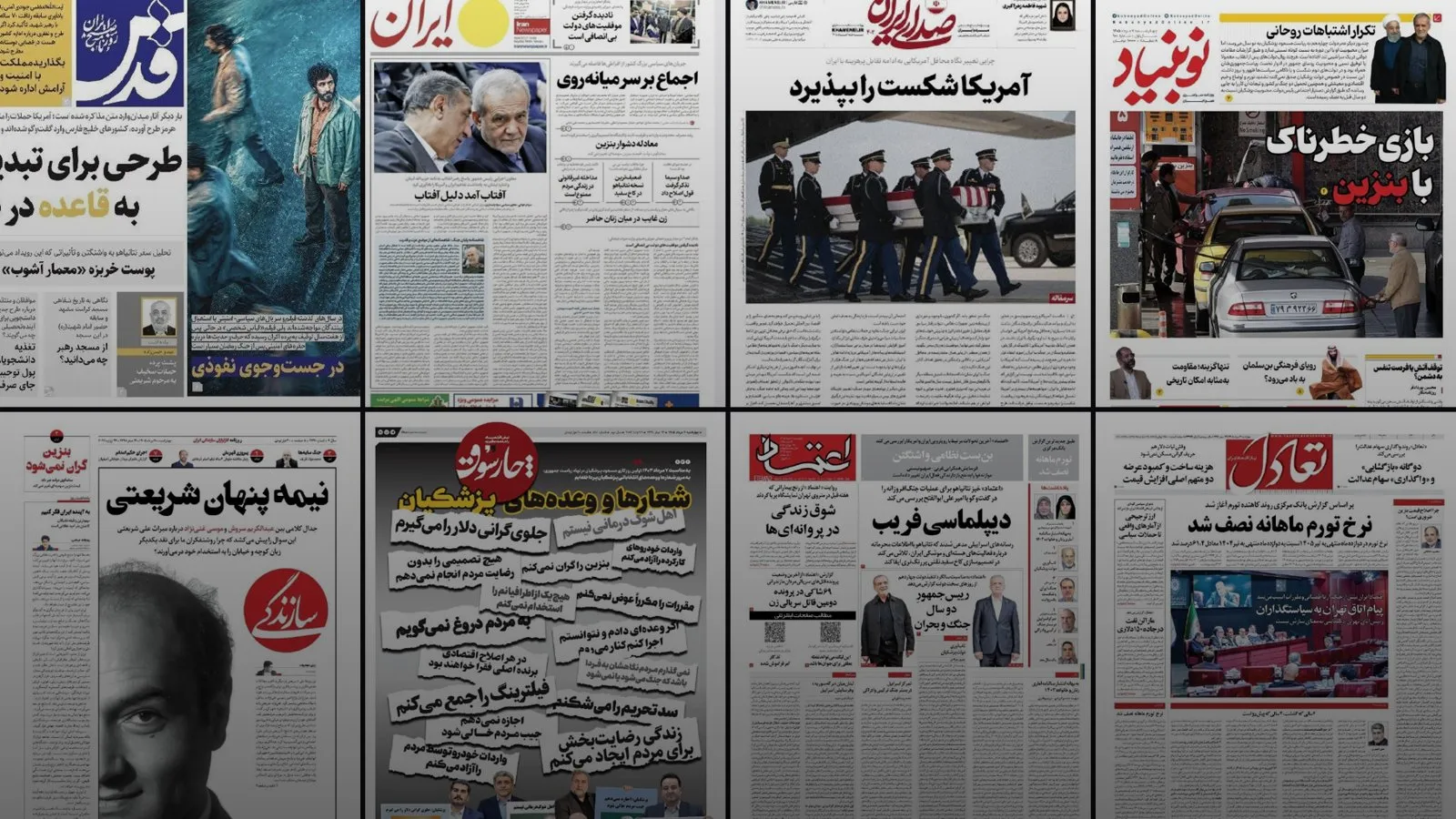
Bottom line: Day 148 hardens the standing Hormuz thread from an asserted vessel standoff into a claimed kinetic interdiction (the IRGC Navy says three ‘violating tankers’ were struck and stopped) and welds it to a near-unanimous ‘do not negotiate the strait away’ editorial line, all staged against a cross-spectrum reading of Netanyahu’s Washington visit as a failing, deceptive gambit, while the state broadcaster’s own paper quietly prices the war’s domestic damage and the reformist and economic titles hold their distance on a factional battle over the government’s two-year record.
Executive Summary
Day 148 is a Strait-of-Hormuz edition, and its lead judgment is that the standing chokepoint thread has crossed from asserted friction into a claimed kinetic interdiction. On the agency wires the IRGC Navy states that three ‘violating tankers’ were struck and stopped (Defa Press 64492, Fars 453286) and Rear Admiral Sayyari asserts ‘complete Iranian dominance’ over the strait (Defa Press 64506); on the front pages Kayhan’s lead editorial warns against ‘opening the enemy’s breathing space through negotiations on the Strait of Hormuz’, Qods headlines ‘a plan to turn power into a rule in Hormuz’, Vatan-e Emrooz insists ‘Hormuz has no price tag’, and Sobh-e No reports a warning that any country accepting compensation from frozen Iranian assets will be denied passage. The mechanism is a coordinated move from last edition’s claimed vessel standoff to a claimed act of interdiction plus an explicit editorial red line against diplomacy, and the significance is that the chokepoint story is now the war’s organising frame; the tanker-strike and dominance claims are Iranian military assertions, uncorroborated here, and the tracking cue is whether any primary or external source substantiates them.
The second organising theme is a near-unanimous framing of Netanyahu’s Washington visit as a failing, deceptive gambit rather than a threat. Qods casts the trip as ‘the banana peel of the architect of chaos under Trump’s feet’; reformist Etemad leads ‘Diplomacy of deception’, reporting Israeli-media claims that Netanyahu is using classified material on Iran’s nuclear and missile activity to enlarge his role in White House decisions; the government daily Iran calls it ‘the weakness of Netanyahu’s prescription at the White House’; Nour News frames it as ‘behind diplomacy’s mask, a new operations room against Tehran’; and Jomhouri Eslami runs pro-Palestinian protests outside the White House as its main image. That the reformist, government and hardline titles converge on a single ‘Netanyahu is weak and duplicitous’ reading indicates centrally-comfortable message discipline across the spectrum, though the underlying material is inference about US-Israel friction rather than a demonstrated outcome.
Beneath the loud claims the edition again separates the corroborated-adjacent from the asserted, and the state’s own broadcaster supplies the sharpest counter-signal. Jam-e Jam prices the war’s domestic cost with unusual candour: a 4,200-megawatt reduction in grid capacity, more than 2,000 network points hit, losses above 60 trillion tomans, Qatar and UAE LNG supply down about 80 percent, and Hormuz transit flows well below pre-conflict levels. Against that, the day’s freshest claimed kinetic escalation, an IRGC Aerospace assertion of a ballistic-missile strike on a US airbase and command node in Jordan (Defa Press 64491, Fars 453283), is a specific new claim with no corroboration on the page, while the closest-to-substantiated kinetic activity remains the Yemen-on-Saudi oil campaign: Vatan-e Emrooz’s ‘Target, Yanbu’, Sobh-e No’s report of the Saudi tanker ‘NCC Ghazal’ driven off by ballistic missiles and Bab al-Mandab transit collapsing from about 40 ships a day to roughly 10, and a Yemeni-claimed downing of a Saudi drone (Fars 453290).
The American-decline narrative consolidates onto opinion and elite-mood claims rather than battlefield facts. Seda-ye Iran devotes its whole front to ‘America should accept defeat’, beneath a khamenei.ir masthead and an editorial flag, using imagery of a US military coffin; Kayhan reports an American analyst conceding ‘we have lost the war’ (the individual is not identifiable from the excerpt and the quote is carried as a claim); Vatan-e Emrooz’s ‘New Middle East’ has US think tanks describing the war as the start of American hegemonic collapse; and Sobh-e No marshals Israeli polling (44 percent calling the war no victory, only 17 percent crediting Netanyahu) to argue the Israeli premier is ‘more despised than ever’. The near-identical carriage indicates centrally-guided amplification of Western and Israeli reporting of caution into a claim of demonstrated defeat, asserted rhetorically and by foreign-source citation.
The home front, meanwhile, is dominated not by the war but by the government’s two-year anniversary and an impending fuel-price decision, and here the factional lines are at their sharpest. On 7 Mordad, the mark of the fourteenth government’s start, principlist Farhikhtegan gives its entire front to ‘Pezeshkian’s slogans and promises’, arraying his campaign pledges (including ‘I will not raise gasoline prices’) as broken; Nobonyad warns of ‘a dangerous game with gasoline’ and ‘repeating Rouhani’s mistakes’; reformist Etemad frames ‘two years of war and crisis’; while the government daily answers that ‘ignoring the government’s successes is unfair’ and posits a ‘consensus on moderation’, and the economic titles carry recovery data, Ta’adol’s ‘the monthly inflation rate has halved’, a rising bourse, and a technocratic case for gasoline reform, with reformist Sazandegi reassuring that ‘gasoline will not get more expensive’ and leading instead on an intellectual debate over Ali Shariati’s legacy. Jomhouri Eslami holds the diplomacy lane, foregrounding Foreign Minister Araghchi’s coordination with Omani and Saudi counterparts and a UN characterisation of Israel’s Lebanon operations as possible war crimes, while Nour News reports fresh Israeli artillery strikes on southern Lebanon and Vatan-e Emrooz’s ‘Jolani, it is not me’ reads Damascus as declining to move against Hezbollah.
Net assessment: this is a Strait-as-red-line edition. The verifiable developments are a further hardening of the Hormuz thread into a claimed interdiction plus an explicit anti-diplomacy editorial line, a candid state-media accounting of the war’s domestic material cost, and a continuing Yemen-on-Saudi maritime campaign; the unverified content is the cluster of Iranian military claims (the Jordan base strike, the three struck tankers, Saudi ‘aggression’ against Iraq) and the American- and Israeli-defeat narratives that ride on foreign-press and polling citation. The highest-significance finding is the chokepoint escalation: the move from asserted standoff to claimed kinetic interdiction, doctrinally sealed by Kayhan’s red-line editorial on the morning Netanyahu is in Washington. The signal most worth watching is whether the tanker-interdiction and Jordan-base claims draw any primary-source or external corroboration, or resolve as messaging as yesterday’s Caspian warning appears to have; the negative-evidence findings are the state broadcaster’s own damage accounting and the reformist and economic titles’ continued distance from the mobilisation line.
Key Points
- KJ-1 [MODERATE-HIGH] The Strait of Hormuz thread has hardened from an asserted vessel standoff into a claimed kinetic interdiction sealed by an explicit editorial red line. The IRGC Navy states that three ‘violating tankers’ were struck and stopped and Rear Admiral Sayyari claims complete dominance over the strait; Kayhan’s lead editorial warns against ‘opening the enemy’s breathing space through negotiations on the Strait of Hormuz’, Qods headlines power ‘turned into a rule in Hormuz’, Vatan-e Emrooz insists it ‘has no price tag’, and Sobh-e No reports transit denied to any state accepting frozen-asset compensation. Significance: this is the sharpest escalation of the chokepoint story to date and moves it to the centre of the war frame, but the interdiction and dominance claims are Iranian military assertions with no external corroboration on the page; the tracking cue is whether any primary or independent source substantiates the tanker strikes.
- KJ-2 [MODERATE-HIGH] Netanyahu’s Washington visit is framed across the factional spectrum as a failing, deceptive gambit rather than a threat, indicating centrally-comfortable message discipline. Etemad’s ‘Diplomacy of deception’ has him leveraging classified Iran material for White House influence; Qods calls him a ‘banana peel’ under Trump’s feet; the government daily Iran cites ‘the weakness of Netanyahu’s prescription’; Nour News sees ‘a new operations room against Tehran’; Jomhouri Eslami foregrounds pro-Palestinian White House protests. Significance: convergence by reformist, government and hardline titles on one reading is a message-discipline signal, but the material is inference about US-Israel friction rather than a demonstrated outcome; the cue is whether any concrete US-Israel decision validates or refutes the ‘weak and duplicitous’ framing.
- KJ-3 [HIGH] The closest-to-substantiated kinetic activity on the pages remains the Yemen-on-Saudi oil campaign, not any Iranian strike on US forces. Vatan-e Emrooz headlines ‘Target, Yanbu’; Sobh-e No reports the Saudi tanker ‘NCC Ghazal’ driven off by ballistic missiles, Bab al-Mandab transit collapsing from about 40 ships a day to roughly 10, and Saudi oil-export revenue down some 90 percent; Fars carries a Yemeni-claimed downing of a Saudi surveillance drone; Nobonyad gibes at ‘bin Salman’s cultural dream’. Significance: the Saudi disruptions should be tracked separately from the uncorroborated Iranian base-strike and Hormuz-interdiction claims that ride on the same coercion narrative; even here the toll figures are attributed claims, and the evidentiary base of the coercion story is Yemeni operations, not a demonstrated Iranian capability.
- KJ-4 [MODERATE] A specific new Iranian military claim, an IRGC Aerospace strike on a US airbase and command node in Jordan, has entered the wires without corroboration. Defa Press and Fars both carry the IRGC Aerospace announcement of a ballistic-missile strike on a US air facility and central-command node in Jordan; Fars separately claims Saudi Arabia ‘confirmed’ military aggression against Iraq alongside America. Significance: these convert the prior edition’s diffuse ‘shock of the strikes’ triumphalism into named, datable operational claims, which raises rather than settles the verification burden; nothing on the pages or accessible externally substantiates them, and they should be held as claims pending independent confirmation, with the cue being any external reporting of an actual incident in Jordan or Iraq.
- KJ-5 [MODERATE-HIGH] The American- and Israeli-defeat narrative has consolidated onto opinion and elite-mood claims rather than battlefield evidence. Seda-ye Iran’s whole-front ‘America should accept defeat’ pairs a US-coffin image with a khamenei.ir masthead; Kayhan reports an American analyst conceding ‘we have lost the war’; Vatan-e Emrooz cites US think tanks on hegemonic collapse; Sobh-e No uses Israeli polling (44 percent calling the war no victory, 17 percent crediting Netanyahu). Significance: the discipline is real and the near-identical carriage indicates central guidance, but the underlying material is Western and Israeli reporting of caution amplified into a claim of demonstrated defeat; the item to watch is whether any operational fact is offered or whether it stays a foreign-source-sourced posture. The named US analyst is not independently identifiable and the quotation is carried as a claim.
- KJ-6 [MODERATE] The state broadcaster’s own daily has priced the war’s domestic material cost with unusual candour, a first-class counter-signal to the triumphalist fronts. Jam-e Jam reports grid capacity down 4,200 MW, more than 2,000 network points damaged, losses above 60 trillion tomans, Qatar and UAE LNG supply down about 80 percent, and Hormuz transit well below pre-conflict levels, alongside a denial of any attack on the Bushehr-area nuclear plant and completed Jask grid repairs. Significance: that the IRIB paper documents costs the ‘we are winning’ titles omit is a calibration check on the edition, indicating the damage figures are treated as reportable even inside the state media; the figures are official accounts pending independent verification.
- KJ-7 [MODERATE] The government’s two-year anniversary has become the day’s dominant home-front battleground, with an impending fuel-price decision as its connective tissue. Farhikhtegan gives its whole front to Pezeshkian’s unkept campaign promises and Nobonyad warns of ‘a dangerous game with gasoline’ and ‘Rouhani’s mistakes’, while the government daily answers ‘ignoring the government’s successes is unfair’ with a ‘consensus on moderation’ and Ta’adol reports halved inflation and argues for fuel reform. Significance: the anniversary crystallises a live principlist-versus-government contest over the cabinet’s record, refracted through the gasoline question, and its prominence displaces the war from most non-hardline fronts; the cue is whether an actual price adjustment lands and how the factions realign around it.
- KJ-8 [MODERATE] Negative evidence: yesterday’s Caspian tripwire has produced no reported kinetic follow-through, and the reformist and economic titles sustain their distance from the war frame. Sobh-e No now reframes the reported Ukrainian Caspian attack as a US strategic miscalculation rather than reporting any Iranian response, indicating the prior edition’s ‘will not go unanswered’ warning has so far resolved into messaging; meanwhile Sazandegi leads on an intellectual debate, Ta’adol on recovery data, and Etemad parses rather than mobilises. Significance: the absence of Caspian follow-through and the persistence of reformist-economic distance are logged as findings in their own right, a proxy for both the limits of the deterrence signalling and the durability of elite reservations about the centrally-set mobilisation line.
Macro Trends
- Hormuz crosses from standoff to claimed interdiction and a hard editorial red line. Last edition’s Strait-of-Hormuz story was an asserted US-Iran vessel standoff; this edition it becomes a claimed act of interdiction plus an explicit anti-diplomacy doctrine. The IRGC Navy says three ‘violating tankers’ were struck and stopped and Rear Admiral Sayyari claims ‘complete dominance’ over the strait; Kayhan’s lead editorial warns against negotiating the strait away, Qods frames ‘power turned into a rule in Hormuz’, Vatan-e Emrooz insists ‘Hormuz has no price tag’, and Sobh-e No reports transit denied to any state accepting frozen-asset compensation. The move is the sharpest turn in the chokepoint thread to date, but the interdiction and dominance claims are Iranian military assertions without external corroboration on the page.
- Netanyahu’s Washington visit read across the spectrum as weakness and deception. From the government daily to the reformist and hardline titles, the Israeli premier’s trip to Washington is framed not as a threat but as a failing, duplicitous gambit. Etemad’s ‘Diplomacy of deception’ has Netanyahu leveraging classified Iran material for White House influence; Qods calls him a ‘banana peel’ under Trump’s feet; Iran cites ‘the weakness of Netanyahu’s prescription’; Nour News sees ‘a new operations room against Tehran behind diplomacy’s mask’; Jomhouri Eslami leads its image on pro-Palestinian White House protests. The cross-factional convergence indicates centrally-comfortable message discipline, though it rests on inference about US-Israel friction rather than a demonstrated result.
- American and Israeli defeat consolidated onto opinion and elite-mood claims. The standing ‘America blinked’ thread sharpens onto polling and elite-sentiment citations rather than operational facts. Seda-ye Iran’s whole-front ‘America should accept defeat’ pairs a US-coffin image with a khamenei.ir masthead; Kayhan reports an American analyst conceding defeat; Vatan-e Emrooz’s ‘New Middle East’ cites US think tanks on hegemonic collapse; Sobh-e No marshals Israeli polls (44 percent calling the war no victory, 17 percent crediting Netanyahu) for ‘more despised than ever’. The near-identical carriage is centrally-guided amplification of Western and Israeli reporting of caution into a claim of demonstrated defeat.
- The state broadcaster prices the war at home while the wires claim new strikes. Jam-e Jam, the IRIB daily, supplies the day’s least triumphalist front, quantifying war damage (grid capacity down 4,200 MW, over 2,000 network points hit, losses above 60 trillion tomans, LNG supply down about 80 percent, Hormuz flows below pre-conflict levels). It runs against the freshest claimed escalation, an IRGC Aerospace assertion of a ballistic-missile strike on a US base and command node in Jordan, uncorroborated here. The only closest-to-substantiated kinetic activity remains Yemen-on-Saudi: the ‘NCC Ghazal’ tanker driven off, Yanbu struck, Bab al-Mandab transit collapsing, a downed Saudi drone.
- The home front turns on the government’s two-year mark and an impending fuel decision. On 7 Mordad, the fourteenth government’s anniversary, the domestic fight eclipses the war on most fronts. Farhikhtegan gives its whole page to Pezeshkian’s unkept campaign promises and Nobonyad warns of ‘a dangerous game with gasoline’ and ‘Rouhani’s mistakes’, while the government daily counters that ‘ignoring the government’s successes is unfair’ and Ta’adol reports halved inflation and argues for fuel-price reform; reformist Sazandegi reassures ‘gasoline will not rise’ and leads on a Shariati-legacy debate. Gasoline is the connective tissue, an anticipated price adjustment refracted through each faction’s lens, and the reformist and economic titles sustain their distance from the mobilisation narrative.
Front-Page Snapshot
- Qods - “A plan to turn power into a rule in Hormuz” (Conservative (Astan Quds Razavi, Mashhad)) - Hormuz leverage and a failing Netanyahu-in-Washington gambit [MODERATE-HIGH]
- Kayhan - “Do not open the enemy’s breathing space through negotiations on the Strait of Hormuz” (Hardline flagship (Leader’s office / IRGC)) - Hormuz declared a non-negotiable red line against talks [HIGH]
- Vatan-e Emrooz - “New Middle East” (Hardline / principlist (channel read)) - American hegemonic collapse, Hormuz and the Yemen front [HIGH]
- Seda-ye Iran - “America should accept defeat” (Principlist / hardline (office-aligned)) - American defeat as centrally-set editorial line [MODERATE]
- Etemad - “Diplomacy of deception” (Reformist) - Netanyahu’s Washington gambit decoded as deception [LOW-MODERATE]
- Sobh-e No - “More despised than ever” (Principlist (channel read)) - Netanyahu-as-loser polling and the maritime pressure map [MODERATE-HIGH]
- Jomhouri Eslami - “Tehran, Muscat and Riyadh stress advancing joint diplomatic efforts” (Traditional / establishment) - Regional diplomacy and the Lebanon war-crime charge [LOW-MODERATE]
- Jam-e Jam - “Power-grid capacity down 4,200 MW following war damage” (State broadcaster (IRIB)) - War’s material cost at home and chokepoint economics [MODERATE]
- Iran - “Consensus on moderation” (Official government daily) - Anniversary defence of the government and a moderation frame [LOW-MODERATE]
- Farhikhtegan - “Pezeshkian’s slogans and promises” (Principlist (Azad University)) - Anniversary broken-promises indictment of Pezeshkian [LOW-MODERATE]
- Nobonyad - “A dangerous game with gasoline” (Conservative / principlist) - Domestic fuel/economy critique welded to resistance doctrine [MODERATE]
- Ta’adol - “The monthly inflation rate has halved” (Economic / business) - Inflation relief and the technocratic case for fuel reform [LOW]
- Sazandegi - “The hidden half of Shariati” (Reformist (Kargozaran)) - Reformist distance, intellectual debate over mobilisation [LOW]
Full report
The complete edition - per-paper front-page analysis and full translation appendices - is available as a PDF: Download the full report.
Compiled from Iranian front pages and outlet channels via open-source monitoring. Translations are editorial; named-figure attributions are verified against the source pages where possible.