Iranian Press Monitor - Tuesday, 28 July 2026 (Day 147)
Tuesday, 28 July 2026 · 6 Mordad 1405 · 13 Safar 1448 - Nine Persian kiosk scans and one English print, plus three daily titles and three agency wires read by channel; Tehran Times was unavailable at the time and one archival Kayhan scan was excluded
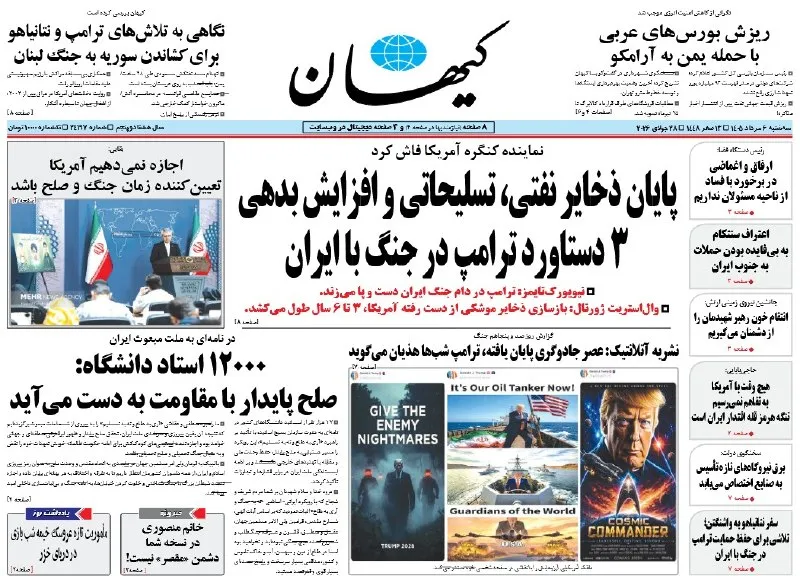
Bottom line: The fronts pivot from last week’s succession-consolidation surge to a multi-front pressure story: a reported Caspian-Sea attack on an Iranian vessel that Tehran vows will ‘not go unanswered’, a US-Iran vessel standoff in the Strait of Hormuz that the IRGC’s Khatam al-Anbia headquarters calls tantamount to ‘war expansion’, and a Trump-Netanyahu-Zelensky summit in Washington, all set against a consolidating American-fatigue narrative, while the only wire-corroborated kinetic reality on the page remains the Yemen-on-Saudi oil campaign.
Executive Summary
Day 147 is a multi-front-pressure edition, and its lead judgment is that the fronts have opened a new potential confrontation axis: a reported attack on an Iranian commercial vessel in the Caspian Sea. Nobonyad gives its whole front to ‘Fear of Iran’s response’ (هراس از پاسخ ایران), reading Ukraine’s cautious remarks as evidence that Kyiv is uneasy about the consequences, while Tehran’s warning that the act ‘will not go unanswered’ (بیپاسخ نخواهد ماند) supplies the deterrent counterpoint; Vatan-e Emrooz and Sobh-e No corroborate, reporting that Ukraine’s president claimed responsibility for striking two Iranian vessels with one sailor killed, and that Foreign Minister Abbas Araghchi warned of a response and called it a UN Charter violation. The mechanism is a deliberate staging of Iranian deterrence credibility against a non-Israeli, non-American actor, and the significance is that the war frame is being widened beyond the Israel-US axis into a new maritime theatre, on the day Trump was reported hosting Netanyahu and Zelensky together in Washington.
The second organising theme is the hardening of the standing Hormuz thread from a governance claim into a live US-Iran vessel standoff. The IRGC’s Khatam al-Anbia central headquarters (via Defa Press) alleges the United States threatened Iranian commercial vessels and tankers in territorial waters over three days and warns that ‘blockade actions constitute war expansion’; Kayhan’s right rail insists ‘no transit through the Strait of Hormuz without Iran’s authority’ (eqtedar); the English Iran Daily runs an exclusive interview arguing ‘Iran, Oman alone should take charge of Strait of Hormuz security’; and Jomhouri Eslami leads its left column with ‘Financial Times: America will be forced to accept Iran’s management of Hormuz.’ Read together, the thread moves from the prior edition’s claimed institutional-and-toll role to asserted operational friction with US shipping, the sharpest escalation of the chokepoint story to date, though the vessel-threat and ‘management’ claims remain Iranian and second-hand assertions rather than demonstrated arrangements.
Beneath the loud claims, the edition again separates the corroborated from the asserted. The multi-country US-base-strike narrative persists, Vatan-e Emrooz’s ‘Shock of the strikes’ presenting American ‘surprise’ at improved Iranian strike quality, yet it is not echoed by the operational content of the state’s own defence wires, whose corroborated kinetic activity remains the Yemen-on-Saudi oil campaign: Kayhan banners ‘Arab bourses collapse with Yemen’s strike on Aramco’; the wires and the Iran daily report Aramco’s Ras Tanura shutdown and pipeline fires at Jizan and Yanbu still burning after 48 hours, Yahya Saree named as spokesman, and Nour News notes explosions near eastern-Saudi oil-and-gas facilities. The American-fatigue narrative, meanwhile, consolidates onto testable public-opinion and materiel claims: Qods leads ‘Defeat: the Yankees’ takeaway from the war’ citing 76 percent of US opinion; the Iran daily carries a 33 percent war-support poll, the lowest since the conflict began; Jam-e Jam runs a ‘United States of Bluff’ infographic on ‘364 false Trump claims’; and Kayhan headlines ‘three achievements of Trump,’ depleted oil and missile reserves and rising debt, sourced to the New York Times, the Wall Street Journal and Representative Thomas Massie.
The intra-regime argument over war and settlement continues, now with the establishment placing the Guard visibly behind the memorandum. Jomhouri Eslami leads on the IRGC spokesman declaring that the ceasefire and the signed MoU are ‘the decision of the system’ and that the Guard ‘submits to it’, the clearest settlement-side discipline signal of the cycle, positioned against the rejectionist wing that pressed the capitulation charge in prior editions. Nobonyad supplies the counter-register from the principlist side, but inward rather than escalatory: a front-page editorial, ‘When national security is sacrificed to strategic illiteracy,’ turns a critical lens on the quality of security decision-making even as the paper demands a credible response abroad. The reformist titles hold apart from both: Shargh leads on domestic councils ‘between law and expediency’ and on ‘hope for a return to diplomacy’ after the recent two-day truce, warning of a ‘third front of the war’; Etemad treats ‘Netanyahu’s mission at the White House’ as diplomacy to be parsed and foregrounds the water crisis.
A domestic story crosses the factional line this edition: the ‘trustees’ (تراستیها) sanctions-evasion case. Sobh-e No reports the judiciary recovering 7.5 billion euros in foreign-currency obligations from illegal trustee networks that withheld oil proceeds, with head of judiciary Mohseni Ejei citing roughly 300 cases, 22 detained and 15 under Interpol red notices; Ta’adol frames the same trustees as ‘the hidden ring of sanctions’ and asks why the return of hard currency remains a serious demand; and reformist Etemad leads on ‘the betrayal of the trustees.’ The convergence of principlist enforcement-triumph, economic-structural analysis and reformist accountability on a single corruption story is itself notable, a rare cross-factional theme running beneath the war narrative. The succession-consolidation surge that dominated the prior edition, by contrast, recedes to a secondary strip: the Leader’s Hezbollah message is demoted to the Iran daily’s top banner (‘Leader hails Hezbollah’s steadfastness’) and a Vatan-e Emrooz sub-item, no longer the day’s full-page centrepiece.
Net assessment: this is a multi-front-pressure edition. The verifiable developments are a reported new maritime incident in the Caspian with an Iranian deterrent warning, an escalation of the Hormuz standoff into asserted friction with US shipping, a corroborated Yemen-on-Saudi oil campaign, a public reassertion of establishment discipline behind the MoU, and a cross-factional domestic corruption crackdown; the unverifiable content remains the cluster of Iranian strikes on US bases, now presented as ‘shock’ but no better corroborated, and the US-collapse and Hormuz-‘management’ claims that ride on foreign-press and second-hand sourcing. The highest-significance finding is the Caspian tripwire: the deliberate widening of the confrontation into a new theatre against a new actor, staged as a deterrence test on the day of a three-capital Washington summit. The signal most worth watching is whether Tehran’s ‘will not go unanswered’ warning produces any kinetic follow-through or resolves as messaging, and the negative-evidence finding is the ebb of the succession surge and the reformist press’s sustained distance from the mobilization line.
Prepared for analysis and early warning. Hostile content documented for defensive assessment only.
Key Points
- KJ-1 [MODERATE-HIGH] A potential new confrontation axis has opened in the Caspian Sea, and Tehran is staging a deterrence signal over it. Nobonyad leads with ‘Fear of Iran’s response’ to a reported attack on an Iranian vessel; Vatan-e Emrooz and Sobh-e No report Ukraine’s president claiming responsibility for striking two Iranian vessels with one sailor killed; Foreign Minister Araghchi is reported warning the act ‘will not go unanswered’ and calling it a UN Charter violation, on the day Trump was reported hosting Netanyahu and Zelensky in Washington. Significance: the war frame is being widened beyond the Israel-US axis into a new maritime theatre against a new actor; the incident and the warning are attributed reporting, not independently confirmed, and the tracking cue is whether the warning produces any kinetic Iranian follow-through or resolves as messaging.
- KJ-2 [MODERATE-HIGH] The Strait of Hormuz thread has hardened from a governance-and-toll claim into an asserted US-Iran vessel standoff. The IRGC’s Khatam al-Anbia headquarters alleges the US threatened Iranian commercial vessels and tankers in territorial waters over three days and warns that ‘blockade actions constitute war expansion’; Kayhan insists on ‘no transit without Iran’s authority’; the English Iran Daily pitches Iran-and-Oman stewardship of Hormuz security; Jomhouri Eslami cites the Financial Times that America will be ‘forced to accept Iran’s management’ of the strait. Significance: this converts the prior edition’s institutional claim into claimed operational friction with US shipping, the sharpest turn in the chokepoint thread to date; the vessel-threat and ‘management’ claims are Iranian and second-hand assertions, and the cue is whether any external party or primary source substantiates them.
- KJ-3 [HIGH] The one kinetic reality corroborated on the state’s own wires remains the Yemen-on-Saudi oil campaign, not any Iranian strike on US bases. Kayhan banners the collapse of Arab bourses after Yemen’s strike on Aramco; the Iran daily and the wires report the Ras Tanura shutdown and fires at the Jizan and Yanbu pipelines still burning after 48 hours (Yahya Saree named), and Nour News notes explosions near eastern-Saudi oil facilities. Significance: the corroborated Saudi disruptions should be tracked separately from the uncorroborated Iranian base-strike and Hormuz-closure claims that ride on them; the evidentiary base of the coercion narrative is Yemeni operations, not a demonstrated Iranian capability.
- KJ-4 [MODERATE-HIGH] The American-fatigue narrative has consolidated onto specific, testable public-opinion and materiel claims. Qods leads ‘Defeat: the Yankees’ takeaway’ citing 76 percent of US opinion; the Iran daily carries a 33 percent war-support poll (‘the lowest since the conflict began’); Jam-e Jam runs a ‘United States of Bluff’ infographic on 364 false Trump claims; Kayhan headlines ‘three achievements of Trump’, depleted oil and missile reserves and rising debt, sourced to the NYT, WSJ and Representative Massie. Significance: the discipline is real (near-identical carriage indicates central guidance), but the underlying material is Western reporting of caution amplified into a claim of demonstrated US weakness; the item to watch is whether any operational fact is offered to substantiate it or whether it remains a foreign-press-sourced posture.
- KJ-5 [MODERATE] Establishment discipline behind the memorandum has been publicly reasserted, placing the IRGC behind the settlement track. Jomhouri Eslami leads on the IRGC spokesman declaring the ceasefire and the signed MoU ‘the decision of the system’ to which the Guard ‘submits’, positioned against the rejectionist wing that pressed the capitulation charge in prior editions. Significance: this is the clearest settlement-side signal of the cycle and complicates the reading that the hardline consensus is uniformly escalatory; the intra-regime split persists, now with the Guard visibly on the discipline side, and the cue is whether the rejectionist titles contest or accept the framing.
- KJ-6 [MODERATE] A domestic sanctions-evasion crackdown, the ‘trustees’ case, has become a cross-factional front-page theme. Sobh-e No reports a 7.5-billion-euro judiciary recovery from illegal trustee networks that withheld oil proceeds (Mohseni Ejei; ~300 cases, 22 detained, 15 under Interpol red notices); Ta’adol frames the trustees as ‘the hidden ring of sanctions’; reformist Etemad leads on ‘the betrayal of the trustees.’ Significance: the convergence of principlist enforcement-triumph, economic-structural analysis and reformist accountability on one corruption story is a rare cross-factional signal beneath the war narrative; the figures are official judiciary claims pending independent confirmation, and the cue is whether the case yields named prosecutions or remains a messaging vehicle.
- KJ-7 [MODERATE] Negative evidence: the succession-consolidation surge that dominated the prior edition has receded, and the reformist press sustains its distance from the war frame. The Leader’s Hezbollah message is demoted from a full-page centrepiece to the Iran daily’s top strip and a Vatan-e Emrooz sub-item; Shargh leads on domestic councils and ‘hope for a return to diplomacy’ while warning of a ‘third front of the war,’ and Etemad treats Netanyahu’s Washington visit as diplomacy to be parsed. Significance: the ebb of the succession-imagery surge after its peak, and the reformist titles’ continued diplomacy-preference and escalation-caution, are logged as findings in their own right, a proxy for the durability of elite reservations about the centrally-set mobilization line.
Macro Trends
- A new confrontation axis opens in the Caspian, staged as a deterrence test. The freshest escalation is not on the Israel-US axis but in the Caspian Sea: a reported attack on an Iranian commercial vessel, with Ukraine’s president said to have claimed responsibility and one sailor killed. Nobonyad leads with ‘Fear of Iran’s response,’ Vatan-e Emrooz and Sobh-e No corroborate, and Foreign Minister Araghchi is reported warning the act ‘will not go unanswered’ and calling it a UN Charter violation. The mechanism is a deliberate staging of Iranian deterrence credibility against a new actor, widening the war frame into a fresh maritime theatre; the incident and the warning are attributed reporting, not independently confirmed.
- The Hormuz thread hardens from a governance claim to a US-Iran vessel standoff. Last edition’s Hormuz story was a claimed governance-and-toll role; this edition it becomes asserted operational friction. The IRGC’s Khatam al-Anbia headquarters alleges the US threatened Iranian vessels and tankers in territorial waters over three days and warns that ‘blockade actions constitute war expansion’; Kayhan insists on ‘no transit without Iran’s authority’; the English Iran Daily pitches Iran-and-Oman stewardship of Hormuz security; and Jomhouri Eslami cites the Financial Times that America will be ‘forced to accept Iran’s management’ of the strait. The move is from institutional claim to claimed friction with US shipping, the sharpest turn in the chokepoint thread to date, though the vessel-threat and ‘management’ claims remain Iranian and second-hand assertions.
- American exhaustion consolidates onto testable public-opinion and materiel claims. The standing ‘America blinked’ thread sharpens onto specific, checkable figures: Qods’s 76 percent of US opinion finding the war harder than expected, the Iran daily’s 33 percent war-support poll (‘the lowest since the conflict began’), Jam-e Jam’s ‘United States of Bluff’ infographic on 364 false Trump claims, and Kayhan’s ‘three achievements of Trump’ (depleted oil and missile reserves, rising debt) sourced to the NYT, WSJ and Representative Massie. The near-identical carriage indicates centrally-guided amplification of Western reporting of caution into a claim of demonstrated US weakness, asserted rhetorically and via foreign-press citation rather than shown on the battlefield.
- The corroborated kinetic reality remains Yemen-on-Saudi at the oil chokepoint. As across recent editions, the one wire-supported kinetic activity is Ansarallah’s campaign against Saudi oil: Kayhan banners the collapse of Arab bourses after Yemen’s strike on Aramco; the Iran daily and the wires report the Ras Tanura shutdown and fires at the Jizan and Yanbu pipelines still burning after 48 hours, with Yahya Saree named; Nour News notes explosions near eastern-Saudi oil-and-gas facilities. The Iranian press repackages this as an energy-and-market shock on the West, but the operational base is Yemeni operations, not a demonstrated Iranian closure of Hormuz or the claimed strikes on US bases.
- Establishment discipline is reasserted behind the MoU, while a domestic corruption story crosses the factional line. Jomhouri Eslami places the IRGC visibly behind the settlement, its spokesman declaring the ceasefire and MoU ‘the decision of the system’ to which the Guard ‘submits’, the clearest settlement-side discipline signal of the cycle against the rejectionist wing. Beneath the war narrative, the ‘trustees’ sanctions-evasion case becomes a cross-factional theme: Sobh-e No reports a 7.5-billion-euro judiciary recovery (Mohseni Ejei, ~300 cases, 22 detained, 15 red notices), Ta’adol calls the trustees ‘the hidden ring of sanctions,’ and reformist Etemad leads on ‘the betrayal of the trustees.’ The succession-consolidation surge that led the prior edition, meanwhile, recedes to a secondary strip, and the reformist titles (Shargh, Etemad) sustain their diplomacy-preference and escalation-caution distance.
Front-Page Snapshot
- Nobonyad - “Fear of Iran’s response” (Conservative / principlist) - The Caspian-Sea attack on an Iranian vessel and Tehran’s warned response [HIGH]
- Jomhouri Eslami - “IRGC spokesman: the ceasefire and MoU are the establishment’s decision, and the IRGC submits to it” (Traditional / establishment) - Establishment discipline behind the MoU, plus an FT-sourced Hormuz-management claim [MODERATE]
- Kayhan - “The end of oil reserves, weapons stocks and rising debt: three ‘achievements’ of Trump in the war with Iran” (Hardline flagship (Leader’s office / IRGC)) - American exhaustion welded to succession-revenge and Hormuz-authority doctrine [HIGH]
- Iran Daily (English) - “Iran says not currently in talks with US” (State English daily (government)) - A public no-talks posture with an Iran-Oman Hormuz-stewardship pitch [MODERATE]
- Vatan-e Emrooz - “Shock of the strikes” (Hardline / principlist (channel read)) - Uncorroborated US-base-strike triumphalism plus the Caspian and Yemen threads [HIGH]
- Qods - “Defeat: the Yankees’ takeaway from the war” (Conservative (Astan Quds Razavi, Mashhad)) - US public-fatigue triumphalism and ridicule of Trump and Infantino [MODERATE-HIGH]
- Jam-e Jam - “Iran: the axis of the power shift from West to East” (State broadcaster (IRIB)) - Civilizational realignment and a ‘United States of Bluff’ infographic on 364 false Trump claims [MODERATE]
- Sobh-e No - “Oil in the chokepoints’ squeeze” (Principlist (channel read)) - Chokepoint energy leverage and the domestic ‘trustees’ sanctions-evasion crackdown [MODERATE-HIGH]
- Iran - “US war support falls to its lowest as Trump’s rhetoric hardens” (Official government daily (channel read)) - US-fatigue polling and domestic-normalcy messaging in a diplomatic register [LOW-MODERATE]
- Ta’adol - “The ‘trustees’: the hidden ring of sanctions” (Economic / business) - Sanctions-evasion structure and the war’s home-front market strain [LOW-MODERATE]
- Etemad - “The betrayal of the ‘trustees’” (Reformist) - Corruption accountability and diplomacy framing, war-triumph absent [LOW-MODERATE]
- Shargh - “The councils between law and expediency” (Reformist) - Domestic governance and a hoped-for return to diplomacy, with a ‘third front’ caution [LOW-MODERATE]
Compiled from Iranian front pages and outlet channels via open-source monitoring. Translations are editorial; named-figure attributions are verified against the source pages where possible.