Iranian Press Monitor - Sunday, 26 July 2026 (Day 145)
Sunday, 26 July 2026 · 4 Mordad 1405 · 11 Safar 1448 - Ten front pages (nine Persian scans, one English print) plus three channel-read dailies and three agency wires; Tehran Times and the office-of-the-Leader website were unavailable at the time
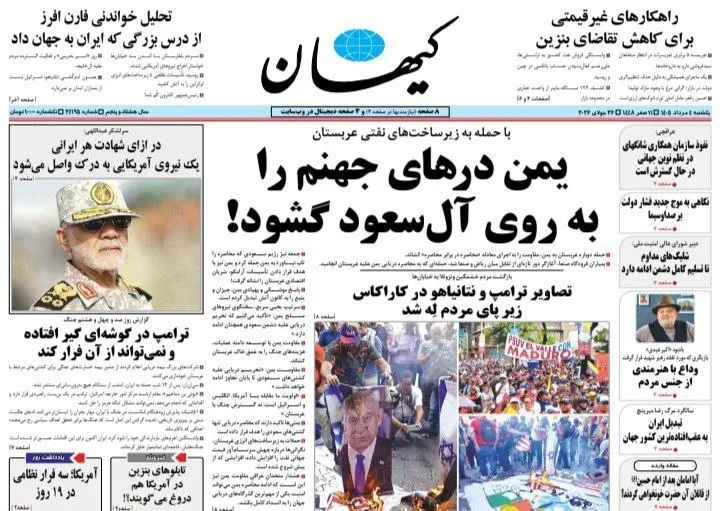
Bottom line: The Iranian front pages converge on amplifying a New York Times report that Washington halted its escalation out of materiel weakness, folding it into an ‘America blinked, Trump is trapped’ narrative, while the only kinetic reality corroborated on the state’s own defense wires remains the Yemen-on-Saudi oil campaign; Iranian claims of destroyed US bases in Erbil, Jordan, Kuwait and Bahrain stay attacker-sourced and are now partly contradicted by Kuwait’s own denial, and the constructive diplomacy on the page runs through Beijing, Muscat and Islamabad rather than Washington.
Executive Summary
Day 145 is an American-retreat amplification edition, and its lead judgment is that the day’s dominant framing move is psychological, not kinetic: a cluster of titles converts a New York Times report that the Trump administration paused its escalation against Iran into a narrative of American weakness and entrapment. Kayhan leads its channel with ‘the New York Times reveals America halted the war’s escalation out of fear of greater losses,’ citing depleted Patriot interceptor stocks and exposure of Arab allies; Sobh-e No runs the same ‘Trump’s reluctance to escalate’ speculation; and the security-linked Nour News prints Trump’s counter-claim, ‘we have not retreated,’ which functions in this edition as the exception that proves the theme. The English Iran Daily supplies the ideological gloss with an opinion piece, ‘global peace threatened by American unilateralism.’ The mechanism is amplification of a single Western report into centrally-convergent messaging, and the analytic caution is that the underlying claim is a reported hesitation, not a verified Iranian battlefield gain.
Beneath that narrative, the edition again separates loud front-page claims from wire-corroborated events. The multi-country US-base strike claim persists and hardens in specificity, Iran Daily’s ‘Armed Forces pummel US bases in Bahrain, Jordan, Kuwait,’ Seda-ye Iran’s ‘complete destruction of three US special-forces munitions systems at the King Faisal base,’ Vatan-e Emrooz’s named operations ‘Nasr-2’ and ‘Saeqeh,’ Fars News’s assertion that Iran struck ‘AWS data-center nodes’ in Bahrain, and a military spokesman’s claim on Defa Press that US infrastructure in Erbil is ‘nearly completely destroyed’, yet the state’s own defense wires document only Yemeni (Ansarallah) operations against Saudi Arabia, and Kuwait’s ambassador is reported on Defa Press to have explicitly denied that any operation was mounted from or against Kuwaiti territory. The most escalatory content of the day remains the least sourced, and the Kuwait denial is fresh negative evidence against it.
The one kinetic reality the wires do corroborate is the Yemen-on-Saudi oil campaign, and the papers convert it into an oil-shock-on-the-West story. Kayhan leads ‘Yemen has opened the gates of hell upon the House of Saud’ after strikes on Yanbu, Jizan and Aramco facilities; Sobh-e No and Defa Press report two Yemeni operations against Aramco and a projectile strike on a tanker roughly seventy miles off Al-Shuqaiq; Vatan-e Emrooz reports two Saudi tankers ablaze in the Red Sea and prices Brent near 101 dollars. The economic press carries the same theme in its own register: Chahar Sough leads ‘a closed Hormuz is Europe’s gas nightmare,’ Etemad frames ‘the Hormuz oil crisis turning into a gas crisis,’ and the IRIB-owned Jam-e Jam cites the International Energy Agency on ‘severely reduced’ Qatari and Emirati LNG supply and Hormuz traffic well below pre-conflict levels. Foreign-ministry spokesmen keep the chokepoint claim alive politically (Hormuz ‘will never return to pre-war conditions’), while confirming Iran-Oman technical talks on safe navigation.
The constructive diplomacy on the page is pointedly eastern and regional, not American. The government daily Iran leads on ‘Beijing’s roadmap for regional peace’ and an Araghchi-Wang Yi meeting; the establishment Jomhouri Eslami leads on ‘new China and Pakistan efforts to return Iran and America to the understanding’; the English Iran Daily confirms four Iran-Iraq cooperation deals including a Basra-Shalamcheh rail memorandum with President Pezeshkian urging ‘swift implementation’; and Foreign Minister Araghchi conducts Shanghai Cooperation Organization diplomacy in Dushanbe, his line rendered as ‘Iran’s diplomacy was met with military action, not dialogue.’ This mediation pole runs directly against the hardline Nobonyad, whose lead calls the collapsed 25-day Iran-US understanding ‘damage more costly than the JCPOA’, so the intra-regime argument over whether to seek an exit, the fracture the prior edition put on the front page, continues today mapped onto the question of returning to talks.
Two threads that had gone quiet reappear. Sobh-e No reports Israeli artillery fire into southern Lebanon (Kafr Tebnit, Markaba, the Bayt Yahoun-Kunin axis), the most concrete Lebanon-front signal in several editions, and Nour News reports Israel extending its emergency status through 11 August citing both Iran and Lebanon, with Netanyahu due to meet Trump in Washington, so Israel and Lebanon re-enter as low-level but active signals rather than the absent fronts of recent days. Separately, Iran’s foreign ministry (via Defa Press) condemns a reported Ukrainian attack on an Iranian commercial vessel in the Caspian that killed one sailor, a discrete new incident to track.
Net assessment: this is an amplification-and-cost edition. The verifiable developments are a reported American pause (Iranian-amplified into a weakness narrative), a corroborated Yemen-on-Saudi oil campaign, active eastern mediation, and a quantified accounting of war damage on Iranian soil; the unverifiable and now partly contradicted content is the cluster of Iranian strikes on US bases across three-plus countries. The highest-significance finding is the coordinated conversion of a Western report on US restraint into an ‘America blinked’ narrative, because it is a messaging posture the state’s own operational channels do not support; the sharpest internal contradiction is again that the state broadcaster’s own paper (Jam-e Jam) counts the war’s cost in megawatts and tomans while other fronts declare American bases destroyed; and the signal most worth watching into the next cycle is the re-activation of the Israel-Lebanon front alongside a Netanyahu-Trump meeting.
Key Points
- KJ-1 [HIGH] A single Western report of American restraint has been converted into a coordinated ‘America blinked, Trump is trapped’ narrative across the fronts. The New York Times account of a paused US escalation (depleted Patriots, exposed Arab allies) runs near-identically on Kayhan, Sobh-e No and Defa Press, is glossed by Iran Daily’s ‘American unilateralism’ opinion piece, and is contradicted only by Trump’s own ‘we have not retreated’ denial reprinted on Nour News. Significance: this is the cycle’s dominant and most consequential framing move because it asserts a shift in the strategic balance through amplified rhetoric rather than any demonstrated Iranian gain; the discipline is real (near-identical carriage indicates central guidance) but the underlying event is a reported hesitation, so the barometer to watch is whether any operational fact is ever offered to substantiate the ‘America blinked’ claim, or whether it remains a purely narrative posture.
- KJ-2 [MODERATE-HIGH] The multi-country US-base strike claims are more specific today but remain uncorroborated and are now partly contradicted. Iran Daily’s ‘pummel US bases in Bahrain, Jordan, Kuwait,’ Seda-ye Iran’s ‘King Faisal base’ destruction, Vatan-e Emrooz’s named ‘Nasr-2’ and ‘Saeqeh’ operations, Fars News’s ‘AWS data-center’ claim and a Defa Press spokesman’s ‘Erbil nearly destroyed’ assertion are unsupported by the operational content of the state’s own defense wires, which report only Yemeni strikes on Saudi Arabia, and Kuwait’s ambassador is reported to have denied any operation from or against Kuwaiti territory. Significance: the most escalatory content of the day is again the least sourced, the added specificity does not add corroboration, and the Kuwaiti denial supplies fresh negative evidence; every base-strike claim should be treated as attacker-sourced messaging to be confirmed outside this monitor.
- KJ-3 [HIGH] The one kinetic reality corroborated on the wires is the Yemen-on-Saudi oil campaign, which the press repackages as an energy shock on the West. Strikes on Yanbu, Jizan and Aramco facilities, tanker attacks near Al-Shuqaiq and in the Red Sea, and Bab al-Mandeb interdiction are reported consistently across Kayhan, Sobh-e No, Vatan-e Emrooz, Defa Press and Fars News, with Brent priced near 101 dollars and IEA-cited Gulf LNG disruption. Significance: the standing dual-chokepoint coercion thread persists, but its evidentiary base is Ansarallah operations, not a demonstrated Iranian closure of Hormuz; the corroborated Saudi disruptions should be tracked separately from the uncorroborated Iranian oil-revenue and Hormuz-closure claims that ride on them.
- KJ-4 [MODERATE-HIGH] The constructive diplomacy on the page is deliberately eastern and regional, not directed at Washington. Iran leads on Chinese mediation (‘Beijing’s roadmap,’ the Araghchi-Wang Yi meeting), Jomhouri Eslami on China-and-Pakistan efforts to restore the understanding, Iran Daily on four Iran-Iraq deals and a Basra-Shalamcheh rail memorandum, and Araghchi conducts SCO diplomacy in Dushanbe, while Iran-Oman talks on Hormuz navigation continue. Significance: this signals a government strategy of demonstrating statecraft through partners while blaming the US track’s collapse on American bad faith; it is the operative counter to the hardline war frame, and whether it becomes the regime’s principal line, against Nobonyad’s rejectionism, is the intra-elite contest to watch.
- KJ-5 [MODERATE] The intra-regime split over seeking an exit persists, now expressed as a diplomacy-versus-rejection divide. The mediation-and-settlement pole (Iran, Jomhouri Eslami, Etemad’s ‘diplomacy besieged by distrust,’ Sazandegi’s ‘mediators against war,’ Ta’adol’s argument that inflation cannot be tamed until sanctions and talks are resolved) stands opposite the rejectionist and mobilization pole (Nobonyad’s ‘damage worse than the JCPOA,’ Kayhan, Seda-ye Iran’s call for the public to ‘stay in the field’). Significance: the fracture the prior edition documented over control of the war narrative continues today mapped onto the return-to-talks question; the alignment of reformist, government and establishment titles on the diplomacy side against a hardline rejectionist bloc is the structural feature to track, not any single day’s headline.
- KJ-6 [MODERATE-HIGH] Israel and Lebanon re-enter as low-level but active fronts after several editions of near-absence. Sobh-e No reports Israeli artillery fire into southern Lebanon (Kafr Tebnit, Markaba, the Bayt Yahoun-Kunin axis), and Nour News reports Israel extending emergency status through 11 August, citing both Iran and Lebanon, ahead of a Netanyahu visit to Trump in Washington; Jomhouri Eslami keeps Israel present through ICC lawfare, a UN-envoy threat and the Golan question. Significance: a concrete Lebanon-front artillery report plus an Israeli emergency-status extension is a re-activation signal worth close tracking, since a return to either the Lebanon or the Israel front would materially change the war’s geometry; the scanned Persian fronts still treat these fronts only glancingly, so the signal comes mainly from the channels and wires.
- KJ-7 [MODERATE] Negative-evidence judgment: the war’s cost is admitted on the page, including on Iranian soil, and the Leader’s direct voice is absent. The IRIB-owned Jam-e Jam quantifies a 4,200-megawatt grid loss and over 60 trillion tomans in damage and reports enemy projectile strikes repaired at Jassk and explosions near Sirik; Ta’adol and Chahar Sough price inflation and gold flight; meanwhile no scanned front carries a direct message from the Leader (Mojtaba Khamenei), whose voice appears only second-hand via Seda-ye Iran’s mobilization framing. Significance: the damage accounting is a first-class counterweight to the triumph narrative and is the more telling for coming from the broadcaster’s own paper, while the Leader’s continued low direct front-page presence on a day of open diplomacy-versus-rejection dispute extends the succession-era pattern and is logged as its own finding.
Macro Trends
- American restraint is recast as American weakness. A New York Times report that Washington paused its escalation, attributed to depleted Patriot interceptor stocks, exposure of Arab allies, and feared economic fallout, is amplified near-identically across Kayhan, Sobh-e No and Defa Press and glossed by Iran Daily’s ‘global peace threatened by American unilateralism’ opinion piece and Kayhan’s recycled ‘Trump cannot find an exit’ motif. Nour News’s printing of Trump’s own denial (‘we have not retreated’) is the lone dissonant note. The convergence indicates centrally-guided message discipline on a psychological-advantage theme built from a single Western report, and it is the edition’s dominant framing move: a claimed shift in the strategic balance asserted through rhetoric rather than demonstrated on the battlefield.
- The claim-versus-wire gap widens, now with a Kuwaiti denial. The multi-country US-base strike claim hardens in specificity (named ‘Nasr-2’ and ‘Saeqeh’ operations, the ‘King Faisal base,’ ‘AWS data-center nodes’ in Bahrain, Erbil infrastructure ‘nearly destroyed’) across Iran Daily, Seda-ye Iran, Vatan-e Emrooz, Fars News and a Defa Press spokesman, yet none is echoed by the operational content of the state’s own wires, which report only Yemeni strikes on Saudi Arabia, and Fars News itself notes ‘no new Iranian strikes’ in its analytical posts. The reported Kuwaiti ambassadorial denial that any operation was mounted from or against Kuwaiti territory is fresh negative evidence. The divergence between curated fronts and defense channels is itself the finding: treat every US-base strike claim as messaging to be confirmed outside this monitor.
- The corroborated kinetic reality is the Yemen-on-Saudi oil campaign. Ansarallah operations against Yanbu, Jizan and Aramco facilities, plus tanker strikes near Al-Shuqaiq and in the Red Sea and interdiction at Bab al-Mandeb, are the day’s one wire-supported kinetic activity (Kayhan, Sobh-e No, Vatan-e Emrooz, Defa Press, Fars News), and the Iranian press packages it as an oil-and-energy shock aimed at the West. Brent is priced near 101 dollars; the economic titles extend the theme (Chahar Sough’s ‘closed Hormuz, Europe’s gas nightmare’; Etemad’s oil-to-gas crisis; Jam-e Jam’s IEA citation on reduced Gulf LNG). The standing dual-chokepoint coercion thread persists, sourced to Yemeni operations rather than to any demonstrated Iranian closure of Hormuz.
- Diplomacy is redirected east, through Beijing, Muscat and Islamabad. With the US channel declared dead by American bad faith, the constructive diplomacy on the page is eastern and regional: Iran leads on ‘Beijing’s roadmap’ and an Araghchi-Wang Yi meeting, Jomhouri Eslami on ‘China and Pakistan efforts’ to restore the understanding, Iran Daily on four Iran-Iraq deals and a rail memorandum, and Araghchi conducts SCO diplomacy in Dushanbe, while Nour News confirms Iran-Oman technical talks on Hormuz navigation. This government strategy of demonstrating statecraft through partners runs directly against Nobonyad’s rejectionist ‘worse than the JCPOA’ verdict, keeping the intra-regime argument over an exit alive as a diplomacy-versus-rejection split.
- War cost is admitted while Israel and Lebanon re-activate. The IRIB-owned Jam-e Jam quantifies the war’s cost (a reported 4,200-megawatt grid-capacity loss, over 60 trillion tomans, projectile damage repaired at Jassk and explosions near Sirik), and Ta’adol and Chahar Sough price inflation and gold flight, a counterweight to the triumph frame sharpened by coming from the broadcaster’s own paper. At the same time, after editions in which Israel and Lebanon were absent as fronts, Sobh-e No reports Israeli artillery into southern Lebanon and Nour News reports Israel extending emergency status through 11 August (citing Iran and Lebanon) ahead of a Netanyahu-Trump meeting, re-activating those fronts as low-level but live signals.
Front-Page Snapshot
- Kayhan - “Yemen has opened the gates of hell upon the House of Saud!” (Hardline flagship (Leader’s office / IRGC)) - Yemen-Saudi oil campaign and ‘America blinked’ narrative [HIGH]
- Iran Daily (English) - “Armed Forces pummel US bases in Bahrain, Jordan, Kuwait” (State English daily (government)) - Multi-country US-base strike claim for the international audience [HIGH]
- Seda-ye Iran - “Why must the people stay in the field?” (Hardline / revolutionary (Leader’s-office material)) - Popular mobilization plus a ‘King Faisal base’ strike claim [HIGH]
- Vatan-e Emrooz - “Three-digit oil returns (channel read)” (Hardline / principlist) - Named strike operations fused with oil-shock framing [HIGH]
- Sobh-e No - “New York Times speculates on Trump’s reluctance to escalate (channel read)” (Principlist) - American-restraint narrative plus a live Lebanon-front report [MODERATE-HIGH]
- Nobonyad - “Damage more costly than the JCPOA” (Conservative / principlist) - Collapsed US understanding cast as strategic loss; anti-diplomacy [MODERATE-HIGH]
- Iran - “Beijing’s roadmap for regional peace” (Official government daily) - Chinese-sponsored regional mediation; defense of the presidency [LOW-MODERATE]
- Jomhouri Eslami - “New China and Pakistan efforts to return Iran and America to the understanding” (Traditional / establishment) - China-Pakistan mediation and Israel lawfare [MODERATE-HIGH]
- Etemad - “The battle of the straits” (Reformist) - Chokepoint tension framed as stalemate; ‘diplomacy besieged by distrust’ [MODERATE]
- Chahar Sough - “A closed Hormuz is Europe’s gas nightmare” (Economic / business) - Hormuz as European energy shock; flight to gold [MODERATE]
- Ta’adol - “Inflation, the prime suspect” (Economic) - Inflation tied to unresolved sanctions and war [LOW-MODERATE]
- Jam-e Jam - “4,200-megawatt cut in grid capacity following war damage (channel read)” (State broadcaster daily (IRIB)) - Quantified war cost and energy disruption [MODERATE]
- Sazandegi - “Farewell to the sultan of roles” (Reformist (Kargozaran)) - Cultural obituary lead; ‘mediators against war’ editorial [LOW]
Full report
The complete edition - per-paper front-page analysis and full translation appendices - is available as a PDF: Download the full report.
Compiled from Iranian front pages and outlet channels via open-source monitoring. Translations are editorial; named-figure attributions are verified against the source pages where possible.