Iranian Press Monitor - Saturday, 25 July 2026 (Day 144)
Saturday, 25 July 2026 · 3 Mordad 1405 · 10 Safar 1448 - Ten front pages (nine Persian scans, one English print) plus three channel-only titles and three agency wires; Tehran Times was unavailable at the time
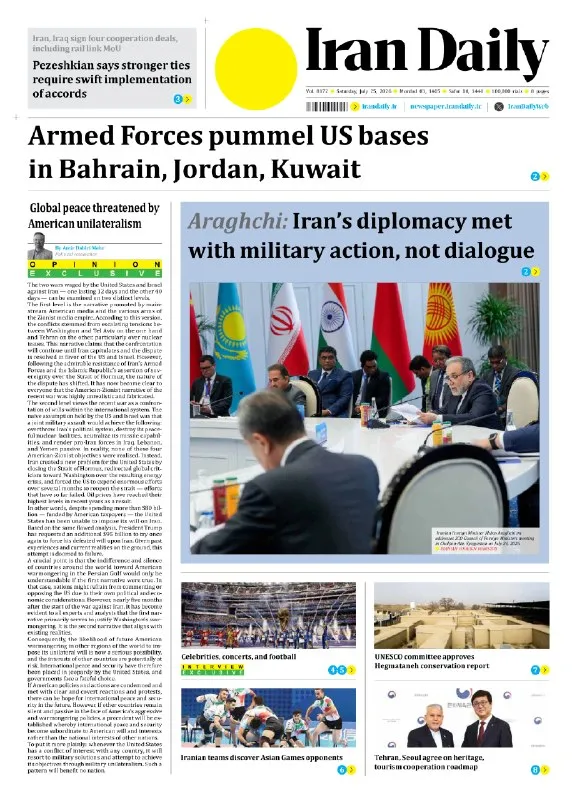
Bottom line: Day 144 puts an intra-regime fracture on the front pages: the presidency and the foreign ministry openly accuse the state broadcaster of censoring the heads of the branches and ‘fanning a warmongering discourse,’ a charge carried on reformist, government and establishment fronts alike, while a hardline cluster declares the 14-point ceasefire framework collapsed and the ‘40-day war’ resumed and claims fresh strikes on US bases in Bahrain, Jordan and Kuwait, claims the state’s own defense wires (which report only Yemeni strikes on Saudi Arabia) do not corroborate, so the day’s sharpest signal is not a battlefield event but the public split over whether Iran is escalating or seeking an exit.
Executive Summary
Day 144 is a factional-fracture edition, and its lead judgment is that the split over the war’s direction has moved from subtext to the front page, fought over control of the state broadcaster. The presidency’s Government Information Council and Foreign Minister Abbas Araghchi publicly accuse Seda va Sima (IRIB) of truncating the speeches of the heads of the branches and of ‘fanning a warmongering discourse’; the reformist Etemad prints Araghchi’s rebuke verbatim (‘not only contrary to media rationality, but a serious blow to national cohesion in the face of foreigners’), the reformist Sazandegi runs a full front-page editorial calling the broadcaster ‘a base of extremism,’ and, most tellingly, the establishment Jomhuri Eslami lends its front to the same protest (‘Seda va Sima in formal conflict with diplomacy and the unity of the three branches’). That a government-and-reformist message discipline runs identically across reformist and establishment titles is strong evidence of a coordinated push, and it reveals an executive branch fighting a hardline broadcaster over who controls the war’s narrative.
The counter-bloc answers with a war-triumph frame that is loud on the page and thin on corroboration. The principlist Nobonyad declares ‘the 14-point memorandum between the presidents of Iran and America has collapsed’ and the armed forces have ‘returned to the successful orbit of the 40-day war,’ over an image of a US flag-draped coffin; the English Iran Daily leads ‘Armed Forces pummel US bases in Bahrain, Jordan, Kuwait’; Qods attributes to a ‘General Abdollahi’ of the ‘Khatam base’ a ‘deadly equation, one American to perdition for each martyred Iranian’; and Vatan-e Emrooz frames coordinated IRGC-and-Army strikes on American bases as proportional response. The central caution is that none of these claims is echoed by the state’s own IRGC-aligned wires: Defa Press, Fars News and Nour News on this date report only Yemeni (Ansarallah) operations against Saudi Arabia (Jizan, Yanbu, an Aramco facility, Saudi flight suspensions), not any Iranian strike on US bases in three countries. The most escalatory headlines of the day are the least sourced.
The diplomacy track, which the 23 July edition found ‘pushed off the page,’ partially returns, anchored not in US talks but in the Iraqi prime minister’s Tehran visit. The official government daily Iran leads on ‘Tehran and Baghdad on the path to drafting a strategic-cooperation document,’ pairs it with an Araghchi interview on ‘the untold details of America’s breach of covenant,’ and the English Iran Daily confirms four cooperation deals including a Basra-Shalamcheh rail-link memorandum, with President Pezeshkian urging ‘swift implementation.’ The economic titles align with this pole: Ta’adol banners ‘diplomacy against sanctions and war’ and prices the conflict as risk the market is absorbing, while even the IRIB-owned Jam-e Jam leads on quantified war damage to Iran’s grid (a reported 4,200-megawatt loss, over 60 trillion tomans), a rare front-page accounting of cost against the triumph register. Foreign Minister Araghchi is simultaneously abroad, addressing the 23rd Council of Foreign Ministers meeting in Dushanbe and meeting Chinese, Russian and Kyrgyz counterparts, with his ‘Iran’s diplomacy was met with military action, not dialogue’ line rendered for the international audience.
The standing chokepoint-and-oil thread continues, now leaning on the Yemen-on-Saudi campaign for its evidentiary base. Kayhan makes the oil weapon its lead (‘the oil-price explosion is Trump’s nightmare in the infrastructure threat’), projects crude toward and above 120 dollars on pressure at Hormuz and Bab al-Mandeb, and claims ‘ships do not dare approach the Red Sea’ alongside a rising-oil-revenue assertion; the wires’ reports of Saudi flight suspensions and fuel queues supply the real-world hook. Mohammad Javad Larijani’s line on Jam-e Jam (‘the management of Hormuz will always remain with Iran’) keeps the chokepoint-control claim in play. The Israel dimension is present only obliquely: Trump’s reported refusal of a 30-year Saudi nuclear deal unless Riyadh joins the Abraham Accords surfaces on Kayhan and Qods (‘Riyadh’s reactors hostage to a deal with the Zionists’), and Israel and Lebanon again appear as no active military front of their own.
Two cross-edition signals are worth filing. The ‘Trump caught in Iran’s whirlpool’ motif runs near-identically on three fronts (Jomhuri Eslami, Qods, Sobh-e No), a message-discipline marker on the US-in-a-trap narrative; and the death of veteran actor Akbar Abdi provides a shared non-war human-interest lead across several titles (Nobonyad, Iran and others), a reminder that the front pages are not wholly given to the war. The absence of a direct front-page message from the Leader (in current coverage, Mojtaba Khamenei) on a day of open factional dispute is itself logged as a finding: the arbiter does not visibly arbitrate.
Net assessment: this is a fracture-and-uncorroborated-escalation edition. The verifiable development is political, not kinetic, an executive branch and the reformist press openly contesting a hardline broadcaster’s control of the war narrative, while the hardline bloc answers with escalation claims (ceasefire collapsed, US bases struck across three countries, a life-for-life ‘equation’) that the state’s own wires do not support. The highest-significance finding is the broadcaster rift, because it exposes a top-level disagreement over whether Iran is resuming the war or seeking an exit; the loudest but least reliable content is the cluster of US-base strike claims; and the one corroborated kinetic reality on the wires is Yemeni strikes on Saudi Arabia, which the papers convert into an oil-and-Red-Sea coercion frame.
Key Points
- KJ-1 [HIGH] An open institutional rift over the war’s narrative has reached the front pages, with the executive branch attacking the state broadcaster. The Government Information Council and Foreign Minister Araghchi accuse Seda va Sima of censoring the heads of the branches and ‘fanning a warmongering discourse,’ carried on the reformist Etemad and Sazandegi, the government daily Iran and the establishment Jomhuri Eslami. Significance: this is the cycle’s most consequential development because it converts a latent factional disagreement into a public, cross-bloc fight over whether Iran escalates or seeks an exit, and its identical carriage on reformist and establishment titles indicates a coordinated executive push rather than organic convergence; the barometer to watch is whether the broadcaster or the government yields, and whether the Leader arbitrates.
- KJ-2 [HIGH] The hardline ‘ceasefire-collapsed, war-resumed’ escalation claims are prominent on the fronts but uncorroborated by the state’s own wires. Nobonyad’s collapse-of-the-14-point-memorandum lead, Iran Daily’s ‘US bases pummeled in Bahrain, Jordan, Kuwait,’ the Qods ‘one American per martyr equation’ and Vatan-e Emrooz’s base-strike framing are contradicted in emphasis by Defa Press, Fars News and Nour News, which report only Yemeni strikes on Saudi Arabia. Significance: the most escalatory content of the day is the least sourced, and the divergence between curated front pages and operational channels is itself the finding; treat every US-base strike claim as attacker-sourced messaging to be confirmed outside this monitor, and read the wire silence as evidence the claims are rhetorical rather than reported.
- KJ-3 [MODERATE-HIGH] The diplomacy track re-enters the front pages, redirected from the collapsed US channel toward Iraq, the SCO and the eastern economies. The government daily Iran leads on the Iran-Iraq strategic-cooperation document and an Araghchi ‘America’s breach of covenant’ interview; Iran Daily confirms four deals and the Basra-Shalamcheh rail memorandum; Ta’adol banners ‘diplomacy against sanctions and war’; and Araghchi conducts SCO diplomacy in Dushanbe. Significance: the negotiation impulse the 23 July edition found ‘pushed off the page’ returns, but pointedly away from Washington, signalling a government strategy of demonstrating statecraft through regional and eastern partners while blaming the US track’s failure on American bad faith; track whether this becomes the government’s principal counter to the hardline war frame.
- KJ-4 [MODERATE-HIGH] Chokepoint-and-oil coercion continues, now sourced to the Yemen-on-Saudi campaign rather than to claimed Iranian closures. Kayhan leads on 120-dollar oil, ‘ships dare not approach the Red Sea’ and rising oil revenue; the wires corroborate Yemeni strikes on Saudi targets (Jizan, Yanbu, Aramco) and consequent Saudi flight suspensions and fuel queues. Significance: the standing dual-chokepoint deterrence thread persists, but its evidentiary base has shifted to Ansarallah operations, which the Iranian press repackages as an oil-shock threat to the West; the gap between the corroborated Saudi disruptions and the uncorroborated Iranian oil-revenue and Hormuz-closure claims should be tracked separately.
- KJ-5 [MODERATE] Negative-evidence judgment: war cost is admitted on the page, and Israel and Lebanon remain absent as active fronts. The IRIB-owned Jam-e Jam leads on a reported 4,200-megawatt grid-capacity loss and 60-trillion-toman damage, and the economic titles price the war as risk; meanwhile no monitored front leads on an Israeli or Lebanese military development, with Israel present only through Trump’s reported Saudi-normalization condition (the Abraham Accords). Significance: the damage accounting is a rare counterweight to the triumph frame and, coming from the broadcaster’s own paper, sharpens the internal contradiction of the censorship rift; the continued Israel-Lebanon quiet should be logged as a finding in its own right, since a return to either front would be a signal.
- KJ-6 [MODERATE] Message-discipline markers recur, and the Leader’s direct voice is absent. The ‘Trump caught in Iran’s whirlpool’ line runs near-identically on Jomhuri Eslami, Qods and Sobh-e No, indicating centrally-guided framing on the US-in-a-trap narrative, while no direct front-page message from the Leader (Mojtaba Khamenei) appears on a day of open factional dispute. Significance: coordinated framing coexists with, and does not resolve, the broadcaster rift, suggesting the discipline operates on the anti-US narrative but not on the escalate-versus-exit question; the Leader’s non-appearance on an arbitration-worthy day continues the succession-era pattern of low direct front-page presence and is worth tracking as its own signal.
Macro Trends
- The war’s narrative control becomes an open institutional fight. The presidency and foreign ministry publicly accuse Seda va Sima (IRIB) of censoring the heads of the branches and reinforcing a warmongering discourse, and the charge runs across reformist (Etemad, Sazandegi), government (Iran) and establishment (Jomhuri Eslami) fronts. The uniformity indicates a coordinated executive push rather than scattered complaint, and it reframes a media dispute as a national-security argument: the government’s case is that the hardline broadcaster, not diplomacy, is the threat to national cohesion. This is the edition’s genuinely new development and the clearest evidence to date of a top-level split over the war’s direction.
- A hardline ‘ceasefire collapsed, war resumed’ frame, loud but wire-uncorroborated. Nobonyad declares the 14-point Iran-US presidential memorandum collapsed and the armed forces back in the ‘40-day war’; Iran Daily claims strikes ‘pummeling’ US bases in Bahrain, Jordan and Kuwait; Qods advertises a ‘one American per martyr equation.’ None is echoed by Defa Press, Fars News or Nour News, whose kinetic reporting on this date is confined to Yemeni strikes on Saudi Arabia. The gap between the front-page triumph claims and the defense wires’ actual content is the central analytic caution of the edition: the escalation is asserted on curated fronts, not documented on the operational channels.
- The diplomacy track returns through Baghdad, not Washington. With US talks framed as dead-by-American-bad-faith, the constructive diplomacy on the page is the Iraqi prime minister’s Tehran visit: a strategic-cooperation document to be drafted, four signed agreements, and a Basra-Shalamcheh rail-link memorandum, led by the government daily Iran and confirmed in English on Iran Daily. Ta’adol’s ‘diplomacy against sanctions and war’ banner and Araghchi’s simultaneous SCO diplomacy in Dushanbe extend the same pole. The negotiation impulse the prior edition found crowded out re-enters, redirected toward regional and eastern partners rather than the collapsed US track.
- Chokepoint coercion now rides the Yemen-on-Saudi campaign. Kayhan leads on the oil weapon (crude toward 120 dollars, ‘ships dare not approach the Red Sea,’ rising oil revenue), and Larijani reasserts permanent Iranian ‘management’ of Hormuz. The evidentiary base has shifted: the corroborated kinetic activity on the wires is Yemeni strikes on Saudi targets (Jizan, Yanbu, Aramco) causing Saudi flight suspensions and fuel queues, which the Iranian press converts into an oil-shock and Red Sea deterrence narrative. The standing dual-chokepoint thread from the 14 and 23 July editions persists, now sourced to Ansarallah operations rather than claimed Iranian closures.
- War cost surfaces on the page, including from the broadcaster’s own paper. The IRIB-owned Jam-e Jam leads on quantified damage to Iran’s electricity grid (a reported 4,200-megawatt capacity cut, over 2,000 network points, more than 60 trillion tomans in losses), and the economic titles (Ta’adol, and the business-diplomacy Chahar Sough) price the war as risk and cost rather than victory. That the broadcaster’s paper counts the damage while its broadcasts are accused of censoring the officials managing the response is the edition’s sharpest internal contradiction, and it is filed as a negative-evidence counterweight to the triumph frame.
Front-Page Snapshot
- Etemad - “Behind the censorship dam of Seda va Sima” (Reformist) - Broadcaster rift; Araghchi’s ‘blow to national cohesion’ rebuke [LOW-MODERATE]
- Jomhuri Eslami - “Seda va Sima’s conduct in formal conflict with diplomacy and inter-branch unity” (Traditional / establishment) - Establishment-side protest against the broadcaster [MODERATE]
- Sazandegi - “The organization of national rupture” (Reformist (Kargozaran)) - Broadcaster as a ‘warmongering base’; anti-war critique [LOW]
- Iran - “Tehran and Baghdad on the path to drafting a strategic-cooperation document” (Official government daily) - Iran-Iraq alignment; Araghchi diplomacy defense [LOW-MODERATE]
- Ta’adol - “A review of support for the automakers” (Economic) - ‘Diplomacy against sanctions and war’; war as priced risk [LOW-MODERATE]
- Kayhan - “The oil-price explosion: Trump’s nightmare in the infrastructure threat” (Hardline flagship (Leader’s office / IRGC)) - Energy coercion; Hormuz and Red Sea oil-shock [HIGH]
- Iran Daily (English) - “Armed Forces pummel US bases in Bahrain, Jordan, Kuwait” (State English daily (government)) - Multi-country US-base strike claim (uncorroborated by wires) [HIGH]
- Nobonyad - “Holding the field, the field” (Conservative / principlist) - Ceasefire-collapse declaration; US-casualty imagery [SEVERE]
- Qods - “A deadly equation against the Yankees” (Conservative (Astan Quds Razavi)) - Life-for-life retaliation threat (single-source) [SEVERE]
- Vatan-e Emrooz - “Coordinated strikes on American bases (channel read)” (Hardline / principlist) - Military retaliation and deterrence framing [HIGH]
- Sobh-e No - “Trump cannot get out of Iran’s whirlpool” (Principlist (channel read)) - ‘Trump trapped’ strategic-advantage narrative [MODERATE-HIGH]
- Chahar Sough - “Negotiation: a tool of American deception” (Economic / diplomacy) - IRGC anti-negotiation signalling [MODERATE-HIGH]
- Jam-e Jam - “A 4,200-megawatt cut in grid capacity following war damage” (State broadcaster daily (IRIB)) - War-damage cost accounting; Hormuz-control claim [MODERATE]
Compiled from Iranian front pages and outlet channels via open-source monitoring. Translations are editorial; named-figure attributions are verified against the source pages where possible.