Iranian Press Monitor - Thursday, 23 July 2026 (Day 142)
Thursday, 23 July 2026 · 1 Mordad 1405 · 8 Safar 1448 - Nine Persian front-page scans, one English print (Iran Daily) and three text titles (Kayhan, Sobh-e No, the government daily Iran), plus three agency wires; Tehran Times was unavailable at the time
Bottom line: Day 142 fuses two escalation frames into one page: the Leader’s reported pledge that the Minab schoolchildren’s killing will be ‘closed with revenge,’ and a cross-factional armed-forces red line that any US strike on Iran’s nuclear sites will be treated as an expansion of the war, so the front pages have swung from the prior cycle’s mediation-first coverage back toward grievance and deterrence, with the diplomacy track largely pushed off the page and Israel present only as the US budget’s beneficiary and the ‘occupied territories’ of the retreat narrative.
Executive Summary
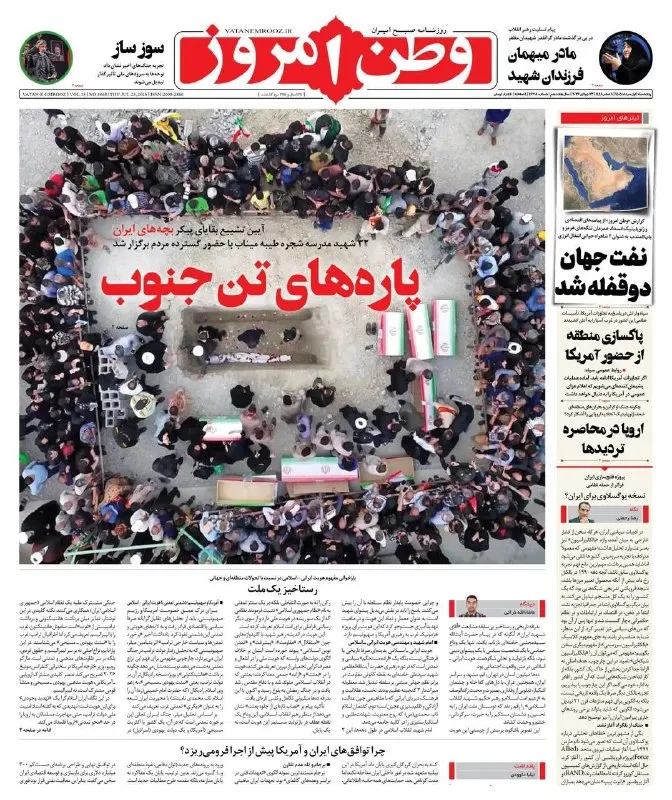
Day 142 is a grievance-and-red-line edition, and its lead judgment is that two escalation frames have merged. The first is a leadership revenge register: over a photograph of a mother holding a shrouded child, the centrist Hamshahri carries the Leader of the Revolution (in current coverage, Mojtaba Khamenei) pledging that ‘this file will be closed with revenge’ and promising ‘greater sensitivity toward the revenge for the blood of our children.’ The Minab school strike, the killing of the schoolchildren logged in prior editions, is thereby reopened as an open account whose closure is defined as retaliation, and the revenge lexicon (انتقام / خونخواهی) is now voiced from the top rather than by the hardline commentariat. The same grief anchors the funerals that lead Vatan-e Emrooz (‘Torn pieces of the south’s body’), Jam-e Jam (‘Torn pieces of Iran’s body,’ with ‘everyone was there except Makan’) and Farhikhtegan (‘We neither forgive nor forget’), and is internationalized in English on Iran Daily (‘Minab buries remains of 32 children killed in US school carnage’).
The second, and the single most consequential shift of the cycle, is a nuclear-strike red line running across the factions. Triggered by a reported US intent to strike Iran’s new nuclear facilities, the Khatam al-Anbia Central Base warning, that any attack on Iran’s nuclear and sensitive centers will be treated as an expansion of the war (توسعه جنگ) and will place US interests, allies and their security under Iranian assault, leads the reformist Etemad (‘Tehran’s ultimatum’), headlines the government’s English Iran Daily (‘Armed Forces warn US against ground invasion, strikes on nuclear sites’), drives Javan’s full-page mushroom-cloud front (‘You are triggering the bomb!’) and appears as a banner on the economic-principlist Chaharsu. That a deterrent message on the nuclear threshold is carried identically on reformist, government and hardline fronts is the strongest evidence of centrally-guided message discipline in the edition, and it marks the nuclear question, dormant in recent cycles, as the live escalation axis.
The corollary is that the diplomacy track has receded from the front pages. Where Day 141 opened with mediators and a leadership ceiling of ‘end the war, but not peace,’ and the government daily foregrounded negotiation, today the official Iran newspaper leads instead on a strike operation (‘Three US bases in Kuwait again targeted by army drone strikes’) and files the US $1.15-trillion defense budget as proof of American-Israeli war-funding, while quoting US Senator Chris Murphy that Trump ‘isn’t serious’ about nuclear talks. The mediation thread is not repudiated so much as crowded out: the state paper has aligned to the military-and-revenge register, and the negotiation ceiling that dominated the prior lead is nowhere on today’s front pages. The reformist Etemad’s ‘internal rift is an invitation for enemies’ is the nearest surviving argument for restraint from within the establishment bloc.
The standing chokepoint thread continues but shifts register from ultimatum to claimed execution and economic risk. The dual-lock framing (Hormuz plus Bab al-Mandeb) recurs as an oil-shock projection on Hamshahri (‘a surge in oil with the closure of 2 chokepoints,’ toward 100 dollars), on Vatan-e Emrooz (‘world oil double-locked’) and, higher still, on Farhikhtegan (‘the siege of Saudi Arabia begins; 120-dollar oil on the way?’). Sobh-e No pushes it toward claimed action, asserting the Guards have closed the Strait, that of three tankers one caught fire and two turned back, and that ‘the Strait of Hormuz remains under our control,’ alongside a claimed strike on a CENTCOM data node in Bahrain (‘CENTCOM’s digital eye went blind’). The economic titles price the same story as danger, not victory: Ta’adol reads ‘the pulse of oil in the chokepoint of crisis’ and ‘a shadow that has not left the world economy,’ and Chaharsu, which on Day 141 demanded the Strait stay closed 60 more days, today recodes Hormuz as the ‘guarantor of victory’ rather than issuing a fresh closure ultimatum, a slight softening of the operational ask worth tracking.
The military claims that underwrite the triumph frame remain attacker-sourced and internally inconsistent, and are logged as claims. ‘Operation Saaeqeh Phase 23’ against Kuwait bases, ‘Operation Nasr 2, Wave 24’ against Bahrain, the claimed US admission that ‘Iran’s strikes are devastating’ on Kayhan, the tanker interdictions and the casualty tallies all originate with the attacking side or its wires; the Kuwait bases are named Al-Doha, Al-Dhafra, Ali al-Salem and Arifjan variously across Kayhan, Fars News, Nour News, Defa Press and the government daily Iran, and the Minab casualty figure is 32 at the funeral (cross-confirmed on Iran Daily’s English page) but 168 in agency messaging. The unreconciled base names and casualty counts are themselves the caution against reproducing any single claim as fact.
Beneath the war, two counter-currents and one absence are worth filing. The reformist Sazandegi again declines the grievance lead, running instead a profile of the philosopher Abdolkarim Soroush (‘Zeal in exile’) and domestic-vulnerability items (‘The fall of Mashhad?’, ‘Threat to the capital’s infrastructure!’) with a ‘war of calculations and the trap of loss’ editorial that reads the moment as cost, not triumph; Farhikhtegan pairs its revenge slogan with an Ahmad Tavakoli feature on ‘within-discourse critique,’ a marker of internal principlist self-examination. The football-governance controversy persists as a cross-factional domestic-control thread (Vatan-e Emrooz’s ‘Politics against football,’ Ta’adol’s economic take). And Israel and Lebanon remain absent as active fronts: Israel surfaces only as the beneficiary of the US budget and as the ‘occupied territories’ of the retreat and travel-warning items, Lebanon not at all.
Net assessment: this is a reassertion-and-escalation-signal edition. The verifiable shift is directional rather than kinetic, the frame moved, the war did not visibly change, but the direction is unambiguous: away from the prior cycle’s mediation lead and toward a fused grievance-and-deterrence page, with the nuclear threshold newly activated as the red line. The highest-significance finding is the cross-factional nuclear-strike warning, because it names, on reformist and government fronts as much as hardline ones, the one escalation that Tehran is signalling in advance it will treat as war-expanding; the leadership revenge pledge over the Minab children is the emotional engine driving that signal, and the disappearance of the diplomacy track from the front pages is the clearest measure of how far the register has swung.
Key Points
- KJ-1 [HIGH] A nuclear-strike red line has been activated and is running cross-factionally. The Khatam al-Anbia warning that any US attack on Iran’s nuclear and sensitive sites will be treated as an expansion of the war leads the reformist Etemad, headlines the government’s English Iran Daily, drives Javan’s mushroom-cloud front and banners the economic-principlist Chaharsu, apparently in response to a reported US intent to strike Iran’s new nuclear facilities. Significance: this is the cycle’s most consequential development because it re-activates the nuclear threshold, quiet in recent editions, as the declared escalation axis, and its identical carriage on reformist, government and hardline fronts is strong evidence of centrally-guided message discipline rather than organic agreement; it is the one escalation Tehran is signalling in advance it will treat as war-expanding, and the barometer to watch is whether the US threat that triggered it materializes.
- KJ-2 [HIGH] The Minab child-casualty grievance has been elevated into a leadership revenge pledge. Hamshahri, a centrist municipal daily, carries the Leader (Mojtaba Khamenei) over a child’s shroud pledging the ‘file will be closed with revenge’ and ‘greater sensitivity toward the revenge for the blood of our children,’ echoed by Jam-e Jam’s ‘prepare the coffins’ and Farhikhtegan’s ‘we neither forgive nor forget.’ Significance: the revenge register (انتقام / خونخواهی) is now voiced from the top and across factions, converting a past grievance into a stated leadership commitment that supplies the emotional engine of the day’s deterrent signalling; the attributed leadership line is a front-page paraphrase, not a retrieved primary-source text, and is judged on the consistency of its rendering rather than a verbatim source.
- KJ-3 [MODERATE-HIGH] The diplomacy track has been pushed off the front pages, and the government daily has aligned to the strike-and-revenge register. The official Iran newspaper leads on ‘Three US bases in Kuwait again targeted by army drone strikes’ and files the US $1.15-trillion budget as American-Israeli war-funding, while the prior cycle’s mediation lead and ‘end the war, not peace’ ceiling are absent from today’s fronts. Significance: this is a directional swing, not a repudiation of negotiation, but a state paper that led on mediators a cycle ago now leads on an operation, which measures how far the register has moved toward escalation; track whether the diplomacy thread returns or stays crowded out, and read the reformist Etemad’s ‘internal rift is an invitation for enemies’ as the surviving establishment argument for restraint.
- KJ-4 [MODERATE-HIGH] Chokepoint coercion has shifted from ultimatum toward claimed action and priced economic risk. Sobh-e No asserts the Strait of Hormuz is ‘under our control’ with a tanker afire and two turned back, plus a claimed Bahrain data-node strike; the oil-shock projections climb (Hamshahri toward 100 dollars, Farhikhtegan toward 120 with a Saudi ‘siege’); yet Chaharsu recodes Hormuz as ‘guarantor of victory’ rather than repeating its Day-141 demand to keep the Strait closed 60 more days. Significance: the register is louder on claimed execution but slightly softer on the explicit closure ultimatum, and the economic titles (Ta’adol) price the same story as crisis rather than victory; treat the tanker-interdiction and cyber-strike claims as attacker-sourced and unconfirmed, and watch the gap between the ‘winning card’ framing and the business press’s risk framing.
- KJ-5 [MODERATE] The strike campaign continues as attacker-sourced claim and remains internally inconsistent on its own facts. ‘Operation Saaeqeh Phase 23’ (Kuwait), ‘Operation Nasr 2, Wave 24’ (Bahrain) and a claimed US admission that ‘Iran’s strikes are devastating’ on Kayhan anchor the US-in-defeat frame, but the Kuwait bases are named Al-Doha, Al-Dhafra, Ali al-Salem and Arifjan variously across five outlets, and the Minab toll is 32 at the funeral versus 168 in agency messaging. Significance: treat the continuing exchange as probable but every base identity and casualty tally as messaging to be confirmed outside this monitor; the unreconciled names and counts, and the outlet-curated ‘Trump’s empty gun’ US-exhaustion collage, are the standing caution against reproducing any single claim as authentic.
- KJ-6 [MODERATE] Negative-evidence judgment: Israel and Lebanon remain absent as active military fronts. No monitored front page leads on an Israeli or Lebanese military development; Israel appears only as the beneficiary of the US $1.15-trillion budget’s ‘military-technological cooperation’ and as the ‘occupied territories’ of the retreat and travel-warning items, and Lebanon not at all. Significance: the confrontation on the page has consolidated around the US-Iran nuclear-and-grievance axis and the chokepoints, and the continued Israel-Lebanon quiet should be logged as a finding in its own right, since a return to either front would be a signal; read the absence against the nuclear-red-line lead rather than as evidence either front has closed.
- KJ-7 [MODERATE] Reformist dissent and internal critique persist beneath the unified war page. Sazandegi declines the grievance lead for a Soroush profile and domestic-vulnerability items with a ‘war of calculations and the trap of loss’ editorial; Farhikhtegan pairs its revenge slogan with an Ahmad Tavakoli ‘within-discourse critique’ feature; the football-governance controversy runs cross-factionally. Significance: the front-page unity elsewhere is a choice, and the surviving counter-currents mark the edition’s factional fault line, the reformist reading of escalation as cost against the mobilizational ‘resurrection of a nation’ framing; track whether the dissent holds or is absorbed as the nuclear-red-line and revenge frames harden.
Macro Trends
- A nuclear-strike red line is activated across the factions. Triggered by a reported US intent to strike Iran’s new nuclear facilities, the Khatam al-Anbia warning that any attack on Iran’s nuclear and sensitive sites will be treated as an expansion of the war runs identically on the reformist Etemad, the government’s English Iran Daily, the hardline Javan and the economic-principlist Chaharsu. The uniformity across factions indicates centrally-guided message discipline on the nuclear threshold rather than organic convergence, and it re-activates the nuclear question, dormant in recent cycles, as the edition’s live escalation axis.
- The Minab child deaths become a leadership revenge pledge. The killing of the schoolchildren, logged in prior editions, is reopened as an open account: Hamshahri carries the Leader (Mojtaba Khamenei) pledging the ‘file’ will be ‘closed with revenge,’ and the funerals lead Vatan-e Emrooz, Jam-e Jam and Farhikhtegan and are internationalized on Iran Daily’s English page. The revenge lexicon (انتقام / خونخواهی) is now voiced from the top, binding the grievance to the day’s deterrent signalling and supplying the emotional engine of the escalation frame.
- The diplomacy track recedes from the front pages. Where Day 141 led with mediators and a ‘end the war, but not peace’ ceiling, today the official Iran daily leads on a strike operation and files the US defense budget as war-funding, while the mediation thread is crowded off the front pages. The negotiation ceiling that dominated the prior lead is absent; the reformist Etemad’s ‘internal rift is an invitation for enemies’ is the nearest surviving establishment argument for restraint. The swing from mediation-first to strike-and-revenge is the cycle’s clearest directional move.
- Chokepoint coercion shifts from ultimatum to claimed action and priced risk. The Hormuz-plus-Bab al-Mandeb dual-lock recurs as an oil-shock projection (Hamshahri toward 100 dollars, Farhikhtegan toward 120 with a Saudi ‘siege’) and, on Sobh-e No, as claimed execution: a Strait ‘under our control,’ a tanker afire, a Bahrain data-node strike. The economic titles price it as crisis, not victory (Ta’adol’s ‘pulse of oil in the chokepoint of crisis’), and Chaharsu recodes Hormuz as ‘guarantor of victory’ rather than repeating its Day-141 ‘60 more days’ closure demand, a slight softening of the operational ask against a louder claimed-action register.
- The strike campaign persists as attacker-sourced, internally inconsistent claim. ‘Operation Saaeqeh Phase 23’ (Kuwait bases), ‘Operation Nasr 2, Wave 24’ (Bahrain) and a claimed US admission of strike damage anchor the US-in-defeat frame, but the Kuwait bases are named Al-Doha, Al-Dhafra, Ali al-Salem and Arifjan variously across Kayhan, Fars, Nour News, Defa Press and Iran, and the Minab toll is 32 at the funeral versus 168 in agency messaging. The unreconciled names and counts are the caution against reproducing any single claim as fact; the ‘Trump’s empty gun’ US-exhaustion collage on Vatan-e Emrooz is outlet-curated illustration, not an order-of-battle assessment.
- Reformist dissent and internal critique survive beneath the unified war page. Sazandegi again declines the grievance lead, running Soroush and domestic-vulnerability items with a ‘war of calculations and trap of loss’ editorial that reads the moment as cost; Farhikhtegan pairs its revenge slogan with an Ahmad Tavakoli ‘within-discourse critique’ feature; the football-governance controversy persists as a cross-factional domestic-control thread. The front-page unity elsewhere is therefore a choice, and the surviving counter-currents mark the edition’s factional fault line.
Front-Page Snapshot
- Etemad - “Tehran’s Ultimatum” (Reformist) - Khatam al-Anbia nuclear-strike red line carried on a reformist front; internal cohesion [HIGH]
- Iran Daily (English) - “Armed Forces Warn US Against Ground Invasion, Strikes on Nuclear Sites” (State English daily (government)) - Nuclear red line and ‘crimes against humanity’ framing for the international audience; Minab ‘32 children’ [MODERATE-HIGH]
- Hamshahri - “This File Will Be Closed With Revenge” (Tehran municipality, centrist) - Leader’s revenge pledge over the Minab children; dual-chokepoint oil surge [HIGH]
- Javan - “You Are Triggering the Bomb!” (Hardline (IRGC-affiliated)) - A US nuclear strike framed as self-detonating the crisis; missile-resilience claim [SEVERE]
- Kayhan - “Iran’s Strikes Are Devastating and Pounding” (Hardline flagship (Leader’s office / IRGC)) - Claimed US admission of strike damage; Kuwait-base, Bushehr and Red Sea claims [SEVERE]
- Jam-e Jam - “Torn Pieces of Iran’s Body” (State broadcaster daily (IRIB)) - Minab grief and ‘prepare the coffins’ threat; Iran-Iraq strategic alignment [HIGH]
- Vatan-e Emrooz - “Torn Pieces of the South’s Body” (Hardline / principlist) - Minab funerals fused with US exhaustion (‘empty gun’) and ‘double-locked oil’ [HIGH]
- Farhikhtegan - “We Neither Forgive Nor Forget” (Principlist (Azad University)) - Enduring revenge slogan; 120-dollar oil via a Saudi ‘siege’; internal principlist critique [MODERATE-HIGH]
- Iran - “Three US Bases in Kuwait Again Targeted by Army Drone Strikes” (Official government daily) - Government daily leads on a strike operation; US budget as US-Israel war-funding; nuclear bad-faith [HIGH]
- Sobh-e No - “CENTCOM’s Digital Eye in Bahrain Went Blind” (Principlist) - Claimed Bahrain data-node strike; Strait ‘under our control’ with a tanker afire; Bab al-Mandeb [HIGH]
- Chaharsu - “The Market’s Kick to the Production Sector” (Economic (principlist front)) - Domestic capital-market critique above Hormuz-as-guarantor and the Khatam al-Anbia nuclear warning [HIGH]
- Ta’adol - “The Pulse of Oil in the Chokepoint of Crisis” (Economic) - Oil-price risk and the war as a ‘shadow on the world economy’; domestic inflation [LOW-MODERATE]
- Sazandegi - “Zeal in Exile” (Reformist (Kargozaran)) - Soroush profile and domestic-vulnerability items; ‘war of calculations’ cost framing; reformist dissent [LOW]
Full report
The complete edition - per-paper front-page analysis and full translation appendices - is available as a PDF: Download the full report.
Compiled from Iranian front pages and outlet channels via open-source monitoring. Translations are editorial; named-figure attributions are verified against the source pages where possible.