Iranian Press Monitor - Sunday, 19 July 2026 (Day 138)
Sunday, 19 July 2026 · 28 Tir 1405 · 4 Safar 1448 - Nine Persian front-page scans, one English print (Iran Daily), four outlet Telegram channels and three agency wires; Tehran Times was unavailable at the time
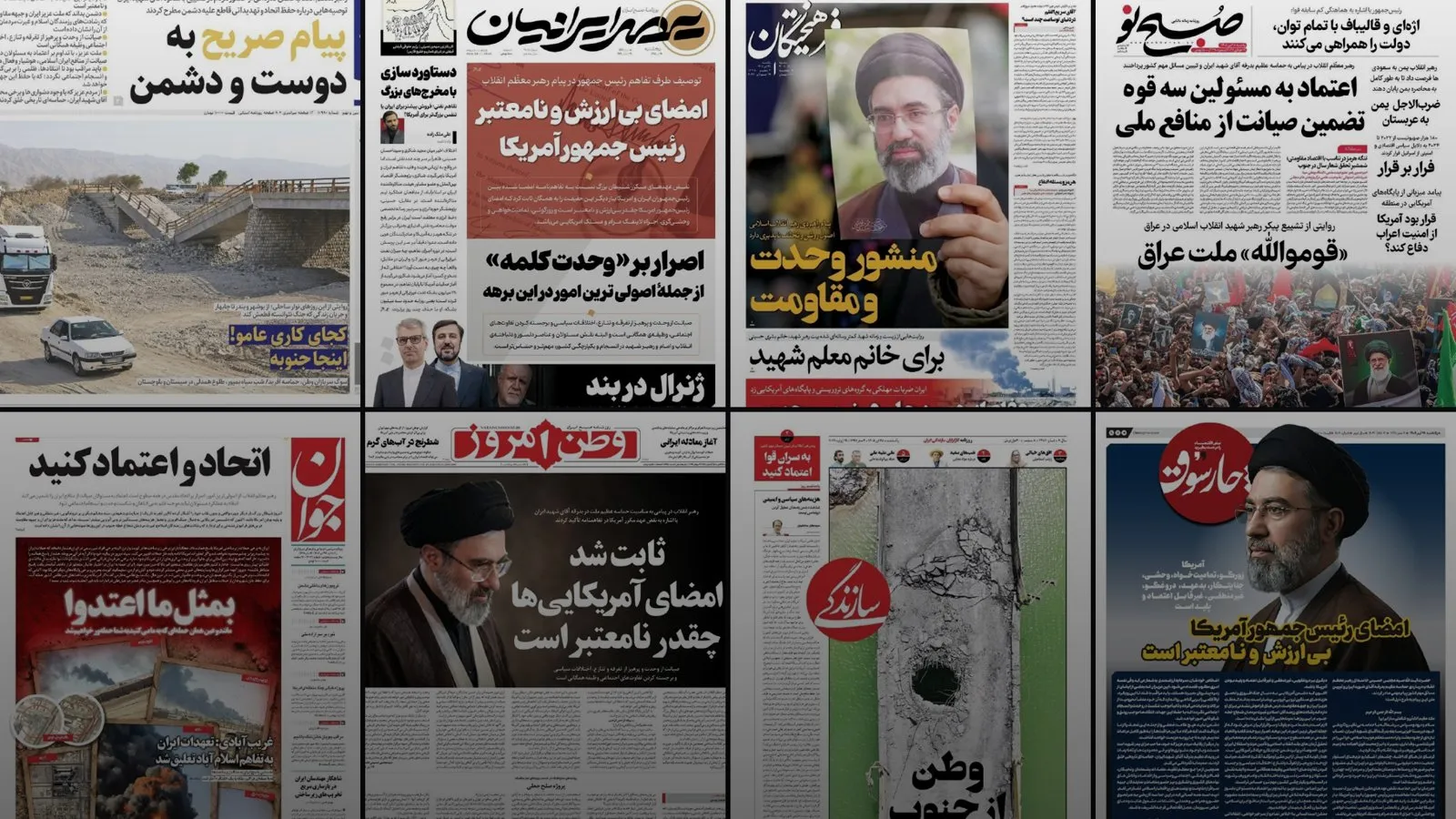
Bottom line: A single, centrally-distributed message from the Leader, staged over a mass funeral procession for his assassinated predecessor, declared the US President’s signature ‘worthless and invalid’ and supplied the cover for the Foreign Ministry’s formal suspension of the ceasefire memorandum, while the hardline flagship moved to brand the domestic argument against the war as fifth-column activity and the reformist and economic press kept the reconstruction bill and the case for diplomacy openly in view.
Executive Summary
Day 138 is a message-discipline edition: a single statement from the Leader (in current coverage, Mojtaba Khamenei), issued on the occasion of a mass funeral and farewell procession for the martyred predecessor (Ali Khamenei, assassinated 28 February 2026), occupies the lead position on nearly every front page monitored. The message has three consistent pillars, and different titles amplify different ones: gratitude-plus-deterrence (Kayhan headlines that the nation and the ‘resistance front’ hold ‘unforgettable lessons for the American enemy’); internal unity (Sobh-e No and Jomhouri-ye Eslami lead on ‘trust in the officials of the three branches guarantees the national interest’); and a rupture with Washington (Sobh-e Iranian and Chaharsoo run the identical banner that ‘the signature of the US President is worthless and invalid’). The word-for-word recurrence of that last formula across independent titles is the clearest evidence this cycle of a centrally-set line rather than organic convergence.
The single most consequential development sits directly beneath the message: Iran’s Deputy Foreign Minister for Legal and International Affairs, Kazem Gharibabadi, announced that Tehran has suspended its obligations under the ceasefire memorandum, named the ‘Islamabad Memorandum’ by Javan and Sobh-e No and rendered as ‘MoU’ by the English Iran Daily, whose banner - ‘Iran suspends MoU commitments after US breaches’ with the sub-line ‘Tehran never initiated any violations’ - packages the step for foreign readers as lawful and reactive. The Foreign Ministry spokesperson’s ‘Iran was not the first to breach’ framing and the Leader’s ‘worthless signature’ formula are the same move at two altitudes: the leadership supplies the moral verdict, the ministry executes the legal act. This is a documented, on-the-record hardening of Iran’s declared posture toward the 17 June ceasefire, distinct from the contested kinetic claims around it.
The kinetic picture remains real in outline but attacker-sourced in detail. The government daily Iran leads on CENTCOM’s own reported count of an ‘eighth wave’ of US strikes on Iran (points near Qeshm and Shadegan struck overnight per the wires), while Iranian retaliation is branded across the agencies as ‘Operation Saaegheh’ phases 16-17 against US bases in Kuwait (Ali al-Salem, Camp Arifjan, Patriot radar) and a strike on a US base in Jordan claimed to have killed two American personnel and damaged Black Hawk helicopters. Iran Daily raises the Iranian casualty toll from US strikes to ‘50 killed, 500 injured,’ up from ‘38 killed, 400 injured’ the prior day. Vatan-e Emrooz’s claim that Iranian strikes reached air-defense systems across West Asia, Africa and Europe is the day’s most maximalist geographic assertion and should be read as amplification. Treat the fact of a continuing exchange as probable and every specific base-by-base and casualty tally as messaging.
The domestic argument over the war stayed in public and turned sharper. Kayhan’s Shariatmadari editorial, ‘It is not an error, it is the line of the fifth column,’ recasts the peace advocates and the critics of Hormuz-closure not as sincere-but-mistaken but as a coordinated adversary line to be handled as a wartime security matter - an attempt to criminalize the cost-of-war argument. That argument is nonetheless everywhere: Sazandegi leads on roughly 3 trillion toman of southern reconstruction damage and defends diplomacy directly; Etemad leads on blackout relief for Hormozgan and free transit for the poor; Jam-e Jam keeps the roughly 4,200-megawatt grid loss, the 60-trillion-toman cumulative damage tally and an 80% Gulf LNG decline on its front page. The clearest sign the fifth-column framing is contested is that Chaharsoo, an economic title carrying the Leader’s harshest anti-US line at the top of its page, simultaneously reported a ‘mass resignation in protest against Shariatmadari.’
Net assessment: this is a codification edition, not a fresh-escalation one. The day’s real, verifiable hardening is declaratory and legal - the formal suspension of the memorandum, wrapped in a saturating leadership message and a mass mourning spectacle for the assassinated predecessor - rather than a demonstrated jump in kinetic capability, where the claims outrun the corroboration. Two internal signals cut against the unison: the hardline flagship’s move to treat domestic dissent as enemy infiltration, and the visible refusal of the reformist, economic and even establishment titles to abandon the reconstruction bill or the diplomatic off-ramp. Read the edition as message discipline and legal rupture running ahead of, and partly substituting for, new battlefield facts, over a press that is unified at the top of the page and openly split beneath it.
Key Points
- KJ-1 [HIGH] The day’s front pages carry a single, centrally-distributed leadership message, not organic editorial convergence. Nearly every monitored title leads on the Leader’s statement, and its harshest formula (‘the signature of the US President is worthless and invalid’) appears verbatim on independent front pages (Sobh-e Iranian, Chaharsoo), while different titles amplify its deterrence, unity and rupture pillars by orientation. The cross-title, word-for-word recurrence indicates guided message discipline. Significance: when the leadership floods the whole press with one formulation, the formulation itself is the policy signal - here, that the ceasefire is being repudiated at the highest level and that the domestic front is being ordered to close ranks behind it.
- KJ-2 [MODERATE-HIGH] Iran has formally hardened its declared posture toward the ceasefire by suspending its obligations under the memorandum, and this - not the battlefield claims - is the edition’s real development. Deputy FM Gharibabadi’s suspension of the ‘Islamabad Memorandum’ is corroborated across the scan (Javan), the English print (Iran Daily) and the Sobh-e No channel, and is framed by the Foreign Ministry as reactive to US breaches. Significance: a documented, on-the-record step down from the 17 June ceasefire, giving Tehran a legal-declaratory basis for continued operations while preserving a ‘they breached first’ posture; watch whether it is paired with any concrete change in operational tempo or remains a declaratory move.
- KJ-3 [MODERATE-HIGH] A real US-Iran exchange is continuing, but its scale, geography and casualties are contested and Iranian-amplified. The government daily concedes a US ‘eighth wave’ (strikes near Qeshm and Shadegan), and Iranian retaliation on US bases in Kuwait and Jordan is branded ‘Operation Saaegheh’ phases 16-17; but the claimed two US dead in Jordan, the F-15 and Black Hawk losses, the 50-killed/500-injured Iranian toll and Vatan-e Emrooz’s Africa-and-Europe strike reach are all single-side sourced, and Iran Daily’s toll rose 12/100 in a single day. Significance: treat the widening exchange as probable and every base-by-base and casualty figure as messaging to be verified, not as established battle damage.
- KJ-4 [MODERATE] The hardline camp is moving to convert the internal cost-of-war debate from a political argument into a security matter, and is meeting open resistance. Kayhan’s Shariatmadari editorial reframes diplomacy advocates and Hormuz-closure critics as a ‘fifth column’ whose identification is a wartime security task; the same morning, Chaharsoo reported a mass resignation in protest against Shariatmadari. Significance: the guided top-line unity message is contradicted beneath the fold by a genuine, escalating elite fight, and the attempt to criminalize dissent is itself generating dissent - a sign the leadership’s message discipline is strained, not settled.
- KJ-5 [MODERATE-HIGH] The reformist, economic and establishment titles continue, in public, to keep the war’s cost and a diplomatic off-ramp on the front page, which remains a better predictor of restraint than the hardline banners. Sazandegi (3-trillion-toman southern damage, a pro-diplomacy editorial), Etemad (blackout relief, free transit), Jam-e Jam (grid loss, Gulf LNG collapse), Jomhouri-ye Eslami (power rationing eased, Khomeini/Beheshti precedent) and even Iran (UAE restraint call) all decline the ‘void signature’ escalation in their leads. Significance: beneath a unison top line, a substantial share of the press is still arguing the coercion posture is economically self-defeating and that a negotiated exit should be preserved.
- KJ-6 [MODERATE] Negative-evidence judgment: the succession-imagery vacuum noted in prior editions has partially closed, but the current Leader’s operative authority is still being carried indirectly. Where earlier editions lacked any direct Mojtaba Khamenei imagery, today Vatan-e Emrooz and Chaharsoo run prominent portraits and every title attributes the day’s message to him. Yet the message’s emotional legitimacy is anchored in the martyred predecessor’s funeral procession rather than in the current Leader’s own standing, and the hardest deterrent and enforcement lines are still voiced through Kayhan, the IRGC-aligned titles and the Foreign Ministry. Significance: the leadership is now willing to foreground Mojtaba Khamenei visually, but continues to route escalation and internal-security messaging through clerical, military and ministerial proxies - a managed-succession pattern worth continued tracking.
Macro Trends
- A saturating, centrally-set leadership message replaces the front pages. For the first time in several editions the dominant story is not a strike or a chokepoint but a single message from the Leader, carried at the top of nearly every monitored title. The message’s three pillars (deterrent gratitude, internal unity, rupture with Washington) are distributed across the titles by orientation, and its harshest formula - ‘the signature of the US President is worthless and invalid’ - appears word-for-word on independent front pages (Sobh-e Iranian, Chaharsoo), the strongest single indicator this cycle of guided message discipline. Vatan-e Emrooz and Chaharsoo give the current Leader, Mojtaba Khamenei, his most prominent portrait treatment since the succession, ending several editions of succession-imagery absence.
- From rhetoric to a legal act: the memorandum is formally suspended. The day’s concrete hardening is declaratory-legal, not kinetic. Deputy FM Gharibabadi’s suspension of Iran’s obligations under the ceasefire memorandum, framed by the Foreign Ministry as reactive (‘Iran was not the first to breach’) and by the English Iran Daily for foreign readers (‘never initiated any violations’), converts the Leader’s ‘void signature’ verdict into policy. This is the clearest, best-corroborated change of posture in the edition and should be tracked as a distinct escalation of Iran’s declared position on the 17 June ceasefire, separate from the disputed battlefield claims.
- The strike campaign continues, still branded and still attacker-sourced. The government daily concedes the US tempo (CENTCOM’s ‘eighth wave,’ strikes near Qeshm and Shadegan), while the wires brand Iran’s retaliation as ‘Operation Saaegheh’ phases 16-17 on US bases in Kuwait and a lethal strike on a US base in Jordan (two dead, one missing, Black Hawks damaged, an F-15 claimed). Iran Daily lifts the domestic casualty toll to 50 killed and 500 injured, and Vatan-e Emrooz claims reach into Africa and Europe. Outside this monitor corroborates only the fact of a continuing regional exchange; the phase counts, five-country geography and casualty tallies remain single-side messaging.
- The fifth-column turn: an attempt to criminalize the cost-of-war argument. Kayhan’s Shariatmadari editorial escalates the intra-elite fight from persuasion to security: it recasts diplomacy advocates and Hormuz-closure skeptics as a coordinated ‘fifth column’ (khat, a line) rather than honest dissenters making a ‘khata’ (an error), and calls their identification a wartime security task. This is message-policing aimed squarely at the reformist and economic counter-current, and it is being resisted in public - Chaharsoo reported a mass resignation against Shariatmadari on the same morning.
- The reconstruction bill and the diplomatic off-ramp stay on the page. The counter-current held its ground. Sazandegi led on roughly 3 trillion toman of Hormozgan strike damage and an editorial defending diplomacy; Etemad on blackout relief and free transit for lower-income deciles; Jam-e Jam on a ~4,200-megawatt grid loss, a 60-trillion-toman cumulative damage figure and an ~80% Gulf LNG decline; Iran surfaced a UAE restraint call and Kuwaiti oil-facility damage the hardline titles omitted. Even Iran Daily kept a Central-Asia corridor thread (a Tehran-Bishkek cultural pact) visible for foreign readers. The economic and reformist case that the coercion doctrine imperils the economy it claims to defend remains the better predictor of restraint than the banners.
- A mass mourning spectacle enlisted as strategic messaging. The funeral and farewell procession for the martyred predecessor - reported across multiple cities including an Iraq leg (‘Rise for God, people of Iraq,’ Sobh-e No) and a Mashhad shrine commemoration attended by the current Leader (Jam-e Jam) - is framed less as mourning than as a demonstration of mobilizational strength and a warning to Washington. It keeps the February assassination a live grievance and supplies the emotional backdrop against which the message and the memorandum-suspension are staged. The procession’s exact nature and its five-months-later timing are unresolved on the pages and are logged as a monitoring item.
Front-Page Snapshot
- Kayhan - “The Leader, Praising the Historic Farewell Procession: The Nation and the Resistance Hold Unforgettable Lessons for the American Enemy” (Hardline flagship (Leader’s office / IRGC)) - Message as deterrent threat; ‘fifth column’ editorial; ‘Black Saturday’ base strikes [SEVERE]
- Iran Daily (English) - “Iran Suspends MoU Commitments After US Breaches: Deputy FM” (State English daily) - Memorandum suspension messaged abroad as lawful; casualty toll raised to 50/500 [MODERATE-HIGH]
- Javan - “Retaliate in Kind Against Those Who Attacked You (Quran 2:194)” (Hardline, IRGC-affiliated) - Retaliation sacralized; Gharibabadi’s MoU suspension foregrounded [HIGH]
- Vatan-e Emrooz - “It Has Been Proven How Invalid the Americans’ Signature Is” (Hardline / principlist) - Leader’s portrait; ‘void signature’; strike-reach claimed across three continents [HIGH]
- Sobh-e No - “Trust in the Officials of the Three Branches Guarantees the National Interest” (Principlist) - Unity pillar; MoU suspension detailed; Iraq procession; Yemen ultimatum to Saudi [HIGH]
- Farhikhtegan - “Charter of Unity and Resistance” (Principlist (Azad University)) - Message institutionalized as a doctrine; ‘Hormuz has no substitute’ [MODERATE-HIGH]
- Sobh-e Iranian - “The Worthless and Invalid Signature of the US President” (Principlist / hardline) - Verbatim ‘void signature’ line; unity of the word; jabs at negotiators [MODERATE-HIGH]
- Chaharsoo - “The Signature of the US President Is Worthless and Invalid” (Economic / business) - Verbatim ‘void signature’; but reports a mass resignation against Shariatmadari [MODERATE]
- Qods - “An Explicit Message to Friend and Foe” (Conservative (Astan Quds Razavi)) - Message as reassurance-plus-warning; predecessor eulogy; southern home front [MODERATE-HIGH]
- Iran - “CENTCOM Reports the End of the Eighth Night of Strikes on Iran” (Official government daily) - US strike tempo; Jordan/Kuwait retaliation; UAE restraint call; Trump lawfare; Khuzestan quake [MODERATE-HIGH]
- Jomhouri-ye Eslami - “The Leader: Trust in the Officials Guarantees Protection of Iran’s Interests” (Traditional / establishment) - Message reported straight; grid/dams; London Palestine solidarity; Khomeini precedent [MODERATE]
- Jam-e Jam - “Power-Grid Capacity Down 4,200 Megawatts Following War Damage” (State broadcaster (IRIB)) - Grid loss and reconstruction; ‘second war over Hormuz’; ~80% Gulf LNG decline; shrine commemoration [MODERATE]
- Sazandegi - “Homeland from the South” (Reformist (Kargozaran)) - ~3-trillion-toman southern reconstruction bill; editorial defending diplomacy [LOW-MODERATE]
- Etemad - “Hormozgan to Be Removed from the Rolling-Blackout Program” (Reformist) - Blackout relief and free transit; war kept off the lead (channel-limited read) [LOW]
Full report
The complete edition - per-paper front-page analysis and full translation appendices - is available as a PDF: Download the full report.
Compiled from Iranian front pages and outlet channels via open-source monitoring. Translations are editorial; named-figure attributions are verified against the source pages where possible.