Iranian Press Monitor - Saturday, 18 July 2026 (Day 137)
Saturday, 18 July 2026 · 27 Tir 1405 · 3 Safar 1448 - Nine Persian front-page scans, one English print (Iran Daily), six outlet Telegram channels and three agency wires; Tehran Times was unavailable at the time
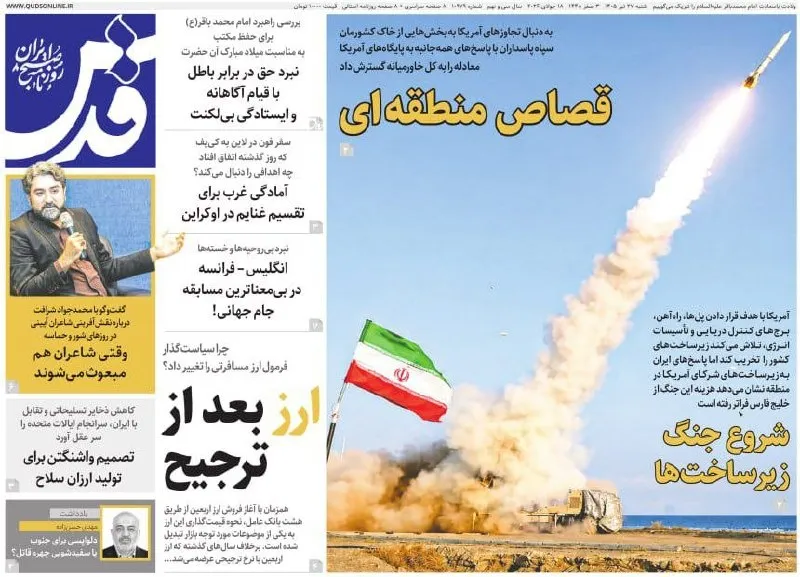
Bottom line: The Iranian press has converged, with visible central coordination, on an ‘infrastructure-for-infrastructure’ war doctrine that the hardline flagship now pushes toward striking the global energy market and opening a second chokepoint, even as a reformist counter-current uses the US Vice President’s own words to argue the war is being prolonged by an Israeli influence operation in Washington.
Executive Summary
Day 137 is the day the retaliation logic acquired a doctrine. After a fresh round of US strikes on southern Iran (the coast, Lorestan, the Makran shore, and the Bambour Garrison at Iranshahr), the front pages move in near-unison from ‘we were attacked’ to ‘we answer infrastructure with infrastructure,’ and the hardline flagship pushes that logic to its endpoint. Kayhan’s banner, ‘Infrastructure against infrastructure: add Israel to the target bank as well,’ sits under the kicker ‘It is time to fire on the global energy market,’ and a sub-headline urges closing Bab al-Mandeb as a second chokepoint: ‘Close Bab al-Mandeb and Trump will kneel.’ Nobonyad tells readers it is ‘time to change the equation’ and put ‘offensive actions on Iran’s agenda’; Qods sacralizes the exchange as ‘regional qisas’ that has ‘extended the equation to the entire Middle East.’ The single most consequential read of the day is this shift from tit-for-tat to an advocated doctrine of energy-market and dual-chokepoint coercion, carried in language consistent enough across titles to indicate centrally-guided message discipline rather than organic editorial convergence.
Beneath the doctrine sits a still-contested kinetic picture. Iranian channels and wires (the IRGC’s ‘Operation Nasr-2’ waves and the Army’s ‘Operation Saeqeh’ phases) claim strikes on US bases in Bahrain (Sheikh Isa, Juffair), Kuwait (Ali al-Salem, HIMARS launchers, the Al-Ahmadi fuel dock), Jordan (Al-Azraq), and further afield at the Salameh rocks in Oman and Tanf in Syria; the English Iran Daily packages this for foreign readers as ‘IRGC batters US bases in Qatar, Kuwait, Jordan, Oman, Syria.’ Outside reporting corroborates the Bahrain, Kuwait and Jordan strikes but not the Qatar, Oman and Syria claims, and describes many incoming rounds as intercepted, so the five-country tally is best read as attacker-sourced amplification. On damage taken, Iran Daily prints 38 killed and 400 injured in the south while Iran’s own Health Ministry gives about 35 killed and 300-plus injured, and the Iranshahr strike on the 388th Brigade is an Iranian military account.
The war-versus-peace fight sharpened, and the reformist camp found a US-official weapon. Sazandegi leads on ‘Israel’s cash-splashing to sink the deal,’ citing Vice President JD Vance’s disclosure (his 15 July podcast remarks, echoing a Time investigation naming Brad Parscale) that an Israeli-funded operation is spending millions to derail Iran-US talks; Etemad defends Ali Rabiei against the hardline campaign under ‘Distortion of the Truth,’ and both treat the second-chokepoint idea skeptically (‘Playing the Bab al-Mandeb card’) rather than as advocacy. The economic press pushes back hardest on the coercion doctrine itself: Ta’adol argues ‘external opening matters as much as defence’ and warns a ‘knot in Hormuz’ sends a ‘tremor through the oil market,’ while Jam-e Jam and Jomhouri-ye Eslami keep the home-front bill on the front page, oil toward $85, fuel rationing pleas, roughly 4,200 megawatts of grid loss (a cumulative repeat), and a sharp Gulf LNG decline. Kayhan and Jomhouri-ye Eslami both foreground the mass Sanaa solidarity rally, folding Yemen into an anti-US encirclement narrative.
Net assessment: this is an escalation edition, but a calibrated one. The dominant, coordinated hardline message is a maximalist coercion doctrine (energy market, Israel’s target bank, a second chokepoint) that outruns what has actually been executed; the economic and reformist titles are simultaneously arguing, in public, that this doctrine would wreck the economy it claims to defend and that the war is being prolonged by an Israeli operation inside Washington rather than by Tehran. The absence of any direct message from the current Leader, Mojtaba Khamenei, on a day of peak escalation rhetoric is a conspicuous silence. Read the day as advocacy and signalling hardening faster than demonstrated capability, with a live internal argument over cost that the hardline fronts are working to shut down.
Key Points
- KJ-1 [HIGH] The dominant, centrally-coordinated message of the day is a maximalist coercion doctrine, not merely tit-for-tat retaliation. Across Kayhan (‘fire on the global energy market,’ add Israel to the ‘target bank,’ close Bab al-Mandeb), Nobonyad (‘change the equation,’ ‘offensive actions’), and Qods (‘regional qisas’), the hardline fronts advocate escalating from base strikes to attacks on regional and global energy infrastructure and a second chokepoint. The cross-title consistency indicates guided message discipline. Significance: the public advocacy has moved ahead of demonstrated action, which raises both the risk of a deliberate energy-market escalation and the risk of over-reading rhetoric as executed policy.
- KJ-2 [MODERATE-HIGH] A real US-Iran strike exchange occurred overnight, but its scale and geography are contested and Iranian-amplified. US strikes on southern Iran (the coast, Lorestan, Makran, the Iranshahr garrison) and Iranian retaliation referencing Bahrain, Kuwait and Jordan are corroborated by outside reporting; the added claims of strikes in Qatar, Oman and Syria, the ‘five-country’ tally, and specific damage counts are attacker-sourced, and many incoming rounds were reported intercepted. Significance: treat the fact of a widening exchange as probable and the specific base-by-base and casualty tallies as messaging to be verified.
- KJ-3 [MODERATE-HIGH] The reformist and economic press are mounting a coordinated, in-public argument against the coercion doctrine, evidence of a genuine and continuing elite split over cost. Sazandegi and Etemad weaponize Vance’s Israeli-influence disclosure to argue the war is externally prolonged; Ta’adol argues ‘external opening matters as much as defence’; Jam-e Jam and Jomhouri-ye Eslami keep grid loss, fuel rationing, oil at $85 and Gulf LNG collapse on the front page. Significance: the hardline push to strike the energy market is being contested domestically as economically self-defeating, and that debate is a better predictor of Tehran’s restraint than the banner headlines.
- KJ-4 [MODERATE] Hormuz is being codified as doctrine while a second chokepoint (Bab al-Mandeb) is floated, a durable escalation of intent even where capability is unproven. Sobh-e No’s ‘Red Line of Hormuz’ and the Aerospace Force’s conditional-strike posture move closure from posture toward stated condition; Kayhan advocates opening Bab al-Mandeb. The hedge stands: external shipping data still show transit reduced rather than sealed, and the US is enforcing its own port-blockade. Significance: watch whether Bab al-Mandeb advocacy converts into Houthi-enabled action and whether Hormuz transit approaches zero rather than merely thinning.
- KJ-5 [MODERATE] The Vance disclosure is genuine and consequential, but the Iranian press is using it instrumentally. Vance did state, on 15 July, that a well-funded Israeli-linked campaign sought to derail the Iran-US deal (consistent with a Time investigation naming Brad Parscale); the reformist papers accurately relay this while folding it into a ‘pool-pashi’ (cash-splashing) frame that serves their own case for salvaging the memorandum. Significance: a rare instance where Iranian framing and verifiable US-official statements align, which strengthens the reformist argument that a diplomatic track still exists beneath the war rhetoric.
- KJ-6 [MODERATE-HIGH] Negative evidence: the current Leader, Mojtaba Khamenei, is absent from the front pages on a day of peak escalation rhetoric. No direct Mojtaba message appears; the day’s leadership-discipline messaging is carried instead by a marja quote (Ayatollah Javadi Amoli, via Nobonyad) and a historical Khomeini panel (Jomhouri-ye Eslami). Significance: the succession-imagery vacuum first noted in earlier editions persists; either the Leader’s office is deliberately keeping him above the escalation rhetoric or his authorship of it is being managed indirectly through clerical and IRGC channels. This absence is itself a tracking indicator.
Macro Trends
- Retaliation hardens into an energy-market coercion doctrine. The mid-week ‘infrastructure-for-infrastructure’ response frame became, on Day 137, an advocated doctrine. Kayhan urges firing ‘on the global energy market,’ adding Israel to the ‘target bank,’ and opening Bab al-Mandeb as a second chokepoint beyond Hormuz; Nobonyad calls to ‘change the equation’ with ‘offensive actions’; Qods labels it ‘regional qisas.’ The consistency of the framing across the hardline titles indicates centrally-guided message discipline, and the doctrine now explicitly targets world energy trade rather than only US bases.
- A branded multi-front strike campaign, still attacker-sourced. IRGC ‘Operation Nasr-2’ waves and Army ‘Operation Saeqeh’ phases claim strikes on US assets in Bahrain (Sheikh Isa), Kuwait (Ali al-Salem, HIMARS, Al-Ahmadi dock), Jordan (Al-Azraq), Oman (Salameh rocks) and Syria (Tanf), with Kuwaiti sirens and Gulf explosions logged repeatedly. Outside reporting confirms the Bahrain, Kuwait and Jordan strikes but not the wider list, and notes many rounds intercepted; the five-country ‘batters US bases’ tally is amplification, and the specific damage counts are messaging.
- The reformist camp turns Vance’s words into a diplomacy weapon. The surviving diplomatic pulse now has a named US-official source. Sazandegi and Etemad lead on Vance’s disclosure that an Israeli-funded, well-financed operation (linked in a Time investigation to Brad Parscale) is working to derail the Iran-US understanding, reframing the war’s persistence as an external-spoiler problem rather than Iranian intransigence. This is the sharpest reformist counter to the hardline ‘the deal is dead’ liturgy and keeps a negotiating track rhetorically alive.
- Hormuz codified, and a second chokepoint floated. Sobh-e No fronts ‘The Red Line of Hormuz’ and ties continued strikes to a condition (calm on the southern coast); the Aerospace Force says strikes continue until the south and the strait are quiet. Kayhan escalates past Hormuz to advocate closing Bab al-Mandeb. Ta’adol and Jam-e Jam counter that the ‘knot in Hormuz’ is already a tremor on the oil market and cite the IEA on a sharp Gulf LNG decline, keeping Hormuz-as-liability visibly tethered to Hormuz-as-leverage.
- The home-front bill stays on the front page. Even escalation fronts carry the cost. Jomhouri-ye Eslami runs oil toward $85 and a Ministry of Energy plea to save a litre of fuel per household daily; Jam-e Jam repeats the roughly 4,200-megawatt cumulative grid loss and 60-trillion-toman damage tally and reports Jask repaired and a Bushehr-perimeter attack denied; Ta’adol headlines a bourse ‘in the shadow of war.’ The economic press keeps arguing, against the hawks, that the coercion doctrine imperils the economy it claims to defend.
- Yemen solidarity folded into an encirclement narrative. Kayhan and Jomhouri-ye Eslami both front the mass Sanaa rally (‘Millions of Yemenis thank Iran for breaking the siege,’ an Arabic caption naming a ‘Friday of Warning and Repulsion’), casting the Yemeni front as part of an anti-US encirclement that complements the Bab al-Mandeb advocacy. It continues the widening-Yemen-front thread from the prior edition, now framed as popular endorsement rather than only kinetic spillover.
Front-Page Snapshot
- Kayhan - “Infrastructure Against Infrastructure: Add Israel to the Target Bank as Well” (Hardline (Leader’s office / IRGC)) - Energy-market coercion; second chokepoint (Bab al-Mandeb) [SEVERE]
- Nobonyad - “Time to Change the Equation” (Conservative / principlist) - Offensive-escalation advocacy; bury the memorandum [HIGH]
- Qods - “Regional Retribution (Qisas)” (Conservative (Astan Quds Razavi)) - Sacralized region-wide retaliation; ‘war of infrastructures’ [HIGH]
- Jomhouri-ye Eslami - “America Strikes Iran’s Infrastructure Again; the Largest Blow to Washington’s Regional Interests” (Traditional / establishment) - Mutual escalation; oil at $85; fuel rationing; Yemen rally [MODERATE-HIGH]
- Iran - “Attack on Infrastructure: Retaliation for a Strategic Defeat” (Official government daily) - Retaliation framing; Central Asia corridor diplomacy [MODERATE-HIGH]
- Iran Daily (English) - “IRGC Batters US Bases in Qatar, Kuwait, Jordan, Oman, Syria” (State English daily) - Five-country strike claim; 38 killed, 400 injured in the south [MODERATE-HIGH]
- Chaharsoo - “America’s Bases Under Iran’s Missile and Drone Strikes” (Economic / business) - Base-strike amplification; Arbaeen FX grievance co-lead [MODERATE-HIGH]
- Vatan-e Emrooz - “Fire Triangles” (Hardline / principlist) - IRGC communique conveyor; Nasr-2 multi-front strikes [HIGH]
- Sobh-e No - “The Red Line of Hormuz” (Principlist) - Hormuz codified; conditional continued-strike posture [MODERATE-HIGH]
- Etemad - “Trump Like Hitler” (Reformist) - Strike documentation (south, Lorestan, Makran); Rabiei defense; Bab al-Mandeb skepticism [MODERATE]
- Sazandegi - “Israel’s Cash-Splashing to Sink the Deal” (Reformist (Kargozaran)) - Vance disclosure; Israel-as-spoiler; salvage the memorandum [LOW-MODERATE]
- Jam-e Jam - “Getting Through the Blackouts; the Second War Over Hormuz” (State broadcaster (IRIB)) - Grid loss and blackouts; Hormuz sovereignty; Gulf LNG decline [MODERATE]
- Ta’adol - “The Economy at the Intersection of Resistance and Diplomacy” (Economic) - Diplomacy over escalation; Hormuz tremor on the oil market [LOW]
Full report
The complete edition - per-paper front-page analysis and full translation appendices - is available as a PDF: Download the full report.
Compiled from Iranian front pages and outlet channels via open-source monitoring. Translations are editorial; named-figure attributions are verified against the source pages where possible.