From Branding to Brokering: Both Sides Confirm Qatar's New York Channel as a Three-Year LNG Outage Puts VAT on the Table and Gulf Funds Buy Into CNN
Qatar has used UN General Assembly week to move from diplomatic branding to a demonstrated brokering role. On September 22, a Qatari mediator carried messages between Iranian Foreign Minister Abbas Araghchi and U.S. envoys Steve Witkoff and Jared Kushner in New York, and both governments have now confirmed the channel on the record. Neither side changed its position, but both credited Qatar within 24 hours, which makes Doha the named channel for any second round. At home, the war is now shaping fiscal policy. The finance minister says a value-added tax is under study, the first-half budget deficit reached QAR 31.5 billion, and QatarEnergy says two damaged Ras Laffan trains will stay offline for three years. In the United States, Qatari capital is moving into the ownership of a major newsroom, while Qatar-linked media have grown steadily more critical of American power.
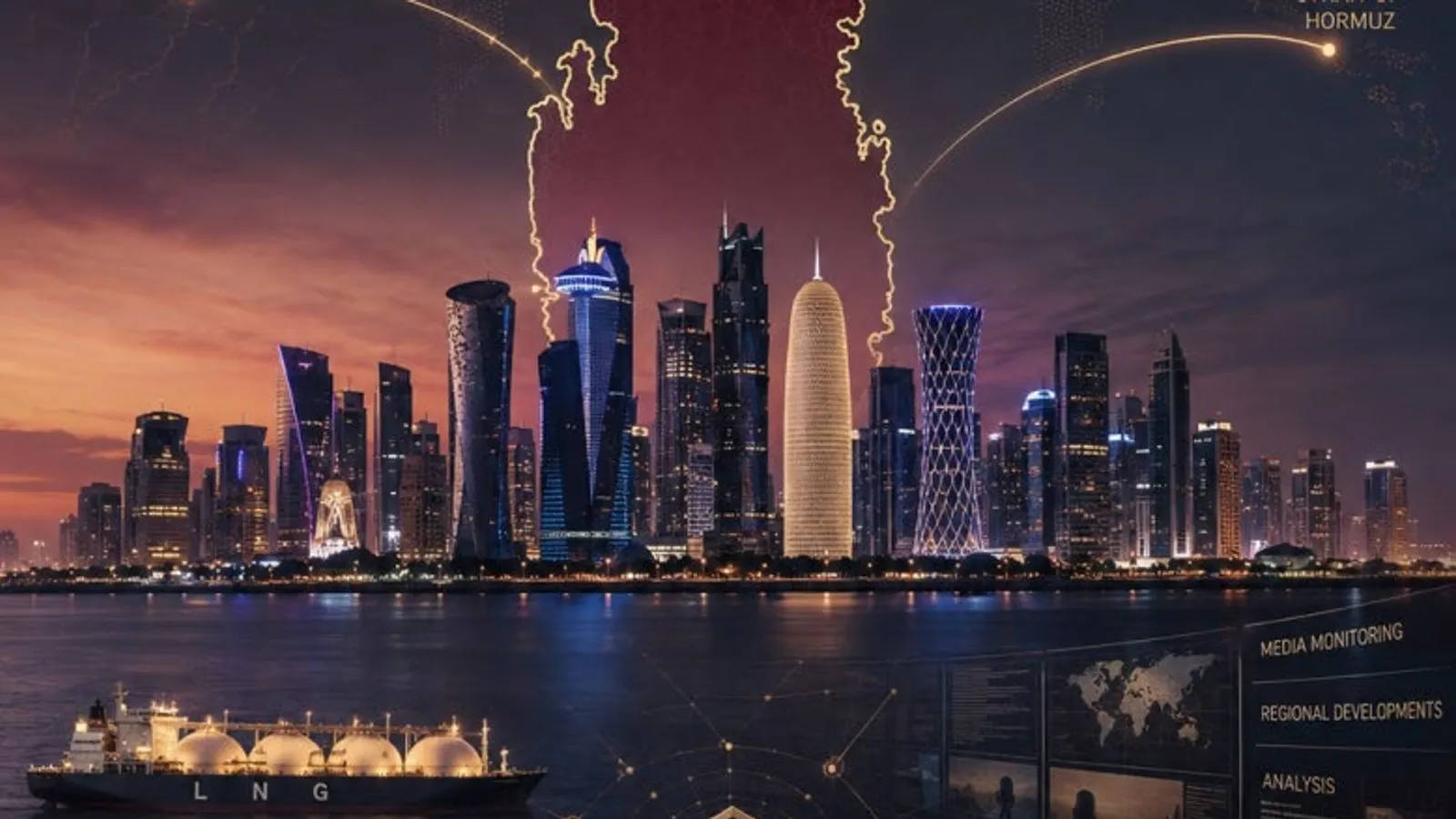
The New York Channel: Qatar’s Mediation on the Record
The Amir’s General Assembly address set out a doctrine, and the meetings that followed showed Qatar’s access. In his speech, covered in the September 23 brief, Sheikh Tamim called Gaza a genocide, rejected displacement, and argued that years of temporary crisis management had produced the current breakdown. His prescription was dialogue, international law, and a collective regional security system. The next day, Qatar joined a U.S.-convened meeting on postwar strategy, energy, and regional security. The prime minister attended a closed meeting on the two-state solution with France, the United Kingdom, and Canada, and Minister of State Mohammed al-Khulaifi used a maritime-security event to place Hormuz and Bab el-Mandeb within a law-of-the-sea framework.
The mediation itself is now confirmed by both parties. Iranian Foreign Ministry spokesman Esmail Baghaei told IRNA that Tehran engaged the U.S. side through a Qatari mediator. He said Iran used the contact to convey its conditions: an end to the war on all fronts, a halt to U.S. attacks, the lifting of the naval blockade and the economic war, and the release of frozen Iranian assets. He described those positions as unchanged. Witkoff wrote that the U.S. team held lengthy talks with the Iranian delegation through mediators who moved between the two sides all day, and that the mediators would continue their work. President Trump called it a very productive meeting with Iran’s mediators. Al-Araby Al-Jadeed led its September 24 front page with what it called a Doha breakthrough, describing a three-hour indirect exchange. The official Qatari readout confirms the prime minister’s meeting with Araghchi and Doha’s efforts to create conditions for dialogue.
Accounts still differ on one point. Iranian officials told Reuters that no face-to-face contact took place, and the format and duration of the exchange remain uncertain. The report therefore holds high confidence that Qatar mediated the exchange and moderate confidence on how it was conducted.
For Doha, the confirmation matters more than the content. Neither side moved, yet both chose to credit Qatar publicly within a day. The report assesses that this makes Qatar the default venue for a second round. The same-day Hormuz-axis daily follows the Iranian side of the channel, including hardline pressure on Araghchi at home.
The Qatari Press Turns the Speech into Doctrine
The domestic media campaign is tightly synchronized. The Qatar News Agency’s Arabic and English services carry the same message, with no meaningful difference in framing. Their morning output stressed the density of Qatar’s diplomatic calendar: al-Khulaifi met the U.S. under secretary of state for political affairs, IAEA Director General Rafael Grossi, the EU’s Gulf representative, and several foreign ministers. QNA also amplified the Amir’s speech by reporting foreign praise and commissioning domestic commentary. The recurring propositions are that the Gulf crisis is a global one, that Hormuz must reopen, that regional security must be collective, and that temporary crisis management has failed. The report reads this as deliberate state-media work to turn a single address into a durable policy narrative.
The Arabic dailies push the same line with more celebration. An Al-Sharq editorial presented Qatar’s General Assembly role as proof of international stature, and signed columns in the paper praised the speech for its wisdom and firmness while offering little analysis. Al-Arab’s editorial turned the speech into a program: reopen Hormuz, return to negotiations, and build a regional security order based on sovereignty and noninterference. In English, Gulf Times foregrounded a Qatar-Turkey convergence narrative, the Qatar Tribune ran experts who framed diplomacy as the route to arrangements that outlast ceasefires, and The Peninsula’s editorial linked supply-chain protection, reserves, and diversification to the Amir’s diplomacy. The Peninsula piece is the clearest example of foreign-policy messaging merged with domestic resilience branding.
Gaza and the Board of Peace
Al-Araby Al-Jadeed gave prominent space to the Board of Peace’s new six-month Gaza recovery plan. The package totals $2.45 billion across 66 projects, including temporary housing, rubble removal, hospital repair, border crossings, power and water infrastructure, solar kits, security facilities, a multinational force, Palestinian police, and a weapons buyback mechanism. Axios independently reported the same 66-project package.
Qatar’s role in the plan is structural. Doha joined the Board of Peace and has pledged major funding to the framework, and its prime minister is working the two-state and ceasefire-implementation tracks at the same time. However, the available reporting does not identify Qatar as the author of the 66 projects or assign it a specific new contribution to this tranche. The report judges with moderate confidence that the plan gives substance to a framework Qatar has joined and funded, and it flags any assignment of a Qatari financing or governance role as the next thing to watch.
The War Economy: VAT, a Three-Year Repair, and Residency for Sale
The war is now visibly entering domestic fiscal policy. Al-Araby reported that Finance Minister Ali al-Kuwari said Qatar is studying a value-added tax as a way to diversify revenue and close financing gaps. Official figures show the pressure. The budget deficit was QAR 10.3 billion in the first quarter and QAR 21.2 billion in the second, for a first-half total of QAR 31.5 billion. Al-Araby put the figure at QAR 36 billion, which the report judges overstates the gap by about QAR 4.5 billion while getting the direction right. The tax itself predates the war, since the GCC agreed a common framework with a 5 percent baseline in 2015. The report therefore judges with moderate confidence that the war has made a long-deferred reform more urgent without creating it.
The energy picture explains the urgency. Speaking at the Qatar Economic Forum’s special edition in New York, QatarEnergy chief executive and Minister of State for Energy Affairs Saad al-Kaabi said the two damaged Ras Laffan trains, which carry 17 percent of Qatar’s LNG capacity, will take three years to repair. That narrows the three-to-five-year range he gave in March. The gas-to-liquids plant hit in the same attacks returns in the first quarter of 2027. Al-Kaabi said Qatar can resume normal operations on the rest of its capacity within weeks of Hormuz reopening, but that QatarEnergy is producing very little LNG today and that expansion equipment still cannot reach the country. The first North Field East train is due in the first half of 2027, later trains in that project depend on the strait, and North Field South should start in 2028. He thanked neighboring states for offering pipeline access and said Qatar had rejected that option on commercial and technical grounds. Asked about reports that Qatar is buying LNG on the market, he said QatarEnergy will become “the largest LNG trader in the world by far.”
Two conclusions follow. About a sixth of Qatar’s LNG capacity will stay offline into 2029 whatever happens in the strait, so the revenue gap behind the VAT debate is a multiyear problem. In addition, the trading push suggests QatarEnergy is sourcing third-party cargoes to keep customer deliveries flowing, which protects market share at thinner margins. Golden Pass in Texas, a joint venture with ExxonMobil that shipped its first cargo in April and should have trains 2 and 3 fully running in 2027, gains weight for Doha as a result. Hormuz remains the binding constraint. The latest public Kpler count showed two observable commodity transits on Monday, although AIS-dark traffic may be missed. Brent stood at $102.13 and WTI at $91.56 in QNA’s September 24 morning market report.
Doha is also using property to hold and attract foreign capital. Cabinet Decision No. 21 of 2026 widened the areas where non-Qataris may own property. Under Justice Ministry rules, a purchase of at least $200,000 grants residency without a sponsor, and a $1 million property carries benefits associated with permanent residency. The developer Dar Global presented its Qatar pipeline to brokers in Dubai on September 22. That pipeline centers on Trump International Golf Club Simaisma, inside the state developer Qatari Diar’s Simaisma project. The report notes that this adds a commercial tie to the president’s family business alongside Qatar’s diplomatic and investment channels to the administration.
Qatari Capital in U.S. Media and the Influence Infrastructure
Qatari capital is moving into American news ownership. On September 17, the FCC’s Media Bureau, acting without a full Commission vote, approved 49.5 percent foreign equity in a combined Paramount-Warner Bros. Discovery that will own CNN and CBS News. Of that, 38.5 points sit with three Gulf sovereign funds: Saudi Arabia’s Public Investment Fund, the Qatar Investment Authority, and the Abu Dhabi Investment Authority. The funds receive nonvoting shares, the Ellison family and RedBird hold all voting stock, and the funds are providing roughly $24 billion toward the deal. Commissioner Anna Gomez objected that the ruling lets repressive governments indirectly control nearly all of the combined company. In a New York Times guest essay, TheWrap founder Sharon Waxman argued that California Attorney General Rob Bonta settled a 12-state antitrust challenge on weak terms. The settlement leaves CNN unsold and creates an independent oversight board for CNN and CBS News whose powers remain undefined. Waxman framed the story as Hollywood’s loss of influence, with the Gulf funds as one source of the industry’s anxiety.
The report judges with high confidence that QIA is set to become a large nonvoting shareholder in the parent of CNN and CBS News. The significance is structural. Qatar’s U.S. exposure is extending from campuses and lobbying into the ownership of a major newsroom, where neither FARA nor Section 117 applies and the only safeguard is the nonvoting share class. The deal must close before the October 1 late-fee deadline, and any congressional move against the FCC ruling will test how far that safeguard persuades Washington.
Qatar’s registered influence network remains active as enforcement tightens. A Justice Department notice on September 16 warned of civil and criminal liability for undisclosed foreign-agent activity. FARA records show current Qatar-related registrations by Cornerstone Government Affairs, Green River Public Affairs, and BGR Government Affairs for the Embassy of Qatar, and by Washington Media Group and Venable for Qatar Foundation and the International Media Office. No new filing shows a firm tasked with lobbying around this week’s General Assembly. No DOJ filing identifies CAIR as a Qatari agent, and the HHS inquiry into CAIR remains open without a finding. QNA did run a feature on U.S. Muslim political mobilization against Islamophobia, which CAIR circulated in its own media digest. That documents amplification by Qatari state media and says nothing about funding. On university funding, the Education Department plans to publish the names of all foreign sources from prior Section 117 reporting cycles on September 25, which could allow Qatar-linked donors to be matched to institutions.
Qatar-Linked Media and the United States: A Four-Week Trend
Negative coverage of the United States in Al Jazeera, The New Arab, and Al-Araby Al-Jadeed has risen since late August in both frequency and intensity. The larger change is in the target. Earlier in the war, hostile material focused mainly on U.S. support for Israel in Gaza. The September material focuses on American power itself: a deterrent that cannot cover two fronts, a security guarantee that failed Saudi Arabia at Bab al-Mandeb, tariff coercion that pushes states toward BRICS, pressure on the UN through about $4.2 billion in unpaid dues, and a president whose approval has fallen to a career low of 32 percent in a Reuters/Ipsos poll. The report’s dated sample runs from Emad Hajjaj cartoons in Al-Araby in late August through Al Jazeera English opinion pieces on Bab al-Mandeb, BRICS, Greenland, and the UN, and stand-alone news stories on Fox News and Reuters/Ipsos polling.
The week’s items fit the pattern. On Al Jazeera, Alanna O’Malley argued that Security Council paralysis is shifting weight to the General Assembly, where middle powers can aggregate influence, a thesis that complements Qatar’s own strategy. Christoph Heusgen criticized both Washington and Beijing ahead of the Xi-Trump summit but portrayed U.S. power as more constrained. Maher al-Zubaidi framed Trump’s access restrictions on CNN, MSNBC, and Politico as a press-freedom issue. In Al-Araby’s print edition, Joumana Haddad’s signed essay argued that post-9/11 Islamophobia has returned to the United States as a tool of domestic politics. The paper’s Xi-Trump coverage drew extensively on American sources and reported Washington’s complaints, but its narrative placed China in the stronger strategic position. The report describes it as source-diverse but frame-asymmetric, and it does not read as Chinese state propaganda.
Three developments explain the timing. The Houthi seizure of Bab al-Mandeb and Washington’s refusal to defend Saudi shipping gave Qatar-linked writers a concrete case that the U.S. guarantee is conditional. The Hormuz closure and the Ras Laffan damage put the war’s cost on Qatar’s own balance sheet. And polling ahead of the November 3 midterms supplies a steady flow of evidence that the war is unpopular in the United States.
Three qualifications apply. Most of the sharpest pieces are signed guest opinion, and some also criticize China or credit Washington. News copy stays sourced to Reuters, Fox News, and U.S. officials, and the report found no fabricated material; the tilt lies in story selection and framing. Finally, the sample is dated and purposive, so the assessment carries moderate confidence. A coded count of August against September opinion output would turn it into a measured trend.
Official Doha is moving in the opposite direction. Over the same four weeks, the Amir attended a U.S.-convened meeting in New York, QIA announced a $20 billion partnership with J.P. Morgan Asset Management, and the prime minister carried messages for Witkoff and Kushner. The widening gap lets Doha offer Washington access and capital while its funded outlets tell Arab and global audiences that American power is in decline. It also gives congressional critics fresh material for the FARA and Al Jazeera registration debate, while leaving Doha deniability, since the sharpest items are signed opinion.
The documentary NAZA, by Yuval Abraham and Rachel Szor, adds a near-term test. It has its North American premiere at the New York Film Festival, which opens September 25, and opens at New York’s IFC Center on September 30. The film alleges, on the basis of interviews with 24 anonymous Israeli military and intelligence personnel, that the IDF set acceptable civilian-casualty thresholds for strikes in Gaza, and the IDF rejects the allegations. Its production and financing are British, with no Qatari credit. Qatari-funded outlets have covered the film consistently since Venice, but amplification is documented and Qatari financing or influence is not.
Key Points
- Qatar’s General Assembly strategy has moved beyond message amplification to live mediation. Iran and the U.S. envoy both confirm the Qatari channel, and Doha is also engaging Western and regional governments on postwar and maritime security (high confidence).
- Qatari media are treating the Amir’s speech as doctrine, presenting Gaza, Hormuz, collective security, and national resilience as one strategic narrative in both Arabic and English (high confidence).
- The Board of Peace’s $2.45 billion, six-month Gaza plan gives content to a framework Qatar has joined and funded, but no source assigns Qatar authorship or a new contribution (moderate confidence).
- VAT is a fiscal option the war has accelerated. The GCC framework dates to 2015, and official first-half deficits total QAR 31.5 billion, below Al-Araby’s QAR 36 billion figure (moderate confidence).
- A sixth of Qatar’s LNG capacity will stay offline for three years. The revenue loss will outlast any Hormuz reopening, and Doha has ruled out pipeline bypass routes (high confidence).
- Negative coverage of the United States in Qatar-linked media has risen since late August, and its target has shifted from U.S. policy on Gaza to American power and Trump himself, while official Doha stays courteous (moderate confidence).
- The Qatar Investment Authority is set to become a large nonvoting shareholder in the parent of CNN and CBS News, a form of exposure that FARA and Section 117 do not reach (high confidence).
- Al-Araby’s Xi-Trump coverage gives Washington’s case space but portrays U.S. leverage as constrained and China as the more patient actor (moderate confidence).
- Al Jazeera’s current opinion cluster favors multilateral institutions and middle-power agency and is sharply skeptical of concentrated U.S. executive power. All three pieces are signed opinion or blog content, and none is a network editorial (moderate confidence).
What to Watch
- Whether a second Qatar-mediated round is scheduled, and whether either side publishes the conditions it conveyed in more detail.
- Whether talk of reopening Hormuz shifts from general aspiration to a sequenced, verifiable arrangement.
- Whether the VAT study becomes a cabinet-approved timetable, with defined exemptions or zero-rated categories.
- Whether the September 25 Section 117 release names new Qatar-linked university donors or contracts.
- Any FARA supplemental filing that names the General Assembly, the Amir’s visit, the Board of Peace, or the Hamas-funding controversy as a lobbying objective.
- Whether HHS publishes findings in the CAIR inquiry. Until then, allegations and government findings should be kept separate.
- Whether the Board of Peace’s Gaza package assigns Qatar a specific financing, implementation, or governance role.
- Fresh Ras Laffan loadings, LNG carrier movements, and North Field schedule revisions.
- Whether the Paramount-Warner Bros. Discovery deal closes before October 1, any full-Commission or congressional challenge to the FCC ruling, and any governance role sought by QIA.
- Whether U.S.-critical opinion in Al Jazeera and Al-Araby holds its September level after the mediation round, and whether any Qatari official distances Doha from it.
- Al Jazeera English and The New Arab coverage of the NAZA festival screenings and the September 30 opening.
- QatarEnergy spot purchases or trading deals that confirm the move into third-party LNG, and any change to Golden Pass timelines.
This post summarizes the Qatar Watch daily brief for September 24, 2026. The report gives priority to primary sources: the Amiri Diwan’s text of the Amir’s speech, Qatari Foreign Ministry and QNA readouts, official budget data, FARA records, the Justice Department’s September 16 notice, the FCC ruling, and Al-Araby Al-Jadeed’s September 24 print edition. Supporting sources include The New Arab, The Jerusalem Post and Reuters, Al Arabiya, Axios, Al Jazeera, Al-Sharq, Al-Arab, Gulf Times, the Qatar Tribune, The Peninsula, The New York Times, Variety, Deadline, The Hollywood Reporter, Arabian Business, Oil & Gas Middle East, CNBC, TradeArabia, Enterprise, CSIS, and The Wall Street Journal. The report holds high confidence that Qatar mediated the September 22 exchange and moderate confidence on its format, because accounts differ on whether any face-to-face contact occurred. The trend in negative U.S. coverage rests on a dated, purposive sample and carries moderate confidence. Al-Araby’s deficit figure is corrected against official data, and allegations about CAIR are kept separate from government findings. See also the same-day Economic Press Review. Earlier posts in the series are collected on the Qatar Watch hub.