Advertising the Model: Doha's Congo Showcase and the Sentence It Won't Say
Doha spent August 24 advertising what it does best and saying as little as possible about what it cannot control. The Democratic Republic of the Congo file supplied the day’s showcase: a roadmap agreed in Switzerland between Kinshasa and the Alliance Fleuve Congo and M23 movement, built on the Doha Framework and negotiated with American, Togolese, African Union, and Swiss participation. Qatari outlets in both languages gave it prominence out of proportion to its regional weight, because it demonstrates the mediation model working end to end in a theater where no Qatari relationship is politically compromising. The harder files were handled with visible economy, and the interpretive weight of the day sits in the media ecosystem. This post summarizes our Qatar Watch extended edition for August 24.
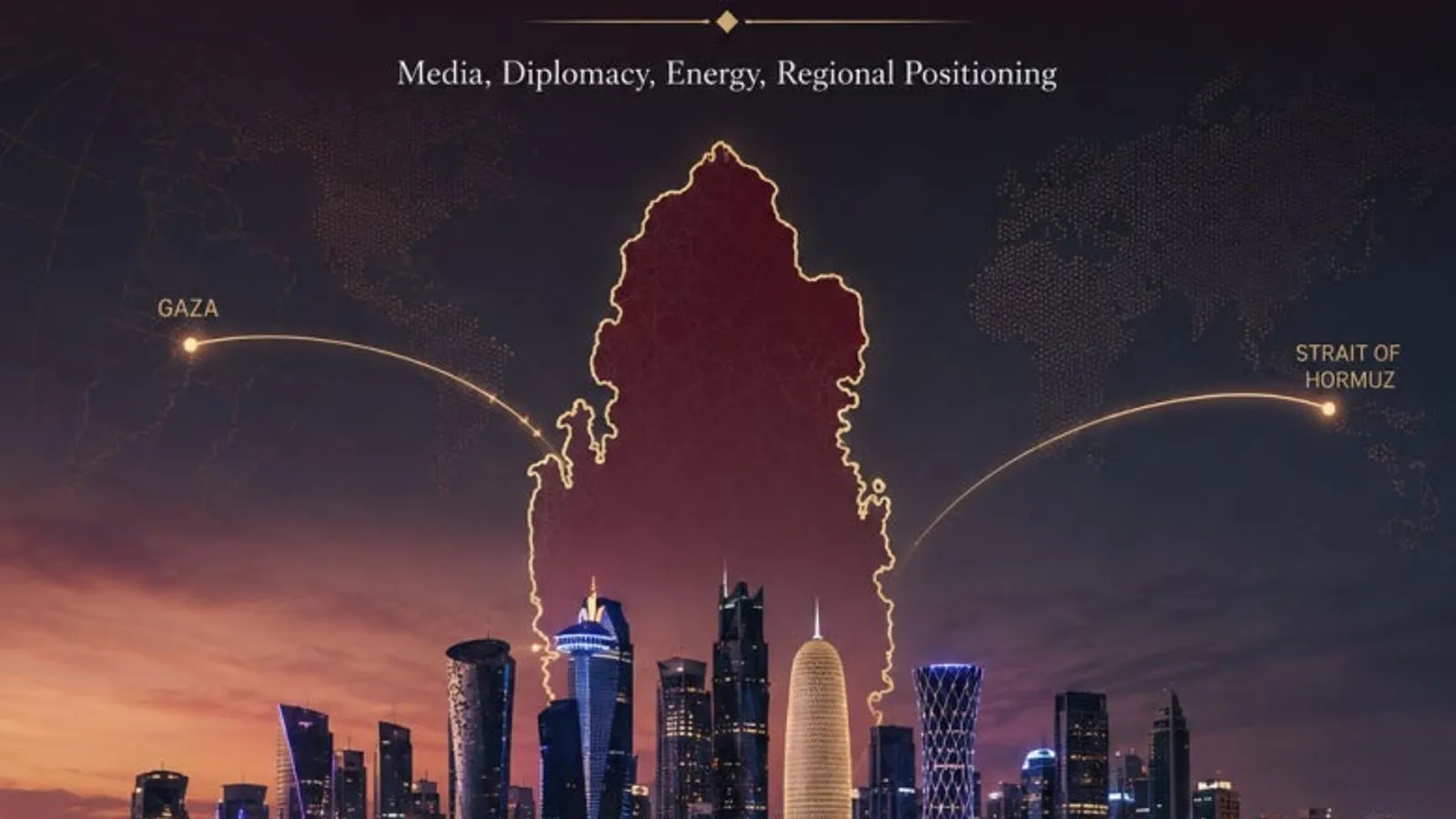
The Showcase and the Silences
Al-Sharq’s editorial, “Qatar Opens the Road to Peace in Congo,” is the clearest domestic statement of the day, and the report reads its function precisely: it universalizes the model instead of describing an episode. On its account Qatar manufactures trust and converts access into political outcomes, and the room in which the talks happen is incidental. The choice of the Congo for that argument is deliberate: a theater where the counterpart is not a designated organization and success can be claimed without reference to Hamas, Iran, or Israel. Establish the general proposition there, and it can then be applied to files where the particulars are contested.
The state channel ran three registers, and none touched the American sanctions campaign against Iran that opened the same day. The prime minister’s meeting with the German defense state secretary was reported through de-escalation vocabulary, with de-escalation appearing before Gaza in the readout and neither Iran nor the sanctions package named. Qatar condemned a bus attack in Syria and expressed full solidarity with the Damascus government, now settled Qatari policy. And Qatar Charity reported a completed vision-restoration program in Sri Lanka, the durable welfare layer doing its usual quiet work. On Gaza there was no new Qatari initiative: the standing formulation remains that both parties should implement the agreed plan in full, and the obstacle it names is Israeli non-implementation.
Two Cartoons Carry the Argument
The state said little, so the editorial pages said it instead, and the report treats the two cartoons, one per language stream, as the day’s clearest reading of Doha’s private position. Al-Watan’s opinion page shows a vulture labeled as American sanctions perched on a floating oil drum: the sanctions campaign framed as a scavenger feeding on damage already done, the drum unlabeled and unowned, the water open sea, the same maritime space Qatar’s LNG transits. Gulf Times ran a Reynold cartoon of a waterbird gliding serenely while its bandaged legs thrash below the waterline, holding in its beak a notice reading Hormuz, New US Territory. The notice reproduces a specific artifact: the map the American president published on Truth Social on August 18 labeling the strait new US territory, and reposted without caption on August 23. A Qatari English-language title answered the American president directly, on the opinion page, the morning after he repeated the claim, and the drawing treats the territorial claim as an image file: the claim floats, and the apparatus that would enforce it is in splints. The report’s conclusion: for a Qatari daily to publish this on the morning the American package is announced, with no accompanying official statement, is the clearest available reading of Doha’s position. The state will not criticize the campaign. The editorial page will.
Al-Watan’s political register ran harder than the state’s in prose as well: a page-12 feature, “Netanyahu Sets the Region Ablaze,” personalizes regional escalation entirely around the Israeli prime minister and assembles Israeli voices, Lapid, Lieberman, Ben Gvir, Golan, Barak, and Haaretz commentary, to argue that Israeli domestic politics is driving the escalation. The report’s note on its Turkish thread is the operative point: a Qatari paper using Turkish framing to advance a Qatari interest, because the Mecca agreement, the Turkish presence in Syria, and Israeli anxiety about both are the architecture Doha expects to shelter under, and presenting Israeli hostility to Turkey as electoral opportunism argues that the architecture will outlast the hostility.
Explaining America to Arab Audiences
Al Jazeera Arabic spent the day explaining American policy as a domestic product. Saleh al-Mutairi, a Kuwaiti broadcaster writing as a guest, set out four Gulf refusals on the model of the Khartoum no’s: no use of Gulf territory for an attack on Iran, no acceptance of Gulf states or their installations being targeted, no acquiescence in Gulf companies becoming collateral damage of the American-Iranian confrontation, and no Iranian attempt to impose its choices on its neighbors. The working part is the sanctions mechanism: banks, shippers, and insurers discipline themselves once American exposure is priced, so a Gulf company ends up choosing between an Iranian counterparty and the dollar system; his answer is Gulf coordination. The report’s note: a Kuwaiti author stating a Gulf position no Gulf government has stated in these terms, three of the four refusals already describing Qatari practice, run under a guest byline that lets Doha watch the argument circulate without owning it.
Azza Karam’s companion essay mapped American Christian nationalism as a coalition, and its foreign-policy conclusion is the load-bearing part for this file: once the relationship with Israel and the confrontation with Iran are sacralized, war becomes an obligation and diplomacy becomes betrayal. Two guest blogs completed the picture, one pricing Trump’s alignment with Netanyahu in domestic political terms, citing a progressive win in California against heavy pro-Israel spending, a federal debt above forty trillion dollars, and a forty-day war that left Hormuz closed, with the judgment that Tehran has no reason to open the strait before the November midterms; the other, from a Gaza researcher, arguing that the Kushner-era diplomacy manages attrition and defers the substantive questions. Read across the four items, the message to Arab audiences is that American policy is held in place by religious and electoral forces at home, and the conclusion it leaves for Arab governments is that lobbying Washington buys little and hedging is the durable investment. None of it appeared in English: the report’s standing judgment is that the Arabic service is the leading indicator and the English service the lagging one, with positions appearing first in a register Qatari officials can disclaim.
The Sentence Qatar Has Never Uttered
The Gaza section states the structural finding as plainly as this series has put it. Qatar’s position through August has been to demand that both parties implement the agreed plan in full, placing the outstanding obligations on Israel and describing Hamas’s acceptance, disarmament provisions included, as a step already taken. That formulation keeps Doha inside a framework that contains disarmament, which is what Washington requires of a mediator, while locating the current failure with Israel, which is what Arab opinion requires of Doha. It also avoids the one sentence Qatar has never uttered: a commitment to delivering Hamas’s weapons, when everything undertaken so far is to transmit positions about them. The report’s expectation for planners follows: Qatar functions as broker, guarantor, and payments channel, not as an enforcement mechanism; it will not take public ownership of a coercive disarmament formula in any foreseeable circumstance, because its usefulness to Washington rests entirely on access to Hamas that no other acceptable mediator has, and public ownership would destroy that access and its Arab standing at once.
The most interesting movement is in the discourse being prepared around that position. The day’s most consequential text on any Qatari-funded platform is an extended Al-Araby Al-Jadeed essay, “The Hamas That Is Changing,” which opens with Sadat’s 1977 Knesset announcement and builds a history of the failed Palestinian doctrine of conscious entanglement, the idea that Arab regimes could be drawn into supporting the armed struggle once the fighting made their support unavoidable. Its application to the present is unsparing: the visible defeat in Gaza came after a war of annihilation that no Arab regime chose to be entangled in stopping, and Hamas is changing not out of any wish for surrender but because it is registering the defeat of the unity of arenas and the turning away of the Arab and Islamic nations from what it kept demanding of them. The essay names the Dahlan arrangements smoothing the work of Kushner, Mladenov, and the Shaath committee, whose business it describes as the disarming of Hamas, and treats the mechanism as a fait accompli. The report’s collection judgment deserves quoting in spirit: the appearance of this argument on a Qatari-funded platform, published from London and edited at arm’s length, is a stronger indicator of where Doha expects the Gaza file to end than any statement from the foreign ministry podium. It is expectation management: conceding defeat, conceding that disarmament is the operative agenda, and assigning responsibility for the outcome to the Arab state system, with the historical frame making the concession bearable.
The Deep Files: Designations and Disclosure
Neither the Muslim Brotherhood file nor the education file moved inside the window, and the report reads Doha’s silence on both as a standing posture rather than an absence of news. The Brotherhood framework changed in late 2025: Executive Order 14362 initiated designations, and on January 13 the Treasury and State Departments designated the Egyptian, Jordanian, and Lebanese chapters, the first time Washington has formally targeted Brotherhood branches under counterterrorism authorities. The Qatari relevance lies in what was left out: analysts place the movement’s transnational leadership structures in Turkey and Qatar, and the National Security Council’s Sebastian Gorka publicly insisted the designations target organizations, not countries, with further action possible, a formulation that preserves the option of designating a transnational body without naming its host state. That is the specific exposure Doha now carries. Its position is unchanged and unstated; the indicator is any move toward designating a transnational structure, or legislative language conditioning security cooperation on host-state conduct, either of which would force Doha into a public position for the first time since 2017.
The education file has moved further and faster. The Department of Education’s disclosure portal established Qatar as the largest single foreign source of gifts and contracts to American universities in 2025 at more than 1.1 billion dollars, up from 396 million in 2024, with cumulative totals reported at 7.7 billion over four decades; Carnegie Mellon alone disclosed a 936 million dollar contract. The March House committee release of nearly nine hundred pages of partnership documentation, with its finding that Northwestern and Georgetown are contractually bound to abide by Qatari law, converted a funding argument into a jurisdictional one. Qatar’s answer has been to hire professionals and stay silent: foreign-agent filings record the Qatar Foundation retaining Washington Media Group at forty thousand dollars a month and the law firm Venable at twenty-five thousand, while a Scott-Stefanik-Gottheimer bill would bar federal funds from institutions operating branch campuses in countries listed as adversarial, Qatar alongside Iran, North Korea, and China. The domestic mirror ran on Al-Watan’s front page the same day: education presented as national development and generosity. The report’s note: Qatar is running two education narratives that never meet, and the item to watch is whether any Qatari outlet ever answers the congressional findings directly. As of August 24, none has.
Key Points
- Qatar is widening its mediation portfolio geographically in order to protect it politically: the Congo roadmap led both Gulf Times and the Al-Sharq editorial column as proof the model works where nothing is compromising (high confidence).
- Doha will remain a transmission and guarantee channel on Gaza but will not accept public ownership of Hamas disarmament; the standing both-parties formulation, and the absence of any new position on August 24, mark the boundary (high confidence).
- Qatar hedges against Iran while refusing to host enforcement against it, and the priority is keeping the Gulf out of the arena; the cartoons treat sanctions and the Hormuz claim as external impositions on Gulf waters while the state stays silent on the package itself (moderate-to-high confidence).
- The Arabic stream carries the strategic argument and the English stream the humanitarian one, an editorial division of labor set in Doha (high confidence).
- Qatari-linked media are preparing Arab audiences for a reduced Hamas: the Al-Araby Al-Jadeed essay concedes the defeat, names the disarmament mechanism, and situates both inside a longer history of Palestinian defeats (moderate-to-high confidence).
- The education and Brotherhood files are the most likely sources of friction with Washington over the next quarter, and Doha’s current strategy is management by silence and paid professional representation (moderate confidence).
What to Watch
- Any Qatari official formulation that explicitly links Hamas disarmament to Israeli withdrawal, reconstruction funding, or international guarantees, which would mark a move from transmission to sponsorship.
- Whether the Al-Araby Al-Jadeed argument, that Hamas is already changing under the weight of a failed regional doctrine, migrates into Al Jazeera Arabic and then into English.
- Whether Qatari titles keep answering American declaratory posts within one news cycle, and whether that treatment moves from the opinion pages to the news pages or official language.
- New meetings involving Qatari officials with Kushner, Mladenov, Hamas leaders, Egypt, or Turkey, and any sign of the Shaath committee resuming work.
- Whether Al Jazeera Arabic begins describing disarmament as an accepted component of the roadmap rather than an external demand, and whether English adopts the Arabic service’s strategic-autonomy language.
- Any move toward designating a transnational Muslim Brotherhood structure, passage of the branch-campus legislation, the next Department of Education disclosure cycle, and whether any Qatari outlet responds directly to the House findings.
- Qatar-Turkey coordination on Gaza, Syria, and postwar security architecture, and any Qatari move toward the Mecca joint defense agreement.
This post summarizes the Iran Dossier Qatar Watch extended edition for August 24, 2026: QNA and state messaging, the Al-Sharq, Al-Watan, and Al-Rayah Arabic pages, the Gulf Times, Peninsula, Qatar Tribune, and Doha News English titles, the Al Jazeera Arabic opinion set and English comparison, the Al-Araby Al-Jadeed opinion pages, and dated background on the standing Brotherhood and higher-education files. The report notes two source caveats it carries explicitly: the Gulf Times opinion headline beside the Reynold cartoon is cropped in the capture supplied, and the byline of the Al-Araby Al-Jadeed Hamas essay should be confirmed against the published page.