A Silent State and a Loud Press: Doha Leaves the October 7 Anniversary to the Media It Funds
On the third anniversary of October 7, the Qatari state said almost nothing and the media it funds said a great deal. The Foreign Ministry’s weekly briefing dealt with U.S.-Iran mediation, Houthi attacks on Saudi Arabia, and the Mecca Defense Alliance, and no anniversary statement appeared in official channels. Al Jazeera, Al-Araby Al-Jadeed, and Al-Watan each ran a full anniversary package, and all three told the same story: October 7 opened a Palestinian struggle that has not ended, and Israel, three years on, has not recovered from the shock. The report judges with high confidence that this division of labor works in Doha’s favor, because it lets Qatar keep its profile as a mediator while its outlets shape Arab opinion on the day. In Washington, Senator Chris Murphy called Qatar an essential ally and then said the Pentagon had denied him access to Al Udeid. Qatari LNG moved more freely through Hormuz in September, but a run of tanker attacks shows how exposed the route remains.
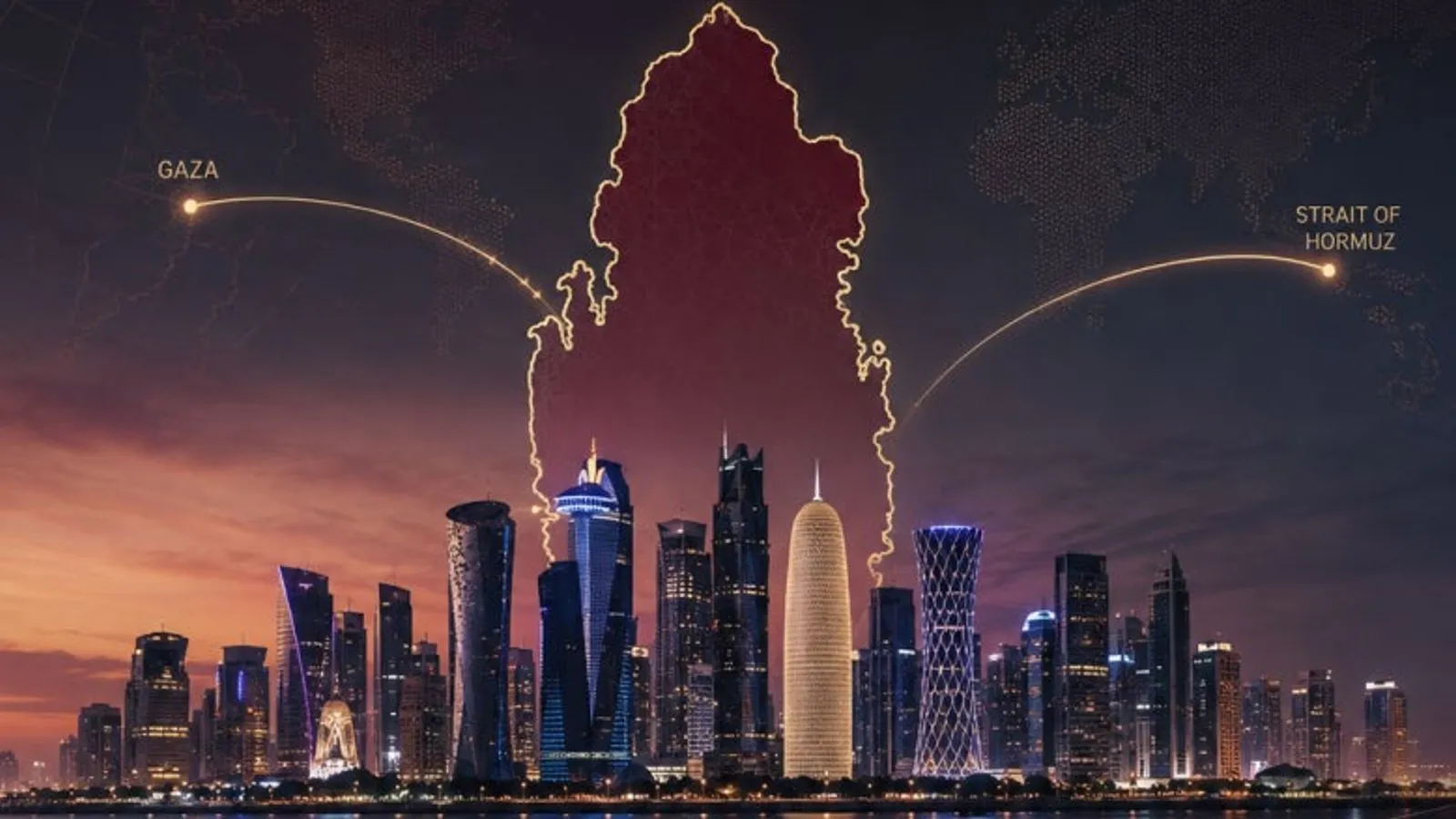
Doha Leaves the Anniversary to Its Media
The sharpest contrast of the day was between the Qatari state and its media. The Qatar News Agency and the Foreign Ministry did not turn the anniversary into a foreign-policy statement. Their output covered mediation between Washington and Tehran, Saudi security, the Mecca Defense Alliance, counterterrorism cooperation, and regional resilience. The anniversary message came instead from the outlets Doha owns, funds, or hosts, and they carried it in full.
Those outlets worked as a single instrument. Al Jazeera and Al-Araby Al-Jadeed share a vocabulary, calling the attack the “Al-Aqsa Flood” and the war that followed a “genocide war.” They also share a chronology in which October 7 opens a struggle that is still under way. The report finds no visible state directive behind this convergence and notes that none is needed. The arrangement gives Doha room to deny responsibility. Officials can point to their own silence while the outlets they fund set the frame for Arab audiences.
Al-Watan devoted a multi-page package to the anniversary and built it around human cost. Black-and-gold banners, large red headlines, and images of destruction framed stories on journalists killed in the war, on prisoners, and on women in Gaza facing death and loss. One spread offered seven observations on the anniversary, and another set U.S. public support for Israel and Israeli Defense Minister Israel Katz’s threats of further action in Gaza beside stories of loss. The package treats October 7 as the start of a continuing sequence defined by the destruction of Gaza, Israeli coercion, and Palestinian endurance. The frame is familiar in Qatari media, and the anniversary concentrated it.
Al-Araby Al-Jadeed Sets the Sharpest Tone
Al-Araby Al-Jadeed, the London-published daily funded by Qatar and headed by Azmi Bishara, carried the anniversary in six places in its October 7 edition. A front-page strip led into a two-page political package, and the theme returned in the opinion, society, and variety pages and in the back-page column. The front-page lead itself went to Yemen’s government offensive and the U.S. midterms, so the anniversary reached readers mostly from the inside pages.
The political package paired a Gaza report with an analysis filed from Doha. The Gaza report gives the Israeli toll of October 7 as 1,136 dead, about 350 of them soldiers, and more than 250 taken captive, against more than 74,000 Palestinians killed in what the paper calls a war of genocide. It refers to the Israeli communities that were attacked as settlements. One of its interviewees, researcher Ehab Jabareen, concedes that the evidence does not show a complete Israeli plan to destroy Gaza before October 7, but argues that the attack moved ideas such as resettlement and buffer zones into mainstream Israeli options. The Doha-datelined analysis goes further in tone. It describes the fighters who crossed from Gaza as bodies that “brought down fortresses built on the bones of the Palestinians.” It then turns to Israeli politics, citing the October 27 Knesset election and an Israeli university poll in which only 27 percent believe Israel won in Gaza and 59 percent expect a similar attack in the coming years. The report reads the formula as consistent across the edition. The breach is remembered with pride, and Israel appears as a country that cannot recover from it.
The society and opinion pages carried the same theme. A report from Copenhagen linked Israeli soldiers’ social-media posts to legal complaints filed in Europe and tied restaurant refusals and port protests abroad to rising Israeli emigration, while conceding that some incidents shade into hostility toward Israelis as such. On the opinion page, Acre-based analyst Antoine Shalhat argued that mass “transfer” of Palestinians has long been part of Zionist thinking and did not begin with October 7. The variety pages presented the global Inktober drawing challenge as having turned Palestinian and covered a Jordanian campaign to boycott an Andrea Bocelli concert at Petra, in part over his message of sympathy to a freed Israeli hostage. The report treats these as argument-driven pieces that reflect the paper’s ideological frame.
Two columns stand apart. Lebanese columnist Ernest Khoury wrote about last week’s flydubai incident, in which, by his account, an Omani co-pilot tried to bring down a Dubai-Tel Aviv flight carrying 174 people, 166 of them Israelis, before the aircraft landed in Tabuk. Khoury blamed the lack of official Arab information for the conspiracy theories that followed, and he condemned social-media users who openly wished the passengers dead. His column drew the edition’s one explicit moral line on Israeli civilian lives, although it also attacked Prime Minister Benjamin Netanyahu in harsh terms. Marwan Kabalan of the Doha-based Arab Center for Research and Policy Studies, which Bishara also heads, added a self-critical note. Arab media, he wrote, cover the Iran war as if it were run from their studios, while the decisions are made in Washington, Tehran, and Tel Aviv. Media can serve as soft power, in his view, but they cannot open a strait or impose a ceasefire. The report judges with moderate confidence that his point marks the limit of the Qatari model. The anniversary coverage shows how far Doha’s outlets can shape the story, and Kabalan shows where that influence stops. We covered Tehran’s reading of the flydubai incident in an earlier post.
Al Jazeera Looks Past Remembrance
Al Jazeera Arabic’s anniversary opinion page focused on the future of Palestinian resistance. Oraib Al Rantawi, director of the Al-Quds Center for Political Studies in Amman, argued that the consequences of October 7 still shape wars, shipping, supply chains, and energy prices across the region. His central claim is that the resistance will survive, but that its tools and political form must adapt and reconnect with the broader Palestinian public instead of belonging to one faction or one form of armed action. A second piece, marking a year since the Trump Gaza plan, described the ceasefire architecture as one-sided. It argued that reconstruction remains marginal, displacement is entrenched, and the international Board of Peace has failed to constrain Israel. In doing so, it shifted responsibility away from Hamas compliance and toward the U.S.-backed arrangements.
Al Jazeera English framed its anniversary coverage around genocide in Gaza and ran an opinion piece on trauma. It also published a short factual item on Israeli memorials that put the toll of the attack at almost 1,200 killed and about 250 taken captive. The report gives that item weight, because the network’s framing is strongly pro-Palestinian and it still placed the Israeli dead on the record. The report assesses with moderate confidence that Al Jazeera’s frame is coherent and gives Israeli loss only marginal space.
The network also treated the U.S.-Israel relationship as less settled than before. An English opinion piece argued that the Republican consensus on Israel is under strain from the America First wing and from younger Republicans. In Arabic, a Qatar University scholar called for a new U.S. defense compact in the region based on burden-sharing, regional air and maritime defense, and a more flexible U.S. military presence. Together, these pieces depict a United States that remains indispensable but no longer holds uncontested primacy.
Mediation, Saudi Security, and the Mecca Alliance
Doha’s official line on regional security was more explicit than usual. Foreign Ministry media director Ibrahim bin Sultan Al Hashmi said the U.S.-Iran talks and message exchanges through Qatar remain active and uninterrupted, and that Doha is seeking progress both sides can build on. On October 6, Emir Sheikh Tamim bin Hamad Al Thani received Iranian Interior Minister Eskandar Momeni, and the Amiri Diwan said the talks covered regional developments and de-escalation. Momeni told Iranian media that a technical team will return to finish work on the file of Iranian pilots downed over Qatar in March. Our October 6 brief covered the opening of that track.
On Saudi Arabia, the language was unusually direct. Qatar condemned Houthi attacks on the kingdom, on Islamic holy sites, and on civilian facilities, and it backed Saudi measures to protect the kingdom’s security. Al Hashmi endorsed the Mecca Defense Alliance as a regional security initiative but said it is too early to discuss Qatar joining it. Doha therefore supports the alliance without taking on its mutual-defense obligations. Asked whether Gulf states now want a security system outside the American framework, he said only that the Mecca agreement strengthens regional cooperation. Foreign Ministry spokesman Majed Al Ansari made a similar case at a Georgetown University in Qatar session, calling for stronger national capabilities, deeper regional cooperation, and a broader security architecture.
The Saudi-Turkish-Pakistani alliance has moved from declaration to implementation. Its strategic committee ordered the immediate execution of mutual-defense commitments and the deployment of agreed forces to Saudi Arabia, and it named retired Pakistani Lieutenant General Noman Mahmood as its first secretary-general. Al-Araby Al-Jadeed reports that Turkish air-defense and electronic-warfare systems and hundreds of Turkish military experts are already in the kingdom, and that Pakistan may carry more of the early military role while Turkish legal procedures delay a larger ground deployment. Qatar’s role remains political. The report found no substantiated public evidence that Qatar is financing Turkish or Pakistani deployments, and it advises against treating claims of Qatari money as established.
Washington: Al Udeid, Section 117, and the Cybermercenary File
Senator Murphy’s Doha visit produced the clearest new U.S. political message about Qatar. After meeting the Emir, Murphy said Qatar is and will remain an essential ally of the United States, citing Al Udeid, Qatar’s hosting of Afghan refugees, its role in hostage releases from Gaza, and its current U.S.-Iran mediation. He also said he raised concerns about the transfer of a luxury aircraft. The more immediate controversy is the base itself. Murphy said the Pentagon denied him access to Al Udeid and declined to arrange a war briefing, and he called the refusal an unconstitutional effort to hide the war’s costs from Congress. The Pentagon cited a standing travel directive. The dispute is between Congress and the Pentagon, but it places Qatar’s main U.S. military facility at the center of an American oversight fight. Murphy also met Qatar Foundation vice chairperson Sheikha Hind bint Hamad Al Thani at Education City to discuss American universities in Qatar.
The report found no new court filing, Education Department action, or Qatari response on Section 117 dated October 6 or 7. Judge Tanya Chutkan’s temporary restraining order still bars the department from publishing donor identities reported by members of the Association of American Universities, except for entities disclosed earlier. The order is set to expire on October 29 unless extended. The government’s response is due October 13, and the universities’ reply is due October 20. Critics continue to cite large aggregate totals as evidence that Doha buys influence, while Qatari officials say most of the money pays for branch-campus operations in Qatar. The report expects the next meaningful change to come with the October 13 filing. Our Section 117 special report examines the order in detail.
On covert influence, no U.S. government action has followed the September request by Senators Ron Wyden and Sheldon Whitehouse and Representative Pat Harrigan to add three Indian hack-for-hire firms to the Commerce Department’s Entity List. Reuters confirmed the request and the companies’ denials. The lawmakers’ letter, as reported by CyberScoop and TechCrunch, alleges that some of the activity was conducted at the behest of the Qatari government against opponents of its World Cup bid and the family of a former House Intelligence Committee chairman. The report holds high confidence that the allegation and the request exist, but lower confidence on state attribution until there is an official finding or independently testable evidence.
LNG Moves Again, but Hormuz Dependence Is Unchanged
Qatari LNG traffic through Hormuz improved in September and early October. S&P Global Energy counted 13 Qatari LNG cargoes leaving the strait in September, part of the highest monthly LNG transit count since the war began, and Reuters tracked more Qatar-linked cargoes reappearing outside the strait around October 2 and 3. The report cautions that the improvement is commercially important but should not be mistaken for normalization. Most Qatari LNG still depends on Hormuz, and no available route can replace seaborne exports from Ras Laffan at scale.
The risk on the route has not eased. Citing the UK Maritime Trade Operations center, Al-Araby Al-Jadeed counted six attacks on tankers in Hormuz in five days, including a strike on the Kuwaiti supertanker Kazma 3 on October 1. It also reported supertanker freight to Asia at a record $34.31 a barrel on October 3, and quoted an analyst who said some shippers now pay informal fees to secure passage. Brent crude stood at $100.93 a barrel and WTI at $89.59 on October 7. Saudi East-West pipeline capacity has been restored to 5.8 million barrels a day, and Gulf hydrocarbon exports reached 81 percent of the prewar rate in September, but neither figure addresses Qatar’s LNG exposure. Our daily intelligence update for October 7 covers the latest tanker strike from the Hormuz side.
Gulf business leaders are now arguing for route diversity. At a meeting of GCC chambers in Manama, reported by Qatar Tribune, Sheikh Khalifa bin Jassim bin Mohamed Al Thani, who chairs both the Federation of GCC Chambers and Qatar Chamber, said Gulf trade security can no longer depend on a single route or port. Industry executives are also urging a shift from lean supply chains toward built-in redundancy, and Al Jazeera Center for Studies has floated a corridor concept that would include a future Qatari gas route through Saudi Arabia, Jordan, and Syria to Turkey and the Mediterranean. The report notes that this remains a strategic scenario with no approved project behind it.
The report’s other files were quiet. Qatar Foundation promoted its Vision 2040 for pre-university education and presented its M. F. Husain museum at TIME100 Art in New York, which the report reads as the slow, institutional arm of Qatari soft power working alongside the fast arm of its media. Qatar-linked coverage of the French student protests treated them as a domestic dispute over schools and policing, with no Muslim Brotherhood or Islamist framing. No major new human rights case surfaced, while Human Rights Watch and Amnesty International continue to document unresolved problems in labor rights and civic freedoms.
Key Points
- Doha left the anniversary message to its media. No statement appeared in official channels, while Al Jazeera, Al-Araby Al-Jadeed, and Al-Watan ran full packages with a shared frame, which lets Doha keep its mediator profile (high confidence).
- Al-Araby Al-Jadeed set the sharpest tone, with six anniversary placements in one edition and a Doha-datelined analysis that recalls the October 7 breach in celebratory language (high confidence).
- Al Jazeera’s frame is coherent and gives Israeli loss marginal space, although its English service did put the Israeli dead on the record (moderate confidence).
- Analysts inside the Qatari ecosystem mark the limit of narrative power. Media reach does not open Hormuz or end a war (moderate confidence).
- Doha’s security line is more explicit. It keeps the U.S.-Iran channel open, condemns Houthi attacks on Saudi Arabia, and backs the Mecca alliance while deferring membership. No public evidence shows Qatar financing Turkish or Pakistani deployments (high confidence).
- U.S.-Qatar ties remain dense and exposed. Murphy called Qatar an essential ally while disputing Pentagon limits on access to Al Udeid, and the Section 117 order stands ahead of the October 13 filing (high confidence).
- Qatari LNG flows have improved, but dependence on Hormuz is unchanged, and Gulf route diversification does not yet cover Ras Laffan (high confidence).
What to Watch
- Any sign that the U.S.-Iran exchanges through Doha produce a concrete step on Hormuz, sanctions, or military de-escalation, and any follow-up to Momeni’s visit.
- Whether Qatar’s support for the Mecca alliance moves from endorsement to participation, financing, exercises, basing, or integrated air and missile defense.
- Whether Murphy’s access dispute leads to bipartisan congressional demands, hearings, or a change in Pentagon policy on Al Udeid.
- The government’s Section 117 response due October 13 and any attempt to narrow or overturn the restraining order.
- Any Commerce Department Entity List decision, Justice Department action, or new primary evidence on the alleged Qatari tasking of hack-for-hire firms.
- Whether October Qatari LNG transits continue the September recovery or are interrupted by new attacks on shipping.
- The durability of Yemeni government advances and Houthi missile operations, since Red Sea insecurity raises the value of alternative Gulf logistics.
- Whether Qatar-funded outlets carry the anniversary frame into the October 27 Knesset election and the U.S. midterms, and whether any Qatari official is pressed to answer for the tone of that coverage.
This post summarizes the Qatar Watch daily intelligence report for October 7, 2026. The report draws on the Qatar News Agency and Foreign Ministry briefings; the October 7 print edition of Al-Araby Al-Jadeed and its reporting on the Mecca alliance and Hormuz shipping; Al-Watan; Al Jazeera Arabic and English; Senator Murphy’s office and Reuters on the Al Udeid dispute; AAU and Education Department materials on Section 117; Reuters, CyberScoop, and TechCrunch on the hack-for-hire request; Reuters, S&P Global Energy, and Qatar Tribune on energy and trade; Qatar Foundation; and Human Rights Watch and Amnesty International. The flydubai account is Khoury’s own. The absence of an official anniversary statement, of evidence for Qatari funding of the Mecca alliance, and of a Muslim Brotherhood angle in the French coverage are nil returns limited to the sources reviewed. The Qatari state attribution in the cybermercenary file remains an allegation. Signed opinion pieces are attributed commentary and do not set Qatari state policy. Earlier posts in the series are collected on the Qatar Watch hub.