A Narrower Record: Qatar Contests Netanyahu's University Charge as the Section 117 Names Come Due
The U.S. record on Qatari money at American universities supports a narrower conclusion than either side of the political argument claims. Federal data show that Qatar was the largest foreign source of reported university funding in 2025, at more than $1.1 billion. They do not show that the money bought changes in teaching, campus politics, or public opinion. Prime Minister Sheikh Mohammed bin Abdulrahman Al Thani contests the purpose and mechanism behind Netanyahu’s charge while leaving the totals unchallenged, and the Education Department is still scheduled to publish the names of foreign sources on October 2. Meanwhile, Doha remains the channel for the U.S.-Iran exchange, Qatar-linked outlets diverged on the Flydubai FZ1073 incident, and Qatar’s LNG exports stay shut in even as Gulf oil flows recover.
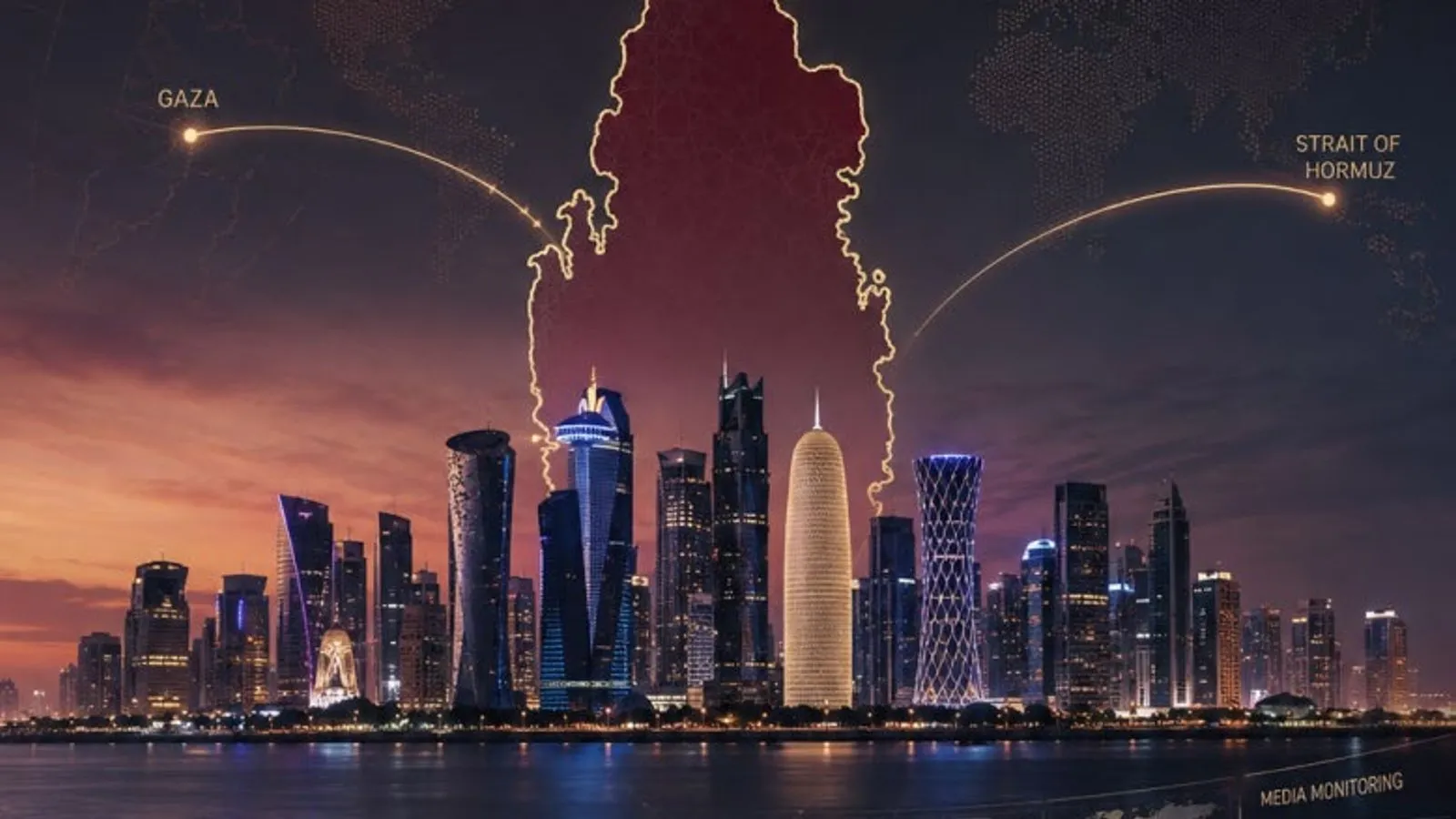
The University Charge and the Section 117 Test
In his September 24 address to the UN General Assembly, Netanyahu placed Qatar at the center of what he called an “eighth front” over truth and public opinion. He alleged that Doha had spent heavily on American universities and media to turn young people against Israel, the United States, and the West. That is a political claim about purpose and effect.
The most relevant U.S. government data answer a different question. For 2025, the Education Department identified Qatar as the largest country source of reportable gifts and contracts, at more than $1.1 billion from state and non-state sources. Section 117 filings establish scale, counterparties, and reportable transactions. They do not establish whether a gift or contract changed a university’s teaching, governance, or political culture.
The prime minister’s rebuttal, given in his Piers Morgan interview and still circulating in The Peninsula, works within that gap. He called the charge totally false and said the large sums mainly pay for U.S. branch campuses operating in Doha, with no Qatari say over students, faculty, or curricula. His argument contests the alleged mechanism of influence. It does not dispute that large Qatari-origin transactions appear in federal reporting. Critics, for their part, argue that the scale and opacity of foreign funding warrant deeper scrutiny in any case.
The Education Department’s September 25 notice still sets October 2 for publishing the names of foreign sources from earlier reporting cycles, after six postponements. No seventh delay had been announced by Thursday morning. Publication would allow a clearer separation of Qatar Foundation, Qatari state entities, and commercial counterparties. It would improve attribution, but it would not by itself answer the separate question of influence. Department of Justice FARA records continue to show disclosed representation of Qatar Foundation, including an August filing by Venable. No material new filing involving CAIR has surfaced, and no public document shows that CAIR acted on behalf of Qatar or Qatar Foundation.
Defense Secretary Pete Hegseth’s September 30 State of the Force address added political heat without adding evidence. He described many colleges as woke and anti-American and announced an officer-training partnership with institutions he presented as closer to traditional civic values. The published excerpts do not mention Qatar, foreign gifts, or Section 117. His critique converges with Netanyahu’s diagnosis of campus ideology, but it offers no support for a Qatar-financing theory. No Qatari official or prominent Qatari outlet has linked the two critiques, so for now the connection is drawn only by outside observers, and Doha has not adopted it.
Doha as the Channel in the U.S.-Iran Track
Doha remains the transmission point for the U.S.-Iran exchange. According to Reuters reporting carried by Al-Araby Al-Jadeed, Foreign Minister Abbas Araghchi met Qatari mediators in Doha on the evening of September 29 and received the U.S. reply to Iran’s proposal. The paper’s sources describe that proposal as a condensed version of the June memorandum of understanding. Washington would meet seven conditions within seven days, led by a ceasefire on all fronts, the lifting of oil sanctions, and the release of frozen assets. Tehran would then reopen Hormuz, with nuclear talks to follow. The sequence of these steps remains the main obstacle.
Foreign Ministry spokesman Majed Al-Ansari said meetings and message exchanges continue without interruption. He described Qatar’s aims as bridging the sequencing gap, restoring freedom of navigation in Hormuz, protecting regional infrastructure, and moving toward a Gulf-Iran security framework based on non-aggression and good-neighborliness. Sheikh Mohammed also told Egyptian Foreign Minister Badr Abdelatty that public statements, including inflammatory remarks by Iranian politicians, set the mediation back, and that closed-door diplomacy works better.
Iranian voices quoted on the same Al-Araby pages were harder-edged. Mohsen Rezaei said President Trump can neither negotiate nor fight. IRGC spokesman Hossein Mohebbi said the Guard has for some time been stopping small vessels that try to cross Hormuz. Expediency Council member Ali Aqa-Mohammadi claimed that armed cells trained in Israel and the UAE had entered Iran. A side item recorded Sultan Haitham bin Tariq receiving UAE national security adviser Sheikh Tahnoun bin Zayed in Muscat, a reminder that Oman runs a parallel Gulf channel.
On Gaza, Al-Ansari said Qatar had joined an eight-country meeting and more than a dozen ministerial contacts, and he argued that Israeli escalation has repeatedly followed progress in the talks. Qatar’s own baseline for its aid is roughly 30 million liters of fuel delivered to Gaza over three years, with another 1.3 million liters recently agreed with the United Nations. Doha describes this assistance as humanitarian and coordinated through international and Israeli-approved mechanisms. Critics dispute the political effects of the wider relationship, and no new public evidence has shifted that balance.
Flydubai FZ1073: One Incident, Two Qatari Frames
The established facts are limited but serious. Flydubai flight FZ1073 from Dubai to Tel Aviv diverted to Tabuk after a violent cockpit incident. Saudi airport authorities reported injuries to both pilots, a safe landing, and an official investigation. The airline said its crew controlled the situation and cautioned against early speculation about motive. Israeli officials later described an attempted crash and raised a terrorism scenario. Neither the Saudi nor the airline statements have established motive or outside direction.
Qatari and Qatar-linked outlets did not speak with one voice. Al-Sharq stayed close to the official statements, leading with the safe landing, the airport’s emergency response, and the continuing investigation. Qatar Tribune carried the Israeli terrorism claim with clear attribution. Al-Araby Al-Jadeed, a London-based paper with Qatari funding, made the incident its front-page story. Its coverage focused on how quickly Netanyahu’s camp and Defense Minister Israel Katz labeled the event jihadist terrorism before investigators had resolved motive. The paper also reported that the co-pilot, said to be of Omani origin, remains in Saudi custody, and that opposition leader Yair Lapid said nothing resembling the incident came up in the security briefing he received the previous evening.
The contrast suggests no synchronized Qatari line. The domestic press kept to the investigative caveat, while Al-Araby used the event to criticize Israeli political messaging. Tehran’s reading of the same flight is covered in our special report on FZ1073.
The Opinion Barometer: Al-Araby and Al Jazeera
Al-Araby’s October 1 print issue sustained a dense editorial agenda against Israeli policy. Beyond the Flydubai coverage, it carried a feature on the October 2000 Al-Aqsa protests, in which Israeli police killed 13 young Palestinians, and linked that memory to current tensions over Al-Aqsa access and the coming Israeli election. A Lebanese national committee report of more than 200 pages on alleged Israeli violations in southern Lebanon was presented through the paper’s own sourcing, and its casualty figures have not been independently verified. Two opinion pieces criticized Netanyahu and the U.S.-mediated Israel-Lebanon framework, and an Emad Hajjaj cartoon showed international-law texts being consumed by fire.
The weekly cartoon page, built on syndicated drawings of Netanyahu’s UN speech, ran under the headline “A War Criminal on the Podium.” On the same page, a satirical column defended the October 2023 attack against Arab critics who question its cost. For a Qatari-funded paper, the column is a clear signal of where its editorial sympathies lie. The culture section reviewed Karam Dana’s book on Palestine solidarity in the United States, which offers a competing account of shifting American attitudes rooted in long-term social and media change. The review is not evidence for or against Qatari influence, but it frames the debate differently from Netanyahu’s single-cause explanation. The arts pages also carried Qatari soft-power items, including the Doha Film Institute’s Geekend festival in Lusail.
Al Jazeera’s opinion pages again showed range. On the Arabic site, a guest contributor in international law argued that the Board of Peace may choose its partners in Gaza but cannot legally end UNRWA’s General Assembly mandate, warning that the agency could be hollowed out through lost access and funding. Another essay linked the decline of a sustained Palestinian presence at Al-Aqsa to rising Temple movement activism. Al Jazeera English, by contrast, published a Saudi commentator arguing that Tehran’s de-escalation offer shifts the cost of an Iran-U.S. bargain onto Gulf states. The split cuts against any assumption of a uniformly pro-Iran network line.
The War Economy: Oil Recovers, LNG Stays Shut In
Gulf oil is moving toward partial physical recovery, but risk has not normalized. Estimates of Gulf crude exports range from 16.3 million barrels per day (Kpler) to 19 million (Goldman Sachs), with JP Morgan at 17.5 million. Much of the spread reflects how each source treats tankers that turn off their transponders, and Goldman’s figure includes about 5.2 million barrels per day of inferred, unobserved exports. Hormuz throughput averaged 13.2 million barrels per day in the week to September 30, about a third below its prewar level of roughly 20 million. Refined-product supply stands at only 58 percent of prewar levels, which helps explain why U.S. diesel reached $6.53 a gallon last week. Brent traded near $96.70 and WTI near $88.90 on October 1.
For Qatar, the asymmetry is unfavorable. Saudi crude can move through bypass pipelines with 3.5 to 5.5 million barrels per day of capacity, but every LNG cargo from Ras Laffan must transit the strait. Reuters calculations based on ICIS data show Qatar shipped 18 LNG cargoes in the first six months of the war, against 509 a year earlier, for an estimated $24 billion in lost sales. QatarEnergy has extended force majeure through the end of November for buyers in Pakistan, Bangladesh, India, and Italy’s Edison. More Qatar-linked LNG vessels have been seen crossing Hormuz, but the recovery remains cautious.
High prices do not offset the losses. In this disruption, Qatar is the exporter that cannot ship, so the windfall flows mainly to competing suppliers in the United States and Australia. QatarEnergy gains only at the margin, through the cargoes it does ship and its 70 percent stake in the Golden Pass export project in Texas, while buying replacement cargoes to honor contracts erodes its margins further. European gas prices have more than doubled since the war began, and buyers are replacing Qatari cargoes, switching fuels, or cutting demand. Each month of force majeure makes that substitution more durable and weakens Qatar’s standing as a reliable long-term supplier.
The prime minister’s view that the shock is circumstantial and not structural holds in one sense: Qatar retains its reserves, its customer base, and its expansion projects. The near-term constraint is still severe. QatarEnergy has put the cost of damage at Ras Laffan at about $20 billion a year in lost revenue, with repairs taking up to five years. The security picture also argues against complacency. Maritime intelligence cited by Reuters reported three Liberian-flagged tankers struck by unknown projectiles in Hormuz on Tuesday, and a Kuwaiti tanker was reportedly hit on September 29. Attribution remains unresolved, and incidents of this kind sustain the risk premium that weighs most heavily on LNG. Iran’s own economic press is tracking the same pressures, as our October 1 Economic Press Review shows.
Migrant Labor: A Mixed Baseline
Qatar’s labor record has two sides. The government has dismantled key parts of the sponsorship system, introduced a minimum wage and wage-protection mechanisms, adopted heat-stress rules, and in 2026 amended the labor law to allow a conditional right to strike. Human Rights Watch continues to document wage theft, recruitment-fee debt, passport confiscation, barriers to changing employers, dangerous heat, and unexplained worker deaths. These are external assessments, and Qatar contests or addresses parts of the record through its reform program.
The Labor Ministry said it closed 388 work sites between June 1 and September 15 for violating the summer work ban. The figure shows that inspections are active, and it also documents widespread non-compliance. In Nepal, the Kathmandu Post reported that new labor approvals for Gulf jobs fell by 52 percent from the start of the Iran war through mid-September, compared with the same period a year earlier. One long-term Qatar worker said his employer closed because of the war and that he returned home without his end-of-service payment. Renewals in Qatar stayed relatively stable, which suggests the shock falls more on new recruitment and weaker employers than on existing jobs. The Non-Resident Nepali Association in Qatar has also submitted a nine-point memorandum on workers’ problems to Nepal’s finance minister.
Key Points
- Netanyahu’s university-funding charge remains politically live. Section 117 data confirm very large Qatari-origin transactions but do not show that the funding bought a political outcome, and the prime minister’s defense contests purpose and mechanism while leaving the totals unchallenged (high confidence).
- Hegseth’s campus rhetoric converges with Netanyahu’s critique without naming Qatar, foreign gifts, or Section 117 (high confidence).
- The October 2 Section 117 publication date stands. A further delay is possible given six earlier postponements, but no notice of one has appeared (moderate confidence).
- Doha remains the channel in the U.S.-Iran track, and the prime minister is pressing all sides to stop negotiating in public. The sequence of a ceasefire, sanctions relief, frozen assets, and Hormuz is still the obstacle (high confidence).
- For Qatar, oil recovery does not carry over into LNG recovery. The price spike benefits competing suppliers more than Qatar (high confidence).
- Qatari and Qatar-linked outlets split on Flydubai FZ1073, and official statements have not established motive (high confidence).
- Qatar’s labor record combines real legal and enforcement reforms with documented wage, heat-safety, and employer-control problems (high confidence).
What to Watch
- Whether the Education Department publishes foreign-source names on October 2 or announces another postponement.
- Whether the Qatari government, QNA, or major domestic papers explicitly connect Hegseth’s university critique to Netanyahu’s accusation.
- Saudi findings on FZ1073, including whether investigators identify a personal motive, ideological intent, or outside direction.
- Any new Israeli threat or operational move against Hamas officials abroad that affects Doha’s ability to host a mediation channel.
- Iran’s answer on the sequencing of the seven-day plan, and any further public warning from Sheikh Mohammed against statements that undercut the mediation.
- Qatar-linked LNG departures, any extension or withdrawal of force majeure, QatarEnergy notices on December deliveries, and the direction of European gas prices into winter.
- War-related wage and job-loss cases among migrant workers in Nepali, Bangladeshi, Indian, and Philippine reporting, and new Labor Ministry enforcement data.
This post summarizes the Qatar Watch daily intelligence report for October 1, 2026. The report draws on QNA, the Qatari Foreign Ministry’s weekly briefing, The Peninsula, Al-Sharq, and Qatar Tribune; Al-Araby Al-Jadeed’s October 1 print and online editions; Al Jazeera Arabic and English opinion pages; the UN transcript of Netanyahu’s address; Education Department Section 117 data and notices; DOJ FARA records; Reuters, ICIS, Goldman Sachs, JP Morgan, Kpler, Chatham House, CSIS, and ChemAnalyst energy data as reported; and Human Rights Watch, QNA, the Kathmandu Post, and Ratopati on migrant labor. The report holds high confidence in official Qatari positions, the Section 117 schedule and 2025 funding totals, the content of the Al-Araby issue, and the main themes of the Al Jazeera pieces. It holds moderate confidence in real-time energy-flow estimates, whose methods differ, and in LNG loss estimates based on Reuters calculations. It holds low to moderate confidence in any claim about motive in the Flydubai incident until Saudi investigators or the airline publish findings. The human-rights baseline is a map of documented allegations, reforms, and enforcement signals, and individual cases still require corroboration. Earlier posts in the series are collected on the Qatar Watch hub, and today’s wider Iranian picture is in the October 1 daily intelligence update.