One Vote in Doha: Hamas's New Leader Tests the Mediator's Shield
A day after Qatar’s coordinated pressure campaign against Israel, the picture that emerges from the August 4-5 reporting window is quieter but more consequential. The Gaza roadmap that President Trump hailed as a breakthrough is best read as a conditional bargain in which each side waits for the other to move first. The widely reported Israeli decision to stop assassinations is, on the available evidence, a pressured pause rather than a policy. And behind both sits the fact that will shape everything else: Hamas chose its new leader by a single vote, and the man who won is the candidate closest to Tehran, living in Doha.
A Bargain, Not a Peace
The 15-point roadmap published by President Trump’s Board of Peace links three processes: a halt to military activity, the transfer of civil authority to a National Committee for the Administration of Gaza, and the decommissioning and storage of heavy weapons, production sites, depots and tunnels. Crucially, weapons would be placed under Palestinian custody, not handed to Israel or to any non-Palestinian actor.
President Trump described the document as a breakthrough. The parties’ behavior describes something else. Israel has not publicly endorsed the roadmap, has raised what it calls serious security concerns, and insists there will be no withdrawal from the Yellow Line before genuine Hamas disarmament. Hamas says it is ready for a difficult and painful framework, but avoids the word disarmament altogether: it conditionally accepted weapons storage under a Palestinian technocratic body, and only after Israel first stops its attacks, withdraws and expands aid.
Two ambiguities carry the whole risk. The first is semantic: whether storage under the National Committee amounts to irreversible disarmament or to safekeeping of an intact arsenal. Hamas preserves Palestinian custody and avoids surrender language; Israel seeks a definitive removal of military capability. The second is sequencing: neither side currently accepts the political and security risk of moving first. Both condition their core obligation on the other’s prior performance, which is precisely what makes the agreement vulnerable without a joint verification mechanism. Until one exists, each side can claim the other moved first in violation.
The Assassination Halt That Was Not Announced
Reports circulated during the window that Israel had decided to stop targeted killings. The evidence supports something narrower, and the distinction matters.
What is confirmed: Board of Peace envoy Nikolay Mladenov pressed Prime Minister Netanyahu to halt strikes in order to advance the weapons agreement; the roadmap’s language requires an end to military operations; and the Associated Press reported no airstrikes in Gaza on Monday after a weekend of escalation. What is not confirmed: any published Israeli cabinet or prime ministerial decision accepting a permanent ban on targeted killings. Israel cited serious security concerns, and National Security Minister Itamar Ben-Gvir publicly demanded that the assassination of Hamas leaders continue. One day without reported airstrikes is an operational lull, not a strategic policy reversal.
Why the question matters is Doha. A verified halt to targeted killings would directly affect the safety, mobility and bargaining power of the Hamas negotiating echelon based in Qatar, al-Hayya first among them. It would also function as Qatar’s most immediate deliverable to Hamas: protection of the negotiators in exchange for implementation of the weapons roadmap. The signal to watch for a genuine policy change is an explicit Prime Minister’s Office, security cabinet or IDF directive suspending targeted killings as part of phase-two implementation. The signal of fragility is Israeli language reserving freedom of action against imminent threats, a reservation wide enough to drive an operation through. Renewed named targeting of Hamas commanders, especially outside Gaza or against negotiating personnel, would end the question entirely.
One Vote, Two Patrons
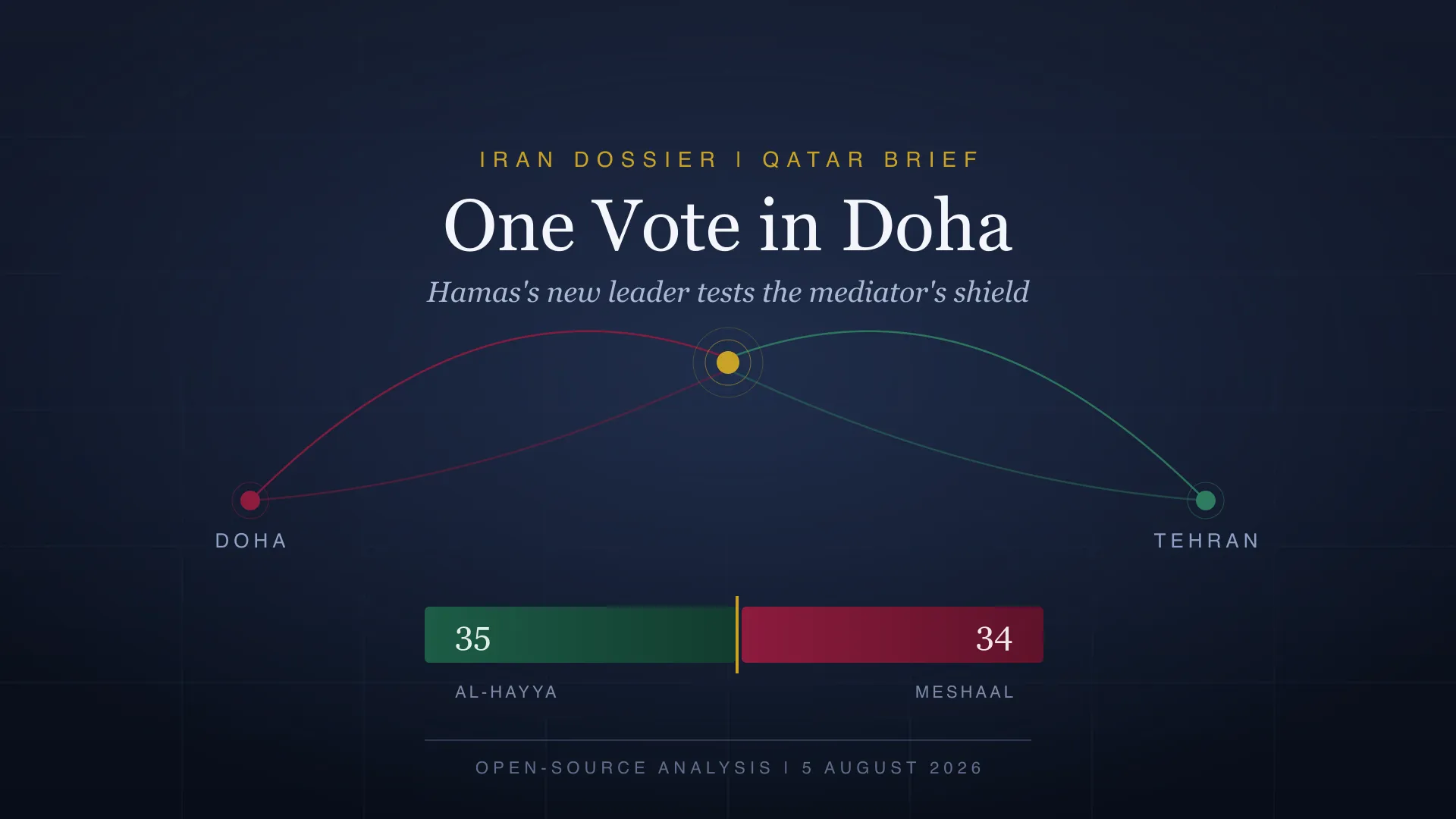
On July 20, Hamas elected Khalil al-Hayya as its overall leader by 35 votes to 34 over Khaled Meshaal. We profiled al-Hayya and Tehran’s embrace of him when the result was announced; two weeks on, the one-vote margin looks like the single most important number in the file. It demonstrates that the movement is almost evenly divided over strategy, alliances and the political meaning of the postwar transition.
The two candidacies mapped onto two orientations. The al-Hayya line: Gaza-centered continuity, stronger identification with the armed-resistance camp, closer relations with Tehran and the Axis of Resistance, and a reputation for being less likely to accept unconditional disarmament. The Meshaal line: the external political wing, wider diplomatic maneuver, greater emphasis on Sunni Arab relationships and reduced dependence on Iran. Reuters assessed the outcome as favoring continuity in armed resistance and closer relations with Tehran rather than ideological moderation. Meshaal publicly accepted the result and pledged support for the new leadership.
Al-Hayya matters because he sits at the intersection of the two external influence centers competing over Hamas. He is based in Doha and has served as chief negotiator in the Qatari-mediated talks with the United States, Israel and Egypt. He is also regarded as maintaining strong relations with Iran, the movement’s principal military and financial sponsor. Qatar’s influence rests on hosting the leadership and controlling the negotiation channel; Iran’s rests on weapons, funding, ideology and Hamas’s integration into the resistance axis. From Doha’s perspective, the risk is that al-Hayya uses Qatar as his political base while allowing Tehran to shape strategic direction, which would weaken Qatar’s ability to deliver Hamas compliance and make Doha less indispensable to Washington.
A correction to the rumor mill is in order here. Reports of a direct Qatar-Hamas rupture over the election are not substantiated by the available reporting. There is no credible confirmation that Qatar opposed al-Hayya’s election or backed Meshaal, and the countervailing evidence is visible in Qatar’s own media: Al Jazeera covered his rise as an institutional transition, highlighted his negotiating experience and in places described him as pragmatic. That is public normalization, not rupture. What the reporting does support is structural tension: Qatar needs a Hamas leadership capable of delivering verifiable weapons decommissioning to protect its credibility with Washington, and the election strengthened the faction least likely to provide it. This is a slow-burning competition between Doha and Tehran over the same movement, not an open confrontation, at least not yet.
Al Jazeera Arabic’s vocabulary completes the picture. The channel routinely uses Hamas’s full name, the Islamic Resistance Movement, and discusses the organization within the framework of “the resistance,” implicitly legitimizing it as a national resistance actor. State-aligned framing of this kind normalizes Hamas positions, and it also understates exactly the kind of Qatar-Hamas friction described above.
The Shield Holds, For Now
Qatar’s pressure campaign against Israel, the subject of yesterday’s analysis, continued through the window on the same pattern. Qatar, Egypt and Türkiye condemned Israeli strikes, emphasized attacks on medical infrastructure and civilian casualties, characterized them as violations of international law and international humanitarian law, and called on the international community to pressure Israel to fulfill its obligations. No new Qatari military or economic measure against Israel was identified: the campaign remains diplomatic and narrative.
The mechanism is unchanged. Doha supports phase-two implementation while assigning Israel the immediate burden of compliance, presenting its position as support for an American-sponsored agreement rather than a separate anti-Israel initiative. Its public line shields Hamas from sole responsibility by asserting that the movement has accepted the framework and that Israel must now implement its obligations. This is mediation with directional attribution, not strict public neutrality. The things to track for escalation are legal action, conditionality in bilateral forums, coordinated Arab-Islamic statements, and lobbying in Washington and European capitals.
Hormuz: The Quieter Channel
On Iran, Qatar remained the cautious balancer it was yesterday. The Amir’s direct contact with President Trump, coordination with Oman and Pakistan, and Doha’s constant emphasis on implementing the US-Iran memorandum of understanding all reinforce the same claim: Qatar is indispensable to de-escalation. To Washington, the message is that Doha can maintain a channel, exchange drafts and facilitate movement toward direct engagement. To Tehran, it is that dialogue and face-saving arrangements remain available, but unilateral Iranian control or political use of the Strait of Hormuz is unacceptable.
The driver is unchanged and structural: freedom of navigation through Hormuz is a core Qatari national interest because LNG exports and maritime insurance depend on predictable access. Qatar is not aligning with Iran. It is managing dependence, geography and energy exposure while preserving its US security relationship.
Key Points
- The Gaza roadmap is a conditional implementation architecture, not a settlement. Its two load-bearing ambiguities, storage-versus-disarmament and sequencing, are unresolved, and both sides condition their core obligation on the other’s prior performance.
- The reported Israeli halt to assassinations is overstated. The evidence supports external pressure, roadmap language and a one-day operational lull, not a verified, durable Israeli policy decision; Ben-Gvir’s public demand to continue targeted killings shows there is no unified Israeli acceptance of a halt.
- Al-Hayya’s one-vote victory is the most operationally significant fact of the period: it exposes a Hamas divided almost exactly in half, and it strengthens the faction most closely associated with Iran, the Gaza military line and resistance to unconditional disarmament.
- Claims of a Qatar-Hamas rupture over the election are unsubstantiated. The verified picture is structural tension: Qatar needs a leadership that can deliver verifiable decommissioning, while al-Hayya’s orientation points the other way. Watch for Qatar-Iran competition over Hamas, not a Doha-Hamas break.
- Qatar’s activity against Israel remained diplomatic and narrative: coordinated condemnation with Egypt and Türkiye, legal-humanitarian framing and media amplification, with no new material coercive measure identified.
- On Iran and Hormuz, Doha is managing exposure, not choosing sides: it defends freedom of navigation as a national interest, keeps the US-Iran channel alive, and avoids language that would publicly blame Tehran.
What to Watch
- An explicit Israeli order or cabinet statement defining whether targeted killings are suspended and what exceptions remain.
- A formal Israeli response to the 15-point roadmap, especially on the Yellow Line, weapons custody and verification.
- Any Qatari or Hamas statement linking the safety of the Doha leadership to weapons implementation or ceasefire compliance.
- Al-Hayya’s movements between Doha, Ankara, Cairo and Tehran, indicating his preferred political and security base.
- Whether Meshaal’s camp is integrated into the new leadership or marginalized after the one-vote contest.
- The emergence, or continued absence, of a joint verification mechanism for attacks, weapons storage and phased withdrawal.
- Further Qatari coordination with Egypt and Türkiye that shifts from mediation toward explicit international pressure on Israel.
This analysis is based on an open-source review of the August 4-5 reporting window: Reuters and Associated Press reporting on the Gaza roadmap, the Board of Peace and the Mladenov-Netanyahu meeting, Reuters and Al Jazeera Arabic and English coverage of the Hamas leadership vote, Qatari official messaging via QNA, and the joint mediator statements by Qatar, Egypt and Türkiye.