The Mediator's Shield: How Qatar Turned Trump's Peace Plan into Pressure on Israel
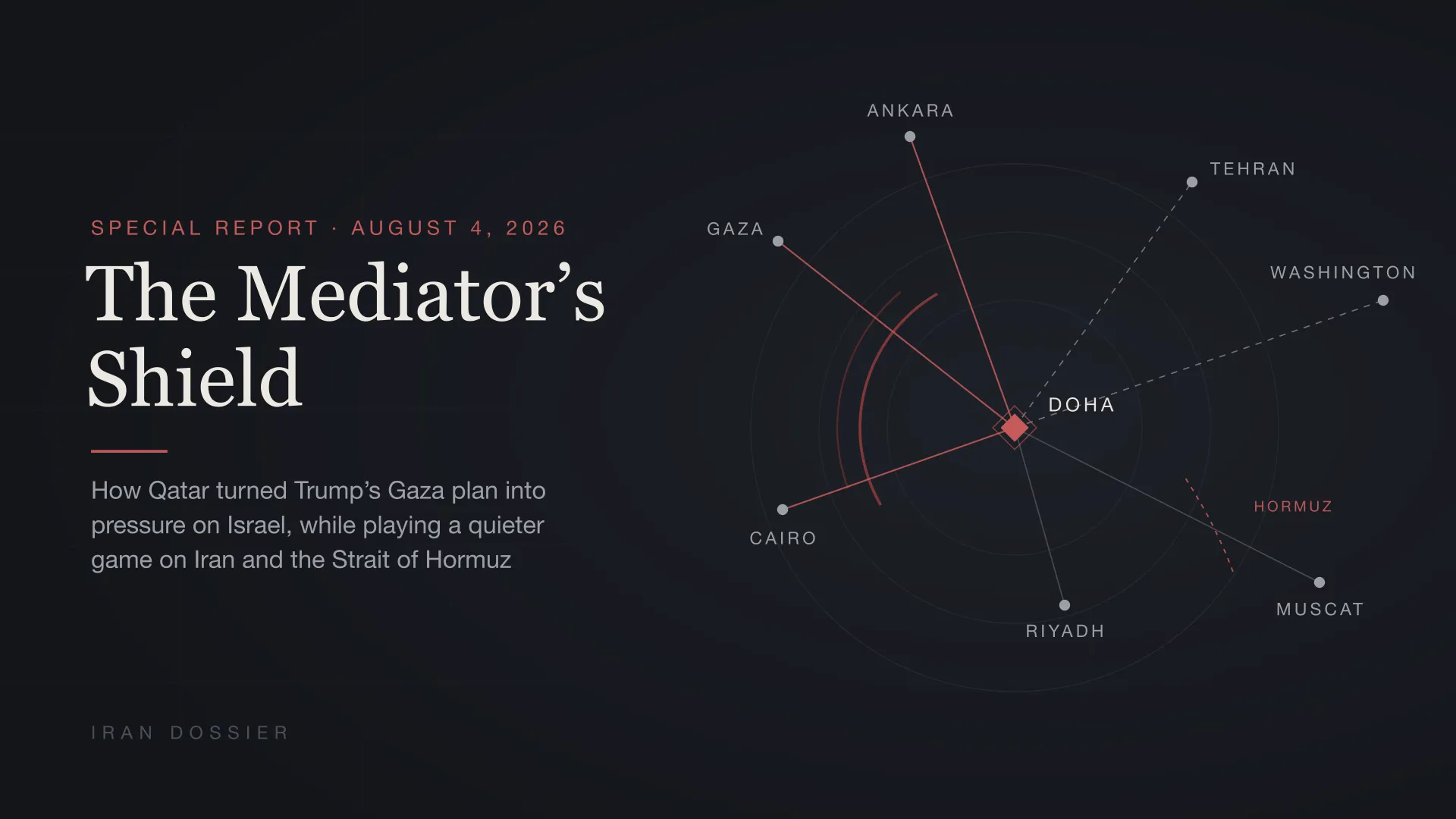
On the evening of August 3, Qatar, Egypt and Türkiye issued a joint mediator statement condemning Israeli attacks in Gaza and calling on the international community to force Israel to complete President Trump’s peace plan. Within hours it was leading Doha’s front pages, cycling through Al Jazeera in two calibrated registers, and being pushed to Palestinian audiences on Telegram in rapid sequence. This is what a coordinated pressure campaign looks like, and it marks the moment Qatari mediation stopped pretending to be neutral.
A Statement That Ended Neutrality
The joint statement, issued by the three Gaza mediators, did four things at once. It strongly condemned Israeli operations in Gaza, singling out attacks on healthcare facilities and the resulting civilian casualties. It characterized continued Israeli activity as a breach of the ceasefire that undermines implementation of the plan’s second phase. It asserted that Hamas and the Palestinian factions have accepted the roadmap, including its weapons-confinement provision. And it called on the international community to pressure Israel to fulfill its obligations and complete the plan.
The language matters as much as the substance. The statement invoked international law and international humanitarian law, framing Israeli strikes as flagrant violations rather than security operations. That is legal framing designed for external audiences: diplomats, international organizations and courts.
What made August 3 exceptional was not the statement alone but the machine behind it. The Peninsula placed it as its lead item. QNA carried it and separately amplified Türkiye’s accusation that Israeli attacks were intentionally undermining peace efforts. Al Jazeera Arabic and the AJPalestine Telegram channel repeated it almost immediately: the Telegram channel posted the statement in a burst at roughly 20:06, 20:10 and 20:13, followed by a video post on intensified Israeli strikes that referred to storage of “weapons of the resistance.” Official diplomacy, state wire, domestic newspapers, satellite channel and Telegram all moved within a short window, in the same direction.
The Sequencing Trap
Underneath the pressure campaign sits a genuine implementation dispute, and it is about sequencing, not principle.
The Board of Peace, the body overseeing the plan, holds that Israel will withdraw beyond the Yellow Line only after complete decommissioning of light and heavy weapons and the destruction of tunnels, followed by transition to civilian governance. Israel insists there will be no further withdrawal before Hamas verifiably disarms, and has communicated what it calls serious security concerns to Washington. Hamas and the factions say they are committed to the roadmap but demand that Israeli attacks stop and that withdrawal proceed as part of a synchronized process; notably, they prefer the language of “storage” or “confinement” of weapons over unilateral disarmament.
Independent reporting confirms the standoff from both ends: Reuters reported Israel linking further withdrawal to disarmament and tunnel destruction while Hamas demanded a halt to strikes first, and the Associated Press reported Board of Peace representative Nikolay Mladenov pressing Prime Minister Netanyahu to halt attacks while the decommissioning agreement was being discussed.
Every actor formally adheres to the roadmap. Each has a different trigger for moving to the next step. That is the most likely near-term failure mode in Gaza: not rejection of the plan, but incompatible sequencing that lets it collapse while everyone claims compliance.
The Shield Itself
Here is the assessment that ties it together: Qatar is not opposing President Trump’s plan. It has adopted the plan as the normative reference point, and is using its own status as mediator to shield the roadmap from Israeli military action while framing pressure on Israel as enforcement of a US-sponsored agreement rather than opposition to Washington.
This is a more sophisticated line than blanket criticism of Israeli policy. By publicly citing Hamas’s acceptance of the weapons-confinement clause, Doha positions the factions as the compliant party and transfers the diplomatic costs of the sequencing dispute onto Israel, precisely during the phase in which those costs matter most.
The move has a price. By identifying Israeli violations as the immediate cause of implementation failure and calling for international pressure specifically on Israel, Qatar has stepped out of facilitation and into coordinated advocacy. The mediator’s shield protects the roadmap, but it also narrows Doha’s room to claim neutrality later.
One Message, Two Frequencies
The Al Jazeera network illustrates how the campaign is tuned per audience. Both services converged on the same conclusion, that Israeli strikes are endangering the roadmap, but in different vocabularies.
Al Jazeera Arabic led with “Board of Peace: Israel will not withdraw before disarmament, while the mediators condemn the violations,” used the phrase “weapons of the resistance,” and framed events through occupation, violations and martyrs. Al Jazeera English foregrounded “complete decommissioning” of weapons and tunnels, Israeli objections, and the transition from rule by the gun to civilian governance.
The Arabic service mobilizes a regional audience; the English service internationalizes the same political direction in institutional language acceptable to Western policy audiences. It is one campaign broadcast on two frequencies.
The Iran Exception
Against this backdrop, Qatar’s Iran policy looks strikingly different: quieter, more careful, and more revealing of Doha’s real exposure.
On August 3, Qatar’s prime minister and foreign minister held separate calls with the foreign ministers of the UAE, Saudi Arabia, Kuwait, Oman and Bahrain. The official readout emphasized de-escalation and implementation of the US-Iran memorandum, including freedom of navigation in the Strait of Hormuz. Gulf Times framed it plainly: the prime minister is rallying Gulf partners to secure the memorandum. This is not message-passing between Washington and Tehran; it is an attempt to organize a common Gulf position around a fragile agreement.
The channel it is protecting remains contested. President Trump described renewed contacts as Iran’s last chance and said Gulf leaders, Qatar included, had urged him to postpone major strikes. Tehran denied direct negotiations with the United States, saying its active talks were with Oman about a temporary safe maritime route. The contradiction increases Qatar’s value as an intermediary and exposes how thin the current arrangement is: on Sunday only nine vessels transited the strait, most via an Iranian-controlled route, while Qatari media highlighted falling oil prices on hopes of a deal.
The asymmetry between Doha’s two campaigns has a structural explanation. Qatar’s LNG export model depends on secure maritime access through Hormuz. On Gaza, Qatar openly names Israel as the violator. On Iran, it avoids any language that would blame Tehran for the strait’s continued closure, and talks instead about implementation, navigation and regional consensus. Doha is not a neutral mediator here; it is a stakeholder and a cautious balancer, aligned with Gulf demands for secure navigation while refusing to choose publicly between Washington and Tehran.
Key Points
- Gaza has overtaken Iran as Qatar’s immediate political messaging priority, but Iran remains the higher structural risk: Hormuz directly touches Qatar’s security and its LNG economy.
- Qatar is using the Trump plan rather than opposing it, recasting it as a mechanism for pressuring Israel and protecting a negotiated weapons-confinement process.
- The August 3 joint statement marked a shift from mediation language to coordinated advocacy against Israel, significant because it was synchronized across official, newspaper, Al Jazeera and Telegram channels within hours.
- Qatar’s Iran policy is deliberately more cautious than its Israel policy: Doha emphasizes implementation, navigation and Gulf consensus, and avoids publicly blaming Tehran for the unresolved closure of Hormuz.
- The most likely near-term failure point in Gaza is not formal rejection of the plan but incompatible sequencing: Israel demands verified disarmament before withdrawal, while Hamas and the mediators demand an end to strikes and movement on withdrawal as the process begins.
- Al Jazeera Arabic remains the sharper instrument of narrative pressure, mobilizing Arab audiences, while Al Jazeera English translates the same political direction into institutional language for international ones.
This analysis is based on an open-source review of the August 3-4 reporting window: statements and readouts from the Qatari Ministry of Foreign Affairs and QNA, coverage in The Peninsula and Gulf Times, the Al Jazeera Arabic and English services, the AJPalestine Telegram channel, and corroborating reporting by Reuters and the Associated Press.