The New Face of Hamas and the Iranian Embrace
When Hamas announced that Khalil al-Hayya (Abu Osama) would succeed the killed Yahya Sinwar as head of its political bureau, the Iranian state press did not treat it as an internal Palestinian matter. Kayhan, the flagship hardline daily, ran the news under a single triumphant headline, “bad news for the Zionists,” and paired it with a photograph chosen to carry the whole argument: al-Hayya in a warm embrace with the late Iranian Supreme Leader, Ayatollah Ali Khamenei. The image, and the framing around it, reveal how Tehran intends to use the Hamas succession to reassure its regional proxy network that the Palestinian front has survived a devastating war intact, and to bind Hamas more tightly to the Iranian-led camp.
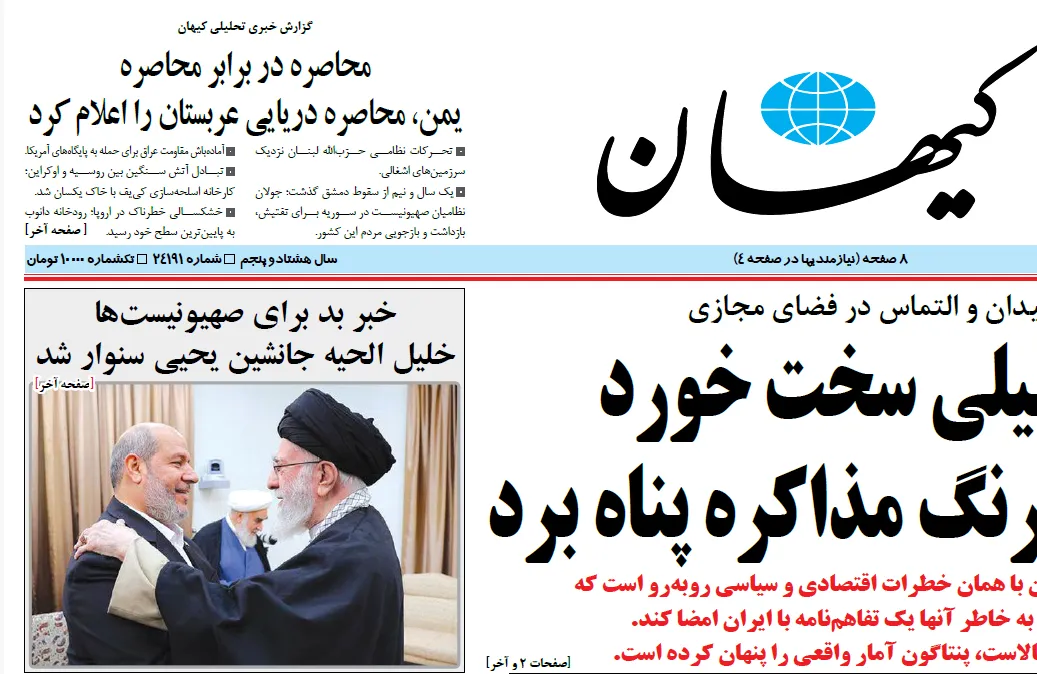
Khalil al-Hayya embraced by the late Iranian Supreme Leader Ali Khamenei, in an image circulated by Kayhan under the headline “Bad news for the Zionists.”
An Image Chosen to Speak
The figure embracing al-Hayya is not the current Supreme Leader, Mojtaba Khamenei, but his father, Ali Khamenei, the martyred Leader (رهبر شهید, rahbar-e shahid) assassinated in February 2026. The photograph is therefore archival, and the decision to reach for it is deliberate. It ties the new Hamas chief not merely to the Iranian state but to the martyred Leader personally, folding Hamas into the martyrdom narrative that the regime has placed at the center of its current legitimacy, the shahada of Ali Khamenei and the transfer of authority to his son.
The embrace does more than signal endorsement. It enlists al-Hayya, and Hamas through him, into the logic of blood vengeance that Tehran has constructed around the assassination, the same “the martyr’s blood will not go unavenged” frame the regime deployed after the killing of Qassem Soleimani, now repurposed for its fallen Leader. In that logic, the martyr’s blood imposes an obligation of retaliation on those bound to him, and the picture positions the incoming Hamas leader inside that circle of obligation.
There is a second, subtler purpose. Martyrdom is not a Shia possession; it is a value the Sunni Islamists of Hamas honor no less deeply, venerating their own fallen from field commanders to Ismail Haniyeh and Sinwar, and al-Hayya’s own wife and children among them. By showing the martyred Shia Leader embracing the incoming Sunni leader, Kayhan reaches for the one currency both sides share and uses it to paper over the sectarian divide that has always complicated Iran’s claim to lead a pan-Islamic resistance. Shared martyrdom, not shared theology, is offered as the ground of unity.
Hamas’s Man Closest to Tehran
Al-Hayya rose through the political, not the military, side of Hamas. Born in Gaza in 1960, he was drawn into the Muslim Brotherhood as a student at the Islamic University in the early 1980s, worked as a teacher, and later earned a master’s degree in hadith studies in Jordan and a doctorate in Islamic sciences in Sudan. He joined Hamas as it emerged during the First Intifada, climbed the movement’s organizational ladder, won a seat in the 2006 Palestinian legislative elections on the Change and Reform list, and headed its information office, taking part along the way in successive rounds of Fatah-Hamas reconciliation talks. Over the years based in Qatar, he became Hamas’s chief interlocutor with the Arab and Islamic world and its lead figure in the indirect negotiations with Israel over ceasefires and prisoner exchanges, before being named deputy to Yahya Sinwar in Gaza in 2021 and, after Sinwar’s killing in October 2024, the movement’s leader in Gaza, a post he has held from Qatar.
This makes one detail of Kayhan’s account revealing. The Iranian item lists among al-Hayya’s credentials the title of commander of the Izz al-Din al-Qassam Brigades, the movement’s military wing, a claim that does not fit his biography. Al-Hayya is a political and negotiating figure who advanced through the bureau and the reconciliation file, not a field commander. The embellishment is not incidental. By militarizing his record, the Iranian press dresses a diplomat in the uniform of a fighter, the better to present his elevation as “bad news for the Zionists” than as the promotion of an interlocutor who has spent years at the negotiating table.

* Kayhan lists among al-Hayya’s credentials the title of commander of the Izz al-Din al-Qassam Brigades*
What in fact makes al-Hayya valuable to Tehran is that negotiating role and his consistent alignment with the resistance camp, not any command pedigree. There is an irony here worth noting. The Iran-Hamas relationship has traditionally been anchored in the military wing, in figures such as Muhammad Deif and Sinwar, who sustained the tie even when the political leadership leaned toward the Gulf. That Tehran now lavishes the imagery of the martyred Leader’s embrace on a figure from the political and diplomatic track shows how far it is willing to go to keep the Palestinian front close, and how much it needs a reliable interlocutor after the deaths of Ismail Haniyeh and Sinwar.
Yet the label often attached to him, “Iran’s man in Hamas,” needs care. It is largely an external characterization, applied approvingly by Iranian media and as a warning by Israeli and Gulf commentators, rather than a description Hamas would give of itself. Hamas retains its own decision-making, its Muslim Brotherhood lineage, and a durable dependence on Qatar that does not always run parallel to Iranian aims. The most accurate reading is that al-Hayya is the Hamas leader most invested in, and most trusted by, the Iranian axis, and that his elevation signals continuity of the relationship rather than the conversion of Hamas into an Iranian instrument. The archival embrace is Tehran advertising a bond, not documenting command over it.
Where Hamas Fits in the Axis of Resistance
The framing around al-Hayya is one move within a wider strategy. Iran’s Axis of Resistance is a network of state and non-state actors, Hizbullah, the Houthis in Yemen, the Iraqi militias, and Hamas and Palestinian Islamic Jihad, through which Tehran projects pressure on Israel and the West while preserving a measure of deniability. Within that network, Hamas holds a distinctive place. It is the Palestinian anchor, the cause that confers legitimacy across the Sunni Arab street and allows a Shia-led Iran to present itself as the champion of a pan-Islamic struggle. Protecting that anchor after the loss of Haniyeh and Sinwar is itself a strategic priority, which is why the succession is being sold as seamless continuity.
Hamas also serves as a source of deniable, horizontal pressure, imposing costs on Israel and, by extension, on Israel’s Western backers, without requiring Tehran to act openly. The same logic runs through the maritime fronts Iran has activated, from the Strait of Hormuz to the Houthi Bab AlMandeb campaign against shipping in the Red Sea: multiply and interlink the pressure points so that no single one can be isolated and answered on its own. Hamas is the Palestine-facing node of that design, and the message of the al-Hayya coverage is that the node is intact and aligned.
The reaction to the succession made that alignment audible as a chorus. Within hours, the whole of the axis moved to bless the appointment in near-identical language. Hizbullah issued a formal statement calling the choice a clear message to the Zionist enemy and its backers that Hamas, despite every attempt to assassinate and weaken its leaders, remains powerful and united, and vowing that the path of resistance would continue with an iron will, faithful to its covenant with the martyrs. The Houthis’ Ansar Allah declared that al-Hayya’s selection proved the invincibility of the resistance. Palestinian Islamic Jihad, the Palestinian Resistance Committees, and the wider Muslim Brotherhoodeach added their own congratulations, casting the smooth internal succession, held under siege and continued Israeli strikes, as proof of Hamas’s structural solidity and its ability to regenerate its leadership.
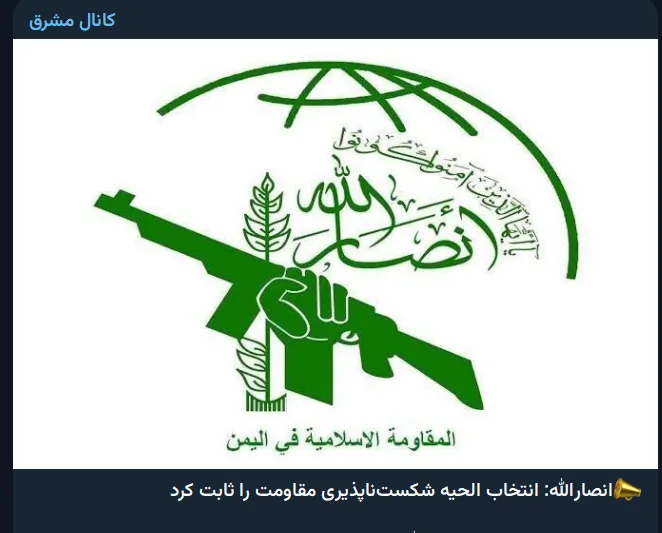
Ansar Allah: Al-Hayya’s Election Is Proof of the Resistance’s Invincibility
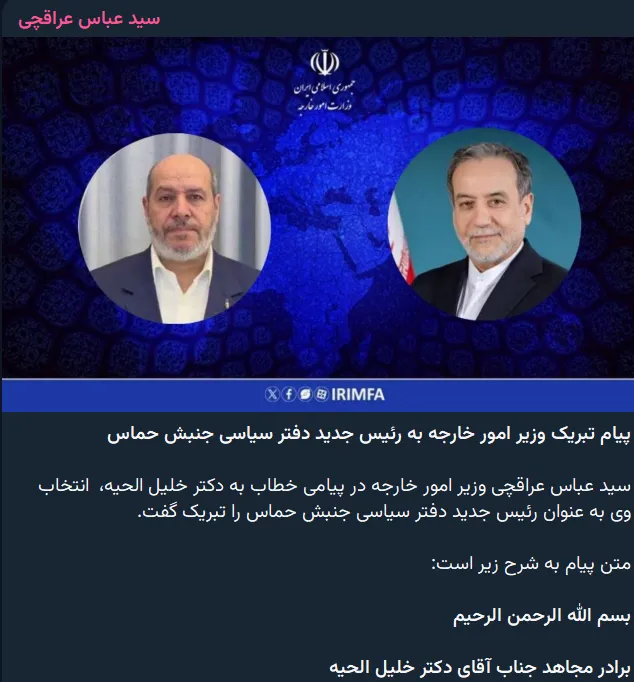
Iran’s own foreign minister, Abbas Araghchi, sent a personal message to “Dear Mujahid brother, Mr. Dr. Khalil al-Hayya”, that honored the movement’s fallen leaders, Sheik Ahmad Yassin, Ismail Haniyeh, and Yahya Sinwar, and reaffirmed what he called Iran’s decisive support for the Palestinian struggle: “I seize this opportunity to reaffirm the unwavering support of the Islamic Republic of Iran for the legitimate struggles of the Palestinian people to liberate themselves from the oppression, apartheid, and colonialism of the Zionist regime. I pray to God that you will be successful in your new role in continuing the path of jihad and resistance until the liberation of the sacred land of Palestine and Jerusalem…”, The coordination and the shared vocabulary of martyrdom, steadfastness, and continuity are themselves the point: they present the succession not as a Palestinian internal matter but as an axis-wide affirmation, orchestrated to project unbroken cohesion after a year of devastating losses.
A Recurring Cycle: Distress Drives Hamas toward Tehran
The current warming is not new but the latest turn of a recurring cycle. When Hamas’s Arab options narrow, it turns to the one patron that reliably supplies money and weapons. The relationship cooled sharply in 2011 and 2012, when Hamas refused to back Bashar al-Assad in the Syrian war and lost its Damascus headquarters, and Khaled Mashal relocated to Doha; it warmed again once distress mounted, and the movement’s center of gravity shifted back to the hawkish military wing, which had sustained the Iranian tie even when the political leadership leaned toward the Gulf.
The same mechanism now operates with far greater force. Catastrophic wartime attrition, including the killing of Haniyeh in Tehran and Sinwar in Gaza, has stripped away leadership and narrowed Hamas’s room to maneuver, raising the value of the Iranian lifeline at the very moment its Gulf relationships are strained. What has changed since the earlier cycles is magnitude, not logic. And the Syrian rupture is a reminder that the cycle can run in reverse, that the relationship can cool when regional alignments diverge, so continuity should not be mistaken for fusion. Al-Hayya’s profile, a veteran political operative and chief negotiator based in Qatar, is exactly the figure who can deepen the Iranian relationship without severing Hamas’s independent lifelines.
The Rhetoric of Vengeance and Its Targets
The succession coverage appears within a press environment saturated with eliminationist language. In the same cycle, Iranian outlets brand the United States military as an enemy whose “blood is licit to shed,” celebrate the reported killing of American servicemembers, and call on the populations of neighboring states to rise against American forces on their soil. President Trump is a recurring figure, alternately derided through mockery and cast as a reckless gambler whose war has cost American lives. Alongside the United States, Israeli and Western officials remain the standing objects of this hostility.
This is where the martyr-embrace imagery acquires its sharper edge. By drawing Hamas into the blood-vengeance frame built around the fallen Leader, the regime rhetorically extends the duty of retaliation across its network. The connection operates at the level of narrative rather than any operational plan, but the effect is to sustain an atmosphere of incitement against named American, Israeli and Western figures, an atmosphere that lowers the threshold for violence even where the language addresses an adversary collectively rather than by name. The elements to watch are familiar: any shift from collective condemnation to the singling out of individuals, and whether the vengeance framing is taken up by Hamas or other members of the axis in their own messaging.
Outlook
The al-Hayya succession points to continuity rather than rupture. A Qatar-based leader with a negotiations portfolio and a record of loyalty to the axis suggests Hamas will keep one foot in the Doha mediation track and one in the Iranian camp, the dual posture that has defined it for more than a decade. For Tehran, the priority is reassurance that the Palestinian front of the axis has survived the war and remains aligned.
The most likely trajectory is continuity with hedging, in which Hamas deepens its reliance on Iran for support while preserving its Qatari and mediation channels and resisting full absorption into an Iranian command relationship. Should the war grind on and Gulf and Western pressure isolate the movement further, the axis ties could tighten to the point where the “Iran’s man” description becomes more accurate over time.
A renewed cooling is less likely in the near term, but the Syrian precedent shows it remains possible if regional alignments shift and Qatar’s pull reasserts itself. What is clear now is that Iran is publicly investing in the relationship, advertising it through the imagery of the martyred Leader’s embrace, and using the succession to weave the Palestinian cause into its own narratives of legitimacy and revenge.