Iranian Press Monitor - Sunday, 25 October 2026 (Day 236)
Sunday, 25 October 2026 · یکشنبه ۳ آبان ۱۴۰۵ · 14 Jumada al-Awwal 1448 - Nine Iranian front pages of 3 Aban 1405 read in full, together with six newspaper channels and three agency wires. Kayhan is read from the paper’s own channel listing for a second cycle because it did not reach the kiosk album. The English-language album did not refresh and carried the previous day’s issue; Tehran Times was not available at the time of compilation.
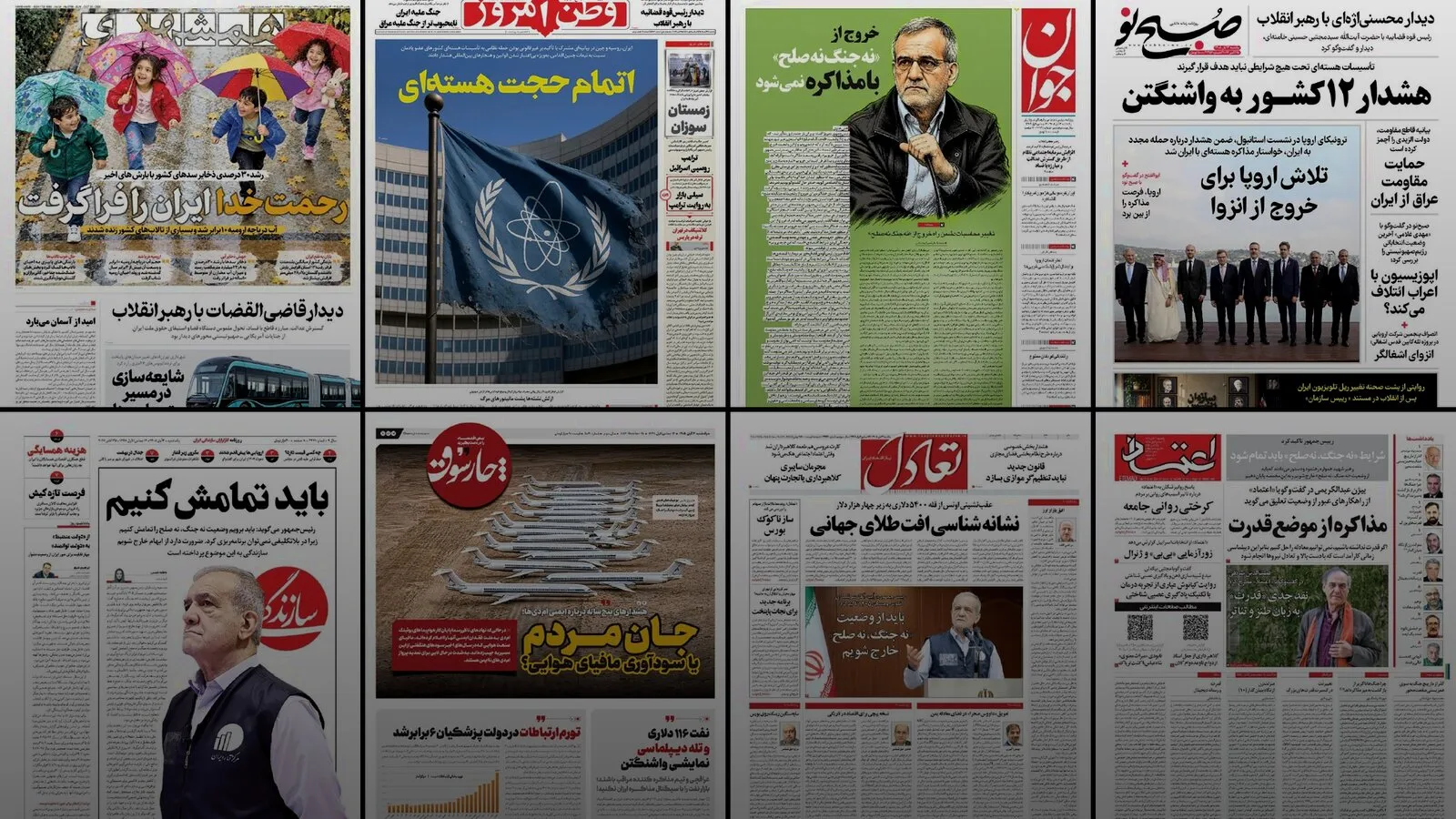
Bottom line: On the morning the Iranian press turned a single presidential sentence about ending the ‘neither war nor peace’ condition into a five-way argument about what should end it, the hardest thing published was not an ultimatum but an admission: Kayhan’s managing editor claimed the closure of the Strait of Hormuz as Iran’s own sanctions regime and called it a divine gift, while the economic press printed a collapse in gold that cuts the ground from under the price argument that claim rests on.
Executive Summary
The lead judgment of this edition is that the Iranian press has converted an internal policy question into a public argument conducted across factional lines, and that the argument is about method rather than about diagnosis. President Masoud Pezeshkian’s statement that the condition of «نه جنگ، نه صلح», neither war nor peace, must end appears on five of the nine front pages in this batch, and no page disputes the diagnosis. What each page does instead is supply a different exit. Etemad, reformist, prints it as a demand with the deck «رهبر شهید همواره رهنمود و دستور میدادند که باید از وضعیت «نه جنگ، نه صلح» خارج شویم و به این مخمصه پایان دهیم», the martyred Leader always gave guidance and instruction that we must leave this condition and end this predicament, and leads on «مذاکره از موضع قدرت», negotiation from a position of strength. Jomhouri-ye Eslami prints it as reconstruction: «با عبور از وضعیت نه جنگ نه صلح باید برای ساختن ایران همت کنیم». Ta’adol captions it beneath the President’s photograph as «باید از وضعیت «نه جنگ، نه صلح» خارج شویم». Javan, the Guard-affiliated daily, accepts the diagnosis and rejects the remedy in its headline: «خروج از «نه جنگ نه صلح» با مذاکره نمیشود», exit will not come through negotiation, with the caption supplying the alternative, «تغییر محاسبات دشمن», changing the enemy’s calculations. And Sazandegi, reformist, strips the imperative out of the same remark and prints the President as resigned: «باید تماشا کنیم», we are left to watch.
The second finding is an admission rather than a threat, and it is the most consequential text in the edition. In the previous cycle this monitor recorded the principlist press conceding in body text that traffic through the Strait of Hormuz had stopped completely and that the closure followed an American order for a prolonged blockade of Iran’s ports, which left the question of agency open. Hossein Shariatmadari, Kayhan’s managing editor, closes it from the direction closest to the Leader’s office. His column «این ۷ از آن ۴۷ بزرگتر است», this seven is greater than that forty-seven, argues that seven months of pressure applied by Iran have cost the United States and Europe more than forty-seven years of American sanctions cost Iran, and calls the closure of the Strait «هدیه الهی», a divine gift. The closure is no longer something done to Iran in that telling; it is Iranian policy, claimed, measured and valued. Kayhan’s front page carries the operational companion to the argument: «نفت ۱۱۷ دلاری آغاز راه است؛ زیر و روی خلیج فارس در تیررس ایران», $117 oil is only the beginning of the road, with the surface and the depths of the Persian Gulf within Iran’s range.
Against that argument the Iranian economic press published a number that nobody on the hardline pages addressed. Ta’adol leads on «نشانهشناسی افت طلای جهانی», reading the signs in the fall of global gold, over the line «عقبنشینی اونس از قله ۵۴۰۰ دلاری به زیر چهار هزار دلار», the ounce retreating from its $5,400 peak to below four thousand dollars, and the security-council-linked wire separately calls it «ریزش سنگین طلا», a heavy collapse. In the same batch Charsoo prints oil at $116, the first downward move in a series that four front pages carried at $117 in the previous cycle. Two safe-haven series are now diverging: the war-risk premium is leaving gold while the chokepoint premium stays in oil. That distinction is unhelpful to the leverage argument, because it indicates a market pricing out the probability of a wider war while continuing to price in a physical closure. No Iranian front page in this batch attempts the reconciliation.
The sitting Leader returned to the front pages after the absence this monitor filed as a finding two cycles ago, and the manner of his return is as informative as the fact. Four papers carry his meeting with the head of the judiciary: Hamshahri as «دیدار قاضیالقضات با رهبر انقلاب», Vatan-e Emrooz and Kayhan as masthead lines, Javan with the substance, «افزایش سرمایه اجتماعی نظام از طریق گسترش عدالت و مبارزه با فساد», and Sobh-e No with the fullest printing of the name this monitor has recorded, «رئیس قوه قضاییه با حضرت آیتالله سیدمجتبی حسینی خامنهای دیدار و گفتوگو کرد», set above its own nameplate. No front page in the batch carries a photograph of him. Neither the time nor the place of the meeting was disclosed. The operative novelty in the message is not the judicial-reform material, which is conventional, but the instruction to pursue recovery of compensation for the material and moral damages of what the statement calls American-Zionist crimes: that converts the war’s damage from a grievance into a docket held by a standing institution.
One page in the batch leads on neither the war nor the economy, and it is the most striking domestic signal of the cycle. Hamshahri, the Tehran municipal daily, gives its whole front page to rainfall: «رحمت خدا ایران را فراگرفت», God’s mercy has enveloped Iran, over children with umbrellas, with a 30 percent growth in dam reserves, reservoir storage at 24.8 billion cubic metres and above the ten-year average, twelve provinces with increased rainfall, Lake Urmia’s water reported tenfold and its extent more than four times last year’s, and the dried sections of the Choghakhor and Kani Barazan wetlands re-watered. One cycle earlier the reformist press was reporting drought across 77 percent of the country. The numbers are specific enough to be checkable, which distinguishes this from decorative good news, and the framing is explicitly theological.
The cycle’s hard events sat on the wires rather than on the front pages, and three of them matter. Lebanon re-entered the monitored set after seven quiet cycles, and it re-entered kinetically: Defa Press reports large-scale Israeli demolitions and detonations in the border town of Khiam. The Yemen-Saudi exchange escalated to the point of closing Gulf airspace to foreign carriers, with a ballistic missile fired at Riyadh and reported intercepted, air-raid sirens in the Saudi capital, a drone attack hours after Riyadh’s airport reopened, Saudi strikes on Taiz and a reported strike on workers’ housing in Sanaa, a Canadian advisory against travel to Riyadh and Dammam airports, Indian and Pakistani carriers extending suspensions, and the Asian Football Confederation moving its tournament. And the tanker-mine series acquired a successor: the Iran newspaper’s channel reports two sanctioned supertankers exploding on mines, matching an IRGC claim of 23 October involving 4.5 million barrels and abandoned crews, for which independent monitoring has found no substantiation in the preceding cases. Against all that, the surface that mattered most in the previous cycle went quiet. Nour News, linked to the Supreme National Security Council, which distributed the ‘zero hour’ imminence warning in the previous cycle, published no imminence material at all today.
The diplomatic track acquired a roster and lost a number. Sobh-e No leads on «هشدار ۱۲ کشور به واشنگتن», twelve countries warn Washington, over the line that nuclear facilities must under no circumstances be targeted; the government daily puts the same diplomacy at eight foreign ministers stressing dialogue; and Sobh-e No’s own channel gives the Istanbul composition as Turkey, Saudi Arabia, Pakistan and Egypt meeting the European three, with an agenda of Palestine, the war on Iran, and freedom of navigation in both the Strait of Hormuz and Bab al-Mandab. The count is not reconciled anywhere in the batch. Vatan-e Emrooz meanwhile takes the trilateral Iran-Russia-China statement on the illegality of attacking safeguarded nuclear facilities and prints it not as an opening but as «اتمام حجت هستهای», the nuclear ultimatum, over a photograph of a shot-through IAEA flag. The same paper’s own analyst, interviewed by Sobh-e No, concedes that these positions will not decisively affect Washington’s decision.
Net assessment: this is an argument edition, and the argument is domestic. Nothing in the monitored twenty-four hours changed the military position, and the two surfaces that have carried escalation in recent cycles, the security wire and the imminence warning, were silent. What moved instead was the question of who gets to define the exit, and it moved in public: a president quoting an assassinated Leader against a stalemate, a Guard daily ruling out his remedy without naming him, a reformist paper printing him as resigned, and the Leader’s own flagship editor claiming the chokepoint as policy and pricing it as a win. The weakness in that last position is now visible in Iran’s own economic press, where gold has broken and oil has ticked down. The thing to watch is not whether the argument is settled but whether the price series that underwrites the hardline side of it continues to fall.
Key Judgments
- KJ-1 [HIGH] The Iranian press is conducting an open, cross-factional argument about how to end the war’s stalemate, with agreement on the diagnosis and no agreement on the method. The evidence is one sentence on five of nine front pages with five different continuations: Etemad pairs «شرایط «نه جنگ، نه صلح» باید تمام شود» with «مذاکره از موضع قدرت»; Jomhouri-ye Eslami continues it as «باید برای ساختن ایران همت کنیم»; Ta’adol captions it «باید از وضعیت «نه جنگ، نه صلح» خارج شویم»; Javan heads its page «خروج از «نه جنگ نه صلح» با مذاکره نمیشود» and substitutes «تغییر محاسبات دشمن»; Sazandegi prints «باید تماشا کنیم». The significance is that this is the opposite of the centrally guided message discipline recorded in the previous cycle: a Guard-affiliated daily publicly rejecting the President’s remedy on the morning his remark leads four other pages indicates that the method question is unsettled at the level where it is decided, and the papers are being allowed to say so.
- KJ-2 [HIGH] Iran has now claimed the closure of the Strait of Hormuz as its own policy instrument, from the outlet closest to the Leader’s office, resolving an ambiguity this monitor flagged one cycle ago. The evidence is Hossein Shariatmadari’s column «این ۷ از آن ۴۷ بزرگتر است», which calls the closure «هدیه الهی», a divine gift, and argues that seven months of Iranian pressure have cost the United States and Europe more than forty-seven years of American sanctions cost Iran, alongside Kayhan’s front page «نفت ۱۱۷ دلاری آغاز راه است؛ زیر و روی خلیج فارس در تیررس ایران». In the previous cycle Sobh-e No’s body text had the price rising after Trump’s order for a prolonged blockade of Iran’s ports, with the closure described as something happening to Iran. The significance is that a claimed closure is a negotiable instrument in a way an imposed blockade is not, and that the claim is made in the register of entitlement rather than of grievance.
- KJ-3 [HIGH] The sitting Leader is being re-established in print without being shown, and the message’s operative content is a compensation mandate rather than a war statement. The evidence is four front pages carrying the judiciary meeting, with Sobh-e No printing «حضرت آیتالله سیدمجتبی حسینی خامنهای» in full above its own nameplate and Javan carrying the substance, «افزایش سرمایه اجتماعی نظام از طریق گسترش عدالت و مبارزه با فساد», against the absence of any photograph on any page in the batch, any disclosed time or place, and any imagery or recording released since the succession. The instruction is to pursue recovery of compensation for the material and moral damages of what the statement calls American-Zionist crimes. The significance is twofold: the name is now circulating at masthead prominence while the person remains unseen, and the war’s damage is being institutionalised as a judicial docket that will outlast any ceasefire.
- KJ-4 [MODERATE-HIGH] The price evidence underpinning Iran’s leverage argument began to move against it in this cycle, and the Iranian hardline press did not address the move. The evidence is a divergence inside Iran’s own economic press: Ta’adol leads on «عقبنشینی اونس از قله ۵۴۰۰ دلاری به زیر چهار هزار دلار», gold retreating from a $5,400 peak to below $4,000, which Nour News separately calls «ریزش سنگین طلا»; Charsoo prints «نفت ۱۱۶ دلاری», the first downward print in a series that four front pages carried at $117 one cycle earlier; and Shariatmadari’s column, which needs the price to be rising, instead reaches past the screen to physical cargoes at $145 and to an attributed Aramco remark about $200. The significance is that a falling gold price with elevated oil indicates a market pricing out a wider war while still pricing a physical closure, which is the opposite of the escalation the leverage argument advertises. Calibration: a single session is not a trend, and overreading two prints would invent a turn; understating it would miss the first break in the series this monitor has tracked for five cycles.
- KJ-5 [MODERATE-HIGH] The President has taken his doctrinal warrant from the assassinated Leader rather than from the serving one, on the morning the serving one returned to the front pages. The evidence is Etemad’s banner deck: «رهبر شهید همواره رهنمود و دستور میدادند که باید از وضعیت «نه جنگ، نه صلح» خارج شویم و به این مخمصه پایان دهیم», the martyred Leader always gave guidance and instruction that we must leave this condition and end this predicament. Shariatmadari’s column opens with the same device from the opposite faction, directing readers back to a quoted statement of the martyred Leader. The significance is that both wings of the argument are sourcing authority to a dead Supreme Leader while a living one is in office and is simultaneously being printed at masthead prominence, which indicates the succession’s authority is established in name faster than it is established in doctrine. Calibration: this is an inference from placement and attribution, not from any statement about the sitting Leader’s standing, and no page in the batch disparages him.
- KJ-6 [MODERATE-HIGH] The Yemen-Saudi front has crossed the civil-aviation threshold and is now a second chokepoint file rather than a separate theatre. The evidence is accumulation across one cycle on five surfaces: a ballistic missile launched at Riyadh which the Saudi-led coalition says it intercepted, air-raid sirens in the Saudi capital, a drone attack hours after Riyadh’s airport reopened, Saudi air strikes on al-Turba in Taiz and a reported strike on workers’ housing in Sanaa with eight dead, a Canadian advisory against travel to the Riyadh and Dammam airports, Indian and Pakistani carriers extending suspensions, and the Asian Football Confederation moving its tournament. The joining move is diplomatic: the Istanbul agenda as reported on the Sobh-e No channel covers freedom of navigation in the Strait of Hormuz and Bab al-Mandab together. The significance is that a negotiation covering both chokepoints gives Iran a wider instrument and a wider exposure than Hormuz alone.
- KJ-7 [MODERATE] Lebanon’s seven-cycle absence from the monitored set has ended, and it ended with a kinetic report rather than with a political one. The evidence is Defa Press’s «تخریب و انفجار گسترده رژیم صهیونیستی در لبنان», reporting large-scale Israeli demolitions and detonations in the border town of Khiam, recorded as the agency’s claim. The significance is in the shape of the return: in the previous cycle Lebanon reached the monitored set only as an American denial of a plan to change its political system, and this monitor filed the silence as a finding. A wire-level kinetic report with a named town is a different order of evidence. Calibration: one agency item is not a campaign, and no front page in the batch carries Lebanon at all; the judgment is that the thread has reopened, not that the theatre has reactivated.
- KJ-8 [MODERATE] The tanker-interdiction series does have a successor claim, correcting this monitor’s previous judgment, and it is weaker in sourcing than its predecessor. The evidence is the Iran newspaper’s channel reporting two sanctioned supertankers exploding after striking mines without stating a location, matching an IRGC statement of 23 October placing two supertankers carrying 4.5 million barrels in total on mines in the southern Strait with crews abandoning ship. No vessel has been identified, and independent monitoring has found no substantiation for the preceding claims in this series. The significance is that the claim has migrated from a public-relations statement placed on five surfaces within ninety minutes, as recorded on 22 October, to an unlocated line on a single channel, which suggests either diminishing confidence in the claim or a deliberate reduction in its prominence. Recorded as an unverified Iranian claim throughout.
- KJ-9 [MODERATE] Negative evidence, filed as a finding: the security wire that carried the previous cycle’s imminence warning published nothing of the kind in this one. The evidence is an absence measured against a specific baseline. In the previous cycle Nour News, linked to the Supreme National Security Council, carried the ‘zero hour’ material alongside Etemad and Shargh, reporting prepared American and Israeli plans against Iranian industrial infrastructure and the missile arsenal. Today its only security item is a video revisiting Asim Munir’s Tehran visit of 20 October, which ended without agreement, and its remaining output is weather, gold, car prices and a religious commemoration. The significance is that the channel which distributes centrally available security information chose not to renew an imminence signal within twenty-four hours of issuing one. Against that, a single uncorroborated channel item places the next risk window after 9 Aban, 31 October, and the Russian embassy in Tehran issued a denial that staff and specialists were being evacuated from the Bushehr nuclear plant, a denial specific enough to imply a circulating report worth locating.
- KJ-10 [MODERATE] An Iranian principlist daily has publicly aligned itself against the Iraqi government’s monopoly of force, which is a new position in this monitor’s record. The evidence is Sobh-e No’s rail item «بیانیه قاطع مقاومت، دولت الزیدی را آچمز کرده است / حمایت مقاومت عراق از ایران», the resistance’s categorical statement has placed the al-Zaidi government in zugzwang, printed as a favourable development. Ali al-Zaidi has been Iraq’s prime minister since 14 May 2026; his published positions are that Iraq will not be a party to any war and that no weapons will remain outside state authority by 30 June 2027, and he ordered the Sheeb crossing with Iran closed on 21 October while arguing publicly that a general closure would harm both countries. The significance is that the Iraqi file has moved from a trade grievance, which is how the previous cycle recorded it, to an explicit question of which Iraqi actor Tehran’s press backs. Track the al-Zaidi file as a named standing thread.
- KJ-11 [MODERATE] The Iranian press is reading the Israeli ballot of 27 October as an input to its own war planning, and the reading contains one verifiable error. The evidence is three surfaces: Etemad files from Israel under «زورآزمایی «بیبی» و ژنرال», which is Benjamin Netanyahu against the retired chief of staff Gadi Eisenkot, whose Yashar party leads most polling without either bloc approaching a majority; Sobh-e No asks whether the opposition will form a coalition with the Arabs; and Kayhan’s analysis forecasts no bloc reaching a majority, a repeat vote in about two months, and the Arab lists as kingmakers, while adding that Iran and Hezbollah will shape the next vote. The error is in the coalition premise that Sobh-e No and Kayhan share: Eisenkot’s own published position is that no Arab party would accept his coalition conditions, which analysts treat as the main constraint on his route to a majority. The significance is that an Iranian expectation of an Arab-backed opposition government is likely to be disappointed, and expectations built on it will have to be revised after 27 October.
- KJ-12 [LOW-MODERATE] Negative evidence, filed as a finding: Iran’s outward-facing English surface produced nothing in this cycle, for the second cycle in which the war has been kept off it. The evidence is that the English-language kiosk album did not refresh and carried Iran Daily Vol 6246 of Saturday 24 October, the issue analysed in the previous edition, whose lead remains ‘China hosts global forum to push for fairer world order’ with the nuclear file appearing only as ‘Iran urges end to selective implementation of IAEA statute’; Tehran Times was not available at the time of compilation. The significance is that the regime’s chosen foreign-audience channel is currently carrying multipolar-order material while its domestic pages carry a claimed chokepoint closure and a public argument about war termination. Calibration: a kiosk album failing to refresh is a distribution fact and not necessarily an editorial choice, which is why this is filed at low-moderate confidence; the editorial pattern it is consistent with has now held for two cycles.
Macro Trends
- One presidential sentence, five incompatible exits. Pezeshkian’s statement that «نه جنگ، نه صلح» must end appears on five of nine front pages and is not disputed anywhere; what is disputed is the remedy. Etemad prints negotiation from a position of strength, Jomhouri-ye Eslami prints reconstruction and the census, Ta’adol prints it as a caption under the President’s photograph, Javan rules out negotiation outright and substitutes changing the enemy’s calculations, and Sazandegi strips the imperative and prints resignation. Agreement on the diagnosis with open disagreement on the method is a more legible state of the system than the message discipline this monitor recorded in the previous cycle.
- The chokepoint closure claimed as Iranian policy. Shariatmadari calls the closure of the Strait «هدیه الهی», a divine gift, and measures seven months of Iranian pressure against forty-seven years of American sanctions. Kayhan’s front page pairs the price claim with target coverage, «زیر و روی خلیج فارس در تیررس ایران». In the previous cycle the same closure appeared in the principlist press as the consequence of an American blockade order, with agency left ambiguous. The ambiguity is now resolved in the direction of claimed Iranian agency, by the outlet closest to the Leader’s office.
- The two safe havens diverge. Ta’adol leads on gold retreating from a $5,400 peak to below $4,000, and the security-council-linked wire calls it a heavy collapse; Charsoo prints oil at $116 against the $117 carried on four front pages a cycle earlier. A falling gold price with a still-elevated oil price indicates a market pricing out a wider war while continuing to price in a physical closure. The hardline argument for leverage is built entirely on the oil series and does not address the gold series anywhere in this batch.
- The Leader returns in text and stays out of sight. Four front pages carry the judiciary meeting and Sobh-e No prints «حضرت آیتالله سیدمجتبی حسینی خامنهای» in full on its masthead line, the most prominent placement of the name this monitor has recorded. No page prints a photograph, no time or place was disclosed, and the office has released no imagery or recording since the succession. The substantive novelty is the instruction to pursue compensation for the material and moral damages of American and Israeli crimes, which assigns the war’s damage to a standing institution as a docket.
- The president reaches past the living Leader to the dead one. Etemad’s banner deck grounds the demand to end the stalemate in the guidance of «رهبر شهید», the martyred Leader, on the same morning the sitting Leader appears on four front pages. Taking doctrinal warrant on the central question of war and peace from an assassinated predecessor rather than from the serving Supreme Leader has no precedent in this monitor’s record, and it is printed by a reformist paper with an interest in making it visible. Shariatmadari’s column opens with the same device, directing readers back to a statement of the martyred Leader.
- Lebanon returns kinetically, Yemen closes Gulf airspace. Defa Press reports large-scale Israeli demolitions and detonations at Khiam in southern Lebanon, ending a seven-cycle absence from the monitored set. In parallel the Yemen-Saudi exchange reached the civil-aviation threshold: a ballistic missile at Riyadh reported intercepted, sirens in the capital, a drone attack hours after the airport reopened, Saudi strikes on Taiz and a reported strike on workers’ housing in Sanaa, a Canadian travel advisory against two Saudi airports, Indian and Pakistani carriers extending suspensions, and a continental football tournament moved. Bab al-Mandab now appears beside Hormuz on the Istanbul agenda, which joins the two chokepoints in one diplomatic file for the first time in this record.
- The security wire went quiet. Nour News, linked to the Supreme National Security Council, carried the previous cycle’s ‘zero hour’ imminence warning alongside two reformist front pages. Today it published no imminence material of any kind; its only security item revisits Asim Munir’s Tehran visit of 20 October, which ended without agreement. Against that silence, the Etemad Online channel carries a single uncorroborated forecast that there will be no war before 9 Aban, 31 October, with risk rising after that date, and the Russian embassy in Tehran denied reports that staff and specialists were being evacuated from the Bushehr nuclear plant.
- Israel’s ballot read as an Iranian variable. Three Iranian surfaces are reading the 27 October Israeli election in operational terms: Etemad files a report from Israel headlined «زورآزمایی «بیبی» و ژنرال», the trial of strength between Bibi and the General, which is Netanyahu against the retired chief of staff Gadi Eisenkot; Sobh-e No asks «اپوزیسیون با اعراب ائتلاف میکند؟», will the opposition form a coalition with the Arabs; and Kayhan’s analysis predicts no bloc reaching a majority, a repeat vote in about two months, and the Arab lists as kingmakers. The coalition premise is the weak point: Eisenkot’s own published position is that no Arab party would accept his conditions.
- An Iranian daily sides against the Iraqi state. Sobh-e No’s rail prints «بیانیه قاطع مقاومت، دولت الزیدی را آچمز کرده است / حمایت مقاومت عراق از ایران», the resistance’s categorical statement has placed the al-Zaidi government in zugzwang. Ali al-Zaidi has been Iraq’s prime minister since 14 May 2026; his published positions are that Iraq will not be party to any war and that no weapons will remain outside state authority by 30 June 2027, and he ordered the Sheeb crossing with Iran closed on 21 October while arguing against a general closure. A Tehran principlist daily openly welcoming armed factions boxing in that government is a new and trackable position.
- Rain displaces drought as the domestic subject. Hamshahri gives its whole front page to rainfall in theological language, «رحمت خدا ایران را فراگرفت», with dam reserves up 30 percent to 24.8 billion cubic metres and above the ten-year average, twelve provinces wetter, Lake Urmia’s water reported tenfold, and dried wetlands re-watered. One cycle earlier the reformist press reported 77 percent of the country in drought. The competing domestic ledger has not gone away: Charsoo prints communications inflation up sixfold under this government with a chart, domestic airfares are reported up roughly 45 percent in a month after carriers lost the exchange-centre rate, and Ta’adol leads its banner with a private-sector warning against a parallel regulator in the new cyberspace bill.
Front-Page Snapshot
- Etemad - “The President: the ‘neither war nor peace’ condition must end / Negotiation from a position of strength” (Reformist) - The stalemate to be ended, with the warrant taken from the martyred Leader [MODERATE-HIGH - doctrinal authority sourced to the assassinated predecessor]
- Javan - “Exit from ‘neither war nor peace’ will not come through negotiation” (Hardline, IRGC-affiliated) - The Guard daily rebuts the President’s remedy and substitutes cost imposition [MODERATE-HIGH - negotiation publicly ruled out as the exit]
- Sazandegi - “We are left to watch” (Reformist / Kargozaran) - The same remark printed as presidential resignation [LOW-MODERATE - the war registered as paralysis]
- Jomhouri-ye Eslami - “The President: passing beyond ‘neither war nor peace’, we must set ourselves to building Iran” (Traditional establishment) - Reconstruction and the census offered as the exit; deterrence sourced to foreign media [MODERATE - deterrence asserted without Iranian commanders]
- Kayhan - “$117 oil is only the beginning of the road; above and below the Persian Gulf are within Iran’s range” (Hardline, close to the Leader’s office (read from the paper’s channel)) - The Strait closure claimed as Iran’s own sanctions regime and called a divine gift [SEVERE - closure claimed as policy, Gulf declared within range]
- Vatan-e Emrooz - “The nuclear ultimatum” (Hardline / principlist) - A trilateral statement on safeguarded facilities printed as an ultimatum over a shot-through IAEA flag [HIGH - nuclear facilities framed as the subject of a formal ultimatum]
- Sobh-e No - “Twelve countries warn Washington” (Principlist) - Nuclear facilities declared off-limits; the Leader named in full; Iraqi factions backed against their own government [MODERATE-HIGH - an Iranian daily endorses pressure on the Iraqi state]
- Ta’adol - “Reading the signs in the fall of global gold” (Economic) - Gold collapses from its peak while oil stays elevated: the two havens diverge [MODERATE - war-risk premium leaving gold]
- Charsoo - “The people’s lives, or the profitability of the aviation mafia?” (Economic) - War costs priced as aviation safety, sixfold communications inflation and a lower oil print [LOW-MODERATE - war cost registered domestically]
- Hamshahri - “God’s mercy has enveloped Iran” (Tehran municipality, centrist) - Rainfall and reservoir recovery led as national relief; the Leader appears without a photograph [LOW - no war content above the fold]
- Agency wires - “Widespread Zionist-regime demolition and explosions in Lebanon” (Defa Press, Fars News, Nour News, Jam-e Jam channel) - Lebanon returns kinetically, the Yemen-Saudi front closes Gulf airspace, a new tanker-mine claim, and the security wire goes quiet [HIGH - the cycle’s hard events sat on the wires, not the front pages]
Full report
The complete edition - per-paper front-page analysis and full translation appendices - is available as a PDF: Download the full report.
Compiled from Iranian front pages and outlet channels via open-source monitoring. Translations are editorial; named-figure attributions are verified against the source pages where possible.