Iranian Press Monitor - Wednesday, 21 October 2026 (Day 232)
Wednesday, 21 October 2026 · چهارشنبه ۲۹ مهر ۱۴۰۵ · 10 Jumada al-Awwal 1448 - Twelve Iranian titles of 29 Mehr 1405: ten front-page scans, nine dailies and the Guard’s weekly, read together with Kayhan and the Iran newspaper from their own channels, four further paper channels and three agency wires. No Iranian English-language front page of the day was published, and Tehran Times was unavailable at the time of compilation.
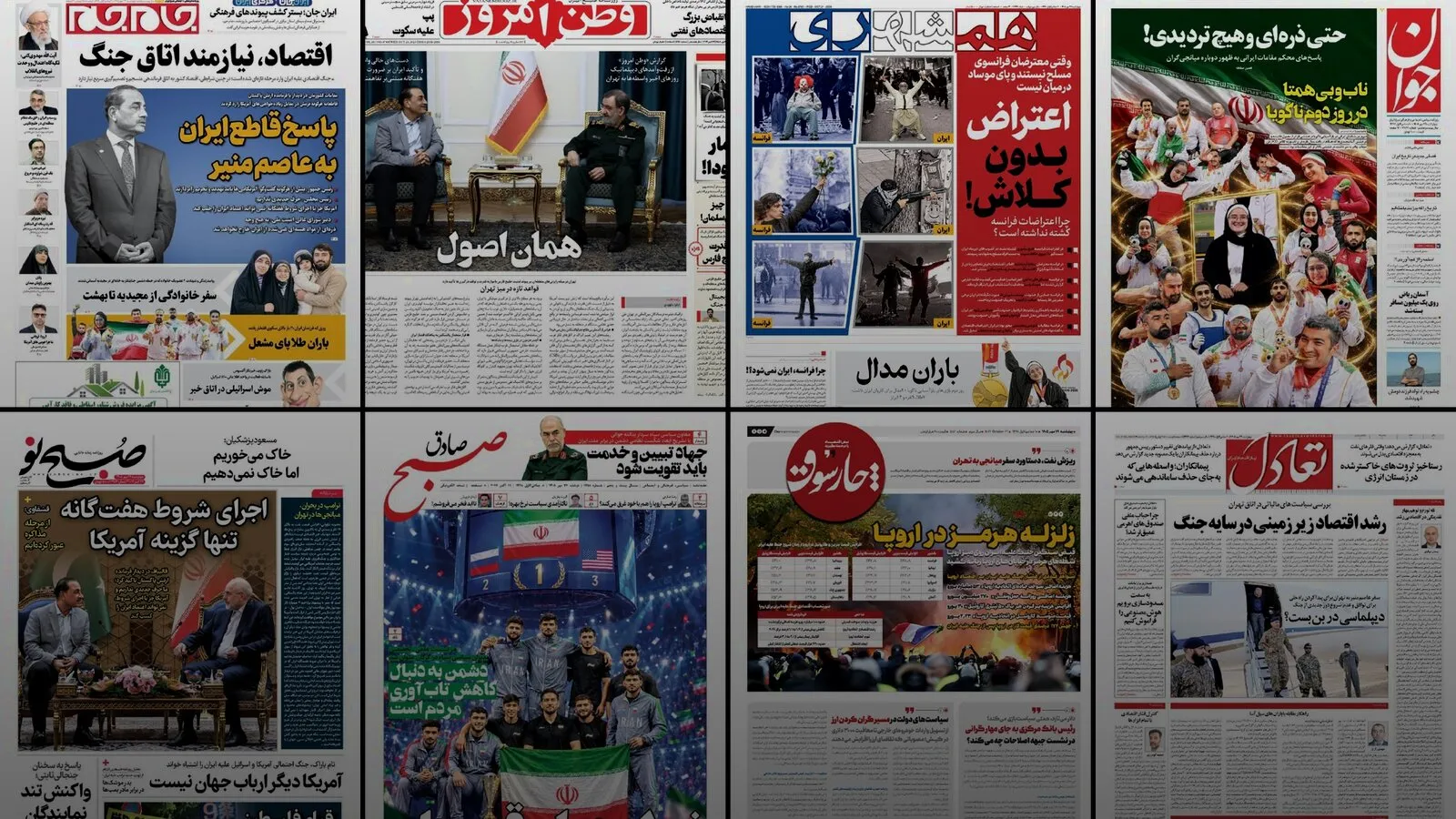
Bottom line: Pakistan’s army chief came to Tehran for the fifth time and left having reopened the border, and four front pages answered him with the same published refusal, while the one sentence that would change the picture, the foreign minister’s statement that Washington has accepted Iran’s conditions and wants only to add points to them, reached no front page at all.
Executive Summary
The lead judgment of this edition is that the Iranian press has published the refusal and suppressed the agreement. Field Marshal Syed Asim Munir, Pakistan’s Chief of Army Staff, arrived in Tehran on Tuesday on what Jomhouri Eslami numbers as «پنجمین سفر رسمی», his fifth official trip, and was received by the President, by the Speaker of parliament and by the Secretary of the Supreme National Security Council. Four separate front pages answer him with the same formula. Sobh-e No leads «اجرای شروط هفتگانه تنها گزینه آمریکا», implementing the seven conditions is America’s only option. Jam-e Jam prints the refusal as a chorus of three offices: the President saying threats and sanctions must be lifted before any dialogue, the Speaker saying «حرف جدیدی نداریم», we have nothing new to say, and the security council secretary saying «به هیچ وجه ذرهای از مواد هستهای غنیشده از ایران خارج نخواهد شد», not an iota of enriched material will leave Iran. Javan reduces the whole position to a two-word banner, «حتی ذرهای», not even an iota. Vatan-e Emrooz calls the visit «دستهای خالی واسطهها», the empty hands of the intermediaries. The uniformity is the evidence: four unaffiliated mastheads reaching identical phrasing on the same morning indicates a centrally supplied line rather than convergent editorial judgement.
Against that chorus sits a single sentence that no front page carries. On its own channel Etemad publishes the fullest rendering of the foreign minister’s interview with Iraq’s Al-Ikhbariya, in which Abbas Araghchi states that indirect negotiations with America continue through mediating states and that «آمریکا با شروط ایران موافق است اما میخواهد چند نکته اضافه کند», America agrees with Iran’s conditions but wants to add a few points. If that rendering is accurate, the published refusal is not a description of the negotiating state but a management of it, and the gap this monitor has tracked since 18 October between what is negotiated and what is printed has not closed after all; it has inverted. On 20 October the finding was that a front page had at last printed the mediation. Today the mediation is on four front pages and the acceptance is on none.
The visit also produced the cycle’s one verifiable deliverable, and it answers a test this monitor set and filed as lapsed. On 19 October Iran Daily printed an expert judgement that the Rimdan and Taftan crossings would reopen on Monday, and on 20 October this monitor recorded that the test had been allowed to pass in silence. Today Munir is quoted on the Sobh-e No channel telling the security council secretary «به صراحت اعلام میکنیم که مشکل مرزهای ایران و پاکستان برطرف شده و از امروز صبح مرز بازگشایی شده است», we state explicitly that the problem of the Iran-Pakistan borders has been resolved and from this morning the border has been reopened, and telling the Speaker that the border issues were «موقتی و فنی», temporary and technical. A border that two cycles of this monitor treated as a pressure point was reopened by the mediator himself, in person, and the reopening appears in channel text rather than on any front page.
The chokepoint at the centre of the war is now described in incompatible terms by Iranian sources on the same morning. Defa Press renders the foreign minister as saying the Strait lies in the internal waters of Iran and Oman, that the route agreed with Oman will be the real passage, and that «تا پذیرش شروط ایران از سوی آمریکا، تنگه بسته است», until America accepts Iran’s conditions the Strait is closed. Etemad renders the same interview as the Strait not fully reopening until the conditions are accepted. Sobh-e No’s editor-in-chief writes in the day’s lead editorial that «تنگه هرمز نیز نه بهطور کامل بسته شده، ولی همین اختلال نسبی، جهان را به هم ریخته است», the Strait has not been completely closed either, but this relative disruption alone has thrown the world into disarray. Closed, not fully open, and not completely closed are three different bargaining positions, and they were all published by state-adjacent Iranian surfaces within a few hours.
The leverage is being extended while it is being argued about. Vatan-e Emrooz’s front page carries a signed column reporting that the IRGC spokesman has named the communications cables running under the Strait «در شمار اهداف جدید», among the new targets, with «۷ کابل بزرگ اینترنتی» beneath the waterway, and Defa Press separately carries the Guard’s deputy for political affairs telling Al-Alam «در صورت حمله به زیرساختهای ما، کابلهای اینترنتی را هدف قرار میدهیم». The same spokesman is quoted saying Iran is preparing to unveil «پدر بمبها», the father of bombs, which closes the escalation exchange this monitor opened on 20 October, when Hamshahri promised that «مادر بمبها بیپاسخ نمیماند». And the government’s own daily lists, without date, flag or claiming authority, that «دو کشتی متخلف در تنگه هرمز به آتش کشیده شدند», two non-compliant vessels in the Strait were set on fire: the first commerce-interdiction item to reach a front-page listing in four cycles.
The adversary’s costs are the batch’s organising argument, and they are now being carried in other people’s numbers rather than in Iranian claims. Chaharsoogh gives its whole front to a table of European fuel prices under «زلزله هرمز در اروپا», with 53 billion euros of additional EU road-fuel cost and 270 million euros a day in additional transport cost. Vatan-e Emrooz prints an International Monetary Fund figure of up to 1.6 percent of Gulf GDP lost to the Strait crisis. Kayhan leads on a retired American admiral’s Foreign Affairs article and carries aviation-analytics figures showing more than 45 percent of scheduled Saudi departures cancelled between 8 and 19 October, with Riyadh’s King Khalid International closed since 10 October. Javan alone brings that to a front page as «آسمان ریاض روی یک میلیون مسافر بسته شد». Taken together, a second regional chokepoint, aerial and in Saudi hands, is being advertised in the Iranian press at the moment the maritime one is under negotiation.
Net assessment: this is a refusal edition with a concession buried in it. The front pages are unusually uniform, unusually confident and unusually free of Iranian operational claims, which is the profile of a press being used to hold a position rather than to report a war; the numbered drone-attrition series that ran through the two preceding cycles simply stopped, and no mining or tanker claim appears anywhere. Beneath that surface the cycle produced a reopened border, a ministerial statement that the other side has accepted the terms, a quiet admission that the chokepoint was never fully closed, and an interdiction claim that the government published and declined to own. The judgement this monitor draws is not that a settlement is near but that the distance between the published position and the negotiated one has become the most informative measurement available, and that it is currently being managed in the direction of understatement.
Key Judgments
- KJ-1 [HIGH] The published Iranian refusal and the negotiated Iranian position have come apart, and the press is being used to hold the first while the second advances. The evidence is a pairing within one cycle. Four front pages carry the same two formulas, Sobh-e No’s «اجرای شروط هفتگانه تنها گزینه آمریکا», Jam-e Jam’s three-office chorus ending in «به هیچ وجه ذرهای از مواد هستهای غنیشده از ایران خارج نخواهد شد», Javan’s banner «حتی ذرهای و هیچ تردیدی!» and Vatan-e Emrooz’s «دستهای خالی واسطهها». Against them, Etemad’s channel carries the foreign minister saying indirect talks continue through mediating states and that «آمریکا با شروط ایران موافق است اما میخواهد چند نکته اضافه کند». The significance is that identical phrasing across unaffiliated mastheads indicates a supplied line, and a supplied line that contradicts the foreign ministry’s own published account is management, not reporting. Calibration runs both ways: the Araghchi sentence reaches this monitor through one outlet’s rendering of a foreign-language interview and is weak evidence of the actual terms, while the editorial decision of four papers to print the opposite is the verified fact and the significant one.
- KJ-2 [HIGH] The mediator’s fifth visit produced a reopened border, which answers the Pakistan test this monitor filed as lapsed, and the deliverable was kept off every front page. The evidence is a sequence across three editions. On 19 October Iran Daily printed an expert judgement that the Rimdan and Taftan crossings would reopen on Monday and that failure to reopen would allow the conclusion that Washington was pressuring Islamabad; on 20 October this monitor recorded the test passing in silence; today Asim Munir is quoted on the Sobh-e No channel telling the security council secretary «مشکل مرزهای ایران و پاکستان برطرف شده و از امروز صبح مرز بازگشایی شده است» and telling the Speaker that the issues were «موقتی و فنی». Jomhouri Eslami numbers the visit as his fifth official trip and titles him «میانجی ارشد ایران و آمریکا». The significance is that the mediation has now produced a verifiable physical outcome rather than only a described framework, and that Iran chose not to credit it in print. Tracking cue: whether trade volumes or crossing status are reported on any Iranian surface this week.
- KJ-3 [HIGH] Iranian state-adjacent surfaces published three incompatible descriptions of the Strait of Hormuz within hours, which means the single most important fact in the war is unsettled inside Tehran’s own messaging. The evidence is three renderings of the same morning. Defa Press: «تا پذیرش شروط ایران از سوی آمریکا، تنگه بسته است», with the minister adding that the Strait lies in the internal waters of Iran and Oman and that the route agreed with Oman will be the real passage. Etemad: «تنگه هرمز تا زمان پذیرش شروط ایران بهطور کامل باز نخواهد شد». Sobh-e No’s editor-in-chief: «تنگه هرمز نیز نه بهطور کامل بسته شده، ولی همین اختلال نسبی، جهان را به هم ریخته است». The significance is that closed, not fully open and not completely closed are three different things to trade, and the same minister also announced new agreed routes with Oman and special corridors for Iraqi vessels, which is the language of a toll rather than a wall. Calibration: two of the three are renderings of one interview by different outlets, so part of the divergence may be translation rather than position; the editorial, which is signed and written for an Iranian audience, is the one that cannot be explained that way.
- KJ-4 [HIGH] A front page has named submarine communications cables as targets, and the same cycle names the weapon that answers the large bomb, which extends the war’s declared target set in two directions at once. The evidence is three items. Vatan-e Emrooz’s signed column reports the IRGC spokesman placing the cables under the Strait «در شمار اهداف جدید» and states that «۷ کابل بزرگ اینترنتی از زیر تنگه هرمز عبور میکند», tying it to earlier warnings by the security council secretary about data centres, cables and artificial-intelligence facilities. Defa Press carries the Guard’s political deputy telling Al-Alam «در صورت حمله به زیرساختهای ما، کابلهای اینترنتی را هدف قرار میدهیم». Defa Press also carries the spokesman saying «درصدد رونمایی پدر بمبها هستیم که برای دشمن تازگی دارد», which completes the exchange opened on 20 October when Hamshahri promised that «مادر بمبها بیپاسخ نمیماند». The significance is that cable cutting is deniable, cheap and regionally catastrophic, which makes it a rational next rung precisely because it is below the threshold that would trigger a resumption of strikes. Calibration: ‘father of bombs’ is undefined and measures rhetorical commitment, not capability; the cable threat is specific enough to be operational and should be weighted higher.
- KJ-5 [MODERATE-HIGH] The government’s own daily published a commerce-interdiction claim and declined to own it, breaking a four-cycle silence on interference with shipping. The evidence is one line in the Iran newspaper’s own listing of its page: «دو کشتی متخلف در تنگه هرمز به آتش کشیده شدند», two non-compliant vessels in the Strait were set on fire. There is no date, no flag, no tonnage, no claiming authority and no elaboration anywhere in the monitored set, and no other title in the batch carries it. On 19 and 20 October this monitor filed the absence of a fresh tanker claim as a finding and asked whether the next one would be printed. The significance is that it was printed, and printed by the government rather than by a hardline title or a Guard wire, which is the surface that carries the least deniability and the most official weight. Filed with a single-source flag and with the caveat that «متخلف», non-compliant, refers to the Strait management organisation’s published non-compliance list, against which 122 vessels were reported on 20 October.
- KJ-6 [MODERATE-HIGH] The oil market priced the Iranian refusal at roughly four dollars a barrel inside one day, which gives an external measurement of what the published position costs. The evidence is three surfaces that together cover the whole arc. Chaharsoogh’s masthead strap, written before the refusals landed, reads «ریزش نفت، دستاورد سفر میانجی به تهران». Kayhan’s channel reports «جهش نفت سفر عاصم منیر را بیاثر کرد», with Brent back inside the 110-dollar channel on Gulf export disruption. Fars News states the mechanism outright: the price had fallen to around 106 dollars with the Pakistani commander’s trip and returned towards 110 after the security council secretary and the Speaker spoke, under the headline «موضع قاطع رضایی و قالیباف ورق نفت را برگرداند». The significance is that Iranian outlets have themselves published the finding that mediation lowers the price and refusal raises it, which makes the domestic argument that holding the chokepoint is costless harder to sustain in its own press. Calibration: these are Iranian renderings of market data and the causal attribution is theirs, not this monitor’s.
- KJ-7 [MODERATE-HIGH] A second regional chokepoint has been opened in the air over Saudi Arabia, and Iran is positioning itself as the broker of it rather than as a party to it. The evidence is a cluster. Kayhan cites the aviation analytics firm Cirium for more than 45 percent of scheduled Saudi departures cancelled or not operated between 8 and 19 October, 5,547 of 12,195 flights disrupted, and King Khalid International in Riyadh fully closed since 10 October with up to 82 percent of departures cancelled at the peak; Javan carries it to a front page as «آسمان ریاض روی یک میلیون مسافر بسته شد»; Nour News reports four further drones fired at Saudi Arabia and claimed intercepted; Vatan-e Emrooz and Defa Press report Saudi strikes killing eight Yemeni fishermen in Taiz and repeated bombing of Al-Nashma; and the foreign minister states that Iran has offered to mediate between Ansarullah and Riyadh and received no answer. The significance is that the Gulf’s aviation and maritime arteries are now both degraded, which compounds the economic pressure the same batch attributes to the Strait and gives Tehran a second file on which to appear indispensable. Calibration: the Cirium figures reach this monitor only through Kayhan and are not verified against the original.
- KJ-8 [MODERATE-HIGH] The hardline press has substituted the adversary’s own institutions for Iranian operational reporting, for a second consecutive cycle, and the substitution is now near-total. The evidence is Kayhan’s front page, which leads on a Foreign Affairs article attributed to William H. McRaven, the retired American admiral and former special-operations commander, arguing that the war was a strategic error and that the American war machine has been grounded by Iranian geography and will; and which carries aviation-analytics figures, an Associated Press account of a Trump rally interrupted by a protester objecting to petrol prices, and a conversation between Michael Anton and Jake Sullivan in which Anton is quoted admitting surprise at Iran’s ability to close the Strait. Vatan-e Emrooz and Fars News add an Axios report that the Pentagon is reassessing its posture and weighing whether to rebuild or abandon bases damaged in Iranian strikes, with naval support activity in Bahrain still unusable; Vatan-e Emrooz adds a CNN report of a White House in disarray before the midterms. The significance is that a case built on the enemy’s own numbers is more persuasive at home and more falsifiable abroad: it can be checked, and if the numbers move the argument has to be abandoned in public. Calibration: every item here is an Iranian rendering of foreign reporting and none is verified against its original; the assessment concerns the editorial choice, not the underlying facts.
- KJ-9 [MODERATE] Negative evidence, filed as a finding: the numbered drone-attrition series stopped, and no mining or tanker claim appeared, in the same cycle in which the submarine-cable threat was published. The evidence is an absence against a pattern. On 20 October four surfaces carried the Guard’s claim of a fifty-fourth MQ-9 destroyed over the Strait within three hours of each other; today no such claim appears on any front page, channel or wire in the monitored set, and the only aerial tracking published is the Iraqi resistance media’s routine daily count of six MQ-9s, one MQ-1 and one E-11 observed over Iraq. The significance is that the series was the main advertised proof of defensive success, and its interruption during a mediation round is consistent either with an actual pause in engagements or with a decision to stop advertising them while terms are being discussed. Filed as an absence: one cycle is not a trend, and the two burned vessels on the government page cut against the simplest reading. Tracking cue: whether the numbering resumes at fifty-five, which would show the series was suspended rather than ended.
- KJ-10 [MODERATE] Negative evidence, filed as a finding: Lebanon has now failed to reach an Iranian front page for a third consecutive cycle, while a strike on it was reported on a state channel the same morning. The evidence is a pairing. The Jam-e Jam channel reports that «رژیم صهیونیستی در حمله هوایی، منطقه الحمرا بین شهرهای زوطر شرقیه و کفرتبنیت در جنوب لبنان را هدف قرار داد», an Israeli air strike on Al-Hamra between Zawtar al-Sharqiyeh and Kfar Tebnit in southern Lebanon. No Persian front page in the batch mentions Lebanon at all. On 19 October this monitor read the absence as crowding and on 20 October as a choice; a third cycle, with a named strike available on the state broadcaster’s own channel, puts it beyond crowding. The significance is that the file is being deliberately kept off the domestic agenda while the Hormuz and Pakistan files run, which is what suppression of a theatre looks like when the alternative would complicate a negotiation. Tracking cue: whether Lebanon reappears if a negotiating round convenes.
- KJ-11 [MODERATE] The succession’s documentary record advanced this cycle in form rather than in substance, and the management of the predecessor’s commemoration continues. The evidence is twofold. Sobh-e Sadegh, the IRGC’s own weekly, prints the current office holder’s name in its fullest form on its cover, «حضرت آیتالله سید مجتبی حسینی خامنهای، رهبر معظم انقلاب اسلامی», attached to a dated congratulatory message on the world wrestling title. Separately the Iran newspaper’s page carries «واکنش وزیر ارشاد به تغییر نام اماکن و خیابانها», the culture minister’s response to the renaming of places and streets, continuing the thread recorded on 20 October in which the martyred predecessor’s office opposed renaming long-established places after him. The significance is that the institution is distinguishing the two offices in print while the successor appears, for a fifth consecutive cycle, only as text: a message on a weekly cover, with no dated public appearance, confirmed photograph or confirmed recording anywhere in the monitored set. Filed as a continuing negative-evidence item; nothing in it establishes anything about the office holder.
- KJ-12 [MODERATE] A state-adjacent paper has spent a front page pre-empting a comparison between European protest and Iranian protest, which indicates that the leadership expects the cost-of-living frame to be legible at home. The evidence is Hamshahri’s lead, «اعتراض بدون کلاش!», protest without a Kalashnikov, built as a six-panel photo grid labelling each image «فرانسه» or «ایران» and strapped «وقتی معترضان فرانسوی مسلح نیستند و پای موساد در میان نیست». Its six bullets concede that French protest is unarmed, undirected from abroad, and unsupported by its media, in order to assert that Iran’s 2022 unrest was none of those things; a side column asks «چرا فرانسه، ایران نمیشود؟!» The significance is in who is publishing it: the Tehran municipality’s own high-circulation daily, on the same morning that Jam-e Jam calls for a war room for the economy and Chaharsoogh prints Europe’s fuel bills on its front. The argument is defensive, and defensive arguments are made about live risks. Calibration: this is an assessment of Iranian editorial anxiety, not a prediction of unrest.
- KJ-13 [MODERATE] The commercial and reformist press is declining the maximalist frame, and it is doing so by question and omission rather than by argument. The evidence is three surfaces. Ta’adol, alone in the batch, prints the mediator’s aircraft on its front and puts a question mark on the outcome, «دیپلماسی در بنبست؟», where every other title prints a refusal, and leads its page on «رشد اقتصاد زیرزمینی در سایه جنگ». Etemad’s front page carries no refusal at all, giving its lead to an interview on the Chinese and Russian role in the talks and its remaining space to housing costs, a crime investigation and «نبرد با خورههای امید», the battle with the canker of hope. Chaharsoogh bills the war’s European cost in full while billing the domestic currency collapse to the economy minister and the central bank. The significance is that the only available form of dissent on the negotiation is the withholding of assent, and three titles are exercising it in the same cycle. Calibration: none of the three argues for terms, and reading a political programme into an omission would overstate it.
- KJ-14 [MODERATE-HIGH] (Added from the Daily Intelligence Report.) The hardline press is now questioning the mediation track itself, beyond the terms of any deal. Nobonyad calls Munir “the uninvited mediator,” Kayhan’s page-2 column presents U.S. openness to talks as a device to divide Iran’s leadership, and Hossein Shariatmadari, on the front page of Asr-e Iranian, puts a closed Strait of Hormuz first among seven demands. These camps cannot veto contacts the system has approved, but they are building the case against any concession in advance.
- KJ-15 [HIGH] (Added from the Daily Intelligence Report.) Iran is widening its threats to Gulf digital infrastructure and timing them to the Israeli and U.S. elections, and the approach has started to cost it goodwill with its mediators. Qatar’s Foreign Ministry publicly answered that cut cables and mines would hurt the Gulf before they hurt the United States.
Macro Trends
- The refusal is uniform and the acceptance is unpublished. Four unaffiliated front pages reach the same two formulas on the same morning: «شروط هفتگانه», the seven conditions, and «حتی ذرهای», not even an iota. Sobh-e No’s channel adds the detail the pages omit, that the conditions were the ones «در نیویورک ارائه شده», presented in New York. Against that, Etemad’s channel carries the foreign minister saying indirect talks continue and that America agrees with Iran’s conditions and wants to add a few points, and Sobh-e No’s own editorial prints, while disclaiming, an Al-Arabiya claim of a six-billion-dollar interest payment on blocked funds in exchange for inspection access. The mechanism is visible: positions go on the page, terms go on the channel, and the gap between them is where the negotiation actually is.
- The mediator delivered a border and the border reached no front page. Asim Munir’s fifth official visit produced the cycle’s one checkable outcome. He is quoted telling the security council secretary that the Iran-Pakistan border problem is resolved and the crossing reopened from this morning, and telling the Speaker that the issues were temporary and technical. This answers the test Iran Daily set on 19 October and that this monitor filed as lapsed on 20 October. It appears in channel text only. A state that wanted the mediation credited would have led with the reopening; a state managing a domestic audience prints the refusal and lets the deliverable travel quietly.
- Three incompatible descriptions of the Strait in one cycle. Defa Press renders the foreign minister as saying the Strait is closed until America accepts Iran’s conditions. Etemad renders the same interview as the Strait not fully reopening until then. Sobh-e No’s editor-in-chief writes that it has not been completely closed and that relative disruption alone has upended the world. The minister also announces an agreement with Oman on new shipping routes and special corridors for Iraqi vessels, which is the vocabulary of a managed passage rather than a closure. Whether Iran holds a closed waterway or a throttled one determines what it has to trade, and its own surfaces do not agree.
- The leverage is being extended to new target classes while it is argued about. Submarine internet cables under the Strait are named as targets, with seven large cables cited; a ‘father of bombs’ is promised against the ‘mother of bombs’ threat that Hamshahri answered on 20 October; and two non-compliant vessels are listed as set on fire on the government daily’s own page. The three items share a profile: deniable, cheap, and catastrophic for the Gulf economies the same batch says are already marked down. None is dated, none names an operator, and none is elaborated, which is how a state advertises a capability without accepting ownership of an act.
- The mediation was priced in dollars within a single day. Chaharsoogh went to press on the first half of the move, printing «ریزش نفت، دستاورد سفر میانجی به تهران», the oil fall as the mediator’s achievement. Kayhan’s channel carries the second half, «جهش نفت سفر عاصم منیر را بیاثر کرد», the oil jump rendered the trip ineffective, with Brent back inside the 110-dollar channel. Fars News reconciles them explicitly: the price had fallen to around 106 dollars with the Pakistani commander’s arrival and returned towards 110 after the security council secretary and the Speaker spoke. Two Iranian front pages printed opposite causal stories about the same twenty-four hours, and the market priced the refusal at roughly four dollars a barrel.
- A second chokepoint has opened, aerial and in Saudi hands. Kayhan carries aviation-analytics figures of more than 45 percent of scheduled Saudi departures cancelled between 8 and 19 October, 5,547 of 12,195 flights disrupted, and Riyadh’s King Khalid International fully closed since 10 October, attributed to Yemeni missile and drone action. Javan brings it to a front page. Nour News reports four more drones fired at Saudi Arabia and intercepted; Vatan-e Emrooz and Defa Press report Saudi strikes killing eight Yemeni fishermen in Taiz and repeated bombing of Al-Nashma. The foreign minister offers Iranian mediation between Ansarullah and Riyadh and says no answer has come. A front that the Iranian press reported as the adversary’s problem is now also a front on which Iran is offering to broker.
- European unrest has been turned inward, against the Iranian public. Jomhouri Eslami leads on Italian riot police, Kayhan reports French cities out of control and Italy calling on its army, Chaharsoogh prices the unrest in euros and Jam-e Jam notes it crossing into Italy and Belgium. Hamshahri does something different and more revealing: it builds a six-panel grid setting unarmed French protesters against armed Iranian ones and asks «چرا اعتراضات فرانسه کشته نداشته است؟» The Tehran municipality’s paper is not arguing with Europe, it is pre-empting a comparison its own readers can make, which indicates that the fuel-and-prices frame is expected to be legible at home.
- The adversary’s institutions have replaced Iranian claims as the evidence base. A retired American admiral in Foreign Affairs, an aviation data firm, the International Monetary Fund, The Economist, Reuters and Ipsos, Axios on the Pentagon weighing whether to rebuild or abandon bases damaged in Iranian strikes, CNN on a White House in disarray before the third of November. For a second consecutive cycle the hardline press has substituted foreign sourcing for its own battle-damage reporting. The advantage is domestic: a claim sourced to the enemy’s own institutions cannot be dismissed at home as regime assertion. The cost is that the Iranian case for endurance now rests on numbers that can move, and if they move it will have to be abandoned in public.
Front-Page Snapshot
- Jam-e Jam - “Iran’s decisive answer to Asim Munir” (State broadcaster (IRIB)) - Three offices refuse the mediator in a single chorus [MODERATE-HIGH]
- Vatan-e Emrooz - “The same principles” (Hardline principlist) - Empty-handed intermediaries, and submarine cables named as targets [HIGH]
- Javan - “Not even an iota, and no hesitation!” (Hardline, IRGC-affiliated) - The red line as a banner; Riyadh’s closed airspace [MODERATE-HIGH]
- Sobh-e No - “Implementing the seven conditions is America’s only option” (Principlist) - Maximalist terms beside an admission that the Strait is not fully closed [MODERATE-HIGH]
- Jomhouri Eslami - “Unrest spreads in several European countries” (Establishment conservative) - The mediator’s fifth visit detailed and demoted below the fold [MODERATE]
- Iran - “We will eat dirt but we will not give up soil” (Government daily (IRNA)) - Two vessels burned in the Strait, listed without date or claiming authority [HIGH]
- Kayhan - “Foreign Affairs: Iran’s geography and resistance have grounded America’s war machine” (Hardline, Leader’s office appointee as managing editor) - The adversary’s own institutions as the evidence base; Saudi aviation collapse [MODERATE-HIGH]
- Hamshahri - “Protest without a Kalashnikov!” (Tehran municipality, centrist) - European unrest turned inward against the 2022 protest record [MODERATE]
- Sobh-e Sadegh - “The young champion generation” (IRGC political weekly, cover dated 27 Mehr) - The Leader’s name printed in full over a sporting proof of ascendancy [LOW-MODERATE]
- Chaharsoogh - “The Hormuz earthquake in Europe” (Commercial and markets daily) - Europe’s fuel bill as the war’s published arithmetic [MODERATE]
- Ta’adol - “The underground economy grows in the shadow of war” (Economic daily, chambers of commerce) - The mediator’s aircraft, and the batch’s only question mark [LOW-MODERATE]
- Etemad - “The game of the great powers” (Reformist) - Mediation as analysis on the page, American acceptance on the channel [LOW-MODERATE]
Additional Reporting: The Daily Intelligence Report
Updated 21 October. A second review of the day’s press, the Daily Intelligence Report on the war, the Strait of Hormuz, and the Axis of Resistance, reads a wider set of titles. These include Tehran Times, Asr-e Iranian, Nobonyad, Farhikhtegan, Sazandegi, Khorasan, and Sada-ye Iran, the daily of the Leader’s office. Its bottom line agrees with this edition’s. Tehran answered Field Marshal Asim Munir with a single script, and it intends to hold its public terms through Israel’s election on October 27 and the U.S. midterms on November 3. The report adds the following.
The hardline press turns on the mediation track
The wider batch shows the hardline press questioning mediation as such. Nobonyad calls Munir “the uninvited mediator” and notes that he arrived while Pakistan’s border was closed to Iranian trucks. Farhikhtegan casts him as a middleman sent to calm oil prices for President Trump before the vote. Kayhan’s lead column on page 2, by Seyyed Mohammad-Emad Aarabi, revisits the April round in Islamabad. It argues that U.S. openness to Iran’s ten-point plan was partly a device to test and divide Iran’s decision-makers, and it cites a 2020 remark by Thomas Friedman that sanctions relief would set Iran’s leaders fighting among themselves.
Asr-e Iranian gave its entire front page to Hossein Shariatmadari, Kayhan’s managing director, under the headline “Surrender or Defense: The Real Duality.” He calls the choice between war and peace a deception and lists seven demands drawn from the late Leader’s statements. A closed Strait of Hormuz heads the list. That sets him directly against Foreign Minister Abbas Araghchi’s offer, reported by Defa Press, to reopen the strait to commercial shipping within seven days once U.S. obligations are met. Shariatmadari also warned against trusting political mediators on the strength of their reputation. Published on the day Munir was in Tehran, the warning reads as aimed both at foreign go-betweens and at the officials who carry their messages.
Qalibaf and Rezaei divide the work as the Leader stays quiet
Speaker Mohammad-Bagher Qalibaf is again acting as the political coordinator of the confrontation. A poster on his Telegram channel proposes “a new strategic equation: war, negotiation, deterrence,” and treats negotiation as one of the war’s instruments. Mohsen Rezaei, as secretary of the Supreme National Security Council, holds the nuclear line, and his own poster states that no enriched material will leave Iran. The report sees a division of labor between the two men and no sign of a split. IRGC commander Maj. Gen. Ahmad Vahidi keeps a low public profile, although the terms both men repeat match long-standing Guards positions. Ayatollah Mojtaba Khamenei’s only front-page presence is a message congratulating the national under-23 wrestling team. The report assesses with moderate to high confidence that it remains unclear who holds the final word on a deal.
The factional contest has also turned personal. Kayhan’s page 2 attacked Amir-Ebrahim Rasouli, an aide to Qalibaf, for weighing the goal of avenging the late Leader against the rising price of diapers. On the same day Sobh-e No, the paper close to Qalibaf, ran criticism from lawmakers of Paydari MP Amir-Hossein Sabeti, who had claimed that some MPs “have a price.”
Threats, Qatar’s reply, and the election calendar
The report attributes the threat against undersea cables to Brig. Gen. Yadollah Javani, the IRGC’s political deputy. He said seven cables under the strait would become targets if Iranian infrastructure is struck (Defa Press). The threat is conditional. Separately, the IRGC Navy said a tanker on an unauthorized route south of Hormuz, with its transponder off, struck a mine and caught fire. It did not name the ship or report casualties, and the claim has not been independently confirmed. Commercial tracking data cited by Reuters recorded at least 18 attacks on ships in two weeks.
Qatar answered in public. Foreign Ministry spokesman Ibrahim bin Sultan Al Hashmi said a cut cable, an oil spill, or a mine would hurt Gulf populations, desalination, and the maritime economy, while the United States is far away (QNA). The report judges with high confidence that Iran is timing its threats to the two elections, and that Qatar’s rebuttal shows the approach has begun to cost Tehran goodwill with the mediators it needs. Tehran Times, unavailable when this edition was compiled, put a Reuters/Ipsos poll showing Trump’s approval at 31 percent on its front page. Reuters reports that Iranian officials see the midterms as leverage and are reluctant to make concessions that could be presented as a win for Trump.
Yemen: an offer to mediate and a press that takes sides
Foreign Ministry spokesman Esmaeil Baghaei offered on October 12 to help resolve the Saudi-Yemeni conflict peacefully. Kayhan’s satirical column ridicules the idea and describes Iran and Yemen’s Houthis as “passengers on the same ship.” Egypt’s National Defense Council pledged on October 18 “all necessary and possible support” to Saudi Arabia, and Iranian outlets report that Egypt’s parliament has postponed its vote on military help to next week. Britain announced defensive RAF Typhoon patrols over Saudi Arabia and ruled out offensive strikes in Yemen. The report assesses that Tehran’s offer is a diplomatic placeholder. In its judgment, the entry of Egypt and Britain also raises the chance that a deadly strike on a Saudi city triggers wider retaliation.
The economy
The report’s indicator table adds figures this edition did not carry:
- The open-market dollar at about 263,000 tomans, against 183,281 at the negotiated official rate, a premium of about 43.5 percent.
- About $4 billion in foreign currency owed to importers of essential goods and animal feed.
- Output at the major carmakers of about 280,000 vehicles in six months, down about 34 percent.
- Chicken at 320,000 tomans per kilogram in municipal markets, up 28 percent.
- Housing production below 400,000 units a year, against an estimated need of more than one million (Etemad).
- Brent at $110.38 and WTI at $99.18 a barrel at 03:50 UTC on October 21 (Reuters).
The report states that new cargo was still halted at the Pakistani border, although empty trucks and some transit continued, and Nobonyad turned the point against Munir. This sits uneasily with Munir’s reported statement, noted above, that the crossing reopened on October 21, and the status of cargo traffic should be treated as unresolved. The report judges with high confidence that economic strain is deepening faster than official rhetoric admits. It also notes that the evidence points to rising strain, short of imminent insolvency or nationwide unrest.
Antisemitic imagery
Jam-e Jam ran a caricature of Axios correspondent Barak Ravid as an “Israeli mouse in the newsroom,” an image that draws on the classic antisemitic depiction of Jews as vermin. Kayhan’s page 2 described a pro-Trump commentator as a servant of “Epstein’s child-eating gang,” language that echoes blood-libel imagery.
Additional indicators to watch
- Any public Iranian step on the seven-day Hormuz formula, and how Kayhan and Shariatmadari respond.
- The content and timing of the joint Qatari-Pakistani proposal that Sazandegi reports.
- Any statement by Ayatollah Mojtaba Khamenei on the negotiations.
- Independent identification of the tanker the IRGC Navy says struck a mine.
- The Egyptian parliament’s vote on military support to Saudi Arabia.
- An open-market dollar above 270,000 tomans, and whether the Pakistani border reopens to cargo.
Full report
The complete edition - per-paper front-page analysis and full translation appendices - is available as a PDF: Download the full report.
Compiled from Iranian front pages and outlet channels via open-source monitoring. Translations are editorial; named-figure attributions are verified against the source pages where possible.