Iranian Press Monitor - Tuesday, 13 October 2026 (Day 224)
Tuesday, 13 October 2026 · سهشنبه ۲۱ مهر ۱۴۰۵ · 2 Jumada al-Awwal 1448 - Ten front pages of 21 Mehr 1405, nine Persian and one English, read against six newspaper channels and three agency wires. Kayhan is read from its own channel rather than from a scan. Tehran Times and the Leader’s official sites were both unavailable at the time of compilation.
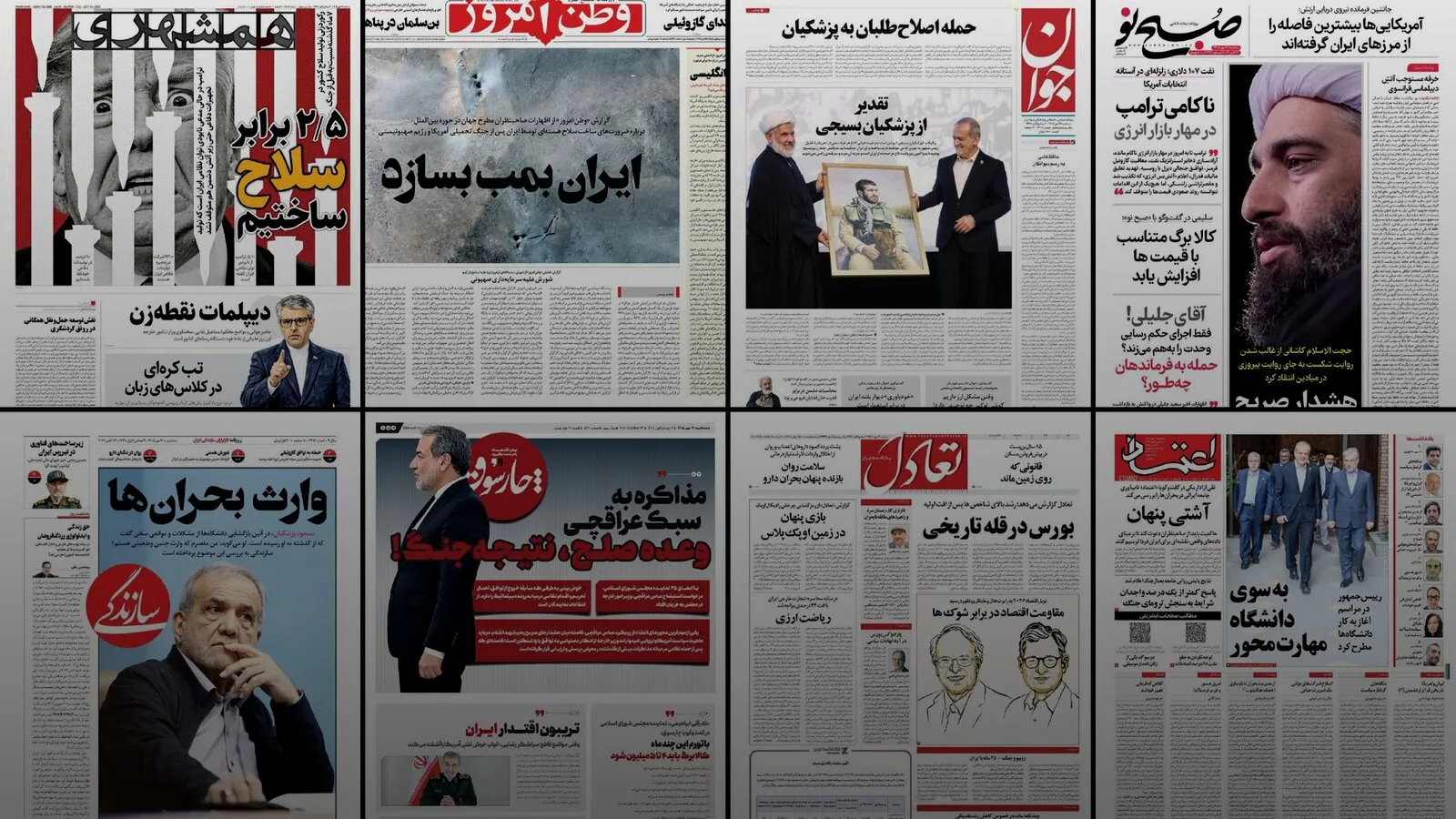
Bottom line: A hardline daily with standing in Iran’s security establishment gave its entire front page to the case for Iranian nuclear weapons acquisition on the same morning that the Leader’s own flagship demanded the removal of the negotiating camp and a principlist title put a 35-signature impeachment motion against the foreign minister across its cover, which indicates that the argument inside Tehran has moved from whether to negotiate to what replaces negotiation.
Executive Summary
The lead judgment of this edition is that Iranian nuclear weaponization appeared as front-page advocacy for the first time in this monitor’s run. Vatan-e Emrooz, a hardline morning daily whose covers track the security estate’s preferred framing, gave roughly two thirds of its sheet to «ایران بمب بسازد», let Iran build the bomb, set over a satellite image of cratered desert terrain. The standfirst names the argument’s warrant precisely: «گزارش «وطن امروز» از اظهارات صاحبنظران مطرح جهان در حوزه بینالملل درباره ضرورتهای ساخت سلاح هستهای توسط ایران پس از جنگ تحمیلی آمریکا و رژیم صهیونیستی», a report on the statements of prominent world experts concerning the necessities of Iran building a nuclear weapon after the war imposed by America and the Zionist regime. The device is as significant as the content. The piece runs under the paper’s «کیوسک» rubric, which presents foreign commentary, and not one of the experts whose statements are said to compel the conclusion is named on the cover or in the channel version at item 28359. That is advocacy constructed so as to be deniable as reporting, and the anonymity of the authorities cited is what makes the construction visible.
The weaponization cover did not appear alone, and the pattern around it is the edition’s real finding. On the same morning, Kayhan, the Leader’s flagship daily, led with «آقای پزشکیان! مراقب «زاویهدارها» باشید», Mr Pezeshkian! Beware of those who hold an angle, asking the president directly to remove from decision-making the figures it says are pushing officials toward capitulation, and arguing that the United States uses diplomacy to disguise a planned attack so that negotiation should be rejected in favour of full military readiness. Charsou, in parallel, gave its whole upper page to «مذاکره به سبک عراقچی؛ وعده صلح، نتیجه جنگ!», negotiation Araghchi-style: the promise of peace, the result of war, reporting that an impeachment request against the foreign minister has been set in motion with 35 parliamentary signatures. Three hardline titles, three distinct instruments, one target, one cycle. The previous edition recorded the delegitimisation of the negotiator class as a leading indicator running ahead of the negotiation; one cycle later it has produced a parliamentary mechanism, a removal demand from the Leader’s own paper, and a published strategic alternative.
What the negotiating track itself produced in the same cycle makes the timing legible. The government daily’s channel carries deputy foreign minister Kazem Gharibabadi at item 509664 saying Iran is ready both for diplomacy and for defending the country, and that Iran’s answer to the American comments on a proposed seven-day ceasefire «همچنان در دست بررسی است», remains under review, to be conveyed through mediators once settled. In the same feed at item 509675, Mohsen Rezaei, secretary of the Supreme National Security Council, calls the American response to Iran’s conditions insufficient, and a denial is carried of claims that the Strait of Hormuz has returned to normal. The externally verifiable record adds that Rezaei said on 12 October that Washington had agreed to some of Iran’s seven conditions and that Iran is no longer in the process of responding. The standing Hormuz-as-coercion thread this monitor has carried since the summer is therefore intact and stalled: the chokepoint remains the instrument, the seven conditions remain the price, and the attack on the negotiators is arriving precisely as the negotiation fails to deliver.
The Saudi theatre, which this monitor recorded one cycle ago as a multi-airport campaign measurable in third-country advisories, has crossed into a different category. The externally verifiable facts are now about Saudi Arabia’s functioning rather than about Yemeni claims: King Khalid International Airport in Riyadh remained closed on 12 October with its suspension extended and no reopening date, fourteen people were killed across the weekend strikes, Etihad has cancelled Abu Dhabi to Riyadh flights to 19 October and Gulf Air all Riyadh flights to 17 October, and Delta has delayed the launch of direct American flights to the kingdom. Against this the Iranian press supplies register: Vatan-e Emrooz banners «بنسلمان در پناهگاه», Bin Salman in the shelter, sourced to the Wall Street Journal, and Jam-e Jam carries a senior Ansarallah figure calling on Saudis to act against their crown prince. And against that, on the same morning, Jomhouri Eslami leads with «آمادگی ایران برای میانجیگری بین یمن و عربستان», Iran’s readiness to mediate between Yemen and Saudi Arabia. The gap this monitor opened as KJ-8 one cycle ago is now readable off two front pages of a single morning.
Two domestic measurements on two reformist and economic covers are the quietest and most durable items in the edition. Etemad prints «پاسخ کمتر از یک درصد واجدان شرایط به سنجش ترومای جنگ», fewer than one percent of eligible respondents answered the post-war trauma assessment, under the line that the monitoring results have now been announced. Ta’adol’s top banner names mental health as «بازنده پنهان بحران دارو», the hidden loser of the drug crisis, with neurological and psychiatric medicines in short supply, while its lead reports the bourse at a historic peak after an initial war collapse. A nominal equity record in a high-inflation war economy is a flight-to-assets signal rather than a growth signal, and the IMF projection carried on two channels the same morning puts Iranian output at minus 7.6 percent for 2026 against 3.6 percent for 2027. Hamshahri, meanwhile, closes part of the gap this monitor flagged as KJ-14 by printing the capital’s utility reductions as a civic scorecard under «تهرانیها علیه جنگ اقتصادی», Tehranis against the economic war: shortage reframed as contribution.
Lebanon returned to the retrievable record after ten consecutive cycles of absence, and it returned on the wires rather than on a cover. Jam-e Jam at item 30876 and Etemad at item 538888 both carry Israeli operations continuing in southern Lebanon with a claim that 48 villages have been completely destroyed, and Jam-e Jam at item 30863 reports the European Union establishing a security mission for Lebanon as UNIFIL’s mandate nears its end. The external record confirms the institutional half precisely and not the destruction claim: the EU Foreign Affairs Council established the EU Support Mission in Lebanon on 12 October with a three-year mandate covering border and maritime security, counter-drone work and training, explicitly not deploying in the south, against UNIFIL’s cessation of operations on 31 December 2026. The 48-village figure is uncorroborated and is carried here as a claim.
Net assessment: this is the edition in which the hardline estate stopped arguing about the diplomacy and started arguing about what comes after it. The three instruments ran in parallel on one morning and the alternative was printed on the largest surface available. Against that stand four counterweights that this monitor records with equal weight, because an edition read only through its loudest cover would be read wrongly: a Chinese scholar telling Iran Daily’s foreign readers that Beijing will proceed cautiously, that Iran has fallen behind the Arab states in Chinese investment and that an open Strait of Hormuz serves Iran’s own interest; an establishment conservative daily offering Iranian mediation in the Saudi war its hardline neighbours are celebrating; the state’s English title choosing a dead child’s handwriting over a weapons claim as its principal image; and a reformist daily reporting that fewer than one in a hundred Iranians would answer a survey about the war. The system is not speaking with one voice. It is speaking with a very loud one and several quieter ones, and this edition is the first in the run in which the loud one has named a nuclear weapon as the destination.
Key Judgments
- KJ-1 [HIGH] KJ-1. Iranian nuclear weaponization appeared as front-page advocacy for the first time in this monitor’s run, on a hardline daily, laundered through foreign authorities the paper declines to name. The evidence is one cover and its channel twin. Vatan-e Emrooz, issue 4733, gave roughly two thirds of its sheet to «ایران بمب بسازد» over a satellite image of cratered terrain, standfirsted «گزارش «وطن امروز» از اظهارات صاحبنظران مطرح جهان در حوزه بینالملل درباره ضرورتهای ساخت سلاح هستهای توسط ایران پس از جنگ تحمیلی آمریکا و رژیم صهیونیستی». The channel carries it at item 28359 under the «کیوسک» rubric with the full text at vatanemrooz.ir/fa/news/421203. Neither surface names a single one of the experts said to compel the conclusion. The significance is the construction rather than the opinion: the rubric and the anonymous attribution let a title with standing in the security estate advocate acquisition while retaining the defence that it is reporting foreign commentary, and that is a deliberately built deniability, not an editorial accident. The calibration runs both ways and this monitor states it: treating one cover as a policy signal would overstate what a single title proves, while treating it as ordinary hardline noise would miss that no cover in this run has previously named the weapon as the destination. The tracking cue is specific: whether a second title carries the same framing within the next three cycles.
- KJ-2 [HIGH] KJ-2. The campaign against Iran’s negotiating camp produced a political, a parliamentary and a strategic instrument on one morning, which indicates centrally guided message discipline rather than organic convergence. The evidence is three covers. Kayhan’s unsigned lead at item 86656, labelled «گزارش خبری تحلیلی کیهان» and carrying no author name and no «یادداشت روز» rubric, is addressed to the president by name under «آقای پزشکیان! مراقب «زاویهدارها» باشید» and asks him to remove from decision-making the figures it says are pushing officials toward capitulation, rejecting negotiation in favour of full military readiness. Charsou gives its upper page to «مذاکره به سبک عراقچی؛ وعده صلح، نتیجه جنگ!» and reports an impeachment request against the foreign minister in motion with «امضای ۳۵ نماینده مجلس شورای اسلامی». Vatan-e Emrooz supplies the alternative. The previous edition filed the delegitimisation of the negotiator class as a leading indicator running ahead of the negotiation; one cycle later the indicator has produced instruments. The significance is that three titles with different owners and different readerships selected three non-overlapping mechanisms against one target in one print cycle, which is a harder pattern to produce by coincidence than three identical headlines would be.
- KJ-3 [HIGH] KJ-3. The impeachment of the foreign minister is a live parliamentary instrument, and the figure Charsou prints for it is not corroborated. The evidence runs in both directions and both are reported. The cover states «با امضای ۳۵ نماینده مجلس شورای اسلامی، درخواست استیضاح عباس عراقچی، وزیر امور خارجه در مجلس به جریان افتاد». The external record confirms that a motion was registered on 6 October 2026 by the Tehran deputy Amir-Hossein Sabeti over Araghchi’s 22 September meeting with the American envoy Steve Witkoff at the UN General Assembly, that the stated ground is that the meeting took place without the permission of Ayatollah Mojtaba Khamenei and without coordination with the Supreme National Security Council, that Mohsen Rezaei has said the talks had prior approval, and that registration is not submission to the presiding board. The 35-signature figure appears on this cover and nowhere in the retrievable record. The significance is that the procedural facts and the printed figure point in the same direction while resting on different evidence, and this monitor separates them: the motion is confirmed, the count is a claim. The tracking cue is whether the motion reaches the presiding board, which is the step that converts it from a pressure instrument into a vote.
- KJ-4 [HIGH] KJ-4. The Hormuz-as-coercion thread carried across this monitor’s editions since the summer is intact and has stalled, with both halves printed in one cycle. The evidence is three items on one channel plus the external record. The government daily’s feed carries deputy foreign minister Kazem Gharibabadi at item 509664 saying Iran is ready for diplomacy and for defence alike and that Iran’s answer on a proposed seven-day ceasefire «همچنان در دست بررسی است», to be conveyed through mediators; Mohsen Rezaei at item 509675 calling the American response to Iran’s conditions insufficient; and in the same item a denial that the strait has returned to normal. Externally, Rezaei said on 12 October that Washington had agreed to some of Iran’s seven conditions, that the response remained inadequate and that Iran is no longer in the process of responding, with mediation running through Qatar and contacts also through Pakistan and Iraq, and enrichment the central obstacle. The significance is sequencing: the attack on the negotiators documented in KJ-2 is arriving in the same cycle in which the negotiation visibly fails to deliver, which is the ordering that preceded the collapse of earlier Iranian diplomatic openings.
- KJ-5 [HIGH] KJ-5. The Saudi theatre has crossed from Iranian claim into externally measurable disruption of the Saudi state’s own functioning. The evidence is almost entirely non-Iranian, which is what distinguishes this judgment from the equivalent one a cycle ago. King Khalid International Airport in Riyadh remained closed on 12 October with its suspension extended and no reopening date announced; fourteen people were killed across the weekend strikes; Etihad cancelled Abu Dhabi to Riyadh flights to 19 October; Gulf Air cancelled all Riyadh flights to 17 October; Delta delayed the launch of direct American service to the kingdom. The Iranian surfaces supply register on top of verified disruption rather than in place of it: Vatan-e Emrooz’s «بنسلمان در پناهگاه» banner sourced to the Wall Street Journal, Jam-e Jam at item 30866 carrying an Ansarallah call for Saudis to act against their crown prince, Defa Press at item 69728 carrying an analyst’s claim that the United States refused to get involved and Israel set conditions. The significance is that the campaign’s effect is now observable without reference to any Iranian or Yemeni claim, which makes it the most solidly evidenced external development in this edition.
- KJ-6 [MODERATE-HIGH] KJ-6. Iran’s declared posture toward Riyadh now contains an explicit mediation offer on a front page, and the gap between that offer and the hardline register has stopped being an inference. The evidence is two covers of one morning. Jomhouri Eslami, a veteran establishment conservative daily, leads with «آمادگی ایران برای میانجیگری بین یمن و عربستان». Vatan-e Emrooz, two places along in the same kiosk album, banners the Saudi crown prince taking shelter under successive Yemeni strikes. One cycle ago this monitor recorded the same divergence as KJ-8 and could not distinguish a deliberate division of labour from a genuine split; the printed offer narrows the question without closing it. The significance is the venue: a title with revolutionary-era standing and no governmental responsibility is the surface on which Tehran floats a de-escalation it is not ready to own in its own name, which is consistent with a division of labour and inconsistent with a simple factional split. The judgment is held at moderate-high because the offer carries no named interlocutor, no channel and no date on the cover.
- KJ-7 [MODERATE-HIGH] KJ-7. Iran is making force-posture and production claims in one cycle that its own diplomatic track contradicts, and the two are being narrated by different authorities to different ends. The evidence is two covers against one wire. Sobh-e No’s banner carries «جانشین فرمانده نیروی دریایی ارتش: آمریکاییها بیشترین فاصله را از مرزهای ایران گرفتهاند», with the channel at item 116695 giving Rear Admiral Bamani saying «ضربات مهلکی به نیروی دریایی آمریکا زدیم» and that the enemy now stands farther off than during what the item calls the Third Imposed War. Hamshahri’s cover carries «۲/۵ برابر سلاح ساختیم» with «۹۳۰۰ شرکت» and «۹۰ درصد» self-sufficiency. The 2.5 figure traces to defence ministry spokesman Reza Talaei-Nik on 6 October 2026 and is a government claim; the other two appear nowhere in the external record of that briefing and are the paper’s own. Against all of it, the same morning’s security council secretary says the Americans have not met Iran’s conditions and the strait has not returned to normal. The significance is that a declared military success and a declared diplomatic failure are being published on the same file within one cycle, and the judgment is held below high because none of the military claims is externally checkable.
- KJ-8 [MODERATE-HIGH] KJ-8. The state’s English-language output is running a materially different, more cautious and more effective argument than the Persian press of the same morning. The evidence is one page. Iran Daily’s lead is ‘Pezeshkian: Enemies have failed to force Iran to surrender’, which is a claim of endurance and not of victory. Its principal image is a surviving Minab pupil’s handwritten letter beside a photograph of a schoolgirl, under Araghchi’s pledge of an international accountability push, a seven-month-old civilian casualty event carried through a child’s handwriting rather than a casualty figure. Its lower half carries Professor Hongda Fan of Shanghai University saying China’s role would be supportive rather than dominant, that Beijing will proceed cautiously because ties depend on Iran’s own development path, that Iran has lagged behind Saudi Arabia and Egypt in Chinese trade and investment since 2016, and that China’s position holds Iran should not seek nuclear weapons while the Strait of Hormuz stays open, which serves Iran’s interest. The significance is the contrast with KJ-1 on the same morning: a Chinese academic is permitted to tell Iran Daily’s foreign readers precisely what a hardline daily is telling Iranian readers to reject, and neither audience sees the other’s page.
- KJ-9 [MODERATE-HIGH] KJ-9. Negative evidence, filed as a finding: the Iranian state cannot currently measure its own population’s war experience, and a reformist daily printed the failure as news. The evidence is one cover line: Etemad’s «نتایج پایش روانی جامعه بعد از جنگ اعلام شد» over «پاسخ کمتر از یک درصد واجدان شرایط به سنجش ترومای جنگ», fewer than one percent of eligible respondents answered the war-trauma assessment. No sponsoring body, sample frame or fieldwork date appears on the cover. The significance is that a sub-one-percent response to a national instrument is a finding about the state’s reach rather than about the population’s mental health, and that a reformist title chose to run a null result as a lead item, beside an interview arguing that the system must build policy on «دادههای واقعی», real data. The judgment is held at moderate-high rather than high because the cover does not permit a distinction between exhaustion, distrust of the instrument, the connectivity restrictions this same paper has been counting in days, and ordinary survey non-response. It should be read as a measurement failure of undetermined cause, which is itself the more useful finding.
- KJ-10 [MODERATE] KJ-10. Negative evidence, filed as a finding: the sitting Leader is absent from this edition, and his absence has a shape because his authorization is the contested fact in its biggest domestic story. The evidence is a complete absence plus three indirect presences. No message, speech, portrait or words presented as Mojtaba Khamenei’s appear on any of the ten front pages, six newspaper channels or three agency wires, and the official sites were not reachable. Against that: the impeachment motion’s stated ground is that the foreign minister met the American envoy without the Leader’s permission, so his authorization is the day’s central contested fact and he has not spoken to it; Charsou anchors its indictment not to him but to «رهبر شهید انقلاب», the martyred Leader, meaning his assassinated predecessor; and Kayhan’s channel at item 86641 carries a video from that predecessor’s tomb. The most recent retrievable message from the sitting Leader is dated 8 October 2026 and is single-sourced. The significance is that a paper reaching for the dead Leader’s general warnings rather than the living Leader’s specific instruction is reaching for the authority it can get. This monitor records the pattern as a tracking item and declines to interpret the reason, because no surface in this edition offers evidence about it.
- KJ-11 [MODERATE] KJ-11. Lebanon re-entered the retrievable record after ten consecutive absent cycles, and it re-entered through European institutional news rather than through an Iranian front page. The evidence is three channel items and the external record. Jam-e Jam at item 30876 and Etemad at item 538888 both carry Israeli operations continuing in southern Lebanon with a claim that 48 villages have been completely destroyed; Jam-e Jam at item 30863 reports the European Union establishing a security mission for Lebanon as UNIFIL’s mandate nears its end. Externally confirmed: the EU Foreign Affairs Council established the EU Support Mission in Lebanon on 12 October 2026 with an initial three-year mandate covering border and maritime security, counter-drone work and training of Lebanese forces, not yet deployed, and explicitly not deploying in the south, against UNIFIL ceasing operations on 31 December 2026. The 48-village figure is uncorroborated; the nearest external figure, roughly 65 towns and villages under Israeli occupation in the south, measures something different. The significance is that the file has changed shape rather than reopened: Lebanon returns to Iranian attention as a European institutional problem, not as an Iranian front.
- KJ-12 [MODERATE] KJ-12. Two principlist front pages spent their leads on friction inside the system rather than on the external file, and a reformist title framed the president as an inheritor rather than an author. The evidence is three covers. Javan, the Guard-affiliated daily, led with «حمله اصلاحطلبان به پزشکیان» over a photograph of the president at a medical awards ceremony, with no external file on the cover at all, on a morning when the Guard’s own commander-in-chief’s Hormuz message was circulating on the defence wires. Sobh-e No ran «آقای جلیلی! فقط اجرای حکم رسایی وحدت را بەهم میزند؟ حمله به فرماندهان چهطور؟», a public principlist quarrel about whether attacking commanders is itself a breach of unity. Sazandegi led with «وارث بحرانها», heir to the crises, quoting Pezeshkian as saying «من مقصر نیستم؛ من وارث چنین وضعیتی هستم». The significance is that the same president was fought over from both directions on one morning, and that the hardline estate is now willing to show its internal friction on front pages. The judgment is held at moderate because a single cycle cannot distinguish a durable realignment from a slow news day on the external file.
- KJ-13 [MODERATE] KJ-13. The standing finding that the Iranian press reports the war’s domestic costs and advocates the strategy but never in one frame is partially closed, by a municipal daily rather than by a factional one. The evidence is Hamshahri’s cover. Its upper two thirds carry «۲/۵ برابر سلاح ساختیم», a wartime production claim; its foot carries «تهرانیها علیه جنگ اقتصادی», Tehranis against the economic war, over «مردم پایتخت در شرایط جنگ اقتصادی تمامعیار، با تمام توان پای کار آمدند» and a figure strip: 500 million litres cut from daily water consumption, petrol consumption down 50 percent, electricity down 10 percent in the capital, 78 percent of household gas subscribers in the low-consumption band. That is a rationing table printed as a mobilisation scorecard on the same page as the weapons claim. The significance is the register: a civic title is asking the capital’s residents to read shortage as contribution, which is a different and more sustainable ask than asking them to ignore it, and it is a mechanism no factional paper in this edition attempts. Set against it, the costs that are not reframed remain unreframed: Ta’adol names psychiatric and neurological medicines as «بازنده پنهان بحران دارو» and no cover connects that to anything.
- KJ-14 [MODERATE] KJ-14. Three hardline surfaces printed three irreconcilable oil prices in one morning without stating their benchmarks, which bears on how the chokepoint’s effect is being represented to Iranian readers. The evidence is three numbers. Sobh-e No’s cover kicker reads «نفت ۱۰۷ دلاری؛ زلزلهای در آستانه انتخابات آمریکا» under «ناکامی ترامپ در مهار بازار انرژی». Vatan-e Emrooz at item 28346 gives dated Brent at 131 dollars with some grades above 150. Kayhan at item 86642 gives a physical Brent of 154 with the paper-to-physical gap approaching 50 after reduced ship traffic. None of the three states its benchmark, which explains part but not all of a 47-dollar spread. The significance is not that one title is wrong: it is that the single most consequential number in the Iranian war economy is being reported across the hardline press without a shared reference, which makes the chokepoint’s claimed effect unauditable by an Iranian reader comparing two papers. This monitor records the discrepancy and does not adjudicate it. The corroborated directional signal, separate from the prices, is Bloomberg’s report carried at item 28350 that ten supertankers bound for Fujairah have stopped or changed course.
- KJ-15 [MODERATE] KJ-15. The British file re-entered the Iranian press through RAF Fairford, and the Iranian account of it is accurate on the facts it chooses to report. The evidence is one rail and the external record. Vatan-e Emrooz’s «بازی انگلیسی», signed Amir Abbas Nouri and sub-headed «آیا اروپا در هزینههای جنگ آمریکا علیه ایران شریک میشود؟», states that the British prime minister claimed the Fairford incident was ordered by Iran, that Britain has produced no document or evidence, and that all the accused have been released; it adds that 29 foreign ministers issued a coordinated endorsement and quotes NATO Secretary-General Mark Rutte welcoming it. Externally confirmed: Andy Burnham said on 12 October that the suspected plot at the American-used base was almost certainly directed by the IRGC, seven men were arrested, all have been released on bail and none charged, police found gasoline but no explosives, the United States withdrew its bombers from Fairford the previous week, Israel said it supplied the intelligence, Britain summoned the Iranian ambassador and Iran denied involvement. The 29-minister statement and the Rutte quotation could not be confirmed and are carried as the paper’s claims. The significance is methodological: the arrest-and-release sequence is the strongest factual material available to the Iranian press on this file and the paper uses it accurately, which is a harder posture to rebut than assertion would be.
Macro Trends
- Nuclear weaponization appeared as front-page advocacy, laundered through unnamed foreign authorities. Vatan-e Emrooz gave roughly two thirds of its cover to «ایران بمب بسازد», let Iran build the bomb, standfirsted as a report on «اظهارات صاحبنظران مطرح جهان» concerning the necessities of Iranian weapons construction after the imposed war. The channel version at item 28359 carries it under the «کیوسک» rubric with the full text at vatanemrooz.ir/fa/news/421203. Not one of the experts is named on either surface. The mechanism is the finding: the rubric and the attribution let a hardline daily put weaponization on a national front page while retaining the claim that it is only reporting what others say.
- Three hardline titles ran three distinct instruments against the negotiating camp in one cycle. Kayhan’s unsigned lead at item 86656 demands that the president remove «زاویهدارها» from decision-making and rejects negotiation in favour of full military readiness. Charsou’s cover reports an impeachment request against Abbas Araghchi in motion with 35 signatures, anchoring the indictment to «هشدارهای صریح رهبر شهید انقلاب», the explicit warnings of the martyred Leader. Vatan-e Emrooz supplies the alternative to the diplomacy the other two are dismantling. The previous edition filed the delegitimisation of the negotiator class as a leading indicator; it has now produced a political, a parliamentary and a strategic instrument on one morning, which indicates centrally guided message discipline rather than organic editorial convergence.
- The standing Hormuz-as-coercion thread is intact and stalled, and both halves were printed on the same morning. The government daily’s channel carries Gharibabadi at item 509664 saying Iran’s answer on a proposed seven-day ceasefire «همچنان در دست بررسی است», remains under review, and Rezaei at item 509675 calling the American response insufficient, alongside a denial that the Strait of Hormuz has returned to normal. The external record adds Rezaei’s 12 October statement that Washington has agreed to some of the seven conditions and that Iran is no longer responding. The IRGC commander-in-chief Ahmad Vahidi’s Navy Day message, carried on Defa Press at item 69712 and corroborated externally, states that no trans-regional power has the right to threaten, dominate or interfere in the strait.
- The Saudi file became measurable in Saudi Arabia’s own functioning rather than in Iranian claims. Externally verified: King Khalid International Airport in Riyadh remained closed on 12 October with its suspension extended and no reopening date, fourteen people were killed across the weekend strikes, Etihad cancelled Abu Dhabi to Riyadh flights to 19 October, Gulf Air cancelled all Riyadh flights to 17 October, and Delta delayed its direct American service. The Iranian surfaces supply register on top of this: Vatan-e Emrooz banners «بنسلمان در پناهگاه» sourced to the Wall Street Journal, Jam-e Jam at item 30866 carries an Ansarallah figure calling on Saudis to move against their crown prince, and Nour News at item 401516 reports a British decision to send air defence and a Voyager tanker to the kingdom, which could not be confirmed externally.
- Iran’s mediation offer and its press register ran in opposite directions on one morning. Jomhouri Eslami leads with «آمادگی ایران برای میانجیگری بین یمن و عربستان», Iran’s readiness to mediate between Yemen and Saudi Arabia, on the same morning that a hardline neighbour celebrates the Saudi crown prince taking shelter and the wires carry a call for Saudis to rise against him. That the offer surfaces on a veteran establishment daily rather than on the government’s own cover is itself the signal: this is the title that can float a de-escalation Tehran is not ready to own.
- Iranian defence output claims moved to a mass-circulation civic cover, with the costs printed beside them. Hamshahri gave its page to «۲/۵ برابر سلاح ساختیم», we built 2.5 times the weapons, over Trump’s face in a US flag, with «۹۳۰۰ شرکت در زنجیره تولیدات دفاعی ایران هستند» and «۹۰ درصد در تولیدات دفاعی خودکفا شدهایم». The 2.5 figure traces to the defence ministry spokesman Reza Talaei-Nik on 6 October 2026 and is an Iranian government claim; the other two are the paper’s own and appear nowhere in the external record of that briefing. The same cover carries «تهرانیها علیه جنگ اقتصادی», with 500 million litres cut from daily water use, petrol consumption halved, electricity down 10 percent in the capital and 78 percent of household gas subscribers in the low-consumption band.
- A state English-language title is running a civilian-casualty accountability campaign built on a child’s handwriting. Iran Daily gives half its page to a surviving Minab pupil’s handwritten letter beside a photograph of a schoolgirl, under ‘Araghchi vows international push over deadly Minab school strike’ and ‘Do not let my friends be forgotten’. The strike itself occurred on 28 February 2026 at the Shajareh Tayyebeh school in Hormozgan, with roughly 156 to 170 dead, most of them girls between seven and twelve; attribution is contested, Iran blames the United States and Israel, both deny responsibility, and the Pentagon’s findings are unreleased. What is new is the letter and the pledge. This is the most effective information posture available to Tehran abroad and it is being run in English only.
- The most cautious reading of Iranian strategy in the edition is printed in English by a Chinese academic. Iran Daily’s exclusive interview with Professor Hongda Fan, director of the China-Middle East Center at Shanghai University, has him saying that China’s role would be supportive rather than dominant, that Beijing will proceed cautiously because bilateral ties depend considerably on Iran’s own development path, that Iran’s cooperation with China has lagged behind Saudi Arabia’s and Egypt’s in trade and investment since 2016, and that China’s position holds that Iran should not seek nuclear weapons while the Strait of Hormuz stays open, which the interview states serves Iran’s own interest. None of this appears in the Persian press of the same morning.
- Two reformist and economic covers measured the domestic cost in numbers the state supplied. Etemad prints «پاسخ کمتر از یک درصد واجدان شرایط به سنجش ترومای جنگ», fewer than one percent of eligible respondents answered the war-trauma assessment, under the announcement of the post-war psychological monitoring results. Ta’adol’s top banner names mental health as «بازنده پنهان بحران دارو» with psychiatric and neurological medicines short, while its lead reports «بورس در قله تاریخی», the bourse at a historic peak after an initial war fall. The IMF projection on two channels puts 2026 output at minus 7.6 percent against 3.6 percent for 2027.
- Lebanon returned after ten absent cycles, on the wires and not on a cover. Jam-e Jam at item 30876 and Etemad at item 538888 carry Israeli operations continuing in southern Lebanon with an uncorroborated claim that 48 villages have been completely destroyed, and Jam-e Jam at item 30863 reports an EU security mission for Lebanon as UNIFIL’s mandate ends. The external record confirms the institutional half: the EU Foreign Affairs Council established the EU Support Mission in Lebanon on 12 October with a three-year mandate for border and maritime security, counter-drone work and training, explicitly not deploying in the south, against UNIFIL’s cessation of operations on 31 December 2026.
- A second principlist front page spent its lead on internal factional friction. Javan, the Guard-affiliated daily, led with «حمله اصلاحطلبان به پزشکیان», the reformists’ attack on Pezeshkian, over a photograph of the president at a medical awards ceremony, with no external file on the cover. Sobh-e No carried «آقای جلیلی! فقط اجرای حکم رسایی وحدت را بەهم میزند؟ حمله به فرماندهان چهطور؟», a public quarrel over whether attacking commanders breaches unity. Sazandegi meanwhile framed the president as «وارث بحرانها», heir to the crises, quoting him as saying «من مقصر نیستم», I am not to blame. Two estates fought over the same president on one morning.
- The British file re-entered the Iranian press through RAF Fairford. Vatan-e Emrooz’s right rail, signed Amir Abbas Nouri, runs «بازی انگلیسی», the English game, over «آیا اروپا در هزینههای جنگ آمریکا علیه ایران شریک میشود؟». The text notes that the British prime minister claimed the Fairford incident was ordered by Iran, that no evidence has been produced and that all the accused have been released, and quotes NATO Secretary-General Mark Rutte welcoming an allied statement on Iranian involvement. The external record confirms the core: Andy Burnham said on 12 October that the suspected plot at the American-used base was almost certainly directed by the IRGC, seven men were arrested and all have been released on bail with no charges brought.
Front-Page Snapshot
- Vatan-e Emrooz - “Let Iran build the bomb” (Hardline principlist) - Nuclear weaponization advocacy [SEVERE]
- Kayhan (channel) - “Mr Pezeshkian! Beware of the ‘angle-players’” (The Leader’s flagship daily) - Purge of the negotiating camp [HIGH]
- Charsou - “Negotiation Araghchi-style: the promise of peace, the result of war!” (Principlist) - Impeachment of the foreign minister [HIGH]
- Hamshahri - “We built 2.5 times the weapons” (Tehran municipality, centrist) - Defence production and economic mobilisation [MODERATE-HIGH]
- Sobh-e No - “Trump’s failure to contain the energy market” (Principlist) - Energy market and naval posture [MODERATE-HIGH]
- Iran Daily - “Pezeshkian: Enemies have failed to force Iran to surrender” (State English-language daily) - Civilian-casualty accountability and the China file [MODERATE]
- Jomhouri Eslami - “Iran’s readiness to mediate between Yemen and Saudi Arabia” (Establishment conservative) - Mediation offer on Yemen [LOW-MODERATE]
- Javan - “The reformists’ attack on Pezeshkian” (Hardline, IRGC-affiliated) - Factional contest over the presidency [LOW-MODERATE]
- Sazandegi - “Heir to the crises” (Reformist, Kargozaran) - Presidential accountability and the diesel file [LOW]
- Etemad - “Hidden reconciliation” (Reformist) - Post-war social measurement and its failure [LOW]
- Ta’adol - “The bourse at a historic peak” (Economic) - War economy and the drug shortage [LOW]
Full report
The complete edition - per-paper front-page analysis and full translation appendices - is available as a PDF: Download the full report.
Compiled from Iranian front pages and outlet channels via open-source monitoring. Translations are editorial; named-figure attributions are verified against the source pages where possible.