Iranian Press Monitor - Monday, 14 September 2026 (Day 195)
Monday, 14 September 2026 · 23 Shahrivar 1405 · 1 Rabi al-Thani 1448 - Ten front pages (nine Persian from the Monday 23 Shahrivar Tasnim kiosk album and Iran Daily from the English kiosk), plus the Kayhan, Vatan-e Emrooz, Jam-e Jam, Etemad, Iran and Sobh-e No channels and the Defa Press, Fars and Nour News wires; Tehran Times and the leadership websites were unavailable at the time of compilation
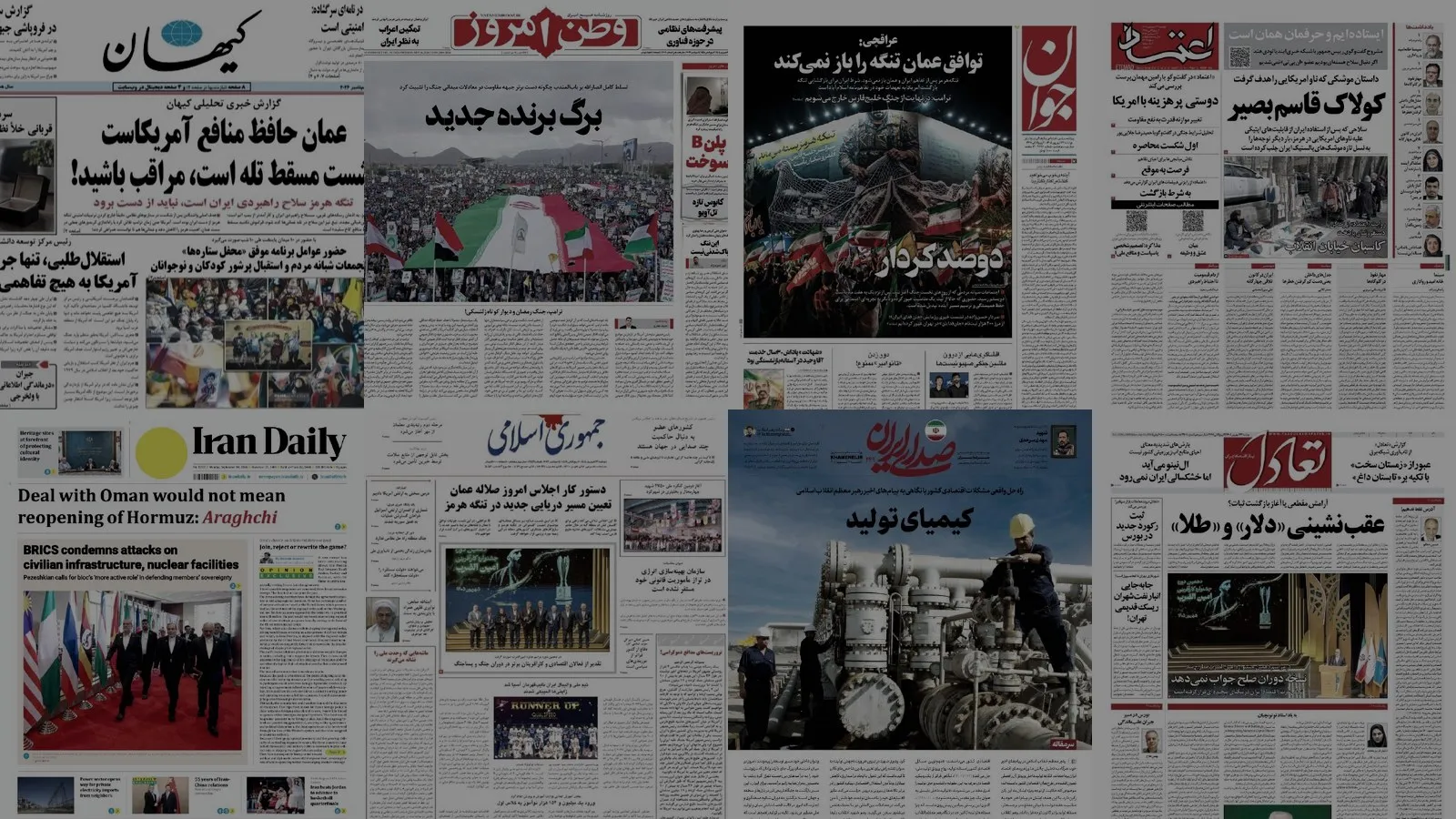
Bottom line: On the morning Iran signed a Hormuz maritime-route arrangement in Oman, the two hardline flagships printed opposite readings of the same event, with Kayhan demanding it be halted in the Leader’s name while the leadership’s own bulletin said nothing about it, which indicates that the settlement track has passed the point where the hardline surface can be held together against it.
Executive Summary
The lead judgment of this cycle is that the hardline press fractured, in public and on the record, over the Hormuz settlement it had until now opposed in unison. Kayhan, published under the Supreme Leader’s office, gives its entire lead to «عمان حافظ منافع آمریکاست / نشست مسقط تله است، مراقب باشید!», Oman is the guardian of America’s interests, the Muscat meeting is a trap, be careful, labelled a Kayhan news-analysis report rather than news. Vatan-e Emrooz, the other hardline flagship, carries the identical event in its masthead kicker as «ایران و عمان ترتیبات دریایی هرمز را نهایی کردند / تمکین اعراب به نظر ایران», Iran and Oman have finalised the Hormuz maritime arrangements, the Arabs submit to Iran’s view. One paper calls the meeting an American trap to be stopped; the other banks it as an Arab capitulation to Iran. Two hardline flagships do not read the same morning this differently by accident, and the divergence is the most consequential single fact in this edition.
The government’s own limiting formula, meanwhile, is now carried without contest by the outlets closest to the security establishment. Javan, the IRGC-affiliated daily, gives its banner to «عراقچی: توافق عمان تنگه را باز نمیکند», Araghchi: the Oman agreement does not open the strait, decked with the condition that reopening requires the American return to its commitments under the Islamabad memorandum. Iran Daily carries the identical sentence in English as «Deal with Oman would not mean reopening of Hormuz: Araghchi». Jomhouri Eslami supplies the procedure without adjectives: «دستور کار اجلاس امروز صلاله عمان / تعیین مسیر دریایی جدید در تنگه هرمز», the agenda of today’s Salalah summit in Oman is the designation of a new maritime route in the Strait of Hormuz, with the maps to be shared with the participating states. That is three institutionally distinct surfaces, military, clerical and governmental, printing the same bounded version of the same arrangement, against one that rejects it.
Kayhan’s rejection is not a shipping-lane argument and should not be read as one. Hossein Shariatmadari’s Yadasht-e Rooz, translated in full at Appendix B, quotes the president’s India Today interview and the foreign minister’s Al-Araby Al-Jadeed interview back at them, asks why a meeting was necessary at all if the arrangement is not a reopening, and then sets out an Iranian condition list that no office has stated: American departure from the region, reparations, a halt to Israeli attacks on Lebanon and Palestine, the nuclear file excluded from negotiations, and «انتقام و خونخواهی آقای شهید», revenge and blood-vengeance for the martyred gentleman. It calls the attending Gulf states «کشورکها», statelets, and «دولتهای دستنشانده و مزدور», client and mercenary governments, and tells the government it has committed a great error. The editorial is marked part one. This is the succession’s legitimacy debt being attached to the maritime file by the paper that claims to speak for the office, on the morning the file closes.
The absence that frames that demand is the one on Seda-ye Iran. The leadership-messaging bulletin, which prints the khamenei.ir affiliation on its own masthead, gave its whole front page to «کیمیای تولید», the alchemy of production, an economic message, and carried no Hormuz condition, no reference to the Salalah meeting and no vengeance framing anywhere. What it does carry on the chokepoints comes entirely in borrowed voices: a Washington Post reading headed «باتلاق ترامپ عمیقتر میشود», Trump’s quagmire deepens, and a captioned satellite before-and-after of the Saudi east-west pipeline pumping station dated 11 September under «اختلال در ۴ درصد عرضه جهانی نفت», disruption of four percent of global oil supply. The leadership surface documents the coercion without owning it, and it did not adopt Kayhan’s condition list. That asymmetry is evidence about Kayhan’s standing, not about the leadership’s position.
Underneath the diplomacy, the war continued and the wires carried a register of claims this monitor labels rather than adopts. Defa Press reports a fully loaded tanker struck by a missile and severely on fire in the Strait of Hormuz, citing UK Maritime Trade Operations, an account closely resembling the incident recorded on 13 September and possibly the same event recirculating. Nour News reports Israeli air strikes around al-Mansouri in southern Lebanon; Fars reports more than 1,100 tonnes of explosives used to destroy tunnels in the Ali al-Taher heights and denies that Iranian personnel were trapped there, while Defa Press reports a limited Israeli repositioning from the same heights. Fars carries Saudi civil-defence alerts for Khamis Mushait, Najran, Jizan and Abha; Etemad’s channel carries Saudi strikes on Emirati-backed forces in southern Yemen near Bab al-Mandab; Defa Press reports Yemeni forces activating drone and missile capability against Saudi-aligned positions. Kayhan and Nour News both put Brent at 108 dollars. Vatan-e Emrooz builds its whole front on the proposition that Ansarullah now holds Bab al-Mandab completely and that Saudi Arabia’s pipeline bypass, its «پلن B», has burned.
The two most analytically significant items in the edition are not about Hormuz at all. The first is Iran Daily’s signed opinion column, «Iran’s choice on trilateral defense pact / Join, reject or rewrite the game?», which openly war-games Iranian accession to what it calls the Mecca Pact between Saudi Arabia, Turkey and Pakistan, and costs that accession in explicit terms: joining «would require changes in tactics, including Iran’s support for Yemen», which «could undermine the legitimacy of the strategy of resistance». That a state daily can print the Yemen relationship as a tradeable asset is a movement in the file that no front-page headline announces. The second is Etemad’s lead, «کولاک قاسم بصیر», the Qassem Basir blizzard, a ballistic-missile profile on the reformist daily of record, printed directly beneath the president’s own words to India Today that «اگر دنبال سلاح هستهای بودیم عضو «انپیتی» نمیشدیم», if we were seeking a nuclear weapon we would not have joined the NPT. The reformist argument is not for escalation; it is that the conventional deterrent is what makes a bounded settlement survivable.
Net assessment: this is a settlement-morning edition in which the settlement is no longer the question and the reaction to it is. The arrangement was signed with the government’s limits attached and with three institutionally distinct surfaces carrying those limits identically, which is message discipline rather than convergence. Against that, one newspaper, the one with the strongest claim to speak for the office, broke ranks and raised the price of any reopening to a list that includes vengeance for an assassinated Leader, and the office’s own bulletin did not follow it. Every economic page in the set, reformist and principlist alike, has meanwhile stopped arguing about the war and started itemising its bill: Chahar Sough charts a 25.5 percent collapse in building permits and denies sanctions as the cause in its own deck, Ta’adol reports the dollar and gold retreating and refuses to call it a recovery, and Sazandegi, which a day earlier called the situation a maritime blockade, leads instead on broadcasting regulation. The direction of travel across this edition is toward a settled external position and an unsettled domestic one.
Key Points
- KJ-1 [HIGH] The hardline consensus on the Hormuz file has broken, and the break is institutional rather than editorial. Kayhan’s lead and editorial demand the Oman arrangement be halted and call the meeting an American trap; Vatan-e Emrooz’s masthead kicker reports the same arrangement as finalised and frames the attending Arab states as having submitted to Iran; Javan, IRGC-affiliated, carries the foreign minister’s limiting formula as its banner without attacking it. Three hardline titles published three incompatible readings of one event on one morning. The significance is that hardline press output can no longer be treated as a single indicator on this file, and that the security establishment’s media estate has separated from the ideological establishment’s on the question of whether a bounded settlement is acceptable.
- KJ-2 [HIGH] The government’s limiting formula has been accepted across institutionally distinct surfaces and is now the operative Iranian position. «توافق عمان تنگه را باز نمیکند», the Oman agreement does not open the strait, with reopening conditioned on the American return to the Islamabad memorandum, appears identically on Javan’s banner in Persian, on Iran Daily’s banner in English, and in substance in Jomhouri Eslami’s procedural account of the Salalah agenda. Three outlets answering to three different institutions do not converge on one sentence by independent news judgment. The significance is that the arrangement is a route designation and not a reopening, that Tehran has fixed the price of an actual reopening to a prior American performance, and that this is message discipline rather than editorial agreement.
- KJ-3 [MODERATE-HIGH] Kayhan’s condition list is a bid for influence over the settlement’s terms, not a statement of leadership policy. The editorial’s demands, American withdrawal from the region, reparations, a halt to Israeli operations in Lebanon and Palestine, exclusion of the nuclear file, and blood-vengeance for the assassinated Leader, have been stated by no office and were absent the same morning from Seda-ye Iran, the bulletin that prints the khamenei.ir affiliation on its masthead and which led instead on production economics. The evidence for the judgment is the asymmetry between the two surfaces; the evidence against it is that Kayhan’s managing editor is a leadership appointee and has in the past run ahead of positions later adopted. The significance is that the list should be weighted as a newspaper’s bid unless and until an office adopts it, and the appearance of any element of it in an official statement would be a substantive escalation indicator.
- KJ-4 [MODERATE-HIGH] Tehran is now openly calculating the cost of trading its Yemen relationship for a regional security seat. Iran Daily’s opinion column examines Iranian accession to the Mecca Pact between Saudi Arabia, Turkey and Pakistan, states that joining would require changes in tactics including Iranian support for Yemen, and concedes that this could undermine the legitimacy of the strategy of resistance. Etemad’s note stack asks whether Saudi influence in Yemen is ending. The significance is that a state daily has printed the trade-off in English rather than in an internal forum, which is how Tehran has historically introduced positions it intends to be heard abroad, and that the Bab al-Mandab position Vatan-e Emrooz calls the war’s decisive card is simultaneously being treated by the government’s own English surface as negotiable.
- KJ-5 [MODERATE] The Iranian domestic market has begun pricing in a settlement, ahead of and independently of any political confirmation. Ta’adol leads on the retreat of the dollar and gold and declines to call it a recovery, asking instead whether it is a momentary calm; Sobh-e No reports the total stock index jumping 153,000 points. Against this, Kayhan and Nour News both report Brent at 108 dollars and Seda-ye Iran documents four percent of global oil supply disrupted by the Saudi east-west pipeline outage. The divergence is the finding: the external price of the coercion strategy is rising while the domestic risk premium falls. The significance is that a domestic market moving before a political announcement is a leading indicator, and a reversal in the rial or the bullion market would be the earliest available warning that the settlement track has stalled.
- KJ-6 [MODERATE] Negative evidence: the outlet that supplied the corridor’s domestic limit has stopped defending it, and the reformist party paper has left the war file entirely. Sobh-e No, this monitor’s single source on 13 September for the parliamentary security commission’s statement that the route designation is in no sense a reopening, carried nothing on Hormuz or Oman in the retrieved window on the signature morning and led on a deflationary reading of the China-Russia-Iran alignment. Sazandegi, which on 13 September called the situation Iran’s maritime blockade and questioned what the summit delivered, led today on broadcasting regulation and reduced the Oman track to a four-word supportive line in a headline strip. Two withdrawals of this kind on one morning are filed as a finding, not as a gap: the papers that were contesting the limit have accepted it, and the argument on these surfaces has moved to domestic ground.
- KJ-7 [MODERATE] The Lebanese front is the most likely near-term source of a shock to the settlement track, and the wires are already positioning for it. Nour News reports Israeli air strikes around al-Mansouri in southern Lebanon; Fars reports more than 1,100 tonnes of explosives used to destroy tunnels in the Ali al-Taher heights and issues a pre-emptive denial that Iranian personnel were trapped there, stating instead that 48 Hezbollah fighters were in two tunnels and eight were killed; Defa Press reports a limited Israeli repositioning from the same heights. Kayhan’s condition list names a halt to Israeli attacks on Lebanon as a precondition for reopening Hormuz. The significance is that a denial issued against an allegation nobody on these pages had made indicates the wire expected the allegation, and that Kayhan has already built the linkage by which a Lebanese escalation would be converted into grounds for repudiating the maritime arrangement.
- KJ-8 [LOW-MODERATE] The tanker strike reported in the Strait of Hormuz on this cycle may be the 13 September incident recirculating rather than a new attack, and is treated here as unresolved. Defa Press reports a fully loaded tanker struck by a missile and severely on fire, citing UK Maritime Trade Operations, in terms closely matching the Panama-flagged tanker recorded in the 13 September edition from the same wire and the same source organisation. No Persian front page in today’s set carries the incident, which for an event of this significance on a signature morning is itself evidence against it being fresh. The significance is calibration: overstating a repeat as a new strike would inflate the escalation signal on the exact morning an arrangement was signed, while dismissing a genuine second strike would miss the event most capable of voiding that arrangement. Corroboration from a front page or a primary maritime advisory is the resolving indicator.
Macro Trends
- The hardline flagships broke ranks on the same event, in the same cycle. This monitor has tracked the hardline surface as a single bloc on the Hormuz file since the closure began. That bloc failed today. Kayhan’s lead calls the Oman meeting «تله», a trap, and its editorial tells the government it has committed a great error; Vatan-e Emrooz’s masthead kicker calls the same meeting «تمکین اعراب به نظر ایران», Arab submission to Iran’s view. Javan, from inside the IRGC’s own media estate, carries the foreign minister’s limiting formula as its banner rather than attacking it. Three hardline titles, three incompatible readings, published the same morning. The operational reading is that the security establishment is more comfortable with a bounded arrangement than the ideological establishment is, and that message discipline on this file can no longer be assumed when assessing hardline output.
- The bilingual split has closed, and its closure dates the concession as accepted. On 12 September the Persian pages led on Bab al-Mandab and the English page omitted the strait entirely; on 13 September the English page led on a dated Monday signature while the government’s own Persian daily filed the chokepoints fifth on a sidebar. This morning Iran Daily’s banner and Javan’s banner carry the identical Araghchi sentence, in English and in Persian, and Jomhouri Eslami prints the agenda in procedural terms. The standing bilingual-messaging thread, this file’s most reliable early indicator of a concession being introduced abroad first, has therefore run its full cycle: introduced abroad on the 13th, domesticated at home on the 14th. When a limit is stated identically in both languages by three institutionally distinct outlets, it has been accepted rather than contested.
- Kayhan attached the succession’s legitimacy debt to the maritime file, and the leadership surface did not follow. Shariatmadari’s condition list for reopening includes «انتقام و خونخواهی آقای شهید», revenge and blood-vengeance for the martyred gentleman, alongside American withdrawal, reparations, a halt to Israeli attacks on Lebanon and Palestine, and the exclusion of the nuclear file. No office has stated any of this. The same morning, the leadership’s own bulletin Seda-ye Iran led on production economics and carried no Hormuz condition and no vengeance framing. That is a measurable gap between the paper that claims the office’s voice and the publication that carries its affiliation on its masthead. The indicator to watch is whether any office, rather than this newsroom, adopts the condition list; until one does, the list is a newspaper’s bid and should be weighted as such.
- The Yemen relationship is being priced in public as a tradeable asset. Iran Daily’s opinion column argues that joining the Mecca Pact between Saudi Arabia, Turkey and Pakistan «would require changes in tactics, including Iran’s support for Yemen», and that this «could undermine the legitimacy of the strategy of resistance». Etemad’s note stack carries «آغاز پایان نفوذ عربستان در یمن؟», the beginning of the end of Saudi influence in Yemen. Vatan-e Emrooz builds its whole front on Ansarullah’s Bab al-Mandab position as the war’s decisive card. Three outlets, from three positions, are treating the Yemen relationship as an object of calculation rather than a fixed commitment, and one of them is a state daily printing the trade-off in English. This is new in this file and is the thread most likely to produce the next significant movement.
- Every economic page has stopped arguing about the war and started billing it. Chahar Sough leads on a 25.5 percent collapse in building-permit issuance under «وقتی تحریم بهانه نیست», when sanctions are not an excuse, names the minister of roads and urban development in its deck, and prints a chamber of commerce member saying what makes the maritime blockade more effective is the laziness of state managers. Ta’adol leads on the dollar and gold retreating and asks whether it is a momentary calm rather than announcing a recovery, while the wires carry Brent at 108 dollars. Sobh-e No’s channel reports the stock index jumping 153,000 points. Sazandegi, which on 13 September called the situation Iran’s maritime blockade, leads on broadcasting regulation instead. The composite picture is an economy in which the external price of the coercion strategy is rising while the domestic panic premium falls, which is what one would expect if households have begun pricing in a settlement, and in which the papers closest to the economy have converted the war into a competence argument.
- Hormuz remains kinetic while it is being signed away, and Lebanon is moving too. Defa Press reports a fully loaded tanker struck by a missile and burning in the Strait of Hormuz on the UK Maritime Trade Operations account, an incident closely resembling the one recorded on 13 September and possibly the same event recirculating; this monitor flags the ambiguity rather than counting it twice. In Lebanon, Nour News reports Israeli air strikes around al-Mansouri, Fars reports more than 1,100 tonnes of explosives used against tunnels in the Ali al-Taher heights while denying that Iranian personnel were trapped there, and Defa Press reports a limited Israeli repositioning from the same heights. A denial of trapped personnel that nobody on these pages had alleged is itself a signal. The standing judgment holds: a corridor signed into a strait where tankers are still being hit is a corridor with a short shelf life, and the Lebanese front is the theatre most likely to supply the pretext for its collapse.
Front-Page Snapshot
- Kayhan - “Oman is the guardian of America’s interests / The Muscat meeting is a trap, be careful!” (Hardline, published under the Supreme Leader’s office, managing editor Hossein Shariatmadari) - The Oman arrangement denounced as an American trap, with an expanded condition list including vengeance for the assassinated Leader [SEVERE]
- Vatan-e Emrooz - “The new trump card” (Hardline principlist morning daily) - Bab al-Mandab control presented as the war’s decisive card, and the Oman meeting as Arab submission to Iran [HIGH]
- Javan - “Araghchi: The Oman agreement does not open the strait” (Hardline, IRGC-affiliated) - The foreign minister’s limit carried by the IRGC daily, paired with Trump’s exit signal [MODERATE-HIGH]
- Etemad - “The Qassem Basir blizzard” (Reformist daily of record) - Missile capability showcased beneath the president’s denial of nuclear-weapons intent [MODERATE-HIGH]
- Seda-ye Iran - “The alchemy of production” (Leadership-messaging surface, khamenei.ir affiliation on the masthead) - Leadership economic messaging in front, dual-chokepoint pressure relayed only through foreign sources [MODERATE]
- Jomhouri Eslami - “Agenda of today’s Salalah summit in Oman: designating a new maritime route in the Strait of Hormuz” (Traditional clerical establishment daily) - The Salalah agenda reported as procedure, and the war’s lack of a military solution conceded in-house [LOW-MODERATE]
- Iran Daily - “Deal with Oman would not mean reopening of Hormuz: Araghchi” (English-language state daily, published by IRNA) - The Hormuz limit stated in English, and Iranian accession to the Mecca pact costed in public against support for Yemen [LOW-MODERATE]
- Chahar Sough - “The construction slump deepened / When sanctions are not an excuse” (Economic daily, hostile to the government’s management record) - Construction collapse charted and the sanctions alibi rejected in the deck [LOW-MODERATE]
- Ta’adol - “The retreat of the dollar and gold” (Economic daily, technocratic) - Currency and bullion retreat read as a possible settlement premium, with no war framing on the page [LOW]
- Sobh-e No - “The eastern triangle” (Principlist; read from its channel, no scan in the kiosk album) - The eastern alignment downgraded from bloc to triangle, and silence on the Hormuz file it limited a day earlier [LOW]
- Sazandegi - “Protest against SATRA’s interventions” (Reformist, Kargozaran-e Sazandegi) - Broadcasting regulation over the settlement, the Oman track reduced to a supportive headline strip [LOW]
Full report
The complete edition - per-paper front-page analysis and full translation appendices - is available as a PDF: Download the full report.
Compiled from Iranian front pages and outlet channels via open-source monitoring. Translations are editorial; named-figure attributions are verified against the source pages where possible.