Iranian Press Monitor - Sunday, 13 September 2026 (Day 194)
Sunday, 13 September 2026 · 22 Shahrivar 1405 · 1 Rabi al-Thani 1448 - Ten front pages (nine Persian from the Sunday 22 Shahrivar Tasnim kiosk album and Iran Daily from the English kiosk), plus the Kayhan, Vatan-e Emrooz, Jam-e Jam, Etemad, Iran and Sobh-e No channels and the Defa Press, Fars and Nour News wires; Tehran Times and the leadership websites were unavailable at the time of compilation
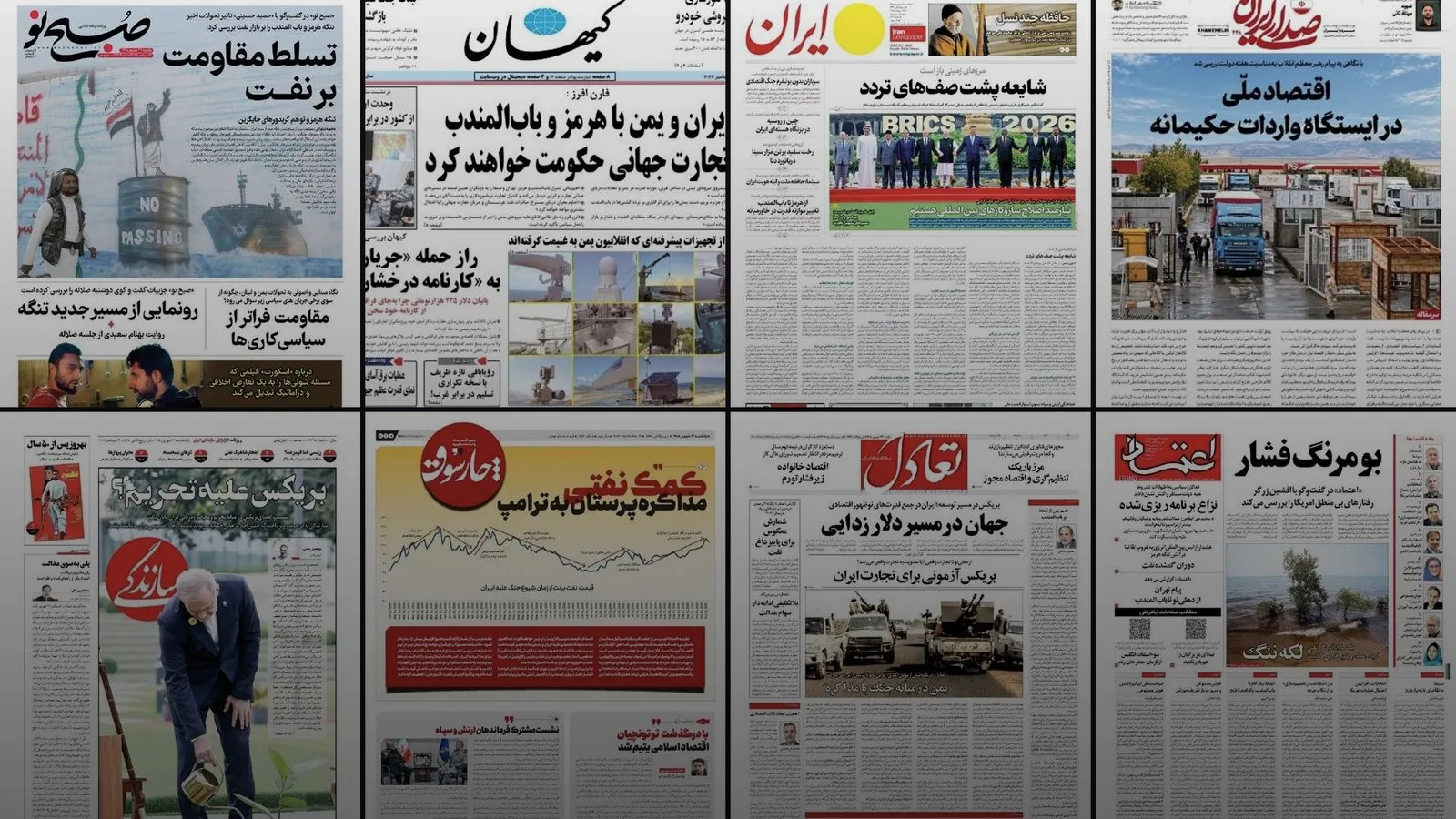
Bottom line: Tehran announced in English that it will sign a Hormuz shipping-route agreement with Oman on Monday, and in Persian, through a named parliamentary security official, that the route is in no sense a reopening of the strait, which together indicate a bounded and reversible concession designed to bank credit abroad without surrendering the instrument at home.
Executive Summary
The lead judgment of this cycle is that the settlement track crossed from convening to commitment, and that Tehran published the commitment’s limits in Persian on the same morning it published the commitment in English. Iran Daily gives its banner to ‘Pezeshkain says Iran, Oman to ink Hormuz shipping route deal on Monday’, with the deck ‘Muscat meeting key step toward regional security: Spox’ attributing the framing to the foreign ministry spokesman. Within hours of the same kiosk cycle, the Sobh-e No channel carries Behnam Saeedi, second deputy chair of the parliamentary National Security Commission, stating that Iran, Oman, Iraq and Gulf Cooperation Council members will attend and that «تعیین این مسیر به هیچ عنوان به معنای بازگشایی تنگه هرمز نیست», the designation of this route in no sense means the reopening of the Strait of Hormuz. Vatan-e Emrooz independently reports the same position with two further specifics: that the entry route to the Persian Gulf lies wholly within Iranian territorial waters, and that Iran attaches seven conditions to any opening. The three sources are not in conflict. They are the same policy, sold to two audiences with different terms attached.
That pattern is the exact inverse of the one this monitor recorded on 12 September and is the more significant finding for it. Twenty-four hours ago six Persian front pages led on Bab al-Mandab and the English paper carried no strait headline at all, from which this monitor judged that Tehran did not wish to own closure in the language its counterparts read. This morning the English paper leads on the agreement and the Persian pages lead on BRICS, oil prices and a factional quarrel. The government’s own Persian daily, Iran, files the chokepoint question fifth on a sidebar under ‘از هرمز تا بابالمندب’ and gives its lead instead to a rumour-control story insisting the land borders are open. An inversion this clean, across two papers published by the same news agency, is a message-management decision rather than divergent news judgment, and it indicates the concession is one Tehran wants credited abroad and minimised at home.
The coercion instrument itself is now being argued for in borrowed voices. Kayhan gives its entire lead to a relay of a Foreign Affairs analysis, credited on its channel to April Longley Alley and Allison Minor, under ‘ایران و یمن با هرمز و بابالمندب بر تجارت جهانی حکومت خواهند کرد’. Every one of its six decks sits inside quotation marks, including the last, which reports that the magazine judges a decisive military solution against Yemeni forces to be out of reach and stresses the necessity of a political solution. That is the sentence Kayhan would not write in its own voice, and its presence on the hardline flagship’s front page is the clearest indication in the set that the security establishment’s own surface is being prepared for an outcome it is not yet willing to advocate. Chahar Sough supplies the same admission from the opposite direction: its entire front is a Brent chart annotated at four inflection points, arguing that every Iranian signal of willingness to talk takes the price down, which concedes that the closure is a wasting asset whose value collapses the moment a corridor is signed.
The underlying military position, unlike the diplomatic one, is not in dispute and is externally corroborated. Ansarullah forces hold Mocha and the island at the southern entrance to the Red Sea, and Saudi Arabia’s East-West crude pipeline has been shut since drone strikes on 10 September, with Brent above 100 dollars. Sazandegi places the pipeline attack in a four-item index strip under ‘انفجار شاهرگ نفتی’, not on its lead, which is itself an editorial judgment that the attack is a liability. Around that position the wires carry a register of claims that this monitor labels rather than adopts: Defa Press on Ansarullah control of more than 4,200 square kilometres including Perim island and on a Yemeni missile and drone strike against a Saudi base in the Shura area; Fars on Tareq Saleh’s flight to Riyadh after defeats on the western coast and on Saudi shipping transit times lengthening roughly ninefold; Sobh-e No on at least six oil tanks destroyed at Abha; Vatan-e Emrooz on 129 Saudi air sorties in 48 hours. Against all of that, the Etemad channel carries Pezeshkian saying plainly that Iran is not at war with Saudi Arabia.
Two further signals belong in this cycle’s warning picture, and they point in opposite directions. Defa Press reports a fresh maritime incident in the Strait of Hormuz, a Panama-flagged tanker struck by a missile as reported by UK Maritime Trade Operations, which is difficult to reconcile with a corridor being signed on Monday and is the single fact most likely to derail it. And the Etemad channel carries the parliament speaker on withdrawal from the Non-Proliferation Treaty, moving the standing treaty-exit thread from two conservative front pages to the presiding officer of the legislature, which is the first time in this file that the argument has been voiced from an office rather than a newsroom.
Net assessment: this is a hinge edition rather than a loud one. Nothing on these ten pages is as dramatic as the chokepoint completion of 12 September, and that is the point: the Iranian press spent this morning not celebrating a position but pricing it, in a Brent chart, an International Energy Agency demand warning, a month-old oil slick across the Sea of Oman, a de-dollarization lead that undercuts itself by asking whether BRICS membership converts into trade at all, and a four-paper argument about who inside the system is to blame. Three surfaces that would ordinarily be the loudest, Kayhan, Chahar Sough and Jomhouri Eslami, all published the premises of a settlement while opposing settlement itself. The most useful near-term indicators are narrow and checkable: whether the signature occurs on 14 September, whether it happens at Muscat or at Salalah, whether any Persian-language front page carries it at the prominence the English page gave it, and whether the Hormuz tanker incident is followed by others.
Key Points
- KJ-1 [HIGH] Tehran has committed to a bounded maritime concession and has published its limits in Persian before publishing the concession itself. Iran Daily’s banner states that Iran and Oman will sign a Hormuz shipping-route agreement on Monday, attributed on the page to the foreign ministry spokesman; the Sobh-e No channel carries Behnam Saeedi, second deputy chair of the parliamentary National Security Commission, saying the designation of the route «به هیچ عنوان به معنای بازگشایی تنگه هرمز نیست»; and Vatan-e Emrooz adds that the entry route lies wholly within Iranian territorial waters and that seven conditions attach to any opening. Significance: this is not a reopening and should not be reported as one. It is a managed transit lane under Iranian jurisdiction that can be withdrawn without abrogating anything, which lets Tehran collect the diplomatic credit of movement while retaining the instrument. For warning purposes the concession is reversible by design, and the indicator that matters is not the signature but whether transit volumes recover afterwards.
- KJ-2 [HIGH] The bilingual split this monitor judged stable on 12 September has inverted, and the inversion is a message-management decision rather than a news-judgment difference. Yesterday six Persian front pages led on Bab al-Mandab and the English front page carried no strait headline; today the English front page leads on the agreement while the government’s own Persian daily, published by the same news agency, files the chokepoints fifth on a sidebar and leads instead on ‘مرزهای زمینی باز است’, a denial that the land borders are closed. Significance: the previous edition read the English omission as reluctance to own closure abroad. The correct generalisation is narrower and more useful: the English surface is used to introduce whatever Tehran wants credited by foreign governments, and the Persian surface to control what the domestic audience concludes from it. That rule predicts where each future move will appear first, and it is testable on the next cycle.
- KJ-3 [MODERATE-HIGH] The hardline press is publishing the premises of a settlement while continuing to oppose settlement, which indicates the security establishment’s surfaces are being positioned to survive an agreement rather than to block one. Kayhan’s entire lead is a quoted relay of a Foreign Affairs analysis whose final deck states that a decisive military solution against Yemeni forces is out of reach and that a political solution is necessary; Chahar Sough’s whole front is a Brent chart whose argument concedes that the price premium is a function of Iranian posture and therefore falls when Iran moves; both papers nonetheless attack the negotiating camp on the same page, Kayhan through Zarif and Chahar Sough through the coinage ‘مذاکرهپرستان’. Significance: an outlet that needed to prevent an agreement would not print the case for one in quotation marks. Calibration runs both ways here: reading this as hardline acquiescence would overstate it, since neither paper advocates anything, but reading it as ordinary hostility would miss that both have now put the settlement’s load-bearing premises into their own readers’ hands.
- KJ-4 [MODERATE-HIGH] The Strait of Hormuz remained kinetic on the eve of the corridor signature, which is the single most likely cause of the agreement failing. Defa Press reports UK Maritime Trade Operations recording a Panama-flagged tanker struck by a missile in the strait; Vatan-e Emrooz reports a single Chinese tanker transiting during the day and disputes American mine-clearance claims; the Etemad channel reports an attack on an Iranian commercial vessel near Qeshm. Significance: a corridor notified to maritime authorities creates a verifiable fact at sea that can be tested independently of anyone’s statements, which is why this monitor set it as the key indicator on 12 September. It can also be destroyed by a single incident attributable to no one. The warning indicator is whether a second tanker is struck between the signature and the first transits; if one is, the agreement’s practical content is nil regardless of what is signed.
- KJ-5 [MODERATE-HIGH] The internal Iranian quarrel has escalated to the point where four front pages across four factional positions describe it on the same morning, and one of them warns it is turning violent in rhetoric. Kayhan defends the Raisi record against an ‘inefficient current’; Sazandegi asks whether Raisi has become a red line and reports a foundation complaint against a blogger; Etemad calls the dispute planned and quotes Mohammad-Ali Abtahi that hardline attacks on Pezeshkian and Ghalibaf exceed those on Trump and Netanyahu; Jomhouri Eslami’s house column reports that nightly gatherings which began with slogans against Trump and Netanyahu have moved on to serving and former Iranian officials, and objects to former presidents being tried in absentia in the press. Significance: a wartime system whose four main print factions all lead on each other rather than on the adversary has an authority problem, not merely a disagreement. It also lowers the probability that any Iranian delegation carries sufficient mandate to conclude more than a technical annex on Monday.
- KJ-6 [MODERATE] Treaty withdrawal has been voiced from an office rather than a newsroom for the first time in this file. The Etemad channel carries the parliament speaker on withdrawal from the Non-Proliferation Treaty, where on 12 September the same argument stood only on the Kayhan and Nobonyad front pages and was assessed here as factional pressure pending exactly this movement. Significance: the indicator set on 12 September has moved, and the correct response is to raise the assessed likelihood that a formal parliamentary instrument follows, not to conclude that withdrawal is policy. The speaker is a principlist presiding over a body that can legislate a mandate without the executive’s consent, and a legislated withdrawal mandate during an active corridor negotiation would be the most destabilising single development available in this file. Watch for a bill, a commission referral or a Guardian Council comment rather than for further statements.
- KJ-7 [MODERATE] Tehran is running an explicit de-escalation line toward Riyadh in the same cycle in which its aligned press celebrates strikes on Saudi targets, and the contradiction is not being reconciled anywhere on these pages. The Etemad channel carries Pezeshkian saying Iran is not at war with Saudi Arabia; Kayhan’s lead relays that Yemeni attacks on Saudi resources have opened a new front and raised pressure on the energy market; Fars reports Tareq Saleh’s flight to Riyadh and Saudi shipping transit times lengthening roughly ninefold; Sobh-e No reports six oil tanks destroyed at Abha; Vatan-e Emrooz reports satellite imagery of damage to the Jizan refinery and 129 Saudi sorties in 48 hours. Significance: the presidential line is the one directed at an audience that can act on it, and it is consistent with the corridor track and with the Gulf Cooperation Council presence at Monday’s meeting. The pressing question for warning is whether Tehran is able to deliver Ansarullah restraint if a Gulf settlement requires it, on which there is no evidence in the monitored set in either direction.
- KJ-8 [MODERATE] Negative evidence, carried forward and partially amended: leadership output returned to a front page this cycle, but on an economic occasion and not on the war. Seda-ye Iran builds its lead from «پیام رهبر معظم انقلاب به مناسبت هفته دولت», the Leader’s Government Week message, rendering it as an argument for disciplined importing. That is the first leadership text to anchor a front page in seven editions, and it is a seasonal message rather than an intervention. Across those seven editions no dated leadership statement on the war, the strait, the Yemen position or the treaty question has been retrievable, and both leadership websites were again unavailable at compilation. Significance: the arbitration gap stands. A corridor is being signed, a treaty exit is being voiced from the speaker’s office and four factions are prosecuting each other, with no visible ruling from the office that would ordinarily settle any of the three. Record also, unchanged, that the succession itself rests in this monitor’s sourcing on printed honorific usage rather than on any primary leadership publication.
- KJ-9 [MODERATE] The measurable costs of the maritime campaign are now being published by Iranian outlets faster than its gains, including costs Iran cannot attribute to anyone else. Etemad’s main photograph is an oiled shoreline captioned as a month since the oil contamination of the Sea of Oman and the Persian Gulf, headed «لکه ننگ»; the same paper carries the International Energy Agency’s demand-sunset warning, a Bloomberg figure of tanker costs up 3.6 times, and an attack on an Iranian commercial vessel near Qeshm; Sazandegi carries stranded foreign passengers and border restrictions; Ta’adol asks on its own front page whether BRICS membership reaches real trade. Significance: an environmental catastrophe in Iran’s own littoral is the one cost in this list that cannot be redescribed as enemy pressure, and its appearance as a front-page photograph rather than an inside item indicates the reformist press has found a line of criticism that survives the wartime constraint on criticism. Expect it to recur, and treat its disappearance as a sign of pressure applied rather than of the problem resolving.
Macro Trends
- The bilingual split reverses, and the reversal dates the concession. The standing bilingual-messaging thread this monitor has tracked since the strait closure inverted in a single cycle. On 12 September six Persian pages led on Bab al-Mandab while the English front page omitted the strait entirely; this morning the English front page leads on a dated, venued, counterparty-named agreement while the government’s own Persian daily files the chokepoints fifth on a sidebar and leads on border-queue rumour control. Two papers published by the same news agency do not diverge this cleanly by accident. The operational reading is that a concession has been decided and is being introduced to foreign readers first, with the Persian-language terms, that this is not a reopening, that the route lies in Iranian territorial waters, that seven conditions attach, published in parallel so that the domestic audience receives the limits before it receives the concession.
- The coercion case is now made in borrowed voices. Kayhan’s lead is a Foreign Affairs relay, not a Kayhan argument, and it carries the magazine’s judgment that no decisive military solution exists and that a political solution is necessary. Chahar Sough’s lead is a price chart conceding that Iranian diplomacy moves the market against Iran’s own leverage. Jomhouri Eslami’s centrepiece is an American academic’s denunciation of the American president, placed directly above Trump’s own prediction that the war ends ‘very soon’. In each case the outlet asserts a conclusion it wants without owning the premise, and in each case the borrowed source carries a clause the outlet would not write. This is a more sophisticated register than the triumphalism of the preceding cycle, and it indicates the hardline surfaces are being positioned to survive a settlement rather than to prevent one.
- The war’s bill is being itemised by outlets with no stake in either camp. The economic and reformist pages converged this morning on cost rather than achievement. Etemad prints the International Energy Agency’s warning of a demand sunset under ‘دوران گمشده نفت’, and gives its main photograph to an oiled shoreline captioned ‘یک ماه از آلودگی نفتی دریای عمان و خلیج فارس گذشت’ beneath the single phrase ‘لکه ننگ’, the only environmental accounting of the maritime campaign anywhere in the set. Ta’adol leads on de-dollarization and then undercuts itself by asking whether BRICS membership reaches real trade. Sazandegi calls the situation Iran’s maritime blockade and asks what tangible achievement the summit delivers. The Etemad channel adds a Bloomberg-sourced figure of tanker costs up 3.6 times and an attack on an Iranian commercial vessel near Qeshm. The pattern from 12 September holds and sharpens: the premium the strategy produces is not reaching Iranian households, and the papers closest to the economy are the ones saying so.
- The internal quarrel is now the contested space on Iranian front pages. Four papers across four factional positions described the same domestic fight on the same morning. Kayhan defends ‘کارنامه درخشان شهید رئیسی’ against an ‘inefficient current’ and separately attacks Zarif for ‘رؤیابافی تازه… تسلیم در برابر غرب’. Sazandegi asks ‘رئیسی خط قرمز شد؟’ over a foundation complaint against a blogger, an item Chahar Sough carries in the opposite framing. Etemad calls it ‘نزاع برنامهریزیشده’, a planned quarrel, and quotes Mohammad-Ali Abtahi saying hardline attacks on Pezeshkian and Ghalibaf now exceed attacks on Trump and Netanyahu. Jomhouri Eslami’s house column warns that nightly gatherings which began with slogans against Trump and Netanyahu have turned on serving and former Iranian officials. Convergence of this breadth is not coordination, it is symptom: the external position is settled enough that the argument has moved inside.
- Treaty withdrawal moves from newsroom to office. The standing Non-Proliferation Treaty thread advanced a real step. On 12 September the withdrawal argument stood on two conservative front pages, Kayhan’s and Nobonyad’s, and this monitor’s judgment was that it remained factional pressure rather than policy until an office rather than a newspaper put it on a record. The Etemad channel this cycle carries the parliament speaker on withdrawal. That is the presiding officer of the legislature, not a columnist, and it is the first movement on that indicator since it was set. It also complicates the Abtahi alignment, since the same speaker is being placed by a reformist paper on the government’s side of the factional line while voicing the hardline camp’s signature demand.
- Hormuz remains kinetic while it is being negotiated. Against the corridor announcement, Defa Press reports UK Maritime Trade Operations recording a Panama-flagged tanker struck by a missile in the Strait of Hormuz, Vatan-e Emrooz reports that only one Chinese tanker transited the strait during the day and questions American mine-clearance claims, and Seda-ye Iran stages the foreign ministry spokesman’s press conference at the site of a strike at Lamerd rather than at the ministry podium. A state that convenes a press conference at a strike site is building an evidentiary and legal case, not preparing a military answer, but a corridor signed into a strait where tankers are still being hit is a corridor with a short shelf life. This is the standing Hormuz-as-coercion thread’s live edge, and it is the most checkable of the near-term indicators.
Front-Page Snapshot
- Iran Daily - “Pezeshkain says Iran, Oman to ink Hormuz shipping route deal on Monday” (English-language state daily, published by IRNA) - Corridor agreement dated, venued and attributed to the foreign ministry spokesman [MODERATE]
- Sobh-e No - “The resistance’s dominion over oil” (Principlist) - The corridor’s domestic limit, in a named parliamentary security official’s voice [MODERATE-HIGH]
- Kayhan - “Foreign Affairs: Iran and Yemen, with Hormuz and Bab al-Mandab, will rule over global trade” (Hardline, published under the Supreme Leader’s office) - Dual-chokepoint dominance argued through a relayed Western analysis [HIGH]
- Chahar Sough - “The negotiation-worshippers’ oil gift to Trump” (Economic, hostile to the negotiating camp) - Brent chart used to price Iranian diplomacy as a loss [MODERATE-HIGH]
- Jomhouri Eslami - “The scheme to allocate the petrol quota to persons rather than cars promotes corruption-breeding speculation” (Traditional clerical establishment) - Relayed American critique of Trump beside Trump’s own end-of-war claim, and a warning against the quarrel turning inward [MODERATE]
- Seda-ye Iran - “The national economy at the station of wise imports” (Leadership-messaging surface, khamenei.ir affiliation on the masthead) - Leadership Government Week message repurposed for import policy; spokesman staged at the Lamerd strike site [MODERATE]
- Ta’adol - “The world on the road to de-dollarization” (Economic, technocratic) - De-dollarization lead undercut by its own question on whether BRICS reaches real trade [LOW-MODERATE]
- Iran - “Rumour behind the transit queues” (Official government daily) - Border-queue rumour control and BRICS reform advocacy; chokepoints filed fifth on a sidebar [LOW-MODERATE]
- Etemad - “The boomerang of pressure” (Reformist daily of record) - The war’s domestic and environmental bill, and the factional quarrel called planned [LOW-MODERATE]
- Sazandegi - “BRICS against sanctions?” (Reformist, Kargozaran-e Sazandegi) - Scepticism toward the summit and the domestic bill for what it calls Iran’s maritime blockade [LOW]
Full report
The complete edition - per-paper front-page analysis and full translation appendices - is available as a PDF: Download the full report.
Compiled from Iranian front pages and outlet channels via open-source monitoring. Translations are editorial; named-figure attributions are verified against the source pages where possible.