Iranian Press Monitor - Saturday, 5 September 2026 (Day 186)
Saturday, 5 September 2026 · 14 Shahrivar 1405 · 23 Rabi al-Awwal 1448 - Ten front pages (nine Persian, one English) from the Saturday 14 Shahrivar batches, plus the Vatan-e Emrooz, Jam-e Jam, Iran, Etemad, Sobh-e No and Kayhan channels and the Defa Press, Fars and Nour News wires; Tehran Times was unavailable at the time
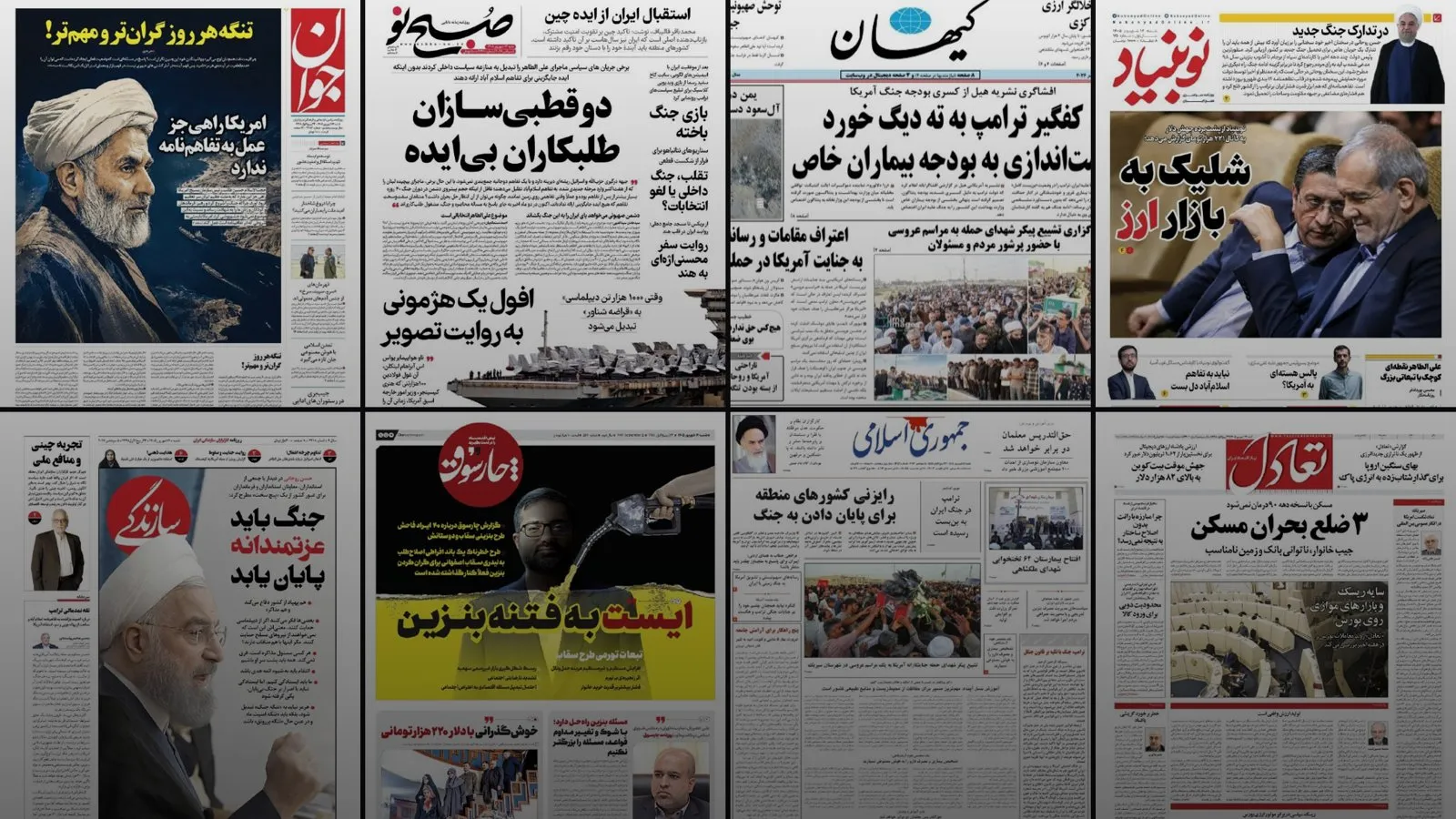
Bottom line: Two days after this monitor recorded the memorandum vanishing from the page, the Saturday fronts show it back at the center of an open intra-system fight: Sazandegi leads with Rouhani’s ‘the war must end honorably’, Sobh-e No attacks the ‘creditors without an idea’ who offer no alternative, Iran Daily tells foreign readers a consensus has re-formed for returning to it, and the Basij chief tells Javan that ‘America has no way but to act on the memorandum’, while Nobonyad calls the Ali al-Taher loss ‘the last arrow into the coffin of the understanding’ and Kayhan opens a second front against Rouhani himself. The document is contested rather than dead, the target of the principlist campaign has moved from a party secretary to a former president in 48 hours, and the undersea-cable proposal of 3 September has not been repeated.
Executive Summary
The lead judgment of the cycle is that the Islamabad memorandum has returned to the Iranian fronts, not as policy but as the object of a factional fight conducted in the open. On 3 September this monitor found the off-ramp withdrawn from the page within a day of Washington declaring the document expired. On the Saturday fronts, the first since the Friday break, it is everywhere. Sazandegi runs a full-page portrait of Hassan Rouhani under ‘the war must end honorably’ and an editorial by Mohsen Hashemi Rafsanjani on ‘the importance of returning to the Islamabad memorandum’. Sobh-e No, the Speaker’s paper, leads with ‘the polarizers, creditors without an idea’, an attack on domestic critics who ‘turned the Ali al-Taher affair into a domestic dispute without offering an alternative to the Islamabad understanding’. Iran Daily tells foreign readers that ‘a consensus’ has re-formed that Washington should return to it and that a deal is Washington’s ‘third option’. And Javan gives its banner to the new Basij chief, Hossein Taeb, saying ‘America has no way but to act on the memorandum’. Against them, Nobonyad calls the Israeli capture claim at Ali al-Taher ‘the last arrow into the coffin of the understanding’ and interviews an expert on why ‘one must not pin hopes on the Islamabad understanding’, and Kayhan’s satirical column asks where Rouhani’s ‘what use is a strait without ships’ differs from ‘the officially declared demands of America and Israel’. The document is contested, which is a different condition from the one recorded two days ago, and the contest is now personal.
The single most consequential item is the change of target. On 3 September five principlist titles attacked Kargozaran secretary-general Hossein Marashi. Today the same lane has moved up the hierarchy to the former president. Nobonyad’s top box, ‘Preparing for a new war’, calls Rouhani ‘the most unpopular president of recent decades’ and says his remarks should be read as ‘the preparation of a specific current for imposing a new war on the country’, and it ties his path to the government’s ‘14-clause memorandum’. Kayhan’s Khabar-e Vizheh is headed ‘America’s and Rouhani’s discomfort at the Strait of Hormuz being closed’, its Goft-o Shonud ridicules the ‘strait without ships’ line, and Shariatmadari’s Nokteh, without naming him, answers Rouhani’s 31 August question about whether the state broadcaster ‘should not become national after 40 days’ by quoting the martyred Leader on the enemy’s effort to cut the nation from its own media. Rouhani’s actual text, verified against the transcript of his 9 Shahrivar meeting with former governors, is more careful than either paper allows: ‘stand firm, but standing firm must not be confused with insisting on an endless war’, ‘whoever is responsible for negotiation, we must all stand behind him’, and ‘Hormuz must not become the strait of war; it must be the strait of security and at the same time a prosperous strait’. Nobonyad’s claim that he demanded a referendum on the war distorts a rhetorical question about whether leaders would accept a different course if the people rejected ‘fighting the great powers for another 20 years’. The distortion is itself evidence: the hardline press is treating the honorable-end doctrine as a threat serious enough to misquote.
The Ali al-Taher ridge, whose capture Israel’s defense minister declared on 4 September and Hezbollah has not confirmed, has been absorbed into this domestic fight rather than treated as a Lebanon story in its own right. No Persian front leads on it. Sobh-e No uses it to argue that the memorandum limited Israel’s advance (‘the enemy’s advance during the 40-day war was far greater than after the understanding’), Nobonyad uses it to argue the opposite, Sazandegi files it as ‘the continuation of the cycle of occupation’, and Kayhan’s Yadasht-e Rooz by Saadollah Zarei, a 40-year history of Hezbollah translated in full in Appendix B, ends by calling the capture ‘a hill whose reality and manner are still unclear’ that Israel ‘may lose within days’. The flagship’s response to the most significant Israeli ground gain in months is therefore reassurance by analogy, not a call for escalation, and Israel and Lebanon remain confined to columns and channel posts for the third edition running. That absence is a finding: the Axis’s setback is being managed by not leading on it.
Kayhan has changed register. Two days ago its lead was ‘track, identify, fire’ and its editor proposed cutting the Gulf’s undersea cables. Today its lead is ‘Trump’s ladle has hit the bottom of the pot’, built on The Hill’s report and Representative Rosa DeLauro’s statement that the Pentagon signed a secret agreement to draw on National Institutes of Health funds to cover war costs, and its page-3 day report says ‘America is forced to swallow the frog of war and return’. The cable proposal is not repeated on the front, and no official, commander or committee has echoed it in the sources read, which is the negative evidence the last edition asked for. The American-exhaustion narrative is now the cross-factional argument of the day and is built almost entirely from American sources: the NIH story on Kayhan, the New York Times ‘dead end’ on Jomhouri Eslami and Nour News, the Guardian’s account of USS Abraham Lincoln’s crew on Jam-e Jam and Sobh-e No (which prints the rust-streaked carrier at its Thai port call as ‘100,000 tons of diplomacy become floating scrap’), record diesel prices on Etemad Online and Nour News, and Trump’s own remark that Democrats ‘prefer we lose’. The frame is more durable than battle-damage claims because its facts are checkable; the inference that they add up to exhaustion is the outlets’.
Hormuz messaging has shifted from control claims to escort failure and coalition deterrence. Vatan-e Emrooz’s morning post, repeated by Etemad Online, reports that the Qatari LNG carrier Al Ghashamiya abandoned a US-escorted transit and diverted to Fujairah, and that seven million barrels are staged in the Gulf of Oman awaiting passage, both resting on tracking-data claims rather than any Iranian action. The government’s own daily and the hardline channels carry the same warning to South Korea that any participation ‘constitutes military participation in the aggression’, placing the threat to a prospective coalition member in the Foreign Ministry’s lane. Javan’s lead argues that the Strait ‘gets dearer and more important every day’ because uncertainty is compounding Washington’s costs before the midterms. Two counter-signals sit inside the reformist lane: Rouhani’s ‘strait of security and prosperity’, the most complete counter-doctrine to Hormuz-as-coercion yet printed, and Etemad’s online promo ‘Hormuz: from the threat of closing the Strait to setting a transit fee’, which suggests a toll regime is being floated as the Strait’s end state and which is closer to the hardline position than the reformist flagship has been.
Economic grievance has turned inward within the principlist camp and is now aimed at the government by name. Chahar Sough’s front carries no war at all: its lead calls the government’s gasoline-pricing option ‘the gasoline sedition’ (فتنه بنزین), the regime’s word for the 2009 and 2019 unrest, montages a fuel nozzle over the face of energy-strategy official Esmail Saghab Esfahani, and blames central bank governor Abdolnaser Hemmati’s ‘blackening’ for 33,000 tomans of the dollar’s rise. Nobonyad’s lead, ‘Shooting at the currency market’, places a photograph of Pezeshkian and Hemmati whispering above the 221,000-toman figure. Kayhan’s top-right item accuses the central bank of censoring the names of ‘currency-disrupting banks’. The President’s instruction, carried by Jomhouri Eslami and Iran Daily, that consumption control be ‘gradual and centered on the people’s cooperation’ reads as a retreat under this pressure. The economic titles that refused mobilization on 3 September still refuse it: Ta’adol leads on the three sides of the housing crisis and treats Sirik as a reputational contest in a single column, while flagging a new Dubai restriction on Iranian goods that would narrow the re-export route it prescribed two days ago.
The diplomatic lane resurfaced where the last edition predicted it would. Jomhouri Eslami leads on ‘regional countries consult to end the war’, naming Pakistan, Oman, Qatar and Saudi Arabia and an Egypt-Qatar foreign ministers’ call, sourced to ‘media sources’ and unconfirmed. Two scheduled escalations sit on the channels but on no front: the US-E3 draft resolution to report Iran to the Security Council at next week’s IAEA Board, which Iran’s Vienna mission pre-frames as ‘the complete failure of snapback fantasies’, and Trump’s repeated threat to strike Pickaxe Mountain ‘very soon’. The Leader is absent again: no message from Mojtaba Khamenei accompanies the Kuhestak funeral, the Army’s four-base retaliation claim or the memorandum fight, and the only Leader text placed on a front-referenced item is the martyred predecessor’s 2022 Nowruz speech, quoted twice by Shariatmadari in defense of the state broadcaster. On the Etemad channel, reformist activist Hamidreza Jalaeipour’s charge that Saeed Jalili’s supporters distributed four million red flags at the Leader’s funeral to crowd out the national flag shows that the succession-imagery contest noted in prior editions is now being fought openly over the funeral itself.
Net assessment: this is a contestation edition. The mobilization frame of 3 September has given way, on the first fronts after the funeral, to an argument about terms, conducted between newspapers that two days ago printed the same atrocity photographs. The consequential findings are that the memorandum survives as a live question rather than as a corpse; that the hardline campaign has escalated from a party secretary to a former president and is misquoting him to do so; that the Ali al-Taher loss is being absorbed by not leading on it; that Kayhan has shifted from kill-chain to budget-exhaustion register and has let the cable proposal drop; that Hormuz messaging now targets escorts and coalition partners rather than claiming control; and that the government is being attacked on gasoline and the rial in the vocabulary of sedition by its own side of the spectrum. The threads to watch are whether any official adopts Rouhani’s ‘strait of security and prosperity’ or Taeb’s memorandum-as-American-obligation, whether the IAEA referral produces a front-page lead next week, whether the four-country consultation is acknowledged by the Foreign Ministry, and whether the Leader speaks before the Board of Governors meets.
Key Points
- KJ-1 [HIGH] The Islamabad memorandum has returned to the Iranian fronts as a contested question rather than as a corpse, superseding the 3 September finding that it survived only as a target. Evidence: Sazandegi’s Rouhani lead and Hashemi Rafsanjani editorial on ‘returning to the Islamabad memorandum’; Sobh-e No’s lead attacking critics who offer ‘no alternative to the Islamabad understanding’; Iran Daily’s Dehghani Firouzabadi interview claiming a re-formed ‘consensus’ for return; Javan’s Taeb banner ‘America has no way but to act on the memorandum’; against them Nobonyad’s ‘coffin of the understanding’ and ‘do not pin hopes’, and Kayhan’s Rouhani items. Significance: when the Speaker’s paper, the reformist party paper, the government’s English title and an IRGC-lane daily quoting the Basij chief all print the document in the same morning, the reopening question is live inside the system; overstating this as movement toward a deal would be wrong, since Taeb’s usage binds Washington rather than Tehran, but understating it would repeat the error of reading 3 September’s silence as closure.
- KJ-2 [HIGH] The principlist campaign has escalated from a party secretary-general to a former president in 48 hours, and it is distorting his words to do so. Evidence: Nobonyad’s ‘Preparing a new war’ box calling Rouhani ‘the most unpopular president of recent decades’ and claiming he demands a popular vote on continuing the war; Kayhan’s ‘America’s and Rouhani’s discomfort at the Strait being closed’, its Goft-o Shonud on ‘a strait without ships’, and Shariatmadari’s Nokteh answering his IRIB remark; the verified Shafaqna transcript of the 9 Shahrivar meeting, in which the ‘vote’ is a rhetorical question about ‘fighting the great powers for another 20 years’ and the operative lines are ‘stand firm, but not an endless war’ and ‘the strait of security and prosperity’. Significance: the willingness to misquote marks the honorable-end doctrine as the position the hardline lane most needs to discredit, and the shift of target upward suggests the Marashi campaign was a rehearsal; Sazandegi’s decision to print Marashi again on its own front shows the reformist camp did not fold.
- KJ-3 [MODERATE-HIGH] The Ali al-Taher loss is being managed by absorption into the domestic memorandum fight and by not leading on it, and the flagship’s response is reassurance rather than escalation. Evidence: no Persian front leads on the ridge; Sobh-e No’s and Nobonyad’s opposite uses of it; Zarei’s Yadasht-e Rooz calling the capture ‘still unclear’ and predicting Israel ‘may lose even that within days’; Sazandegi’s ‘cycle of occupation’ strip; Israel and Lebanon otherwise confined to Kayhan’s and Vatan-e Emrooz’s channel items on southern Lebanon strikes. Significance: continuing the standing negative-evidence thread, an Axis setback that the Israeli defense minister has declared complete is being kept off the top of the page for the third edition running; an eventual lead on it would mark either a confirmed Hezbollah counter-attack or a decision to convert the loss into a mobilization event.
- KJ-4 [MODERATE-HIGH] The American-exhaustion narrative has consolidated across factions and is now built from American rather than Iranian sources, which makes it more durable than battle-damage claims. Evidence: Kayhan’s NIH-Pentagon lead and ‘swallow the frog’ day report; Jomhouri Eslami’s and Nour News’s NYT ‘dead end’; Jam-e Jam’s and Sobh-e No’s Guardian-sourced Lincoln crew story and ‘floating scrap’ photograph; Etemad Online’s and Nour News’s record diesel price; Nour News’s Bernie Sanders item; Trump’s ‘Democrats prefer we lose’ on Vatan-e Emrooz and Sobh-e No. Significance: the facts are checkable and the inference is the outlets’; as with the Driscoll and ‘rise up’ episodes of prior editions, the frame allows the hardline lane to present pressure as proof of American weakness before the midterms, and it now has the government’s English title (‘a deal is the third option’) and the reformist flagship (‘the decline of power’, Leylaz) arguing the same premise toward a different conclusion.
- KJ-5 [MODERATE-HIGH] Hormuz messaging has shifted from claims of control to escort failure and deterrence of coalition partners, with the threat to South Korea now in the official lane. Evidence: Vatan-e Emrooz’s and Etemad Online’s Al Ghashamiya diversion and Tanker Trackers’ seven million barrels, both tracking-data claims; the identical South Korea warning on the Iran newspaper channel, Vatan-e Emrooz and Press TV; Javan’s uncertainty-as-lever lead; Energy Secretary Wright’s statement that escorts should be possible by month’s end as the implicit foil. Significance: an escort-failure story built on tracking data is harder to falsify than a mine or missile claim, and the official warning to Seoul should be tracked against its deployment decision; inside the reformist lane, Rouhani’s ‘strait of security and prosperity’ is the counter-doctrine and Etemad’s ‘transit fee’ promo is a drift toward the hardline end state that should be watched for repetition.
- KJ-6 [MODERATE] Negative-evidence finding: the undersea-cable sabotage proposal of 3 September has not been repeated by Kayhan or echoed by any official, and the flagship has changed register from kill-chain to budget exhaustion. Evidence: Kayhan’s front and page 2 today carry the NIH lead, Zarei’s Hezbollah editorial and the Rouhani items, with no cable reference; Defa Press, Fars, Nour News, Jam-e Jam and the Army spokesman’s briefing contain no cable language. Significance: the priority tracking cue of the last edition closes negative for this cycle; a single non-repetition does not retire the proposal, since the mid-July dual-chokepoint editorial preceded official use by weeks, but it lowers the near-term probability that the proposal was a prepared campaign rather than the editor’s own advocacy.
- KJ-7 [HIGH] Domestic economic grievance is now being aimed at the government by name from within the principlist camp, in the vocabulary of sedition. Evidence: Chahar Sough’s ‘halt the gasoline sedition’ lead, its Saghab Esfahani montage and its ‘Hemmati’s blackening made the dollar 33,000 tomans dearer’; Nobonyad’s ‘shooting at the currency market’ over the Pezeshkian-Hemmati photograph; Kayhan’s ‘censorship of the names of currency-disrupting banks’; Pezeshkian’s ‘gradual, with the people’s cooperation’ instruction on Jomhouri Eslami and Iran Daily; the free-market dollar above 220,000 tomans confirmed by Euronews and IranWire. Significance: calling a fuel-price measure ‘fetneh’ pre-loads the 2019 memory and tells the government that any consumption decision will be treated as a security event by its own side of the spectrum, which narrows the sequencing choice the economic press identified on 3 September; the transmission chain toward political instability still shows no observable link, but the coalition attacking the government on prices now includes hardline titles rather than only technocrats.
- KJ-8 [MODERATE] The regional-mediation off-ramp has resurfaced where predicted, on the establishment title, while two scheduled escalations remain confined to the channels. Evidence: Jomhouri Eslami’s lead on consultations by Pakistan, Oman, Qatar and Saudi Arabia and an Egypt-Qatar call, sourced to ‘media sources’; the Qatari and Omani visits to Tehran in late August on the record; the US-E3 draft IAEA resolution for next week and Iran’s ‘snapback fantasies’ response only on Vatan-e Emrooz’s channel; Trump’s Pickaxe Mountain threat only on Sobh-e No’s channel. Significance: an official acknowledgment of the four-country consultation by Araghchi or Baghaei would mark the diplomatic lane’s return to the page; the absence of the IAEA referral from every front, four days before the Board meets, suggests the press has not yet been told how to frame it and is the item most likely to produce a new lead next week.
- KJ-9 [LOW-MODERATE] Negative-evidence finding: the Leader remains absent from the fronts on the day of the funeral and the memorandum fight, and the succession-imagery contest is now being fought over the funeral itself. Evidence: no message from Mojtaba Khamenei on ten scans or nine channels; the only Leader text on a front-referenced item is the martyred predecessor’s 1 Farvardin 1401 speech quoted twice by Shariatmadari; Tehran Times still promoting the Government Week message as the latest Leader text; Jalaeipour’s charge on the Etemad channel that Jalili’s supporters distributed four million red flags at the funeral to crowd out the national flag. Significance: consistent with the pattern of the Leader appearing through intermediaries rather than in his own voice, and with the flagship using the predecessor’s authority when it needs a Leader quotation; a Leader statement before the IAEA Board meets would be the first test of whether he speaks on the memorandum question at all. Confidence is low because khamenei.ir could not be reached.
Macro Trends
- The memorandum returns to the page as a fight, not a policy. Within 48 hours of this monitor recording the off-ramp’s disappearance, the document is on six fronts. For it: Sazandegi’s Rouhani lead and Hashemi Rafsanjani editorial, Sobh-e No’s attack on critics ‘without an idea’, Iran Daily’s ‘consensus’ for return, and Javan’s Taeb banner (‘America has no way but to act on the memorandum’), which uses it as an obligation on Washington rather than as a concession. Against it: Nobonyad’s ‘coffin’ and ‘do not pin hopes’, and Kayhan’s Rouhani items. The 3 September finding that the document survived only as a target is superseded: it is now contested across the spectrum and inside the hardline camp itself.
- The target moves from Marashi to Rouhani. The five-title campaign against Kargozaran’s secretary-general recorded on 3 September has been replaced by a three-title campaign against the former president: Nobonyad’s ‘preparing a new war’, Kayhan’s Khabar-e Vizheh, Goft-o Shonud and Nokteh, and Javan’s Ardabil Friday-prayer item (still on Marashi). Marashi himself reappears on his own party’s front, unrepentant, with ‘the Chinese experience and national interests’. The verified transcript shows Nobonyad’s ‘referendum’ charge to be a distortion; the willingness to distort marks the honorable-end doctrine as the thing the hardline lane most needs to discredit.
- Ali al-Taher absorbed, not led. Israel’s declared capture of the ridge overlooking Nabatieh appears on no Persian lead. Sobh-e No and Nobonyad use it as evidence for opposite conclusions about the memorandum; Kayhan’s Zarei calls it ‘a hill whose reality and manner are still unclear’ and predicts its loss ‘within days’; Sazandegi files it as ‘the cycle of occupation’. Continuing the standing negative-evidence thread on Israel and Lebanon, the Axis’s setback is being managed by keeping it off the top of the page, and the flagship’s response is historical reassurance rather than a call for escalation.
- American exhaustion argued from American sources. Kayhan’s NIH-Pentagon lead (‘the ladle has hit the bottom of the pot’), Jomhouri Eslami’s and Nour News’s NYT ‘dead end’, Jam-e Jam’s and Sobh-e No’s USS Abraham Lincoln crew story and ‘floating scrap’ photograph, Etemad Online’s record diesel price, and Trump’s remark that Democrats ‘prefer we lose’ are assembled into a single cross-factional thesis before the midterms. Kayhan’s day report, ‘America is forced to swallow the frog of war and return’, is the thesis in one line. The facts are checkable; the inference that they sum to exhaustion is the outlets’.
- Hormuz messaging shifts to escort failure and coalition deterrence. Vatan-e Emrooz and Etemad Online report the Qatari LNG carrier Al Ghashamiya abandoning a US-escorted transit for Fujairah and seven million barrels queued in the Gulf of Oman, both tracking-data claims; the government daily, Vatan-e Emrooz and the Iran channel carry the identical warning that South Korean participation ‘constitutes military participation in the aggression’. Javan’s lead makes uncertainty itself the lever (‘the Strait gets dearer every day’). The counter-doctrine, Rouhani’s ‘strait of security and prosperity’, and Etemad’s transit-fee promo are the two reformist positions to track; the second is closer to the hardline end state than the reformist lane has previously gone.
- Kayhan changes register and drops the cables. The flagship moves from ‘track, identify, fire’ to budget exhaustion, and neither its front nor its page-2 editorial repeats the undersea-cable proposal of 3 September. No official echo of the proposal was found in the channels or wires. The priority tracking cue of the last edition therefore closes negative for this cycle, without prejudice to its return.
- Economic grievance weaponized within the principlist camp. Chahar Sough brands the government’s gasoline option ‘sedition’ and montages a fuel nozzle over Saghab Esfahani’s face; Nobonyad puts Pezeshkian and Hemmati under ‘shooting at the currency market’; Kayhan accuses the central bank of censoring ‘disrupting banks’. The President’s ‘gradual, with the people’s cooperation’ instruction on Jomhouri Eslami and Iran Daily reads as retreat. Continuing the domestic-cost lane, the strain has moved from being visible on every faction’s front to being aimed at the government by name in the vocabulary of 2019.
- The diplomatic lane resurfaces on the establishment title, and the Leader stays absent. Jomhouri Eslami’s ‘regional countries consult to end the war’ (Pakistan, Oman, Qatar, Saudi Arabia; an Egypt-Qatar call) is the predicted return of the off-ramp through the mediation channel, unconfirmed beyond the paper’s ‘media sources’. The IAEA referral and Trump’s Pickaxe Mountain threat sit only on channels. No Leader message accompanies the funeral, the retaliation claim or the memorandum fight; the only Leader text on a front-referenced item is the martyred predecessor’s 2022 speech. Jalaeipour’s red-flags charge on the Etemad channel shows the succession-imagery contest now fought over the funeral itself.
Front-Page Snapshot
- Sazandegi - “The War Must End Honorably” (Reformist / Kargozaran) - Rouhani’s honorable-end doctrine; ‘strait of security and prosperity’; return to the memorandum [MODERATE]
- Nobonyad - “Shooting at the Currency Market” (Principlist) - Rouhani ‘preparing a new war’; Ali al-Taher as ‘the coffin of the understanding’; rial blamed on the government [MODERATE-HIGH]
- Sobh-e No - “The Polarizers: Creditors Without an Idea” (Principlist, Speaker’s camp) - Memorandum defended against hardline critics; Ghalibaf welcomes China’s security idea; carrier as ‘floating scrap’ [MODERATE-HIGH]
- Javan - “The Strait Gets Dearer and More Important Every Day!” (Hardline, IRGC-affiliated) - Uncertainty as lever; Basij chief: ‘America has no way but to act on the memorandum’ [HIGH]
- Kayhan - “Trump’s Ladle Has Hit the Bottom of the Pot: Encroachment on the Budget of Special Patients” (Ultra-hardline flagship) - US budget exhaustion; Rouhani attacked; Zarei on Hezbollah; cable proposal not repeated [HIGH]
- Jomhouri Eslami - “Regional Countries Consult to End the War” (Traditional / establishment) - Mediation off-ramp (Pakistan, Oman, Qatar, Saudi Arabia); Trump at a ‘dead end’; gradual gasoline policy [LOW-MODERATE]
- Chahar Sough - “Halt the Gasoline Sedition” (Economic, principlist-leaning) - Gasoline reform branded ‘fetneh’; Hemmati blamed for the dollar; elite ‘having a good time’ [MODERATE]
- Ta’adol - “Three Sides of the Housing Crisis” (Economic / business) - Housing, bourse risk, Dubai goods restriction; Sirik as reputational contest only [LOW-MODERATE]
- Etemad - “The Decline of Power” (Reformist) - Leylaz on the ‘drowning superpower’; Army four-base claim; Hormuz transit fee floated; ‘dialogue is rationality’ [MODERATE]
- Iran Daily - “Armed Forces stand ready for any faceoff with US” (Official English-language daily) - Readiness for foreign readers; direct-hit analysis; ‘deal is the third option’; memorandum ‘consensus’ [MODERATE]
- Vatan-e Emrooz (channel) - “Midnight failure of the American escort in the Strait of Hormuz” (Hardline principlist) - Al Ghashamiya diversion; seven million barrels queued; warning to South Korea; IAEA referral pre-framed [HIGH]
- Jam-e Jam (channel) - “Army spokesman: the enemy failed in all 20 objectives” (State broadcaster daily) - Official deterrent claims; Araghchi to Jordan; Lincoln crew; EU gas at 15-year low [MODERATE-HIGH]
- Iran (channel) - “Iran warns South Korea: participation in Hormuz equals military involvement” (Official government daily) - Coalition deterrence in the official lane; US arms sales to host states [MODERATE-HIGH]
- Tehran Times (web, cached 4 Sept) - “Persian Gulf equilibrium: the fracturing of US hegemony” (English-language state daily) - Hegemony-fracture essay; Camp Titin reach; Lamerd phosphorus allegation [MODERATE-HIGH]
Full report
The complete edition - per-paper front-page analysis and full translation appendices - is available as a PDF: Download the full report.
Compiled from Iranian front pages and outlet channels via open-source monitoring. Translations are editorial; named-figure attributions are verified against the source pages where possible.