When Analytical Labels Become Strategic Liabilities: Rethinking "Moderates" and "Hardliners" in Iran
When Analytical Labels Become Blind Spots: What Hossein Shariatmadari Can Teach the West About Understanding Iran
** **
In today’s Yaddasht-e Rooz (“Daily Note”) published in Kayhan, Hossein Shariatmadari—editor-in-chief of Iran’s most influential conservative newspaper and one of the Islamic Republic’s leading ideological voices—launches a sweeping critique of one of the most deeply entrenched concepts in Western analysis of Iran: the distinction between “moderates” and “hardliners.”
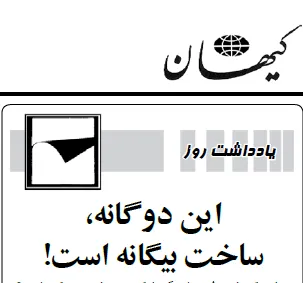
For Shariatmadari, these are not neutral analytical categories. They are part of what he describes as a deliberate political vocabulary promoted by Iran’s adversaries to redefine the Islamic Republic’s internal political discourse. His argument is ideological, but it also raises an important methodological question that deserves careful consideration by intelligence professionals, policymakers, and scholars of Iran.
“Do not use the political vocabulary of the enemy.”
This warning, repeated over the years by Iran’s Supreme Leader and prominently cited by Shariatmadari in today’s editorial, is more than ideological rhetoric. It challenges one of the central analytical frameworks through which Western governments, intelligence services and academia have interpreted Iranian politics for more than three decades.
For much of that period,** Iran has routinely been described through the familiar binary of “moderates” versus “hardliners.”** Elections, leadership transitions, and foreign policy debates have frequently been analyzed through this lens, often with the expectation that the rise of “moderates” would signal meaningful strategic change.
Shariatmadari argues that the entire framework is fundamentally mistaken.
Whether one ultimately agrees with his conclusion is beside the point. His article invites a broader methodological question: Has one of the West’s most familiar analytical frameworks become an obstacle to understanding the Islamic Republic on its own terms?
Who Is Hossein Shariatmadari?
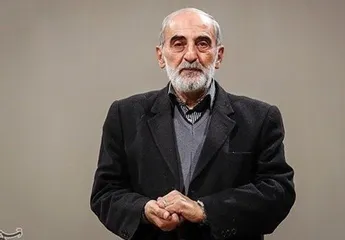
Hossein Shariatmadari has served as editor-in-chief of Kayhan since 1993. Appointed directly by the Supreme Leader as his representative at the newspaper, he occupies a unique position within the ideological establishment of the Islamic Republic.
For decades, Kayhan has been regarded by diplomats, intelligence analysts and Iran specialists as more than a newspaper. It is widely viewed as one of the clearest public windows into the thinking of Iran’s conservative establishment and as an important indicator of the ideological direction emerging from the Office of the Supreme Leader. While Shariatmadari does not formulate state policy, his editorials have frequently articulated strategic narratives that later became increasingly prominent in official Iranian discourse.
For that reason alone, his critique deserves close examination—not because it must be accepted, but because** it reflects how an influential segment of the Iranian establishment understands the conceptual battlefield on which political legitimacy is contested.**
“Hardliner” and “Moderate”: A Political Vocabulary Imported from the Outside
Shariatmadari’s central argument is that the terms “hardliner” and “moderate” are themselves political weapons.
He writes:
“One of the enemy’s deceptive tactics, intended to distance the revolutionary forces from the principles and foundations of the Islamic Republic and to encourage leniency in the face of the enemy’s coercion, has been the distortion of the concepts of ‘hardliner’ and ‘moderate.’ Those who remain steadfast in their commitment to Islam and the Revolution are labeled ‘hardliners,’ while those who retreat from revolutionary principles and ignore national interests are presented as ‘moderates.’”
According to Shariatmadari, the problem is not merely semantic.
It is conceptual.
He argues that the very structure of the Western dichotomy rests on a false assumption: that revolutionary commitment and moderation represent opposite ends of a political spectrum.
He rejects this outright:
“The users of these terms fail to recognize the enemy’s deceptive tactic. ‘Moderation’ is not the opposite of ‘hardline.’ If ‘hardline’ means insistence on and perseverance in principles—and this is precisely what it means—its opposite is not moderation but deviation.”
This distinction forms the intellectual core of his argument.
In his view, firmness in defending revolutionary principles should not be interpreted as extremism but as fidelity to the Islamic Republic’s ideological foundations.
The Supreme Leader’s Own Definition
To reinforce his argument, Shariatmadari turns repeatedly to statements made by Iran’s Supreme Leader, presenting them as definitive guidance on the issue.
He quotes the Supreme Leader warning Iranian officials:
“We should not use the enemy’s political vocabulary. I emphasize this particularly to our friends and brothers serving in political, governmental and non-governmental positions. Do not use the enemy’s terminology. From the very beginning, the enemies of the Revolution introduced the expressions ‘hardliner’ and ‘moderate.’ At that time, in their view, Imam Khomeini was the greatest hardliner. Today they say the same about me.”
The quotation continues:
“‘Moderate’ sounds like a beautiful word, but Islam does not speak this way. Islam supports the middle path, but in Islam the ‘middle’ is not the opposite of steadfastness. The middle path stands in opposition to deviation.”
Shariatmadari also reproduces another passage in which the Supreme Leader argues:
“Those outside our borders who call people ‘hardliners’ have a specific intention. By ‘hardliners’ they mean those who are more determined and steadfast in defending the Revolution. Our friends inside the country should be careful not to repeat what the enemy intends. When they say ‘hardliners,’ they mean the Hezbollah forces. And by ‘moderates,’ they mean those who are prepared to yield before them.”
Whether or not one accepts this interpretation, the passages provide a remarkably explicit explanation of how the Iranian leadership itself understands these labels.
A Challenge to Western Methodology
For intelligence professionals, the significance of Shariatmadari’s article extends beyond Iranian domestic politics.
It challenges the conceptual vocabulary through which much of the West has interpreted Iran for decades.
Since the 1990s, elections in Iran have routinely been framed as contests between “moderates” and “hardliners.” Leadership transitions have often been interpreted as indicators of ideological change. Diplomatic initiatives have frequently been evaluated according to whether they strengthened one camp or the other.
Yet the Islamic Republic’s core strategic doctrines have demonstrated striking continuity across successive administrations.
Support for the Axis of Resistance, investment in ballistic missile capabilities, advancement of the nuclear program, opposition to American regional strategy and confrontation with Israel have remained remarkably consistent despite changes in presidents, cabinets and electoral coalitions.
This continuity raises an important methodological question.
Has the familiar “moderate-hardliner” framework encouraged analysts to overestimate factional differences while underestimating institutional continuity?
That question does not require accepting Shariatmadari’s ideological conclusions.
It simply requires acknowledging that the categories employed by outside observers should themselves remain open to critical examination.
Looking Beyond Elections
None of this suggests that political factions inside Iran are imaginary.
Differences over economic management, governance, diplomacy and tactics are real.
Nor does Shariatmadari’s article invalidate decades of scholarship on elite competition within the Islamic Republic.
However, it does suggest that analysts should distinguish more carefully between tactical disagreements and strategic consensus.
Political competition can coexist with broad agreement on the state’s fundamental strategic objectives.
If so, then elections may influence the style, pace and presentation of Iranian policy without fundamentally altering its long-term direction.
That possibility deserves greater attention than it has often received.
A Personal Reflection
In my view, Shariatmadari’s critique exposes a broader analytical weakness that has characterized much of Western scholarship and intelligence analysis on Iran over the past three decades.
The repeated use of the “moderate-hardliner” dichotomy has often encouraged analysts to focus on personalities, elections and factional competition while underestimating the remarkable continuity of the Islamic Republic’s strategic doctrine.
This does not mean that the distinction is entirely without value.
Domestic political competition inside Iran is real, and important differences exist over economic policy, governance and diplomatic tactics.
Yet the enduring consistency of Iran’s national security priorities suggests that these familiar labels have often explained less than they appeared to explain.
If Shariatmadari is correct about one thing, it is not necessarily his ideological interpretation of Iranian politics.
Rather, it is his warning that analytical categories should never become substitutes for analysis itself.
The most dangerous assumptions in intelligence work are often those that become so familiar they are no longer questioned.
The “moderate-hardliner” paradigm may be one of them.