Iranian Press Monitor - Sunday, 1 November 2026 (Day 243)
Sunday, 1 November 2026 · یکشنبه ۱۰ آبان ۱۴۰۵ · ۲۱ جمادیالاول ۱۴۴۸ - Ten Iranian front pages, nine Persian and one English, read against nine outlet and agency channels
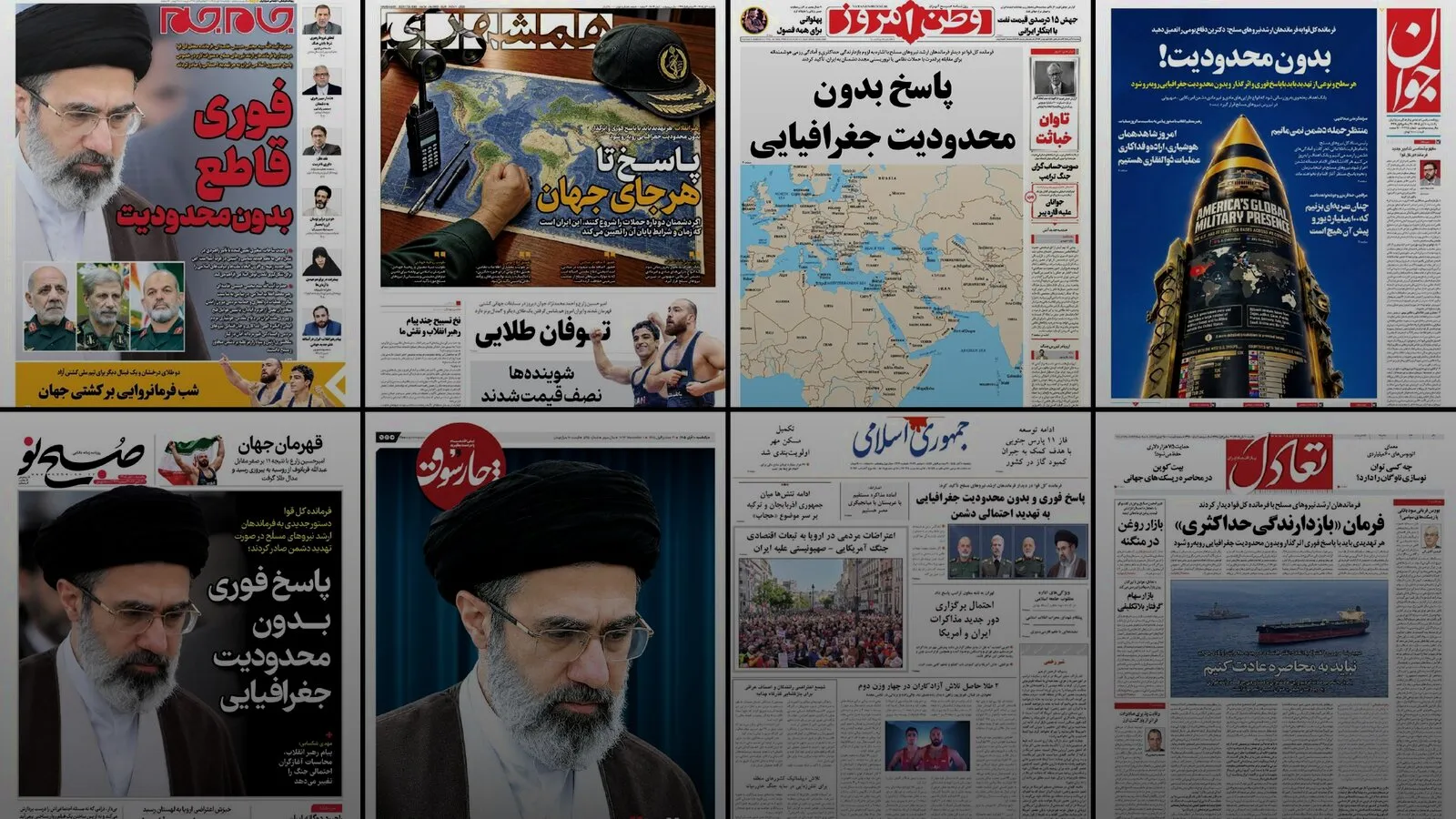
Bottom line: A single order to the armed forces, to answer any threat immediately and without geographical limitation and to update the target bank against American and Israeli assets, was printed in near-identical wording on nine of ten Iranian front pages two days before the United States votes, while the negotiating track it is meant to cover advanced far enough that the government’s English daily published the foreign minister calling American dialogue efforts a positive step.
Executive Summary
The lead judgment of this cycle is about distribution, not content. On the morning of 1 November the Commander-in-Chief’s order to senior armed forces commanders appeared on nine of the ten front pages in this scan set, and on eight of them in wording that varies only in compression: «هر سطح و نوعی از تهدید باید با پاسخ فوری و اثرگذار و بدون محدودیت جغرافیایی روبهرو شود», every level and type of threat must be met with an immediate and effective response, without geographical limitation. The Revolutionary Guard’s daily set it as «بدون محدودیت!». The state broadcaster’s daily compressed it to «فوری، قاطع، بدون محدودیت». The Tehran municipality’s paper rendered it «پاسخ تا هرجای جهان», a response anywhere in the world. The reach of the convergence is what distinguishes it from ordinary message discipline: Charsoo, an economic daily in its third year, gave its entire front page to one full-bleed portrait and the order, with no market, currency or energy item anywhere above the fold, and Ta’adol, the Chamber of Cooperatives’ paper, led on the doctrinal term «بازدارندگی حداکثری», maximum deterrence. When two business papers with no commercial reason to carry a military instruction carry it as their lead, the finding is not that the press agrees but that the press was briefed.
Inside the order, the clause that matters is not the response formula but the targeting instruction printed verbatim on both Hamshahri and Javan: «بانک اهداف به نحوی بهروزرسانی شود که انواع داراییهای مادی و غیرمادی دشمن آمریکایی-صهیونی در تیررس نیروهای مسلح قرار گیرد», the target bank is to be updated so that the material and immaterial assets of the American-Zionist enemy of every kind come within range. Two papers then supplied the geography the clause leaves open. Vatan-e Emrooz gave two-thirds of its page to a plain political map running from the Atlantic to the Indian Ocean on which two of the few filled markers outside capitals are Port of Duqm and Diego Garcia, both British-linked basing. Javan composited an English-language infographic onto a missile nose cone reading AMERICA’S GLOBAL MILITARY PRESENCE and THE U.S. HAS AT LEAST 128 BASES ACROSS 46 COUNTRIES, with ranked tables of host countries. An instruction about categories of asset is an abstraction; a map and an inventory are not, and both were published on the same morning, in a cycle in which the Foreign Ministry designated the Royal Navy and the Royal Air Force terrorist organisations and MI6 a hostile entity.
Against that, the diplomatic track moved further in this cycle than in any since the letter appeared, and the press kept it almost entirely off the Persian page. Iran Daily, the English state daily, boxed at the top of its front page ‘Araghchi describes US efforts for dialogue as positive step’. On the same morning the Iran newspaper’s own channel carried the same foreign minister in Persian saying «در حال حاضر نیازی به دیدار با آمریکاییها نمیبینیم», at present we see no need to meet the Americans. One named principal, one cycle, two languages, two opposite dispositions. On 31 October this monitor recorded availability published in English and refusal published in Persian across two different outlets and judged it a signalling choice; today both halves run through a single named speaker, which removes the alternative explanation that two editors simply made different calls.
The sharpest unresolved item in the cycle is a contradiction between two Iranian sources about whether Tehran has answered the letter at all. Jomhuri Eslami, an establishment title, kickered its second lead «تهران به نامه معاون ترامپ پاسخ داد», Tehran has responded to the letter of Trump’s deputy, headlined the possibility of a new round of Iran-America negotiations, and printed its source on the page: Al-Araby Al-Jadeed citing informed sources on important progress in the indirect talks, with China and Russia to act as guarantors. But the Secretary of the Supreme National Security Council, the letter’s named recipient, had said on the record in the preceding evening «هنوز به نامه معاون رئیسجمهور آمریکا پاسخی ندادم», I have not yet answered it. What the Qatari outlet is independently reported to have carried is progress in the Doha discussions, not a delivered reply. The judgment here is that Jomhuri Eslami has printed the outcome it wants in place of the fact, and that this says more about establishment preference than about Iranian policy.
The diplomatic detail that the front pages withhold is carried, in volume, on the papers’ own channels, and it is specific. Iran has a seven-condition package covering sanctions relief, the unfreezing of assets and an end to fighting on all fronts, to be satisfied before nuclear talks begin; Qatar is the principal mediator running a phased plan, and an Iranian official has called Qatar’s ideas unacceptable; the Secretary says the American side’s third proposal has become clearer and shows some readiness, that indirect talks have entered a new phase, and that Iran awaits a final American response; the Strait of Hormuz will not reopen until the conditions are met, and the chief difference between the seven conditions and an earlier Islamabad understanding concerns who manages the strait. He also said, flatly, that no new decision has been taken on changing the nuclear doctrine, which is a direct negative to the thread this monitor opened two cycles ago and is recorded as such.
The counter-signals in the same cycle are serious and are not on any front page. The Etemad channel carried a Wall Street Journal account of a Trump-Netanyahu telephone call as Washington weighs resumed air strikes. Three channels carried an armed movement calling itself «یحیی» naming the assets of Trump and those close to him in the United Arab Emirates as its principal targets, which extends the declared target set to a Gulf state’s territory and to a named individual’s private holdings. Three channels carried more than fifty Israeli strikes on about thirty towns in southern Lebanon in a single morning, with Lebanon entering a ninth round of talks with Tel Aviv. Not one of the ten front pages carries Lebanon in any position, for a fourth consecutive cycle, and this time the mismatch is between a silent press and the loudest single night of Lebanese strikes recorded in this series.
Net assessment: this is an edition in which the Iranian system published maximum rhetorical reach and maximum practical caution on the same morning, and allocated each to a different surface. The order and its target bank went to every readership in Persian; the receptivity went to the foreign reader in English; the conditions, the mediator, the phases and the explicit denial that nuclear doctrine has changed went to the channels, where they are deniable. Two days before the American midterms, that is a posture designed to foreclose nothing: it lets Tehran be seen to have threatened everything, conceded nothing and refused no meeting. The thing to watch is not 3 November but 4 November, which is 13 Aban, the anniversary of the embassy seizure, for which the rally routes in Tehran province were published in this cycle. The mobilisation that will meet the American result is already scheduled.
Key Judgments
-
KJ-1 [HIGH] The Commander-in-Chief’s order of 31 October was centrally distributed to the Iranian daily press, and the distribution reached titles with no editorial interest in carrying it. The evidence is nine of ten front pages in this scan set, eight of them printing «هر سطح و نوعی از تهدید باید با پاسخ فوری و اثرگذار و بدون محدودیت جغرافیایی روبهرو شود» in wording that varies only by compression, across the Revolutionary Guard’s daily, the state broadcaster’s daily, the Tehran municipality’s paper, two hardline titles, an establishment title, the leading reformist paper and two economic dailies. The decisive items are the economic ones: Charsoo gave its entire front page to one full-bleed portrait and the order with no economic content above the fold, and Ta’adol led on «بازدارندگی حداکثری». The significance is that uniform wording in aligned titles proves little, while the same wording placed as the lead of business papers indicates a briefing distributed to the whole press, not editorial convergence, and it places that briefing on the evening of 31 October. Calibration: treating uniformity as proof of an operational decision would overstate it, since a press instruction is a communications act and not a military one; treating it as routine coverage of a leadership meeting would understate it, because routine coverage does not displace a business daily’s entire front page. Update from the combined report: its headline table covers 27 titles and shows 22 of them leading on the order. Seda-ye Iran, the online daily of the Leader’s own website, drew range rings out to 4,000 kilometers under “Without Limits” and called the order Iran’s offensive strategy; Tehran Times printed a missile inscribed with the phrase. Etemad was the only political daily to lead on another story, Mohsen Hashemi’s warning about the Vance letter.
-
KJ-2 [HIGH] The target-bank clause has moved from a leadership instruction into mass-circulation print, and two titles supplied it with a specific geography centred on Anglo-American basing. The evidence is the clause printed verbatim on Hamshahri and Javan, «بانک اهداف به نحوی بهروزرسانی شود که انواع داراییهای مادی و غیرمادی دشمن آمریکایی-صهیونی در تیررس نیروهای مسلح قرار گیرد»; Vatan-e Emrooz devoting two-thirds of its page to a map from the Atlantic to the Indian Ocean whose filled non-capital markers include Port of Duqm and Diego Garcia; and Javan compositing an English-language infographic reading THE U.S. HAS AT LEAST 128 BASES ACROSS 46 COUNTRIES, with ranked host-country tables, onto a missile nose cone. In the same cycle the Foreign Ministry designated the Royal Navy and the Royal Air Force terrorist organisations and MI6 a hostile entity, a measure independently confirmed and framed by Tehran as reciprocal to Britain’s IRGC listing and the use of British facilities during the war. The significance is that the published target set now names British-linked infrastructure alongside American, which is a widening of the declared adversary and a specific one. Calibration: a map in a newspaper is not a target list and a base inventory is a widely available open-source graphic; what is new is not the information but its placement under a targeting order on the Guard’s front page. Reading these as operational planning would be a serious error, and reading them as decoration would miss that they answer precisely the question the order leaves open.
-
KJ-3 [HIGH] Whether Tehran has answered the Vance letter is contradicted within the Iranian press itself, and the front-page claim that it has is not established. The evidence is Jomhuri Eslami’s second lead, kickered «تهران به نامه معاون ترامپ پاسخ داد» over «احتمال برگزاری دور جدید مذاکرات ایران و آمریکا», sourced on the page to Al-Araby Al-Jadeed citing informed sources on important progress in indirect Tehran-Washington talks with China and Russia as guarantors; set against the Secretary of the Supreme National Security Council, the letter’s confirmed recipient, stating on the record in the preceding evening «هنوز به نامه معاون رئیسجمهور آمریکا پاسخی ندادم». Open reporting independently places the Qatari outlet’s claim as progress in the Doha discussions, not a delivered Iranian reply, and independently confirms the letter, the recipient and the Qatari channel. The significance is twofold: this monitor’s judgment of 31 October that Tehran had decided to give no answer before the midterms is amended, not withdrawn, since the principal’s own words still support it, and an establishment title has been observed publishing the diplomatic outcome it prefers as though it were fact. Calibration: the Secretary’s statement predates the front page by hours and could in principle have been overtaken; but a reply conveyed overnight and reported only through a third-country paper, while the recipient’s office says nothing, is the less likely reading. Update from the combined report: Rezaei said in a long television interview on 31 October that he had read the letter, found its tone fundamentally different from Trump’s earlier letter, and had not replied; Araghchi said only that it had been discussed in high-level meetings. The Jomhuri Eslami claim of a reply remains single-sourced.
-
KJ-4 [HIGH] One named Iranian principal published receptivity in English and refusal in Persian within a single news cycle, which establishes the two-surface signalling pattern as deliberate policy, not editorial variance. The evidence is Iran Daily’s boxed front-page item ‘Araghchi describes US efforts for dialogue as positive step’, set against the Iran newspaper channel carrying the same foreign minister in Persian as «در حال حاضر نیازی به دیدار با آمریکاییها نمیبینیم», at present we see no need to meet the Americans; with the same channel also carrying «نامه ونس را مطالعه و در جلسات سطح بالا درباره آن بحث کردیم», we studied the Vance letter and discussed it at high-level meetings. The significance is that on 31 October this monitor filed the same split at MODERATE confidence because it ran across two different outlets and could be explained by two editors’ choices; routed through one speaker in one cycle, that explanation is unavailable, and the allocation of disposition by language is established as a decision taken above the newsroom. Calibration: a foreign minister may say different things in different settings for ordinary diplomatic reasons, and this is not evidence of bad faith; the finding is about the system’s use of language as an addressing mechanism, not about sincerity.
-
KJ-5 [MODERATE-HIGH] Negative evidence: the Secretary of the Supreme National Security Council has explicitly denied that any decision has been taken to change Iran’s nuclear doctrine, which contradicts the strongest reading of this monitor’s judgment of 31 October. The evidence is his statement «تصمیم جدید برای تغییر دکترین هستهای گرفته نشده است», carried on the Vatan-e Emrooz and Sobh-e No channels in the same cycle, alongside his separate statements that Iran will demand twenty-two legal rights it says the NPT has blocked and that continued membership is not assured if further wars occur. Two cycles ago this monitor judged at HIGH confidence that doctrine revision had moved to the mass-market page and that the route to a decision was being rehearsed in public, on the evidence of three front pages. Both things are true and they resolve in a specific way: the public rehearsal was real and the decision was not near. The significance is for calibration of this series as much as for the file itself, because a judgment built on front-page placement has now been tested against the one office positioned to confirm or deny it, and it was denied. Calibration: an official denial of a decision is not evidence that no process exists, and the same official’s NPT remarks keep the exit option live; but a denial from the right office outweighs placement inference, and the judgment is adjusted accordingly. Update from the combined report: Araghchi separately said Iran remains a party to the NPT but will not allow renewed unrestricted IAEA access under current conditions. The press debate runs ahead of the official line: Nobonyad’s top story argued that nuclear restraint bought Iran war, sanctions and terror, Farhikhtegan headlined Rezaei’s acknowledgment that a debate about the doctrine exists, and parliamentary voices have urged NPT withdrawal. A shift would most likely follow a new round of strikes.
-
KJ-6 [MODERATE-HIGH] The Iranian diplomatic position is now specific enough to be negotiated against, and it has been published in detail on the channels while being kept off every Persian front page. The evidence is the Sobh-e No and Iran newspaper channels carrying, through the evening of 31 October: a seven-condition Iranian package covering sanctions relief, frozen assets and an end to fighting on all fronts, to be met before nuclear talks; Qatar as principal mediator operating a phased plan aimed first at a framework agreement, with an Iranian official calling Qatar’s ideas unacceptable; the Secretary saying the American side’s third proposal has become clearer and shows some readiness to accept the conditions, that indirect talks have entered a new phase, and that Iran awaits a final American response; the Strait of Hormuz not reopening until the conditions are met; and the chief difference from an earlier Islamabad understanding being who manages and supervises transit through the strait. The significance is that the standing Hormuz-as-coercion thread has become a governance claim: Iran is not only pricing the chokepoint, it is bidding to administer it. Calibration: channel statements by one official are not a negotiating text, the seven conditions have never been published in full, and the American side has not commented; what is established is the shape of the Iranian ask, not the state of the talks.
-
KJ-7 [MODERATE-HIGH] Escalation signalling in this cycle extended beyond state forces and beyond the Gulf’s waterways to named private assets on the territory of a Gulf state. The evidence is three channels, Nour News, Fars News and Jam-e Jam, carrying an armed movement calling itself «یحیی» stating that the assets of Trump and those close to him in the United Arab Emirates are its principal targets and that it will pursue linked persons and companies wherever they are; set beside the Fars channel’s report, independently corroborated and more precisely sourced than the channel states, that about 94 percent of 4,345 scheduled departures from Riyadh King Khalid International were cancelled between 10 and 27 October after missile attacks on the airport. The significance is the direction of travel: from shipping lanes, to Saudi energy and aviation infrastructure, to the personal holdings of a named foreign leader in a third country. That last category maps uncomfortably onto the order’s undefined «داراییهای غیرمادی», immaterial assets. Calibration: the «یحیی» claim is an unverified statement by an actor this monitor cannot characterise, carried on Iranian channels, and it may be amplification without capability; the aviation figures are independently confirmed and attributed in open reporting to Houthi attacks, not to Iranian action.
-
KJ-8 [MODERATE] Negative evidence, fourth consecutive cycle: Lebanon is absent from every front page in this scan set on the morning of the heaviest reported night of Israeli strikes recorded in this series. The evidence is three channels, Vatan-e Emrooz, Jam-e Jam and the agency feeds, carrying «آخرین وضعیت تجاوزات رژیم صهیونیستی به خاک لبنان در بامداد امروز» with more than fifty strikes on about thirty towns in southern Lebanon despite the ceasefire, and Lebanon entering a ninth round of talks with Tel Aviv; against ten front pages, none of which carries Lebanon in any position. The significance is that the gap has widened, not merely persisted: on 31 October the file was quiet in both places, and today it is loud in one and silent in the other, which converts a possible oversight into a visible allocation. A press that gave nine front pages to a targeting order and none to fifty strikes on an allied front is indicating where it has been told the political argument lies. Calibration: absence from ten scanned pages is not absence from roughly thirty national dailies, and this judgment is bounded by the scan set; the inference is about relative placement, which that bound does not undermine.
-
KJ-9 [MODERATE] The economic press is the only part of this press describing the blockade as a condition Iran suffers, and in this cycle it added a cost borne by a neighbour. The evidence is Ta’adol’s centre-page photograph of a warship beside a laden tanker under «نباید به محاصره عادت کنیم», we must not get used to the blockade, decked with the argument that Iran once grew accustomed to a siege and gained nothing but damage, printed beside a cooking-oil market in difficulty and an equity market in indecision; and, on three channels, a gas crisis in Pakistan in which free-market LPG prices are said to have doubled after supply disruption at the Iranian border, in a market Iran is reported to supply at upwards of seventy percent. Two cycles ago the same paper printed empty tankers and thirsty markets in Iran’s own distillate supply. The significance is that the clock strategy published by the Guard’s daily has a denominator that is now being printed, and that it is beginning to include the goodwill of a neighbour Iran supplies. Calibration: one front page and one channel item are not a trend, no quantity is attached to the Ta’adol warning, and the Pakistani figures are Iranian-channel reporting that this monitor has not independently confirmed.
-
KJ-10 [MODERATE] The Iranian press has begun publishing for the day after the American vote, and the mobilisation that will meet the result is already scheduled. The evidence is the Nour News channel publishing the rally routes for 13 Aban in Tehran province, which falls on 4 November, the day after the midterm elections and the anniversary of the embassy seizure; Iran Daily running an opinion piece headed ‘What happens after midterm election’, the only item in the scan set to address the question directly; Etemad’s front-page column «نامه جیدی ونس و حساسیت زمان», J.D. Vance’s letter and the sensitivity of time; and the Vatan-e Emrooz channel carrying a Politico assessment that Republicans may lose Congress and that Trump’s influence could weaken. The significance is that this monitor asked on 31 October what would replace the published clock on 4 November, and the answer is visible in advance: a scheduled anniversary demonstration, an English-language opinion frame for foreign readers, and a hardline wire narrative of American political decline. Calibration: 13 Aban is an annual fixture and its scheduling is not a response to the midterms; the analytic point is the coincidence of dates and the use the press is already making of it, not a claim of causation.
-
KJ-11 [MODERATE] Hardline voices are reading the order’s call for an immediate response to threats as license for preemption, a step the Leader’s text does not take. (Added from the combined report.) Saadollah Zarei’s lead column in Kayhan defines “immediate” as acting once a threat emerges, before it is carried out, and urges the armed forces to fire once a threat becomes “serious and near.” Chief of the General Staff Abdollahi wrote that the armed forces “will not wait for the start” of enemy action once signs of hostile intent appear (Tasnim), and Javan made that its second headline. Mohammad Reza Naqdi, senior adviser to the IRGC commander, told Defa Press that Iran must be able to take operations to enemy territory. No official has announced a decision to strike first. The gap between text and gloss narrows Washington’s warning time and raises the risk that U.S. force movements around the midterms are read in Tehran as the signs of hostile action Abdollahi described.
-
KJ-12 [MODERATE] Tehran is keeping the Vance channel open while denying that talks are under way. (Added from the combined report.) An Iranian delegation that included a deputy foreign minister traveled to Doha on 31 October after Qatari-Iranian talks in Tehran the day before; Tasnim confirmed the visit and said no meeting with U.S. officials is scheduled. Araghchi told Al Jazeera that the format of any talks will be decided only after Washington accepts Iran’s terms, and that a revised formula shortens a reported five-day Qatari implementation window to two days once the main political terms are agreed.
-
KJ-13 [LOW] Mojtaba Khamenei’s personal role in war decisions cannot be verified from open sources. (Added from the combined report.) His three meetings of the past week, with the heads of the three branches, with Rezaei and with the three senior commanders, produced no photograph, video or audio; official media illustrated the latest with a composite of four file portraits. The sequence, political consultations first and military instructions second, does point to a consolidated decision center acting in his name, which the combined report holds at moderate confidence. It could equally describe a process centered on the Supreme National Security Council.
-
KJ-14 [HIGH] The factional fight over the Vance letter, Qatar and the FATF is sharpening, and every camp claims the Leader’s two-track sequence. (Added from the combined report.) Kayhan’s special report attacks Sazandegi by name for welcoming Qatari mediation; Nobonyad ran “Qatar Again, America’s Rescue Agent” and “We Gave Concessions and Stayed on the Blacklist!”; Asr-e Iranian attacked the government’s FATF strategy. On the other side, Sazandegi quoted Mohammad Javad Zarif that negotiating under pressure does not necessarily mean surrender, and Etemad gave its lead to Mohsen Hashemi’s call to scrutinize the letter’s hidden assumptions while staying inside the negotiating frame.
-
KJ-15 [MODERATE] The press is advertising Iran’s asymmetric options: fast boats, drones, mines and undersea cables. (Added from the combined report.) Kayhan’s page 2 surveyed four decades of IRGC fast-attack craft; Defa Press described a drone doctrine built on cost asymmetry, with the Arash family reported at a 2,000-kilometer range; the Army Navy claimed another tanker struck mines east of the strait; and two Kayhan reader items asserted plans to target Gulf undersea internet cables. The craft specifications are manufacturer claims, the mine claim is not confirmed by UKMTO, and the cable items are reader submissions, not official statements.
-
KJ-16 [MODERATE] Europe is now named openly as a cost-bearer and a theater. (Added from the combined report.) Rezaei posted a poster addressed to Europe under “Terror and War Carry a Price; Now It Is Your Turn to Pay.” Araghchi answered German Chancellor Friedrich Merz’s estimate that the war has cost Europe more than 100 billion euros by saying the sum would be “nothing” next to Iran’s response to any attack. Zarei listed U.S. bases in Germany, France, Britain, Bulgaria, Turkey, Greece and Cyprus as part of the next war’s theater, and on 1 November the Foreign Ministry designated the Royal Navy and Royal Air Force terrorist organizations and listed MI6 as a hostile group. The designations are unilateral; their enforcement and international effect are not established.
-
KJ-17 [HIGH] Economic strain is deepening and spreading unevenly across the provinces. (Added from the combined report.) Official data for Mehr 1405 (23 September to 22 October) put annual inflation at 88.7 percent, with food inflation above 100 percent in 30 of 31 provinces and twelve-month inflation ranging from 63.6 percent in Tehran to 96 percent in Ilam. The FATF kept Iran under countermeasures on 30 October, winter gas supply estimates fall short of last winter’s household peak, and the national housing program has delivered 107,000 units against a promise of four million.
Macro Trends
- A single instruction saturates the field, and the business papers prove it was distributed. Nine of ten front pages carry the same order, eight in wording that differs only by compression, across titles of every factional position from the Revolutionary Guard’s daily to the leading reformist paper. Convergence between Kayhan-adjacent titles is routine and proves little. What is not routine is Charsoo, an economic daily in its third year, surrendering its entire front page to one portrait and one military order with no economic item above the fold, and Ta’adol, the Chamber of Cooperatives’ paper, leading on «بازدارندگی حداکثری». A business desk has no commercial reason to produce that page and a business readership no reason to want it. The inference mechanism matters more than the conclusion: uniform wording plus placement in titles with no editorial stake indicates centrally-guided distribution, not organic convergence, and it dates the distribution to the evening of 31 October.
- The target bank acquires a geography, and the geography is British as much as American. The instruction to update the target bank so that material and immaterial assets of the American-Zionist enemy fall within range is printed verbatim on the municipal paper and on the Guard’s paper. Two titles then make it concrete. Vatan-e Emrooz prints a map from the Atlantic to the Indian Ocean whose filled markers outside capitals include Port of Duqm and Diego Garcia; Javan prints an English-language inventory of 128 American bases in 46 countries composited onto a missile nose cone. In the same cycle the Foreign Ministry designated the Royal Navy and the Royal Air Force terrorist organisations and MI6 a hostile entity, citing British facilities used during the war and Britain’s listing of the IRGC. Three separate publications pointing at the same basing arc in one morning is a pattern, and it narrows ‘without geographical limitation’ from a slogan to a set of islands and ports.
- One foreign minister, two languages, two dispositions. Iran Daily’s front page carries ‘Araghchi describes US efforts for dialogue as positive step’. The Iran newspaper’s channel carries the same man saying Iran sees no need to meet the Americans at present. Both are this cycle. Yesterday the same split ran across two outlets and could be read as editorial difference; through a single named principal it cannot. The system is maintaining a public posture of refusal for the domestic audience and a public posture of reachability for Washington and Doha, and it is doing so with one speaker, which means the allocation is decided above the newsroom. The English page carries the only item in the entire scan set that addresses the day after the American vote directly, an opinion piece headed ‘What happens after midterm election’.
- The negotiating substance migrated entirely to the channels, and it is detailed. Not one Persian front page prints the seven conditions, the Qatari phased plan, the three American proposals, the dispute over who manages the Strait of Hormuz or the Secretary’s statement that he has not answered the letter. All of it is on the papers’ own Telegram channels, in quantity, through the evening of 31 October. The channels are where the system puts what it needs on the record and off the page: deniable, searchable by the parties who matter, invisible to the kiosk reader. The standing Hormuz-as-coercion thread acquires its most precise formulation here, that the strait does not reopen until the conditions are met and that the chief gap with the earlier Islamabad understanding is the question of who supervises transit. The chokepoint is now explicitly a governance claim, not only a weapon or a price.
- The doctrine-revision thread receives an authoritative denial. Two cycles ago this monitor recorded revision of Iran’s nuclear doctrine moving from the security press to the mass-market kiosk and judged, at HIGH confidence, that the route to a decision was being rehearsed in public. In this cycle the Secretary of the Supreme National Security Council stated, carried on two separate channels, that no new decision has been taken to change the nuclear doctrine, while adding that Iran will press twenty-two legal rights under the NPT and that continued membership is not assured in the event of further war. The denial is specific, it is from the right office, and it is recorded here as negative evidence against the stronger reading of the earlier judgment. Doctrine talk has not stopped; the claim that a decision is near has been contradicted by the one official positioned to know.
- The cost of the campaign is carried by the economic press and by nobody else. Ta’adol printed a warship beside a laden tanker under «نباید به محاصره عادت کنیم», we must not get used to the blockade, with a deck arguing that Iran once grew accustomed to a siege and gained nothing but damage from the habit. The word «محاصره» appears three times on that page, and every time it describes a condition Iran is in, not one Iran imposes. Two cycles ago the same paper printed empty tankers and thirsty markets in Iran’s own distillate supply. The cost side has a second datum this cycle, reported on three channels: a gas crisis in Pakistan with free-market LPG prices doubling after supply disruption at the Iranian border, in a market Iran is said to supply at upwards of seventy percent. The campaign is beginning to produce costs that Iranian and neighbouring readers can see.
- Lebanon is loud on the channels and silent on every page, for a fourth cycle. Three channels carried more than fifty Israeli strikes on about thirty towns in southern Lebanon in a single morning, with Lebanon entering a ninth round of talks with Tel Aviv. None of the ten front pages carries Lebanon in any position. The gap has widened instead of closing: three cycles ago the mismatch was between a quiet file and a quiet press, and today it is between the heaviest reported night of strikes in this series and total front-page silence. Front-page placement is how this press indicates where political weight is being applied, and Lebanon is receiving none of it in a week whose entire printed attention went to a targeting order and an American election.
Front-Page Snapshot
-
Javan - “Without limitation!” (Hardline daily affiliated with the Revolutionary Guard) - The order turned into a target inventory: 128 American bases in 46 countries printed in English on a missile, and the Chief of the General Staff declaring Iran will not wait for the enemy’s first move [SEVERE]
-
Vatan-e Emrooz - “A response without geographical limitation” (Hardline principlist daily) - The reach of the order drawn as a map to Diego Garcia and Duqm; European cost and street unrest offered as the theory of victory [HIGH]
-
Hamshahri - “A response anywhere in the world” (Daily of the Tehran municipality, centrist and mass-market) - The target-bank instruction made civic reading, with Iran claiming to set the timing of any new round [MODERATE-HIGH]
-
Jam-e Jam - “Immediate, decisive, without limitation” (Daily of the state broadcaster IRIB) - The order as the whole story for the largest audience, wrapped in a 1981 anniversary, with the diplomatic file withdrawn entirely [HIGH]
-
Charsoo - “The decisive order of the Commander-in-Chief: a response to the enemy at any point in the world” (Economic daily, year three, issue 585) - A business paper surrenders its entire front page to one military order with no economic content above the fold [MODERATE]
-
Sobh-e No - “An immediate response without geographical limitation” (Principlist daily, issue 2461) - The only page to theorise the order, arguing it is deterrence aimed at ending the condition of no war and no peace [MODERATE-HIGH]
-
Jomhuri Eslami - “An immediate and geographically unrestricted response to any possible enemy threat” (Establishment daily) - The only page to headline the diplomatic track, claiming Tehran has answered the Vance letter in contradiction of the recipient’s own statement [MODERATE]
-
Etemad - “A deception operation” (Leading reformist daily) - The letter read as a trap to be navigated, not refused, with the military order deliberately demoted to a box [MODERATE]
-
Iran Daily - “Leader orders Armed Forces to deliver ‘geographically unrestricted response’ to enemy threats” (State-affiliated English daily published by IRNA) - The order relayed in English for quotation while the foreign minister’s receptivity to American dialogue is published beside it [MODERATE]
-
Ta’adol - “The order of ‘maximum deterrence’” (Economic daily of the Iran Chamber of Cooperatives) - Maximum deterrence read as a cost, with a warning against normalising the blockade printed over a warship and a tanker [LOW-MODERATE]
-
Tehran Times - “Immediate, Effective, With No Geographical Limitation” (English-language, state-aligned) - The order rendered as a missile inscribed with its key phrase, beside Araghchi saying Iran has no plans for talks until its conditions are met
-
Seda-ye Iran - “Without Limits…!” (Online daily of the Leader’s website, KHAMENEI.IR) - Range rings from 300 to 4,000 kilometers across Europe, with the order labeled Iran’s offensive strategy
-
Kayhan - “An Immediate Response Without Geographical Limitation to Every Level and Type of Threat” (Ultra-hardline) - The order as the lead, a preemption gloss in the lead column, and a special report attacking Sazandegi over Qatari mediation
-
Nobonyad - “Immediate Response; Without Geographical Limitation” (Hardline) - The order beside “Qatar Again, America’s Rescue Agent” and a case against nuclear restraint
-
Farhikhtegan - “The Architect of Iran’s New Doctrine” (Principlist) - An archival portrait of the Leader, with Rezaei’s acknowledgment of a debate on the nuclear doctrine
-
Sazandegi - “Three Defensive Orders” (Reformist-centrist) - A text-only cover, with Zarif defending negotiation under pressure and a day note asking whether Doha can untie the knot
-
Jahan-e Sanat - “The Unequal Geography of Inflation” (Economic) - Provincial inflation as the lead and “An Iran-U.S. Agreement in the Shadow of the Qatari Factor” below it
-
Donya-ye Eqtesad, Asia and Jahan-e Eghtesad - Housing “at the threshold of tolerance,” the FATF file, and freight costs hitting livelihoods (Economic) - The household squeeze, with the Financial Intelligence Unit’s upbeat FATF reading in Asia
The Wider Read: What the Combined Report Adds
Our combined Daily Intelligence Report and Iranian Press Monitor for 1 November reads 27 titles against the ten above, and it confirms this edition’s lead finding: the order saturated the press, and the business papers carried it too. It also adds the commentary that surrounded the order, the diplomatic detail behind the Doha visit, and the economic data, which change the weight of several judgments. Those changes are marked as updates in the Key Judgments above. For the day’s war and Hormuz picture in full, see our Hormuz-axis daily for 1 November; for the order itself, our special report on the Leader’s directive; and for markets and the provinces, the Economic Press Review.
Preemption Enters the Commentary
The order speaks of answering “every level and type of threat,” and the commentary around it pushed that wording toward a first strike. Zarei’s column in Kayhan, headlined “Come Down Hard on the Enemy,” argues that “immediate” means acting as soon as a threat appears, that any threat “even one not yet executed” would meet unlimited military action, and that a new war could put NATO territory under fire. He lists U.S. bases from Germany and Cyprus to Diego Garcia and the Philippines as part of the theater. Army spokesman Mohammad Akraminia told Defa Press that the doctrine has shifted from a purely defensive approach toward an offensive one, and Kayhan International told foreign readers that the range “could mean areas as far as North America itself.” Kayhan’s satirical dialogue column went further and floated drone attacks on the White House by Iran’s supporters inside the United States.
Kayhan’s religious page supplied a theological frame the same morning. Khalil Aghakhani’s essay calls defense of the homeland a Quranic duty, permissible in any form, and likens hesitation on the battlefield to the conduct of hypocrites, a line that suits the hardline attack on “compromisers.” The essay also ties legitimate defense to proportion and “no excess,” which sits uneasily beside a response “without geographical limitation.” Tasnim framed the order as a doctrinal step from the late Leader’s warning that any new war would be regional to a war without geographical limits. We assess that Tehran is trying to raise the expected price of a short U.S. strike after the midterms by promising an unlimited answer, and that the public commitment makes escalation more likely if a strike comes.
The Leader Without a Picture
Since his succession, Mojtaba Khamenei has governed through written texts on his website and Telegram channel and through accounts of meetings given by others. The meeting with Abdollahi, Army commander Amir Hatami and IRGC commander Ahmad Vahidi was, by Zarei’s account, their first collective audience with him. The commanders briefed him on readiness along the Gulf coast, in the Hormuz operational zones and on the northwestern and southeastern borders, and reported a “multifold” rise in munitions production. The only image released was a composite of four file portraits.
The evidence for an active role is indirect but consistent: the directives arrive in a coherent sequence, and the commanders’ statements afterward match their language. Abdollahi issued his message to the “mobilized nation” after what he called the decisive order of the Commander-in-Chief. The evidence against a hands-on role is the absence of any verifiable appearance. A first verified image or video of the Leader with his commanders would be a significant signal, as would continued silence through a new round of fighting. The Leader also issued a message on the anniversary of the 1980 Zolfaqari operation at Abadan, comparing the Baathist siege to today’s “third imposed war”; Jam-e Jam, Farhikhtegan and Iran carried it as a second front-page item.
Doha, the Vance Letter and the Factions
Rezaei’s television interview of 31 October set out Tehran’s account of the channel. Washington has sent three rounds of proposals through mediators over more than a month: the first unsatisfactory, the second more suitable but suspicious, the third with unresolved ambiguities. Iran rejects negotiations before its seven conditions are implemented. No authoritative numbered text of those conditions has been published; across official statements they cover an end to hostilities on all fronts, an end to the U.S. naval blockade, oil-export waivers and sanctions relief, the return of restricted funds, Iran-Oman navigation arrangements in Hormuz, verifiable guarantees against renewed attack, and recognition of Iran’s sovereign and nuclear rights. Araghchi’s version adds a Hormuz route defined jointly with Oman with competing routes closed, and the return of Iranian assets held in Qatar. Kayhan International, citing The New York Times, reported that Vance proposed a meeting he would lead, with the nuclear program on the table from the start and Qatar or Turkey as possible venues.
Rezaei followed the interview with two posters: one promising “devastating blows” with new weapons if Iran is attacked and an open diplomatic path if the conditions are met, the other addressed to Europe. Asr-e Iranian’s Hamid Lashgari read the Leader’s sequence of meetings as making realization of the conditions the precondition for any step, and Sobh-e No called it a dual strategy. The security services tightened the home front at the same time: Judiciary chief Gholamhossein Mohseni-Ejei ordered swift trials for those who “sold the homeland,” and the judiciary spokesman has cited 250 cases involving 1,895 people accused of working with Israel or other hostile states. We assess that the hardline camp owns today’s front pages and is using the Leader’s language to cast any engagement with Vance as surrender, while the government and reformist papers argue that diplomacy and deterrence can run together. The Leader’s sequence gives both sides cover, which suggests he has not closed the door on a deal.
Washington, Europe and Britain
At a G20 press availability in Atlanta on 31 October, Secretary of State Marco Rubio said President Trump had made no decision on renewed strikes, preferred a diplomatic result, and would set no public deadline. Shargh’s headline captured the mood in Tehran: “Atlanta: No Photo, No Agreement.” CENTCOM said U.S. forces had redirected 144 commercial vessels under the blockade, denied Iranian claims that U.S. unmanned surface vessels had been destroyed, and said the main Hormuz transit routes had been cleared of mines. Hormozgan province said U.S. forces attacked two Iranian fishing boats off Qeshm, wounding one fisherman and leaving two missing; there is no U.S. confirmation. Treasury Secretary Scott Bessent posted that Hormuz transit is back to prewar levels “minus Iranian barrels,” while Kayhan International cited UKMTO data showing traffic still 70 percent below prewar levels. The two figures measure different things: Bessent excludes Iranian barrels, and the UKMTO figure as reported covers total traffic.
Several papers, including Kayhan International, Vatan-e Emrooz, Sobh-e No and Jomhuri Eslami, gave heavy play to youth-led protests in Europe over living costs and tied them to the war, reporting 320,000 participants in France alone. Vatan-e Emrooz ran Reza Bagheripour on “Europe in the Line of Fire.” We assess that Tehran is widening its deterrent message to Europe through costs, targets and legal designations, with the aim of separating European capitals from Washington before any new strike.
Hormuz, Yemen, Lebanon and Iraq
UKMTO’s log records Warning 189-26, a crude tanker hit by an unidentified projectile, and Warning 190-26, the boarding of a large fishing vessel; it does not confirm that the vessels Iran cites struck mines. A body calling itself the Persian Gulf Strait Authority has issued transit and enforcement notices, including a threat against vessels allegedly linked to Sinokor; its legal status and authenticity remain unverified. Majlis National Security Committee member Esmaeil Kowsari said after visiting the strait that Iran’s goal is to remove America from the region entirely.
The Saudi-led coalition said it intercepted a drone over Riyadh on 31 October without naming the launching unit, and no independently verified new Houthi strike on a commercial vessel in Bab al-Mandab was established for the period. Kayhan’s front page carried a Houthi threat against Aramco’s facilities, and Jomhuri Eslami reported that Ansarullah is ready for direct talks with Riyadh through Egyptian mediation. Saudi Foreign Minister Faisal bin Farhan raised Hormuz and Bab al-Mandab together with Russia’s Sergei Lavrov and Japan’s Toshimitsu Motegi. In Lebanon, military prosecutors have charged suspects over a truck carrying about 780 kilograms of explosives at Dahr al-Baidar, which sharpens the dispute between the state and Hezbollah over weapons; Hezbollah-aligned Al-Akhbar framed the case as an attempt to provoke internal confrontation. On the Iraqi border, Kayhan led its left column on protests in support of Iran and for reopening the crossings, and Jomhuri Eslami’s editorial “The Wounded Lion” read remarks by U.S. envoy Tom Barrack as an admission of America’s weakening hold on its partners.
The day’s material is anti-Zionist in register and lacks the overtly antisemitic tropes of recent weeks. Javan ran a feature calling Iran’s partition the goal of Zionist diplomacy. Kayhan’s religious essay lists synagogues, alongside monasteries, churches and mosques, among the houses of worship whose protection is a religious duty. No reporting on the Jewish community of Iran appeared in the day’s sources.
The Economy Behind the Order
The economic dailies tell a different story from the political front pages. Official data for Mehr 1405 show 88.7 percent year-on-year inflation, a 76.8 percent twelve-month average and 4.4 percent month on month. Jahan-e Sanat reported a 32-point gap between provinces, with Hormozgan at 113.7 percent year on year, and argued that a single national voucher adjustment cannot deliver the same purchasing power everywhere; Asr-e Iranian put inflation for the poorest deciles at 85.8 percent. Its editorial, by Fatemeh Rahimi, called the “neither war nor peace” condition a costly deadlock. The press split on the FATF statement: Asia led with the Financial Intelligence Unit’s claim of progress on ten action-plan items, while Nobonyad and Asr-e Iranian used the result to attack the government’s strategy. An Eghtesad Saramad analysis estimates available gas capacity near 700 million cubic meters a day against a previous household peak of about 730 million, an estimate that needs technical confirmation but points to curtailments for industry and power. Labor protests by pensioners, transport workers and public-service staff remain scattered and issue-specific, and a coordinated national movement is not in evidence. January Brent last settled at $113.43 a barrel on 30 October, with the expiring December contract at $117.64.
What to Watch
- An authorized Iranian reply to the Vance letter, or a Qatari announcement of a roadmap covering sanctions, frozen funds, Hormuz navigation and a halt on all fronts.
- White House decisions in the days after the 3 November vote, including U.S. force movements that Tehran could read as signs of hostile action.
- Any first verified image, video or audio of Mojtaba Khamenei with military commanders.
- Official language moving from response to explicit preemption, especially from the General Staff or the Supreme National Security Council.
- Verified incidents in Hormuz and Bab al-Mandab: mine strikes, attacks on fishing or merchant vessels, enforcement by the self-styled strait authority, and new UKMTO warnings.
- Iranian or proxy action against European interests or Gulf undersea infrastructure, and European responses to the British designations.
- Kayhan and Nobonyad attacks on named reformist figures or on the Foreign Ministry over the Vance channel, and any signal from the Leader’s office on the factional fight.
- A Majlis bill on NPT withdrawal, or a shift in Rezaei’s no-decision line on the nuclear doctrine.
- Winter gas curtailments, the value of the food voucher, and further protests over wages and pensions.
Full report
The complete edition - per-paper front-page analysis and full translation appendices - is available as a PDF: Download the full report.
Compiled from Iranian front pages and outlet channels via open-source monitoring. Translations are editorial; named-figure attributions are verified against the source pages where possible. Updated at 13:00 UTC on 1 November with our combined Daily Intelligence Report and Iranian Press Monitor for the same date: Key Judgments 11 to 17 and the dated updates carry that report’s own confidence levels, and its claims are attributed as the report attributes them. Unverified items (the mine and fishing-boat claims, the cable-targeting reader items, the strait authority’s notices, and Iranian specifications for boats and drones) are flagged as such.