Iranian Press Monitor - Tuesday, 27 October 2026 (Day 238)
Tuesday, 27 October 2026 · سهشنبه ۵ آبان ۱۴۰۵ · 16 Jumada al-Awwal 1448 - Eight Iranian front pages of 5 Aban 1405 read in full, with one English page, five newspaper channels and three agency wires. Kayhan is read from its own channel because its page did not reach the kiosk album. Tehran Times was not available at the time of compilation.
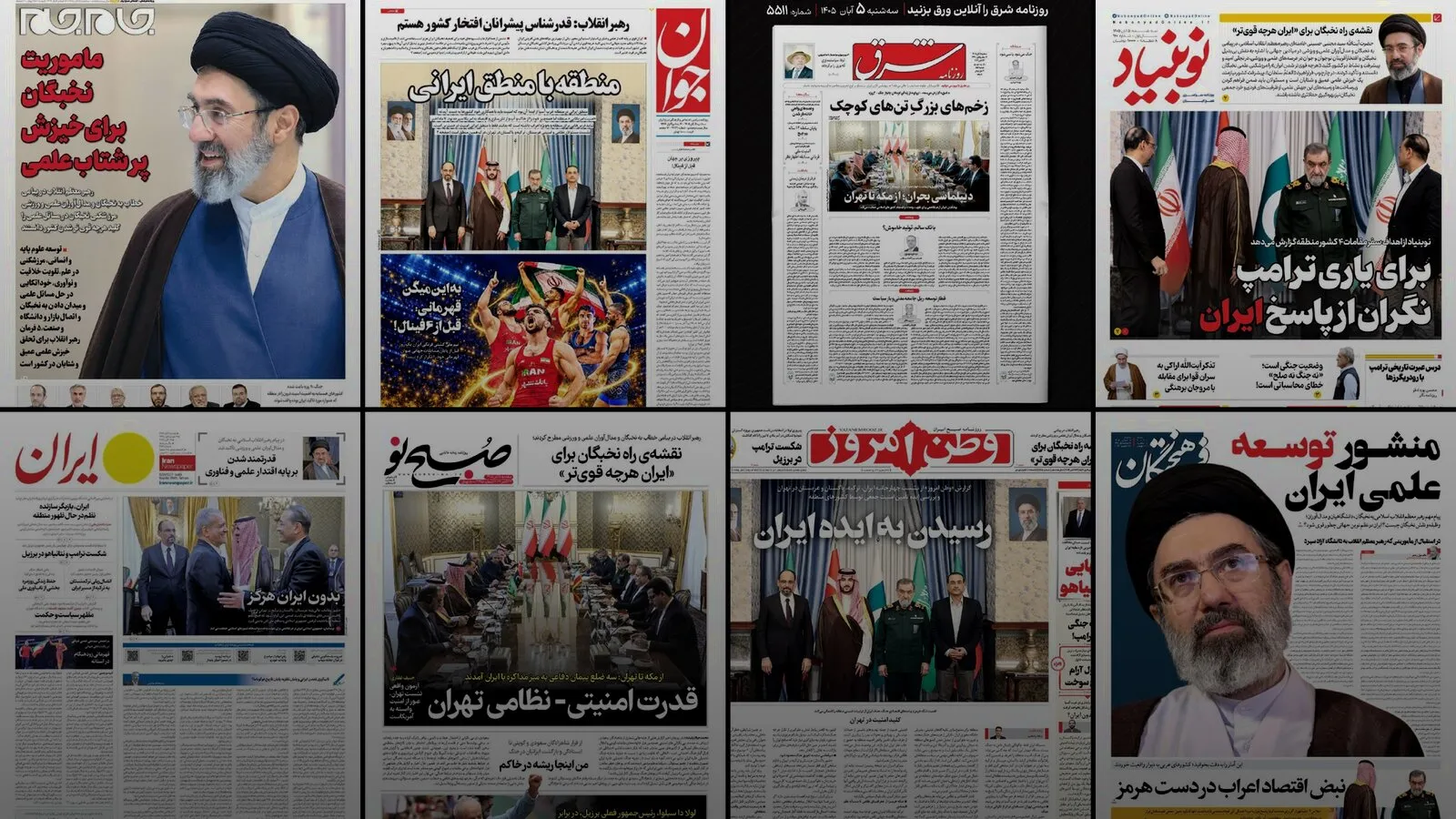
Bottom line: The defence minister of Saudi Arabia, the commander of Pakistan’s armed forces and Turkey’s intelligence chief sat down in Tehran with the secretary of Iran’s Supreme National Security Council, seven of eight Iranian front pages called it the region’s surrender to Iranian security logic, and the Leader’s own paper used its editorial column that same morning to call it a mirage and to accuse the council of being set up to abandon Yemen.
Executive Summary
The lead judgment of this cycle is not about the summit, it is about the reaction to it. On 26 October the Saudi defence minister Khalid bin Salman, Pakistan’s armed forces commander Asim Munir and Turkey’s intelligence chief Ibrahim Kalin met Mohsen Rezaei, secretary of the Supreme National Security Council, in Tehran. Seven of the eight Persian front pages lead on it or carry its photograph. On the same morning, in the same press, Kayhan’s managing editor Hossein Shariatmadari published a two-part editorial titled «اجلاس تهران آب یا سراب؟!», the Tehran summit, water or mirage, which names the council’s deputy secretary Ali Bagheri, quotes his stated aims back at him, and addresses «عزیزان شورای عالی امنیت ملی», our dear friends at the Supreme National Security Council, with a demand that they answer whether Saudi Arabia has stopped fighting Yemen. The outlet closest to the Leader’s office attacked its own security council’s diplomacy on the day that diplomacy convened. That is a different order of event from an editorial disagreement, and it is the single highest-significance finding in the batch.
The grounds of the attack are precise and they identify the one fact the celebratory pages suppress. Shariatmadari records that two months ago the three visitors concluded «پیمان مکه», the Mecca Pact, whose declared purpose is the defence of Saudi Arabia against external threat; asks what external threat Saudi Arabia faces other than the Yemeni revolutionaries; and concludes that under «وحدت ساحات», the unity of arenas, Iran, Hezbollah, Ansarallah, the Iraqi Hashd and the Palestinian resistance are «یک روح واحد», one single soul in several bodies, so that fighting Yemen is fighting Iran. Only one front page in the batch, Sobh-e No’s, names the Mecca Pact at all, with the kicker «از مکه تا تهران: سه ضلع پیمان دفاعی به میز مذاکره با ایران آمدند». Every other page that celebrates the summit does so by leaving out what the three men signed in August and whom they signed it against.
The reason those three men got on aircraft is on the wires and almost nowhere on the printed pages. Nour News leads its security output on «موشکهای یمن بر فراز ریاض؛ آرامکو و زیرساختهای سعودی در کانون حملات», Yemeni missiles over Riyadh with Aramco and Saudi infrastructure at the centre of the attacks, and reports explosions in eastern Saudi Arabia halting flights at Dammam. Kayhan reports more than four thousand flights cancelled and 86 percent of King Khalid international airport’s schedule lost, with Yemen warning international carriers out of Saudi airspace. The Jam-e Jam channel carries the Canadian government telling its citizens to avoid both Riyadh and Dammam airports. The open record is harder still: Cirium data record 4,071 of 4,736 scheduled flights cancelled at King Khalid between 8 and 25 October and more than 7,800 nationwide, about 45 percent of all scheduled Saudi departures, after a missile strike on the airport on 10 October that killed twelve and wounded more than three hundred. A kingdom whose capital’s airport has been closed for most of a month sent its defence minister to Tehran. Farhikhtegan is the only front page that says so out loud, with «نبض اقتصاد اعراب در دست هرمز», the pulse of the Arab economy is in Hormuz’s hands, and the instruction «این آمار را به دقت بخوانید؛ کشورهای عربی به دیوار واقعیت خوردند».
That reading matters because it changes what the summit is. If the three came because they were persuaded, as Javan’s «منطقه با منطق ایرانی» and Vatan-e Emrooz’s «رسیدن به ایده ایران» both claim, then a durable regional architecture is forming. If they came because Riyadh’s air traffic and oil infrastructure are under attack from Iran’s ally and because the strait is shut, as Farhikhtegan and Shariatmadari both say in their different registers, then the summit is a function of pressure and will last exactly as long as the pressure does. The two readings are printed in the same batch and neither is reconciled with the other anywhere in it.
The chokepoint claim itself has now completed a migration this monitor has tracked for five cycles. It began as an ambiguous consequence conceded in body text, became Kayhan’s «هدیه الهی», a divine gift, acquired an external warrant when Obama’s Cleveland line was promoted to doctrine on five surfaces one cycle ago, and today is published by the defence wire as settled strategy: Defa Press runs «تنگه هرمز؛ اهرم راهبردی ایران در تغییر محاسبات آمریکا», ties Obama’s remark explicitly to the Leader’s own earlier statements about levers of pressure, and attaches an International Energy Agency figure of roughly twenty million barrels a day. Shariatmadari states flatly that «بستن تنگه هرمز», the closing of the Strait of Hormuz, is what brought the three to Tehran. A claim that was deniable in September is now an admitted instrument of state on the Leader’s own surface, and the admission is being made in order to win an internal argument rather than an external one.
The military track is signalling in the opposite direction from the diplomatic one, and the timing is not accidental. On the day the Supreme National Security Council hosted a de-escalation summit, Defa Press published Sardar Sanaei-rad, deputy head of the political office of the Commander-in-Chief’s military office, saying «پاسخ ایران به هر ماجراجویی، شگفتانههای جدید و سیلی محکمتر است», that Iran’s answer to any adventurism will be new surprises and a harder slap, and that Iran would set aside its earlier restraint in a future round. The Army ground forces commander ordered units held at maximum readiness, warning that in a war situation any negligence carries heavy costs. Set against Trump’s statement of 25 October that it is decision time on Iran, a deal or finish it off, with a third carrier group moving toward the Gulf and no American strikes since 1 September, the Iranian system is running an accommodation track and an escalation track simultaneously and letting both be seen.
No Iranian surface claims an outcome, which is itself informative. The only primary document anywhere in the batch is the four-way press statement, published in full on the Sobh-e No channel, and it says that the participants agreed to continue talks on strengthening cooperation including on regional peace and security. That is all it says. Sobh-e No’s editor Mahboubeh Niavarani is the only front-page voice to put the resulting question honestly: «این نشست، تاکتیکی برای دور کردن خطر جنگ است یا آغازی برای شکلگیری امنیت دسته جمعی», is this meeting a tactic to push the danger of war away or the beginning of collective security. The analyst Hanif Ghaffari, in the same paper, attaches the only condition on a sympathetic page: the three must first prove they have actually made endogenous security their first priority.
Nobonyad supplies the front-page dissent, and it is a principlist paper dissenting from a principlist consensus on the same morning. Its headline over the Saadabad photograph reads «برای یاری ترامپ، نگران از پاسخ ایران», here to help Trump, afraid of Iran’s answer, under the kicker that the paper is reporting on the aims of the four countries’ officials. This is the same paper that one cycle ago used the Speaker’s moment of restoration to print the charge that he had jailed a sitting member, so the pattern holds: Nobonyad reliably prints the camp’s internal objection on the morning the camp is celebrating. Its revival of «نه جنگ، نه صلح», specifically in order to call it «خطای محاسباتی», a miscalculation, is the first front-page return of the presidential exit argument in two cycles, and it returns as a target.
The bet on adversary elections, which this monitor flagged one cycle ago as carrying a hard expiry date, reached its first settlement day and the press has banked it. Lula’s defeat of Flavio Bolsonaro in the Brazilian runoff of 25 October, 51.79 percent to 48.21, is on five front pages, and the Iranian rendering is uniform: Vatan-e Emrooz calls it «شکست ترامپ در برزیل», the government’s Iran calls it «شکست ترامپ و نتانیاهو در برزیل», Sobh-e No calls it «آغاز موج ضد ترامپ», the start of the anti-Trump wave, Farhikhtegan calls it «ویوا داسیلوا!» and Kayhan quotes Lula that this is nobody’s backyard any more. The second settlement, the Israeli ballot, was being held as these pages went to press and the handling is noticeably more careful: Vatan-e Emrooz runs «تنهایی نتانیاهو» on military objections to a fresh Iranian adventure, Farhikhtegan asks «بوی رفتن نتانیاهو میآید؟», and the Iran newspaper’s channel prints a sober seat count in which neither bloc reaches sixty-one. The third, the American midterms of 3 November, is carried only through The Atlantic’s byline in a Kayhan item on Iran’s role in a possible Republican defeat.
Net assessment: this is the edition in which the Iranian system’s two authorities said opposite things about the same event in public on the same morning. The security council hosted three American-aligned militaries and called it the beginning of endogenous regional security; the Leader’s paper called it a mirage and accused the council of being set up to abandon Yemen. Both are right about something. The summit is real, it happened at the level of defence minister, army chief and intelligence chief, and it is the first collective encounter between the Mecca Pact and Iran. It also produced nothing but an agreement to keep talking, it was convened against a background in which Iran’s ally is closing Saudi airspace, and it is being conducted while Iran’s own military wing promises a harder slap. What to watch over the next week is not whether the dialogue continues, it is whether anything in the Yemen file moves. Shariatmadari has defined the test in public and in advance: if Saudi Arabia’s war on Yemen pauses, the summit was water, and the Leader’s paper will have lost an argument it chose to have in the open. If it does not, the summit was a mirage on the terms its own host’s newspaper set.
Key Judgments
- KJ-1 [HIGH] The outlet closest to the Leader’s office publicly attacked the Supreme National Security Council’s own summit on the morning it convened, and did so over Yemen. The evidence is Kayhan’s «یادداشت روز» of 5 Aban, «اجلاس تهران آب یا سراب؟!», published in two parts and signed by the paper’s managing editor Hossein Shariatmadari. It names the council’s deputy secretary Ali Bagheri, quotes his two stated aims for the meeting, concedes his theory and rejects his practice, and demands directly that «عزیزان شورای عالی امنیت ملی» answer whether Saudi Arabia has stopped fighting Yemen. Its doctrinal basis is «وحدت ساحات», the unity of arenas, under which Iran, Hezbollah, Ansarallah, the Hashd and the Palestinian resistance are «یک روح واحد», one soul in several bodies, so that the Mecca Pact’s commitment to defend Saudi Arabia against the Yemeni revolutionaries is a commitment against Iran. The significance is that a disagreement normally handled inside the system was placed in the open, in the Leader’s own paper, against the state’s highest security body, with a test stated in advance. Calibration: Kayhan has attacked diplomatic openings before, so the posture is not new; what is new is naming a serving deputy secretary and addressing the council as an institution on the day of its own event.
- KJ-2 [HIGH] The Mecca Pact’s three signatories met Iran collectively for the first time, and the Iranian press overwhelmingly presented the meeting as the region’s conversion rather than as a negotiation. The evidence is the official four-way press statement published in full on the Sobh-e No channel, recording that the first meeting of the four regional states was held in Tehran on 4 Aban 1405 / 26 October 2026, hosted by Mohsen Rezaei as secretary of the Supreme National Security Council, with Khalid bin Salman as Saudi defence minister, Asim Munir as commander of Pakistan’s armed forces and Ibrahim Kalin as head of Turkish intelligence, and that the participants agreed to continue talks. Against that, seven of eight Persian front pages print a verdict: «رسیدن به ایده ایران», «منطقه با منطق ایرانی», «بدون ایران هرگز», «قدرت امنیتی - نظامی تهران», «تهران قلب امنیت منطقه». The significance is a gap between what was signed, an agreement to keep talking, and what was published, a regional realignment. Calibration: the meeting itself is real and was held at the level of defence minister, army chief and intelligence chief, which is a genuine escalation of contact; overreading it would turn a communique into an architecture, underreading it would miss the first collective Mecca Pact contact with Tehran.
- KJ-3 [HIGH] The condition that produced the summit is a sustained attack on Saudi aviation and oil infrastructure by Iran’s Yemeni ally, and it is reported on the Iranian wires and on one Iranian front page. The evidence is Nour News leading on «موشکهای یمن بر فراز ریاض؛ آرامکو و زیرساختهای سعودی در کانون حملات» and reporting explosions in eastern Saudi Arabia halting Dammam flights; Kayhan reporting more than four thousand cancelled flights and 86 percent of King Khalid international airport’s schedule lost with Yemen warning foreign carriers out of Saudi airspace; the Jam-e Jam channel carrying Canada’s advisory against travel to both Riyadh and Dammam airports; and Fars News carrying Yemeni strike claims against the coalition’s counter-claims. The open record is firmer: Cirium data record 4,071 of 4,736 scheduled flights cancelled at King Khalid between 8 and 25 October and more than 7,800 nationwide, about 45 percent of all scheduled Saudi departures, following a missile strike on the airport on 10 October that killed twelve and wounded over three hundred, with Houthi claims against Aramco facilities at Yanbu, the Rabigh refinery and the East-West pipeline, and the kingdom’s flagship investment conference postponed to 2027. The significance is that it supplies the causal account the celebratory pages omit: the Saudi defence minister flew to Tehran because the capital’s airport has been shut for most of a month by a force Tehran supports. Calibration: Yemeni and coalition battle claims are each side’s claims; the aviation disruption is corroborated by an independent analytics source and by a third-country travel advisory, which is a different evidentiary class.
- KJ-4 [HIGH] Iran’s closure of the Strait of Hormuz has been moved from deniable consequence to declared instrument on the state’s own surfaces, and the admission was made to win an internal argument. The evidence is Defa Press publishing «تنگه هرمز؛ اهرم راهبردی ایران در تغییر محاسبات آمریکا», which ties Obama’s Cleveland remark explicitly to the Leader’s earlier statements about levers of pressure and attaches an International Energy Agency figure of roughly twenty million barrels a day through the strait in 2025; Shariatmadari writing that «بستن تنگه هرمز» has narrowed the field for America and its Western, Hebrew and Arab allies and brought them close to suffocation, and using that as the reason the three delegations came; and Farhikhtegan’s «نبض اقتصاد اعراب در دست هرمز». The significance is that the chokepoint is no longer being described as something that happened to the world, it is being claimed as something Iran is doing, by the Leader’s own paper, in an argument with Iran’s own security council. Calibration: Trump’s counter-claim of 25 October that the United States now controls the strait and that crude flows have returned to pre-war levels is on the record and is not reconciled with the Iranian account anywhere in this batch; the strait’s actual transit status is not established by either side’s statements.
- KJ-5 [MODERATE-HIGH] Iran ran a de-escalation track and an escalation signal on the same morning, through different institutions, without either acknowledging the other. The evidence is Defa Press publishing Sardar Sanaei-rad, deputy head of the political office of the Commander-in-Chief’s military office, saying «پاسخ ایران به هر ماجراجویی، شگفتانههای جدید و سیلی محکمتر است» and that Iran would abandon its earlier restraint in a future round, on the day the Supreme National Security Council hosted the summit; alongside the Army ground forces commander ordering units held at maximum readiness with the warning that in a war situation any negligence carries heavy costs; and Kayhan rendering the President’s own summit remarks as defiance, that the idea the Iranian nation can be forced to surrender is false and void. The external backdrop is Trump’s 25 October statement that it is decision time, a deal or finish it off, with a third carrier group moving toward the Gulf and no confirmed American strikes since 1 September. The significance is that this is a deliberate two-track posture rather than a message-discipline failure, because the two tracks are being published on adjacent surfaces. Calibration: a deputy of a political office is not a commander, and his statement is signalling rather than an order.
- KJ-6 [MODERATE-HIGH] The summit produced no substantive outcome and no Iranian surface claims one, which makes the celebratory framing an assertion about meaning rather than about result. The evidence is the only primary document in the batch, the four-way press statement on the Sobh-e No channel, whose entire operative content is that the participants agreed to continue talks on strengthening cooperation among the four states including on regional peace and security. No Iranian page reports a commitment, a mechanism, a follow-up date or a Yemen clause. Sobh-e No’s editor-in-chief Mahboubeh Niavarani asks on the page whether the meeting is «تاکتیکی برای دور کردن خطر جنگ» or «آغازی برای شکلگیری امنیت دسته جمعی», and the analyst Hanif Ghaffari sets a prior condition, that the three must first prove endogenous security has become their first priority. The significance is that the two most analytically careful principlist voices in the batch both decline to call the result. Calibration: an opening meeting producing only an agreement to continue is normal diplomatic practice and is not evidence of failure; it is evidence against the verdict seven front pages printed.
- KJ-7 [MODERATE-HIGH] The front-page dissent came from a principlist paper, not a reformist one, and it read the delegation as Trump’s errand. The evidence is Nobonyad’s lead over the Saadabad photograph, «برای یاری ترامپ، نگران از پاسخ ایران», here to help Trump, afraid of Iran’s answer, under the kicker «نوبنیاد از اهداف سفر مقامات ۴ کشور منطقه گزارش میدهد»; and, on the same page, «وضعیت جنگی است؛ «نه جنگ، نه صلح» خطای محاسباتی است!», reviving the presidential exit formula in order to call it a miscalculation. The significance is twofold: the quarrel about the summit is internal to the principlist camp rather than between camps, which matches the pattern this monitor recorded one cycle ago when the same paper indicted the Speaker on the morning of his restoration; and the exit argument, absent from every front page in the previous edition, has returned as a target rather than as a proposal. Calibration: one page is not a camp, and Nobonyad’s house style is contrarian, so this is a reliable indicator of dissent existing rather than a measure of how widely it is held.
- KJ-8 [MODERATE] Negative evidence, filed as a finding: the President travelled to Moscow for the gas exporters’ summit in this cycle and no Persian front page carries it. The evidence is the absence set against the record. Iran Daily’s banner is ‘Iran calls on GECF states to increase gas share in global energy mix’; the Iran newspaper’s channel carries Pezeshkian before departure saying «اقدامات آمریکا موجب ناامنی انتقال آزاد انرژی در جهان است», American actions are making the free transfer of energy insecure; the visit is to the eighth Gas Exporting Countries Forum summit with a bilateral with Putin, following Lavrov’s visit to Tehran on 19 October. None of the eight Persian front pages prints it. The significance is a choice about which diplomacy counts: a one-day regional security meeting that produced a communique fills seven front pages, while the President’s visit to Iran’s principal great-power partner on the file that underwrites the entire leverage argument is a channel item. Calibration: an outbound presidential trip often lands on the following day’s pages, so this may be a timing artefact rather than a judgement, which is why it is filed at moderate and should be re-checked in the next edition.
- KJ-9 [MODERATE] The bet on adversary elections has paid once and only in the theatre furthest from the war, and the Iranian rendering strips the result of its local content. The evidence is Lula’s defeat of Flavio Bolsonaro in the runoff of 25 October, confirmed at 51.79 percent to 48.21, carried on five front pages as an American defeat rather than a Brazilian choice: Vatan-e Emrooz’s «شکست ترامپ در برزیل», the government paper’s «شکست ترامپ و نتانیاهو در برزیل», Sobh-e No’s «آغاز موج ضد ترامپ», Farhikhtegan’s «ویوا داسیلوا!», and Kayhan quoting Lula that this is nobody’s backyard any more. Against that, the Israeli ballot being held as these pages printed is handled with care, through «تنهایی نتانیاهو» on military objections to a fresh Iranian adventure, Farhikhtegan’s «بوی رفتن نتانیاهو میآید؟», and the Iran channel’s sober count giving Eisenkot’s Yashar twenty to twenty-three seats with neither bloc near sixty-one. The significance is that the substitution of adversary elections for military victory, flagged one cycle ago with a hard expiry date, has survived its first test by collecting a result that changes nothing about Iran’s position. Calibration: the Brazilian reading is not fabricated, Trump did campaign for the losing side, but presenting a domestic Brazilian runoff as a strategic reverse for Washington is editorial framing, not analysis.
- KJ-10 [MODERATE] Negative evidence, filed as a finding: the serving Leader has gone a third consecutive cycle without a dated appearance, and on the edition’s central question he is silent while his newspaper is not. The evidence is the shape of his presence. His message to the elites and medal-winners leads Kayhan, Nobonyad, Farhikhtegan and Jam-e Jam and runs as a banner on Iran and Sobh-e No, and its subject is scientific development under the meta-strategy «العلمُ سلطان». It was read out at an event rather than delivered. The portraits printed beside it on three pages are stock images. His condition is attested at second hand by the head of the judiciary, whose account Kayhan headlines «کشتیبان نظام در اوج اقتدار، استواری و تزلزلناپذیری است». Meanwhile his own paper’s editor publicly instructs the Supreme National Security Council without invoking any ruling from him. The significance is that the succession continues to exercise authority through message, attribution and testimony rather than through presence, and that an argument this sharp between two arms of the state is being conducted without the arbiter appearing. Calibration: the inference is from form and placement; nothing in this batch disparages him, and the message’s own content is unremarkable.
- KJ-11 [MODERATE] Lebanon has fallen out of the front-page register entirely and survives in this batch only as artillery fire and an American denial. The evidence is Al-Mayadeen, relayed by Fars News and by the Vatan-e Emrooz channel, reporting Israeli artillery shelling Wadi Zebqin, Mayfadoun, Baraachit, Haddatha and Aita al-Jabal in southern Lebanon; and the Jam-e Jam channel carrying the US State Department spokesman denying that any American or Turkish proposal exists to alter the Taif-based structure of Lebanon’s political system. Neither reaches a printed page. The significance is editorial rather than military: a file that was a declared flashpoint through the summer is now handled as routine, which means Iranian readers are being given a regional picture in which the Lebanese front has stopped generating decisions. Calibration: absence from front pages is not absence from the ground, and the denial itself indicates that a Lebanese political question is live enough in Washington to require denying.
- KJ-12 [LOW-MODERATE] The outward-facing English surface withholds the chokepoint doctrine for a fourth consecutive cycle and leads instead on energy supply. The evidence is Iran Daily Vol 6249 of 27 October: the banner is ‘Iran calls on GECF states to increase gas share in global energy mix’, the lead is ‘Pezeshkian: Iran hopes to help create unity, bring back security to region’ with the deck that Iranian, Saudi, Pakistani and Turkish officials discussed regional security, and the page’s exclusive is Marandi arguing that Iran’s wartime experience can contribute to China’s global governance initiative. The Mecca Pact is not named, no indispensability claim is made, and Hormuz does not appear. The significance is that Iran is selling itself abroad as a supplier and a stabiliser while selling itself at home as the holder of a veto over the world’s oil artery, and the split has now held across four editions. Calibration: a single English daily is a thin basis for inference about an entire external communication posture, which is why this is filed low-moderate; the pattern’s persistence rather than any one issue is what carries the weight.
Macro Trends
- Seven front pages treat a meeting as a verdict. Vatan-e Emrooz’s «رسیدن به ایده ایران», arriving at the idea of Iran, Javan’s «منطقه با منطق ایرانی», the region on Iranian logic, Sobh-e No’s «قدرت امنیتی - نظامی تهران», the government’s «بدون ایران هرگز», never without Iran, Farhikhtegan’s yellow band carrying the same phrase, Jam-e Jam’s «تهران قلب امنیت منطقه» and Shargh’s «دیپلماسی بحران؛ از مکه تا تهران» are seven renderings of one arrival. Six of the seven present it as settled. Only Shargh’s word «بحران», crisis, and Sobh-e No’s editor’s open question treat the outcome as undetermined, and the official statement the participants actually signed commits them to nothing but further conversation.
- The Leader’s paper breaks with the Leader’s security council in public. Kayhan’s Yadasht-e Rooz of 5 Aban, signed by Hossein Shariatmadari, names the council’s deputy secretary Ali Bagheri, quotes his two stated aims, calls his theoretical exposition proper and then calls his practice contradictory, and closes with a Hafez couplet addressed to «عزیزانمان در شورای عالی امنیت ملی» warning them not to be deceived by a mirage. The substantive demand is that Yemen not be traded. This is not factional commentary at one remove: it is the outlet closest to the Leader’s office instructing the state’s highest security body, by name, on the morning of its own summit.
- The Saudi emergency that explains the summit is on the wires and off the pages. Nour News leads on Yemeni missiles over Riyadh with Aramco and Saudi infrastructure at the centre of the attacks and reports Dammam airport flights halted. Kayhan reports over four thousand cancelled flights and 86 percent of King Khalid’s schedule lost. Jam-e Jam’s channel carries Canada warning its citizens off both airports. Fars carries the Yemeni armed forces’ strike claims and the coalition’s counter-claims; Defa Press carries Saudi jets bombing Taiz. Of the eight Persian front pages, only Farhikhtegan states the connection, and it states it as coercion rather than as persuasion.
- Hormuz completes the journey from consequence to admitted instrument. Defa Press publishes «تنگه هرمز؛ اهرم راهبردی ایران در تغییر محاسبات آمریکا», tying Obama’s Cleveland remark to the Leader’s own earlier statements on levers of pressure and attaching an International Energy Agency figure of about twenty million barrels a day for 2025. Shariatmadari writes that «بستن تنگه هرمز» has brought America and its allies close to suffocation. Vatan-e Emrooz converts the Obama line into American electoral mechanics with «ضربه جنگی به ترامپ!». Five cycles ago this was a consequence nobody owned; it is now a strategy the Leader’s paper claims as Iran’s own, in print, to win an internal argument.
- The military track signals escalation on the day the diplomatic track convenes. Defa Press carries Sanaei-rad promising «شگفتانههای جدید و سیلی محکمتر», new surprises and a harder slap, with earlier restraint set aside in any future round. The Army ground forces commander orders maximum readiness. Trump said on 25 October that it is decision time, a deal or finish it off, and has moved a third carrier group toward the Gulf with no American strikes since 1 September. The de-escalation summit and the escalation signal were published on the same surfaces on the same morning, which indicates two tracks running deliberately rather than a discipline failure.
- Brazil banked, Israel hedged, the midterms outsourced. Lula’s 51.79 to 48.21 defeat of Flavio Bolsonaro on 25 October is on five front pages and is rendered uniformly as Trump’s loss rather than Brazil’s choice: «شکست ترامپ در برزیل», «شکست ترامپ و نتانیاهو در برزیل», «آغاز موج ضد ترامپ», «ویوا داسیلوا!». The Israeli ballot, being held as these pages printed, is handled with visible caution: military objections to a new Iranian adventure, a question mark after Netanyahu’s departure, and a seat count in which neither bloc reaches sixty-one. The American midterms appear only through a borrowed Atlantic byline. The bet placed one cycle ago has paid once, in the theatre furthest from the war.
- The exit argument returns as a target. «نه جنگ، نه صلح», neither war nor peace, organised five of nine front pages two cycles ago, vanished entirely in the last edition, and returns today on Nobonyad’s page in the form «وضعیت جنگی است؛ «نه جنگ، نه صلح» خطای محاسباتی است!», it is a war situation and neither war nor peace is a miscalculation. The President meanwhile is restored to the war file by the government’s own paper, which personalises the summit onto him, and Kayhan prints his line that the idea the Iranian nation can be made to surrender is false and void. The argument about how the war ends is back, and it has come back as something to refute.
- The President’s other diplomatic track reaches the English banner and no Persian page. Pezeshkian left for Moscow in this cycle for the eighth Gas Exporting Countries Forum summit and a meeting with Putin, following Lavrov’s visit to Tehran on 19 October. Iran Daily’s banner is ‘Iran calls on GECF states to increase gas share in global energy mix’. The Iran newspaper’s channel carries his line before departure that American actions are making the free transfer of energy insecure. Not one of the eight Persian front pages carries the trip. A regional security summit that produced a communique is the whole front page; a presidential visit to Moscow on the energy file is a channel item.
- Lebanon present only as artillery and as an American denial. Al-Mayadeen, relayed by Fars News and by the Vatan-e Emrooz channel, reports Israeli artillery shelling Wadi Zebqin, Mayfadoun, Baraachit, Haddatha and Aita al-Jabal in southern Lebanon. The Jam-e Jam channel separately carries the US State Department denying any American or Turkish proposal to change the Taif-based structure of Lebanon’s political system. Neither item reaches a front page. A file that was a declared flashpoint through the summer now registers in this press as routine shelling and a denial, which is a measurable decline in editorial priority rather than evidence of calm on the ground.
- The Leader is a message, a portrait file and a visitor’s testimony. His message to the elites and medal-winners leads four front pages and appears on a fifth, and it is about scientific development, not the war. It was read out at an event rather than delivered. The portraits run beside it are stock images. His condition is attested at second hand by the head of the judiciary, whose account Kayhan headlines «کشتیبان نظام در اوج اقتدار، استواری و تزلزلناپذیری است», the helmsman of the system is at the peak of authority, steadiness and immovability. On the edition’s actual strategic question, whether the summit is water or a mirage, the Leader is silent and his newspaper is not.
Front-Page Snapshot
- Vatan-e Emrooz - “Arriving at the idea of Iran” (Hardline / principlist) - The quadrilateral summit presented as the region’s intellectual surrender to Iran’s own security idea, with Netanyahu’s isolation and Trump’s Brazilian defeat on the rail [HIGH]
- Javan - “The region on Iranian logic” (Hardline, IRGC-affiliated) - Three American-aligned militaries read as converts to Iranian security doctrine, with Yemen unmentioned [MODERATE-HIGH]
- Sobh-e No - “Tehran’s security and military power” (Principlist) - The only front page to name the Mecca Pact, and the only one to leave the outcome an open question [MODERATE-HIGH]
- Farhikhtegan - “The charter of Iran’s scientific development” (Principlist, Azad University) - The Leader’s message above an explicit claim that the chokepoint, not persuasion, brought the Arab states to the table [HIGH]
- Iran - “Never without Iran” (Official government daily) - The summit personalised onto the President under a flat claim of regional indispensability, while his Moscow trip stays off the page [MODERATE-HIGH]
- Nobonyad - “Here to help Trump, afraid of Iran’s answer” (Conservative / principlist) - The delegation read as an American errand, and the presidential exit formula revived in order to be called a miscalculation [MODERATE-HIGH]
- Kayhan - “The Tehran summit: water or mirage?” (Hardline, closest to the Leader’s office (read from the paper’s channel)) - The Leader’s paper attacks its own security council by name over whether Yemen is being traded, and claims the Hormuz closure as Iran’s act [SEVERE]
- Jam-e Jam - “The elites’ mission for an accelerated scientific surge” (Daily of the state broadcaster (IRIB)) - The Leader’s message fills the page and the summit is demoted to a foot-of-page vindication of endogenous security [MODERATE]
- Shargh - “Great wounds on small bodies” (Reformist) - The war’s child casualties above the summit, which it calls crisis diplomacy, under a front-page editorial asking whether the war restarts [MODERATE]
- Iran Daily (English) - “Pezeshkian: Iran hopes to help create unity, bring back security to region” (English-language state daily) - Gas diplomacy promoted above the summit and the chokepoint doctrine withheld for a fourth cycle [LOW-MODERATE]
- Agency wires - “The Strait of Hormuz: Iran’s strategic lever for changing American calculations” (Defa Press, Fars News, Nour News) - Hormuz published as declared strategy and a harder next round promised, while Riyadh’s airport and Aramco stay under attack [HIGH]
- Etemad Online - “Voting begins in Israel’s parliamentary election” (Reformist (read from the Etemad Online channel)) - The Israeli ballot, Israeli shelling of southern Lebanon and munitions clearance from the forty-day imposed war, with no summit coverage at all [MODERATE]
Full report
The complete edition - per-paper front-page analysis and full translation appendices - is available as a PDF: Download the full report.
Compiled from Iranian front pages and outlet channels via open-source monitoring. Translations are editorial; named-figure attributions are verified against the source pages where possible.