Iranian Press Monitor - Monday, 26 October 2026 (Day 237)
Monday, 26 October 2026 · دوشنبه ۴ آبان ۱۴۰۵ · 15 Jumada al-Awwal 1448 - Nine Iranian front pages of 4 Aban 1405 read in full, together with five newspaper channels and three agency wires. Kayhan, Sobh-e No, Etemad, the Iran newspaper and Vatan-e Emrooz are read from their own channels because their pages did not reach the kiosk album in readable form. The English-language album refreshed after two stale cycles. Tehran Times was not available at the time of compilation.
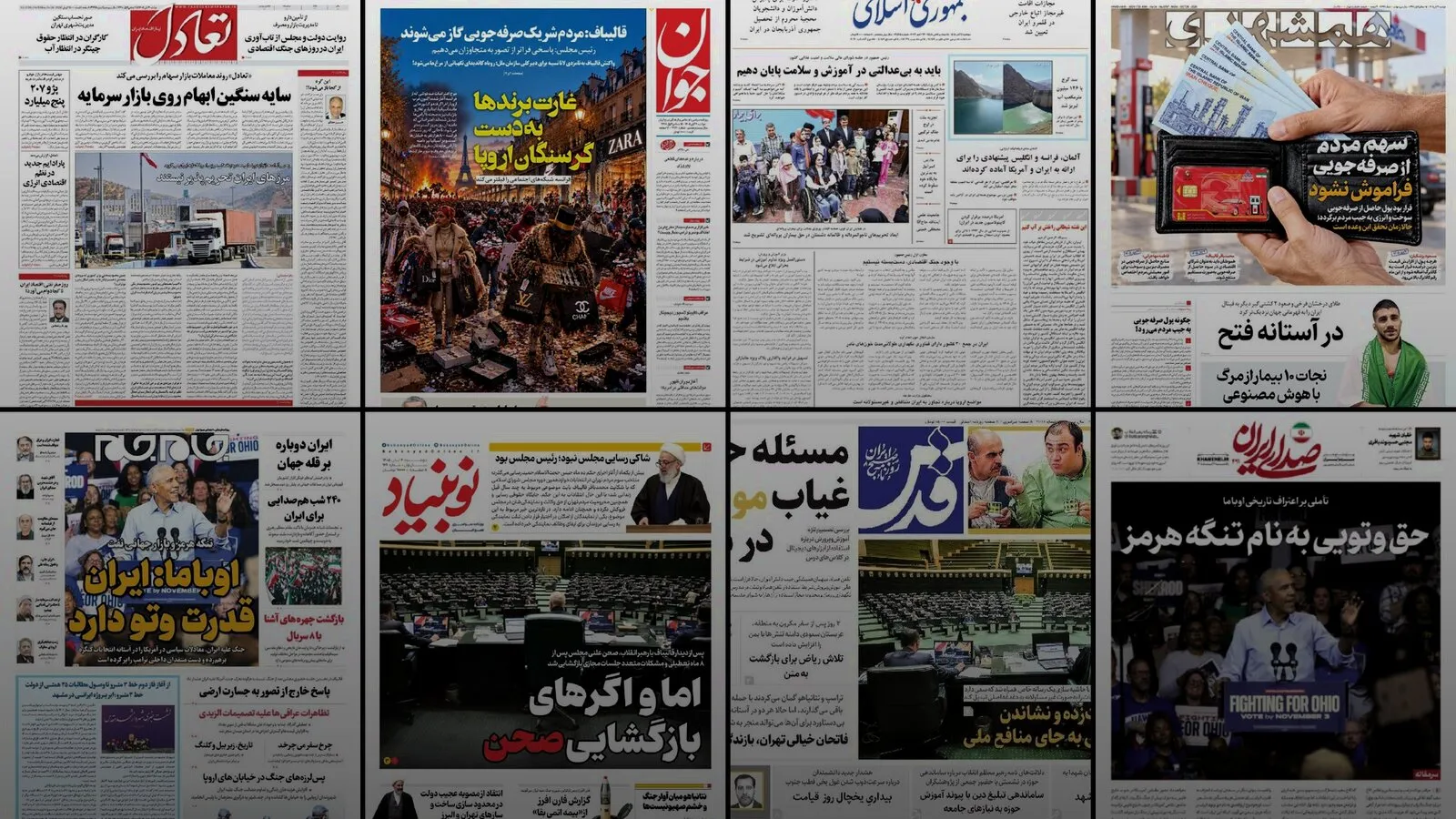
Bottom line: On the morning Iran’s parliament resumed regular plenary business for the first time since the war began, five Iranian surfaces including the Leader’s own paper took a line from an American former president’s campaign speech, that Iran now holds a veto over the Strait of Hormuz, and printed it as the regime’s doctrine, while the cycle’s one genuinely new strategic fact, the arrival in Tehran of the Saudi defence minister, Pakistan’s army chief and Turkey’s intelligence chief, appeared on no front page at all.
Executive Summary
The lead judgment of this edition is that the Iranian press has adopted an adversary’s words as its own strategic doctrine, and that it did so across institutional lines within forty-eight hours. Speaking in Cleveland on Saturday 24 October for the Democratic candidates Sherrod Brown and Amy Acton, Barack Obama attacked the Trump administration’s war and said that Iran now has veto power over the Strait of Hormuz, where oil goes through to get to the world, and that this is the reason the price of oil is up. By Monday morning the sentence is on five Iranian surfaces in four different institutional lanes. Seda-ye Iran, published by the office for the preservation and publication of the Leader’s works, gives its entire front page to «حق وتویی به نام تنگه هرمز», a right of veto by the name of the Strait of Hormuz, under the kicker «تأملی بر اعتراف تاریخی اوباما», a reflection on Obama’s historic confession. Jam-e Jam, the state broadcaster’s daily, prints «اوباما: ایران قدرت وتو دارد». Javan, the Guard-affiliated daily, prints «اوباما: حق وتوی هرمز را به ایران دادیم», we gave Iran the veto over Hormuz. The government’s own paper prints «حق وتوی ایران بر شریان نفت جهان», Iran’s right of veto over the world’s oil artery. Vatan-e Emrooz carries the same material under «ایران قدرتمندتر شده است». Four institutional lanes printing one borrowed formula in one cycle indicates centrally guided message discipline rather than organic editorial convergence.
The significance is in what the borrowing does to a claim this monitor has been tracking for three cycles. Two editions ago the principlist press conceded in body text that Hormuz traffic had stopped and left the agency ambiguous. One edition ago Kayhan’s managing editor closed that ambiguity from the hardline side, claiming the closure as Iran’s own instrument and calling it «هدیه الهی», a divine gift. Today the same claim is republished with an American warrant attached, which converts a boast into a finding and makes it very much harder to walk back. It also changes who the claim is for: a divine gift is addressed to the faithful, a confession extracted from the enemy is addressed to everyone else. Note what the formula quietly does to the facts: Obama said the war had handed Iran a veto, as an indictment of the administration that started it. The Iranian pages print the veto and drop the indictment’s premise, which is that the leverage is a product of American failure rather than of Iranian design.
The cycle’s principal domestic event is that the Islamic Consultative Assembly resumed regular plenary business. Nobonyad’s front page dates it precisely: «پس از دیدار قالیباف با رهبر انقلاب، صحن علنی مجلس پس از ۸ ماه تعطیلی و مشکلات متعدد جلسات مجازی بازگشایی شد», after Ghalibaf’s meeting with the Leader of the Revolution, the public floor of parliament reopened after eight months of closure and the many problems of virtual sessions. Jam-e Jam confirms it as «نخستین جلسه حضوری مجلس بعد از جنگ». Sobh-e No’s front-page headline is simply «جلسه علنی در صحن». Qods runs a wide photograph of the chamber. Jomhouri-ye Eslami carries the first legislative product, a schedule of penalties for unauthorised residence by foreign nationals. The eight-month figure is the paper’s own and counts from the suspension of 28 February, passing over the single in-person sitting of 12 July; the accurate description is the resumption of regular plenary business, not the first sitting since the war. The causal claim printed on the page is the striking part: the chamber reopened because the Speaker went to see the Leader, which assigns a legislature’s own procedure to an audience with an office-holder no one has seen.
The restoration is not being celebrated uniformly, and the quarrel is inside the principlist camp. Nobonyad, a principlist paper, uses the morning of the Speaker’s success to run, in the box above its own lead, the charge «شاکی رسایی مجلس نبود؛ رئیس مجلس بود», Rasaei’s plaintiff was not the parliament, it was the Speaker of parliament. Hojjat al-Islam Hamid Rasaei, elected third on the Tehran list, began a ten-month sentence on 27 September after a complaint by Mohammad-Baqer Ghalibaf, and is the first sitting member of the Iranian parliament imprisoned during his term; Rasaei is a declared opponent of renewed talks with Washington and Ghalibaf is read by part of the principlist camp as favouring them. Qods, from the opposite side, complains on its own front page that «بازگشت جلسات مجلس به صحن علنی با حاشیهسازی یک رسانه خاص همراه شد», that the return of sessions to the chamber was accompanied by one particular outlet manufacturing a side-issue, under the headline «رسانه سیاستزده و نشاندن دعوای سیاسی به جای منافع ملی». Read together the two pages are a live factional fight about the Speaker, conducted in print on the day of his restoration.
The hardest fact of the cycle is on the wires and on no front page. The foreign ministry spokesman Esmaeil Baghaei, carried by Defa Press and Fars News and independently reported by Reuters through the Etemad Online channel, says that the Saudi defence minister, Pakistan’s army chief and Turkey’s intelligence chief will attend a joint meeting in Tehran with the Secretary of the Supreme National Security Council. Fars and Nour News publish a photograph of a Saudi C-130 Hercules transport at Mehrabad airport, which is the only physical corroboration available. This is three American-aligned regional militaries putting their most senior security principals on the ground in Tehran, and it is carried as agency copy while nine front pages lead on a borrowed slogan, on a reopened chamber, on European looting and on the fuel-savings dividend. The gap between the significance of the event and its placement is the single clearest editorial signal in the batch.
Against the leverage argument, the Iranian economic press continues to price what the political press narrates, and the vocabulary it uses has sharpened. Ta’adol leads on «سایه سنگین ابهام روی بازار سرمایه», the heavy shadow of ambiguity over the capital market, choosing ambiguity rather than loss as the market’s dominant condition, and runs a signed column headed «روز صفر نفتی؛ اقتصاد ایران تا کجا دوام میآورد؟», oil zero day: how far can Iran’s economy hold out. The security-council-linked wire quotes gold back near $4,000 an ounce after the collapse from a $5,400 peak that led the economic press one cycle ago, and the Etemad channel carries oil at the same $117 it carried a week ago. The most awkward datum is printed by a hardline paper: Vatan-e Emrooz carries a Middle East Eye citation of Kpler data showing regional exports back at pre-war levels, with some analysts treating the price move as a temporary spike. No page in the batch reconciles a veto over the world’s oil artery with a price that has stopped moving and an export series that has recovered.
Four papers have replaced a claim of military victory with a claim about their adversaries’ elections, and the substitution has a date on it. Nobonyad’s front-page column by the journalist Mohsen Pourdadfar, «نتانیاهو میان آوار جنگ و خشم صهیونیستها», argues that three years of multi-front war with full American backing has left Netanyahu facing a crisis of public confidence, bereaved families’ protests, a split in his own camp and the charge of exploiting the Iranian threat for votes. Qods prints the same argument about both leaders as «فاتحان خیالی تهران، بازندگان احتمالی انتخابات», the imaginary conquerors of Tehran and the probable losers of the elections. Jam-e Jam’s deck says the war has upset American political equations before the congressional elections and freed the hands of Trump’s domestic critics. Nobonyad’s international page prints it as the Democrats’ revolt. The Israeli ballot falls on 27 October, with polling through the final week showing Netanyahu and the retired chief of staff Gadi Eisenkot close and neither bloc near a majority, and the American midterms fall on 3 November. The Etemad channel meanwhile reports Trump posting a direct appeal to Israelis to vote for Netanyahu, citing the strikes on Iran’s nuclear programme.
Two softening signals appear in the batch and neither is owned by an Iranian official. Jomhouri-ye Eslami prints, attributed to unnamed European diplomatic sources, that Germany, France and Britain have prepared a proposal to put to both Iran and the United States, describing a phased scheme reaching negotiations on a comprehensive nuclear agreement and the settlement of sanctions and frozen assets, alongside a Chinese call for the Agency’s examination of the Iranian file to stop. The same page boxes «آمریکا درصدد برقرار کردن کاپیتولاسیون جدید در ایران!», America is seeking to establish a new capitulation in Iran, invoking the 1964 immunity law whose passage produced the founder’s exile, and Javan independently runs «مراقب کاپیتولاسیون دیجیتال باشیم» on its own rail. Pairing an exit with the grievance that makes exits suspect is how this press has handled every opening in this record. In the other direction, a commentary on the Sobh-e No channel raises, as a conditional, a change in Iran’s nuclear doctrine in the event of an American tactical strike: the softest available way of putting that question back on a principlist page.
The Iraqi file moved materially. Iran Daily’s exclusive interview reports that Shalamcheh, the crossing Iranian officials recommended as the alternative when al-Sheeb, known in Iran as Chazabeh, closed on 21 October, is now itself closed on the stated grounds of technical problems, with passengers from both countries stranded and southern Iraqi local authorities negotiating with Khuzestan to reopen it. Kayhan and Jam-e Jam both report Iraqi street protests against the Chazabeh closure in Maysan province, which is a different posture from the one this monitor recorded one cycle ago, when Sobh-e No was welcoming armed factions boxing in Prime Minister Ali al-Zaidi’s government. Ta’adol answers the whole file with a photograph of lorries at a frontier post captioned «مرزهای ایران تحریمپذیر نیستند», Iran’s borders are not sanctionable, which is an assertion rather than a report.
Net assessment: this is a borrowed-warrant edition, and the borrowing is doing work that Iran’s own position cannot currently do for itself. The military position did not change in the monitored twenty-four hours; the price series that underwrites the leverage argument has stopped moving in Iran’s favour and the export series has recovered; the parliament came back only after its Speaker went to see a Leader no one has seen; and the only genuinely new strategic development, a tri-national security delegation landing in Tehran, was handled as agency copy. What filled that space instead was an American politician’s sentence and a bet on two foreign ballots. Both the sentence and the bet are external validations, and both are outside Iranian control. The thing to watch over the next eight days is what this press prints after 27 October and after 3 November, because an edition built on adversaries losing their elections has no second position prepared if they do not.
Key Judgments
- KJ-1 [HIGH] Iran’s media system has adopted an American former president’s campaign line as its own chokepoint doctrine, across four institutional lanes within forty-eight hours, which indicates centrally guided message discipline rather than editorial convergence. The evidence is one formula on five surfaces: Seda-ye Iran, the Leader’s own outlet, with «حق وتویی به نام تنگه هرمز» under «تأملی بر اعتراف تاریخی اوباما»; Jam-e Jam, the state broadcaster’s daily, with «اوباما: ایران قدرت وتو دارد» under the kicker «تنگه هرمز و بازار جهانی نفت»; Javan, Guard-affiliated, with «اوباما: حق وتوی هرمز را به ایران دادیم»; the government’s Iran newspaper with «حق وتوی ایران بر شریان نفت جهان»; and Vatan-e Emrooz with «ایران قدرتمندتر شده است». The underlying remark is confirmed: at a Cleveland rally on 24 October for Sherrod Brown and Amy Acton, Obama said Iran now has veto power over the Strait of Hormuz, where oil goes through to get to the world, and that this is the reason the price of oil is up. The significance is that a claim this monitor watched migrate from ambiguous consequence to claimed Iranian policy over two cycles has now acquired an external warrant, which makes it a stronger negotiating position and a harder one to retract. Calibration: the Iranian rendering is accurate as to Obama’s words and silently drops his premise, that the leverage is a product of American failure rather than Iranian design.
- KJ-2 [HIGH] Iran’s parliament has resumed regular plenary business for the first time since the war’s opening weeks, and the papers attribute the restoration to the Speaker’s audience with a Leader no one has seen. The evidence is Nobonyad’s kicker, «پس از دیدار قالیباف با رهبر انقلاب، صحن علنی مجلس پس از ۸ ماه تعطیلی و مشکلات متعدد جلسات مجازی بازگشایی شد»; Jam-e Jam’s «نخستین جلسه حضوری مجلس بعد از جنگ»; Sobh-e No’s front-page headline «جلسه علنی در صحن»; Qods’s chamber photograph; and Jomhouri-ye Eslami’s report of the chamber’s first legislation, penalties for unauthorised residence by foreign nationals. External reporting of 19 October had online sessions running no more than twice a week with 117 members petitioning for a return to in-person business, and of 21 October had the Speaker meeting the unseen Supreme Leader. The significance is dual: the regime is signalling institutional normalisation eight months into the war, and it is simultaneously recording that a legislature’s own procedure turned on a private audience with an office-holder who has not appeared in public since the succession. Calibration: Nobonyad’s eight-month count runs from 28 February and passes over the single in-person sitting of 12 July, so the correct description is the resumption of regular plenary business, not the first sitting since the war.
- KJ-3 [HIGH] Three American-aligned regional militaries sent their most senior security principals to Tehran in this cycle, and no Iranian front page carries it. The evidence is the foreign ministry spokesman Esmaeil Baghaei, reported by Defa Press and Fars News, saying the Saudi defence minister, Pakistan’s army chief and Turkey’s intelligence chief will attend a joint meeting in Tehran, with Fars adding that the Iranian principal is the Secretary of the Supreme National Security Council; Reuters reporting the same meeting through the Etemad Online channel; and a photograph published by Fars and Nour News of a Saudi C-130 Hercules transport at Mehrabad airport. The significance is that this is a movement rather than a statement, and it is the cycle’s only new strategic fact: Riyadh, Islamabad and Ankara coordinating security with Tehran at the level of defence minister, army chief and intelligence chief, while the Yemen front is closing Gulf airspace and Washington is tightening a maritime blockade. Calibration: participants are recorded by office because no Iranian surface named them, and a single military transport photograph is corroboration of an arrival rather than of an agenda.
- KJ-4 [MODERATE-HIGH] The public argument about how to end the war, which organised the entire previous edition, has been displaced rather than resolved. The evidence is subtractive and specific. One cycle ago Pezeshkian’s statement that the condition of «نه جنگ، نه صلح» must end appeared on five of nine front pages with five incompatible continuations, from negotiation from strength through reconstruction to the Guard daily’s flat rejection of negotiation. Today it appears once, as a single line in a headline roundup on the President’s own paper’s channel. The President himself is on two front pages, Jomhouri-ye Eslami’s lead and an Iran Daily side item, both on health policy. The significance is that a doctrine of standing leverage requires no exit and therefore no argument about one: the veto formula is not an answer to the exit question, it is a way of not asking it. Calibration: one cycle of displacement is not resolution, and the question will return the moment the price series or the diplomatic track moves.
- KJ-5 [MODERATE-HIGH] Kayhan has converted the economic-war claim from rhetoric into asserted machinery and an asserted transaction, both of which are checkable and neither of which is substantiated. The evidence is the paper’s lead, «تشکیل شورای جنگ اقتصادی، پاتک ایران به ترامپ», which presents an economic war council as the answer to American pressure, dates it against the expiry of what the paper calls the US Treasury Secretary’s claimed deadline for Iran’s economic collapse, and attributes remarks to Mohsen Rezaei as Secretary of the Supreme National Security Council; paired with «ایران با مصادره محموله نفتکش آمریکایی حق ۷۷۱ بیمار پروانهای را از آمریکا گرفت» and with a claimed 1.5 billion litre diesel saving. The American campaign it answers is real: shadow-fleet designations through October and a Treasury announcement of 22 October that Iran’s oil lifeline had been cut. The significance is that one cycle ago the same outlet’s claim was theological and unfalsifiable; today it is institutional and specific, which is a sign of pressure to produce evidence of effect. Recorded throughout as unverified Iranian claims: no cargo seizure of this description appears in the open record.
- KJ-6 [MODERATE-HIGH] Four Iranian papers have substituted the electoral defeat of Iran’s adversaries for a claim of military victory, and the substitution carries a hard expiry date. The evidence is Nobonyad’s front-page column by Mohsen Pourdadfar, «نتانیاهو میان آوار جنگ و خشم صهیونیستها», on a crisis of public confidence, protests by bereaved families, a split in Netanyahu’s camp and the charge of exploiting the Iran threat for votes; Qods’s «فاتحان خیالی تهران، بازندگان احتمالی انتخابات»; Jam-e Jam’s deck on the war freeing the hands of Trump’s domestic critics before the congressional elections; and Nobonyad’s page-seven «شورش دموکراتها علیه ترامپ». The Israeli ballot is on 27 October, with Netanyahu and Gadi Eisenkot close in final-week polling and neither bloc near sixty-one seats, and the American midterms on 3 November. The significance is that Iranian expectations are now explicitly pinned to two foreign results Tehran does not control, and the Etemad channel’s report that Trump has openly asked Israelis to vote for Netanyahu shows the other side treating the same ballot as a referendum on the war. Calibration: overreading this would turn editorial hope into assessed policy; underreading it would miss that this press has, for one cycle, stopped claiming to be winning.
- KJ-7 [MODERATE] The Iraq-Iran land corridor has narrowed again, and the Iranian frame has shifted from backing armed factions to claiming the Iraqi street. The evidence is Iran Daily’s exclusive interview reporting that Shalamcheh is now closed on stated technical grounds with travellers stranded and southern Iraqi authorities negotiating with Khuzestan to reopen it, which matters because Shalamcheh is the crossing Iranian officials recommended when al-Sheeb, known in Iran as Chazabeh, closed on 21 October for a security review and the installation of smuggling-detection equipment; Kayhan’s «تظاهرات مردم خشمگین عراق به نفع ایران و علیه بسته شدن مرز چذابه»; Jam-e Jam’s report of price rises and spreading protests in Maysan; and Jam-e Jam’s separate interview line that Iran-Iraq trade has stopped. Reporting attributes the closures to American pressure on Baghdad to reduce the number of operational crossings. The significance is that the frame has broadened from the factional endorsement this monitor recorded one cycle ago to a claim of popular Iraqi support, which is both harder to verify and harder to disown. Track the al-Zaidi file and the crossing count as named standing threads.
- KJ-8 [MODERATE] Negative evidence, filed as a finding: the security wire linked to the Supreme National Security Council has now been silent on imminence for a second consecutive cycle, and is silent on the meeting its own council is hosting. The evidence is a measured absence. Two cycles ago Nour News carried the zero-hour warning of prepared American and Israeli plans against Iranian industrial infrastructure and the missile arsenal. One cycle ago it published no imminence material. Today its security output is the Hormuz cost argument, «تنگه هرمز و تحمیل هزینه به غرب», the Wall Street Journal on airlines rerouting around Saudi airspace, an Asian football dispute and a gold quotation, with nothing at all on the Saudi, Pakistani and Turkish delegation meeting its own secretary, which Fars and Defa Press both carried. The significance is that the channel that distributes centrally available security signalling has moved from warning to cost accounting, and has chosen not to put its own council’s diplomacy on its own feed. Calibration: silence on a hosted meeting is more readily explained by protocol than by policy, which is why this is filed at moderate rather than higher.
- KJ-9 [MODERATE] Iran’s economic press is now publishing the endurance question in terms its political press does not acknowledge, and a hardline paper has printed the datum that most undercuts the leverage argument. The evidence is four items in one batch: Ta’adol’s lead «سایه سنگین ابهام روی بازار سرمایه», naming ambiguity rather than loss as the market’s condition; Ta’adol’s signed column «روز صفر نفتی؛ اقتصاد ایران تا کجا دوام میآورد؟»; Nobonyad’s page-five report that the gas imbalance again threatens industrial and power-station fuel on the edge of winter with no executable Russian contract; and Vatan-e Emrooz carrying a Middle East Eye citation of Kpler data showing regional exports back at pre-war levels and the price move possibly temporary. Gold is quoted near $4,000 on the security wire after last cycle’s collapse from a $5,400 peak, and oil is unchanged at the $117 the Etemad channel carried a week ago. The significance is that the two price series that moved against Iran one cycle ago have now stopped moving at all, which is worse for the leverage argument than a fall: a veto that produces no further price response is not being exercised. Calibration: a flat week is not a trend, and the export-recovery figure is a single analyst citation in a hostile-to-the-argument direction, carried without comment.
- KJ-10 [MODERATE] Negative evidence, filed as a finding: the serving Leader has now gone a second consecutive cycle without appearing in any image, and the only message of his the batch records is institutional rather than strategic. The evidence is the shape of his presence: no photograph on any of nine front pages; a jurisprudence-lesson excerpt titled «شیطان را تحقیر کنید», citing Qur’an 4:76 on the weakness of Satan’s scheming, pushed as video through the Kayhan, Vatan-e Emrooz and Defa Press channels; a letter on the reorganisation of the seminary referenced by Qods and discussed at a researchers’ session; the audience with the Speaker to which Nobonyad attributes the chamber’s reopening; and Jam-e Jam’s «۲۴۰ شب همصدایی برای ایران», nightly gatherings said to continue on his instruction. The significance is that the succession’s authority is being exercised through instruction, attribution and a counter rather than through presence, and that on the edition’s central strategic claim, the Hormuz veto, the warrant invoked is an American politician’s and not the Leader’s. Calibration: no page in the batch disparages him, and the inference is from placement and form, not from any statement about his standing.
- KJ-11 [MODERATE] Two de-escalatory signals surfaced in this batch and neither is owned by an Iranian official, which is how this press has handled every opening in this record. The evidence is Jomhouri-ye Eslami’s sub-lead, «ادعای منابع دیپلماتیک اروپایی: آلمان، فرانسه و انگلیس پیشنهادی را برای ارائه به ایران و آمریکا آماده کردهاند», describing a phased scheme reaching negotiation on a comprehensive nuclear agreement and settlement of sanctions and frozen assets, with a Chinese call for the Agency’s examination of the Iranian file to be halted alongside it; and a commentary on the Sobh-e No channel raising a change in Iran’s nuclear doctrine as a conditional in the event of an American tactical strike. The first is attributed to unnamed Europeans, the second to a commentator, and the same Jomhouri-ye Eslami page boxes a warning that America seeks a new capitulation in Iran. The significance is that both the exit and the escalation are being aired without anyone in Tehran having to stand behind either. Calibration: an unsourced European proposal on a single front page is a weak indicator of an actual track, and the doctrine item is commentary, not policy.
- KJ-12 [LOW-MODERATE] The outward-facing English surface refreshed after two stale cycles and conspicuously withholds the chokepoint doctrine, which indicates the Hormuz veto is written for domestic consumption. The evidence is Iran Daily Vol 6248 of 26 October, after the kiosk album carried Vol 6246 twice: the banner is ‘Qalibaf: Any new aggression will trigger response beyond imagination’, the lead is ‘Nothing will be same as before aggression against Iran: Araghchi’ with the deck on American bases failing to bring security to their host countries, and the page’s reported exclusive is on Iraq struggling to keep its borders with Iran closed. The veto formula that leads four Persian surfaces appears nowhere on the English page. The significance is that Iran is selling deterrence and a changed baseline abroad while selling a claimed veto over world oil at home, which is a meaningful split between the audiences. Calibration: a single refreshed issue is a thin basis for an editorial inference, and a kiosk album’s refresh cycle is a distribution fact; the pattern of withholding the chokepoint claim from the English surface has now held for three cycles.
Macro Trends
- An adversary’s sentence promoted to doctrine on five surfaces. Obama’s Cleveland line that Iran now has veto power over the Strait of Hormuz appears on the Leader’s own paper as «حق وتویی به نام تنگه هرمز», on the state broadcaster’s daily as «اوباما: ایران قدرت وتو دارد», on the Guard daily as «اوباما: حق وتوی هرمز را به ایران دادیم», on the government paper as «حق وتوی ایران بر شریان نفت جهان» and on Vatan-e Emrooz as «ایران قدرتمندتر شده است». The Leader’s outlet calls it «اعتراف تاریخی», a historic confession. Four institutional lanes carrying one borrowed formula in a single cycle is message discipline, and the formula is rhetorically stronger than the divine-gift framing it replaces because the warrant is external.
- The chamber reopens, and the principlist camp fights over the Speaker who reopened it. Nobonyad dates the reopening to Ghalibaf’s meeting with the Leader and then uses the same page to charge that the Speaker personally put the only imprisoned sitting member there. Qods accuses an unnamed outlet of manufacturing a controversy out of the restoration. Sobh-e No simply headlines «جلسه علنی در صحن». Jomhouri-ye Eslami carries the chamber’s first legislative output. The restoration is real and the credit for it is contested, and the contest is internal to the principlist camp rather than between it and the reformists.
- The cycle’s hardest fact arrives by air and never reaches a front page. The Saudi defence minister, Pakistan’s army chief and Turkey’s intelligence chief are reported by the foreign ministry spokesman as meeting the Secretary of the Supreme National Security Council in Tehran, with a Saudi C-130 photographed at Mehrabad. Three American-aligned regional militaries putting their senior security principals on Iranian soil is the most consequential item in the batch and it is carried only by wires. The security-council-linked wire that is closest to the hosting institution publishes nothing about it at all.
- The presidential exit argument is displaced rather than settled. One cycle ago Pezeshkian’s sentence that the condition of «نه جنگ، نه صلح» must end ran on five of nine front pages with five incompatible continuations. Today it survives as a single line in a headline list on the President’s own paper. Nothing resolved the argument; a doctrine that requires no exit took its place. The President appears on two front pages in this batch, on health policy and on the Supreme Council for Health and Food Security, and on neither in connection with the war.
- Economic war turned into standing machinery and a falsifiable transaction. Kayhan leads on «تشکیل شورای جنگ اقتصادی، پاتک ایران به ترامپ», dating the council against the expiry of what it calls the American Treasury Secretary’s claimed deadline for Iran’s collapse, and pairs it with the claim that Iran confiscated an American tanker’s cargo and converted it into the entitlement of 771 epidermolysis bullosa patients. The shift matters: a claimed divine gift cannot be checked, a claimed council with a named secretary and a claimed seizure can be. Nothing in the open record substantiates either.
- Adversary elections substituted for military victory. Nobonyad’s front-page column puts Netanyahu between the rubble of war and the anger of his own public; Qods calls Trump and Netanyahu the imaginary conquerors of Tehran and the probable losers of the elections; Jam-e Jam says the war has freed the hands of Trump’s domestic critics; Nobonyad’s international page prints the Democrats’ revolt; Javan’s lead gives Europe over to hunger and looting and its rail asks what is behind the Vance-Trump rift. The Israeli ballot is on 27 October and the American midterms on 3 November, which gives this frame a hard expiry date.
- The economic press prices what the political press narrates. Ta’adol leads on «ابهام», ambiguity, as the capital market’s dominant condition and runs a column headed «روز صفر نفتی؛ اقتصاد ایران تا کجا دوام میآورد؟». Gold is quoted back near $4,000 after the collapse from a $5,400 peak and oil is unchanged at the figure carried a week ago. Vatan-e Emrooz, a hardline paper, carries a Kpler-based citation that regional exports are back at pre-war levels and that the price move may be temporary. Nobonyad reports Iran entering winter with a gas imbalance and no executable Russian contract. None of this is reconciled with a veto over the world’s oil artery anywhere in the batch.
- The second Iraqi crossing closes and the Iranian frame switches to the Iraqi street. Iran Daily reports Shalamcheh closed, the crossing Iranian officials recommended when al-Sheeb, Chazabeh in Iranian usage, closed on 21 October, with travellers stranded and Iraqi local authorities negotiating to reopen it. Kayhan and Jam-e Jam report protests in Maysan against the Chazabeh closure. One cycle ago the Iranian frame was armed factions boxing in the al-Zaidi government; today it is an Iraqi public said to be protesting in Iran’s favour, which is a broader and more deniable claim of Iraqi support.
- Capitulation reactivated as a frame from two directions at once. Jomhouri-ye Eslami boxes «آمریکا درصدد برقرار کردن کاپیتولاسیون جدید در ایران!», invoking the 1964 immunity law whose passage produced the founder’s exile, on the same page that reports an E3 proposal reaching phased sanctions relief and frozen assets. Javan independently runs «مراقب کاپیتولاسیون دیجیتال باشیم». The founding grievance of the revolution is being applied simultaneously to an alleged American legal demand and to foreign technology platforms, which pre-frames both a negotiated settlement and a connectivity opening as surrender.
- The Leader present as a name, a number and an audio file, and not as a face. No front page in this batch carries a photograph of the serving Leader. His appearances are a jurisprudence-lesson clip titled «شیطان را تحقیر کنید» pushed through three channels, a letter on reorganising the seminary referenced by Qods, the audience that Nobonyad says caused the parliament to reopen, and Jam-e Jam’s count of «۲۴۰ شب همصدایی برای ایران», nightly gatherings attributed to his instruction. Authority is being exercised and attributed; the person remains unseen for the second consecutive cycle in this record and no imagery or recording has been released since the succession.
Front-Page Snapshot
- Seda-ye Iran - “A right of veto by the name of the Strait of Hormuz” (The Leader’s office publication (KHAMENEI.IR)) - Obama’s campaign line printed as a historic confession and promoted to doctrine [SEVERE]
- Jam-e Jam - “Obama: Iran has veto power” (Daily of the state broadcaster (IRIB)) - The veto line as the lead, the Speaker’s warning from the restored chamber, Iraqi protests against the border closures [HIGH]
- Javan - “The looting of the brands at the hands of Europe’s hungry” (Hardline, IRGC-affiliated) - Europe framed as dissolving into hunger and looting, with Obama carried below as corroboration; the lead image is a synthetic composite [MODERATE-HIGH]
- Iran - “Iran’s right of veto over the world’s oil artery” (Official government daily (read from the paper’s channel)) - The veto doctrine on the government surface as the presidential exit question drops out of sight [HIGH]
- Vatan-e Emrooz - “Iran has become stronger” (Hardline / principlist (read from the paper’s channel)) - Obama carried a fifth time, alongside the one market datum in the batch that cuts against the leverage argument [MODERATE]
- Sobh-e No - “Open session in the chamber” (Principlist (read from the paper’s channel)) - The restored chamber as the headline, with a conditional nuclear-doctrine scenario in the commentary [MODERATE-HIGH]
- Nobonyad - “The ifs and buts of reopening the chamber” (Conservative / principlist) - The chamber reopens after the Speaker’s audience with the Leader, and the same page indicts him over a jailed member [MODERATE]
- Qods - “The question of the mobiles’ attendance and absence at school” (Conservative, Astan Quds Razavi, Mashhad) - The restored chamber reported as a manufactured media controversy; the Leader’s seminary letter as the cycle’s only authoritative message [LOW-MODERATE]
- Kayhan - “An economic war council is formed: Iran’s counter-strike against Trump” (Hardline, closest to the Leader’s office (read from the paper’s channel)) - Economic war turned into standing machinery, with an unverified seizure of an American cargo as its first claimed return [HIGH]
- Etemad - “Heavy explosions in the Strait of Hormuz on the eve of the global oil market’s reopening” (Reformist (read from the Etemad Online channel)) - Tanker explosions in the southern corridor set against a regional security meeting convening in Tehran [HIGH]
- Agency wires - “Senior Saudi, Turkish and Pakistani officials travel to Tehran” (Defa Press, Fars News, Nour News) - Saudi, Pakistani and Turkish security chiefs arrive in Tehran as the Yemeni front keeps raising the aviation cost [HIGH]
- Iran Daily (English) - “Qalibaf: Any new aggression will trigger response ‘beyond imagination’” (English-language state daily) - The English surface returns after two stale cycles with deterrence and Araghchi, and confirms a second Iraqi crossing closed [MODERATE-HIGH]
- Jomhouri-ye Eslami - “We must put an end to injustice in education and health” (Traditional establishment) - An attributed European proposal on the nuclear file set against a new capitulation warning on the same page [MODERATE]
- Ta’adol - “The heavy shadow of ambiguity over the capital market” (Economic) - Policy ambiguity priced into equities while a column asks how long Iran lasts at oil zero [MODERATE]
- Hamshahri - “Let the people’s share of the savings not be forgotten” (Tehran municipality, centrist) - The fuel-saving dividend demanded back from the government, with three officials’ dated promises printed as a ledger [LOW-MODERATE]
Full report
The complete edition - per-paper front-page analysis and full translation appendices - is available as a PDF: Download the full report.
Compiled from Iranian front pages and outlet channels via open-source monitoring. Translations are editorial; named-figure attributions are verified against the source pages where possible.