Iranian Press Monitor - Saturday, 24 October 2026 (Day 235)
Saturday, 24 October 2026 · شنبه ۲ آبان ۱۴۰۵ · 13 Jumada al-Awwal 1448 - Eight Iranian front pages of 2 Aban 1405 read in full, together with the English-language Iran Daily, six newspaper channels and three agency wires. Kayhan’s page is read from the paper’s own channel listing because it did not reach the kiosk album, and Tehran Times was not available at the time of compilation.
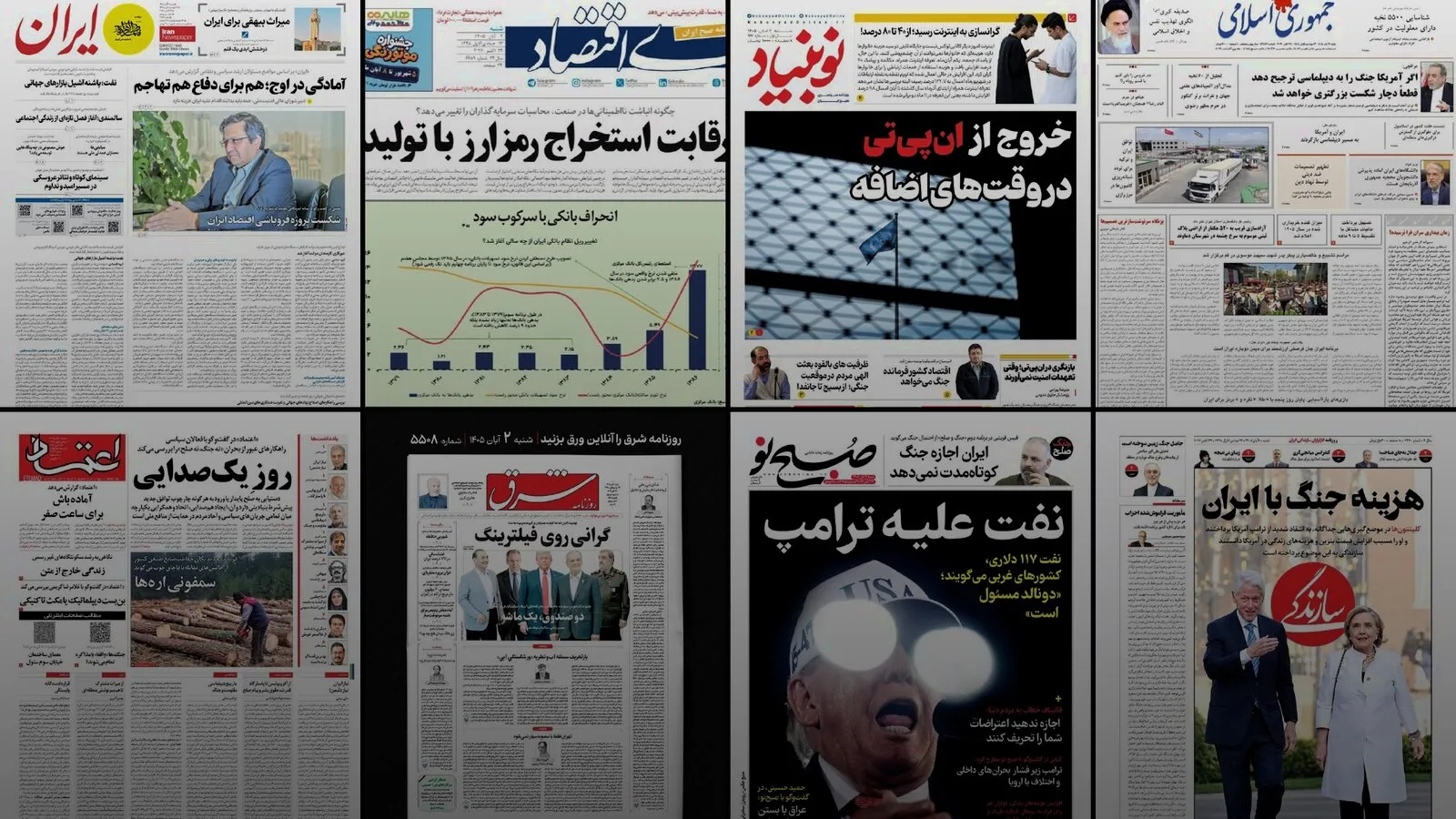
Bottom line: On the morning Iranian papers across three factions printed warnings of an imminent American and Israeli strike, the escalation that actually advanced in print was nuclear: a conservative daily gave its entire front page to leaving the Non-Proliferation Treaty, which means the doctrinal question recorded two cycles ago as a single right-rail remark has become a published argument with a lead headline behind it.
Executive Summary
The lead judgment of this edition is that the nuclear-doctrine question has crossed from aside to argument in forty-eight hours of publishing time. On 22 October this monitor filed the question as live on both sides for the first time, on the evidence of one unbannered right-rail box in Kayhan carrying its managing director saying the doctrine on producing a nuclear weapon may change as the times change, paired with an Israeli accusation relayed on an Iranian channel. Today Nobonyad, a conservative daily, gives the whole of its front page to «خروج از انپیتی در وقتهای اضافه», leaving the NPT in injury time, printed across a photograph of the United Nations flag seen through razor wire, and supports it with two separate pieces of its own. The signed editorial by Alireza Bahrami argues that «تجربههای جنگ ۱۲ روزه و جنگ رمضان باید یک تصور خطرناک را در سیاست خارجی ایران به چالش بکشد», that the twelve-day war and the Ramadan war must challenge the assumption that compliance, transparency and one-sided confidence-building can buy security from parties that use sanctions and force, and it closes the case with the facts of the file: Iran cooperated with the Agency, was subject to the severest inspections, and its facilities were struck and its scientists assassinated anyway. A third item on the same page reports that «مطالبه بازنگری در دکترین هستهای ایران از یک بحث محدود سیاسی فراتر رفته است», the demand for revision has moved beyond a confined political debate. This is one small masthead and not a policy organ, and the injury-time metaphor concedes that nothing has been decided, but a structured public case is a different object from a remark, and cases of this kind are normally built in the smaller press before they appear in the large.
The cycle’s second finding is an imminence signal carried simultaneously by papers that agree on nothing else. Etemad, reformist, runs «آماده باش برای ساعت صفر», alert for zero hour, and reports American and Israeli plans against Iranian industrial infrastructure and the missile arsenal, sourced in its body text to American officials, with the caveat that it is not yet clear whether Donald Trump will approve them. Shargh, also reformist, runs «دو صندوق، یک ماشه», two boxes and one trigger, captioned as a report on a pass in the war’s fate and on «ادعاهای اطلاعاتی آمریکا و اسرائیل», the intelligence claims of America and Israel. Nour News, linked to the Supreme National Security Council, publishes the same picture in security-service register: reports indicate the preparation of new American and Israeli attack options, Tom Barrack is said to have called an attack likely at the weekend, Trump’s reaction is called ambiguous, CNN’s report of American diplomats being moved out of regional posts is folded in, and the summary then states plainly that «وقوع حمله و زمان احتمالی آن هنوز تأیید نشده است», the attack and its timing are not confirmed. Three surfaces from two factions plus the security wire, carrying one imminence signal with the confirmation caveat intact, is centrally available information being distributed rather than a panic.
Against that warning the state apparatus published readiness in three registers in one morning. The government’s own daily leads on «آمادگی در اوج؛ هم برای دفاع هم تهاجم», readiness at its peak for defense and for offense alike, attributing it not to a named commander but to the aggregate positions of senior political and military officials, and carrying one attributed line from the Secretary of the Supreme National Security Council: «همه باید بدانند اقدام علیه ایران هزینه دارد», everyone must know that action against Iran carries a cost. The Jam-e Jam channel carries the Army Ground Forces commander ordering units to hold readiness at the highest level, with the warning that in a state of war any negligence carries heavy costs. And the Chief of the General Staff, Major General Ali Abdollahi, in a statement carried verbatim by both Defa Press and Fars News, says «تحت هیچ شرایطی نمیگذاریم ناوهای زنگزده آمریکا دوباره وارد خلیج فارس شوند», that under no circumstances will America’s rusty warships be allowed back into the Persian Gulf, and claims the US Navy has been rendered unable to approach Iran’s territorial waters. The same statement contains the cycle’s most revealing passage on the nuclear question: Abdollahi turns Trump’s own two claims against each other, that the facilities were destroyed and that Iran must not have a weapon, and asks what the repetition means if the first is true. The claim about the US Navy is an assertion by an Iranian commander and nothing in the monitored set tests it.
The oil price has become the Iranian press’s shared instrument, and this cycle it carries a number and a mechanism. Brent passing $117 appears on four front pages and three channels within one morning: Kayhan leads on «قیمت نفت از ۱۱۷ دلار عبور کرد» with American technology stocks falling in the shadow of the oil shock, Sobh-e No fills its page with «نفت علیه ترامپ», oil against Trump, Donya-e-Eqtesad examines «پیام نفت ۱۱۷ دلاری», the message of $117 oil, and the Vatan-e Emrooz kiosk item calls it «رکورد رسوایی ترامپ», Trump’s record scandal, the highest level since the Ramadan war. The IRGC spokesman’s own posting, relayed by the Iran newspaper and Sobh-e No channels, gives Brent at $117.30 and West Texas Intermediate at $103.57. What makes this more than a scoreboard is the accompanying argument, assembled almost entirely from Western officials’ words as rendered by Iranian outlets: Poland’s prime minister saying it must be stated loudly that Trump is responsible for fuel prices, Emmanuel Macron insisting «این جنگ، جنگ اروپا نیست», that this war is not Europe’s war, France’s foreign minister warning each new tension raises the price, Britain’s foreign secretary Ed Miliband saying the Iran war has driven British inflation and that the country cannot bear its continuation, and Germany’s foreign minister saying the conflict has no military solution. Sazandegi reaches the same conclusion through the Clintons. Four Iranian factions have converged on the proposition that the chokepoint’s cost is being paid inside the Western alliance.
Two things in the same cycle complicate that proposition from inside Iran’s own press. Sobh-e No’s lead text concedes, in a clause its headline does not carry, that the oil price rose «پس از دستور او برای محاصره طولانیمدت بنادر ایران», after Trump’s order for a prolonged blockade of Iran’s ports, and that «تردد شناورهای متخلف در تنگه هرمز به کلی متوقف شده», traffic of non-compliant vessels through the Strait has stopped completely. That is the first description in this monitor’s record of pressure running in both directions on the waterway, and it sits awkwardly beside Kayhan’s own evidence of success, an American carrier’s fuel bill up 67.5 percent with a $269 million loss and QatarEnergy negotiating to buy American LNG, both of which Kayhan attributes to «بستهشدن تنگۀ هرمز», the closure of the Strait. Closure is now the fifth Iranian formula for the waterway in four cycles, after closed, not fully open, not completely closed, and the IRGC Navy’s managed and controlled of 22 October. Separately, Donya-e-Eqtesad prints the domestic cost in the only terms its readership trusts: capital leaving manufacturing for cryptocurrency mining because production has become the riskier bet, under a question no political paper in the batch is permitted to ask, «ایران و آمریکا در آستانه جنگ سوم؟».
The standing escalation threads moved unevenly. The submarine-cable file, which this monitor has tracked from a spokesman’s warning on 20 October to a signed column on 21 October to the Guard daily’s lead image on 22 October, today acquires a named senior commander and a second target class: Kayhan’s front page carries «سرلشکر محسن رضایی هشدار داد: هدف قرارگرفتن کابلهای ارتباطی و مراکز داده منطقه در صورت تجدید جنگ», Major General Mohsen Rezaei warning that the region’s communication cables and data centres will be targeted if the war resumes. Extending the threat from the cables to the data centres behind them widens the target class from transit to storage and is the single most consequential escalation line in the batch. The seven-vessel interdiction claim of 22 October has no successor in this cycle: no new shipping claim appears on any front page, channel or wire read here. The numbered drone-attrition series is absent for a fourth consecutive cycle, and no shootdown claim of any kind appears in the monitored set.
The diplomatic track reappeared in print after a cycle of being closed from both ends, and it reappeared with a venue. Jomhouri-ye Eslami leads on the foreign minister by name, «عراقچی: اگر آمریکا جنگ را به دیپلماسی ترجیح دهد قطعاً دچار شکست بزرگتری خواهد شد», if America prefers war to diplomacy it will certainly suffer a bigger defeat, with the conditional offer restated in the deck. Its right rail reports «نشست هفت کشور در اسلامبول برای جلوگیری از گسترش درگیریهای منطقهای», a seven-country meeting in Istanbul to prevent the spread of regional conflicts, and Sazandegi’s banner independently calls the same session «کنفرانس میانجیگری / نشست استانبول برای مهار جنگ», the mediation conference to contain the war. The Etemad channel, citing Tasnim, supplies the roster: the foreign ministers of Germany, France, Italy, Pakistan, Egypt and Saudi Arabia met Erdogan in Istanbul on Friday evening to discuss regional developments, the situation of the Strait of Hormuz and America’s war against Iran. Running alongside it is a second, bilateral track that reached only one channel: Araghchi, writing on the Iran newspaper’s channel, says he hosted Sergey Lavrov in Tehran this week and that «هفته آینده این گفتوگوها و رایزنیها، با حضور روسای جمهور دو کشور در مسکو استمرار خواهد یافت», that next week the consultations continue with the two presidents in Moscow, confirming that Masoud Pezeshkian will travel to Russia. Against both, Shargh prints Mohsen Rezaei saying the negotiations have stopped.
Net assessment: this is a threshold edition rather than an escalation edition. Nothing happened in the monitored twenty-four hours that an Iranian paper could call a victory, and the one hard claim from the previous cycle, the seven-vessel interdiction, was not renewed. What the press did instead was prepare three thresholds in public: the nuclear one, argued as a full front-page case for the first time; the infrastructural one, extended from cables to data centres by a named general; and the diplomatic one, reopened at a named venue with a named roster while a Guard-adjacent figure declares the talks already stopped. The imminence warnings sit above all three, carried identically by reformist front pages and by the security council’s own wire, with the confirmation caveat attached in each case. The edition’s most telling absence is at the top: two cycles after the Leader’s first photographed, dated appearance, nothing from the office reaches any front page, and the only leadership image published anywhere in the set is the President at the grave of the predecessor.
Key Judgments
- KJ-1 [HIGH] KJ-1. The case for leaving the Non-Proliferation Treaty has moved from a single remark to a fully argued front page, which makes this the most advanced doctrinal escalation in this monitor’s record. The evidence is three items on one page of Nobonyad on 24 October: the lead «خروج از انپیتی در وقتهای اضافه», leaving the NPT in injury time, run full-width over a United Nations flag behind razor wire; a signed editorial by Alireza Bahrami arguing that the twelve-day and Ramadan wars disprove the assumption that compliance and transparency can secure Iran from parties that use sanctions and force, with the file’s own history as proof, cooperation with the Agency and the severest inspections followed by strikes on the facilities and the assassination of scientists; and a separate news item reporting that the demand for revision «از یک بحث محدود سیاسی فراتر رفته است», has moved beyond a confined political debate. On 22 October the equivalent evidence was one unbannered box in Kayhan’s right rail. The significance is that a structured public case addressed to a general readership is a different stage from an allusion, and in Iranian practice such cases are built in the smaller conservative press before they surface in the flagships. Calibration runs hard in both directions: treating a single conservative daily as a policy signal would badly overstate it, nothing here is attributed to any official body, «در وقتهای اضافه» explicitly concedes no decision has been taken, and the opposite case is printed the same morning by Sazandegi through Ali Akbar Salehi; equally, dismissing a lead headline, an editorial and a news item that all argue one proposition as ordinary commentary would understate a genuine shift. Tracking cue: whether any flagship masthead or any official repeats the injury-time framing.
- KJ-2 [HIGH] KJ-2. An imminent-strike warning was carried in one cycle by two reformist front pages and by the security council’s own wire, with the confirmation caveat intact in each, which indicates distribution of centrally available information rather than factional alarm. The evidence is three surfaces. Etemad runs «آماده باش برای ساعت صفر», alert for zero hour, reporting American and Israeli plans against Iranian soil including industrial infrastructure and the missile arsenal, sourced in its body to American officials, and stating it is not yet clear whether Trump will approve them. Shargh runs «دو صندوق، یک ماشه» over a montage of Lavrov, Trump, Pezeshkian and Rezaei, captioned as a report on a pass in the war’s fate and on American and Israeli intelligence claims. Nour News, linked to the Supreme National Security Council, publishes the same picture with named components: reported preparation of new American and Israeli attack options, Tom Barrack’s reported remark that an attack was likely at the weekend, Trump’s ambiguous reaction, CNN’s report of American diplomats being moved out of regional posts, and the explicit statement that «وقوع حمله و زمان احتمالی آن هنوز تأیید نشده است». The significance is that the Iranian system is preparing its domestic audience for a strike while declining to assert that one is coming, which is the posture of a state that expects to absorb rather than to initiate. Calibration: every element reaches this monitor as an Iranian rendering, the Barrack remark is single-sourced to Nour News and unverified, and warnings of this kind have recurred in this series without a strike following.
- KJ-3 [HIGH] KJ-3. The submarine-cable threat has acquired a named senior commander and a second target class, extending the publicly justified target set from transit infrastructure to the data centres behind it. The evidence is Kayhan’s own front-page listing for 2 Aban: «سرلشکر محسن رضایی هشدار داد: هدف قرارگرفتن کابلهای ارتباطی و مراکز داده منطقه در صورت تجدید جنگ», Major General Mohsen Rezaei warning that the region’s communication cables and data centres will be targeted if the war is renewed. The thread’s prior steps are on this monitor’s record: a spokesman’s warning on 20 October, a signed column naming seven cables under the Strait on 21 October, and on 22 October the Guard daily’s severed-cable lead image, Farhikhtegan’s published rationale that the cables belong to the war’s paymasters, and Shargh’s reformist framing of digital deterrence. The significance is that the conditional has been retained, «در صورت تجدید جنگ», if the war is renewed, while the class of things covered by it has grown, and that it is now attached to a commander rather than to a spokesman or a column. Calibration: nothing in the monitored set establishes that any cable has been cut or any data centre threatened operationally, Rezaei holds no operational command over such a mission, and the same commander is printed elsewhere in the batch saying the negotiations have stopped, which is consistent with a figure whose current function is public signalling.
- KJ-4 [HIGH] KJ-4. Iran’s own press has now published, in one cycle, both the claim that the chokepoint is costing the adversary and the admission that the waterway is closed in both directions. The evidence is a pairing inside the hardline and principlist press. Sobh-e No’s lead text states that the oil price rose «پس از دستور او برای محاصره طولانیمدت بنادر ایران», after Trump’s order for a prolonged blockade of Iran’s ports, and that «تردد شناورهای متخلف در تنگه هرمز به کلی متوقف شده», traffic of non-compliant vessels has stopped completely. Kayhan attributes American Airlines’ 67.5 percent fuel-cost increase and $269 million loss, and QatarEnergy’s negotiation to buy up to three million tonnes a year of American LNG from Woodside’s Louisiana project, to «بستهشدن تنگۀ هرمز», the closure of the Strait. The significance is twofold. Closure is now the fifth Iranian formula for the waterway in four cycles, after closed, not fully open, not completely closed, and the IRGC Navy’s managed and controlled of 22 October, and it is the formula least compatible with a toll that can be traded. And an Iranian paper conceding a prolonged American blockade of Iranian ports is the first acknowledgement in this monitor’s record that the interdiction runs in both directions. Calibration: the blockade line appears once, in one paper’s body text and not in a headline, and the commercial figures reach this monitor through Iranian renderings of Western reporting.
- KJ-5 [MODERATE-HIGH] KJ-5. The diplomatic track reopened in print with a named venue, a named roster and one scheduled date, after a cycle in which this monitor recorded it being closed from both ends. The evidence is four surfaces. Jomhouri-ye Eslami leads on «عراقچی: اگر آمریکا جنگ را به دیپلماسی ترجیح دهد قطعاً دچار شکست بزرگتری خواهد شد», with the conditional offer restated in the deck, and reports «نشست هفت کشور در اسلامبول» in its right rail. Sazandegi’s banner independently calls the session «کنفرانس میانجیگری / نشست استانبول برای مهار جنگ». The Etemad channel, citing Tasnim, names the participants: the foreign ministers of Germany, France, Italy, Pakistan, Egypt and Saudi Arabia met Erdogan in Istanbul on Friday evening to discuss regional developments, the Strait of Hormuz and America’s war against Iran. And Araghchi, on the Iran newspaper’s channel, confirms he hosted Lavrov in Tehran and that «هفته آینده این گفتوگوها و رایزنیها، با حضور روسای جمهور دو کشور در مسکو استمرار خواهد یافت», placing Pezeshkian in Moscow next week. The significance is that mediation now has an address and the bilateral Russian channel has a date, which is more institutional substance than this file has carried in a week. Calibration: Iran was not at the Istanbul table, which is a mediation session about Iran rather than with it; no independent confirmation of the 23 October session was available at compile time and its roster differs in one member from the comparable 30 August Istanbul session; and Mohsen Rezaei is printed in the same batch saying the negotiations have stopped.
- KJ-6 [MODERATE-HIGH] KJ-6. Readiness was published in three registers on one morning with the attribution graded to the size of the claim, which indicates centrally guided message discipline rather than organic convergence. The evidence is the pattern of who says what. The offensive claim, «آمادگی در اوج؛ هم برای دفاع هم تهاجم», appears on the government daily’s front page attributed only to the aggregate positions of senior political and military officials, with the single named line being the Supreme National Security Council secretary’s «همه باید بدانند اقدام علیه ایران هزینه دارد». The discipline order is institutional: the Army Ground Forces commander, on the Jam-e Jam channel, instructing units to hold readiness at the highest level because in a state of war negligence carries heavy costs. The maximal claim is personal: Major General Ali Abdollahi, Chief of the General Staff and Khatam al-Anbiya commander, telling Defa Press and Fars verbatim that America’s rusty warships will never re-enter the Persian Gulf and that the US Navy has been rendered unable to approach Iran’s waters. The significance is that the most falsifiable claim carries the most personal attribution and the least falsifiable carries the least, which is how a system distributes reputational risk when it is signalling rather than reporting. Calibration: Abdollahi’s claim about the US Navy is an assertion and nothing in the monitored set tests it; his appointment on 10 August 2026 after his predecessor’s death in a strike is confirmed independently.
- KJ-7 [MODERATE-HIGH] KJ-7. Iran’s argument that the war’s cost is being paid inside the Western alliance is now built almost entirely out of named Western officeholders, which makes it stronger as rhetoric and more exposed as a forecast. The evidence is the roster assembled across four mastheads and three channels in one morning: Poland’s prime minister saying it must be stated loudly that Trump is responsible for fuel prices; Emmanuel Macron tying France’s costs to the confrontation and insisting «این جنگ، جنگ اروپا نیست»; France’s foreign minister warning each new tension raises the price; Britain’s foreign secretary Ed Miliband saying the cost-of-living crisis is his public’s first concern, that the Iran war has sharply raised energy bills, food prices and inflation, and that the country cannot bear the conflict continuing; Germany’s foreign minister saying the conflict has no military solution and warning that a new round would damage the global economy and European citizens; and Bill and Hillary Clinton, on Sazandegi’s front page, blaming Trump for American gasoline prices. The significance is that Tehran has chosen a theory of victory that depends on Western domestic politics rather than on the battlefield, and has committed its own press to it across the factional spectrum. Calibration: every one of these quotations is an Iranian rendering and none was verified against its original; statements of this kind are routine domestic politics in the countries concerned and do not by themselves indicate a policy change toward Iran.
- KJ-8 [MODERATE] KJ-8. Negative evidence, filed as a finding: two cycles after the Leader’s first photographed, dated appearance, the office produced nothing for any front page, and the only leadership image in the batch is the President at the predecessor’s grave. The evidence is a complete absence measured against a new baseline. On 22 October seven of ten Persian front pages carried the Leader’s meeting with the Speaker, two printed a photograph, and two printed «آیتالله سیدمجتبی حسینی خامنهای» in the body text. Today no front page, channel or wire in the monitored set carries a message, meeting, readout or photograph of the office holder; the Defa Press channel publishes the President «در رواق دارالذکر و زیارت مزار رهبر شهید», at the martyred Leader’s grave; and the only invocation of the office is Abdollahi’s general «رهبری شجاع و حکیم». The significance is that the turnout instruction which was the content of the first photographed appearance has not been repeated or developed by any masthead, so the appearance has not yet become a pattern of transmission. Filed as an absence with its ordinary explanation stated: the intervening day was a Friday falling in Fatimiyeh mourning, and one publishing day of silence proves little. Tracking cue: whether the next edition carries a dated engagement.
- KJ-9 [MODERATE] KJ-9. Negative evidence, filed as a finding: the 22 October seven-vessel interdiction claim has no successor, and the numbered drone-attrition series is now absent for a fourth consecutive cycle. The evidence is what is not there. On 22 October the IRGC Navy’s public relations office put one statement on five Iranian surfaces within roughly ninety minutes: four non-compliant tankers struck and set on fire during ship-to-ship transfers, three further vessels mined west of the Strait, «این یک اخطار جدی است», and American bases named as a possible next step. In this batch no new shipping-interdiction claim appears on any front page, channel or wire; no shootdown claim of any kind appears, and the MQ-9 series that stood at a claimed fifty-fourth on 20 October has not resumed. The significance is that in a cycle whose dominant content was warning and readiness, the Iranian system published no new kinetic claim at all, which is consistent with a deliberate pause in advertised action while an imminence warning is being circulated, and is also consistent with there having been nothing to claim. Filed with both readings stated. Tracking cue: whether a claim resumes in the same week as the Moscow visit.
- KJ-10 [MODERATE] KJ-10. The land-transit squeeze recorded on 22 October has begun to be worked around rather than absorbed, and Iran is answering Iraq with dependency rather than grievance. The evidence is three moves in one cycle. Jomhouri-ye Eslami photographs trucks under Turkish flags at «مرز رازی» and captions an Iran-Turkey agreement for round-the-clock traffic there. Sobh-e No prints Seyyed Hamid Hosseini, board member and former secretary-general of the Iran-Iraq Joint Chamber of Commerce, saying «عراق با بستن مرزها، صنایع خود را زمینگیر میکند», that Iraq grounds its own industry by closing the borders, because roughly 8,000 megawatts of Iraqi electricity and its gas supply come through Iran. Iran Daily, in English, publishes an Iran-Iraq target of ten million two-way tourist trips a year on the same morning. The significance is that the response has shifted register in two cycles, from Jam-e Jam naming Iraq’s prime minister on 22 October to an economic dependency argument and an English-language cooperation target today, which is the posture of a state that expects the Iraqi closure to be reversible. Calibration: the Razi agreement reaches this monitor only through one paper’s photo caption, and a tourism target published in English is an aspiration rather than a transit fact.
- KJ-11 [MODERATE] KJ-11. The Iranian economic press is now publishing war costs in terms its own readership can price, and the figures are domestic rather than rhetorical. The evidence is concentrated in one masthead and corroborated across three. Donya-e-Eqtesad leads on «رقابت استخراج رمزارز با تولید», capital competing away from production into cryptocurrency mining under the accumulation of industrial uncertainty, prints «بازگشت مسکن به خط دلار» with housing at its highest in roughly twelve and a half years, and runs its lead editorial by Mousa Ghaninejad on «تورم افسارگسیخته», runaway inflation tied explicitly to the recent war. Nobonyad reports internet tariffs rising 40 percent now and probably 80 percent by year end; Shargh leads on the same tariff; the Iran newspaper’s channel reports North Khorasan water resources down 45 percent with yields halved; Fars reports two million fewer women of childbearing age since 1394. Against this, the Central Bank governor tells Bloomberg the project to collapse Iran’s economy has failed, and Iran Daily tells English readers the Bank has curbed inflation’s acceleration. The significance is that the official rebuttal is now being published in the same cycle as the material it rebuts, in two languages, which indicates the state expects the domestic cost argument to be made and intends to contest it rather than suppress it.
- KJ-12 [LOW-MODERATE] KJ-12. Lebanon remains off every Iranian front page for a sixth consecutive cycle, but the theatre’s silence is no longer total on the wires, and the West Bank has displaced it. The evidence is a change in the shape of the absence. Not one of the eight Persian front pages mentions Lebanon; the only Lebanon item anywhere in the monitored set is the Jam-e Jam channel carrying the US State Department spokesperson saying there is no American or American-Turkish proposal to change Lebanon’s political system and that nothing is being advanced against the Taif settlement. In its place the Palestinian theatre has returned to the wires: Kayhan reports the Israeli army beginning a broad operation in al-Khalil and raids on several West Bank cities after what it calls a successful resistance operation there; the Etemad channel reports Netanyahu ordering operations and a siege in the West Bank after a shooting near Halhul wounded five Israelis and two Palestinians were killed by army fire; and the Vatan-e Emrooz and Nour News channels report Israeli artillery striking west Rafah. The significance is that the de-emphasis recorded since 19 October is specific to Lebanon rather than to the Israeli file as a whole, which strengthens the reading that it is a choice about one front and not a general crowding-out. Tracking cue: whether Lebanon returns if the Istanbul track produces anything.
Macro Trends
- The nuclear threshold is now argued in public, not alluded to. Nobonyad devotes a lead headline, a signed editorial and a separate news item to the same proposition on one front page: that NPT membership failed to protect Iran and that withdrawal is a live option in injury time. Two cycles ago this monitor recorded the doctrinal question as a single unbannered remark in Kayhan’s right rail. The argument’s structure is the thing to note, a sunk-cost case built from the file’s own history, compliance honoured and facilities struck anyway, which is the form taken by a case being prepared for a general readership. The counter-position is printed the same morning and is not weak: Sazandegi gives its left rail to Ali Akbar Salehi, the former head of the Atomic Energy Organisation, under «حاصل جنگ، زمین سوخته است», the outcome of war is scorched earth. The factional line on the nuclear question now runs through the press in both directions on the same day.
- An imminence warning carried identically by reformists and by the security wire. Etemad’s «آماده باش برای ساعت صفر» reports prepared American and Israeli plans against Iranian industrial infrastructure and the missile arsenal, sourced to American officials, with Trump’s approval described as still unsettled. Shargh frames the day as a pass in the war’s fate turning on American and Israeli intelligence claims. Nour News, linked to the Supreme National Security Council, publishes the same content in security register, folding in Tom Barrack’s reported weekend-attack remark, Trump’s ambiguous reaction and CNN’s report of diplomats leaving regional posts, and then states that the attack and its timing are unconfirmed. When a reformist front page, a reformist analytical lead and the security council’s own wire carry one warning with the caveat intact, the mechanism is distribution of available information rather than factional alarm.
- Readiness published in three registers on one morning. The government daily prints «آمادگی در اوج؛ هم برای دفاع هم تهاجم», offensive as well as defensive readiness, attributed to the aggregate positions of senior officials rather than to a commander. The Army Ground Forces commander orders units to hold readiness at the highest level. The Chief of the General Staff, Major General Ali Abdollahi, tells two wires that America’s rusty warships will never re-enter the Persian Gulf and that the US Navy has been rendered unable to approach Iranian waters. Civilian attribution for the offensive claim, institutional attribution for the discipline order, and personal attribution for the maximal claim is a distribution of risk across three kinds of speaker, and it is what centrally coordinated messaging looks like when the content is deterrence rather than mobilisation.
- The oil price has become a shared instrument, and the alliance is the target. Brent at $117 appears on four front pages and three channels in one morning, with the IRGC spokesman’s own posting supplying $117.30 for Brent and $103.57 for WTI. The argument built on it is assembled almost entirely from Western officials’ words as rendered in Iranian outlets: Poland’s prime minister, Macron’s «این جنگ، جنگ اروپا نیست», France’s foreign minister, Ed Miliband on British inflation, Germany’s foreign minister on the absence of a military solution, and in Sazandegi’s case the Clintons on American gasoline prices. Hardline, principlist, reformist and business mastheads have converged on one proposition, that the chokepoint’s cost is being paid inside the Western alliance. Its vulnerability is that the same press has now published a prolonged American blockade of Iran’s ports and a complete stop to non-compliant vessel traffic as the price’s cause.
- The target class widens from cables to data centres. Kayhan’s front page carries Major General Mohsen Rezaei warning that the region’s communication cables and data centres will be targeted if the war is renewed. The cable thread has run for five cycles, from a spokesman’s warning on 20 October, to a signed column naming seven cables on 21 October, to the Guard daily’s severed-cable lead image and Farhikhtegan’s published rationale on 22 October, and now to a named general adding storage to transit. Nothing in the monitored set establishes that any cable has been cut or any data centre approached. What has changed is the breadth of the class that has been publicly justified, and a class that is argued for in public is further along than one that is merely threatened.
- Mediation reappears with a venue and a roster, bilaterally and multilaterally. Two front pages print the Istanbul mediation session, Jomhouri-ye Eslami as a seven-country meeting to prevent regional spread and Sazandegi as a conference to contain the war, with the Etemad channel supplying the roster of German, French, Italian, Pakistani, Egyptian and Saudi foreign ministers meeting Erdogan on Friday evening to discuss the Strait of Hormuz and America’s war against Iran. In parallel, Araghchi confirms on the Iran newspaper’s channel that he hosted Lavrov in Tehran and that the consultations continue next week with the two presidents in Moscow, which makes a Pezeshkian visit to Russia the cycle’s firmest scheduled diplomatic event. On 22 October this monitor recorded a track being closed from both ends; today it has two named venues and one named date, while Mohsen Rezaei tells Shargh the negotiations have stopped.
- The land-transit front moves in Iran’s favour for the first time. Jomhouri-ye Eslami photographs trucks under Turkish flags and captions «توافق ایران و ترکیه برای تردد شبانهروزی کامیونها در مرز رازی», round-the-clock truck traffic at the Razi crossing. Sobh-e No answers the Iraqi closure with dependency rather than grievance, printing Seyyed Hamid Hosseini of the Iran-Iraq Joint Chamber of Commerce saying Iraq grounds its own industry by closing the borders because roughly 8,000 megawatts of its electricity and its gas come through Iran. Iran Daily, in English, prints an Iran-Iraq target of ten million two-way tourist trips a year. Three neighbouring borders have now moved in four cycles, Pakistan reopened, Iraq restricted, Turkey extended to twenty-four hours, which is what a transit squeeze looks like when it is being worked around rather than absorbed.
- Europe in revolt becomes a cross-factional frame. Kayhan prints an iron-fist policy with the French army assisting police repression; the Vatan-e Emrooz channel reports 70,000 police with helicopters and armoured vehicles deployed and left and green parties filing a joint complaint; Sobh-e No runs «اروپا زیر فشار گرانی» listing protests in France, Portugal, Italy, Belgium and Serbia, alongside Qalibaf telling the peoples of the world not to let their protests be distorted; Shargh, reformist, runs «آمادهباش پاریس برای شنبه سرنوشتساز». Four mastheads across the factional spectrum are telling one domestic audience that the adversary’s societies are the ones in the street. The Iranian press has spent four cycles publishing its own cost-of-living material; this frame is the answer it has chosen to pair with it.
- The domestic ledger is tariffs, water and demography, and it is being published. The internet tariff is the cycle’s shared domestic grievance and it leads a reformist flagship: Shargh runs «گرانی روی فیلترینگ», price rises on top of filtering, while Nobonyad gives it a banner at 30 to 80 percent and an item saying people’s virtual life has got dearer too. Alongside it the Iran newspaper’s channel reports a 45 percent fall in North Khorasan’s water resources with yields down by half; Shargh reports drought across 77 percent of the country; Fars reports the population of women aged 20 to 39 down by two million since 1394 and by 300,000 in the last year; Donya-e-Eqtesad reports housing at its highest in twelve and a half years and capital moving from production into crypto mining. The state’s visible answer is administrative, the remote-working regulation now issued by the First Vice President and the national census opening today.
Front-Page Snapshot
- Nobonyad - “Leaving the NPT in injury time” (Conservative / principlist) - Nuclear doctrine: withdrawal argued as a lead [HIGH - NPT exit argued with editorial and news support]
- Kayhan - “The oil price has passed $117; Rezaei warns the region’s cables and data centres will be targeted” (Hardline, close to the Leader’s office (read from the paper’s channel)) - Infrastructure threat widened to data centres [SEVERE - named general extends the target class]
- Etemad - “The day of speaking with one voice / Alert for zero hour” (Reformist) - Imminent-strike warning and a unity precondition [HIGH - prepared strike plans reported from American officials]
- Iran - “Readiness at its peak: for defense and for offense alike” (Official government daily) - Offensive readiness declared without a named commander [HIGH - state daily asserts offensive capability]
- Shargh - “Price rises on top of filtering / Two boxes, one trigger” (Reformist) - War at a turning point; Rezaei says talks have stopped [MODERATE-HIGH - negotiations declared stopped]
- Sobh-e No - “Oil against Trump” (Principlist) - $117 oil as leverage; prolonged blockade of Iran’s ports conceded [MODERATE-HIGH - both directions of the chokepoint acknowledged]
- Donya-e-Eqtesad - “Crypto mining in competition with production / Iran and America on the threshold of a third war?” (Business / economic) - War risk priced; capital leaving production [MODERATE-HIGH - third war forecast with an energy mechanism]
- Jomhouri-ye Eslami - “Araghchi: if America prefers war to diplomacy it will certainly suffer a bigger defeat” (Traditional establishment) - Conditional diplomacy, Istanbul mediation, Turkey corridor [MODERATE - threat stated conditionally]
- Sazandegi - “The cost of war with Iran” (Reformist / Kargozaran party) - American domestic cost; Salehi warns of scorched earth [LOW-MODERATE - war costed in the adversary’s politics]
- Iran Daily (English) - “China hosts global forum to push for fairer world order” (Government English-language daily) - Multipolar order, IAEA grievance, Iraq tourism target [LOW - war kept off the English front page]
Full report
The complete edition - per-paper front-page analysis and full translation appendices - is available as a PDF: Download the full report.
Compiled from Iranian front pages and outlet channels via open-source monitoring. Translations are editorial; named-figure attributions are verified against the source pages where possible.