Iranian Press Monitor - Thursday, 22 October 2026 (Day 233)
Thursday, 22 October 2026 · پنجشنبه ۳۰ مهر ۱۴۰۵ · 11 Jumada al-Awwal 1448 - Ten Iranian front pages of 30 Mehr 1405, read in full, together with six newspaper channels and three agency wires. The English-language kiosk batch available to this edition was two days old, and Tehran Times was not available at the time of compilation.
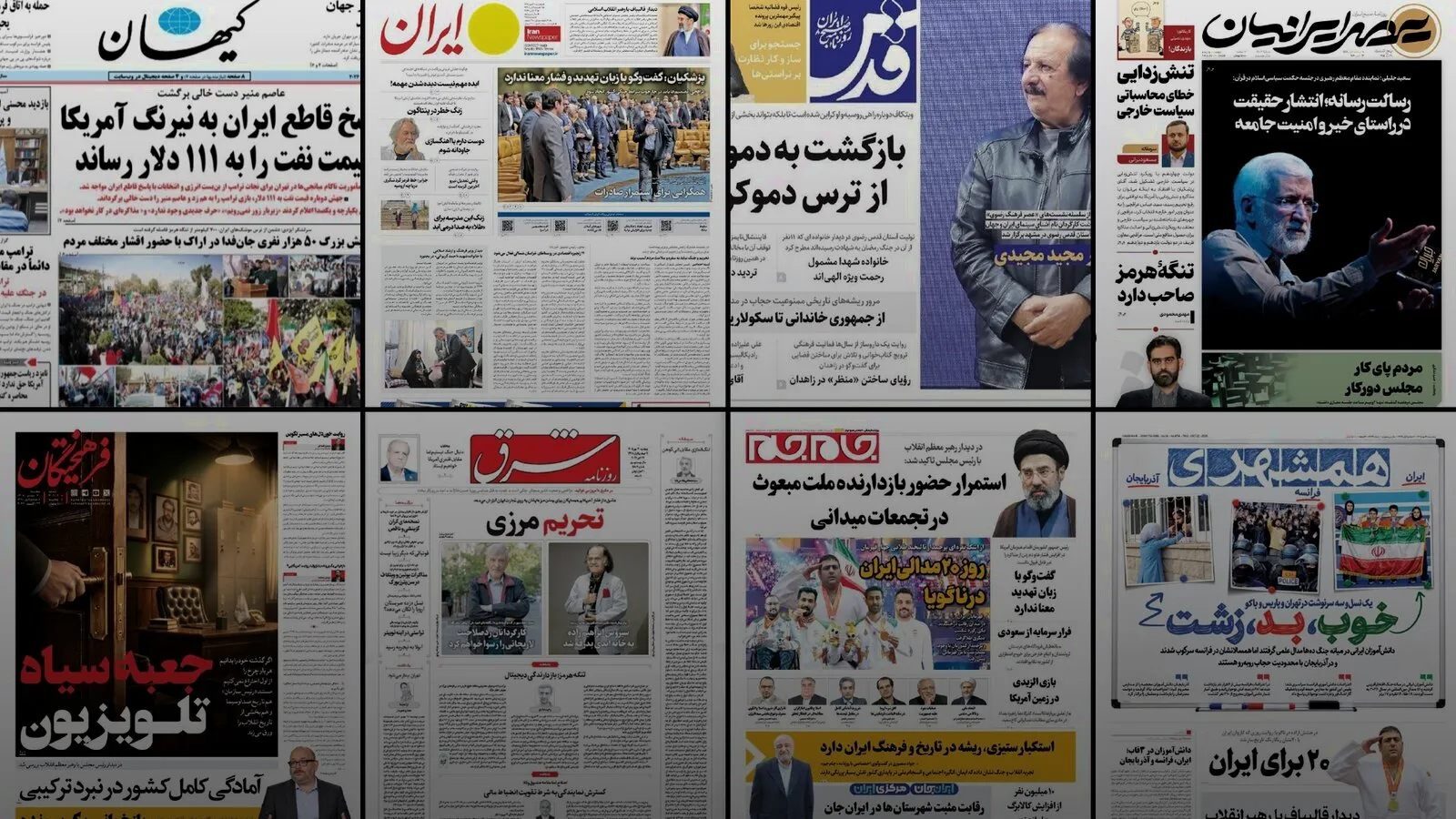
Bottom line: On the morning the Leader of the Revolution appeared in a photographed, dated meeting for the first time in this monitor’s record, the Guard’s newspaper put a severed undersea cable on its front page and the IRGC Navy claimed seven vessels struck or mined around the Strait of Hormuz, which means Tehran spent the cycle demonstrating leverage rather than trading it.
Executive Summary
The lead judgment of this edition is that the succession’s documentary record closed a gap today, and that what the record contains is an instruction about crowds rather than about war. Seven of the ten Persian front pages in the batch carry the Speaker of parliament’s meeting with the Leader. The Iran newspaper and Jam-e Jam print a photograph of a sayyid cleric in a black turban above it; the Iran and Javan pages print the office holder’s name in the body text as «آیتالله سیدمجتبی حسینی خامنهای», and the Sobh-e No channel gives the same name independently. For six consecutive cycles this monitor filed the office holder’s appearance as text only, with no dated public event and no confirmed photograph anywhere in the monitored set. That absence has now been answered. The content of the answer is the second finding: the readout’s operative emphasis is «استمرار حضور آگاهانه و بازدارنده ملت مبعوث در اجتماعات میدانی», the continued conscious and deterrent presence of the commissioned nation at field gatherings. Kayhan illustrates it the same morning with a 50,000-strong Jan-Feda exercise in Arak. The first photographed act of the new office is a call for turnout.
The cycle’s hardest operational material is a single attributed statement that reached five Iranian surfaces inside roughly ninety minutes. The IRGC Navy’s public relations office says four «متخلف», non-compliant, tankers were struck and set on fire during ship-to-ship oil transfers in the north-central Persian Gulf, that three further vessels struck mines west of the Strait of Hormuz overnight, and that «این یک اخطار جدی است», this is a serious warning, with American bases in the region named as the next step if the conduct continues. Defa Press adds the line that matters most for reading Tehran’s position: the Navy «تنگه هرمز را مدیریت و کنترل میکنند», manages and controls the Strait of Hormuz. On 21 October this monitor recorded three incompatible Iranian descriptions of the waterway, closed, not fully open, and not completely closed. Managed and controlled is a fourth formula and the only one consistent with the rest of the evidence: a toll rather than a wall. It is also the first time in this monitor’s record that interference with shipping has been claimed by a named military authority rather than listed in an unowned line, as it was on the Iran newspaper’s own page on 21 October.
The submarine-cable file moved three steps in one cycle and now spans the factional spectrum. Javan, the Guard’s daily, leads on «قطعی کابلها قطعی شد», a pun in which the cutting of the cables is also the settling of the question, over a full-width illustration of a severed fibre-optic cable glowing red at the break. Farhikhtegan, principlist, publishes the argument rather than the threat: «چرا تهدید به حمله به کابلهای اینترنت در دریا جدی و مؤثر است؟ / حمله به کارفرمایان جنگ», why the threat to attack undersea internet cables is serious and effective, framed as striking the war’s paymasters. Shargh, reformist, reaches the same subject under the heading «تنگه هرمز؛ بازدارندگی دیجیتال», the Strait of Hormuz as digital deterrence. On 20 October this was a spokesman’s warning, on 21 October a signed column naming seven cables, and today it is a lead image, a published rationale and a reformist analytical frame. Nothing in the monitored set establishes that any cable has been cut, and the Javan headline is a pun rather than a claim of an accomplished act. What has changed is that the target class has been argued for in public, which is the step that normally precedes rather than follows an operation.
The negotiation is being closed from both ends, and this reverses the pattern this monitor recorded on 21 October. Yesterday the refusal was printed and the acceptance travelled only on a channel. Today Javan prints «عراقچی: امریکا تمایلی به تفاهم ندارد», America has no inclination toward an understanding, while the same foreign minister is quoted on four separate channels saying Iran will give diplomacy another chance if Washington shows sincere intent and warning Trump of «توافق شرافتمندانه یا شکست راهبردی», an honourable agreement or a strategic defeat. Hassan Qashqavi, on the Sobh-e No channel, goes further than any front page: «از مرحله مذاکره عبور کردهایم / توپ در زمین آمریکاست», we have passed the stage of negotiation, the ball is in America’s court, and neither Lavrov nor Munir, he says, brought a concrete proposal. From the other side, Trump is relayed on three Iranian channels saying «ما با ایرانیها مذاکره نمیکنیم», we are not negotiating with the Iranians, that something will happen soon, and that the war was the biggest thing America has done. Asr-e Iranian’s signed front-page editorial completes the picture by indicting the negotiating premise itself rather than any set of terms.
A second front has opened that is not maritime at all. Shargh leads the whole batch’s one genuinely new story: «تحریم مرزی», a border embargo, strapped «شرق از فشار آمریکا بر همسایگان برای بستن مرزهایشان به روی تجارت ایران گزارش میدهد», American pressure on the neighbours to close their borders to Iranian trade. Three other surfaces touch the same file from different directions in the same cycle. Jam-e Jam attacks Iraq’s prime minister by name, «بازی الزیدی در زمین آمریکا», al-Zaidi’s game on America’s pitch, strapped from the suspension of flights to the closure of crossings; the same paper’s channel carries Baghdad’s own statement that the Al-Shib crossing was halted for technical upgrades and that Iraq will not let its soil be used to threaten neighbours; and Kayhan prints a governor’s reassurance that traffic at the Mehran crossing is flowing. The Iran Daily issue of 20 October had already published the answer, an op-ed arguing that Iran’s northern corridors through the Caspian and Central Asia are the opportunity. A reformist paper naming the squeeze, a state paper blaming a neighbouring head of government, and a hardline paper denying the effect, all in one morning, is the clearest available evidence that the land-transit file is live.
Two items sit outside the day’s running threads and are the ones most worth watching. Kayhan’s right rail carries, without a banner, its own managing director saying at a Quranic-politics session that «دکترین تولید سلاح هستهای با تغییر زمانه ممکن است تغییر کند», the doctrine on producing a nuclear weapon may change as the times change. On the same cycle the Vatan-e Emrooz channel relays Netanyahu accusing Iran of seeking a bomb and claiming that the Leader has decided to lift the prohibition on building one. A right-rail box in a newspaper is not a policy announcement and an adversary’s assertion relayed by an Iranian channel is not evidence of a decision, but the two appearing together in one cycle is the first time in this monitor’s record that the doctrinal question has been live on both sides at once. Separately, the Jam-e Jam channel reports that several explosions were heard at Kerpan Sirik in Hormozgan with the source and cause unknown, and no front page in the batch mentions it.
Net assessment: this is a demonstration edition rather than a negotiation edition. Every significant item in it, the named naval claim against seven vessels, the severed cable on the Guard’s front page, the published justification for cable interdiction, the mass exercise in Arak, the attack on a neighbouring prime minister, is an exhibition of leverage addressed to an audience rather than an exchange of terms with a counterparty. The negotiating track is being argued against by its own press on the morning its foreign minister is printed saying the other side is not interested. Lebanon reaches no front page for a fourth consecutive cycle although three wires carry Israeli strikes on it, and the numbered drone-attrition series is absent for a second. The edition’s one genuinely new fact, the photographed meeting, points the same way: the instruction it carries is for the population to assemble, which is what a leadership does when it expects to have to absorb pressure rather than to settle it.
Key Judgments
- KJ-1 [HIGH] The standing finding that the office holder appears only as text is closed, and the content of his first photographed appearance is an instruction about crowds rather than about the war. The evidence is a convergence across seven of ten front pages: Jam-e Jam leads on «در دیدار رهبر معظم انقلاب با رئیس مجلس تأکید شد: استمرار حضور بازدارنده ملت مبعوث در تجمعات میدانی»; the Iran newspaper and Jam-e Jam both print a photograph of a sayyid cleric in a black turban; the Iran and Javan bodies print «آیتالله سیدمجتبی حسینی خامنهای» and source the readout to the Leader’s office; Hamshahri, Farhikhtegan, Vatan-e Emrooz and Kayhan carry the same meeting with their own framings; and the Sobh-e No channel names the office holder independently. For six consecutive cycles this monitor filed the absence of any dated appearance or confirmed photograph. The significance is twofold: the institution has now produced the documentary act it had withheld, and what it chose to transmit through it is «استمرار حضور آگاهانه و بازدارنده ملت مبعوث در اجتماعات میدانی», the continued deterrent presence of the commissioned nation at field gatherings, which Kayhan illustrates with a 50,000-strong exercise in Arak. Calibration: the photographs are identified by the printed name beside them and not by the face, no video, location or date of the meeting itself reached this monitor, and nothing here establishes anything about the office holder beyond what the Iranian press published.
- KJ-2 [HIGH] Interference with shipping has moved from an unowned line to a named military claim covering seven vessels, and the authority that issued it describes the Strait as managed rather than closed. The evidence is one statement on five surfaces. The IRGC Navy’s public relations office says four «متخلف» tankers were struck and set on fire during ship-to-ship oil transfers in the north-central Persian Gulf, «هر ۴ کشتی همزمان مورد اصابت قرارگرفته و در آتش میسوزند», and that three further ships struck mines west of the Strait overnight, closing with «این یک اخطار جدی است» and a warning that US bases in the region could follow; Defa Press, Fars News, Nour News, the Vatan-e Emrooz channel and the Iran newspaper channel all carry it within roughly ninety minutes, and the Kayhan channel adds that the four belonged to the United States or carried cargo for an American company. Defa Press also carries the Navy saying it «تنگه هرمز را مدیریت و کنترل میکنند», manages and controls the Strait. The significance is that the 21 October finding, a commerce-interdiction claim printed without a claiming authority, has been replaced by an owned one an order of magnitude larger, and that the fourth description of the waterway supersedes the three incompatible ones recorded yesterday: a managed passage is a toll, and a toll is a thing that can be traded. Calibration: five Iranian surfaces carrying one statement establishes central issuance and not truth; no flag, name, tonnage, date or operator is given for any of the seven vessels and no independent maritime source was available to this monitor.
- KJ-3 [HIGH] The submarine-cable file has moved from threat to front-page certainty and has acquired a published justification, which makes it the most advanced escalation option in the monitored set. The evidence is three mastheads from three factions in one cycle. Javan, the Guard’s own daily, leads on «قطعی کابلها قطعی شد», in which قطعی is both the cut and the settled question, over a full-width illustration of a severed fibre-optic cable, returning to the IRGC political deputy’s warning that cables in the Strait will be struck if Iranian infrastructure is attacked. Farhikhtegan publishes the rationale rather than the threat: «چرا تهدید به حمله به کابلهای اینترنت در دریا جدی و مؤثر است؟ / حمله به کارفرمایان جنگ», striking the war’s paymasters. Shargh, reformist, frames the same subject as «تنگه هرمز؛ بازدارندگی دیجیتال». On 20 October this was a spokesman’s line and on 21 October a signed column naming seven cables under the Strait. The significance is that target classes that are publicly argued for are further along than target classes that are merely threatened, and that the argument offered, that the cables belong to the war’s financiers rather than to its combatants, is a proportionality claim built for the moment after an act. Calibration: nothing in the monitored set establishes that any cable has been cut, the Javan headline is a deliberate pun rather than a claim of an accomplished act, and the assertion that cable cutting figured in the Witkoff and Putin meeting reaches this monitor through one Iranian paper’s unsourced rendering.
- KJ-4 [MODERATE-HIGH] The nuclear-doctrine question became live on both sides within a single cycle, for the first time in this monitor’s record. The evidence is a pairing. Kayhan’s right rail carries its own managing director, the post held by Hossein Shariatmadari, telling a session on the political wisdom of Islam in the Quran that «دکترین تولید سلاح هستهای با تغییر زمانه ممکن است تغییر کند», the doctrine on producing a nuclear weapon may change as the times change; the box carries no banner and no other title in the batch repeats it. On the same cycle the Vatan-e Emrooz channel relays Netanyahu accusing Iran of seeking a bomb and claiming specifically that the Leader has decided to lift the prohibition on building one, closing with «یا ما وجود خواهیم داشت یا آنها». The significance is that the Iranian formulation and the Israeli accusation are the same proposition stated from opposite ends, and that the Iranian one appears in the paper most closely associated with the Leader’s office. Calibration runs hard both ways: a right-rail remark by a newspaper editor is not a policy announcement and treating it as one would badly overstate it, while an adversary’s claim relayed by an Iranian channel is evidence of Iranian editorial choice and not of any decision. Tracking cue: whether the Kayhan formulation is repeated by any official body, by the Leader’s office, or on any other front page.
- KJ-5 [HIGH] The negotiating track is being closed from both ends, which reverses the asymmetry recorded on 21 October. The evidence is a set of same-cycle contradictions. Javan’s front page prints «عراقچی: امریکا تمایلی به تفاهم ندارد», America has no inclination toward an understanding, while the Vatan-e Emrooz, Jam-e Jam, Sobh-e No and Iran newspaper channels carry the same foreign minister saying Iran is ready to give diplomacy another chance if Washington shows sincere intent, and warning Trump of «توافق شرافتمندانه یا شکست راهبردی». Hassan Qashqavi, on the Sobh-e No channel, says «از مرحله مذاکره عبور کردهایم / توپ در زمین آمریکاست» and that neither Lavrov nor Munir brought a concrete proposal. Trump is relayed on three Iranian channels saying «ما با ایرانیها مذاکره نمیکنیم», that something will happen soon, and that the war was the biggest thing America has done. The significance is that yesterday the refusal was printed and the acceptance travelled only by channel, which this monitor read as management; today both surfaces carry refusal, the foreign minister is the only figure on either surface still offering a track, and the one paper that engages the question directly, Asr-e Iranian, attacks the premise of negotiating rather than any set of terms. Calibration: the Trump and Araghchi lines reach this monitor only as Iranian renderings, and a foreign minister saying different things to different audiences is normal diplomatic conduct rather than evidence of a rupture.
- KJ-6 [MODERATE-HIGH] A land-transit front has opened alongside the maritime one, and Iran has begun naming a neighbouring head of government for it. The evidence is four surfaces from four directions. Shargh leads on «تحریم مرزی», a border embargo, strapped «شرق از فشار آمریکا بر همسایگان برای بستن مرزهایشان به روی تجارت ایران گزارش میدهد». Jam-e Jam’s rail runs «بازی الزیدی در زمین آمریکا», al-Zaidi’s game on America’s pitch, strapped from the suspension of flights to the closure of crossings; Ali al-Zaidi has been Iraq’s prime minister since 14 May 2026. The Jam-e Jam channel carries Baghdad’s own spokesman saying the Al-Shib crossing was halted for technical upgrades and that «اجازه نمیدهیم از خاک کشور برای تهدید همسایگان استفاده شود». Kayhan prints a governor saying traffic at the Mehran crossing is flowing. The significance is that the pressure Iran answered on 21 October with a reopened Pakistani border is reappearing on the Iraqi one, and that the state broadcaster’s paper is preparing an Iranian readership to blame a neighbouring government rather than only Washington. Calibration: Baghdad’s technical explanation may be true, one halted crossing is not an embargo, and Shargh’s reporting of American pressure is the paper’s own and is not corroborated elsewhere in the batch. Tracking cue: whether a second neighbouring government is named in the same register.
- KJ-7 [MODERATE-HIGH] The Gulf aviation and infrastructure collapse is now documented by Saudi and American official sources rather than by Iranian claim, which both strengthens the finding and limits what Iran can claim about it. The evidence has changed character in one cycle. On 21 October it was aviation-analytics figures quoted by Kayhan. Today the Etemad channel carries the Saudi Civil Aviation Authority on an attack at King Fahd International in Dammam killing one and injuring eight; Defa Press carries the Saudi Energy Ministry on an intercepted drone over the Shaybah field with two non-citizen residents killed, and Saudi air defences engaging drones over the Eastern Province; the Jam-e Jam channel carries flight-radar data showing repeated halts at Dammam and the US Embassy in Riyadh issuing a security alert over threats to Saudi infrastructure and airports; Nour News relays the State Department limiting its regional departure warning to Saudi Arabia; and Fars reports Riyadh’s airport closed to flights for twelve days from 10 October with 108 cancellations in one day. Jam-e Jam converts this into «فرار سرمایه از سعودی», capital flight from Saudi Arabia, and Vatan-e Emrooz into bin Salman seeking an exit from a strategic deadlock, with Bab al-Mandab named alongside Hormuz. The significance is that the Gulf’s maritime and aviation arteries are both now degraded on evidence that is not Tehran’s. Calibration: the Jeddah airport strike and the Kuwait airport stoppage rest on unnamed sources in Iranian renderings and are not confirmed; the Yemeni attribution of these attacks is the Iranian press’s, and Egypt’s president is relayed saying Cairo has no plan to attack Yemen and is defending Saudi territory only.
- KJ-8 [MODERATE-HIGH] Iran is publishing the oil price as the scoreboard of its own refusal, and has built its economic case on numbers that can move against it. The evidence is the lead itself plus three supports. Kayhan’s main headline reads «پاسخ قاطع ایران به نیرنگ آمریکا قیمت نفت را به ۱۱۱ دلار رساند» under the kicker that Asim Munir returned empty-handed; Fars reports Brent breaking 110 and touching 111, a level it says has occurred only once before; Kayhan’s top-left banner attributes a sevenfold rise in world oil freight costs to Goldman Sachs; Nour News reports the United States drawing on its emergency diesel reserve weeks before the midterms; and the Jam-e Jam channel reports OFAC adding five individuals, four entities and nine vessels to the Iran-related list. The significance is that an argument explicitly priced in dollars is falsifiable in dollars, and that Iranian outlets have now twice in three cycles published the finding that mediation lowers the price and refusal raises it, which makes the domestic claim that holding the chokepoint is costless harder to sustain in Iran’s own press. Calibration: Kayhan’s own front page and channel give the freight multiple as sevenfold and thirtyfold in the same cycle, which is an internal inconsistency inside one outlet, and all the market figures reach this monitor through Iranian renderings.
- KJ-9 [MODERATE] Negative evidence, filed as a finding: Lebanon has now failed to reach any Iranian front page for a fourth consecutive cycle, while three separate Iranian surfaces carry Israeli strikes on it in the same twenty-four hours. The evidence is the pairing of a complete printed silence with a steady wire flow. Defa Press reports Israeli army artillery striking an area between the town of Hadatha and the village of Harithis in southern Lebanon; Fars reports local sources hearing several explosions in southern Lebanon framed as continued Israeli attacks; the Sobh-e No channel reports Israeli fighter aircraft bombing an area between Shaqra and Mays al-Jabal. Not one of the ten Persian front pages mentions Lebanon. On 19 October this monitor read the absence as crowding, on 20 October as a choice, on 21 October as beyond crowding; a fourth cycle with three dated strike reports available on Iranian wires settles it. The significance is that an entire theatre is being kept off the domestic agenda while the Hormuz, border and mobilisation files run, which is what deliberate de-emphasis of a front looks like when acknowledging it would complicate the other three. Tracking cue: whether Lebanon reappears on a front page if a negotiating round convenes or if a strike produces a named Iranian casualty.
- KJ-10 [MODERATE] Negative evidence, filed as a finding: the numbered drone-attrition series remains absent for a second consecutive cycle, and no MQ-9 claim appears anywhere in the monitored set. The evidence is an absence measured against a pattern. On 20 October four surfaces carried the Guard’s claim of a fifty-fourth MQ-9 destroyed over the Strait within three hours of each other; on 21 October this monitor filed the series’ interruption; today no shootdown claim of any kind appears on any front page, channel or wire read for this edition, and the only aerial tracking published is the Iraqi resistance media’s routine daily count relayed by the Vatan-e Emrooz channel of four MQ-9s, one E-11, one F-16 and one F-15 over Iraq. The significance is that the series was the main advertised proof of defensive success, and its continued suspension in the same cycle in which the Navy publishes a seven-vessel interdiction claim suggests a reallocation of what gets advertised rather than a pause in activity. Filed as an absence: two cycles is a short run, and the alternative explanation, that there have been no engagements to claim, is not excluded by anything in this batch. Tracking cue: whether the numbering resumes at fifty-five.
- KJ-11 [MODERATE] The mediation record is being written out of the Iranian press one day after it produced its only verifiable deliverable, and a second mediator has surfaced without ever having reached a front page. The evidence is three items. Kayhan’s kicker reads «عاصم منیر دست خالی برگشت», Asim Munir returned empty-handed, on the morning after the visit that reopened the Iran-Pakistan crossings, a deliverable no Iranian front page has yet credited. Hassan Qashqavi, on the Sobh-e No channel, says that neither Lavrov nor Munir brought a concrete proposal, which is the first indication in this monitor’s record of a Russian mediation attempt running alongside the Pakistani one. The Sobh-e No channel also relays Tom Barrack at the Doha security forum conceding that the United States is no longer «ارباب جهان», the master of the world, and saying Washington wants a peace deal with Iran over Hormuz. The significance is that Tehran is simultaneously receiving mediators, declining to credit them in print, and publishing an American official’s admission that a deal is wanted, which is the posture of a party that intends to be paid for the chokepoint rather than relieved of it. Calibration: the Barrack and Qashqavi lines reach this monitor through one Iranian channel each and are not verified against their originals.
- KJ-12 [MODERATE] Domestic economic strain is being handled in the press as administration rather than as grievance, and the comparative-morale argument has now run on two consecutive Hamshahri front pages. The evidence is a cluster across the civilian register. Jam-e Jam reports ten million people left out of the food-coupon increase and the interior ministry agreeing to expand municipal powers; the Jam-e Jam channel reports train tickets raised twenty percent without notice with an apology from the rail association; the Iran newspaper’s channel reports a government decree granting eligible civil servants at least two remote working days a week, which Asr-e Iranian turns against parliament as «مردم پای کار، مجلس دورکار»; Farhikhtegan defends the medicine-currency allocation as twice the 1403 level; Qods reports the judiciary chief personally taking charge of the biggest economic case of the moment and searching for a supervision mechanism over the trusts. Hamshahri meanwhile runs «خوب، بد، زشت», one generation and three fates in Tehran, Paris and Baku, the second consecutive front page built on a favourable comparison between Iranian and French young people. The significance is that defensive arguments are made about live risks, and a municipal daily with the batch’s largest civilian readership returning to the same comparison twice in two days is an indicator of expected domestic legibility, not a prediction about the street.
- KJ-13 [LOW-MODERATE] An unexplained domestic security event in Hormozgan was reported by the state broadcaster’s own channel and reached no front page, which is worth recording precisely because nothing was made of it. The evidence is a single item: the Jam-e Jam channel reports «صدای چند انفجار در کرپان سیریک استان هرمزگان شنیده شد», the sound of several explosions heard at Kerpan Sirik in Hormozgan province, with the source and cause stated as not yet known. Hormozgan is the province that fronts the Strait of Hormuz. No Persian front page in the batch mentions it, no agency wire elaborates, and no authority is quoted. The significance is that in a cycle in which the same press published a seven-vessel interdiction claim, a severed-cable front page and a mass exercise in Arak, an unexplained set of explosions on Iranian soil beside the waterway was allowed to pass without framing, which is unusual enough to note. Filed with a single-source flag and no inference as to cause. Tracking cue: whether any Iranian surface returns to it with an attribution.
Macro Trends
- The succession’s first photographed act is an order for turnout. Seven of ten front pages carry the Speaker’s meeting with the Leader; the Iran newspaper and Jam-e Jam run a photograph above it, and the Iran and Javan bodies print «آیتالله سیدمجتبی حسینی خامنهای» in full. The readout’s operative line is «استمرار حضور آگاهانه و بازدارنده ملت مبعوث در اجتماعات میدانی», the continued conscious and deterrent presence of the commissioned nation at field gatherings, with the loaded term مبعوث borrowing the vocabulary of prophetic commissioning. Each paper frames the enemy’s war to its own taste: Vatan-e Emrooz as «نظامی، اقتصادی و شناختی», military, economic and cognitive; Farhikhtegan as «نبرد ترکیبی», the combined battle; Hamshahri as livelihood and cohesion. The convergence on a single readout with factionally tuned framings is central supply with local decoration, and the thing supplied is mobilisation rather than escalation.
- Interference with shipping is now owned, named and multiplied. On 21 October the only maritime claim in the batch was one unowned line on the government daily’s page about two non-compliant vessels set on fire. Today the IRGC Navy’s public relations office states that four tankers were struck and burned during ship-to-ship oil transfers in the north-central Gulf and that three more struck mines west of the Strait, on five Iranian surfaces within about ninety minutes, with the Kayhan channel adding that the four were American or carrying American cargo and the statement itself warning that US bases could follow. Defa Press carries the formula that organises the rest: the Navy «تنگه هرمز را مدیریت و کنترل میکنند», manages and controls the Strait. That is the answer to the three incompatible descriptions recorded on 21 October, and it describes a toll, not a closure.
- Submarine cables crossed from threat to argument. Javan leads with «قطعی کابلها قطعی شد» over an illustration of a cut fibre-optic cable; Farhikhtegan publishes the rationale, that striking the cables strikes «کارفرمایان جنگ», the war’s paymasters; Shargh houses the same subject inside «بازدارندگی دیجیتال», digital deterrence. Three mastheads from three factions reach the data layer under the waterway in one morning, two cycles after it was a single spokesman’s warning. The profile that made the cables attractive has not changed, deniable, cheap and catastrophic for the Gulf economies, but a target class that is being publicly justified is further along than one that is being threatened.
- The negotiating track is being closed from inside the Iranian press. Javan prints the foreign minister saying America has no inclination toward an understanding; four channels carry the same minister offering diplomacy another chance; Qashqavi says on the Sobh-e No channel that «از مرحله مذاکره عبور کردهایم», we have passed the stage of negotiation, and that neither Lavrov nor Munir brought a concrete proposal, which is the first indication in this monitor’s record of a Russian mediation attempt alongside the Pakistani one. Asr-e Iranian’s signed front-page editorial attacks the premise rather than the terms, reconstructing the foreign minister’s appointment as the consequence of a mistaken belief in de-escalation. The 21 October asymmetry, refusal in print and acceptance on the channel, has flattened: today both surfaces carry refusal and only the minister’s own words cut the other way.
- The land borders are the cycle’s new front. Shargh reports American pressure on Iran’s neighbours to close their borders to Iranian trade. Jam-e Jam names Iraq’s prime minister and straps the piece from suspended flights to closed crossings; the Jam-e Jam channel carries Baghdad saying the Al-Shib crossing is halted for technical upgrades and that Iraq will not let its soil be used to threaten neighbours; Kayhan prints a governor saying traffic at Mehran is flowing. Two days earlier the English-language Iran Daily had already published the counter-argument, that the northern corridors through the Caspian and Central Asia are the opportunity. A squeeze that the reformist press reports, the state press blames on a neighbour, the hardline press denies, and the English press pre-answers for foreigners is a squeeze that is being felt.
- The Gulf aviation collapse is now documented by its own victims. On 21 October the evidence was an aviation analytics firm quoted by Kayhan. Today it is official: the Saudi Civil Aviation Authority reports an attack on King Fahd International at Dammam killing one and injuring eight; the Saudi Energy Ministry reports an intercepted drone over the Shaybah field with two non-citizen residents killed; Saudi air defences engaged drones over the Eastern Province; the US Embassy in Riyadh issued a security alert over threats to Saudi infrastructure and airports; and the State Department is relayed saying the regional departure warning applies to Saudi Arabia alone. Iranian surfaces add Jeddah airport halted with four aircraft circling and Kuwait airport stopped, both from unnamed sources and both unconfirmed. Jam-e Jam converts the whole cluster into «فرار سرمایه از سعودی», capital flight from Saudi Arabia, and Vatan-e Emrooz into bin Salman searching for an exit from a strategic deadlock with Bab al-Mandab named beside Hormuz.
- Iran is publishing the oil price as the scoreboard of its own refusal. Kayhan’s lead ties the number to the position directly: «پاسخ قاطع ایران به نیرنگ آمریکا قیمت نفت را به ۱۱۱ دلار رساند», Iran’s decisive answer drove oil to 111 dollars. Fars reports Brent breaking 110 and reaching 111. Kayhan’s top-left banner attributes a sevenfold rise in global oil freight costs to Goldman Sachs, while its own channel text says thirtyfold. Nour News reports the United States drawing on its emergency diesel reserve weeks before the midterms, and the Jam-e Jam channel reports OFAC adding five individuals, four entities and nine vessels to the Iran list. The argument is coherent and it is also a hostage to the data: a case built on published market numbers has to be abandoned in public if the numbers move.
- Domestic strain is being published as administration rather than as grievance. Jam-e Jam reports ten million people left out of the food-coupon increase; the Jam-e Jam channel reports train tickets up twenty percent without notice and an apology from the rail association; the Iran newspaper’s channel reports a decree granting eligible civil servants at least two remote working days a week, which Asr-e Iranian immediately turns against parliament as «مردم پای کار، مجلس دورکار», the people at work, the parliament working from home; Farhikhtegan defends the medicine-currency allocation as twice the 1403 level; and Qods reports the judiciary chief personally taking over the biggest economic case of the moment. Hamshahri meanwhile runs a second consecutive front page comparing Iranian young people favourably with French ones, now adding Azerbaijan. The register is managerial and defensive, which is what a system publishes when it expects the cost-of-living frame to be legible at home.
Front-Page Snapshot
- Javan - “The cutting of the cables is now certain” (Hardline, IRGC-affiliated) - A severed submarine cable as the lead image, and the Leader’s readout in the rail [SEVERE]
- Vatan-e Emrooz - “The contest against Trump” (Hardline principlist) - The war as an American electoral liability, with the nuclear-threshold accusation routed to the channel [HIGH]
- Kayhan - “Iran’s decisive answer to America’s trickery drove the oil price to 111 dollars” (Hardline; managing director appointed by the Leader’s office) - Oil at 111 dollars as the published price of refusal, with a nuclear-doctrine line in the rail [HIGH]
- Farhikhtegan - “Television’s black box” (Principlist, Azad University) - A published justification for striking undersea cables, and the Leader’s meeting read as hybrid-war readiness [HIGH]
- Jam-e Jam - “The continued deterrent presence of the commissioned nation at field gatherings” (State broadcaster (IRIB)) - The Leader’s meeting as a mobilisation order, and Iraq’s prime minister named [MODERATE-HIGH]
- Asr-e Iranian - “The media’s mission: publishing the truth in the service of the good and the security of society” (Principlist) - A signed editorial indicting the negotiating premise itself [MODERATE-HIGH]
- Iran - “Pezeshkian: dialogue in the language of threat and pressure is meaningless” (Government daily (IRNA)) - The presidency refuses coercion in print while the Navy’s seven-vessel claim travels by channel [MODERATE-HIGH]
- Qods - “A return to democracy out of fear of the Democrats” (Conservative, Astan Quds Razavi) - An Israeli strike plan printed on a front page and read as enemy hesitation [MODERATE-HIGH]
- Shargh - “A border embargo” (Reformist) - American pressure on the neighbours to close the land borders, reported as cost rather than posture [MODERATE]
- Hamshahri - “The good, the bad and the ugly” (Tehran municipality, centrist) - A second consecutive comparison front page, now adding Baku, with the Leader’s readout reduced to livelihood [LOW-MODERATE]
- Iran Daily - “Iran, Russia agree regional conflicts have no military solution: FM” (English-language state daily; the available issue is dated 20 October) - Northern corridors pre-argued for a foreign readership, two days before the border story broke at home [LOW]
Full report
The complete edition - per-paper front-page analysis and full translation appendices - is available as a PDF: Download the full report.
Compiled from Iranian front pages and outlet channels via open-source monitoring. Translations are editorial; named-figure attributions are verified against the source pages where possible.