Iranian Press Monitor - Monday, 19 October 2026 (Day 230)
Monday, 19 October 2026 · دوشنبه ۲۷ مهر ۱۴۰۵ · 8 Jumada al-Awwal 1448 - Eleven Iranian newspapers of 27 Mehr 1405: ten front-page scans, nine Persian and one English, read together with Kayhan from its own channel and with six paper channels and three agency wires. Tehran Times and the Leader’s own site were unavailable at the time of compilation.
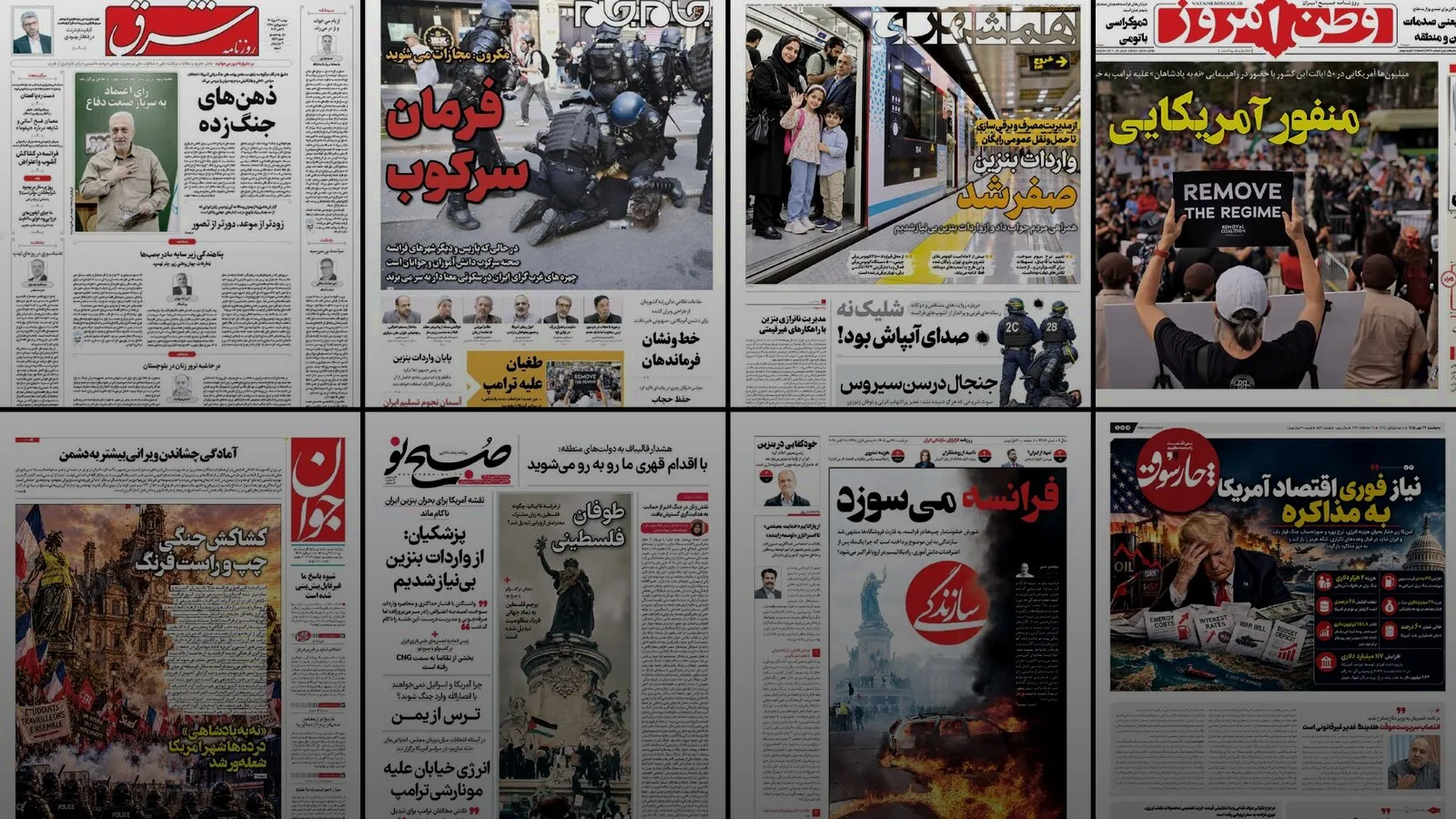
Bottom line: The dated seven-day offer to reopen the Strait of Hormuz reached a Persian front page for the first time this morning and reached it as a prohibition, printed by an economic daily that spent its whole page pricing the war in American currency to argue the chokepoint is worth more held than traded, while parliament installed a missile-industry manager at the defense ministry by 237 votes and the speaker opened a second coercion front against Gulf states over their artificial-intelligence investments.
Executive Summary
The lead judgment of this edition concerns a single sentence on one front page. On 18 October this monitor recorded that Tehran was running coercion and a dated conditional offer at the same time in two different languages, that the seven-day plan to reopen the Strait of Hormuz existed only in English on Iran Daily, and that the first Persian front page to print it would mark a decision to prepare the domestic audience for a settlement. That page arrived this morning and it did the opposite. Chaharsoogh, an economic daily, gave its entire front to the proposition that «آمریکا زیر فشار بحران هزینه انرژی، نرخ بهره و صورتحساب جنگ قرار دارد و ایران نباید در قبال وعدههای تکراری، تنگه هرمز را باز کند و به میز مذاکره بازگردد»: America is under pressure from energy costs, interest rates and the war bill, and Iran should not open the Strait and return to the table in exchange for repeated promises. The offer crossed into Persian as a thing to be refused, which is a materially different event from the one the tracking cue anticipated, and a more informative one.
The paper builds the refusal out of an entire page of American pain, and the construction matters more than the figures. A six-panel box prices the war for the American household at 2,000 dollars, puts gasoline up 45 percent and natural gas up 68 percent, counts 38 billion dollars of war cost against Washington’s budget and a 60 percent drawdown of the strategic petroleum reserve, and a banner laid over a map captioned STRAIT OF HORMUZ attributes a 117 billion dollar increase in US bond repayments to interest-rate growth «در اثر شوک هرمز», as an effect of the Hormuz shock. Every one of those numbers is the outlet’s own and none is corroborated here. What is analytically solid is the shape of the argument: the closure is being presented to the Iranian reader as an appreciating asset whose price rises the longer it is held. That is an argument for duration, and it is being made on the commercial rather than the ideological side of the press.
Iran Daily kept the other half of the structure intact. Its English lead states that the seven-day plan remains on the table, its deck carries the foreign minister saying Lebanon’s internal affairs are a matter for the Lebanese themselves, and the Iran newspaper channel carried the mechanism in Persian the same cycle: «با اجرای شروط ایران، تنگه هرمز روز ششم باز میشود», with Iran’s conditions implemented, the Strait opens on the sixth day. Ta’adol, the other economic title, put the question on its masthead ear as «آتشبس بدون صلح و طرحی برای خروج از جنگ» over «بنبست دیپلماسی باز میشود؟»: a ceasefire without peace and a plan for leaving the war, will the diplomatic deadlock open. Two economic dailies now hold both ends of the argument, which locates the real domestic debate about a settlement in the commercial press rather than in the factional one.
The second event of the morning is institutional. Parliament confirmed Mehrdad Akhlaghi Ketabchi as minister of defense and armed forces support, and Kayhan is the surface that printed the number: «با ۲۳۷ رأی موافق». The portfolio has gone to a man whose career is in the ministry’s aerospace and missile organisations and who previously ran the Defense Industries Organisation, not to an operational commander, and Shargh fixed the reading precisely with «رأی اعتماد به سرباز صنعت دفاع», a vote of confidence for the soldier of the defense industry. His first published line, carried as Vatan-e Emrooz’s masthead ear, is that an attack on Iran means «صدمات زیاد به دشمن و منطقه», heavy damage to the enemy and to the region, and his first instruction, carried on the channels, is that missile and drone production must accelerate. The president called the vote «پیام گیرایی به دنیا», a compelling message to the world. An appointment that prioritises replenishment over command is a statement about what the war is now expected to consume.
The third event opens a target set this monitor has not previously recorded. Sobh-e No’s banner is the speaker’s warning to the region’s governments that they «با اقدام قهری ما رو به رو میشوید», will face our coercive action, and the full construction on the paper’s channel makes the object explicit: regional governments, investment funds and companies are to give no financing, no shares, no land and no energy to artificial-intelligence or data companies that assist military aggression or have a hand in killing children, and anyone who assists them will face coercive action. The same statement announces that «نهاد مدیریت دادههای خلیج فارس در راه است», a Persian Gulf data-management body is on the way. Tehran has in one statement extended coercion from shipping to the compute and data layer that Gulf capital is currently buying into, and has paired the threat with a claim to regional governance over it. Vatan-e Emrooz’s ear extending the threatened damage to «the region» is the same message in military register on the same morning.
Beneath those three, the batch is saturated by a fourth theme. Six of the nine Persian pages lead or co-lead on disorder in the West: Jam-e Jam’s «فرمان سرکوب» over French gendarmes kneeling on a protester, Sazandegi’s «فرانسه میسوزد», Javan’s «کشاکش جنگی چپ و راست فرنگ», Ta’adol’s «پاریس اقتصاد و خیابان», Vatan-e Emrooz’s «منفور آمریکایی» on the «No Kings» marches, Hamshahri’s media-criticism banner, with Kayhan fusing both theatres into «آتش جنگ به دامن جنگافروزان افتاد». The hook that made the saturation possible is a quotation the Iranian press can use against its author: Macron attributing France’s fuel-price rise to the war against Iran, answered the same day by Araghchi with «دیگر برای فرافکنی دیر شده است», it is too late for deflection, and by the foreign ministry spokesman with «آتش گاهی به خانه طراحانش بازمیگردد», fire sometimes returns to the house of those who designed it. Western domestic instability is being converted into evidence that Iranian endurance is working, which is the mechanism by which the perceived cost of continuing goes down.
The domestic counterpart is the gasoline story, which five surfaces carry as a victory. Hamshahri leads «واردات بنزین صفر شد» and renders it as free metro travel and electric buses; Sobh-e No frames it as «نقشه آمریکا برای بحران بنزین ایران ناکام ماند»; Sazandegi, the reformist party daily, prints the government’s 12 billion dollar saving at face value. Only Ta’adol prints the mechanism inside the claim: «درآمد افزایش قیمت، صرفهجویی و مدیریت مصرف به مردم پرداخت میشود», the income from the price increase will be paid back to the people. A fuel price rise is inside the self-sufficiency announcement on exactly one of six surfaces, and the same economic press is simultaneously counting 34 billion dollars of shutdown damage at the Iran Chamber and printing three-digit inflation in a front-page cartoon caption.
Two absences are findings in their own right. The IRGC Navy claimed on the evening of 26 Mehr that a tanker struck a naval mine south of the Strait, with video and a warning that vessels switching off navigation systems will be met with force, and not one front page in this batch carries it, one day after the batch began reporting the maritime campaign as a running total. And Lebanon, which Beirut re-opened by asking Tehran to appoint a new ambassador, reaches no Persian front page at all and reaches the English one only as the foreign minister’s statement that Lebanon’s affairs are for the Lebanese. On the morning Tehran extends coercion to Gulf data centres, it is publicly distancing itself from the file it has historically been least willing to distance from.
Net assessment: this is a hardening edition with a visible seam. The hardening is real and broad, running from a production-focused defense ministry through a new non-military coercion vector to an economic daily arguing in print that the chokepoint should not be traded, and it rests on a theory of the adversary, drawn from French streets and American marches, that is flattering and dated to the American midterms. The seam is that the same commercial press carrying the hardening is also the only press counting its bill, and that the diplomatic track described by a former minister on a reformist channel, a seven-point framework whose general outline the United States is said to have accepted with the sequencing still disputed, is further advanced than any front page in the batch admits. The edition should therefore be read as Tehran raising its asking price in public while the negotiation it will not print continues underneath, with Hormuz the asset being priced and Gulf capital the next thing being bid against.
Key Judgments
- KJ-1 [HIGH] The seven-day offer to reopen the Strait of Hormuz has crossed onto a Persian front page for the first time, and it crossed as a prohibition rather than as preparation. The evidence is Chaharsoogh’s lead deck, which states that Iran «نباید در قبال وعدههای تکراری، تنگه هرمز را باز کند و به میز مذاکره بازگردد», should not open the Strait and return to the table for repeated promises, set against Iran Daily’s English lead that the plan is still on the table and the Iran newspaper channel’s Persian mechanism that the Strait opens on day six if Iran’s conditions are met. On 18 October this monitor filed the tracking cue that the first Persian front page to print the seven-day clock would mark a decision to prepare the domestic audience for a settlement. The significance is that the cue has been answered in the negative: the domestic surface that finally carried the trade carried it in order to foreclose it, which raises the political cost of accepting the same terms later. Calibration runs both ways: treating one economic daily as the voice of a decision would overstate it, and treating the first Persian appearance of the offer as nothing because it was hostile would miss that the subject is now sayable in Persian at all.
- KJ-2 [HIGH] The defense portfolio has been given to a missile and aerospace industrialist rather than to an operational commander, and the vote rather than the man is what the press is selling. The evidence is convergent across four surfaces: Kayhan printing «مهرداد اخلاقی با ۲۳۷ رأی موافق سکاندار وزارت دفاع شد»; Shargh framing him as «سرباز صنعت دفاع»; Vatan-e Emrooz carrying as its masthead ear his first line that an attack on Iran means heavy damage «به دشمن و منطقه»; and the channels carrying his first instruction, that missile and drone production must accelerate, together with the president calling the vote a compelling message to the world and Rahim Safavi welcoming it. Outside the day’s press, open reporting records his prior leadership of the Defense Industries Organisation and his listing under UN Security Council resolution 1747 as head of the Shahid Bagheri Industrial Group. The significance is that a ministry filled after its holder was killed has been filled for throughput, which indicates planning for a long consumption of munitions rather than for a change in how they are used.
- KJ-3 [HIGH] Tehran has opened a second coercion front aimed at third-party Gulf states and at the artificial-intelligence and data layer their capital is buying into. The evidence is the speaker’s warning carried as Sobh-e No’s banner and in full on the paper’s channel: regional governments, investment funds and companies are to give «نه تأمین مالی، نه سهام، نه زمین، نه انرژی» to AI or data firms said to assist military aggression or to have a hand in killing children, «هر کس به آنان یاری برساند، با اقدام قهری ما روبهرو خواهد شد», and «نهاد مدیریت دادههای خلیج فارس در راه است». Vatan-e Emrooz’s ear extends the new minister’s threatened damage to «the region» on the same morning. The significance is that this names a constituency rather than a government, is cheap to threaten and hard to attribute if acted upon, and attaches a claimed governance institution to the threat, which is the shape a durable campaign takes rather than a one-day line. Tracking cue: the naming of a specific state, fund or firm would move this from doctrine to campaign.
- KJ-4 [HIGH] Six of nine Persian front pages have made Western street disorder their lead or co-lead, and the hook is a quotation from Macron that the Iranian press can turn against him. The evidence is the saturation itself: Jam-e Jam’s «فرمان سرکوب», Sazandegi’s «فرانسه میسوزد», Javan’s «کشاکش جنگی چپ و راست فرنگ», Ta’adol’s «پاریس اقتصاد و خیابان», Vatan-e Emrooz’s «منفور آمریکایی» on the fifty-state marches, Hamshahri’s «شلیک نه، صدای آبپاش بود!», with Kayhan fusing both theatres, and the hook is Macron’s attribution of France’s fuel-price rise to the war against Iran, answered within the cycle by Araghchi and by the ministry spokesman. The significance is mechanical rather than rhetorical: an argument that the adversary is destroying itself reduces the perceived cost of continuing, and it costs Tehran nothing to make because the adversary supplies the pictures. Calibration: this is an assessment of Iranian editorial intent and of its effect on Iranian decision-making, not an assessment of French or American stability, and the two should not be conflated.
- KJ-5 [HIGH] The gasoline self-sufficiency claim is this cycle’s domestic victory narrative, and exactly one of six surfaces prints the price increase inside it. The evidence is the spread: Hamshahri’s «واردات بنزین صفر شد» rendered as free metro and electric buses, Sobh-e No’s «نقشه آمریکا برای بحران بنزین ایران ناکام ماند», Sazandegi’s 12 billion dollar saving carried at face value by the reformist party daily, Jam-e Jam’s linkage to a larger food-coupon allowance, Iran Daily’s English version, against Ta’adol alone printing «درآمد افزایش قیمت، صرفهجویی و مدیریت مصرف به مردم پرداخت میشود». The significance is that an achievement the state can advertise has been separated in print from the measure that produced it, which is the standard shape of a claim intended to survive contact with the pump. Tracking cue: whether the rebate is reported as paid.
- KJ-6 [MODERATE-HIGH] The negotiating track is materially further advanced than any front page in the batch admits, and the detail reaches print only sideways. The evidence is four non-front-page surfaces in one cycle: a reformist channel carrying a former minister’s account that Iran has proposed a seven-point framework whose general outline the United States accepted, with the two sides disagreeing on the order of implementation; Lavrov arriving in Tehran and saying the Islamabad memorandum contains what is needed to return Hormuz to diplomacy; Iraq’s foreign minister saying Baghdad is working to convene Iran and the Gulf states; and Araghchi spending the day at the OIC ministerial. Not one of the eleven titles reports any of it on page one. The significance is that the gap between what is being negotiated and what is being printed has now persisted for two consecutive cycles, which means the Iranian reader is being prepared for continuation while the state prepares for sequencing. Calibration: a single former official’s account of a framework is weak evidence of its terms and good evidence that terms exist.
- KJ-7 [MODERATE-HIGH] Negative evidence, filed as a finding: a fresh mined-tanker claim reached no front page, one day after the batch began reporting the maritime campaign as a running total. The evidence is the mismatch. On the evening of 26 Mehr the Guard’s navy announced that a tanker had struck a naval mine south of the Strait, published video of an engine-room fire and warned that vessels switching off navigation systems would be met with force; on the morning of 27 Mehr none of the nine Persian scans, and neither the Kayhan digest nor the English page, carries it. The significance is that page-one reporting of the Strait is being managed: either the scale reporting of 18 October was a single authorised disclosure rather than a new baseline, or incident reporting has been switched off while a dated reopening offer is formally live. Tracking cue: whether the next mining claim is printed, and on which titles.
- KJ-8 [MODERATE-HIGH] Pakistan has been designated in print as the next pressure point, and the state daily has pre-announced how a continued closure will be read. The evidence is Iran Daily’s page-one exclusive interview, which records the foreign ministry spokesman confirming a temporary halt for technical and precautionary reasons, states in its own standfirst that Pakistan’s land borders gained importance «following the US naval blockade», and quotes its expert that Islamabad’s debt to Washington through the IMF and World Bank is roughly three times its reserves, that the border is expected to reopen on Monday, and that if it does not «we may be able to conclude that the United States is putting pressure on Pakistan» and that Pakistan has aligned with a policy of land blockade. The Vatan-e Emrooz channel puts the same proposition as a question: did Pakistan close the border on American orders. The significance is that a test with a date has been published before the date, which constrains how Tehran can describe the outcome either way. Tracking cue: the status of the Rimdan and Taftan crossings on 20 October.
- KJ-9 [MODERATE] Negative evidence, filed as a finding: Lebanon has been publicly de-emphasised in the same cycle in which Beirut asked for re-engagement. The evidence is a pairing across two surfaces and an absence on nine. A principlist channel reports that Lebanon’s prime minister has asked Iran to appoint a new ambassador to Beirut; Iran Daily’s page-one deck carries the foreign minister saying «Lebanon’s internal affairs a matter for Lebanese themselves»; no Persian front page in the batch mentions Lebanon at all. The significance is that a request for an ambassador is an invitation to re-enter a file, and the published answer is a formula of non-involvement delivered in English. Filed as an absence rather than as a decision: a single cycle of silence on nine front pages is consistent with crowding as well as with policy. Tracking cue: whether an ambassador is named.
- KJ-10 [MODERATE] The Leader reaches the front pages for a third consecutive cycle as text and as commentary on text, and the audiovisual gap is unchanged. The evidence is the form of his appearance: Vatan-e Emrooz boxes a reading of his message for the birth of Hazrat Zeinab and Nurses’ Day under «از مراقبت تا اقتدار», from care to authority, and Jam-e Jam runs «خوانشی مستند از پیام رهبر معظم انقلاب», a documented reading of the message. The message itself appears in full on no surface in the batch, and the primary site was unavailable at compile time. The significance is that the documentary basis of the succession continues to accumulate while the physical basis does not: no dated public appearance, confirmed photograph or confirmed recording accompanies the material in this batch, as in the two preceding cycles. Filed as a continuing negative-evidence item, not as a resolved question, and nothing in it establishes anything about the office holder.
- KJ-11 [MODERATE] The war’s domestic bill is now being printed in units the war frame cannot absorb, and it is the commercial press printing them. The evidence is three items across two economic dailies: Ta’adol’s «خسارت ۳۴ میلیارد دلاری تعطیلیها», 34 billion dollars of damage from the shutdowns raised at a meeting of Iran Chamber representatives, beside «بورس در محاصره نااطمینانی»; Ta’adol’s lead printing the fuel price increase inside the self-sufficiency claim; and Chaharsoogh’s own front-page cartoon of the agriculture minister hugging a European travel plan while the guaranteed-purchase-price file and the brief to curb «تورم ۳ رقمی», three-digit inflation, lie on the floor. The significance is that the same paper arguing most forcefully to hold the chokepoint concedes three-digit inflation as background on its own front page, so the hold-out case is being made with the cost already in view rather than denied.
- KJ-12 [MODERATE] The American midterm calendar continues to organise Iranian war coverage, and it has now acquired a named window. The evidence is continuity plus a new specific: Jam-e Jam frames the «No Kings» round as organised around early voting in the midterms; the Vatan-e Emrooz channel carries an Israeli analyst it names Citrinowicz saying hostilities could begin between 13 Aban and the opening of Congress on 13 Dey; a reformist channel carries a former minister saying Washington may use a large bomb near the buried Kouh-e Kolang site before the midterms and that Iran would answer against American carriers; and the same channels carry Trump saying the United States would end its mission against Iran if Tehran does not change course quickly and that he would act himself if Netanyahu loses. The significance is that both a start window and an end condition are now in circulation in the Iranian press, which narrows the band in which restraint is being justified. Calibration: these are renderings of foreign statements carried by Iranian outlets and are not corroborated here.
Macro Trends
- The chokepoint has become an asset with a published price. For three cycles the Strait has been reported as an instrument: closed, mined, declared, offered. This morning it is reported as a holding. Chaharsoogh’s entire front converts the closure into a balance sheet of American pain and concludes that the asset should not be sold for promises; Ta’adol asks on its ear whether the deadlock will open; Iran Daily keeps the seven-day clock running in English; the Iran newspaper channel prints the day-six mechanism in Persian. The change is not in the policy but in how the policy is being justified to Iranians, and a position justified by its rising price is harder to abandon than one justified by grievance.
- The defense ministry has been handed to production rather than to command. Mehrdad Akhlaghi Ketabchi comes from the ministry’s aerospace and missile organisations and from the Defense Industries Organisation, he was confirmed by 237 votes, Shargh calls him the soldier of the defense industry, Rahim Safavi welcomed him in terms of jihadi management, and his first published instruction is that missile and drone production must accelerate. A war whose next minister is chosen for throughput rather than for operational judgement is a war whose planners expect to be spending munitions for some time.
- Coercion has opened a second, non-military front against Gulf capital. The speaker’s warning on Sobh-e No tells regional governments, funds and firms to withhold financing, shares, land and energy from artificial-intelligence and data companies said to assist military aggression, promises coercive action against anyone who does not, and announces a Persian Gulf data-management body. Vatan-e Emrooz’s masthead ear extends the new defense minister’s threatened damage to «the region» on the same morning. Taken together these aim at the one asset class Gulf states are currently building, which is cheap to threaten and difficult to attribute if acted on.
- Western street disorder has become the load-bearing evidence for endurance. Six of nine Persian pages lead or co-lead on France or the American marches, and Kayhan fuses them. The hook is Macron’s own attribution of the fuel-price rise to the war against Iran, which the foreign minister and the ministry spokesman both answered within the cycle. This is the lowest-cost argument available to the Iranian press, because it requires nothing of Iran and because its evidence is supplied by the adversary’s own television pictures, and it is the argument most likely to be mistaken for an assessment when it is a morale operation.
- The endurance claim is printed six times and priced once. Gasoline self-sufficiency appears on five Persian surfaces and on the English page. Hamshahri converts it into free transit, Sobh-e No into the failure of an American plan, Sazandegi into a 12 billion dollar saving. Only Ta’adol prints that a price increase is inside it and that the proceeds are to be rebated. The economic press is simultaneously the only place the war’s bill appears at all: 34 billion dollars of shutdown damage at the Iran Chamber, a bourse besieged by uncertainty, and three-digit inflation stated as background in a cartoon caption.
- The negotiation is further along than the front pages, and it is reported sideways. None of the eleven titles reports the state of talks. A reformist channel does: a former minister describing a seven-point Iranian framework whose general outline the United States is said to have accepted, with the order of implementation still disputed. Lavrov arrived in Tehran this cycle saying the Islamabad memorandum contains what is needed to return Hormuz to diplomacy, Iraq’s foreign minister says Baghdad is working to convene Iran and the Gulf states, and Araghchi spent the day at the OIC. The whole diplomatic architecture of the week is off the front pages, which is consistent with the pattern recorded on 18 October and is now a two-cycle finding.
- The incident-level maritime record has gone quiet at the front page. One day after the batch first reported the Hormuz campaign as a running total, a fresh IRGC Navy claim of a mined tanker south of the Strait, published with video and with a warning about vessels running dark, reached no front page at all. Either the scale reporting of 18 October was a single authorised disclosure rather than a new baseline, or incident reporting has been suppressed while a reopening offer is formally on the table. Both readings point the same way: what appears on page one about the Strait is being managed rather than reported.
Front-Page Snapshot
- Chaharsoogh - “The American economy’s urgent need for negotiations” (Economic daily) - Hormuz as an appreciating asset that must not be traded for promises [HIGH]
- Iran Daily - “Iran says its seven-day plan to reopen Strait of Hormuz still on table” (English state daily (IRNA)) - The dated reopening offer kept alive in English; Lebanon distanced; Pakistan named as the next pressure point [MODERATE-HIGH]
- Ta’adol - “No further need for gasoline imports” (Economic daily) - Self-sufficiency with the price rise shown, beside the only front-page question about leaving the war [LOW-MODERATE]
- Vatan-e Emrooz - “The American pariah” (Hardline principlist) - Fifty-state marches as adversary decay; the new minister’s deterrent extended to the region [HIGH]
- Javan - “Readiness to make the enemy taste greater devastation” (Hardline, Revolutionary Guard affiliated) - Four institutions compressed into one deterrent voice; European disorder as blowback [SEVERE]
- Kayhan - “The fire of war has fallen into the warmongers’ own laps” (Hardline; editor appointed by the Leader’s office (channel-sourced)) - Adversary disorder as vindication; the 237-vote confirmation; editorial energy spent on a domestic target [MODERATE-HIGH]
- Shargh - “War-struck mouths” (Reformist) - Domestic war rhetoric as a liability; the defense portfolio read as industry rather than command [LOW-MODERATE]
- Sobh-e No - “Ghalibaf’s warning to the region’s governments: you will face our coercive action” (Principlist) - Coercion extended to the AI and data layer; Palestine as Europe’s common protest language [HIGH]
- Hamshahri - “Gasoline imports have gone to zero” (Tehran municipality, centrist) - Endurance rendered as free transit and electrification [LOW]
- Sazandegi - “France is burning” (Reformist, Kargozaran party daily) - European radicalism as a parable about the cost of extremism at home [LOW-MODERATE]
- Jam-e Jam - “Crackdown order / Macron: you will be punished” (State broadcaster (IRIB) daily) - Western repression as a weapon against domestic liberals; commanders’ warning; hijab as legal duty [MODERATE-HIGH]
Full report
The complete edition - per-paper front-page analysis and full translation appendices - is available as a PDF: Download the full report.
Compiled from Iranian front pages and outlet channels via open-source monitoring. Translations are editorial; named-figure attributions are verified against the source pages where possible.