Iranian Press Monitor - Sunday, 18 October 2026 (Day 229)
Sunday, 18 October 2026 · یکشنبه ۲۶ مهر ۱۴۰۵ · 7 Jumada al-Awwal 1448 - Thirteen Iranian newspapers of 26 Mehr 1405: ten front-page scans, nine Persian and one English, read together with three further papers from their own channels and three agency wires. Kayhan, Iran and Etemad are read from their channels because no scan of them reached the day’s kiosk batch. Tehran Times was unavailable at the time of compilation.
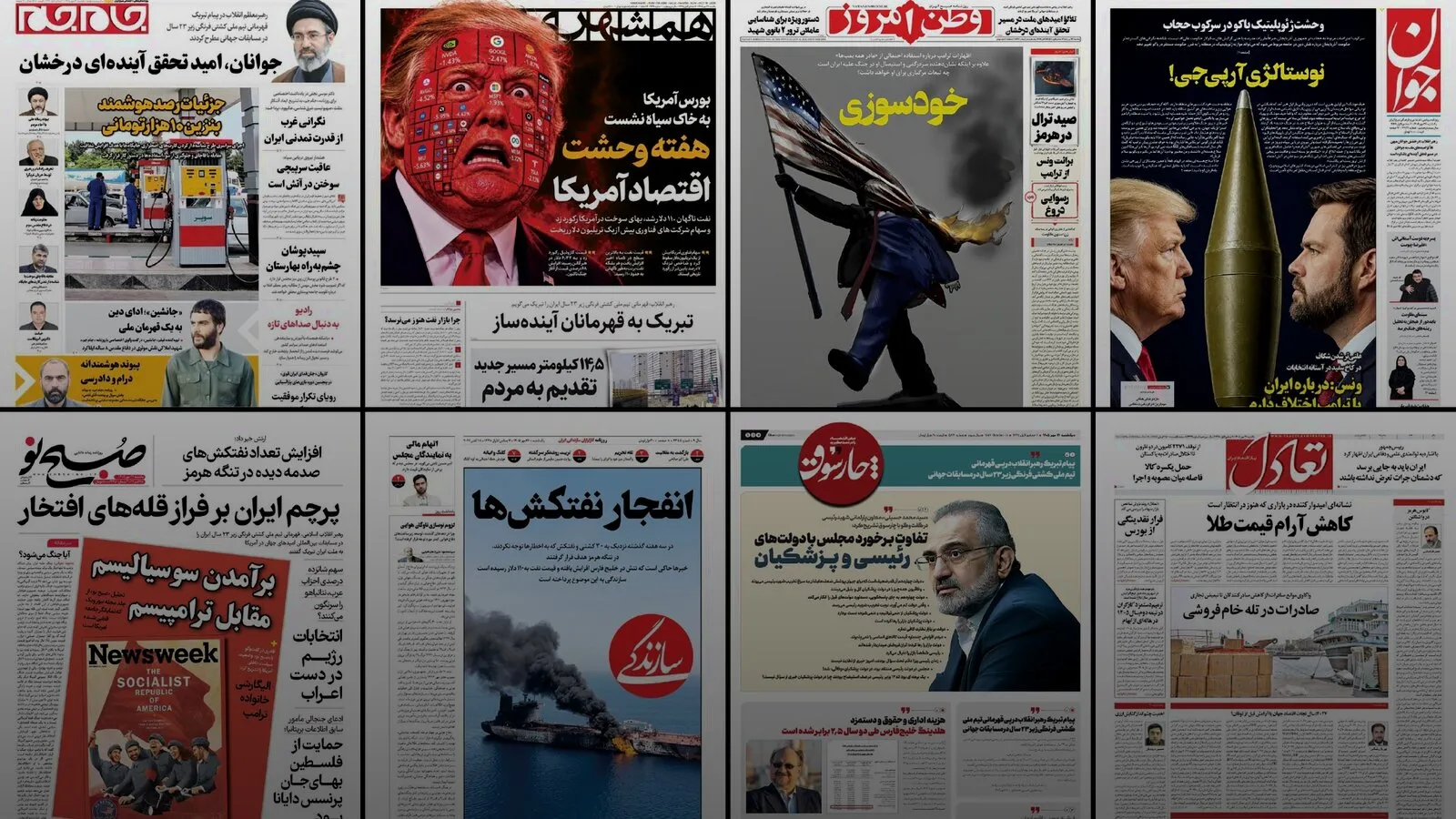
Bottom line: On the morning after the Guard declared the Strait of Hormuz closed and claimed a second loaded supertanker had been mined, the Iranian front pages printed the scale of the maritime campaign for the first time as a number rather than as an incident, and the foreign minister used the same day to put a dated seven-day reopening offer through Qatar, so the chokepoint is now being worked simultaneously as the instrument of coercion and as the only thing Tehran has to trade.
Executive Summary
The lead judgment of this edition is that the Iranian press has stopped reporting the maritime campaign one hull at a time and has begun reporting it as a scale, and that the highest figure in the batch comes from the reformist side of the aisle. Sazandegi gives its whole front page to «انفجار نفتکشها», the explosion of the tankers, over a deck that reads: in the past three weeks nearly thirty ships and tankers that did not heed the warnings were targeted in the Strait of Hormuz. The sentence concedes deliberate targeting and assigns the cause to the victims’ non-compliance in a single clause. Sobh-e No’s masthead banner puts an Iranian state institution’s name on the damage, attributing to the Artesh an announced increase in the number of damaged tankers in the Strait. Jam-e Jam carries the Guard’s formula as routine right-rail furniture, «عاقبت سرپیچی سوختن در آتش است», the fate of defiance is to burn in fire, which the government daily Iran prints the same morning in full as «عاقبت متخلفان، سوختن در آتش اعتماد به آمریکاست», the fate of violators is to burn in the fire of trusting America. In the previous cycle this monitor recorded the Guard declaring the Strait closed on a night when no front page carried any of it. This morning the print lag has closed and the campaign is on page one across the factional spectrum.
The second finding is that the same day carries a dated, conditional, routed offer to end it, and that only the English-language page prints it. Iran Daily leads its picture story with Abbas Araghchi at the 52nd Organisation of Islamic Cooperation Council of Foreign Ministers in Baghdad on 17 October, saying Tehran is ready for dialogue on credible guarantees, that Iran negotiated in good faith for two years and was attacked instead, and that a seven-day plan has been passed through Qatar under which the Strait could reopen if conditions are met. Etemad’s channel supplies the half no front page prints: the Salalah track, intended to reopen the Strait temporarily pending a permanent arrangement, «این تلاش به نتیجه نرسید», did not succeed, and Doha says mediation continues under serious challenge. Nour News, closest to the Supreme National Security Council, adds that Qatar considers the Iranian proposal obstructed by American insistence on the nuclear file, and refuses to treat Trump’s talk of an ending as an ending. Read together, the seven-day plan is the second attempt after a failed one, which is the accurate reading and which the Persian press does not supply.
The third finding is a named reprisal set aimed at a state that would not be the striking party. Kayhan’s front-page analysis states that the destruction of Israel’s nuclear facilities would be the answer to any attack on «کوهکلنگ», the buried complex Trump said on 16 October that US forces may need to take a shot at, and Hossein Shariatmadari’s «یادداشت روز» runs the same position over two parts under «مادر بمبهای شما و پدر موشکهای ما», your mother of bombs and the father of our missiles, closing on the line: send your mother of bombs and our missiles will give them their father. Vatan-e Emrooz devotes its whole page to the same American statement under «خودسوزی», self-immolation, answering a weapons threat with a prediction of the threatener’s self-destruction rather than with a counter-claim of capability. The IRGC spokesman’s derision of a civilisation that names its heaviest bomb mother appears on three surfaces the same day. A specific American target has been met with a specific Israeli reprisal set on the surface whose editor the Leader’s office appoints, which is the conventional channel for positions the state wants circulated without formally adopting them.
The fourth finding is the coordinated amplification of a real but hedged American statement into a claimed rupture. Javan leads on a rocket warhead standing between Trump and Vance under «ونس: درباره ایران با ترامپ اختلاف دارم», Vance: I have a disagreement with Trump about Iran, kickered to the rift becoming more public on the eve of the elections. Vatan-e Emrooz runs the same claim in its right rail as «برائت ونس از ترامپ», Vance’s disavowal of Trump, with a deck saying the vice president declared himself to have been opposed to the war. The underlying remark is genuine: Vance did signal disagreement in a 16 October interview. What both pages omit is that he also said the two are aligned, urged critics not to abandon the administration over foreign policy, and that Trump’s own account was that his deputy had been philosophically a little bit different at the outset. Two IRGC-aligned titles printing the same inflation in near-identical terms on the same morning indicates centrally guided message discipline rather than organic editorial convergence.
The fifth finding is that the war is now being read through the American electoral calendar on principlist as well as reformist pages. Sobh-e No’s lead editorial is «آیا جنگ میشود؟», will there be war, and answers that the war is no longer a political trump card for Trump but a political and economic liability sixteen days before the midterms, citing a Pew figure it renders as 64 percent of Americans opposed. The government daily’s front page states it flatly: «هزینه جنگ ترامپ با ایران در انتخابات آمریکا آشکار خواهد شد», the cost of Trump’s war with Iran will become apparent in the American elections. Hamshahri composites Trump’s face out of a red stock-market heat map under «هفته وحشت اقتصاد آمریکا», a week of terror for the American economy, and prices it: oil at 110 dollars, diesel at a record 6.32 dollars a gallon, technology shares down more than a trillion. The first two figures are close to the external record. Ta’adol’s right rail completes the inversion with «کابوس هرمز در واشنگتن», the Hormuz nightmare in Washington. Tehran is assessing this war through the adversary’s domestic clock rather than through the front, and 3 November is the date it has chosen.
The sixth finding is that the better-corroborated theatre is Yemen, and that Tehran is offering mediation there from a position of leverage. Jomhouri Eslami leads on the foreign ministry’s declared readiness to help resolve matters between Saudi Arabia and Yemen peacefully, with the pointed framing that twelve years of foreign intervention, military approach and blockade have not solved Yemen’s problem. Iran Daily’s page-one interview asks whether Riyadh could tap Iran’s diplomatic clout. The offer lands in a week when Ansarullah struck Riyadh’s King Khalid International Airport four times in five days and the airport stayed shut through 17 October, when Saudi aircraft bombed a school in Taiz and Al-Khokha in Hodeidah, and when the Saudi-led coalition confirmed intercepting two ballistic missiles towards Khamis Mushait. Defa Press adds the first commitment of its kind this monitor has logged: the secretary general of Iraq’s Kataib Sayyid al-Shuhada saying his group would enter a war if Iran faced a real threat.
Net assessment. This is a high-signal kiosk and the signal is structural rather than episodic. For the first time in this run the printed pages and the operational record are describing the same thing on the same day: a chokepoint campaign at a scale the papers now quantify, a closure declared by the Guard, a reprisal doctrine naming a third state’s nuclear facilities, and a dated offer to reopen the Strait within a week routed through a mediator whose previous track has already failed. The two halves are not in tension; they are the same policy addressed to different readerships, and the fact that the offer appears only in English while the coercion appears in Persian is itself the allocation. Three markers carry forward. The Leader is on page one for a second consecutive cycle and again through a ceremonial vehicle, a sports message over his printed signature, with the audiovisual record still empty. The adversary’s election has become the organising date of Iranian war coverage across factional lines. And the reformist press has begun doing two things it had not done before: printing the scale of the maritime campaign, and asking in a party organ why Iran’s air defences were neglected for decades.
Key Judgments
- KJ-1 [HIGH] The Iranian press has shifted from reporting the Hormuz campaign incident by incident to reporting it as a quantified total, and the shift is cross-factional. The evidence is four surfaces on one morning: Sazandegi’s lead deck, «در سه هفته گذشته نزدیک به ۳۰ کشتی و نفتکش که به اخطارها توجه نکردند، در تنگه هرمز هدف قرار گرفتند»; Sobh-e No’s masthead banner attributing to the Artesh an announced increase in damaged tankers; Vatan-e Emrooz’s photograph of a vessel burning bow to stern under «صید ترال در هرمز»; and Vatan-e Emrooz’s own channel carrying a TASS count of 22 vessels attacked between 1 and 13 October. The significance is that a total implies a policy, and a policy printed as a total is one the readership is being prepared to defend rather than to be shocked by. Calibration runs both ways: the thirty-vessel figure sits above the externally corroborated range, since UKMTO counted at least twelve in the week to 16 October and noted that many struck vessels do not report, so overstating it would inflate the signal while understating it would miss a campaign that Kpler data show cut transit to about 68 percent of the pre-war baseline. Tracking cue: whether a second title publishes an independent total, or whether the thirty figure is simply repeated.
- KJ-2 [HIGH] Tehran is running coercion and a dated conditional offer simultaneously, and has allocated them to different languages. The evidence is the day’s split: the Guard’s burn formula on Jam-e Jam and in full on the government daily, against Iran Daily’s English lead carrying Araghchi at the OIC in Baghdad on 17 October saying Tehran is ready for dialogue on credible guarantees and has passed a seven-day plan through Qatar under which the Strait could reopen if conditions are met. No Persian front page in the batch carries the seven-day plan. The significance is that the offer is an external instrument with a domestic cost Tehran has declined to pay in print, which both limits how far it can be walked back and limits how much domestic constituency it can build. Tracking cue: the first Persian front page to print the seven-day clock would mark a decision to prepare the domestic audience for a settlement.
- KJ-3 [HIGH] The published reprisal set for a strike on Iran’s buried nuclear complex now names Israel’s nuclear facilities, which widens the retaliation envelope to a state that need not be the striking party. The evidence is two Kayhan surfaces on the same day: the front-page analysis «انهدام تأسیسات هستهای اسرائیل پاسخ هرگونه حمله به «کوهکلنگ»», and Shariatmadari’s two-part «یادداشت روز» stating that American and allied infrastructure in the region, Europe and the United States itself would not be safe and extending the set to Israeli nuclear facilities. The occasion is Trump’s 16 October refusal to rule out the MOAB and his naming of the buried Pickaxe Mountain site. The significance is that Kayhan’s editor is appointed by the Leader’s office, which makes the paper the conventional channel for positions the state wants circulated without adopting, and that naming a target converts deterrence into a commitment with a visible failure mode. Nothing here is endorsed or treated as a capability assessment.
- KJ-4 [HIGH] Two IRGC-aligned front pages inflated the same hedged American statement into a claimed rupture on the same morning, which indicates centrally guided message discipline rather than organic convergence. The evidence is the pairing: Javan’s lead, «ونس: درباره ایران با ترامپ اختلاف دارم», staged across a rocket warhead between the two men and kickered to the rift becoming more public before the elections; and Vatan-e Emrooz’s right rail, «برائت ونس از ترامپ», with a deck saying the vice president declared he had been opposed to the war. Externally, Vance did signal disagreement in a 16 October interview, but also said the two are aligned and urged critics not to abandon the administration, and Trump characterised him only as having been philosophically a little bit different at the outset. The significance is in the uniformity of the omission rather than in the claim: both titles dropped the same qualifier. Tracking cue: survival into a third cycle would mark a campaign rather than a news peg.
- KJ-5 [HIGH] Iranian war coverage has adopted the American midterm election as its organising date, across factional lines. The evidence is six of thirteen titles: Sobh-e No’s editorial «آیا جنگ میشود؟» answering that the war is now a liability for Trump sixteen days out; the government daily’s «هزینه جنگ ترامپ با ایران در انتخابات آمریکا آشکار خواهد شد»; Javan’s and Vatan-e Emrooz’s election-framed Vance covers; Hamshahri’s «هفته وحشت اقتصاد آمریکا» with oil at 110 dollars and record diesel; and Ta’adol’s «کابوس هرمز در واشنگتن». The significance is that a theory of the adversary anchored to a dated event has a dated expiry, and external reporting that Trump has ordered readiness for larger operations after 3 November means both sides have placed their next decision point on the same calendar square. Calibration: this is a reading of Iranian editorial intent, not a prediction of either side’s conduct after that date.
- KJ-6 [MODERATE-HIGH] The negotiation track is weaker than the day’s offer implies, and only the channels report the weakness. The evidence is three non-front-page surfaces: Etemad carrying Doha’s confirmation that the Salalah meeting intended to reopen the Strait temporarily «این تلاش به نتیجه نرسید», did not succeed, and that mediation continues under serious challenge; Nour News saying Qatar considers the Iranian proposal obstructed by American insistence on the nuclear file, and refusing to treat Trump’s talk of an ending as an ending; and Nour News reporting roughly six billion dollars of Iranian funds held in Qatar as an incentive in play. The significance is that the seven-day plan is a second attempt after a failed one, which materially changes how it should be read, and that no Iranian front page carries the failure. Tracking cue: whether Doha or Islamabad, the two named mediators, publicly set a deadline.
- KJ-7 [MODERATE-HIGH] Yemen remains the better-corroborated theatre and Tehran is offering mediation there from a position of leverage rather than neutrality. The evidence is Iranian and external. Jomhouri Eslami leads on the foreign ministry’s readiness to use its good offices «در صورت تقاضای طرفین», if the parties request it, with the framing that twelve years of intervention and blockade have not worked; Iran Daily runs a page-one interview asking whether Riyadh could tap Iranian clout. Externally, Ansarullah struck Riyadh’s King Khalid International Airport four times in five days with the airport closed through 17 October, Saudi aircraft struck Taiz and Al-Khokha, and the Saudi-led coalition itself confirmed intercepting two ballistic missiles towards Khamis Mushait. The significance is that the offer is made while the pressure runs Riyadh’s way and dates the problem to 2015 rather than to the present escalation. Tracking cue: any Saudi public response, which has not appeared in two cycles of offers.
- KJ-8 [MODERATE-HIGH] The mine-on-an-unauthorised-route template has now been applied to a second loaded supertanker and is being contested in public by the adversary’s theatre commander, which makes the Strait a contested-claims environment rather than a reported one. The evidence is the pairing of claims: the IRGC’s 17 October statement that a supertanker carrying more than two million barrels caught fire after striking a mine while running an unauthorised route with navigation and radar switched off, with the naval commander warning that vessels deactivating navigation would be treated as hostile; against CENTCOM’s commander stating on 16 October that the Strait is controlled by the United States and its regional partners and not by Iran, that 400 ships and 100 million barrels transited in a week, and that the container ship GFS Pride was struck by an IRGC projectile rather than a mine. The significance is that the template is stable while the verification environment is not, which is the condition under which an incident is most likely to be misread by one side or both. Calibration: neither account is adopted here.
- KJ-9 [MODERATE] The Leader is on the Iranian front pages for a second consecutive cycle, again through a ceremonial vehicle, and the audiovisual gap recorded on 17 October is unchanged. The evidence is six of ten scanned pages carrying his message on the under-23 Greco-Roman world title as banner, ear or lead, with Jam-e Jam and Chaharsoo printing his portrait and Javan printing the body in full over the signature «سید مجتبی حسینی خامنهای» and the date ۲۵ مهر ۱۴۰۵. The significance is that the documentary basis of the succession continues to strengthen while the physical one does not: no dated public appearance, confirmed photograph or confirmed recording accompanies the text on any surface in the batch, as was the case in the previous cycle. Filed as a continuing negative-evidence item rather than as a resolved one. Tracking cue: a Leader item carrying a dated appearance.
- KJ-10 [MODERATE] Negative evidence, filed as a finding: the reformist press has opened a defence-capability file in its own party organ, and nothing else in the batch answers it. The evidence is a single column. Sazandegi’s «یادداشت روز» is «لزوم نوسازی ناوگان هوایی», the necessity of renewing the air fleet, bylined to a member of the Kargozaran-e Sazandegi central council and standfirsted «چرا در دهههای گذشته، توسعه زیرساختهای دفاع هوایی کمتر مورد توجه قرار گرفته است؟». No other title in the batch, and no channel read for this edition, raises air defence at all. The significance is in the asymmetry: on a morning when thirteen papers discuss the Strait, the American election, a bomb and a wrestling title, exactly one asks why the country’s air defences were underbuilt, and it is a party daily rather than a military or principlist surface. Tracking cue: whether any principlist title answers it, which would indicate the question has been permitted.
- KJ-11 [MODERATE] The Azerbaijan file has been re-centred again, this time from Israel’s diplomatic presence onto the internal religious politics of Baku, while energy cooperation with the same government is advertised on the English page. The evidence is two surfaces on one morning: Javan’s banner «وحشت ژئوپلیتیک باکو در سرکوب حجاب», arguing that the hijab crackdown reflects an anxiety about religion’s role that could shift the regional balance against the Baku establishment; and Iran Daily’s lead headline on Iran, Russia and Azerbaijan discussing regional gas cooperation with proposed seasonal swaps, printed as the Russian foreign minister tours the Gulf en route to Tehran. The significance is that the file is being worked as partnership and as ideological target simultaneously, which is a pattern this monitor has now logged in two consecutive cycles with the target shifting each time.
- KJ-12 [MODERATE] The domestic cost of the war is being reported in units the state cannot reframe, and the economic press is doing it on the same pages that carry the deterrence line. The evidence is three items: Ta’adol’s ear counting 2,771 trucks halted and exports to Pakistan disrupted, under a banner quoting the President that Iran must reach a point where enemies do not dare attack; Sazandegi’s brief «تله تحریم - پاکستان مرز خود با ایران را بست!»; and Chaharsoo’s cartoon of citizens paying cash at an internet cafe to register for a ration coupon. Externally, Islamabad suspended the Gabd-Rimdan and Taftan crossings on 17 October citing security and smuggling, while Tehran’s foreign ministry calls the halt technical. The significance is that stranded freight and a fee to claim a subsidy are concrete and unanswerable by war framing, and they are appearing beside the war’s rhetoric rather than in place of it.
Macro Trends
- The print lag has closed, and what closed it was a number. On 17 October this monitor recorded a ceremonial kiosk sitting on top of a high-tempo night, with the Guard’s closure declaration reaching no front page at all. This morning the campaign is on page one across the spectrum: Sazandegi’s thirty vessels in three weeks, Sobh-e No’s Army bulletin on rising tanker damage, Jam-e Jam and Iran carrying the burn formula, Hamshahri debunking a salvage rumour about a sunken container ship, Ta’adol framing the Strait as Washington’s nightmare. The shift from incident reporting to scale reporting is the editorial event, because a campaign described by its total is one the public is being prepared to carry rather than to be startled by.
- Coercion and offer are being printed on the same day in different languages. The Guard’s burn warning and the closure claim run in Persian on the state broadcaster’s daily and the government daily; the seven-day reopening plan, routed through Qatar with a condition attached, runs in English on Iran Daily and nowhere on a Persian front page. Etemad’s channel alone reports that the preceding Salalah track failed. This is not incoherence but allocation, and it means the offer should be assessed as an external-facing instrument with a domestic cost Tehran has chosen not to pay in print.
- The reprisal envelope has been widened to a non-belligerent’s nuclear facilities. Kayhan’s front-page analysis and Shariatmadari’s two-part note both state that an American strike on Kouh-e Kolang would be answered by destroying Israel’s nuclear facilities. Trump named that complex himself on 16 October. Naming the target and the reprisal set on the surface whose editor the Leader’s office appoints converts a general deterrent claim into a specific, checkable commitment, which is both a stronger signal and a trap: a named commitment not acted on is a visible climbdown.
- The American midterms have become the organising date of Iranian war coverage. Sobh-e No’s editorial prices the war as an electoral liability, the government daily dates the bill to the election, Javan and Vatan-e Emrooz read the Vance remark through the election, Hamshahri reads the markets through it and Ta’adol reads the Strait through it. Six of thirteen titles in this batch organise their lead argument around 3 November. The risk this creates is symmetrical: a theory of the adversary that depends on an election outcome has a fixed expiry date, and so does the restraint that may be resting on it.
- Yemen remains the better-evidenced theatre and is now also the mediation offer. Jomhouri Eslami leads on Tehran’s readiness to help resolve Saudi-Yemeni matters, Iran Daily asks in English whether Riyadh could use Iranian clout, and the wires supply the pressure that gives the offer its leverage: Riyadh’s airport closed through 17 October after four strikes in five days, Saudi aircraft over Taiz and Hodeidah, two ballistic missiles intercepted towards Khamis Mushait on the coalition’s own admission. Unlike the Hormuz claims, the Yemen record is corroborated from multiple non-Iranian sources, which is why it remains the more reliable read on regional escalation.
- The reformist press has started asking defence questions in its own party organ. Sazandegi’s note of the day, bylined to a member of the Kargozaran central council, asks why the development of air-defence infrastructure received less attention in past decades. That is wartime self-criticism aimed at the security establishment, printed by the party daily that also carries the batch’s highest vessel count. In earlier cycles the reformist counterweight ran against the executive on economics; it has now reached force structure, which is a materially more sensitive file.
- The inward ledger is now denominated in borders and coupons. Ta’adol counts the Pakistan closure in 2,771 stranded trucks and disrupted exports, Sazandegi captions it «تله تحریم», the sanctions trap, and Chaharsoo’s cartoon has citizens paying cash at an internet cafe to register for a ration coupon they were told was free. Islamabad calls the suspension a security and smuggling matter, Tehran’s foreign ministry calls it technical, and the economic press simply counts the vehicles. The war’s domestic cost is being reported in units the state cannot reframe.
Front-Page Snapshot
- Sazandegi - “Explosion of the tankers” (Reformist, Kargozaran party daily) - Nearly thirty vessels struck in three weeks printed as a scale finding, with oil at 110 dollars and a party-organ question about neglected air defence [SEVERE]
- Kayhan (channel-read) - “Destroying Israel’s nuclear facilities is the answer to any attack on Kouh-e Kolang” (Hardline, editor appointed by the Leader’s office) - A named reprisal set against a third state’s nuclear sites, with Shariatmadari’s two-part MOAB note [SEVERE]
- Sobh-e No - “Iran’s flag atop the peaks of honour” (Principlist) - The Army confirms rising tanker damage in the banner while the editorial prices the war into the US midterms [HIGH]
- Vatan-e Emrooz - “Self-immolation” (Hardline principlist) - Trump’s MOAB threat answered as self-destruction, with Vance’s hedged remark printed as a disavowal [HIGH]
- Javan - “RPG nostalgia!” (Hardline, IRGC-affiliated) - A claimed Trump-Vance rupture over Iran staged across a warhead, over an escalating Azerbaijan file [HIGH]
- Iran (channel-read) - “The cost of Trump’s war with Iran will become apparent in the American elections” (Official government daily) - The Guard’s burn formula printed in full in the government’s own voice, with the bill dated to 3 November [HIGH]
- Jam-e Jam - “The youth, hope for the realisation of a brilliant future” (State broadcaster IRIB daily) - The Leader’s sports message above the Guard’s burn warning carried as routine bulletin copy [MODERATE-HIGH]
- Hamshahri - “A week of terror for the American economy” (Centrist, Tehran municipality) - Oil at 110 dollars and record diesel priced as American damage, with a front-page debunk of a sunken container ship’s cargo rumour [MODERATE-HIGH]
- Jomhouri Eslami - “Iran declares readiness to help resolve the issues between Saudi Arabia and Yemen peacefully” (Traditional clerical establishment) - Mediation offered while Riyadh is under fire, alongside an admission that Tehran and Karaj fuel depots are being rebuilt [MODERATE-HIGH]
- Etemad (channel-read) - “(front-page headline not retrievable this cycle)” (Reformist) - The failed Salalah reopening track reported where no front page carries it, with Doha still mediating [MODERATE-HIGH]
- Iran Daily - “Araghchi: Tehran ready for dialogue based on credible guarantees” (English-language state daily (IRNA)) - A seven-day Hormuz reopening plan routed through Qatar, printed in English beside gas diplomacy with Moscow and Baku [MODERATE]
- Ta’adol - “A slow decline in the price of gold” (Economic daily) - Pakistan’s border closure counted in 2,771 stranded trucks while the Strait is framed as Washington’s nightmare [MODERATE]
- Chaharsoo - “The difference between parliament’s treatment of the Raisi and Pezeshkian governments” (Economic daily, principlist register) - Wartime scarcity turned into a factional competence attack, with a ration coupon that costs cash to claim [LOW-MODERATE]
Full report
The complete edition - per-paper front-page analysis and full translation appendices - is available as a PDF: Download the full report.
Compiled from Iranian front pages and outlet channels via open-source monitoring. Translations are editorial; named-figure attributions are verified against the source pages where possible.