Iranian Press Monitor - Saturday, 17 October 2026 (Day 228)
Saturday, 17 October 2026 · شنبه ۲۵ مهر ۱۴۰۵ · 6 Jumada al-Awwal 1448 - Thirteen Iranian newspapers of 25 Mehr 1405: ten front-page scans, nine Persian and one English, read together with three further papers from their own channels and three agency wires. Kayhan, Iran and Etemad are read from their channels because no scan of them reached the day’s kiosk batch. Tehran Times and the Leader’s official site were unavailable at the time of compilation.
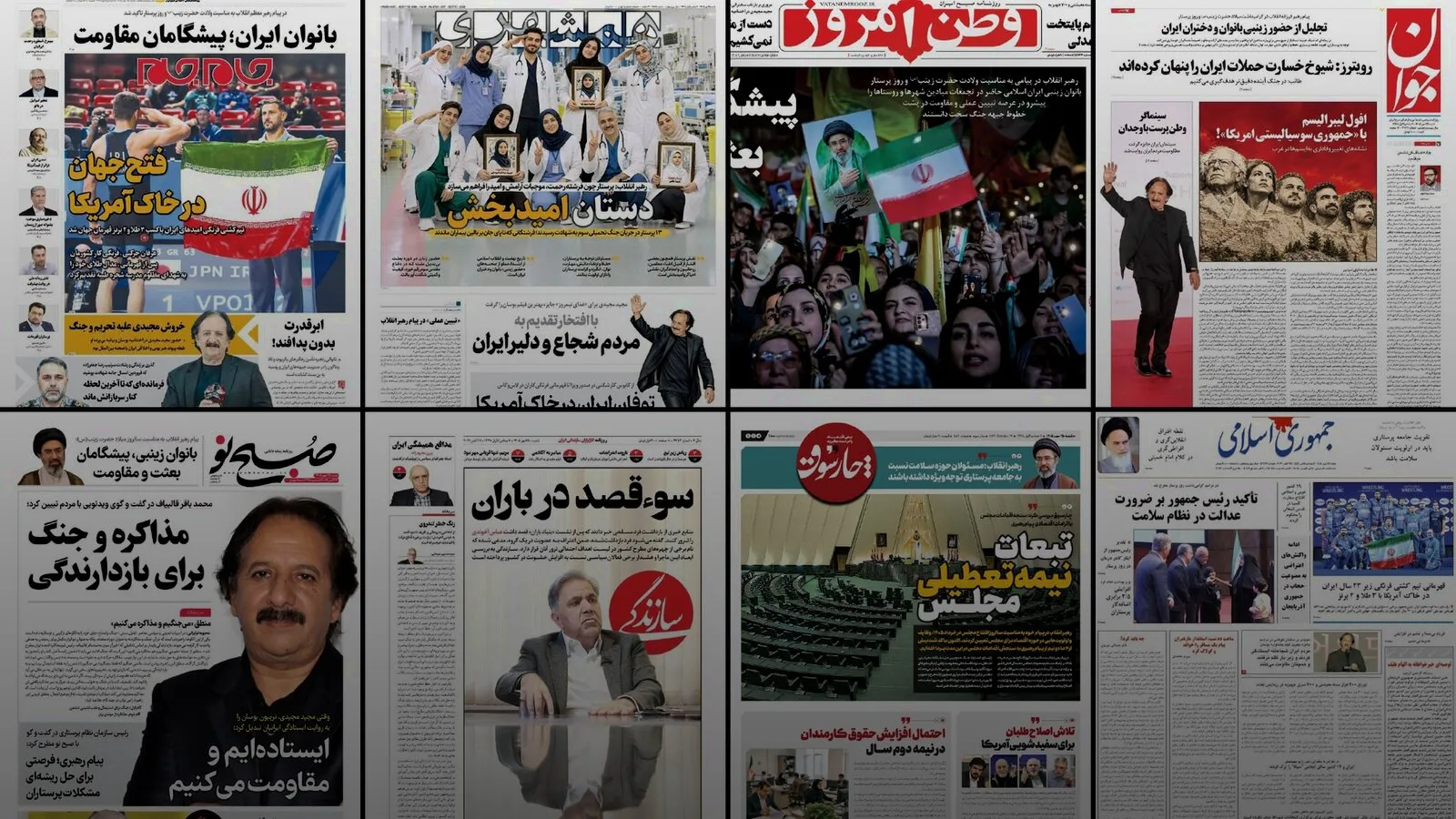
Bottom line: The incumbent Leader reappeared on the Iranian front pages for the first time in ten cycles, on a Nurse Day message signed in his own name, and those pages went to press hours before the IRGC Navy claimed a loaded supertanker had been mined and declared the Strait of Hormuz closed, so this morning’s calm kiosk measures a print deadline and not a change in the war.
Executive Summary
The lead judgment of this edition is that the incumbent Leader has returned to the Iranian front-page record, and that he returned through a nursing message rather than through the war. For ten consecutive cycles this monitor filed his front-page absence as a negative-evidence finding. This morning his message for the birth of Hazrat Zeynab and Nurse Day is the banner or masthead-ear item on seven of the ten scanned pages; Sobh-e No and Chaharsoo print his portrait beside it; Vatan-e Emrooz’s lead photograph is a night rally in which a poster bearing his image and the printed name «مجتبی الخامنئی» is held beside the national flag; and the government daily publishes the text over the signature «سید مجتبی حسینی خامنهای», Seyed Mojtaba Hosseini Khamenei. The documentary evidence for the succession is therefore stronger this morning than at any point in this run. What has not changed is the audiovisual position: there is no dated public appearance, no confirmed footage, and no photograph of the Leader taken this week on any surface in the batch. The absence finding is superseded; the caveat underneath it is not.
The second finding is that the morning’s front pages and the morning’s events belong to different days. The Persian kiosk batch was posted at 21:28 UTC on 16 October. At about 02:10 Tehran time the IRGC Navy said on the Fars and Kayhan channels that a supertanker carrying more than two million barrels of crude had struck a mine while attempting to pass the Strait of Hormuz by an unauthorised route, with its tracking and radar switched off, and stated flatly «تنگهٔ هرمز بسته است», the Strait of Hormuz is closed. In the same window four channels carried renewed fires at Aramco’s eastern Saudi facilities and explosions at Dammam, Khamis Mushait and Abha; Brent was reported at $110 intraday and $109.66 at the close; Nour News logged ninety-eight military flights in the region in twenty-four hours, American aerial refuelling activity, mobile shelters in Tel Aviv, and Trump again raising the possibility of striking Kharg. Not one of these reached a front page. Readers of this edition should treat the ceremonial tone of the printed pages as a deadline artefact and nothing else.
The third finding is that the chokepoint argument has changed category. Through recent cycles Tehran’s maritime claim was an enforcement claim: ships in violation, punishment, an invoice rendered. This morning Vatan-e Emrooz prints it as a precedent claim. Its special box, «هرمز؛ الگوی نظم جدید دریاها», Hormuz: the template for the new order of the seas, says that after Iran, Indonesia at Malacca, China in the South China Sea and Russia at the Bering Strait have set out to overturn a seventy-year-old maritime order. Javan supplies the operational half on the same kiosk, «فرماندهان نیروهای مسلح: تنگه هرمز همچنان بسته است», over «تنگه هرمز را «میدان» ایران کنترل میکند نه «روایت» ترامپ». Iran Daily supplies the doctrinal vocabulary in English: a “distributed maritime strategy”, a “no-go zone”, a “southern arc” of pressure running from the Gulf of Oman to the Red Sea. An enforcement claim can be traded away in a negotiation. A claim to have authored a new order of the seas cannot be withdrawn without conceding that the order was never established, and that is the significance of the shift.
The fourth finding is that the campaign against the negotiating camp has crossed from print into an alleged armed plot, and that the man who answered it in print is one of the men the hardline press named two cycles ago. Sazandegi gives its entire front page to «سوءقصد در باران», reporting the arrest of an armed man who it says intended to assassinate the former roads minister Abbas Akhoundi after a meeting of the Baran Foundation, and who it says confessed to membership of a group and claimed that other prominent national figures are on a target list. The paper’s editorial, «زنگ خطر تندروی», the alarm bell of extremism, is signed by Seyed Hossein Marashi, the Kargozaran spokesman whom Kayhan’s «یادداشت روز» named on 15 October alongside Mohammad Javad Zarif and Hassan Rouhani. On the same morning Chaharsoo runs «تلاش اصلاحطلبان برای سفیدشویی آمریکا» over a four-portrait panel in which Zarif is identifiable. The story reaches no other front page in the batch and does not appear on Etemad’s channel, and Kayhan published no signed editorial at all in this cycle.
The fifth finding is a reversal of attribution rather than of fact. Two cycles ago this monitor recorded Gholamhossein Karbaschi, on the wire closest to the Supreme National Security Council, saying that striking three ships in the Strait had violated the Islamabad memorandum. This morning the deputy foreign minister Saeed Khatibzadeh says on Vatan-e Emrooz’s channel that the United States and Israel violated it, naming the attack on Lebanon as the violation, and that any negotiated outcome must match the result of the war. Sobh-e No’s editorial by Mahboubeh Niavarani goes further and reframes the memorandum as the conversion of battlefield gains into a political mechanism, crediting its first step with lifting the oil blockade and sanctions. Ta’adol’s front page, alone in the batch, treats it as something that still needs underwriting: «آیا مسکو ضامن احیای تفاهم اسلامآباد میشود؟», will Moscow become the guarantor of reviving the Islamabad understanding, published the weekend the Russian foreign minister is reported to be arriving in Tehran on Monday.
Net assessment. This is a low-signal kiosk sitting on top of a high-tempo night, and the gap between them is the edition’s main intelligence content. The printed pages are ceremonial, soft-power heavy and factionally busy: a Leader’s message on seven of ten, a Greco-Roman wrestling title won in Las Vegas on five, Majid Majidi’s Busan prize on seven, a parliament audited and found half shut, a currency market described as trapped in a vicious circle. Underneath them the Guard’s navy declared a strait closed, Saudi oil infrastructure burned for a second time, oil crossed $110, and the body that would ordinarily count maritime attacks said it cannot count them because the ships being hit are not reporting. The direction of travel is not softening. What this morning supplies is three durable markers to carry forward: a Leader who is now documentarily present and audiovisually still absent, a chokepoint claim promoted from enforcement to precedent, and a loyalty campaign that has acquired, at least in one reformist paper’s account, a gun.
Key Judgments
- KJ-1 [HIGH] The incumbent Leader has returned to the Iranian front-page record after ten consecutive cycles of absence, and the vehicle is a ceremonial health message rather than the war. The evidence is a sweep of the batch: his Nurse Day message is the banner or masthead-ear item on Jam-e Jam, Hamshahri, Vatan-e Emrooz, Javan, Sobh-e No, Chaharsoo and Jomhouri Eslami; Sobh-e No and Chaharsoo print his portrait beside it; Vatan-e Emrooz’s lead photograph shows a rally poster carrying his image and the printed name «مجتبی الخامنئی»; and the government daily publishes the text over the signature «سید مجتبی حسینی خامنهای». The significance is that this monitor’s standing negative-evidence finding on his front-page absence is now superseded, and the documentary basis of the succession is stronger than at any earlier point in this run. The caveat is unchanged and is stated as part of the judgment: no dated public appearance, confirmed video or confirmed audio accompanies the text on any surface in the batch, so what improved is the paper record, not the physical one. Tracking cue: whether the next Leader item carries a dated appearance or remains a signed text.
- KJ-2 [HIGH] The chokepoint claim has been promoted from an enforcement practice to a published precedent for other states’ straits, which materially raises the cost of trading it away. The evidence is three surfaces on one morning. Vatan-e Emrooz’s special box «هرمز؛ الگوی نظم جدید دریاها» carries the kicker «پس از ایران، اندونزی در مالاکا، چین در دریای چین جنوبی و روسیه در تنگه برینگ، به دنبال تغییر نظم ۷۰ ساله افتادند». Javan prints «فرماندهان نیروهای مسلح: تنگه هرمز همچنان بسته است» over «تنگه هرمز را «میدان» ایران کنترل میکند نه «روایت» ترامپ». Iran Daily’s opinion page supplies the doctrine in English: a distributed maritime strategy, a no-go zone, and a southern arc of pressure from the Gulf of Oman to the Red Sea. The significance is structural: an enforcement claim is a bargaining chip, while a claim to have authored a new maritime order is an identity position, and identity positions are surrendered late and expensively. Calibrating in both directions: overstating this would read a single special feature as doctrine, while understating it would miss that three separate outlets printed the same upgrade on the same morning.
- KJ-3 [HIGH] The campaign against Iran’s negotiating camp has escalated from naming figures in print to an alleged armed plot against one of them, and the reformist press answered it almost alone. The evidence is a chain across three cycles. Kayhan’s «یادداشت روز» of 15 October named Mohammad Javad Zarif, Hossein Marashi and Hassan Rouhani and closed on the assassinated Leader’s warning that judicial and security bodies should act against those who cooperate with the enemy. This morning Sazandegi gives its entire front page to «سوءقصد در باران», reporting an armed man arrested after a Baran Foundation meeting who it says intended to kill the former roads minister Abbas Akhoundi, confessed to membership of a group, and claimed that other prominent national figures are on its target list; the paper’s editorial «زنگ خطر تندروی» is signed by that same Marashi; and Chaharsoo runs «تلاش اصلاحطلبان برای سفیدشویی آمریکا» over a panel including Zarif. The negative half is part of the finding: the plot reached no other front page in the batch, did not appear on Etemad’s channel, and Kayhan published no signed editorial in this cycle. Single-source flag: the plot rests on Sazandegi’s account alone. Tracking cue: whether a judicial or interior-ministry statement confirms an arrest.
- KJ-4 [HIGH] Authorship of the Islamabad memorandum’s breach has been reversed within two cycles, and the memorandum is being preserved as an Iranian asset while the violation is externalised. The evidence is a direct inversion. Two cycles ago Nour News, the wire closest to the Supreme National Security Council, carried Gholamhossein Karbaschi saying that striking three ships in the Strait had violated the memorandum. This morning the deputy foreign minister Saeed Khatibzadeh says the United States and Israel violated it, naming the attack on Lebanon as the breach, and that any negotiated outcome must match the result of the war; Sobh-e No’s editorial recasts the memorandum as the political conversion of battlefield gains and credits its first step with lifting the oil blockade and sanctions. The significance is that a framework both sides are accused of breaking is nonetheless being kept alive by both the hardline and the diplomatic register, which is the behaviour of parties who intend to return to it. Tracking cue is immediate: Ta’adol’s rail asks «آیا مسکو ضامن احیای تفاهم اسلامآباد میشود؟» and the Russian foreign minister is reported to be arriving in Tehran on Monday.
- KJ-5 [HIGH] A doctrine of simultaneous war and negotiation has been printed as an explicit two-step sequence on a principlist front page, supplying a watchable trigger in place of a slogan. The evidence is one editorial. Sobh-e No leads «مذاکره و جنگ برای بازدارندگی» and its سرمقاله by Mahboubeh Niavarani reduces the doctrine to «گام اول: جنگ برای استیصال و عقبنشینی دشمن / گام دوم: مذاکره از موضع برتر», war to exhaust the enemy and force his retreat, then negotiation from the superior position, with «بازدارندگی پایدار», durable deterrence, as the single objective. The significance is that this converts «هم میجنگیم و هم مذاکره میکنیم» from rhetoric into a stated condition: Tehran opens talks when it assesses the adversary as exhausted, which is an indicator that can be watched. Verification flag inside the judgment: the editorial describes Mohammad Bagher Ghalibaf, the Speaker of the Majlis, as «رئیس تیم مذاکرهکننده ایران», head of Iran’s negotiating team, a title no other paper, channel or wire in this batch gives him; it is recorded as the paper’s own characterisation.
- KJ-6 [MODERATE-HIGH] The cycle’s two hardest military events reached no front page at all and exist in this edition only on the wires, which makes the morning’s ceremonial tone a print-deadline artefact rather than a de-escalation signal. The evidence is a timeline. The Persian kiosk batch was posted at 21:28 UTC on 16 October. At about 02:10 Tehran time the IRGC Navy’s supertanker claim and the declaration «تنگهٔ هرمز بسته است» appeared on the Fars and Kayhan channels; renewed Aramco fires and Dammam explosions appeared across four channels in the same window; Brent was reported at $110 intraday and $109.66 at the close; and Nour News logged ninety-eight regional military flights in twenty-four hours, American aerial refuelling, mobile shelters in Tel Aviv and Trump again raising a strike on Kharg. None of the ten scanned pages carries any of it. The significance for readers of this product is methodological as much as substantive: on a conflict running at this tempo the printed page is now a lagging indicator, and any judgment drawn from front-page tone alone will be a day behind. Tracking cue: whether tomorrow’s pages carry the tanker, and in which of the four registers this monitor has recorded for maritime incidents.
- KJ-7 [MODERATE-HIGH] The mine-on-an-unauthorised-route template has now been applied to a third hull in four cycles, and the external check on it has formally degraded in the same cycle. The evidence has an Iranian and an external half. The template was used against a supertanker in an earlier cycle and against the container ship GFS Pride on 14 October; this morning it is applied again to a supertanker said to be carrying more than two million barrels, with the added detail that the vessel had switched off its tracking and radar. Externally, Etemad’s channel carries UK Maritime Trade Operations saying it cannot obtain accurate figures on attacks in the Strait because most targeted ships do not report them. The significance is that a stable narrative template and a weakening verification environment are moving in opposite directions at the same time, which is the condition under which maritime claims become effectively unfalsifiable and therefore cheaper to make. Calibrating in both directions: the degraded reporting environment does not make the Iranian claim false, and it equally removes the basis on which it could be shown true.
- KJ-8 [MODERATE-HIGH] Yemen remains the better-corroborated theatre of the two, and Tehran this cycle printed an operational disclaimer and a leverage claim on the same morning. The evidence runs outward from the Iranian pages. Yahya Saree claims 101 Saudi air and missile attacks in twenty-four hours on Sanaa and several provinces; Sanaa’s foreign ministry writes to OIC foreign ministers citing attacks since 26 March 2015; five channels carry Aramco’s eastern facilities burning again with explosions at Dammam, Khamis Mushait and Abha; Jam-e Jam’s channel adds Australia’s advisory to avoid Saudi oil facilities, New Zealand’s travel advice and the extension of the American suspension at Riyadh’s King Khalid airport to 17 October. Against this, the foreign ministry spokesman Esmaeil Baghaei rejects claims of Iranian involvement in Yemeni operations and offers help in ending the conflict if both sides ask, and Saeed Khatibzadeh says Riyadh has not answered Iran’s mediation proposal, while Sobh-e No’s front page carries «یمن میتواند معادلات جنگ ایران - آمریکا را تغییر دهد». The significance is that Tehran is simultaneously claiming the Yemeni front as a strategic variable in its own war and disclaiming authorship of its operations, which is the posture of a party keeping a mediator’s seat open.
- KJ-9 [MODERATE-HIGH] The morning’s two heaviest damage assertions are both borrowed from Western sources and neither is reproducible from the retrieved record. The evidence is three items. Javan’s banner reads «رویترز: شیوخ خسارت حملات ایران را پنهان کردهاند», Reuters: the sheikhs have concealed the damage of Iran’s attacks; Kayhan’s own front-page list carries a Reuters investigative report on Iran’s precise strikes on American bases in the Persian Gulf; and Iran Daily prints “CIA report warns Israel could head toward civil war, total collapse” under a LEAK tag. The significance is in the pattern rather than in any one claim: the two propositions the Iranian press most needs external authority for, that Gulf states are concealing Iranian battle damage and that Israel is internally disintegrating, both arrive wearing a foreign masthead. Attribution firewall: these are Iranian renderings of foreign reporting; quoting a rendering does not verify the original, and none of the three is reproduced here as authentic without primary-source confirmation.
- KJ-10 [MODERATE] The Azerbaijan file has been re-centred from the school hijab dispute onto Israel’s diplomatic presence in the Caucasus, and the Iranian count of the resulting walkout exceeds the externally corroborated one. The evidence is two front pages and the external record. Jomhouri Eslami prints «در اعتراض به سخنرانی رئیس رژیم صهیونیستی: ایران و ۱۲ کشور سالانه اجلاس «سیکا» را ترک کردند» and names thirteen delegations including Qatar and Saudi Arabia, with Kazem Gharibabadi representing Iran; Jam-e Jam runs an op-ed «تحقیر اسرائیل در باکو», Israel’s humiliation in Baku, by Mohsen Pakaein, a former Iranian ambassador to Azerbaijan. Externally the seventh CICA summit was held in Baku on 15 October and international reporting names five delegations leaving during Isaac Herzog’s address, Iran, Turkey, Kuwait, Pakistan and the Palestinian Authority, with the Emir of Qatar recorded as staying. The hijab thread survives only as Jomhouri Eslami’s «توصیهای خیرخواهانه به الهام علیاف». The significance is that the exaggeration is in the magnitude rather than in the event, which is the same failure mode this monitor recorded when the Israeli-authorship claim about the Azerbaijani dress rules collapsed without retraction.
- KJ-11 [MODERATE] The war is being given a fixed ordinal name across factional lines, and the naming is being sourced to the Leader’s own text. The evidence is three surfaces. Hamshahri’s front-page banner counts thirteen nurses martyred «در جریان جنگ تحمیلی سوم», in the Third Imposed War. Defa Press publishes «بعثت بیبدیل ملت ایران»، روایتی از مقاومت در دفاع مقدس سوم, the Third Holy Defense, and states that it takes the phrase from the Leader’s message of 24 Mehr. Vatan-e Emrooz and Sobh-e No both render the message’s headline as «پیشگامان بعثت». The significance is that naming this conflict in the grammar of the 1980-88 war assigns it in advance a canonical duration, a canonical sacrifice and a canonical outcome, which is a durable mobilisation asset and also a commitment: a war with an ordinal cannot be ended quietly. Tracking cue: whether «دفاع مقدس سوم» migrates from the agency wires onto the front pages.
- KJ-12 [MODERATE] Negative evidence, filed as a finding: a scheduled national vote remains suspended by the Supreme National Security Council, and the fact is reported once, in one paper, without comment. The evidence is a single paragraph. Jomhouri Eslami carries the chair of the Majlis internal affairs committee saying «شورای عالی امنیت ملی هنوز مجوزی برای برگزاری انتخابات شوراها صادر نکرده است», the Supreme National Security Council has still not issued authorisation to hold the council elections. No other paper or channel in the batch carries it. The significance is as a measure of agenda control rather than of the elections themselves: the suspension of a national vote under wartime security authority is the kind of item that would ordinarily draw reformist comment, and on a morning when one reformist daily led on an assassination plot and the other carried a European war-cost estimate, neither carried this. Tracking cue: whether any authorisation or formal postponement is announced before the statutory window closes.
Macro Trends
- The Leader is back on page one, and the file he returned through is health, not war. Seven of ten scanned front pages carry his Nurse Day message as banner or ear; two print his portrait in the masthead; a third makes a rally poster of him its lead photograph; the government daily publishes the text over his printed name. The war enters the message only obliquely, through «جنگ سخت», hard war, and a charge that the arrogance network restricts Iranians’ access to medicine. For a succession whose evidentiary base this monitor has repeatedly described as documentary rather than audiovisual, the morning strengthens the documentary half and leaves the other exactly where it was.
- Print now lags the wires by a night, and the lag is where the war is. The kiosk batch was posted at 21:28 UTC; the supertanker claim, the Hormuz closure declaration, the renewed Aramco fires, the Dammam and Khamis Mushait explosions and the move in Brent all broke after it. Three agency wires and two newspaper channels carried them before dawn and no front page carried any of them. The operational tempo of this conflict has moved to surfaces that publish hourly, and the printed page is now a lagging ceremonial indicator rather than the day’s record.
- The chokepoint claim graduated from enforcement to precedent. Vatan-e Emrooz’s special box presents Hormuz as the template other states are now following at Malacca, in the South China Sea and at the Bering Strait; Javan prints commanders saying the Strait remains closed and opposes Iran’s «میدان», field, to Trump’s «روایت», narrative; Iran Daily’s English opinion page gives the whole posture a doctrinal name. The argument has shifted from what Iran is entitled to do to what Iran has already established, which is a far harder position to concede in talks.
- The loyalty campaign moved from naming to an alleged attempt, and the rest of the press did not follow. Sazandegi’s whole front page reports an armed plot against Abbas Akhoundi with a claimed target list of further figures, and its editorial by Seyed Hossein Marashi, himself named in Kayhan’s editorial two cycles ago, demands decisive action against freelance violence. Chaharsoo runs a reformist-whitewashing panel featuring Zarif the same morning. Jomhouri Eslami answers in the establishment’s own idiom, printing Khomeini on where revolutionism ends and extremism begins and Beheshti on rule by standards rather than favour. The story itself reaches no other front page and no reformist channel, and Kayhan ran no signed editorial at all.
- Yemen still corroborates where Hormuz contradicts, and Tehran has now added a formal disclaimer. Yahya Saree claims 101 Saudi air and missile strikes in twenty-four hours; Sanaa writes to OIC foreign ministers citing attacks since March 2015; Aramco burns again at Dammam with explosions at Khamis Mushait and Abha; Australia tells its citizens to stay clear of Saudi oil facilities, New Zealand advises against travel, and the American suspension at Riyadh’s King Khalid airport runs to 17 October. Against all of that the foreign ministry spokesman Esmaeil Baghaei rejects claims of Iranian involvement in Yemeni operations and offers mediation, and Khatibzadeh says Riyadh has not answered the offer, while Sobh-e No’s front page carries «یمن میتواند معادلات جنگ ایران - آمریکا را تغییر دهد». Disclaimer and leverage claim are being printed on the same morning.
- The economic press kept the inward ledger and extended it to the legislature. Ta’adol leads on a currency market in a vicious circle of volatility, runs a page on the bourse against war risk, and asks whether Moscow can be made guarantor of the Islamabad understanding. Chaharsoo audits parliament against the Leader’s own economic instructions of Khordad 1405 and finds it «نیمهتعطیل», half shut, and its cartoon has officials sawing the corners off a conference table in honour of the government’s consensus slogan while the people’s tablecloth is forgotten. In earlier cycles this counterweight ran against the executive; this cycle it has reached the Majlis.
- The war is acquiring a canonical name, and it is the third in a series. Hamshahri counts thirteen nurses killed «در جریان جنگ تحمیلی سوم», in the Third Imposed War. Defa Press publishes «بعثت بیبدیل ملت ایران»، روایتی از مقاومت در دفاع مقدس سوم, the Third Holy Defense, taking the phrase from the Leader’s message. Naming a war in the same grammar as the 1980-88 conflict assigns it a canonical duration, a canonical cast and a canonical ending, which is a mobilisation asset with a long tail rather than a headline.
Front-Page Snapshot
- Javan - “The decline of liberalism with the “Socialist Republic of America”!” (Hardline, IRGC-affiliated) - Hormuz closure restated by commanders; Reuters-sourced Gulf damage claim; a promise of more precise targeting in the next war [SEVERE]
- Kayhan (channel-read) - “The tyrants of the age have no capacity to confront the army of Iran’s Zeynab-like women” (Hardline, Leader’s office appointee as editor) - Supertanker mine claim and a flat declaration that the Strait is closed; Aramco burning; no signed editorial this cycle [SEVERE]
- Vatan-e Emrooz - “Vanguards of the Be’that” (Hardline principlist) - The Leader’s message as lead, with Hormuz generalised into a template for Malacca, the South China Sea and the Bering Strait [HIGH]
- Sobh-e No - “Negotiation and war, for deterrence” (Principlist, close to the parliamentary leadership) - A two-step war-then-negotiate doctrine printed as policy, with the Islamabad memorandum reframed as an Iranian gain [HIGH]
- Iran Daily - “Pezeshkian calls for global action on war-related environmental damage” (English-language state daily (IRNA)) - Yerevan diplomacy and the Armenia corridor, over an English-language doctrine of distributed maritime denial and an unverified Israeli-collapse leak [HIGH]
- Sazandegi - “An assassination attempt at Baran” (Reformist, Kargozaran party) - Reported armed plot against former minister Abbas Akhoundi, with a claimed target list of further national figures [HIGH]
- Jomhouri Eslami - “The President stresses the necessity of justice in the health system” (Traditional clerical establishment) - CICA walkout over the Israeli president’s speech, Colombia’s Jerusalem embassy, and the only report that council elections remain unauthorised [MODERATE-HIGH]
- Jam-e Jam - “Conquest of the world on American soil” (State broadcaster (IRIB) daily) - Wrestling title won in the United States, a medal dedicated to school-strike martyrs, and a claim that American air defence is exhausted [MODERATE]
- Ta’adol - “The currency market in a vicious circle of volatility” (Economic daily) - War and sanctions priced inward, with Moscow floated as guarantor of the Islamabad understanding before Lavrov’s Tehran visit [MODERATE]
- Iran (channel-read) - “Nurses: angels of mercy and hope” (Official government daily) - The Leader’s message published over his printed name; a nuclear-weapons disclaimer and Armenia corridor diplomacy, with Hormuz entirely absent [MODERATE]
- Etemad (channel-read) - “(no front-page headline retrievable this cycle)” (Reformist) - UKMTO reporting that Hormuz attack figures cannot be obtained; OIC diplomacy; European war costs; silence on the Akhoundi plot [MODERATE]
- Hamshahri - “Hands that give hope” (Centrist, Tehran municipality) - Nurse Day lead carrying the batch’s one casualty count: thirteen nurses killed in what it calls the Third Imposed War [LOW-MODERATE]
- Chaharsoo - “The consequences of a half-shut parliament” (Economic daily, principlist register) - Parliament audited against the Leader’s own economic instructions and found wanting; reformists accused of whitewashing America [LOW-MODERATE]
Full report
The complete edition - per-paper front-page analysis and full translation appendices - is available as a PDF: Download the full report.
Compiled from Iranian front pages and outlet channels via open-source monitoring. Translations are editorial; named-figure attributions are verified against the source pages where possible.