Iranian Press Monitor - Thursday, 15 October 2026 (Day 226)
Thursday, 15 October 2026 · پنجشنبه ۲۳ مهر ۱۴۰۵ · 2 Jumada al-Awwal 1448 - Thirteen Iranian newspapers of 23 Mehr 1405: nine front-page scans, eight Persian and one English, read together with four further papers from their own channels and three agency wires. Kayhan, Sobh-e No, Etemad and Iran are read from their channels because no scan of them reached the day’s kiosk batch. Tehran Times and the Leader’s official sites were unavailable at the time of compilation.
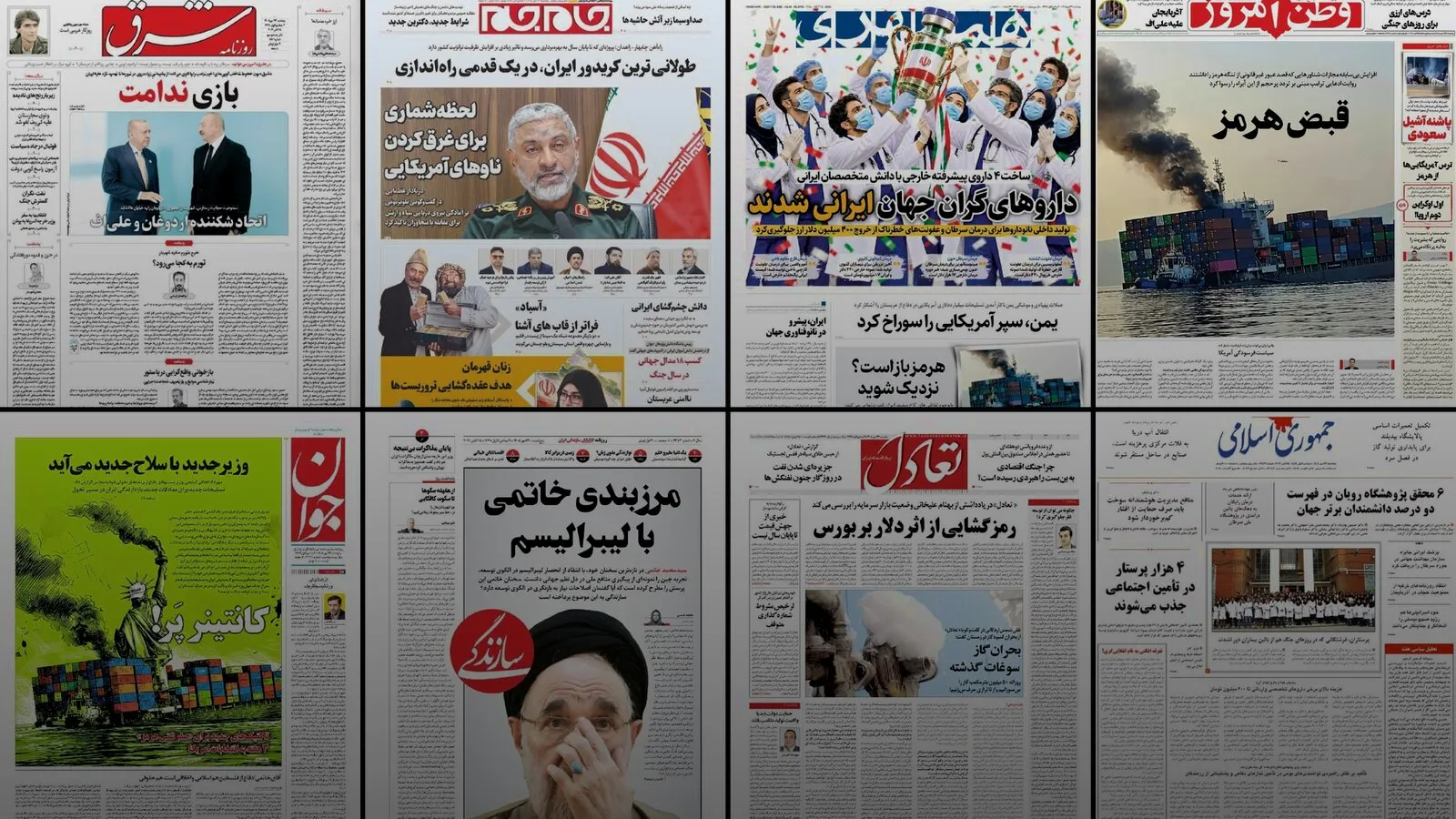
Bottom line: A Singapore-registered container ship went to the bottom of the Strait of Hormuz, and by the next morning the Iranian press had published three mutually exclusive explanations for it: a mine for the foreign reader, an attack for the domestic one, and no cause at all for the clerical and government dailies, while the Guard’s own paper printed the objective the sinking serves and the government’s own paper printed the deal that would end it.
Executive Summary
The lead judgment of this edition is that the Iranian state published three incompatible accounts of the same hull inside one morning, and that the version carrying no Iranian agency was the one printed in English. Iran Daily, the state news agency’s English daily, led its front page with “Container ship sinks in Strait of Hormuz after hitting mine in unauthorized route” and repeated the cause in its photograph caption, placing the responsibility on the ship’s own routing. Hours earlier the IRGC spokesman, carried on the state broadcaster’s own channel at item 31077, had said «حمله به کشتیهای متخلف پاسخی به سومین نقض عهد آمریکا بود», that the attack on the violating ships was a response to America’s third breach of its undertaking. The verb there is «حمله», attack, and the object is plural. A third formulation ran on the clerical-conservative and government front pages: «سپاه: کشتی کانتینربر متخلف با ۲۵۰۰ کانتینر در جنوب تنگه هرمز غرق شد», the Guard says a violating container ship sank, a construction that reports the outcome and withholds the cause entirely. The external record identifies the vessel as the GFS Pride, struck by an unidentified projectile on 14 October, with all twenty-one crew evacuated and a maritime security firm stating there is no independent evidence that a mine caused the sinking. What is new is not that Tehran claims a maritime success; it is that the mine template this monitor recorded against a supertanker in an earlier cycle has been reused for a different kind of incident, and that it now survives only in the foreign-language edition.
The second finding is that the hardline press has stopped arguing for closure of the strait and started certifying it, each title in its own register. Kayhan, closest to the Leader’s office, ran «نفت ۱۵۰ دلاری یعنی تنگه هرمز بسته است», oil at a hundred and fifty dollars means the Strait of Hormuz is closed, which hands the verification to the commodity market and no longer asks the reader to take the navy’s word. Sobh-e No dropped the enforcement vocabulary altogether with «تنگه سه قفله شد», the strait has been triple-locked, and reported that attacks on rule-breaking vessels had reached a weekly high. Vatan-e Emrooz kept the juridical frame and sharpened it to a single noun, «قبض هرمز», the Hormuz bill, over a full-page photograph of the burning ship, with a strap describing «افزایش بیسابقه مجازات شناورهایی که قصد عبور غیرقانونی از تنگه هرمز را داشتند», an unprecedented increase in the punishment of vessels intending illegal passage. Three hardline titles, three vocabularies, one conclusion.
The third finding converts a timing inference this monitor has carried for several cycles into a published fact. Javan, the Guard’s daily, gave its front page to a cartoon of the Statue of Liberty in a gas mask beneath a Trump cap, standing over the burning ship under the banner «کانتینر پَر!», containers gone, and set beneath it the line «تاکتیکهای جدید برای «صفر نفتی هرمز» / ۳ هفته به انتخابات امریکا», new tactics for the oil-zeroing of Hormuz, three weeks to the American elections. One cycle ago this monitor assessed the electoral timing from a pull quote and a Western wire and rated it a finding rather than a framing. Today the Guard’s own paper prints the objective and the clock on the same line. «صفر نفتی» is not a pressure campaign described in the language of leverage; it is a stated end state, zero oil through the strait, and it is dated.
Against that, the government’s own daily published the opposite policy on the same morning, and did so in detail. Iran carried the analyst Hadi Afghahi at items 509886 and 509891 arguing for «سازوکار منطقهای برای مدیریت تنگه هرمز», a regional mechanism for managing the strait without outside powers, and reporting that Iran has put seven axes for diplomacy to Washington through a Qatari mediator, with the release of frozen Iranian assets and a declared end to the war among its demands. The external record supports an active track: Oman’s foreign minister said on 14 October that the bilateral Oman-Iran talks on the strait had concluded and that implementing their understandings and resuming maritime traffic now depend on the Iran-United States negotiations, and Reuters reported two days earlier that Tehran was reviewing the American response to its own reopening proposal. Sazandegi put a headline over that statement, «پایان مذاکرات بینتیجه», the end of inconclusive negotiations, that is more pessimistic than the statement beneath it; its own sub-line renders Albusaidi accurately. The two Iranian positions are not rhetorical variants of each other. One requires the strait to be usable and the other requires it closed, and Ghalibaf supplied the formula that tries to hold both, «هم میجنگیم و هم مذاکره میکنیم», we will both fight and negotiate.
The leverage thread moved again, and this time it moved onto neighbours. One cycle ago Javan claimed a digital veto over the submarine cables carrying the American technology economy. This morning Sobh-e No published «وابستگی ۹۵ درصدی بحرین و قطر به کابلهای اینترنت تنگه هرمز», a ninety-five percent dependence of Bahrain and Qatar on the internet cables running through the strait. That is a different target set with different consequences: Silicon Valley cannot be coerced by Tehran in any near term, whereas Bahrain and Qatar are states whose banking and transit cooperation Iran actively needs, and one of which the government daily names on the same morning as the mediator carrying its seven axes to Washington. The cable claim and the Qatari channel appear in the same cycle, in different papers, pointing in opposite directions.
The domestic campaign against the negotiating camp crossed a threshold. Kayhan’s «یادداشت روز», signed by Hossein Shariatmadari and titled «آمریکا در ایران سفارتخانه ندارد ولی دهها سفیر دارد!», America has no embassy in Iran but it has dozens of ambassadors, named Mohammad Javad Zarif, Hossein Marashi and Hassan Rouhani, and closed by invoking the assassinated Leader’s warning that judicial and security bodies should act against those who cooperate with the enemy. One cycle ago the same campaign was argued against a sitting minister and a school of thought; today it names a former president and ends on a prosecutorial citation. It also drew the first direct answer this monitor has recorded: Etemad’s channel carried «تفرقهافکنی میکنید، تهمت میزنید، خلاف نظر رهبری عمل میکنید و اسمش را انقلابیگری میگذارید», you sow division, you slander, you act against the Leader’s view, and you call it revolutionism, which answers the hardliners on their own ground and names nobody.
Dissent on the maritime campaign itself surfaced where it is least expected. Nour News, the wire closest to the Supreme National Security Council, carried Gholamhossein Karbaschi at item 402020 saying «زدن ۳ کشتی در تنگه هرمز باعث نقض تفاهمنامه اسلامآباد شد», that striking three ships in the Strait of Hormuz violated the Islamabad memorandum, and at items 402016 to 402019 calling for the war to be ended by agreement, invoking Khomeini’s acceptance of Resolution 598 as the precedent. A security-linked wire publishing a reformist arguing that Iran’s own strikes broke the ceasefire understanding is a more consequential item than any front page in this edition, and it carries a count, three ships, that neither Kayhan’s two nor the external record’s one sinking plus one damaged hull matches.
The second front hardened and is the better-corroborated half of the edition. Hamshahri ran «یمن، سپر آمریکایی را سوراخ کرد», Yemen punctured the American shield, crediting drone and missile attacks with exposing billion-dollar American systems defending Saudi Arabia. Vatan-e Emrooz ran «پاشنه آشیل سعودی», the Saudi Achilles heel, over a photograph of a Saudia airliner being hosed down. Six separate Iranian surfaces carried the Australian advisory telling nationals to stay clear of Saudi oil facilities and the New Zealand advice against travel, and Jam-e Jam added that the United States has restricted its own employees’ use of Saudi airports with the Riyadh suspension extended to 17 October. The external record confirms Houthi strikes on Riyadh’s King Khalid airport and on an Aramco administrative building in Dhahran, airframe damage to a Saudia aircraft, Lufthansa suspending Riyadh service and Cathay Pacific extending its suspension into 2027. Where Hormuz produces three Iranian accounts of one hull, the Saudi front produces convergent Iranian reporting that the external record largely sustains.
The counterweights all held, and as in previous cycles they ran below the fold, in the economic press, or in another language. Ta’adol led its top-right column with «جزیرهای شدن نفت در روزگار جنون نفتکشها», the islanding of oil in the era of tanker madness, conceding that the logistics cage holds Iranian crude as well, and carried Ali Shams Ardakani’s «روزانه ۵۰ میلیون مترمکعب گاز را میسوزانیم و از ناترازی حرف میزنیم!», we burn fifty million cubic metres of gas a day and then talk about imbalance, which charges the winter shortage to Iranian waste rather than to the enemy. The same page used Abdolnaser Hemmati’s attendance at the Fund’s annual meetings in Bangkok as proof that the adversary’s two-week collapse prediction failed, and Iran Daily carried the governor’s rejection of collapse claims as an illusion on its own banner, beside an interview arguing that domestic measures “cannot fully replace diplomatic progress”. Sazandegi meanwhile opened a different argument entirely, giving its whole front to Mohammad Khatami detaching the reform project from liberalism and naming China as the model of pursuing national interest inside an unjust order.
Net assessment: this is an edition in which the Iranian state’s two policies became impossible to reconcile on the page. The Guard’s daily printed an end state and a date; the government’s daily printed a mediated architecture and a list of demands; the speaker of parliament endorsed both at once; and the security council’s own wire published a reformist saying the strikes broke the ceasefire. The press discipline that this monitor has recorded for weeks on the chokepoint question did not hold this morning, and the break ran along the line between the institutions that conduct the campaign and the institutions that would have to end it. The incumbent Leader, who would be the authority to settle it, is absent from the front-page record for the tenth consecutive cycle, and the only Leader-level text in the hardline press this morning belongs to his assassinated predecessor.
Key Judgments
- KJ-1 [HIGH] KJ-1. The Iranian state published three mutually exclusive explanations of one sunken hull within a single news cycle, and the explanation assigning Iran no agency was the one printed in English. The evidence is three surfaces. Iran Daily’s front page states “Container ship sinks in Strait of Hormuz after hitting mine in unauthorized route” and repeats the cause in the photograph caption. The state broadcaster’s own channel carries the IRGC spokesman at item 31077 saying «حمله به کشتیهای متخلف پاسخی به سومین نقض عهد آمریکا بود», the attack on the violating ships was a response to America’s third breach. Jomhouri-ye Eslami and the government daily print «سپاه: کشتی کانتینربر متخلف با ۲۵۰۰ کانتینر در جنوب تنگه هرمز غرق شد», reporting the outcome and withholding the cause. Externally the vessel is the GFS Pride, struck by an unidentified projectile on 14 October, crew of twenty-one evacuated, with a maritime security firm stating no independent evidence supports a mine. The significance is the audience segmentation rather than the discrepancy itself: the deniable account is reserved for the foreign reader and the claimed one for the domestic, which indicates a message architecture designed for two publics rather than editorial confusion. The calibration runs both ways and this monitor states it: treating the English mine account as the state’s position would miss the spokesman’s admission, while treating the spokesman as decisive would overstate how settled the attribution is inside the system. The tracking cue is whether any Iranian authority reconciles the two in a single statement, or whether the split persists by language into the next cycle.
- KJ-2 [HIGH] KJ-2. The hardline press has moved from certifying the chokepoint campaign to declaring its objective met, and it has adopted an external verification standard to do so. The evidence is three titles in one morning. Kayhan’s digest at item 86812 carries «نفت ۱۵۰ دلاری یعنی تنگه هرمز بسته است», oil at a hundred and fifty dollars means the Strait of Hormuz is closed, which transfers proof of closure from Iranian claim to commodity price. Sobh-e No at item 116741 runs «تنگه سه قفله شد», the strait has been triple-locked, and reports attacks on violating vessels at a weekly high. Vatan-e Emrooz’s «قبض هرمز» presents the sinking as an invoice rendered under an unprecedented increase in punishment of vessels. The significance is that a press which spent earlier cycles insisting the strait remained open to compliant traffic has stopped making that claim: the argument has shifted from legitimacy to results. The tracking cue is the price itself, because a title that stakes its proof on a hundred and fifty dollar oil has committed to a falsifiable test.
- KJ-3 [HIGH] KJ-3. The alignment of the Hormuz campaign with the American election is no longer an inference drawn by this monitor; it is printed on the Guard’s own front page as an objective with a deadline. The evidence is one line. Javan sets beneath its cartoon of the burning ship the text «تاکتیکهای جدید برای «صفر نفتی هرمز» / ۳ هفته به انتخابات امریکا», new tactics for the oil-zeroing of Hormuz, three weeks to the American elections. «صفر نفتی» states an end state rather than a pressure, and the three-week figure places the horizon at the first week of November. The significance is twofold: an end state can be declared achieved or failed, which creates a decision point the campaign did not previously have, and the explicit electoral reference converts a maritime enforcement posture into declared election interference by Iran’s own press. The calibration is that a newspaper is not a ministry, and nothing here establishes that the stated objective is operational policy; what it establishes is that the Guard’s publishing arm sees no cost in printing it.
- KJ-4 [MODERATE-HIGH] KJ-4. A negotiated architecture for the Strait of Hormuz exists, was published this cycle by the government’s own daily, and is irreconcilable with the objective printed by the Guard’s daily on the same morning. The evidence has an Iranian and an external half. Iran carries the analyst Hadi Afghahi at item 509886 on «سازوکار منطقهای برای مدیریت تنگه هرمز», a regional mechanism excluding outside powers, and at item 509891 reporting seven Iranian axes for diplomacy conveyed to Washington through a Qatari mediator, with release of frozen assets and a declared end to the war among the demands. Externally, Oman’s foreign minister said on 14 October that the bilateral Oman-Iran track on the strait had concluded and that implementation and the resumption of maritime traffic depend on the Iran-United States negotiations, and Reuters reported on 12 October that Tehran was reviewing the American response to its own reopening proposal. The significance is that the two published Iranian positions require opposite physical conditions in the same waterway, and that the speaker of parliament reconciled them only rhetorically, at Sobh-e No item 116751: «هم میجنگیم و هم مذاکره میکنیم». The tracking cue is whether the seven axes surface from any ministry rather than an analyst, and whether Sazandegi’s «بینتیجه», fruitless, finds support that Albusaidi’s own words do not provide.
- KJ-5 [HIGH] KJ-5. The submarine-cable leverage claim has been redirected within one cycle from American technology firms onto two Gulf Arab states, one of which Iran is simultaneously using as a mediator. The evidence is a pair of items one day apart. One cycle ago Javan’s banner claimed a digital veto over cables carrying the American technology economy and argued for a transit due. This morning Sobh-e No publishes «وابستگی ۹۵ درصدی بحرین و قطر به کابلهای اینترنت تنگه هرمز», a ninety-five percent dependence of Bahrain and Qatar on the cables through the strait, on the same day the government daily names Qatar as the channel carrying Iran’s diplomatic package to Washington. The significance is that the new target set is reachable in a way the first was not: Tehran cannot coerce Silicon Valley in any near term, but it can credibly threaten the connectivity of two neighbours, and doing so puts at risk the mediation and the financial channels it depends on. The tracking cue is specific: whether any Iranian official body, as distinct from a newspaper, references Gulf cable dependency, and whether Doha’s mediating role continues to be reported alongside it.
- KJ-6 [MODERATE-HIGH] KJ-6. The campaign against the negotiating camp has escalated from criticising policy to naming former office-holders and inviting judicial action against them, and for the first time in this run it drew a direct published rebuke. The evidence is two texts on one morning. Kayhan’s «یادداشت روز», signed by Hossein Shariatmadari at items 86814 and 86824, is titled «آمریکا در ایران سفارتخانه ندارد ولی دهها سفیر دارد!» and names Mohammad Javad Zarif over the Turkmenchay treaty, Hossein Marashi over a call for tactical retreat and Hassan Rouhani over a wartime referendum proposal, closing on the assassinated Leader’s warning that judicial and security bodies should act against those who cooperate with the enemy. Etemad’s channel at item 539250 answers that those who sow division and slander are acting against the leadership’s own counsel on unity while calling it revolutionism. The significance is the change of venue the editorial proposes: an argument that has been conducted in print for weeks now ends on a recommendation of prosecution, aimed at a former president. The calibration is that Kayhan has made comparable demands before without consequence, and the correct tracking cue is institutional rather than rhetorical, namely any judicial or security action, or any response in print from the three named men.
- KJ-7 [MODERATE-HIGH] KJ-7. Dissent against the maritime campaign has reached the wire closest to the Supreme National Security Council, and it is framed as a breach of Iran’s own ceasefire undertaking. The evidence is a cluster on one channel. Nour News carries Gholamhossein Karbaschi at item 402020 saying «زدن ۳ کشتی در تنگه هرمز باعث نقض تفاهمنامه اسلامآباد شد», that striking three ships in the Strait of Hormuz violated the Islamabad memorandum, and at items 402016 to 402019 calling for the war to be ended by agreement, invoking Khomeini’s acceptance of Resolution 598 as precedent and saying Iran needed to persuade the international inspectorate it was not pursuing a weapon. At item 402021 he attributes much of the country’s difficulty to the foreign ministry’s underperformance. The significance is the venue rather than the speaker: Karbaschi’s views are not new, but their publication on a security-linked wire on the morning of a sinking indicates that the argument about whether the campaign is lawful under Iran’s own undertaking is live inside the security establishment, not only in the reformist press. The tracking cue is whether the memorandum is named again by officials, and whether the three-ship count he uses is adopted or corrected.
- KJ-8 [MODERATE-HIGH] KJ-8. The Yemen and Saudi theatre is now the better-corroborated half of the Iranian coercion narrative, and its confirmed damage is concentrated in aviation rather than in oil output. The evidence runs from the Iranian pages outward. Hamshahri leads a section with «یمن، سپر آمریکایی را سوراخ کرد» and Vatan-e Emrooz runs «پاشنه آشیل سعودی» over a Saudia airliner being hosed down, asking how Ansarullah exploited Saudi missile-defence weakness. Six Iranian surfaces carry the Australian advisory to avoid Saudi oil facilities and the New Zealand travel advice; Jam-e Jam at item 31076 adds American restrictions on its own employees’ use of Saudi airports with the Riyadh suspension extended to 17 October; Sobh-e No at item 116745 carries a Yemeni military figure telling Aramco shareholders to sell. Externally confirmed are Houthi strikes on King Khalid airport and on an Aramco administrative building in Dhahran, damage to a Saudia airframe, Lufthansa’s suspension of Riyadh service to 16 October and Cathay Pacific’s extension into 2027. The significance is that Riyadh’s measurable loss is in air connectivity and insurance exposure, not yet in crude output, and the Iranian press is at present describing that accurately. The unverified components are named: the Wall Street Journal aircraft figures relayed at Etemad item 539247 and the Typhoon shoot-down claim, which Nour News itself marked as needing confirmation.
- KJ-9 [MODERATE] KJ-9. The claim that Israel authored Azerbaijan’s school dress enforcement collapsed within one cycle, and it collapsed without retraction. The evidence is the replacement of the citing party. One cycle ago four Iranian surfaces assigned Israeli authorship to the Azerbaijani measure, against an external record supplying no Israeli element. This morning Jomhouri-ye Eslami’s rail carries «انتقاد روزنامههای ترکیه از ممنوعیت حجاب در آذربایجان», Turkish newspapers criticising the ban, Sobh-e No at item 116742 attributes the Israel accusation to critics inside Azerbaijan rather than to Iran, and both Vatan-e Emrooz at item 28642 and Sobh-e No at item 116756 carry the Iranian embassy in Baku rejecting an Azerbaijani agency report that linked the dress rules and unrest to Iran. The significance is the mechanism this exposes: a claim can enter four Iranian surfaces in one cycle and be quietly reassigned in the next, which means convergence across titles is weaker evidence of central direction than it appears when observed on a single morning. The tracking cue is whether the Israeli-authorship formulation reappears once the embassy denial has aged.
- KJ-10 [MODERATE-HIGH] KJ-10. Negative evidence, filed as a finding: the incumbent Leader is absent from the front-page record for a tenth consecutive cycle, and the only Leader-level authority invoked in the hardline press this morning belongs to his assassinated predecessor. The evidence is a complete sweep of the cycle’s retrievable surfaces. Mojtaba Khamenei appears on none of the nine Persian and English front pages, none of the four channel-read newspapers, and none of the three agency wires. The external record places his most recent reported remarks on 8 October, to the domestic security forces, with no independently confirmed video or audio and no confirmed public appearance since his first statement in March 2026 was read by a television anchor over a still photograph. Kayhan’s editorial closes by citing the assassinated Leader’s warning on cooperation with the enemy, and Javan’s front page addresses «آقای خامنهای!» in the vocative without honorific, with a byline the scan does not resolve. The significance is that the authority that would be needed to settle the contradiction between the Guard’s published objective and the government’s published architecture is, on the public record, not settling anything. The calibration is that absence from front pages is not absence from government, and this monitor asserts only what the record shows.
- KJ-11 [MODERATE] KJ-11. Lebanon returned to the retrievable record after a single cycle of absence, and it returned through the foreign ministry rather than through the resistance file. The evidence is one item. Sobh-e No at item 116746 reports Iran’s foreign minister and Lebanon’s president discussing Israeli attacks on Lebanon and the occupation of southern areas. One cycle ago this monitor filed Lebanon’s disappearance as a finding after a single cycle of return, and the pattern now visible across three cycles is intermittency rather than suppression. The significance is in the channel: a head-of-state call reported on a principlist paper’s channel frames Lebanon as a diplomatic file, which is a different register from the resistance framing that carried it earlier in this run. The tracking cue is whether Lebanon reaches a front page rather than a channel, and whether it is carried by the foreign ministry or by the Guard.
- KJ-12 [MODERATE] KJ-12. The economic press continued to price the campaign inward, and this cycle it did so in the same issue in which it claimed the adversary’s economic war had failed. The evidence is one front page and one banner. Ta’adol’s top-right report is «جزیرهای شدن نفت در روزگار جنون نفتکشها», the islanding of oil in the era of tanker madness, conceding that Iranian crude is held in a logistics cage; its centre page carries Ali Shams Ardakani saying «روزانه ۵۰ میلیون مترمکعب گاز را میسوزانیم و از ناترازی حرف میزنیم!»; and its top-left asks why the economic war has reached a strategic deadlock, offering Abdolnaser Hemmati’s attendance at the Fund’s annual meetings as the answer. Externally, Hemmati has been Central Bank governor since December 2025 and the meetings are running in Bangkok from 12 to 18 October, where he rejected collapse claims and asked the Fund to study the effects of war and payment restrictions. Iran Daily carried the same rejection in English, beside an analyst arguing domestic measures cannot fully replace diplomatic progress. The significance is that the system’s own economic titles are simultaneously claiming survival and itemising the cost, and that the cost they itemise is largely self-inflicted.
- KJ-13 [MODERATE] KJ-13. The defence ministry vacancy may close this week, and the nominee reached parliament in the cycle after he reached the Guard. The evidence is two pages. Javan’s banner reports «مهرداد اخلاقی کتابچی، وزیر پیشنهادی دفاع از برنامههای تحولی خود به مجلس گزارش داد», the proposed defence minister reporting his transformation programmes to parliament, under the headline «وزیر جدید با سلاح جدید میآید». Jomhouri-ye Eslami gives front-page space to the meeting that one cycle ago existed only on two agency wires, under «در دیدار وزیر پیشنهادی دفاع با فرمانده کل سپاه مطرح شد: تأکید بر نقش راهبردی توانمندیهای بومی در تأمین نیازهای دفاعی و پشتیبانی از رزمندگان». The post has been vacant since February and the confidence vote was reported as likely on 18 October. The significance is sequence: the nominee was presented to the Guard before he was presented to the chamber, and both presentations were framed around domestic production rather than around policy or command. The tracking cue is the vote itself and whether any portfolio question beyond procurement is put to him.
- KJ-14 [MODERATE] KJ-14. Negative evidence, filed as a finding: the most significant reformist intervention of the cycle went unanswered by the rest of the reform press in the retrievable record. The evidence is one front page and four silences. Sazandegi gave its entire front to Mohammad Khatami detaching the reform project from liberalism and naming China as the model of pursuing national interest inside an unjust order, and framed it as an open question, «آیا گفتمان اصلاحات نیاز به بازنگری در الگوی توسعه دارد؟». The external record confirms the remarks. Shargh, the largest reformist daily in the batch, led instead on Trump’s contradictions and a brittle Turkey-Azerbaijan axis and carried nothing on Khatami; Etemad’s channel carried nothing on him; neither did the government daily or the economic titles. The significance is that a former president repositioning the camp’s development model during a war drew no visible response from the camp, which suggests either that the remark is being left to settle before anyone answers it, or that no reformist title wishes to be seen arguing about liberalism in the week its leading figures were named as America’s ambassadors. The tracking cue is the next reformist front page that either takes up the China question or conspicuously avoids it.
Macro Trends
- Enforcement language and attack language now contradict each other inside one state. Vatan-e Emrooz calls the sinking a bill, «قبض هرمز», and describes «مجازات», punishment, of vessels. Iran Daily calls it a mine struck on an unauthorised route. The IRGC spokesman calls it «حمله», an attack, and a response to an American breach. Sobh-e No reports attacks at a weekly high. Jomhouri-ye Eslami and the government daily report that the ship sank and name no cause. The juridical frame that let Tehran present maritime coercion as rule-following has not been abandoned, but it is now one register among four, and the one that contradicts it comes from the Guard’s own spokesman.
- The objective has been published, and it is dated. «صفر نفتی هرمز», the oil-zeroing of Hormuz, printed on the Guard’s daily beneath a countdown to the American election, is the first time in this run that an end state and a political deadline have appeared together on an Iranian front page. Kayhan supplies the verification standard for it, oil at a hundred and fifty dollars, and Sobh-e No supplies the status report, triple-locked. The campaign is no longer being argued; it is being scored against a target.
- Leverage keeps migrating, and this cycle it migrated onto Gulf neighbours. The chokepoint thread began in hydrocarbons, extended one cycle ago into submarine cables aimed at American technology firms, and this morning named Bahrain and Qatar as ninety-five percent dependent on the cables running through the strait. The same cycle has the government daily naming Qatar as the mediator carrying Iran’s seven diplomatic axes to Washington. The leverage argument and the diplomatic channel now run through the same two capitals.
- The second front is the better-evidenced one. Iranian reporting on Saudi Arabia converged this cycle rather than fragmenting, and the external record largely sustains it: strikes on Riyadh’s airport and on an Aramco building in Dhahran, airframe damage to a Saudia aircraft, foreign carriers suspending service, Western advisories to stay clear of oil facilities, and the United States restricting its own employees’ use of Saudi airports. A Yemeni military figure addressing Aramco shareholders, carried by Sobh-e No, states the economic theory plainly. Where Hormuz produces contradiction, Yemen produces corroboration.
- The loyalty campaign turned prosecutorial, and drew its first answer. Kayhan’s editorial named a former foreign minister, a former vice-president and a former president as the functional ambassadors of a closed embassy, and closed on the assassinated Leader’s warning that judicial and security bodies should act. Etemad answered on the same morning by invoking the leadership’s own counsel on unity against the accusers. The argument has moved from policy to loyalty, and from loyalty to venue.
- The economic press keeps the inward ledger nobody else prints. Ta’adol conceded that Iranian oil is islanded by the same maritime disorder the security press celebrates, charged the winter gas deficit to fifty million cubic metres burned daily at home, and used the central bank governor’s presence at the Fund’s meetings in Bangkok as the proof that the adversary’s collapse prediction failed. Iran Daily published an analyst saying domestic measures cannot fully replace diplomatic progress. The counterweight is consistent across cycles and it is consistently placed where the general reader will not meet it.
Front-Page Snapshot
- Vatan-e Emrooz - “The Hormuz Bill” (Hardline principlist) - Maritime enforcement framed as an invoice rendered, over a full-page photograph of the burning ship [SEVERE]
- Javan - “Containers: gone!” (IRGC-affiliated) - The oil-zeroing of Hormuz printed as an objective, three weeks to the American election [SEVERE]
- Kayhan - “Oil at 150 dollars means the Strait of Hormuz is closed” (Hardline, Leader’s office) - Closure certified by commodity price; editorial naming three former office-holders as America’s ambassadors [SEVERE]
- Jam-e Jam - “Counting the moments to sinking the American warships” (State broadcaster IRIB) - The IRGC Navy commander’s televised threat, with the spokesman on the same channel calling the merchant sinkings an attack [SEVERE]
- Sobh-e No - “The strait has been triple-locked” (Principlist) - Escalation acknowledged in plain terms; cable leverage redirected onto Bahrain and Qatar [HIGH]
- Hamshahri - “The world’s expensive drugs have become Iranian” (Tehran Municipality, centrist) - Pharmaceutical self-sufficiency above the fold, the commander’s taunt and the Yemen shield story below it [HIGH]
- Iran Daily - “Container ship sinks in Strait of Hormuz after hitting mine in unauthorized route” (State news agency, English) - The deniable account of the sinking, beside the central bank governor rejecting collapse claims [MODERATE]
- Jomhouri-ye Eslami - “Six Royan Institute researchers on the world’s top two percent list” (Traditional clerical-conservative) - Science and nursing lead; the Guard’s maritime claim carried without a cause; the Azerbaijan claim reassigned to the Turkish press [MODERATE]
- Iran - “We must turn the conditions of the economic war into an opportunity” (Official government daily) - A regional Hormuz mechanism with Oman and seven diplomatic axes to Washington through Qatar [LOW]
- Etemad - “You sow division, you slander, you act against the Leader’s view, and you call it revolutionism” (Reformist) - The first direct rebuke of the loyalty campaign, argued on the hardliners’ own ground [LOW-MODERATE]
- Sazandegi - “Khatami draws a line against liberalism” (Reformist, Kargozaran) - A former president repositions the reform camp toward the China model; Omani track headlined as fruitless [LOW]
- Ta’adol - “Decoding the dollar’s effect on the equity market” (Economic) - Iranian oil islanded by tanker madness; fifty million cubic metres of gas burned daily; the governor at the Fund’s meetings as proof the economic war stalled [LOW]
- Shargh - “The game of regret” (Reformist) - Trump’s contradictions and a brittle Erdogan-Aliyev alliance; the sinking absent from the front page [LOW-MODERATE]
Full report
The complete edition - per-paper front-page analysis and full translation appendices - is available as a PDF: Download the full report.
Compiled from Iranian front pages and outlet channels via open-source monitoring. Translations are editorial; named-figure attributions are verified against the source pages where possible.