Iranian Press Monitor - Monday, 12 October 2026 (Day 223)
Monday, 12 October 2026 · دوشنبه ۲۰ مهر ۱۴۰۵ · 1 Jumada al-Awwal 1448 - Ten front pages of 20 Mehr 1405, nine Persian and one English, read with six newspaper channels and three agency wires. Tehran Times and the Leader’s official site were both unavailable at the time of compilation.
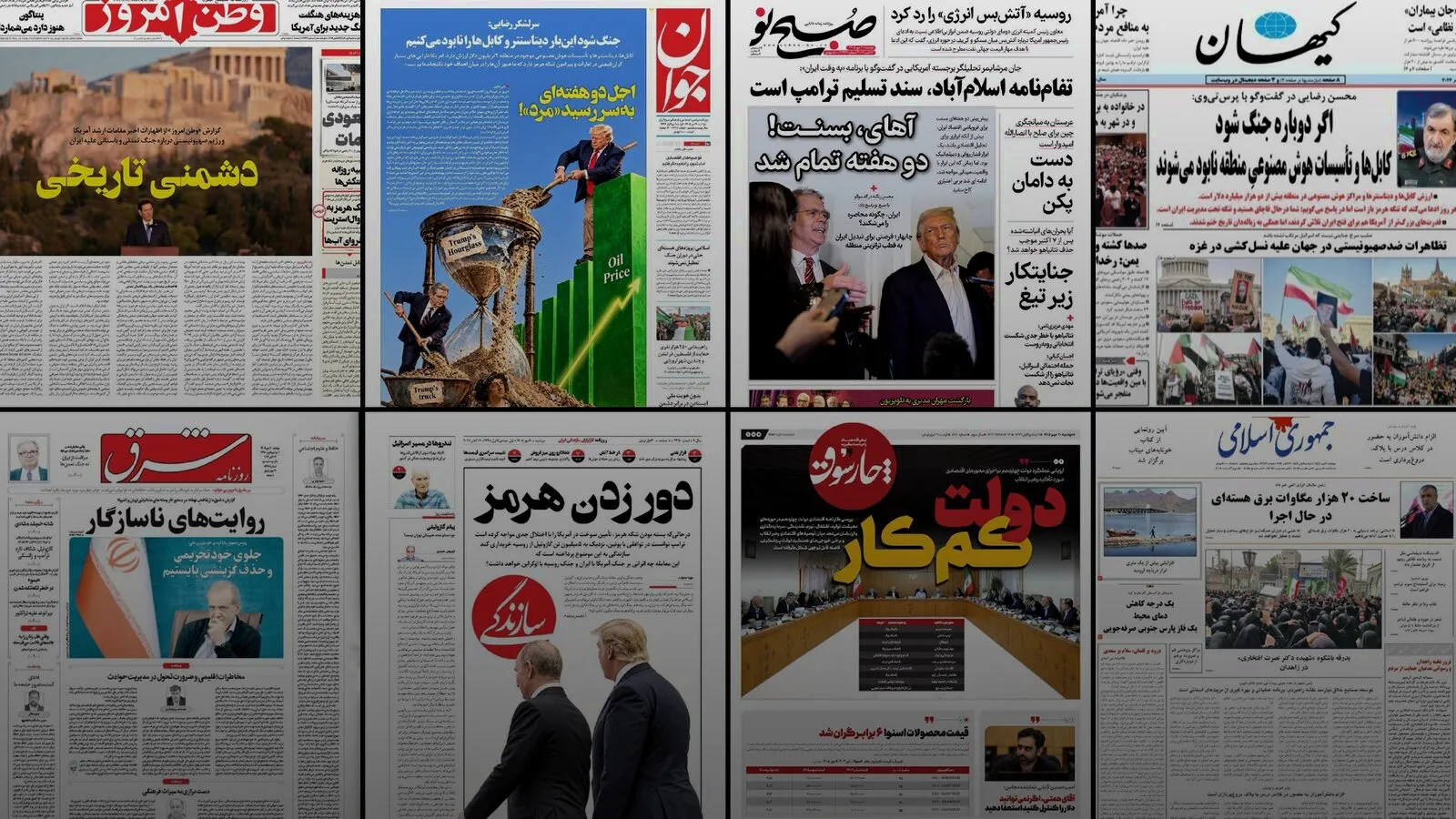
Bottom line: On a morning when the Guard Corps’ navy was being credited in Iran’s own government daily with mining a third tanker in the Strait of Hormuz, four front pages across the factional spectrum spent their best space on the June ceasefire memorandum signed in Islamabad, one calling it Trump’s surrender document and another calling it the dormant document to be revived, which indicates that the chokepoint is being held shut to force the return of an agreement whose own published terms promised to reopen it.
Executive Summary
The lead judgment of this edition is that the Iranian press has put the June ceasefire memorandum back at the centre of its argument, and that it is doing so in the same cycle in which the instrument the memorandum was supposed to free is being closed harder. Sobh-e No’s banner carries John Mearsheimer calling «تفاهمنامه اسلامآباد» Trump’s document of surrender. Etemad’s entire upper page carries Behzad Nabavi calling the same text «سند مسکوت», the dormant document, and arguing for its revival. Shargh reads the two sides’ negotiating packages against each other and reports «روایتهای ناسازگار», incompatible narratives. The independently verified terms of that memorandum, signed in mid-June 2026 with Pakistani mediation, include restoring commercial shipping through the Strait of Hormuz. The strait is therefore not a side theatre to the diplomacy: it is the diplomacy’s own deliverable, withheld.
The security council’s own wire says so in as many words. Nour News, the outlet closest to the Supreme National Security Council, reports at item 401243 that a seven-day plan is moving through mediators including Qatar, that Kazem Gharibabadi has received the American side’s views through them, that Tehran will answer after internal review, and that the return of Hormuz to normal depends on American compliance with earlier commitments. That last clause is the standing Hormuz-as-coercion thread of this monitor stated on the record by the institution that would have to lift it, and it converts what has been an inference across earlier editions into a printed condition.
The second finding is the target set. Mohsen Rezaei, who independent reporting confirms has been secretary of the Supreme National Security Council since early August 2026 and is the Leader’s own representative on that council, told Press TV that a renewed war would destroy the region’s undersea cables, data centres and artificial-intelligence facilities, which he valued at more than two trillion dollars. Kayhan led on it. Javan led on it and added American assets in the Emirates and around the strait by name. Vatan-e Emrooz carried it as its top-right banner. Kayhan’s managing editor then published a column at item 86556, over his own name, endorsing the target set and arguing that the fibre-optic cables carrying global internet, banking and artificial-intelligence traffic are a strategic lever. Three covers and a signed editorial in one morning is centrally guided message discipline rather than organic convergence, and the content being disciplined is a public identification of civilian communications infrastructure as a target.
The third finding is that the maritime campaign has acquired a named instrument. The Iran newspaper’s channel reports at item 509547 that the IRGC Navy says a supertanker struck a sea mine in the Strait of Hormuz after switching off its navigation systems and taking an unauthorised route; Jam-e Jam’s channel at item 30753 makes it the third tanker mined on Sunday, a shuttle tanker carrying 750,000 barrels, severely on fire. Iran Daily gives its cover to a photograph of a tanker burning on the water under the line that Iran will strike enemy vessels again if necessary, which Kayhan’s rail attributes to Rear Admiral Sayyari. Kayhan’s own day-report box names the instrument in its title: «وقتی «رؤیای ترامپ» با مین و واقعیتها در هرمز منفجر میشود». In the previous cycle this monitor recorded a tanker struck by an unidentified projectile. One cycle later the attribution is self-declared, the count is plural and the rules of passage are being published.
The fourth finding corrects the previous edition’s sharpest criticism and preserves it. Yesterday this monitor judged that the Iranian press had a verified mass-casualty attack on a Gulf Arab capital available to it and declined to lead on it, and that Kayhan chose an unverified oil-field claim over the airport. Today Kayhan prints the airport, and prints the figure: «۱۲ کشته و ۳۰۹ زخمی», which is accurate to the independent record of the Saturday strike. It prints it under the headline «صدها کشته و زخمی», hundreds dead and wounded, which its own bullet does not support. The selection has reversed; the inflation has not. Vatan-e Emrooz, on the same morning, prints the same figure accurately in its rail. Two hardline papers had the same material and only one of them overstated it, which is the distinction that makes this an editorial choice rather than a house style.
The fifth finding is that the civilizational frame recorded as new two cycles ago and as institutionalised one cycle ago has now become a two-way exchange, and that it rests on a predicate that checks out. Vatan-e Emrooz gives its whole front page to «دشمنی تاریخی», historical enmity, over a photograph of the Acropolis, and names the occasion precisely: the US Secretary of State spoke on 7 October in Athens on the Pnyx and opened with Xerxes’ attack on Greece and the burning of Athens in 480 BC. Independent reporting confirms the speaker, the date, the location and the opening. The Iran newspaper’s channel carries two separate commentaries on the same speech, one of them by a history professor, at items 509549 and 509553. Fars News then carries an adviser to the IRGC aerospace commander replying in the identical register: «آمریکا و صهیونیستها تمدن ندارند», America and the Zionists have no civilization. Javan folds Columbus Day, which falls on this date, into the same argument through its montage. A framing built on an accurately read adversary speech is more durable than one built on invention, and that is the reason to track it.
The sixth finding is the one piece of dissent, and it is argued in the adversary’s own terms. Sazandegi, the Kargozaran party daily, leads «دور زدن هرمز», going around Hormuz, over a photograph of Putin and Trump walking together, and states as settled fact that the strait’s closure has seriously disrupted American fuel supply while Trump has nonetheless bought close to five million tons of Russian diesel. The headline is a warning to Tehran that its central instrument has a workaround. Shargh’s clipping rail corroborates the story from a second reformist desk as «گازوئیل، شکاف تازه ترامپ و زلنسکی». Iran Daily answers it for a foreign readership in an exclusive interview arguing that the arrangement is fragile, that Russia is itself short of diesel and importing from India, and that the whole thing depends on Ukraine halting refinery strikes it has not halted. The same transaction is being used to produce alarm in Persian and calm in English inside one state media group.
Net assessment: this is the most coherent edition of the series to date and the most dangerous in its specifics. Across ten covers the Iranian press is making one argument in four registers, that the adversary has declared a civilizational war, that the chokepoint is the instrument which converts that war into American financial pain, that the June memorandum is the only exit and must be revived on Iranian terms, and that the state’s nuclear build continues regardless, with the Atomic Energy Organization’s twenty thousand megawatts carried by three separate estates on the same morning. What the edition does not do is connect any of that to what its own pages record about the cost at home: fourteen days without internet on the Etemad cover, winter gas shortfalls in eleven provinces on the government daily’s channel, consumer prices up sixfold on the economic daily’s table, and a hardline member of parliament demanding the economy minister’s resignation on the same page. The gap between the strategic argument and the domestic ledger is the edition’s largest unexamined space, and it is where the next cycle should be read.
Key Judgments
- KJ-1 [HIGH] KJ-1. The June ceasefire memorandum returned to the Iranian front pages as a live instrument, named by its signing city, from both ends of the factional spectrum, in the same cycle in which the strait it promised to reopen was declared mined. The evidence is four surfaces. Sobh-e No’s banner carries John Mearsheimer calling «تفاهمنامه اسلامآباد» Trump’s document of surrender, with the channel version at item 116684 adding that he expects Trump to be forced into a second and harder agreement and that Iran is in no hurry. Etemad’s entire upper page carries Behzad Nabavi on the same text under «احیای سند مسکوت», reviving the dormant document. Shargh compares the two sides’ negotiating packages and reports «روایتهای ناسازگار». Nour News, closest to the Supreme National Security Council, reports at item 401243 a seven-day plan moving through mediators including Qatar. The independently verified terms of the mid-June Islamabad memorandum, mediated by Pakistan, include lifting the naval blockade and restoring commercial shipping through the Strait of Hormuz. The significance is that the chokepoint is not a theatre adjacent to the diplomacy: it is the diplomacy’s own named deliverable, and it is being withheld to force the agreement’s revival on better terms. The calibration runs both ways and this monitor states it: reading the convergence as coordination would overstate what two interviews with two different men prove, while reading it as coincidence would miss that both estates chose the same four-month-old document on the same morning.
- KJ-2 [HIGH] KJ-2. The sitting secretary of the Supreme National Security Council publicly identified the region’s undersea cables, data centres and artificial-intelligence facilities as targets, and the Leader’s flagship daily endorsed the target set over its editor’s own name. The evidence is three covers and a signed column. Kayhan leads with «اگر دوباره جنگ شود کابلها و تأسیسات هوش مصنوعی منطقه نابود میشوند», attributed to a Press TV interview. Javan leads with the same statement and extends it: American assets in the Emirates and around the Strait of Hormuz will certainly be kept among Iran’s targets. Vatan-e Emrooz runs it as the top-right banner. Kayhan’s channel then publishes item 86556 over the name حسین شریعتمداری, arguing that the fibre-optic cables carrying global internet, banking and artificial-intelligence traffic are a strategic lever against the United States and its allies, and praising Rezaei by name for saying so. Independent reporting confirms Rezaei was appointed secretary of the Supreme National Security Council in early August 2026 and was made the Leader’s representative on that council by decree. The significance is that this is an office-holder’s declared target set rather than a veteran commander’s rhetoric, that the targets are civilian infrastructure serving third countries, and that the simultaneity across three estates indicates centrally guided message discipline rather than organic editorial convergence.
- KJ-3 [HIGH] KJ-3. Mining is now the declared Iranian instrument in the Strait of Hormuz, stated by the IRGC Navy through the government’s own daily and photographed on the cover of the state English-language paper. The evidence is four surfaces. The Iran newspaper’s channel at item 509547 reports the IRGC Navy saying a supertanker struck a sea mine after switching off its navigation systems and taking an unauthorised route. Jam-e Jam at item 30753 makes it the third tanker mined on Sunday, a shuttle tanker carrying 750,000 barrels, severely on fire, on the same IRGC Navy public-relations account. Iran Daily gives its cover photograph to a tanker burning on the water under ‘Iran will strike enemy vessels again if necessary’, which Kayhan’s rail attributes to Rear Admiral Sayyari. Kayhan’s own day-report box names the instrument in its title, «وقتی «رؤیای ترامپ» با مین و واقعیتها در هرمز منفجر میشود». The external record supports a pattern rather than this instance: IRGC mine claims run back to late August, and US Central Command has described striking IRGC minelaying forces in the strait. The significance is the change in attribution. In the previous cycle this monitor recorded a tanker struck by an unidentified projectile; one cycle later the mining is self-declared, the count is plural, and rules of passage are being published. The count itself is not reliable: the Iran channel’s own headline says second while its body says third.
- KJ-4 [HIGH] KJ-4. Kayhan printed the Riyadh casualty figure it withheld from its front page a day earlier, and overstated it in the headline for a second consecutive cycle. The evidence is one cover read against itself and against a second paper. The bullet reads «حمله موشکی نیروهای مسلح یمن به فرودگاه بینالمللی ملک خالد ریاض ۱۲ کشته و ۳۰۹ زخمی برجای گذاشته است», which matches the independent record of the Saturday 10 October strike, one source giving thirteen and 308. The headline above it reads «صدها کشته و زخمی», hundreds dead and wounded. On the same morning Vatan-e Emrooz carries the identical figure accurately in its rail, «۱۲ کشته و بیش از ۳۰۰ زخمی در فرودگاه ریاض», under «سعودی مات». The significance is twofold. The selection criticised in the previous edition has reversed, which this monitor records as a correction to its own forward expectation: the paper did carry the attack once it could carry it on its own terms, as a demonstration of Saudi air-defence failure. The inflation has not reversed, and because a second hardline paper handled the same material without it, this is an editorial decision at one title rather than a convention of the estate.
- KJ-5 [HIGH] KJ-5. The civilizational frame has become a two-way exchange and it rests on an adversary speech the Iranian press has read accurately. The evidence is four surfaces and one external check. Vatan-e Emrooz gives its whole front page to «دشمنی تاریخی» over a photograph of the Acropolis, and its body text names the occasion precisely: the US Secretary of State spoke on 7 October in Athens on the Pnyx, where the citizens of ancient Athens assembled, and opened with Xerxes’ attack on Greece and the burning of Athens in 480 BC before turning to present-day Iran. Independent reporting confirms the speaker, the date, the location and the opening. The Iran newspaper’s channel carries two separate treatments of the same speech, at items 509549 and 509553, the second by a history professor. Fars News at item 467868 carries an adviser to the IRGC aerospace commander answering in the identical register. Javan folds Columbus Day, which falls on this date, into the same argument. The significance is that a framing built on a correctly reported speech is more durable than one built on invention, and that the Iranian side has now adopted the adversary’s own category rather than merely denouncing it. The negative half of the finding matters too: nothing in the external record supports the further claim, made in the Vatan-e Emrooz text, that this language links Western civilization, Jewish historical heritage and religious prophecy as a single programme; that is the paper’s construction and is reported as such.
- KJ-6 [MODERATE-HIGH] KJ-6. Iran declared a wartime expansion of nuclear generating capacity, and three different estates carried the declaration on the same morning. The evidence is three covers. Jomhouri Eslami leads with the head of the Atomic Energy Organization announcing «ساخت ۲۰ هزار مگاوات برق هستهای در حال اجرا» and the printed line that construction projects were not and will not be shut down even in wartime. Javan’s rail carries «اسلامی: پروژههای هستهای حتی در دوران جنگ تعطیل نمیشوند». Iran Daily leads in English with ‘Iran to press ahead with 20,000-MW nuclear power plan despite attacks’. The significance is the category: this is a claim of expansion, not of survival, made by the organisation’s own head in a war in which nuclear facilities have been struck, and the English rendering adds the defiance the Persian versions leave implicit, which indicates the announcement is aimed at a foreign readership as much as a domestic one. The judgment is held at moderate-high rather than high because no cover carries a site, a timetable or a contract, and an announcement of megawatts under construction is not evidence of megawatts under construction.
- KJ-7 [MODERATE-HIGH] KJ-7. The Yemeni campaign against Saudi Arabia has become a multi-airport campaign, and its effect is now measurable in third-country government advisories rather than in Iranian claims. The evidence is the wires on one side and foreign states on the other. Vatan-e Emrooz item 28223 carries a Yemeni military claim of strikes on Aramco and on both King Khalid in Riyadh and King Fahd in Dammam; Defa Press item 69629 adds Khamis Mushait and Abha, and item 69641 says the Abha strike halted all flights there. Against those claims stand three independent reactions: the UK embassy advising citizens to avoid every Saudi airport except Medina, reported on Etemad’s channel at item 538673; a US warning on air travel to the kingdom, reported by Fars at item 467854; and South Korea telling its citizens to leave Saudi Arabia promptly, reported by Jam-e Jam at item 30759. The significance is methodological as much as substantive: the Iranian claims cannot be verified from here, but three governments issuing travel and evacuation advisories in one cycle is an externally observable proxy for disruption, and it is a larger disruption than any single casualty figure demonstrates.
- KJ-8 [MODERATE-HIGH] KJ-8. Iran’s diplomatic posture toward Riyadh runs in the opposite direction from its press register, and the gap is widening rather than closing. The evidence is three items. Jam-e Jam’s channel at item 30754 reports a telephone call between the Iranian foreign minister Araghchi and the Saudi foreign minister Faisal bin Farhan, in which Araghchi said that insisting on a military approach while ignoring a political solution will complicate the situation, and offered Iranian help in starting Saudi-Yemeni talks. Sobh-e No’s rail reports Riyadh hoping for Chinese mediation toward peace with Ansarallah under «دست به دامان پکن». Etemad at item 538688 reports Saudi energy memoranda with Kuwait, Qatar and Egypt. The significance is that Tehran is publicly offering to mediate the war that its hardline front pages are simultaneously presenting as a Saudi checkmate, which indicates either a deliberate division of labour between the diplomatic and informational tracks or a genuine divergence between them, and this monitor cannot yet distinguish the two. The telephone call appears on one channel only and is reported as a claim; the two ministers do have a documented history of such calls through 2026, which makes it plausible without making it confirmed.
- KJ-9 [MODERATE-HIGH] KJ-9. For a second consecutive cycle the Iranian press attacked adversary credibility using a dated, verifiable predicate, and the predicate again checks out. The evidence is two covers and one external confirmation. Sobh-e No leads «آهای، بسنــت! دو هفته تمام شد» and its channel at item 116682 states the predicate precisely: the US Treasury Secretary said on 27 September 2026 that Iran’s economy would probably collapse within two weeks, with the window closing on 19 Mehr 1405. Javan gives its whole page to the same expiry as a montage built on an hourglass. Independent reporting confirms that Bessent made the statement on 27 September on a US Sunday broadcast, citing roughly fifteen million barrels of Iranian oil still at sea, as part of a pressure campaign named Operation Economic Outcast. The significance is that this is the second cycle running in which Iranian covers have chosen an auditable American claim over an unauditable Iranian one, which is a more effective information posture than battle-damage assertion and a harder one to rebut. The calibration: the expiry of a prediction is not evidence that the underlying pressure has failed, and none of these covers engages the substance of the campaign they are mocking.
- KJ-10 [MODERATE] KJ-10. The reformist press has begun arguing in print that Iran’s central instrument can be bypassed, and the state’s English-language paper is answering that argument rather than ignoring it. The evidence is three surfaces. Sazandegi leads «دور زدن هرمز» over a photograph of Putin and Trump, stating that the strait’s closure has seriously disrupted American fuel supply while Trump nonetheless bought close to five million tons of Russian diesel, and asking what the transaction does to both wars; its day-note is titled «پیام گازوئیلی», the diesel message. Shargh’s clipping rail carries «گازوئیل، شکاف تازه ترامپ و زلنسکی» from a second reformist desk. Iran Daily’s exclusive interview argues the arrangement does not justify saying Russia has abandoned Iran, that Russia faces its own diesel shortage and is reported to be importing from India, that the arrangement depends on Ukraine halting refinery strikes it is not halting, and that Ukraine and Europe are both unhappy with it. The significance is that the same transaction is producing alarm in Persian and reassurance in English within one state media group, which is the clearest instance of audience-specific framing in this edition, and that the chokepoint strategy now has a published domestic critique to answer.
- KJ-11 [MODERATE] KJ-11. The Leader’s economic rulebook, printed as doctrine one day, became the instrument of a domestic indictment the next, and the Leader is otherwise absent from this edition. The evidence is two consecutive issues of one paper. Charsoogh gave its entire front page on 19 Mehr, issue 577, to «ده فرمان اقتصادی», ten economic commandments compiled from the Leader’s own messages running from «معیشت مردم» to «اقتصاد مقاومتی». On 20 Mehr, issue 578, the same headings return as the left column of an audit table under «دولت کمکار», the underperforming government, with predominantly negative verdicts in the right column and a cabinet photograph above them. The significance is the mechanism rather than the criticism: using the Leader’s words as the yardstick makes the indictment unanswerable in factional terms, because the paper is not opposing his programme but reporting that the government has not delivered it. The accompanying negative finding is that this citation is the Leader’s only presence in the edition. No cover carries a message from him, a portrait of him or words presented as spoken by him on this day, and the official site was not reachable, so the absence is documented rather than interpreted.
- KJ-12 [MODERATE] KJ-12. The hardline estate is delegitimising the negotiator class in the same cycle in which two other front pages argue for reopening negotiations. The evidence is three surfaces plus one from the previous cycle. Charsoogh’s front page carries a full caricature of Mohammad Javad Zarif in Qajar brocade and feathered hat, kneeling before a gilded signpost reading «واشینگتن», captioned «تسلیمالدوله», a mock Qajar honorific meaning roughly Surrender-of-the-Realm, with accompanying text arguing that Iran’s problem is structural decline and excessive trust in Western promises rather than enmity with America. Fars News at item 467862 carries a television host attacking Zarif and the nuclear deal in the same idiom, continuing the «دستمال کاغذی برجام» banner recorded in the previous cycle. Etemad at item 538689 carries Mostafa Najafi, an adviser to Rezaei, saying the Iran-United States talks are far from agreement and closer to tension. The significance is sequencing: the attack on the negotiators is running ahead of the negotiation, which is the pattern that preceded the collapse of earlier Iranian diplomatic openings, and it is worth tracking as a leading indicator rather than as commentary.
- KJ-13 [MODERATE] KJ-13. Negative evidence, filed as a finding: Lebanon is absent for a tenth consecutive print cycle and a fourth consecutive cycle from the wires, and the Israeli front remains absent as an active theatre for a third. The evidence is a complete absence across ten front pages, six newspaper channels and three agency wires. No Lebanese item appears anywhere in the retrievable material. The Israeli file appears only in three non-operational forms: Netanyahu’s domestic and legal exposure on the Sobh-e No rail under «جنایتکار زیر تیغ», foreign street protest on the Kayhan and Javan covers, and rhetorical denunciation on the Fars wire. The significance is that this edition’s one new Israel-facing development is a prediction that the Israeli prime minister will be removed by accumulated domestic crisis, which is the first time in the run of this monitor that an Iranian front page has treated Israeli internal politics as a theatre in its own right. A sustained absence of a front plus the emergence of a political-removal frame is a different signal from an absence alone, and it should be read as the file changing shape rather than as the file closing.
- KJ-14 [MODERATE] KJ-14. Negative evidence, filed as a finding: the edition records substantial domestic costs and connects none of them to the strategy it advocates. The evidence is four items on four surfaces. Etemad’s cover prints «صبح بدون اینترنت» and marks fourteen days since part of daily life went offline, the first time a duration for the connectivity shutdown has appeared as a number on a front page in this run. The government daily’s own channel carries winter gas-pressure scenarios at item 509546 and low-gas alternatives for four northern provinces at item 509558, tied to a warning covering eleven provinces. Charsoogh prints a sixfold rise in one manufacturer’s appliance prices against a 1403 baseline and a member of parliament, Amir-Hossein Sabeti, telling the economy minister to resign if he cannot control the dollar. Not one front page places any of this beside the chokepoint campaign, the cable threat or the nuclear build that the same papers carry. The significance is that the Iranian press is currently capable of reporting the cost and of advocating the policy, and is not yet willing to do both in the same frame; the cycle in which some paper does will be the one worth marking.
Macro Trends
- The Islamabad memorandum returned to the front pages as a live instrument, from both ends of the factional spectrum. Sobh-e No’s banner carries Mearsheimer calling «تفاهمنامه اسلامآباد» Trump’s surrender document and predicting he will be forced into a second and harder agreement; Etemad’s whole upper page carries Behzad Nabavi calling it «سند مسکوت», the dormant document, and arguing for its revival; Shargh reports «روایتهای ناسازگار» after comparing the two sides’ negotiating packages. One estate wants it back as a victory to be collected, the other as a channel to be reopened, and both want it back. The memorandum’s independently verified terms include restoring commercial shipping through the Strait of Hormuz.
- The security council’s own wire conditioned the reopening of Hormuz on American compliance, in print. Nour News item 401243 reports a seven-day plan moving through mediators including Qatar, Kazem Gharibabadi receiving the American side’s views through them, a Tehran response to follow internal review, and the strait’s return to normal depending on American compliance with earlier commitments. The standing Hormuz-as-coercion thread carried across this monitor’s earlier editions is now a printed condition from the institution that would have to lift it, not an inference from headlines.
- A sitting security council secretary named civilian communications infrastructure as a target set, and three covers carried it. Mohsen Rezaei, confirmed as secretary of the Supreme National Security Council since early August 2026 and the Leader’s representative on that council, told Press TV that renewed war would destroy the region’s undersea cables, data centres and artificial-intelligence facilities, valued at over two trillion dollars. Kayhan led on it, Javan led on it and added American assets in the Emirates and around the strait, Vatan-e Emrooz banner-ran it, and Kayhan’s managing editor endorsed the target set over his own name at item 86556.
- Mining is now the declared instrument in the Strait of Hormuz. The Iran newspaper’s channel at item 509547 reports the IRGC Navy saying a supertanker hit a sea mine after switching off navigation systems and taking an unauthorised route; Jam-e Jam at item 30753 makes it the third mined on Sunday, a shuttle tanker of 750,000 barrels severely on fire; Iran Daily gives its cover to a burning tanker under a naval commander’s promise to strike again, attributed by Kayhan’s rail to Rear Admiral Sayyari; and Kayhan’s own day-report box names mines in its title. One cycle ago this was an unidentified projectile.
- Kayhan printed the Riyadh toll it withheld a day earlier, and inflated it in the headline. The bullet gives «۱۲ کشته و ۳۰۹ زخمی», accurate to the independent record of the Saturday strike; the headline above it reads «صدها کشته و زخمی», hundreds dead and wounded. Vatan-e Emrooz prints the same figure accurately in its rail under «سعودی مات». The selection reversed from the previous cycle and the inflation did not, and the fact that a second hardline paper handled the identical material without overstating it makes this a choice rather than a house convention.
- The civilizational frame became a two-way exchange, built on a speech that checks out. Vatan-e Emrooz’s «دشمنی تاریخی» names the occasion exactly: the US Secretary of State on the Pnyx in Athens on 7 October, opening with Xerxes and the burning of Athens in 480 BC, which independent reporting confirms in speaker, date, place and content. The Iran newspaper’s channel carries two commentaries on the same speech at items 509549 and 509553, one by a history professor. Fars News then carries an IRGC aerospace adviser answering in the same register at item 467868: America and the Zionists have no civilization.
- A wartime expansion of nuclear generating capacity was declared by three estates on one morning. Jomhouri Eslami leads with the Atomic Energy Organization head announcing twenty thousand megawatts under construction and stating that building did not stop and will not stop in wartime; Javan’s rail carries the same line; Iran Daily leads with it in English and adds the words ‘despite attacks’. This is a claim of expansion rather than of survival, and the English version supplies the defiance the Persian versions leave implicit.
- The Saudi theatre became a multi-airport campaign, and three third-party governments reacted. Vatan-e Emrooz item 28223 carries a Yemeni claim of strikes on Aramco and on both King Khalid in Riyadh and King Fahd in Dammam; Defa Press item 69629 adds Khamis Mushait and Abha and item 69641 says the Abha attack halted all flights there. The externally verifiable measure is the reaction: Etemad item 538673 reports the UK embassy telling citizens to avoid every Saudi airport except Medina, Fars item 467854 reports a US warning on air travel to the kingdom, and Jam-e Jam item 30759 reports South Korea telling its citizens to leave.
- Iran’s diplomatic track with Riyadh runs opposite to its own press register. Jam-e Jam item 30754 reports a telephone call between Araghchi and Faisal bin Farhan in which the Iranian foreign minister said insisting on a military approach while ignoring a political solution will complicate matters, and offered to help start Saudi-Yemeni talks. Sobh-e No’s rail reports Riyadh hoping for Chinese mediation with Ansarallah under «دست به دامان پکن», and Etemad item 538688 reports Saudi energy memoranda with Kuwait, Qatar and Egypt. Tehran is offering to mediate the war its hardline covers are celebrating. The call is single-source and is reported here as a claim.
- A dated American prediction expired and the Iranian press audited it on schedule. Sobh-e No leads «آهای، بسنت! دو هفته تمام شد» and its channel at item 116682 supplies the predicate precisely: the US Treasury Secretary said on 27 September 2026 that Iran’s economy would probably collapse within two weeks, and the window closed on 19 Mehr. Independent reporting confirms the statement, the date and the roughly fifteen million barrels at sea cited with it. Javan carries the same expiry as a full-page montage. For a second consecutive cycle the covers are attacking adversary credibility with checkable predicates rather than contesting adversary claims.
- The reformist press argued in print that the chokepoint can be bypassed, and the state English daily answered. Sazandegi leads «دور زدن هرمز» over Putin and Trump, stating that the strait’s closure has disrupted American fuel supply while Trump bought close to five million tons of Russian diesel, and asking what that does to both wars. Shargh’s rail corroborates with «گازوئیل، شکاف تازه ترامپ و زلنسکی». Iran Daily’s exclusive interview answers for foreign readers that the arrangement is fragile, that Russia is short of diesel and importing from India, and that it depends on Ukraine stopping refinery strikes it has not stopped.
- The Leader’s economic rulebook became the government’s scorecard within one cycle. Charsoogh gave its entire front page on 19 Mehr, issue 577, to «ده فرمان اقتصادی» compiled from the Leader’s own messages. On 20 Mehr, issue 578, the same headings return as the columns of an audit table under «دولت کمکار», the underperforming government, and the verdicts are predominantly negative. The Leader is present in this edition by citation only, as the authority for a domestic indictment, with no message, portrait or direct words on any cover.
- The hardline estate is delegitimising the negotiator class exactly as the negotiation reopens. Charsoogh’s front page carries a caricature of Mohammad Javad Zarif in Qajar dress kneeling before a signpost reading «واشینگتن», captioned «تسلیمالدوله». Fars News item 467862 carries a television host attacking Zarif and the nuclear deal in the same idiom, following the «دستمال کاغذی برجام» banner recorded in the previous cycle. Etemad item 538689 carries Mostafa Najafi, an adviser to Rezaei, saying the Iran-United States talks are far from agreement and closer to tension.
- Negative evidence, filed as a finding: Lebanon is absent for a tenth consecutive print cycle. No Lebanese item appears on any of the ten retrievable front pages, on any of the six newspaper channels or on any of the three agency wires. This is the tenth consecutive cycle without a Lebanese front-page item and the fourth consecutive cycle without one on the wires. The Israeli file is present only as Netanyahu’s domestic and legal exposure on the Sobh-e No rail, as foreign street protest on the Kayhan and Javan covers, and as rhetoric, with no Israeli operational front on any cover for a third consecutive cycle.
- Negative evidence, filed as a finding: the domestic costs are printed and never connected to the strategy. Etemad prints «صبح بدون اینترنت» and marks fourteen days since part of daily life went offline. The government daily’s own channel carries winter gas-pressure scenarios at item 509546 and low-gas alternatives for four northern provinces at item 509558, linked to a warning covering eleven provinces. Charsoogh prints a sixfold rise in one manufacturer’s appliance prices and a member of parliament demanding the economy minister’s resignation. Not one front page places any of this beside the chokepoint campaign it also carries.
Front-Page Snapshot
- Kayhan - “Mohsen Rezaei to Press TV: if war comes again, the region’s cables and AI facilities will be destroyed” (Hardline, the Supreme Leader’s flagship daily) - Security council secretary’s target set; Riyadh airport toll [SEVERE - state threat to regional undersea cables and AI infrastructure, endorsed by the editor]
- Javan - “The two-week death sentence has run out, and ‘he died’!” (Hardline, IRGC-affiliated) - Rezaei target set naming US assets in the UAE; expiry of the US economic prediction [SEVERE - names American assets in the Emirates and around the strait as targets]
- Vatan-e Emrooz - “Historical enmity” (Hardline principlist) - Civilizational war framing on a verified US speech; Hormuz as a weapon against US markets [HIGH - war justification built on a correctly read adversary speech]
- Iran Daily - “Iran to press ahead with 20,000-MW nuclear power plan despite attacks” (English-language state daily, IRNA group) - Wartime nuclear expansion; naval threat to shipping; fragility of the Russian diesel route [HIGH - naval commitment to strike vessels again, printed over a burning tanker]
- Sobh-e No - “Hey, Bessent! The two weeks are up” (Principlist, No. 2447) - Islamabad memorandum as American surrender; Netanyahu’s removal [MODERATE-HIGH - argues the ceasefire memorandum was a US defeat and time favours Tehran]
- Jomhouri Eslami - “The head of the Atomic Energy Organization announces: construction of 20,000 MW of nuclear electricity is under way” (Traditional establishment) - Wartime nuclear build; Zahedan funeral for the killed police officer [MODERATE-HIGH - declared wartime expansion of nuclear capacity]
- Etemad - “Reviving the dormant document” (Reformist) - Reviving the Islamabad memorandum; fourteen days without internet [LOW - argues for reopening the ceasefire channel]
- Shargh - “Incompatible narratives” (Reformist daily of record) - Contradiction between the Iranian and American negotiating packages [LOW - documents a structural mismatch rather than advocating escalation]
- Sazandegi - “Going around Hormuz” (Reformist, Kargozaran party, No. 1930) - Russian diesel bypassing the chokepoint; criticism of the war footing [LOW-MODERATE - warns Tehran that its central instrument has a workaround]
- Charsoogh - “The underperforming government” (Economic daily, principlist register, No. 578) - Government scored against the Leader’s own economic priorities; Zarif caricature [LOW-MODERATE - domestic indictment with pre-emptive attack on the negotiator class]
Full report
The complete edition - per-paper front-page analysis and full translation appendices - is available as a PDF: Download the full report.
Compiled from Iranian front pages and outlet channels via open-source monitoring. Translations are editorial; named-figure attributions are verified against the source pages where possible.