Iranian Press Monitor - Saturday, 10 October 2026 (Day 221)
Saturday, 10 October 2026 · شنبه ۱۸ مهر ۱۴۰۵ · 28 Rabi’ al-Thani 1448 - Ten Persian front pages of 18 Mehr 1405, read alongside six outlet channels and three agency wires, with Kayhan reconstructed from its own channel; the English-language kiosk had not advanced past the 8 October issue, and Tehran Times was unavailable at the time of compilation.
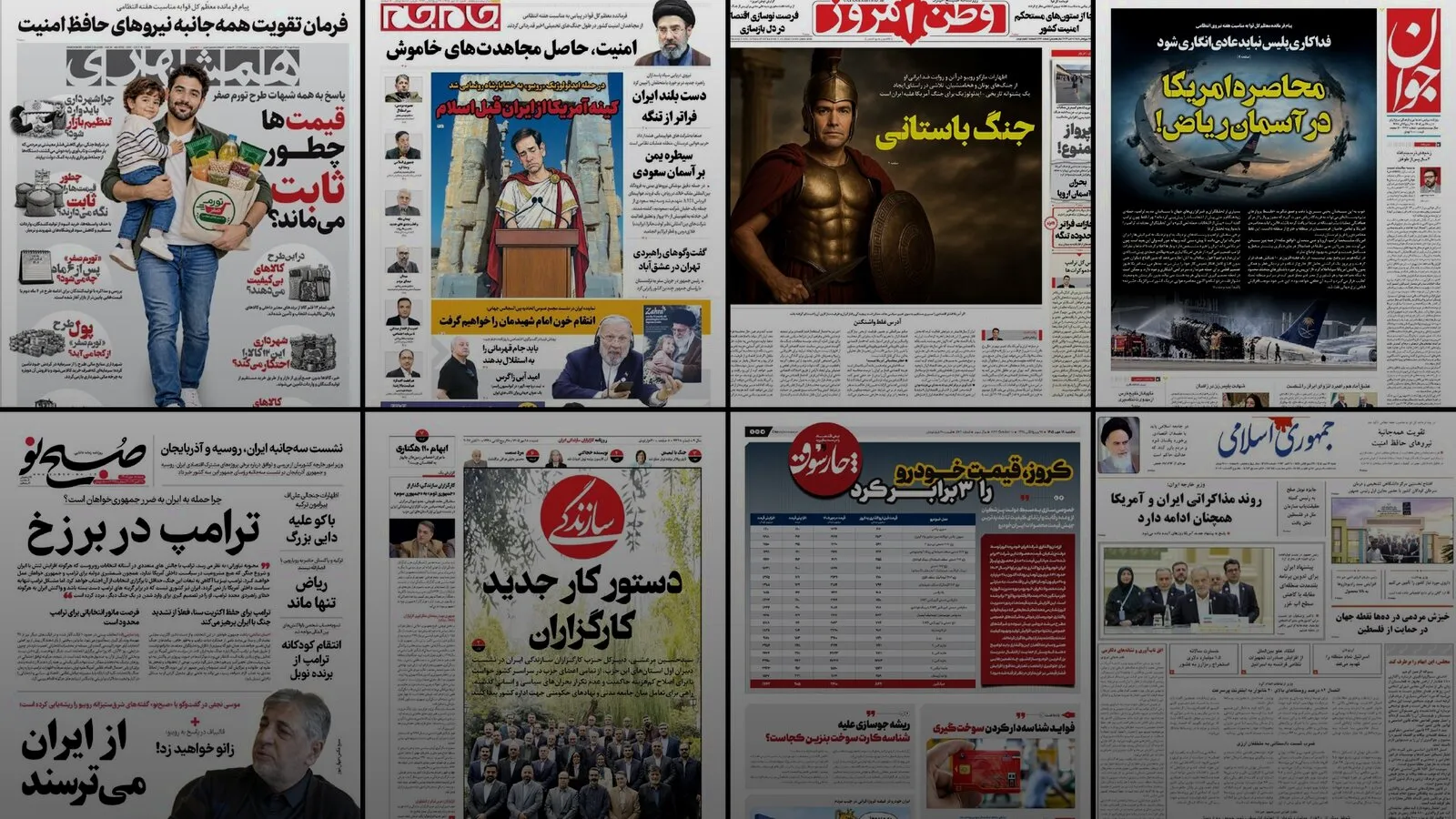
Bottom line: On the morning the Leader’s signature returned to Iranian front pages after five empty cycles, it was spent on the police and on numbering the present conflict as the second and third imposed wars, while the operational news moved to the sidebars: the Guard Corps navy announced punishment for vessels beyond the Strait of Hormuz, Sanaa declared Saudi airspace a theatre of military operations, and the hardline estate’s own editorial argued the system’s legitimacy from a Leader who has been dead for seven months rather than from the one whose message it had just printed.
Executive Summary
The lead judgment of this edition is that the Leader is back in print and that the terms of his return are more informative than its fact. Five of the ten front pages carry his Police Week message as a top strap or as the lead: Hamshahri’s «فرمان تقویت همهجانبه نیروهای حافظ امنیت», Jam-e Jam’s «امنیت، حاصل مجاهدتهای خاموش», Javan’s «فداکاری پلیس نباید عادیانگاری شود», Vatan-e Emrooz’s strap on the firm pillars of the country’s security, and Jomhouri Eslami’s «تقویت همهجانبه نیروهای حافظ امنیت», with Kayhan leading on «فراجا یکی از ستونهای مستحکم امنیت کشور است». This monitor recorded five consecutive cycles in which no front page carried any message, speech, photograph or signature of the Leader while his office was repeatedly cited as the source of permission for military decisions. That absence has ended. Two details in the text do the work. Kayhan’s rendering places the honorific «امام» before the name, «حضرت آیتاللهالعظمی امام سیدمجتبی خامنهای», a title this monitor has previously recorded only for Khomeini and for the assassinated predecessor. And the message credits the police with standing firm «در جنگهای تحمیلی دوم و سوم», in the second and third imposed wars, which numbers the present conflict’s phases in the Leader’s own voice against the 1980 to 1988 war with Iraq as the first. Jam-e Jam softens this to «جنگهای تحمیلی اخیر». A state that has started counting its wars in the Leader’s signature has fixed a vocabulary it will have to use again at any settlement.
The second finding is that the hardline estate’s own theory of legitimacy did not come back with him. Kayhan ran the message as its lead and, on the same cycle, ran Hossein Shariatmadari’s Yadasht-e Rooz «گوسالهپرستها و گوسالهشناسها!», whose central passage sets the forty nights of Moses’s absence against «مردم ایران نزدیک به ۷ ماه است که امام خود را ندیدهاند، ولی نه فقط در صراط مستقیم ثابت قدمتر شدهاند بلکه «گوسالهشناس» هم شدهاند»: the people of Iran have not seen their Imam for nearly seven months, and have become not calf-worshippers but calf-experts. The seven-month span and the reference to «آقای شهید» two sections earlier identify that Imam as Seyyed Ali Khamenei, assassinated on 28 February. The living successor, whose message is the lead of the very same edition, does not appear in the analogy at all. The inference mechanism matters: this is not an omission in passing but a structural requirement of the argument, because the comparison only works if the people have been left without their guide. The hardline estate is still locating authority in the dead Leader and in public endurance, and has published that on the morning the new Leader’s signature returned.
The third finding is a change in the war’s frame. For the first time in this monitor’s run the dominant hardline lead is neither nuclear, nor the chokepoint, nor Israel, but history. Vatan-e Emrooz gave its entire cover to a computer-generated image of the US Secretary of State’s face on a Greek hoplite under the single word «جنگ باستانی», decked as an attempt to build «یک پشتوانه تاریخی-ایدئولوژیک برای جنگ آمریکا علیه ایران». Jam-e Jam ran «کینه آمریکا از ایران قبل از اسلام», America’s grudge against pre-Islamic Iran, kickered to Rubio’s attack on Xerxes. Sobh-e No carried an interview with Mousa Najafi under «از ایران میترسند» and the parliament speaker’s reply «زانو خواهید زد». Even Etemad, which rejects the content, accepts the register, printing «بازگشت به تاریخ برای توجیه جنایت» over the word «رجزخوانی», the pre-combat boast of Persian epic. The occasion is verifiable: on 7 October the Secretary of State spoke at the Pnyx in Athens, and the address’s historical passage recounts the sack of Athens in 480 BC and the Acropolis stand against the Persian invaders. The significance is that a civilizational frame has no negotiable terms. Nuclear enrichment has a number and a chokepoint has coordinates; Xerxes has neither.
The operational news of the cycle was in the sidebars. Jam-e Jam, the state broadcaster’s own daily, printed «دست بلند ایران فراتر از تنگه», Iran’s long arm beyond the Strait, decked «نیروی دریایی سپاه پاسداران راهبرد جدید در برخورد با متخلفان را تبیین کرد». Vatan-e Emrooz boxed the same thing as «مجازات فراتر از محدوده تنگه», punishment beyond the Strait’s limits, with the bullet «ورود شناورهای ارتقاءیافته به میدان رزم». The Iran newspaper channel carried the navy’s warning on punishing violating vessels, and Defa Press published what it called the first image of the LPG carrier it says the Guard Corps navy struck near the strait. The previous edition of this monitor judged that the chokepoint had moved from posture to bargain, with coordinates agreed with Oman and a seven-day plan in mediators’ hands. This cycle the enforcement claim moved outward from the chokepoint while the bargain stayed in place, which is a widening of geography rather than a hardening of position, and it is the single development in this edition most likely to produce an incident that neither track can absorb.
The region’s other chokepoint behaved the same way. Four covers carried the closure of Saudi airspace, and every one of them published it as a gain. Javan led the whole page on «محاصره آمریکا در آسمان ریاض!», America besieged in the sky of Riyadh, over a burned-out Saudia airliner. Jam-e Jam ran «سیطره یمن بر آسمان سعودی», decked to Sanaa’s warning that Saudi airspace is a zone of military operations. Vatan-e Emrooz ran «پرواز ممنوع!» with the cost of the war to Riyadh as the explicit frame, and Sobh-e No ran «ریاض تنها ماند», Riyadh left alone, kickered that Turkey and Pakistan will not confront Ansarallah. The independent record supports the core: strikes on King Khalid International and on Abha, three dead by Saudi account, a heavily damaged Saudia aircraft, Yahya Saree declaring Saudi airspace a theatre of military operations with Mecca and Medina excluded, and mass cancellations and suspensions by foreign carriers. What it does not support is Jam-e Jam’s specification of a destroyed A321 airframe and of three named-category Saudi dead including a Saudia pilot, which is the paper’s rendering of a Sanaa claim. The structural point is that this is an escalation in Gulf civil aviation that the Iranian press can celebrate without Iran having to own it.
On the adversary’s intentions the Iranian press disagreed with itself in public, which is itself the finding. Sobh-e No led on «ترامپ در برزخ», Trump in limbo, with Mahboubeh Niavarani’s analysis of why an attack on Iran damages the Republicans before the midterms and the pull quote «ترامپ برای حفظ اکثریت سنا، فعلاً از تشدید جنگ با ایران پرهیز میکند». Etemad, on the same morning, ran «آماده باش ترامپ» over a report on renewed war posture in the region, and Nour News relayed American media reporting on military preparations for a possible resumption within three weeks. A principlist daily forecasting adversary restraint and a reformist daily forecasting adversary attack, printed on the same morning without either acknowledging the other, indicates the absence of a centrally imposed line on the single most consequential question in front of the system. For a press this monitor has repeatedly found to converge under message discipline, divergence at this point is an observation about the state’s own uncertainty, not about editorial independence.
The negotiating track survived the cycle and lost its sponsors. Jomhouri Eslami alone led on it, with «روند مذاکراتی ایران و آمریکا همچنان ادامه دارد» and the sub-deck «پاسخ به پیشنهاد جدید آمریکا روزهای آینده داده میشود», which matches the foreign minister’s statement of 8 October that Iran is reviewing the American response conveyed through mediators and will answer within days. Etemad’s channel relayed Yuri Ushakov saying Putin had told Trump that diplomatic options on Iran remain open. Nobody else printed it. A track carried by one clerical-establishment daily, while the hardline estate leads on Xerxes and the reformist estate leads on a women’s sport ban in Qom, is a track without a factional coalition in print, and that is a more precarious position than open opposition would be.
The economic press spent the cycle refusing the war dividend. Kayhan’s kiosk column reprinted an eightfold rise in oil freight costs through Hormuz as achievement; Ta’adol printed a hundred-dollar barrel as «پازل سه رقمی طلای سیاه!», a puzzle to be dissected, and set «بورس در قله تاریخی» against the question «شامخ بازار بزرگتر شد یا اقتصاد گرانتر؟». Charsoogh gave its cover to «کروز قیمت خودرو را ۳ برابر کرد», prosecuting the privatisation of Iran Khodro model by model against a printed price table. Hamshahri gave its cover to defending a municipal zero-inflation scheme against hoarding, quality and funding charges, conceding a six-month horizon. Three covers of one morning describe a nominal boom, a grocery-margin cut and a tripling of car prices, and none of them acknowledges the others. The war is no longer sufficient to suspend domestic economic scrutiny.
One external development was reported accurately by the Iranian press, which is rare enough to record. On 9 October the American president announced that Russia would supply diesel to the United States and to world markets, and the Treasury issued a general licence authorising Russian-origin diesel through 7 April 2027. Vatan-e Emrooz, Jam-e Jam, Etemad and Fars all carried it, with the tonnages, the licence date, the Ukrainian objection and the Reuters caution that a lasting price fall is unlikely. The usual pattern of this monitor is that adversary-origin material arrives in Persian with an upgraded verb. Here it did not, because the facts are already sufficient for the argument the Iranian press wants to make: that the cost of the war has reached the adversary’s own fuel pumps eight months in.
Net assessment: this is a consolidation edition with one genuine structural change inside it. Nothing moved on the battlefield, nothing moved on the negotiating table, and nothing in the Iranian press claimed otherwise. What moved is the architecture: the Leader’s signature returned and numbered the war, the hardline estate’s legitimacy argument stayed with his predecessor, the quarrel acquired a civilizational framing with no negotiable terms, and the Guard Corps navy’s enforcement claim stepped outside the chokepoint that has bounded it since June. Set against a Gulf in which Saudi airspace is now a declared operations zone and an American administration that has just reopened its fuel supply through Moscow before a midterm vote, the risk in this cycle is not that either side decides to escalate. It is that the geography in which an incident can occur has widened in a week in which neither side’s declared positions moved at all.
Key Judgments
- KJ-1 [HIGH] The Leader’s print absence has ended, and the terms of the return are the finding rather than the fact. The evidence is six covers and one rendering. Hamshahri, Jam-e Jam, Javan, Vatan-e Emrooz and Jomhouri Eslami each carry the Police Week message as a strap or lead, and Kayhan leads outright on «فراجا یکی از ستونهای مستحکم امنیت کشور است». Kayhan’s rendering (channel item 86360) attributes the message to «حضرت آیتاللهالعظمی امام سیدمجتبی خامنهای» and reports it as crediting the police with standing firm «در جنگهای تحمیلی دوم و سوم»; agency copy of the same message signs it «سید مجتبی حسینی خامنهای». Two elements are new: the honorific «امام» before the living Leader’s name, previously recorded in this monitor only for Khomeini and for the assassinated predecessor, and an ordinal that numbers the present conflict’s phases as the second and third imposed wars. The significance is that a state which has begun counting its wars in the Leader’s own signature has committed to a vocabulary that will constrain how any ceasefire or settlement can be described, and that the first institution addressed on the return is the internal-security force rather than the Guard Corps.
- KJ-2 [HIGH] The hardline estate’s legitimacy argument still runs through the assassinated Leader, and it published that on the morning the successor’s signature returned. The evidence is the structure of one text. Shariatmadari’s Yadasht-e Rooz «گوسالهپرستها و گوسالهشناسها!» sets Qur’an 7:142 and Moses’s forty-night absence against «مردم ایران نزدیک به ۷ ماه است که امام خود را ندیدهاند، ولی نه فقط در صراط مستقیم ثابت قدمتر شدهاند بلکه «گوسالهشناس» هم شدهاند». The seven-month span dates the absence to 28 February 2026 and the earlier reference to the funeral of «آقای شهید» fixes the referent as Seyyed Ali Khamenei. The analogy is load-bearing: it only works if the people have been left without their guide, so the living Leader cannot appear in it. Jam-e Jam’s Inter-Parliamentary Union item points the same way, with «انتقام خون امام شهیدمان را خواهیم گرفت» and a placard carrying the predecessor’s image. The significance is that the succession remains administratively complete and emotionally unconsummated: the office issues instructions, and the martyr supplies the legitimacy.
- KJ-3 [HIGH] The war’s dominant Iranian frame moved this cycle from capability to civilization, and the frame has no negotiable terms. The evidence is four covers reading one speech. Vatan-e Emrooz gave its entire front to a computer-generated image of the US Secretary of State as a Greek hoplite under «جنگ باستانی», decked «اظهارات مارکو روبیو و روایت ضدایرانی او از جنگهای یونان و هخامنشیان، تلاشی در راستای ایجاد یک پشتوانه تاریخی-ایدئولوژیک برای جنگ آمریکا علیه ایران است». Jam-e Jam ran «کینه آمریکا از ایران قبل از اسلام» kickered to an ideological attack on Xerxes. Sobh-e No ran the Mousa Najafi interview «از ایران میترسند» and Qalibaf’s reply «زانو خواهید زد», which Defa Press item 69494 records as a post on X warning that those pursuing Alexander’s legacy will meet Valerian’s fate. Etemad rejected the content and kept the register, printing «رجزخوانی باستانگرایانه روبیو» over «بازگشت به تاریخ برای توجیه جنایت». The occasion is verifiable: the 7 October address at the Pnyx in Athens, whose historical passage recounts the 480 BC sack of Athens and the Acropolis stand against the Persian invaders. The significance is that every prior Iranian frame in this war contained a quantity that could be traded, an enrichment level, a transit corridor, a prisoner list. A quarrel about Xerxes contains none, and it is the first frame of this war that the reformist estate has adopted rather than contested.
- KJ-4 [HIGH] Guard Corps naval enforcement has been extended beyond the Strait of Hormuz in print, and the extension was published by the state broadcaster’s own daily as doctrine rather than by a hardline one as a threat. The evidence is three surfaces carrying one claim. Jam-e Jam printed «دست بلند ایران فراتر از تنگه» decked «نیروی دریایی سپاه پاسداران راهبرد جدید در برخورد با متخلفان را تبیین کرد». Vatan-e Emrooz boxed it as «مجازات فراتر از محدوده تنگه», decked «هشدار سپاه به شناورهایی که قصد عبور غیرمجاز از تنگه هرمز را دارند», with the bullet «ورود شناورهای ارتقاءیافته به میدان رزم». The Iran newspaper channel carried the navy’s warning on punishing violating vessels (item 509342), and Defa Press item 69495 published what it called the first image of the LPG carrier NV Sunshine, which the navy says it struck near the strait after an attempted transit of an unauthorised route. The independent record carries the Guard Corps claim and the accompanying warning that violators will be punished beyond the strait, and records roughly a dozen attacks, attempted attacks or harassment incidents involving oil, LNG and LPG tankers in the week to 5 October. The significance is geographic rather than rhetorical. The previous edition of this monitor judged the chokepoint to have moved from posture to bargain, with coordinates agreed with Oman. Those coordinates bound a negotiation to a place; an enforcement claim that reaches past that place removes the boundary while leaving the negotiation intact, which widens the space in which an incident can occur without widening anybody’s declared position.
- KJ-5 [HIGH] Saudi civil aviation has become a declared theatre of operations, and the Iranian press is publishing it as a strategic gain Iran does not have to own. The evidence is four covers and one wire. Javan led its whole front on «محاصره آمریکا در آسمان ریاض!» over a burned-out Saudia airliner and an encircled American transport aircraft, attributing the result to America rather than to Yemen. Jam-e Jam ran «سیطره یمن بر آسمان سعودی» decked «صنعا به شرکتهای هواپیمایی هشدار داد: حریم هوایی عربستان، منطقه عملیات نظامی است». Vatan-e Emrooz ran «پرواز ممنوع!» with the explicit frame of cost imposed on Riyadh for continuing the war. Sobh-e No ran «ریاض تنها ماند» kickered «ترکیه و پاکستان حاضر به رویارویی با انصارالله نیستند». Kayhan’s kiosk column reprinted «یمنیها پالایشگاههای آرامکو و فرودگاههای آلسعود را به آتش کشیدند». The independent record confirms missile attacks on King Khalid International in Riyadh and on Abha, three dead by Saudi account, a heavily damaged Saudia aircraft, Yahya Saree’s declaration that Saudi airspace has become a theatre of military operations with the airspace over Mecca and Medina excluded and humanitarian flights permitted by authorisation from Sanaa, a widened European aviation advisory, and more than a hundred daily cancellations at Riyadh. It does not support Jam-e Jam’s specification of a destroyed Airbus A321 airframe and three Saudi dead including a Saudia pilot, which is the paper’s rendering of a Sanaa claim. The significance is that this is the first escalation of the war to close a major Gulf capital’s airspace to commercial traffic, and it reaches the Iranian front pages as an achievement without an Iranian signature on it.
- KJ-6 [MODERATE-HIGH] There is no centrally imposed Iranian line on whether the United States will resume major operations, and two estates printed opposite forecasts on the same morning. The evidence is two covers and a wire. Sobh-e No (No. 2445) led on «ترامپ در برزخ» over «چرا حمله به ایران به ضرر جمهوریخواهان است؟», Mahboubeh Niavarani’s analysis that the approaching midterms make escalation electorally unaffordable, with the pull quote attributed to Ehsan Salehi «ترامپ برای حفظ اکثریت سنا، فعلاً از تشدید جنگ با ایران پرهیز میکند». Etemad ran «آماده باش ترامپ» over a report on war posture in the region. Nour News item 400689 relayed American media reporting that preparations are being made for a possible resumption of fighting within three weeks without a final decision having been taken, alongside sanctions on seventeen tankers and a reported move against roughly a billion dollars in Iranian crypto assets. The calibration runs both ways: overstating the divergence would read ordinary editorial variation as a policy vacuum, while understating it would miss that these two papers have in previous cycles converged within hours on far less consequential questions. The significance is that a principlist paper forecasting adversary restraint until 3 November is, in effect, publishing a window, and windows are the conditions under which miscalculation becomes attractive to the side that believes it has one.
- KJ-7 [MODERATE-HIGH] The Iran-United States negotiating track remains live and has lost its factional sponsorship in print. The evidence is one lead and one absence. Jomhouri Eslami alone led on «روند مذاکراتی ایران و آمریکا همچنان ادامه دارد», sub-decked «پاسخ به پیشنهاد جدید آمریکا روزهای آینده داده میشود», which matches the foreign minister’s statement of 8 October that Iran was reviewing the American side’s response conveyed through mediators and would reply within days, with messages still passing through intermediaries. Etemad’s channel item 538301 relayed Yuri Ushakov’s statement that Putin told Trump diplomatic options on Iran remain open. Against that, no hardline, reformist or economic cover carried the negotiation in any form; Kayhan’s kiosk column instead reprinted «تهدیدات ترامپ نه محاسبات ایران را تغییر میدهد نه تنگه را باز میکند». The significance is that the track now rests on a single clerical-establishment daily and on the foreign ministry’s own voice, with no estate invested in defending it, which makes it cheap to abandon and expensive to deliver. The promised reply «روزهای آینده» also creates a dated commitment this monitor can test against the next cycles.
- KJ-8 [MODERATE-HIGH] The American diesel arrangement with Russia is being read across the Iranian press as proof that the war’s costs have reached the adversary’s home front, and for once the Iranian rendering is not inflated. The evidence is four surfaces reporting one event accurately. Vatan-e Emrooz carried the 300,000-tonne figure, the Treasury licence running to 7 April 2027, Zelensky’s objection and the Axios report that the decision shocked Kyiv and European allies (items 27990 to 27993); Jam-e Jam carried the Reuters caution that the arrangement will not produce a lasting fall in global fuel prices (item 30515) and the Politico forecast of a severe European gas shortage this winter (item 30514); Etemad carried the same Reuters line (item 538295); Fars carried congressional Democrats saying Americans are paying the price of the war through petrol and diesel prices (item 467407). The independent record confirms the 9 October announcement, the phased tonnages, the general licence authorising Russian-origin diesel through 7 April 2027, a diesel price rise of close to seventy percent since the war began in February, and the Ukrainian reaction. The significance is methodological as much as substantive: this monitor has recorded a consistent pattern of adversary-origin material arriving in Persian with an upgraded verb, and its absence here indicates the Iranian press judged the unembellished facts sufficient, which is the strongest available signal of how damaging Tehran believes the adversary’s energy position to be.
- KJ-9 [MODERATE] The Nobel Peace Prize was absorbed into the Palestine frame by every Iranian outlet that carried it, and the reaction to it, not the award, is what the Iranian press is actually reporting. The evidence is three covers. Jam-e Jam ran «نوبل برای افشاگر نسلکشی» kickered «از رواندا تا غزه؛ زنی که عدالت را به سلاح صلح تبدیل کرد». Jomhouri Eslami ran «جایزه نوبل صلح به رئیس کمیته حقیقتیاب سازمان ملل در فلسطین تعلق یافت». Sobh-e No ran «انتقام کودکانه ترامپ از برنده نوبل» kickered «تسویهحساب شخصی با واکنشهای بینالمللی مواجه شد». The independent record confirms the 2026 prize was announced on 9 October to Navi Pillay, the South African jurist and former UN High Commissioner for Human Rights, that fresh American sanctions on the International Criminal Court were announced within hours, that the American president reshared a post describing the laureate as a hater of America and Israel, and that Israel’s foreign ministry called the award a weaponisation of the prize. The significance is that Iranian outlets reached for the one element of the story with no Iranian content in it at all, an American punitive reaction to an international legal institution, which is a cheaper argument than any claim about Iran’s own standing and indicates the limits of what the Palestine frame can currently be made to carry.
- KJ-10 [MODERATE] The Iranian economic press is now contradicting the political press on the war’s domestic effects, in the same cycle and without acknowledgement. The evidence is four covers. Kayhan’s kiosk column reprinted «بحران کمرشکن هرمز برای ابرنفتکشها؛ هزینه حمل نفت ۸ برابر شد», an eightfold rise in oil freight costs, as evidence of successful coercion. Ta’adol printed a hundred-dollar barrel as «پازل سه رقمی طلای سیاه!» and placed «بورس در قله تاریخی» beside «شامخ بازار بزرگتر شد یا اقتصاد گرانتر؟», which is a direct statement of the nominal-versus-real problem. Charsoogh gave its whole cover to «کروز قیمت خودرو را ۳ برابر کرد», prosecuting the handover of Iran Khodro to a named private acquirer against a model-by-model price table, with the average price of twenty best-selling models cited at around 867 million tomans before the transfer in late 1403. Hamshahri spent its cover defending a municipal zero-inflation scheme, conceding a six-month horizon and answering four separate accusations. Jomhouri Eslami printed an annual 1.5 billion dollar national cost for crypto mining. The significance is that the war has stopped functioning as a suspension of domestic accountability, and that the most granular consumer-price evidence available to this monitor is now being published by Iranian papers themselves.
- KJ-11 [MODERATE] Negative evidence, filed as a finding: Lebanon is absent for an eighth consecutive print cycle and for a second consecutive cycle from the wires as well. The evidence is a complete absence across ten front pages, six outlet channels and three agency wires. No cover carries a Lebanese item of any kind, no outlet channel carried Lebanese political content, and the three agency wires, which in earlier cycles carried Hezbollah statements and southern Lebanon strike reports as routine filler, carried none. Set against the previous edition, which recorded the seventh empty print cycle and the first empty wire cycle, this is a consolidation of the blackout rather than a one-day gap. The significance is that a theatre the Iranian system spent two decades presenting as the forward edge of its deterrence has now been entirely withdrawn from the Iranian public’s field of vision, which is consistent either with a theatre that has gone quiet or with a theatre whose condition the system has decided not to describe. The two are not distinguishable from Iranian print alone, and this monitor does not attempt to distinguish them.
- KJ-12 [MODERATE] Negative evidence, filed as a finding: the Israeli front has no presence on any Iranian front page this cycle as an active theatre. The evidence is two mentions in ten covers, neither of them operational. Jomhouri Eslami carried «اردوغان: اسرائیل تمام منطقه را تهدید میکند», a third-party warning rather than an Iranian claim, and Javan carried a signed commentary «۳ سال پس از طوفان» marking the third anniversary of the 7 October 2023 operation, which is retrospective. No cover carries an Israeli strike, an Iranian retaliation, a casualty figure or a battle-damage claim from the Israeli front, and the agency wires carried Saudi strikes on Hudaydah, Saada and Hajjah instead. The calibration matters here: inferring a quiet front from editorial silence would overread, since this monitor has repeatedly found that Iranian print suppresses losses rather than reporting them. What can be said is narrower and still useful. For the duration of this cycle the Iranian state described the war to its own public as a Gulf and Red Sea conflict about shipping, airspace and fuel prices, with Israel present only as a historical grievance and a neighbour’s complaint.
Macro Trends
- The Leader’s signature returned to the front pages after five empty cycles, and it numbered the war. Five of ten covers carry the Police Week message as a strap or lead and Kayhan leads on it outright, ending a print absence this monitor had tracked for five consecutive cycles in which the Leader’s office was cited as the source of permission without any text appearing. Kayhan’s rendering carries the honorific «امام» before «سیدمجتبی خامنهای» and the clause «در جنگهای تحمیلی دوم و سوم», the second and third imposed wars. The institution addressed is the internal-security force, not the Guard Corps and not the armed forces, on a morning when the Guard Corps navy is announcing enforcement beyond the Strait in three other papers.
- The hardline legitimacy argument still runs through the assassinated Leader, not the living one. Shariatmadari’s Yadasht-e Rooz builds its title from Qur’an 7:142 and requires the Leader to be absent: «مردم ایران نزدیک به ۷ ماه است که امام خود را ندیدهاند». The seven-month span and the earlier reference to «آقای شهید» place the referent with Seyyed Ali Khamenei. The successor, whose message is the same edition’s lead, is not in the passage. Jam-e Jam’s Inter-Parliamentary Union item carries «انتقام خون امام شهیدمان را خواهیم گرفت» and a placard bearing the predecessor’s image. The dead Leader remains the operative figure of legitimacy across the hardline estate.
- The quarrel was recast as civilizational on three covers at once, and the reformist estate accepted the register. Vatan-e Emrooz gave its whole cover to «جنگ باستانی» with the Secretary of State rendered as a Greek hoplite; Jam-e Jam ran «کینه آمریکا از ایران قبل از اسلام» kickered to Xerxes; Sobh-e No ran «از ایران میترسند» and the speaker’s «زانو خواهید زد»; Etemad rejected the content while adopting the vocabulary, printing «رجزخوانی باستانگرایانه روبیو» and «بازگشت به تاریخ برای توجیه جنایت». The occasion is a verifiable 7 October address at the Pnyx in Athens. A civilizational frame is the only frame in this war with no negotiable quantity in it.
- Guard Corps naval enforcement moved outside the chokepoint and was published as doctrine, not as threat. Jam-e Jam printed «دست بلند ایران فراتر از تنگه» over the navy’s new approach to violators; Vatan-e Emrooz boxed «مجازات فراتر از محدوده تنگه» with «ورود شناورهای ارتقاءیافته به میدان رزم»; the Iran newspaper channel carried the warning on punishing violating vessels; Defa Press published what it called the first image of the LPG carrier NV Sunshine, which the navy says it struck near the strait. The previous edition recorded the chokepoint acquiring terms, a timetable and agreed coordinates. The bargain has not changed; the enforcement area has.
- Gulf civil aviation became a declared theatre and the Iranian press carried it as a gain Iran does not have to own. Javan led on «محاصره آمریکا در آسمان ریاض!», Jam-e Jam on «سیطره یمن بر آسمان سعودی» with Sanaa’s warning that Saudi airspace is a military operations zone, Vatan-e Emrooz on «پرواز ممنوع!» framed as cost imposed on Riyadh, Sobh-e No on «ریاض تنها ماند». The independent record supports strikes on King Khalid and Abha, three dead by Saudi account, a damaged Saudia aircraft, the Saree declaration excluding Mecca and Medina, and mass cancellations. The specific airframe and casualty details in Jam-e Jam go beyond it.
- Two estates printed opposite forecasts of American intent on the same morning and neither acknowledged the other. Sobh-e No led on «ترامپ در برزخ» with the judgment that the midterm calendar makes escalation unaffordable and that «ترامپ برای حفظ اکثریت سنا، فعلاً از تشدید جنگ با ایران پرهیز میکند»; Etemad ran «آماده باش ترامپ» on renewed regional war posture; Nour News relayed American reporting of preparations for possible resumption within three weeks. In a press this monitor has repeatedly found converging under message discipline, open divergence on the central question indicates there is no line to converge on.
- The negotiating track survived but lost its coalition in print. Jomhouri Eslami alone led on «روند مذاکراتی ایران و آمریکا همچنان ادامه دارد» with «پاسخ به پیشنهاد جدید آمریکا روزهای آینده داده میشود», consistent with the foreign minister’s 8 October statement that Iran is reviewing the American reply through mediators. Etemad’s channel relayed Ushakov saying Putin told Trump diplomacy on Iran remains open. No hardline, reformist or economic cover carried the negotiation at all. A diplomatic track sponsored by one clerical-establishment daily is structurally weaker than one under open attack.
- The war is no longer sufficient to suspend domestic economic scrutiny. Charsoogh prosecuted the privatisation of Iran Khodro as «کروز قیمت خودرو را ۳ برابر کرد» against a printed model-by-model price table, naming a private acquirer rather than a ministry. Hamshahri spent its whole cover defending a municipal zero-inflation scheme against hoarding, quality, funding and neglect charges. Ta’adol set «بورس در قله تاریخی» against «شامخ بازار بزرگتر شد یا اقتصاد گرانتر؟» and treated a hundred-dollar barrel as a puzzle rather than a victory. Jomhouri Eslami printed an annual 1.5 billion dollar cost for crypto mining.
- Adversary-origin material was for once reported without upgrade, because it did not need one. The 9 October American announcement that Russia would supply diesel to the United States and world markets, under a Treasury general licence running to 7 April 2027, was carried by Vatan-e Emrooz, Jam-e Jam, Etemad and Fars with the tonnages, the licence date, the Ukrainian objection and the Reuters caution that a lasting price fall is unlikely. Congressional Democrats’ line that Americans are paying for the war was carried alongside. The absence of the usual verb inflation is the tell: the facts already serve the argument.
- Lebanon is absent for an eighth consecutive print cycle and the Israeli front has no print presence as an active theatre. Not one of the ten front pages carries a Lebanon item, and none of the six outlet channels or three agency wires carried Lebanese political content this cycle either, a second consecutive wire blackout. Israel appears only twice and never as a front: Jomhouri Eslami’s «اردوغان: اسرائیل تمام منطقه را تهدید میکند» and Javan’s third-anniversary commentary «۳ سال پس از طوفان». A war whose Israeli and Lebanese theatres have vanished from the Iranian front pages is being described to its own public as a Gulf and Red Sea war.
Front-Page Snapshot
- Vatan-e Emrooz (Vol. 13, No. 4739) - “The ancient war” (Hardline principlist) - The Athens speech read as the ideological scaffolding for war, with Guard Corps punishment extended beyond the Strait in the rail [SEVERE]
- Jam-e Jam - “Security, the fruit of silent striving” (Daily of the state broadcaster (IRIB)) - The Leader’s message, the Xerxes quarrel, naval reach beyond the Strait and the Saudi air closure, ranked on one cover [SEVERE]
- Javan (Year 28, No. 7376) - “America besieged in the sky of Riyadh!” (Hardline, Islamic Revolutionary Guard Corps-affiliated) - Riyadh’s airports read as American encirclement, beside a pulpit demand to leave the NPT [HIGH]
- Kayhan (channel-reconstructed) - “FARAJA is one of the firm pillars of the country’s security” (Hardline, published under the Supreme Leader’s office) - The Leader’s first printed message in weeks spent on the police, beside an editorial that counts seven months without him [HIGH]
- Sobh-e No (No. 2445) - “Trump in limbo” (Principlist) - American escalation judged electorally unaffordable until the November midterms [MODERATE-HIGH]
- Jomhouri Eslami - “The Iran-United States negotiating process is still continuing” (Traditional clerical establishment) - The negotiation led alone: an American proposal on the table and an Iranian answer promised within days [LOW-MODERATE]
- Etemad - “An attack on women’s sport” (Reformist) - A women’s sport ban in Qom led over the war, with renewed American war posture reported in the rail [MODERATE]
- Sazandegi (Year 9, No. 4268) - “Kargozaran’s new agenda” (Reformist, Kargozaran-e Sazandegi party organ) - A reformist party convenes its provinces and publishes a Third Republic transition frame [LOW]
- Hamshahri - “How will prices stay stable?” (Tehran municipality, centrist) - A municipal zero-inflation scheme defended box by box against hoarding and quality charges [LOW]
- Charsoogh (Year 3, No. 521) - “Crouse has tripled the price of cars” (Economic daily) - Iran Khodro’s privatisation prosecuted model by model against a printed price table [LOW]
- Ta’adol - “The three-digit puzzle of black gold!” (Economic daily) - A hundred-dollar barrel and a record index read as a pricing puzzle, not a war dividend [LOW]
Full report
The complete edition - per-paper front-page analysis and full translation appendices - is available as a PDF: Download the full report.
Compiled from Iranian front pages and outlet channels via open-source monitoring. Translations are editorial; named-figure attributions are verified against the source pages where possible.