Iranian Press Monitor - Thursday, 8 October 2026 (Day 219)
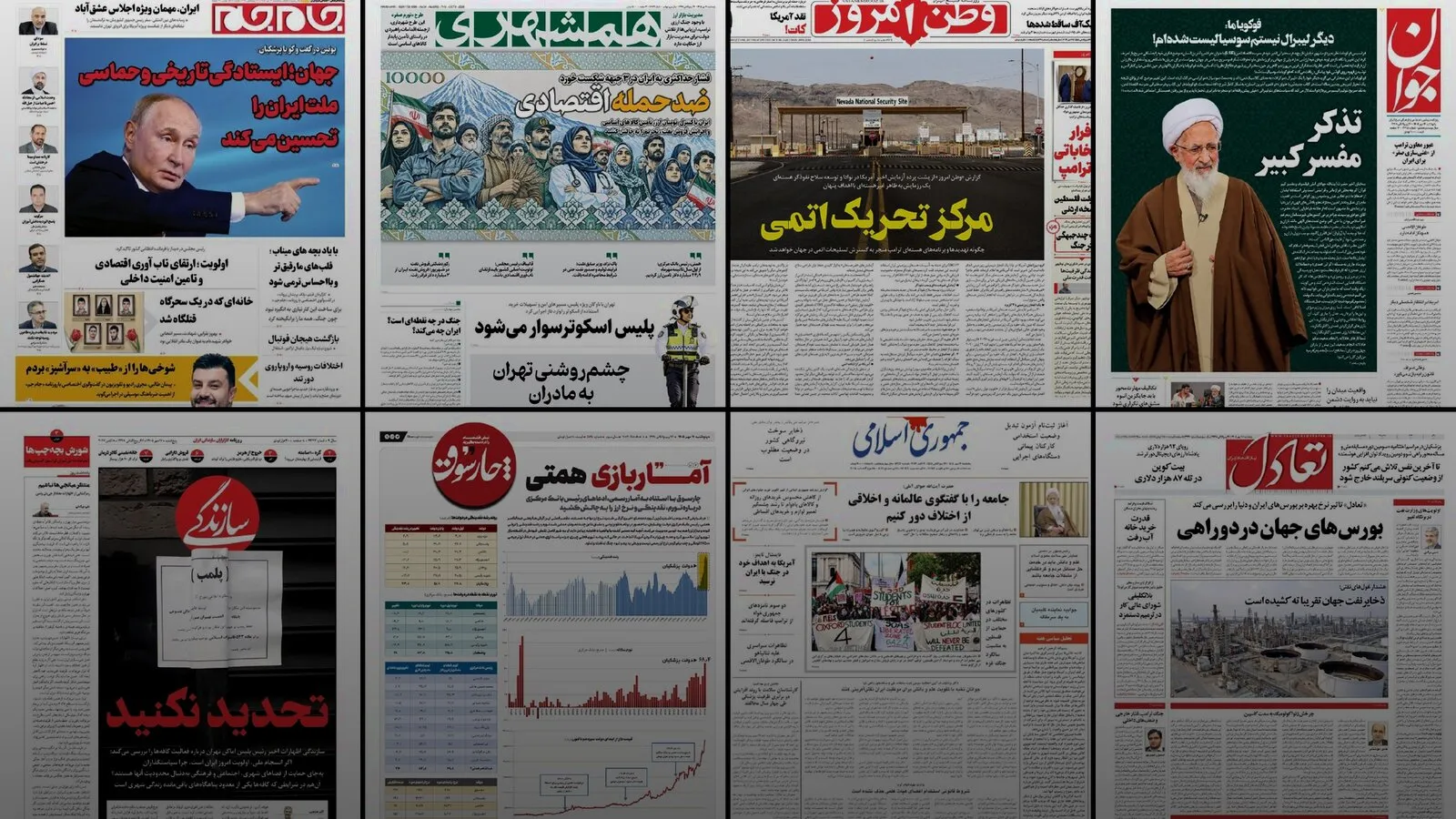
Thursday, 8 October 2026 · پنجشنبه ۱۶ مهر ۱۴۰۵ · 26 Rabi’ al-Thani 1448 - Nine Persian front pages and one English front page of 16 Mehr 1405, read alongside six outlet channels and three agency wires; Kayhan and Sobh-e No are reconstructed from their own channels, and Tehran Times was unavailable at the time of compilation.
Bottom line: The Iranian state published its willingness to negotiate in three places on one morning, from the president’s cabinet table to the Guard Corps daily’s reading of the American vice president, while its own foreign ministry disclosed that Iran has given mediators a seven-day plan and agreed coordinates with Oman for safe passage through a strait in which, on adversary counts the Iranian press reprints approvingly, at least twelve ships were hit in a single week and ninety-three since February.
Executive Summary
The lead judgment of this edition is that the Strait of Hormuz has moved from slogan to schedule. Iranian officials spent the cycle describing, in public, an operational mechanism for reopening it: the foreign ministry spokesman Esmaeil Baqaei said Iran’s conditions for ending the war and restoring security in the Persian Gulf and the strait have been stated, that Iran will answer American proposals through mediators, and that Iran and Oman have agreed coordinates for safe shipping lanes; the foreign minister Abbas Araghchi told parliament that Iran had presented mediators with a «طرح ۷ روزه برای بازگشت امنیت به تنگه هرمز», a seven-day plan for the return of security to the strait, with Iran’s conditions set out in an operational format. On the independent record a seven-day proposal was delivered via mediators late last month and Iran is reviewing Washington’s response. This is the first cycle in which the chokepoint has been described by Iranian officials as a thing with terms, a timetable and coordinates rather than as a posture.
The second finding is that the price of the strait is now being published by the Iranian press itself, in adversary numbers it does not dispute. Sobh-e No’s channel reproduced Reuters for at least twelve attacks on tankers and gas carriers near the strait in the week of 7 to 14 Mehr, the highest weekly count since the war began, and the Financial Times for danger pay to tanker masters and at least 93 ships attacked since 28 February, including the attribution of those attacks to Iran. Kayhan’s channel reported a tanker anchorage fire some thirty nautical miles east of Fujairah, fourteen ships hit in seven days, warnings to more than six others, oil near 102 dollars and analysts expecting 110 if the pattern holds, and carried Reuters on oil executives saying the world has consumed nearly all its emergency reserve and Bloomberg on the cost of moving a very large crude carrier from the United States to Asia reaching about 77 million dollars against 9.2 million in 2025. A press that normally quarantines hostile reporting is reprinting it without a firewall, because a hostile tally is the strongest available evidence that the coercion is working.
The third finding is that the negotiation surfaced on Iranian front pages for the first time without being disguised, and that it surfaced on both sides of the factional line. Iran Daily, Vol. 8233, boxed ‘President: Iran will negotiate from position of strength amid “full-scale war”’ over a photograph of the 7 October cabinet session, forty-eight hours after the same masthead carried the president calling talks with Washington meaningless; the Iran newspaper channel carried the matching Persian formula, «برای احقاق حقوق ملت ایران از موضع عزت و اقتدار سخن میگوییم». Javan, the Guard Corps daily, led its rail with «عبور معاون ترامپ از «غنیسازی صفر» برای ایران», reading JD Vance’s Reuters interview as an American retreat. Sazandegi gave its front-page column to Ali Bigdeli under «منتظر میانجیها نباشیم», decoding the same interview as an opening Iran should take directly. Three estates, one text, three different uses, and none of them a refusal.
The fourth finding is the countervailing one, and it is a warning against reading the morning as détente. Etemad’s channel carried Axios, citing American officials, reporting that the Pentagon has instructed Central Command to finalise preparations for resuming operations in Iran, and twenty-eight minutes later carried Trump claiming progress in the talks. Jam-e Jam’s channel carried The Atlantic reporting that the White House has asked the Pentagon to prepare options for striking Iran before the 3 November midterms, and separately carried Trump praising his envoy. The Iranian information estate is holding both of these at once and is publishing only the half that suits each surface: Jam-e Jam’s channel reproduced Trump’s compliment to Steve Witkoff and omitted the sentence from the same San Antonio rally in which he said the deal is not something he wants.
The fifth finding is that the Leader’s office has moved from silence to invocation without issuing a text. For a fifth consecutive cycle no message, speech, photograph or signature of the Leader appears on any front page. What appears instead is the Leader as a permission-granting instance in someone else’s sentence: Kayhan’s cover carries Brigadier General Mohammad Reza Naghdi saying «هر زمان رهبر انقلاب مجوز بدهند بُرد موشکها را افزایش خواهیم داد», and his fuller Al-Alam remarks hold that the ceiling on Iranian weapons range is a decision of the officials and the Leader rather than a technical limit. The office’s only publication of the cycle is a KHAMENEI.IR poster quoting the martyred predecessor on the al-Aqsa Flood anniversary. The current Leader is named in print once, by a foreign president: Sobh-e No reports Putin conveying greetings to «آیتالله سید مجتبی حسینی خامنهای».
The sixth finding is domestic, and it is the sharpest internal confrontation this file has recorded. Two front pages of the same morning published incompatible accounts of the same central bank. Hamshahri gave its cover to «ضد حمله اقتصادی» with Hemmati’s claim of 24.9 billion dollars of foreign currency supplied since the start of the year printed as proof that maximum pressure has failed; Charsoogh gave its entire cover to «آماربازی همتی», dismantling the governor’s inflation, liquidity and exchange-rate claims from the central bank’s own published series, with annual inflation printed at 68.4 percent. On the same morning Etemad ran «شبهه تحدید آزادی بیان», putting three named lawyers against Article 22 of the counter-infiltration bill, adopted by parliament on 6 October by 174 votes to 6, which criminalises interviews with outlets the intelligence ministry designates hostile and exempts officials; and Sazandegi ran «تحدید نکنید» against the sealing of Tehran cafes. The two reformist covers chose the same verb on the same day.
Net assessment: this is the first edition in this file’s record in which the Iranian press stopped arguing about whether a negotiation exists and started arguing about its terms. The chokepoint is the currency: the government is costing it in coordinates and timetables for mediators, the Leader’s office daily is defending it as a prerogative that an executive cannot spend («تنگه هرمز با خبردرمانی باز نمیشود»), and the economic titles are printing what it costs Iranians, with Brent above 100 dollars sitting next to shrinking housing affordability and a stalled wage review. Against that, two separate American outlets report strike preparation on a pre-midterm clock, and the system’s own front pages still carry no Iranian operational claim of any kind. A press that has to build its war case from a CIA assessment, a CBS investigation, a congressional loss list and a Financial Times shipping tally has, by that fact, told you where the initiative is not.
Key Judgments
- KJ-1 [HIGH] The Strait of Hormuz has moved from posture to bargain, and the Iranian government has said so in public. The evidence is two officials on the record in one cycle. Foreign ministry spokesman Esmaeil Baqaei stated that Iran’s conditions for ending the war and restoring security in the Persian Gulf and the strait have been set out, that Iran will reply to American proposals through mediators, and that Iran and Oman have agreed coordinates for safe shipping lanes (Defa Press item 69398, Jam-e Jam channel item 30318). Foreign minister Abbas Araghchi told MPs that Iran presented mediators with a «طرح ۷ روزه برای بازگشت امنیت به تنگه هرمز», with Iran’s conditions in an operational format (Iran newspaper channel item 509190). The independent record confirms that a seven-day proposal was passed through mediators late last month and that Tehran is reviewing Washington’s reply, and separately records Qalibaf saying the strait will not open until Iran’s conditions under the Islamabad memorandum are met. The significance is that coordinates, a timetable and an operational format are the vocabulary of implementation, not of deterrence. A chokepoint held as a symbol cannot be traded; a chokepoint with agreed coordinates for safe lanes already has been, partially, and the remaining question is price.
- KJ-2 [HIGH] The Iranian press is reprinting hostile shipping-attack tallies without rebuttal, which identifies the one claim the system wants believed above all others. The evidence is the absence of a firewall where the firewall is normally absolute. Sobh-e No’s channel carried Reuters for at least twelve attacks on tankers and gas carriers near the strait in the week of 7 to 14 Mehr, described as the highest weekly count since the war began, and the Financial Times under the Persian headline «حملات ایران تنگه هرمز را به شدت خطرناک کرده است», reproducing the attribution of the attacks to Iran and the figure of at least 93 ships attacked since 28 February. Kayhan’s channel added a tanker anchorage fire thirty nautical miles east of Fujairah, fourteen ships in seven days, oil near 102 dollars and an expectation of 110. Vatan-e Emrooz carried Reuters on traffic at a two-month low. The countervailing evidence is that the independent record puts roughly forty percent of Gulf oil exports outside the strait by pipeline and offshore transfer, so throughput is degraded rather than stopped. The significance is methodological: where Iranian outlets drop the attribution firewall, they are telling you which adversary finding they regard as an asset, and the asset here is the insurance market’s assessment of risk, not any Iranian operational claim.
- KJ-3 [HIGH] The negotiation reached the front pages of three distinct estates on one morning and not one of them printed a refusal. The evidence is three covers and a channel. Iran Daily, Vol. 8233, boxed ‘President: Iran will negotiate from position of strength amid “full-scale war”’ over the 7 October cabinet session, two cycles after the same masthead printed the president calling talks with Washington meaningless; the Iran newspaper channel carried the Persian formula «برای احقاق حقوق ملت ایران از موضع عزت و اقتدار سخن میگوییم». Javan, the Guard Corps daily, printed «عبور معاون ترامپ از «غنیسازی صفر» برای ایران». Sazandegi gave its front-page column to Ali Bigdeli under «منتظر میانجیها نباشیم». The significance lies in the direction of each title’s effort: the hardline paper is working to make the American position look softer and the reformist paper is working to make the Iranian response look more direct, which are two halves of the same preparation. The discriminating test for the next cycles is whether any principlist title describes an Iranian concession rather than only an American one; until it does, the domestic ground for a settlement has been prepared on one side only.
- KJ-4 [MODERATE-HIGH] Both Iranian readings of the Vance interview are wrong in the same direction, and the error is load-bearing. The evidence is the record of what he said. In a Reuters interview conducted around a 5 October campaign stop in Alaska and published 7 October, JD Vance said Iran must make a ‘meaningful’ reduction in enrichment capacity for any agreement, asked ‘why do you need 60 percent enriched fuel?’, said ‘we’re not going to trade words for actions’, and said Washington is uncertain who makes decisions in Tehran. Javan read this as the American vice president passing beyond a zero-enrichment demand; Sazandegi read it as a meaningful opening. There was no stated zero-enrichment position to abandon: at Munich in May 2025 Vance said explicitly ‘we don’t care if people want nuclear power’ and drew the line at weapons-capable enrichment. The significance is that an Iranian consensus is forming around a concession that was not made, which is the most fragile kind of consensus: it survives only while the Iranian press controls the rendering, and it collapses the moment Washington restates the demand in its own words. Vance’s remark that Washington cannot identify who decides in Tehran is the more important sentence on the Iranian file and no Iranian title carried it.
- KJ-5 [MODERATE-HIGH] American strike preparation and American deal progress arrived on the same Iranian wires minutes apart, and each Iranian surface published only the convenient half. The evidence is four channel items and one speech. Etemad’s channel carried Axios, citing American officials, reporting that the Pentagon has instructed Central Command to finalise preparations for resuming operations in Iran (item 537905, 04:30), and at 04:58 carried Trump claiming progress in the negotiations (item 537916). Jam-e Jam’s channel carried The Atlantic reporting White House requests for strike options before the 3 November midterms (item 30320) and Trump praising his envoy’s progress (item 30322). Both Trump quotations come from the San Antonio rally of 6 October, at which he also said ‘the deal isn’t really something that I want to do, but they’re willing to offer us anything to stop’; the Iranian renderings carry the praise and drop the refusal. The significance is that the Iranian audience is being given a negotiation without the adversary’s stated reluctance and without the adversary’s stated alternative. A public prepared only for the deal is a public that will experience a strike before the midterms as a betrayal rather than as a declared possibility, which raises the domestic cost of either outcome.
- KJ-6 [MODERATE-HIGH] The Leader’s office has converted a fifth cycle of silence into an unanswerable veto, by being cited as the source of permission while issuing no text. The evidence is the pattern of citation. No front page in this batch carries any message, speech, photograph or signature of the Leader. Kayhan’s cover carries Brigadier General Mohammad Reza Naghdi, senior adviser to the Guard Corps commander-in-chief, saying «هر زمان رهبر انقلاب مجوز بدهند بُرد موشکها را افزایش خواهیم داد»; his fuller remarks to Al-Alam, carried 14 and 15 Mehr, state that Iran’s weapons range is set by the decision of the officials and the Leader rather than by any technical ceiling, and that the strait is closed and will remain closed until Iran’s legitimate demands are met. The office’s one publication of the cycle is a KHAMENEI.IR poster, «ضربه بیعلاج», quoting the martyred predecessor. The living Leader is named in Iranian print once, in Sobh-e No’s report that Putin conveyed greetings to «آیتالله سید مجتبی حسینی خامنهای». The limitation is that the official site was unreachable at compile time, so this is five cycles of print silence rather than five of confirmed silence. The significance is that missile range and the strait, the two levers a negotiation would have to touch, have both been placed inside an office that does not speak, which removes them from the executive’s reach without requiring anyone to say no.
- KJ-7 [MODERATE-HIGH] Two Iranian front pages of the same morning published mutually exclusive accounts of the central bank, and the one with the harder number is the more informative. The evidence is two covers. Hamshahri’s «ضد حمله اقتصادی» printed Hemmati’s claim of 24.9 billion dollars of currency supplied between the start of the year and mid-Mehr, under the kicker «فشار حداکثری به ایران در ۳ جبهه شکست خورد», alongside Qalibaf on economic resilience and a claim of oil sales above three billion dollars in Shahrivar. Charsoogh gave its whole front page to «آماربازی همتی», challenging the governor’s inflation, liquidity and exchange-rate claims from the bank’s own published series, with annual inflation printed at 68.4 percent and tabulations by administration back to Khatami. The significance is twofold. A principlist economic daily publishing 68.4 percent annual inflation as a refutation of a government claim, rather than as a grievance, is the most usable Iranian-published macroeconomic figure in this file’s record and the one to track against the next official release. And the resilience cover quotes an oil minister who resigned four days earlier, Mohsen Paknejad, replaced in an acting capacity by Hamid Bovard of the National Iranian Oil Company, in a departure open reporting ties to disagreements with the president and to more than ten billion dollars of export revenue held by a trader network.
- KJ-8 [MODERATE] The reformist estate has opened a coordinated domestic-rights front, and its target is a statute passed two days earlier. The evidence is two covers using one verb. Etemad ran «شبهه تحدید آزادی بیان» with three named lawyers against Article 22 of the counter-infiltration bill: Ali Mojtahedzadeh calling it explicitly contrary to free expression and the constitution, Kambiz Norouzi on its restriction of expression and media self-defence, and Saleh Noghrehkar that security caution must not override fundamental freedoms. The independent record confirms the Majlis adopted Article 22 on 6 October by 174 votes to 6 with 2 abstentions, criminalising interviews with outlets designated hostile by the intelligence ministry, exempting government officials by an amendment proposed by the Tehran deputy Alireza Salimi, with penalties of six months to two years, a fine and 31 to 74 lashes; the bill is not yet law and still requires the remaining articles and Guardian Council review, and the UN fact-finding mission has called for its withdrawal. Sazandegi ran «تحدید نکنید» over a sealed cafe door. Etemad’s lead was the president’s own «پروندهسازی نکنیم». The significance is that the reformist press is defending the legality of its own sourcing in print while the legislature criminalises it, and that it is doing so by quoting the executive against the legislature rather than by opposing the system.
- KJ-9 [MODERATE] The hardline estate’s evidence base is now overwhelmingly adversary-origin, and the Persian rendering consistently carries a stronger verb than the source. The evidence is a cover built out of three American items. Vatan-e Emrooz printed «مرکز تحریک اتمی» over a photograph of the Nevada National Security Site, with a deck alleging the development of a nuclear penetrator weapon and «یک رزمایش هستهای بهظاهر غیرهستهای با اهداف پنهان»; the underlying event, announced by the National Nuclear Security Administration on 30 September, is a subsurface chemical high-explosive experiment directed at detecting low-yield nuclear explosions by the decoupling technique, with no nuclear detonation and no weapons programme in the published account. The same cover’s banner, «تیکآف ساقطشدهها», converted a congressional tally of American aircraft damaged or destroyed into aircraft shot down, with 39 airframes added and the F-15 count said to have tripled; the independently reported congressional figure is 81 aircraft lost or damaged, compiled from news reporting, the Defense Department, Central Command and the inspector general. Kayhan led for a second cycle on the CIA Red Cell assessment and on the CBS News Camp Buehring investigation. The significance is that the verb is where the fabrication happens: the documents are real, the numbers are close, and the claim that is added in translation is the one no source supports.
- KJ-10 [MODERATE] Javan published a renunciation by Francis Fukuyama that no account of the event supports, and the misattribution is structural rather than careless. The evidence is the banner «فوکویاما: دیگر لیبرال نیستم، سوسیالیست شدهام!», sourced in the body to a recent Fukuyama lecture at the London School of Economics. The LSE event is real: it was held on 2 September 2026 around his memoir ‘In the Realm of the Last Man’, chaired by the LSE president. Reporting on that London appearance describes him defending, qualifying and partly revising the end-of-history thesis, conceding modernisation theory as disproven, and remaining explicitly agnostic about alternatives to liberal democracy. The socialism line traces to a 2018 New Statesman interview headlined around ‘socialism ought to come back’, in which he immediately added ‘it all depends on what you mean by socialism’ and rejected social ownership of the means of production outside clear cases such as utilities. The significance is in the pattern rather than the single error: Vatan-e Emrooz’s own channel ran two further Fukuyama items the same cycle, on Republican House losses and on Trump as the greatest threat to American democracy since the Civil War. One Western theorist is being built into a standing authority on American decline, and the strongest line attributed to him is the one he did not say.
- KJ-11 [MODERATE] Negative evidence, filed as a finding: Lebanon has now disappeared from the wires as well as from print, a seventh consecutive empty print cycle and the first with no channel presence either. The evidence is a complete absence across ten front pages, six outlet channels and three agency wires. The previous cycle at least produced a run of statements by Hezbollah’s secretary-general Naim Qassem on Sobh-e No’s channel, which removed the propagation-lag explanation for the print silence; this cycle removes the channel presence too. Against that, the war’s published geography has consolidated around the Gulf and the Red Sea: the Saudi civil aviation authority confirmed three killed and 36 injured at Abha and King Khalid airports, Bloomberg reported that Washington has instructed Riyadh not to launch a ground operation in Yemen while the war with Iran continues and Hormuz is disrupted, the American embassy in Saudi Arabia went to alert, and a retired Guard Corps officer told Defa Press that attacks on Iran are launched from the United Arab Emirates. The significance is that the axis Iranian official rhetoric describes and the theatre Iranian media actually cover have fully separated: the system claims a northern front it will not report at any level, while its reporting has become a Gulf and Red Sea file.
- KJ-12 [MODERATE] Iran’s first international flight in forty days exists because of an American licence, and the Iranian press published the flight without the licence. The evidence is the resumption and its paperwork. Kayhan item 86213, Etemad item 537907 and Nour News item 400183 all carried the arrival of an Iraqi Airways service from Najaf at Imam Khomeini International Airport at 06:50, the first international arrival in forty days, as a restoration of normality. The independent record records that Najaf International Airport suspended all Iran services on 25 September following United States Treasury sanctions on Iran’s aviation sector, that Iranian carriers resumed Najaf flights only after Washington granted Baghdad an exemption, and that Iraqi Airways received its own waiver to operate Najaf-Iran services. The significance is a measurement rather than an accusation. On the same morning Hamshahri’s cover argued that maximum pressure has failed on three fronts, and the one concrete piece of good news the system had to report is a function of an American waiver that no Iranian outlet mentioned. The gap between the argument and the mechanism is the usable intelligence, and the discriminating test is whether any Iranian title reports the waiver when the next route reopens.
- KJ-13 [MODERATE] A correction carried into this edition, and the calibration behind it stands. The previous edition recorded, from the independent record at the time, that Saudi authorities had confirmed no strike on Riyadh’s King Khalid International Airport. That has been superseded: the Saudi General Authority of Civil Aviation has confirmed two killed and 28 injured at Abha and one killed and eight injured at King Khalid, three dead and 36 injured in total, the dead being Moroccan, Algerian and Sudanese residents, with injuries from minor to critical; the authority named no perpetrator, the Yemeni armed forces claimed the attacks, and the Saudi foreign ministry condemned continued attacks on civilians. Separately, the previous edition’s calibration judgment on American force movements recurs in this cycle: Sazandegi’s page-three teaser «خروج از هرمز / ناو آمریکایی، خلیج فارس را ترک کرد» repeats the departure-as-flight read that the open record describes as rotation accompanied by reinforcement, and it does so from the reformist rather than the hardline estate. The significance is that the error is not factional. Treat Iranian reporting of American repositioning as a sentiment indicator across all estates, not as an order-of-battle source, and treat a Saudi non-confirmation as provisional for at least one cycle.
Macro Trends
- The chokepoint acquired terms, a timetable and coordinates, and Iranian officials said so in public. Foreign ministry spokesman Esmaeil Baqaei stated that Iran’s conditions for ending the war and restoring security in the Persian Gulf and the Strait of Hormuz have been set out, that Iran’s reply to American proposals will be delivered through mediators, and that Iran and Oman have agreed coordinates for safe shipping lanes (Defa Press item 69398, Jam-e Jam channel item 30318). Foreign minister Abbas Araghchi told a parliamentary session, per the Iran newspaper channel item 509190, that Iran presented mediators with a «طرح ۷ روزه برای بازگشت امنیت به تنگه هرمز», its conditions framed in an operational format. On the independent record a seven-day proposal was delivered through mediators late last month and Tehran is reviewing Washington’s response, while parliament speaker Qalibaf has said publicly that the strait will not open until Iran’s conditions under the Islamabad memorandum are met. The shift is from a posture that could be maintained indefinitely to a bargain with a clock, and a bargain with a clock can be refused, which the previous posture could not.
- The Iranian press reprinted adversary attack tallies without a firewall, because the tally is the argument. Sobh-e No’s channel carried Reuters for at least twelve attacks on tankers and gas carriers near the strait in the week of 7 to 14 Mehr, the highest weekly figure since the war began, and the Financial Times headline «حملات ایران تنگه هرمز را به شدت خطرناک کرده است» with danger pay for masters and crews and at least 93 ships attacked since 28 February. Kayhan’s channel reported a tanker anchorage fire about thirty nautical miles east of Fujairah, fourteen ships in seven days, warnings to more than six others, and oil near 102 dollars. Vatan-e Emrooz carried the Financial Times danger item and Reuters on traffic at its lowest in more than two months. The independent record is consistent in direction and adds the qualifier the Iranian versions omit: transits are at a small fraction of normal while roughly forty percent of Gulf oil exports now bypass the strait by pipeline and ship-to-ship transfer, so the strait is throttled rather than sealed. An estate that normally labels adversary reporting as enemy narrative is reproducing it verbatim here, which identifies precisely which claim the system wants believed.
- The negotiation reached the front pages of three estates in one morning, and nobody printed a refusal. Iran Daily boxed ‘President: Iran will negotiate from position of strength amid “full-scale war”’; the Iran newspaper channel carried the Persian formula «برای احقاق حقوق ملت ایران از موضع عزت و اقتدار سخن میگوییم»; Javan led its rail with «عبور معاون ترامپ از «غنیسازی صفر» برای ایران»; Sazandegi’s front-page column by Ali Bigdeli ran under «منتظر میانجیها نباشیم». Two days earlier the same English masthead had carried the president calling negotiations meaningless, and no principlist title had carried the Doha channel at all. The distribution has changed: the Guard Corps daily is now in the business of explaining why the American position has softened, which is the editorial posture of a title preparing its readers for an outcome rather than resisting one. The discriminating test is whether any hardline title prints an Iranian concession rather than only an American one.
- Strike preparation and deal progress arrived on the same wires, minutes apart, and each surface published only its half. Etemad’s channel carried Axios reporting that the Pentagon has instructed Central Command to finalise preparations for resuming operations in Iran (item 537905) and, twenty-eight minutes later, Trump claiming progress in the talks (item 537916). Jam-e Jam’s channel carried The Atlantic on White House requests for strike options before the 3 November midterms (item 30320) and Trump saying his envoy is making very good progress (item 30322). The San Antonio rally of 6 October produced both halves in one speech: Trump called Steve Witkoff a great negotiator and said ‘the deal isn’t really something that I want to do, but they’re willing to offer us anything to stop’. Jam-e Jam’s channel printed the first clause and dropped the second. Selective quotation of an adversary at the sentence level, on a file this consequential, is a measurable editorial choice and not an accident of length.
- The Leader is absent from print for a fifth cycle and present everywhere as the office that grants permission. No front page in the batch carries a message, speech, photograph or signature of the Leader. Kayhan’s cover carries Naghdi’s «هر زمان رهبر انقلاب مجوز بدهند بُرد موشکها را افزایش خواهیم داد», and his fuller Al-Alam remarks state that Iran’s weapons range is limited by the decision of the officials and the Leader, not by technology, and that the strait is closed and will stay closed until Iran’s legitimate demands are met. The office’s own publication of the cycle is a poster, «ضربه بیعلاج», quoting the martyred predecessor on the al-Aqsa Flood anniversary. The living Leader is named in Iranian print once, inside a report of Putin’s greetings. An office cited as the source of authorisation while issuing nothing itself functions as an unanswerable veto, and that is a different institutional fact from silence.
- Two front pages of the same morning published incompatible accounts of the same central bank. Hamshahri’s «ضد حمله اقتصادی» printed Hemmati’s claim of 24.9 billion dollars of currency supplied from the start of the year to mid-Mehr, Qalibaf on economic resilience as the national priority, oil sales above three billion dollars in Shahrivar, and the former oil minister Paknejad saying production and export continued under blockade. Charsoogh devoted its entire front page to «آماربازی همتی», challenging the governor’s inflation, liquidity and exchange-rate claims from the central bank’s own series, with annual inflation printed at 68.4 percent and per-administration tabulations back to Khatami. Neither title names the other. Note also that Paknejad resigned on 4 October and was replaced in an acting capacity by Hamid Bovard of the National Iranian Oil Company, reportedly over disagreements with the president and a trader network holding more than ten billion dollars of unrepatriated export revenue; Hamshahri labels him correctly as «وزیر سابق» and prints his reassurance anyway.
- The reformist estate opened a domestic-freedoms front with a shared verb. Etemad ran «شبهه تحدید آزادی بیان» with three named lawyers, Ali Mojtahedzadeh, Kambiz Norouzi and Saleh Noghrehkar, against Article 22 of the counter-infiltration bill, adopted by parliament on 6 October by 174 votes to 6 with 2 abstentions, criminalising interviews with outlets the intelligence ministry designates hostile, exempting officials by amendment and carrying six months to two years’ imprisonment, a fine and 31 to 74 lashes; the bill still requires the remaining articles and the Guardian Council. Sazandegi ran «تحدید نکنید» over a sealed cafe door, against the Tehran premises police. Etemad’s lead quoted the president’s own «پروندهسازی نکنیم». The three pieces are one argument made three ways, and the shared root «تحدید» across two reformist front pages on one morning indicates a coordinated register. The UN fact-finding mission has called for the bill’s withdrawal.
- Adversary-origin material is now the hardline estate’s primary evidence base, and the verbs are upgraded in translation. Vatan-e Emrooz built its cover from the National Nuclear Security Administration’s Nevada experiment, announced 30 September as a non-nuclear subsurface chemical test to improve detection of low-yield explosions, and printed it as «مرکز تحریک اتمی» with a nuclear-penetrator programme attached; its banner turned a congressional list of American aircraft damaged or destroyed into «تیکآف ساقطشدهها», shot down, with the claim that the F-15 count has tripled. Kayhan led on the CIA Red Cell assessment for a second cycle and on the CBS News Camp Buehring investigation. Javan printed Francis Fukuyama renouncing liberalism, a claim no account of his 2 September LSE appearance supports and which traces to a qualified 2018 interview. The pattern is three cycles old: the case is assembled from the adversary’s own documents, which is cheaper and harder to refute than a battle-damage claim, and the Persian rendering consistently carries a stronger verb than the source.
- Lebanon is absent for a seventh consecutive print cycle and is now absent from the wires as well. Not one of the ten front pages carries a Lebanon item of any kind, and in this cycle none of the six outlet channels or three agency wires carried Lebanese political content either, where the previous cycle at least produced a run of Naim Qassem statements on Sobh-e No’s channel. The northern front has therefore moved from print absence with wire presence to absence at both levels. Set against this, the war’s geography on the wires has shifted decisively to the Gulf and the Red Sea: Saudi confirmation of casualties at Abha and King Khalid, Bloomberg reporting that Washington has told Riyadh not to mount a ground operation in Yemen while the war with Iran continues and Hormuz is disrupted, an American embassy alert in Saudi Arabia, and a retired Guard Corps officer telling Defa Press that attacks on Iran are launched from the United Arab Emirates. Negative evidence, filed as a finding.
- Normalisation arrived by waiver and was published without the waiver. The first international flight to land at Imam Khomeini International Airport in forty days, an Iraqi Airways service from Najaf, touched down at 06:50 Tehran time and was carried by Kayhan, Etemad and Nour News as a restoration. The independent record supplies the missing half: Najaf had suspended Iran services on 25 September after United States Treasury sanctions on Iran’s aviation sector, Iranian carriers returned to Najaf only after Washington granted Baghdad an exemption, and Iraqi Airways received its own waiver for Najaf-Iran flights. An Iranian press that is simultaneously arguing that maximum pressure has failed on three fronts has published a resumption that exists because of an American licence, and has not mentioned the licence. This is the cleanest available measure of the gap between the argument and the mechanism.
Front-Page Snapshot
- Iran Daily (Vol. 8233) - “Speaker warns of enemy plots to foment domestic insecurity after failure on battlefield / President: Iran will negotiate from position of strength amid ‘full-scale war’” (English-language state daily) - Negotiation accepted in English; domestic disorder pre-attributed to the adversary [MODERATE-HIGH]
- Kayhan (channel-reconstructed) - “The Strait of Hormuz will not be opened by news-therapy” (Hardline, published under the Supreme Leader’s office) - The chokepoint defended as a prerogative the executive cannot spend; missile range held at the Leader’s discretion [HIGH]
- Sobh-e No (channel-reconstructed) - “From Iran International’s narrative-building against the Strait of Hormuz to global acknowledgement of its effect” (Principlist) - Adversary shipping-attack tallies reproduced approvingly as proof that the coercion works [HIGH]
- Javan - “The admonition of the great exegete” (Hardline, Islamic Revolutionary Guard Corps-affiliated) - Clerical authority on the lead; the American vice president read as retreating from zero enrichment [MODERATE]
- Vatan-e Emrooz (Vol. 18, No. 4720) - “The atomic-provocation centre” (Hardline principlist) - A detection experiment in Nevada recast as covert weapons development; American aircraft losses recast as shoot-downs [MODERATE-HIGH]
- Sazandegi (Year 9, No. 4267) - “Do not restrict” (Reformist, Kargozaran-e Sazandegi party organ) - Policing of social space argued as a cohesion failure; front-page column urging direct talks rather than mediators [LOW-MODERATE]
- Etemad - “Let us not build cases against people” (Reformist) - Three named lawyers against Article 22 of the counter-infiltration bill; the vacant defence ministry surveyed as history [MODERATE]
- Hamshahri - “The economic counter-attack” (Tehran municipality, centrist) - Maximum pressure declared defeated on three fronts, argued from four official quotations including a minister who resigned four days earlier [LOW-MODERATE]
- Charsoogh - “Hemmati’s statistics game” (Economic daily, principlist-leaning) - The central bank’s claims dismantled from its own published series; annual inflation printed at 68.4 percent [LOW]
- Ta’adol - “The world’s exchanges at a fork in the road” (Economic daily) - Depleted emergency oil stocks and interest rates, beside shrinking housing affordability and a stalled wage review [LOW]
- Jam-e Jam - “The world admires the historic and epic steadfastness of the Iranian nation” (Daily of the state broadcaster) - Putin’s praise given the whole cover; the Ashgabat trip framed as proof against isolation [LOW-MODERATE]
- Jomhouri Eslami - “Let us keep society away from discord through scholarly and ethical dialogue” (Traditional clerical establishment) - Internal cohesion voiced through clerical authority; American failure argued from American politics [LOW-MODERATE]
Full report
The complete edition - per-paper front-page analysis and full translation appendices - is available as a PDF: Download the full report.
Compiled from Iranian front pages and outlet channels via open-source monitoring. Translations are editorial; named-figure attributions are verified against the source pages where possible.