Iranian Press Monitor - Wednesday, 7 October 2026 (Day 218)
Wednesday, 7 October 2026 · چهارشنبه ۱۵ مهر ۱۴۰۵ · 25 Rabi’ al-Thani 1448 - Nine Persian front pages and one English front page of 15 Mehr 1405, read alongside six outlet channels and three agency wires; Kayhan is reconstructed from its own channel, and Tehran Times was unavailable at the time of compilation.
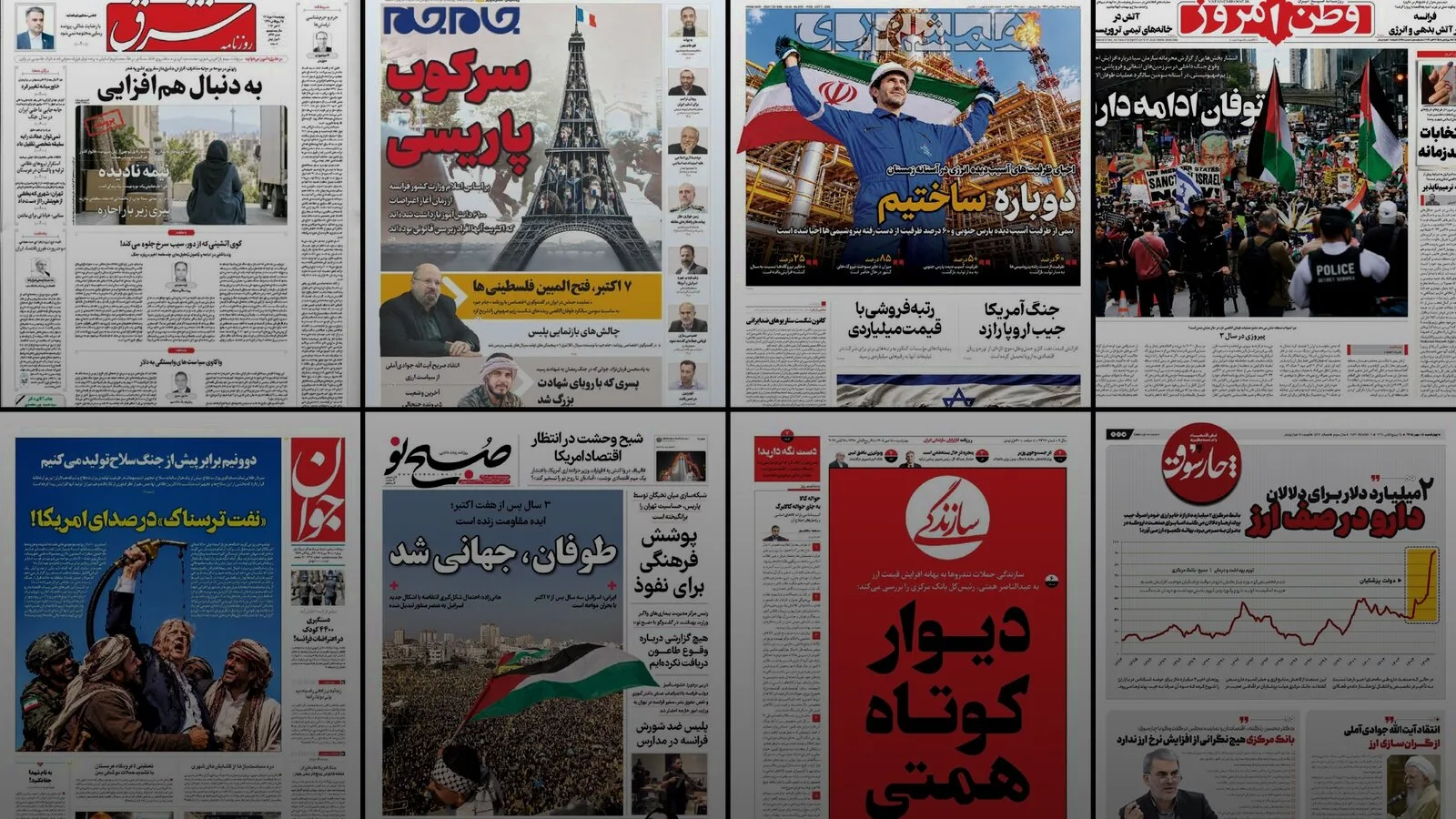
Bottom line: Four Iranian front pages marked the third anniversary of 7 October with claims of Israeli collapse sourced to a leaked American intelligence assessment and to Western polling rather than to any Iranian operation, while the state’s own English-language daily put a working Tehran-Doha mechanism on its cover, naming a joint task force, a technical team and three Iranian military pilots held in Qatar, directly beneath a headline reporting the president’s refusal to negotiate.
Executive Summary
The lead judgment of this edition is that the Iranian press commemorated an anniversary it did not own and published a negotiation it will not admit to. Four Persian covers gave their lead or a banner to the third anniversary of the Tufan al-Aqsa operation. Vatan-e Emrooz printed «توفان ادامه دارد», the storm continues, and sourced its deck not to any Iranian claim but to the publication of parts of a confidential CIA report on the rising likelihood of civil war in the occupied territories and the political collapse of the Zionist regime. Sobh-e No printed «طوفان، جهانی شد», the storm went global, and argued it from a Pew series showing 67 percent unfavourable views of Israel across 36 countries. Hamshahri printed «۷ اکتبر هنوز ادامه دارد» over a torn Israeli flag with the deck «دومینوی شکستهای تاریخی صهیونیستها». Jam-e Jam banded «۷ اکتبر، فتحالمبین فلسطینیها», giving the day the name of Iran’s own 1982 counter-offensive. Not one of the four claimed an Iranian action. The evidentiary base of the anniversary coverage is an American leak, a Western poll, a Palestinian crowd photograph and an analogy.
The second thread runs in the opposite direction and is the edition’s highest-significance finding. Iran Daily, the state’s English-language daily, Vol. 8232, led with «UN chief urges US, Iran to return to diplomacy» over the sub-deck «Pezeshkian says negotiations with Washington ‘meaningless’», and then boxed as its main story «Tehran, Doha to form joint task force to follow up on agreements: Momeni», with the deck «Iran to send technical team to Qatar for further talks on Iranian pilots», over a photograph of the Qatari Emir receiving Iran’s interior minister in Doha. Shargh led the Persian side of the same visit with «به دنبال همافزایی», in pursuit of synergy, under the kicker «رایزنی در دوحه در میانه مذاکرات», consultations in Doha in the middle of the negotiations. The independent record supplies what neither cover prints: Eskandar Momeni said he carried a message from President Pezeshkian and that the Emir conveyed the latest proposal, and the fate of three Iranian military pilots Tehran says Doha has held since the war was on the agenda. A refusal and a mechanism were published within two inches of each other.
The hardline estate’s domestic fire was turned on the parliament, not on the government, and it came from the Leader’s office. Kayhan’s «یادداشت روز», signed by Hossein Shariatmadari, is titled «مجلس هفتماه در رأس امور نبود!» and asks «مجلس در کجای مذاکرات حساس و سرنوشتساز اخیر حضور داشته است؟». It argues that appointing the speaker to head the negotiating team paralysed the chamber, and that the same office cannot both conduct a negotiation and supervise it. That is a named conflict-of-interest charge against Mohammad Baqer Qalibaf, published on the morning Sobh-e No reproduced Qalibaf’s own English-language Halloween economic meme on its front page under «شبح وحشت در انتظار اقتصاد امریکا». A speaker running foreign-facing messaging while the Leader-aligned daily questions his institutional standing is a factional datum, not a style note.
The deterrence material moved from rank to industry. Javan banded its masthead with «دو و نیم برابر پیش از جنگ سلاح تولید میکنیم», attributing to defence ministry spokesman Brigadier General Reza Talaei-Nik a claim of more than a thousand systems in production and output raised in line with «دکترین دفاعی تهاجمی», the offensive-defensive doctrine. The independent record confirms the speaker, the date and the figures as his. The pattern this file has tracked across three cycles holds: on 5 October Javan put NPT exit above its masthead as an unowned demand, on 6 October it rendered a general’s denial as a first-person nuclear-doctrine promise, and on 7 October it has taken a spokesman’s briefing and printed it in the first person plural with an offensive doctrine attached and no countervailing line.
Hamshahri published the only quantified picture of war damage on any Iranian cover in this file’s record, and the numbers cut against the paper’s own headline. Under «دوباره ساختیم», we have rebuilt it, the Tehran municipality daily printed four figures: 60 percent of lost petrochemical capacity back in production, 50 percent of South Pars’s damaged capacity back in production, power-plant fuel stocks at 85 percent and 25 percent above last year. A cover that says half of the country’s largest gas asset is still down is making an admission in the shape of a boast, and it sits on the same morning as Javan’s claim that weapons output is now two and a half times its pre-war level. The edition contains two incompatible accounts of Iranian industrial capacity, one from energy and one from defence.
The domestic economic argument became a direct, dated exchange between two titles on opposite flanks about one named official. Sazandegi gave its entire red cover to «دیوار کوتاه همتی», Hemmati’s low wall, examining what it calls the hardliners’ attacks on the central bank governor and arguing that «حمله به رئیسکل بانک مرکزی، آدرس غلط دادن است»: it personalises responsibility and reduces crises of foreign policy, oil sales and the budget to one man. Charsoogh, a principlist economic daily, printed «۲ میلیارد دلار برای دلالان / دارو در صف ارز», charging that the central bank spends two billion dollars of reserves into the pockets of the rich and the brokers while pleading a currency shortage for a pharmaceutical industry in crisis, and carried a member of parliament saying the bank has no concern at all about the rate. Sazandegi also teased «در جستوجوی وزیر», noting that the ministries that handle the war have been left without ministers, and «پنجره در حال بستهشدن است», flagged to the former Turkish president Abdullah Gul, whose argument is that the window for a deal narrows after the American midterms.
Net assessment: this is an anniversary edition with a back channel running underneath it, and the two halves have different audiences. The Persian covers were written for the domestic reader and gave him an adversary collapsing from within, argued from the adversary’s own documents. The English cover was written for Washington and Doha and gave them a task force, a technical team and three pilots. Lebanon returned to this file’s sources for the first time in six cycles, but only on a channel: Sobh-e No carried a run of statements by Hezbollah’s secretary-general Naim Qassem, and no cover took them. The Strait of Hormuz reached no front page for a second consecutive cycle and survives only in Kayhan’s channel, where closure is costed at an eighty percent rise in grain prices and presented as leverage rather than as a risk. What the Iranian reader got this morning was a three-year-old operation reframed as a strategic victory, a French police story, and an argument about who is to blame for the exchange rate. What the foreign reader got was a phone number in Doha.
Key Judgments
- KJ-1 [HIGH] KJ-1. The Iranian press commemorated the third anniversary of 7 October without claiming a single Iranian action, and built its case entirely out of adversary-origin material. The evidence is four covers and their sourcing. Vatan-e Emrooz led «توفان ادامه دارد» with a deck sourced to the publication of parts of a confidential CIA report on the rising likelihood of civil war in the occupied territories and the political collapse of the Zionist regime; the independent record identifies it as a CIA Red Cell assessment titled ‘Fracture From Within’, prepared in August and disclosed on 5-6 October by Drop Site News, and notes it was written against the background of an Israeli election set for 27 October. Sobh-e No led «طوفان، جهانی شد» and argued it from a 2026 Pew series, 67 percent unfavourable against 25 percent favourable across 36 countries. Hamshahri ran «۷ اکتبر هنوز ادامه دارد» over a torn Israeli flag with the deck «دومینوی شکستهای تاریخی صهیونیستها». Jam-e Jam banded «۷ اکتبر، فتحالمبین فلسطینیها» over an exclusive interview with the Hamas representative in Iran. The significance is that a press with nothing of its own to announce has learned to run an anniversary on the adversary’s own documents, which is cheaper, more durable and harder to refute than a battle-damage claim, and which indicates the commemorative cycle is a political argument about Israeli cohesion rather than an operational signal.
- KJ-2 [HIGH] KJ-2. The Tehran-Doha channel is a working mechanism with a named agenda, and the Iranian state published it for foreign readers while its president publicly denied the premise. This is the edition’s highest-significance finding. The evidence is one cover carrying both halves. Iran Daily, Vol. 8232, led «UN chief urges US, Iran to return to diplomacy» over the sub-deck «Pezeshkian says negotiations with Washington ‘meaningless’», and boxed as its main story «Tehran, Doha to form joint task force to follow up on agreements: Momeni» with the deck «Iran to send technical team to Qatar for further talks on Iranian pilots», over a photograph of the Qatari Emir receiving the Iranian interior minister in Doha. The independent record adds that Eskandar Momeni said he carried a message from President Pezeshkian and that the Emir conveyed the latest proposal, and that the fate of three Iranian military pilots Tehran says Doha has held since the war was on the agenda. Shargh carried the Persian half under «رایزنی در دوحه در میانه مذاکرات», consultations in Doha in the middle of the negotiations. No hardline or principlist title carried the visit at all. The significance is that a joint task force, a technical team and a prisoner file are process, and process is what a state builds when it expects to need a record; the public refusal is for the domestic audience and the mechanism is for everyone else.
- KJ-3 [HIGH] KJ-3. The daily published under the Supreme Leader’s office has opened a named institutional front against the speaker of parliament, and the vehicle is the negotiation itself. The evidence is Kayhan’s «یادداشت روز», signed by Hossein Shariatmadari and titled «مجلس هفتماه در رأس امور نبود!» (channel item 86104). It invokes Khomeini’s formula that parliament is «در رأس امور», asks «مجلس در کجای مذاکرات حساس و سرنوشتساز اخیر حضور داشته است؟», names the defence ministry vacancy among seven months of unresolved business, credits Mohammad Baqer Qalibaf’s record and then argues that appointing the speaker to head the negotiating team is what paralysed the chamber, because one office cannot both conduct a negotiation and supervise it. The independent record confirms Qalibaf has led the negotiating track during 2026, with a contested April episode in which he stepped down before continuing in a leading role; the editorial’s chronology is Kayhan’s and is flagged as such. The significance is twofold: the Leader’s office daily has conceded in print that destiny-shaping negotiations took place, and it has attached a conflict-of-interest charge to the single figure who has run both the chamber and the talks. On the same morning Sobh-e No reproduced Qalibaf’s own English-language economic meme approvingly on its front page.
- KJ-4 [MODERATE-HIGH] KJ-4. Javan has now converted attributed official language into institutional voice in three consecutive cycles, and today’s lever is an offensive doctrine attached to an industrial claim. The evidence is the banner «دو و نیم برابر پیش از جنگ سلاح تولید میکنیم», printed in the first person plural, with the deck attributing to «سردار طلایینیک، سخنگوی وزارت دفاع» more than a thousand systems, weapons, equipment and munitions in the ministry’s production network, upgraded and increased in line with «دکترین دفاعی تهاجمی», the offensive-defensive doctrine. The independent record confirms Brigadier General Reza Talaei-Nik as defence ministry spokesman, the press conference as 6 October, and both the 2.5-fold and thousand-systems figures as his. The countervailing evidence is that the underlying remarks are a deterrent formula about response to renewed aggression, not a declaration of intent, and that the production figures are unverifiable from open sources. The significance is in the technique rather than the numbers: on 5 October this title put NPT exit above its masthead as a demand belonging to no one, on 6 October it printed a general’s denial as a first-person nuclear-doctrine promise, and today it prints a spokesman’s briefing as a first-person industrial commitment with an offensive doctrine named. The discriminating test is whether «دکترین دفاعی تهاجمی» is repeated verbatim by a second title or by any named office.
- KJ-5 [MODERATE-HIGH] KJ-5. The most informative Iranian claim of the morning is an admission: half of South Pars remains out of production eight months into the war, published as good news. The evidence is Hamshahri’s cover under «دوباره ساختیم», with four unsourced figure boxes: 60 percent of lost petrochemical capacity returned to production, 50 percent of South Pars’s damaged capacity returned to production, power-plant fuel stocks at 85 percent and 25 percent above last year, under the deck «احیای ظرفیتهای آسیبدیده انرژی در آستانه زمستان». No other Iranian front page in this file’s record has quantified war damage. The significance is that the municipality daily has put a number on the degradation of the country’s largest gas asset and on its incomplete recovery at the start of the heating season, and that this sits on the same morning as Javan’s claim of weapons output at two and a half times pre-war levels. Where a system publishes a shortfall it has not been forced to publish, the shortfall is usually the more reliable figure. Track the 85 percent power-plant stock number through the winter.
- KJ-6 [MODERATE-HIGH] KJ-6. Negative evidence, filed as a finding: Lebanon re-entered this file’s sources after five empty cycles and was still not promoted to any front page, which removes the propagation-lag explanation for its absence. The evidence is a channel run and a complete print silence. Sobh-e No’s own channel carried a sequence of statements by Hezbollah’s secretary-general Naim Qassem, speaking at the launch of an institution dedicated to Hassan Nasrallah’s legacy: that Israel will not be able to remain in southern Lebanon, that any solution must begin with an Israeli and American departure, and that the group is ready to discuss restricting weapons under Lebanese law but will not trade concessions for a withdrawal. Across ten covers there is no Lebanon item of any kind. The Guard Corps anniversary statement, by contrast, lists Lebanon among the unified fronts. The significance is that the statement’s geography and the press’s geography have come apart: the system claims an axis that includes Lebanon while its print surface will not carry Lebanese political content even when its own channels have it. Six consecutive print cycles is past the point where a deadline artefact accounts for it.
- KJ-7 [MODERATE-HIGH] KJ-7. A correction carried from the previous edition: the American force movement that three Iranian covers called flight on 6 October is, on the independent record, a rotation accompanied by reinforcement. The evidence is the open record of carrier movements. One carrier left the region for a port call after an extended deployment at sea, and at the start of October a third carrier strike group sailed for the Central Command area with an amphibious ready group, in what the open reporting describes as the largest American carrier concentration in the region since 2003, with arrival expected by late November. On 6 October Etemad published the American departure from Iraq as «فرار از تیررس», escape from the line of fire, Vatan-e Emrooz published bombers out of Fairford as «فرار جنگندهها», and this file recorded the uniform vocabulary without correcting the underlying read. Etemad’s channel today carried an American carrier strike group and a destroyer departing West Asia. The significance is a calibration one: the Iranian press is reading individual unit movements as strategic withdrawal, and a file that repeats that read inherits the error. Treat Iranian reporting of American repositioning as a sentiment indicator, not as an order-of-battle source.
- KJ-8 [MODERATE] KJ-8. Negative evidence, filed as a finding: the Leader published nothing for a fourth consecutive cycle, and this edition cannot fully exclude a retrieval failure. The evidence is the absence across ten front pages of 15 Mehr of any message, speech, photograph, citation or signature of the Leader, and the fact that on the morning of the Tufan al-Aqsa anniversary the message the system actually published was a Guard Corps statement, carried by Defa Press, Vatan-e Emrooz and Iran. The limitation is that khamenei.ir could not be reached at the time of compilation, so the finding rests on the covers and the channels rather than on the official record; it is reported as four cycles of print silence rather than four cycles of confirmed silence. The significance is institutional. In a system where the Leader’s message is normally the organising text of a commemorative cycle, the Guard Corps supplied it instead, and Kayhan’s editorial spent the same morning arguing that another constitutional organ has been absent for seven months. Two of the system’s pillars are being publicly described as not in the room.
- KJ-9 [MODERATE] KJ-9. The Strait of Hormuz has been removed from the shop window and is being costed on the wire as leverage rather than argued as a risk. The evidence is a second consecutive cycle of complete front-page silence set against Kayhan’s channel. That channel carried the Saudi Aramco chief executive putting the real oil price at 140 dollars with 200 possible, the paper’s own analysis tying the figure to the chokepoint and to three billion barrels lost since the war began, its rendering of a US presidential claim as «یاوهگویی ترامپ: تنگه هرمز به آمریکا تعلق دارد», and «عواقب بستن هرمز: انتظار افزایش ۸۰ درصدی قیمت غلات», an expected eighty percent rise in grain prices. The Guard Corps statement separately cites Iranian control of the strait as a source of adversary difficulty, and the UN Secretary-General’s 6 October appeal explicitly asked for navigational rights and freedoms to be fully restored. The significance is the direction of the argument: a grain-price consequence published by the Leader’s office daily without any line cautioning against closure is an inventory of what Iran can impose, and it is being kept out of print where it would be read as a threat and kept in channel where it reads as analysis.
- KJ-10 [MODERATE] KJ-10. The reformist estate is publishing a deadline, and it dates the deadline to the American midterms. The evidence is Sazandegi’s cover and its teasers. The cover, «دیوار کوتاه همتی», relocates the currency crisis from the central bank’s competence to sanctions and blocked assets, arguing that the governor «نمیتواند… تحریمهای بانکی را بردارد و داراییهای ایران را آزاد کند» and that attacking him personalises what is a foreign-policy problem. The page-three teaser, «پنجره در حال بستهشدن است», is flagged to Abdullah Gul, the former president of Turkey, whose argument on the independent record is that the window narrows after November because the American administration’s urgency drops, and that Iran should avoid a maximalist position. The page-two teaser, «در جستوجوی وزیر», notes that the ministries which handle the war have been left without ministers. The significance is that a governing-party-adjacent organ is making the case for a settlement in economic rather than diplomatic language, on a clock, and is doing so in the same cycle in which the Doha mechanism surfaced in print.
- KJ-11 [MODERATE] KJ-11. Two state-aligned titles published detention figures for the French protests that differ by a factor of seven, which is the first measurable intra-estate factual divergence in this file’s record. The evidence is two covers of the same morning. Jam-e Jam gave its entire front page to «سرکوب پاریسی» and attributed its figure to the French interior ministry: 600 school students detained at the start of the protests, a majority of them minors. Javan printed «دستگیری ۴۴۰۰ کودک در اعتراضات فرانسه!». Sobh-e No reported the French ambassador summoned to the Iranian foreign ministry over the treatment of student protests and separately framed French cultural networking among Iranian elites as an infiltration vector under «پوشش فرهنگی برای نفوذ»; Jam-e Jam’s channel carried 715 police and 215 students injured. The significance is diagnostic rather than substantive: a campaign in which the attributed, sourced figure and the unattributed, larger figure run side by side on the same morning indicates amplification outpacing verification, and it gives a usable test of which Iranian titles are checking numbers before printing them.
- KJ-12 [MODERATE] KJ-12. Iran put a named Gulf host state on notice in print for the first time in this file’s record, and the warning is specific about airspace and bases. The evidence is Jomhouri Eslami’s item «هشدار ایران به بحرین درباره استفاده از خاک این کشور علیه تهران», whose body text frames Bahrain as having placed its territory and airspace at America’s disposal for what it calls an unlawful war against Iran, and sets out two paths for Manama, the first being to confirm regional security through cooperation with its neighbours. On 6 October the equivalent warning was addressed to «کشورهای میزبان آمریکا و سازمانهای بینالمللی», host states and international organisations, as a class. The significance is the move from class to name: a general deterrent statement that acquires a specific addressee is the step at which host-state warnings become actionable intelligence for the states concerned. The same cover carries, from unnamed Egyptian military figures, the most absolute eliminationist formulation in the batch, «چیزی به نام «اسرائیل» باقی نخواهد ماند»; it is single-source, carries no named speaker and no occasion, and is documented here for defensive assessment only.
Macro Trends
- Four covers marked the 7 October anniversary and none of them claimed an Iranian action.. Vatan-e Emrooz led with «توفان ادامه دارد» and sourced its deck to the publication of parts of a confidential CIA report on civil war and political collapse in Israel; the independent record identifies that document as a CIA Red Cell assessment titled ‘Fracture From Within’, prepared in August and first disclosed on 5-6 October by Drop Site News, none of which the cover prints. Sobh-e No led with «طوفان، جهانی شد» and argued it from a Pew series: 67 percent unfavourable views of Israel across 36 countries against 25 percent favourable. Hamshahri ran «۷ اکتبر هنوز ادامه دارد» over a torn Israeli flag. Jam-e Jam banded «۷ اکتبر، فتحالمبین فلسطینیها» over an exclusive interview with the Hamas representative in Iran, which files the operation as the opening of a liberation campaign on the model of Iran’s own 1982 recovery of Khorramshahr. Four titles across three estates choosing the same frame on the same morning indicates centrally guided message discipline rather than organic editorial convergence; what the uniformity cannot supply is an Iranian claim, and none was made.
- The negotiation returned to print on the English cover and on the reformist cover, and nowhere else.. Iran Daily boxed «Tehran, Doha to form joint task force to follow up on agreements: Momeni» with the deck «Iran to send technical team to Qatar for further talks on Iranian pilots», under a lead reporting the UN Secretary-General’s call to return to diplomacy and the president’s description of talks as meaningless. Shargh led «به دنبال همافزایی» under the kicker «رایزنی در دوحه در میانه مذاکرات». No principlist or hardline title carried the Doha visit at all. The distribution is the finding: a government that wants a settlement without owning one publishes the mechanism where foreign governments read and omits it where its own base reads. The discriminating test is whether any principlist title names the joint task force in the next cycle.
- The Leader’s office daily opened a conflict-of-interest front against the speaker.. Kayhan’s «یادداشت روز», signed Hossein Shariatmadari, is titled «مجلس هفتماه در رأس امور نبود!» and argues that appointing Mohammad Baqer Qalibaf to head the negotiating team paralysed the chamber he leads, because the same office cannot conduct a negotiation and supervise it. The editorial concedes the negotiations exist in the act of complaining about them, asking «مجلس در کجای مذاکرات حساس و سرنوشتساز اخیر حضور داشته است؟». The independent record confirms Qalibaf has led the negotiating track during 2026 and also records a contested April episode in which he stepped down before continuing in a leading role; the chronology is Kayhan’s, the institutional charge is the signal. It lands on the same morning Sobh-e No reproduces Qalibaf’s own English-language economic meme approvingly on its front page.
- Javan rotated the escalation lever for a third consecutive cycle, this time onto industrial capacity and an offensive doctrine.. The banner reads «دو و نیم برابر پیش از جنگ سلاح تولید میکنیم», attributed to defence ministry spokesman Brigadier General Reza Talaei-Nik, with more than a thousand systems in the ministry’s production network and output raised in line with «دکترین دفاعی تهاجمی». The independent record confirms the speaker, the 6 October press conference and both figures. The pattern is the point: NPT exit as an unowned demand on 5 October, a general’s denial printed as a first-person nuclear-doctrine promise on 6 October, a spokesman’s briefing printed in the first person plural with an offensive doctrine attached on 7 October. One title is doing the work of making attributed official language sound institutional, and the lever changes while the technique does not.
- Two covers published incompatible accounts of Iranian industrial capacity on the same morning.. Hamshahri’s «دوباره ساختیم» quantifies the war damage in four figures: 60 percent of lost petrochemical capacity recovered, 50 percent of South Pars’s damaged capacity recovered, power-plant fuel stocks at 85 percent and up 25 percent year on year. Javan’s banner claims weapons production at two and a half times its pre-war level. The energy sector is publishing a half-recovered asset base as good news on the threshold of winter; the defence sector is publishing an output multiple. Both cannot be a general description of the Iranian industrial position eight months into the war, and the one with named figures and a visible shortfall is the more informative. Track whether the 85 percent power-plant stock figure is repeated or revised as the heating season begins.
- The currency argument became a dated exchange between a reformist party organ and a principlist economic daily about one named official.. Sazandegi gave its whole cover to «دیوار کوتاه همتی», defending the central bank governor Abdolnaser Hemmati and arguing that attacking him «آدرس غلط دادن است», gives a false address, because it personalises responsibility and reduces crises of foreign policy, oil sales and the budget to one man, when the bank cannot lift banking sanctions or free Iran’s assets. Charsoogh printed «۲ میلیارد دلار برای دلالان / دارو در صف ارز» and carried the MP Mohsen Zanganeh saying the bank has no concern at all about the rate. The relocation Sazandegi performs is the analytically interesting half: moving the currency crisis from monetary management to sanctions and blocked assets makes a negotiated settlement the only available remedy, which is the same conclusion its «پنجره در حال بستهشدن است» teaser reaches by way of the American midterm calendar.
- France became the preferred vehicle for reciprocal human-rights pressure, and the estate could not agree on a number.. Jam-e Jam gave its entire cover to «سرکوب پاریسی» with an Eiffel Tower built from detained students, citing the French interior ministry for 600 school students detained at the start of the protests, a majority of them minors. Javan printed «دستگیری ۴۴۰۰ کودک در اعتراضات فرانسه!» on the same morning. Sobh-e No reported the French ambassador summoned to the foreign ministry over the treatment of student protests, and separately ran «پوشش فرهنگی برای نفوذ», treating French cultural networking among Iranian elites as an infiltration problem. Jam-e Jam’s channel carried 715 police and 215 students injured. A factor-of-seven divergence between two state-aligned titles on a single detention figure is the first measurable intra-estate factual divergence this file has recorded, and it indicates the France file is being amplified faster than it is being checked.
- Yemen escalated against Saudi Arabia on the wires again, and the covers took only the consequence, not the event.. Across the overnight channels the Yemeni armed forces claimed ballistic and drone strikes on Riyadh’s King Khalid International and on Abha, the downing of a Chinese-made CH-4 drone, the failure of a Saudi push toward Bab al-Mandab and the killing of a Saudi-aligned brigade commander; Defa Press reported flight stoppages at King Khalid and at Dammam’s King Fahd and images of a fire at an Aramco facility at Rabigh. Javan’s cover took only the summary, «تعطیلی ۵ فرودگاه عربستان با تشدید حملات موشکی یمن»; Kayhan’s front-page list took the spokesman’s drone claim. These are claims by a belligerent: Saudi authorities confirmed no strike on the Riyadh airport, and flight-tracking showed Riyadh traffic held for several hours rather than the airport disabled. The pattern of covers taking the effect and leaving the operation on the wire is now three cycles old.
- Lebanon reappeared in this file’s sources after five empty cycles, and still reached no front page.. Sobh-e No’s channel carried a run of statements by Hezbollah’s secretary-general Naim Qassem, speaking at the launch of an institution for Hassan Nasrallah’s legacy and arguing that Israel cannot remain in southern Lebanon, that a solution must begin with an Israeli and American departure, and that the group would discuss restricting weapons under Lebanese law but would not trade concessions for a withdrawal. Not one of the ten covers carried a Lebanon item of any kind. The reappearance matters because it removes the propagation-lag explanation: the material reached an Iranian principlist outlet’s own channel and was not promoted to print. Negative evidence, filed as a finding: the Iranian press is carrying the northern front at wire level only, for a sixth consecutive cycle in print.
- The Strait of Hormuz stayed off the covers for a second cycle and is being costed, on the wire, as leverage.. No front page in the batch carries a Hormuz item. Kayhan’s channel carries three: the Saudi Aramco chief executive putting the real oil price at 140 dollars with 200 possible, the paper’s own treatment tying that to the chokepoint and to three billion barrels lost since the war began, «یاوهگویی ترامپ: تنگه هرمز به آمریکا تعلق دارد», and «عواقب بستن هرمز: انتظار افزایش ۸۰ درصدی قیمت غلات». The Guard Corps anniversary statement separately refers to Iranian control of the strait as a source of the adversary’s difficulty. A grain-price figure printed by the Leader’s office daily as a consequence of closure, without a line arguing against closure, is leverage accounting, not risk reporting. The chokepoint has not left the Iranian argument; it has left the shop window.
Front-Page Snapshot
- Vatan-e Emrooz - “The Storm continues” (Hardline principlist) - A leaked CIA assessment of Israeli civil war and political collapse published as the anniversary lead; «پیروزی در سال ۳», victory in year three; an irreparable-blow column asking why Israel cannot return to its pre-7 October condition [HIGH]
- Sobh-e No - “The Storm went global” (Principlist) - Three years after 7 October, the idea of resistance argued from a Pew series on global opinion of Israel; the speaker’s English-language economic meme aimed at the American reader; the French ambassador summoned [MODERATE-HIGH]
- Hamshahri - “We have rebuilt it” (Tehran municipality, centrist) - The only quantified war-damage recovery figures on any Iranian cover, with half of South Pars still down; «۷ اکتبر هنوز ادامه دارد» over a torn Israeli flag; America’s war charged to Europe’s pocket [MODERATE]
- Jam-e Jam - “Parisian repression” (State broadcaster daily (IRIB)) - Six hundred French schoolchildren detained, sourced to the French interior ministry; 7 October banded as the Palestinians’ Fath al-Mobin in an exclusive interview with the Hamas representative in Iran [MODERATE-HIGH]
- Javan - “‘Scary oil’ in America’s own voice!” (Hardline, IRGC-affiliated) - Weapons output at two and a half times pre-war levels under an offensive-defensive doctrine, banded above the masthead; five Saudi airports reported shut; 4,400 children claimed arrested in France [HIGH]
- Kayhan - “Parliament was not at the helm of affairs for seven months!” (Hardline, published under the Supreme Leader’s office) - A named conflict-of-interest charge against the speaker for heading the negotiating team; Hormuz closure costed at an eighty percent grain-price rise; Aramco’s chief executive on a 140 dollar real oil price [HIGH]
- Iran Daily - “UN chief urges US, Iran to return to diplomacy” (English-language state daily (IRNA)) - A Tehran-Doha joint task force, a technical team and three Iranian military pilots, boxed directly beneath the president’s description of negotiations as meaningless [MODERATE]
- Shargh - “In pursuit of synergy” (Reformist daily of record) - The interior minister’s Doha trip led as consultations «in the middle of the negotiations»; the Middle East filed as changed three years after 7 October [LOW-MODERATE]
- Jomhouri Eslami - “A new wave of Afghans entering Iran: a silent plot or institutional dereliction!” (Traditional clerical establishment) - The eastern border led and editorialised as the Taliban’s silent war; Bahrain warned by name over its airspace and bases; an unattributed eliminationist formulation carried from Egyptian officers [HIGH]
- Sazandegi - “Hemmati’s low wall” (Reformist, Executives of Construction party) - The central bank governor defended by name against the hardliners; the war ministries reported left without ministers; a closing-window warning flagged to Turkey’s former president [LOW-MODERATE]
- Charsoogh - “Two billion dollars for the brokers / Medicine in the currency queue” (Economic daily, principlist line) - Currency reserves charged to brokers while the pharmaceutical industry is told there is none; an MP saying the central bank has no concern about the rate; a senior cleric’s criticism of currency policy [LOW-MODERATE]
Full report
The complete edition - per-paper front-page analysis and full translation appendices - is available as a PDF: Download the full report.
Compiled from Iranian front pages and outlet channels via open-source monitoring. Translations are editorial; named-figure attributions are verified against the source pages where possible.