Iranian Press Monitor - Tuesday, 6 October 2026 (Day 217)
Tuesday, 6 October 2026 · سهشنبه ۱۴ مهر ۱۴۰۵ · 24 Rabi’ al-Thani 1448 - Nine Persian front pages and one English front page of 14 Mehr 1405, read alongside six outlet channels and three agency wires; Kayhan is reconstructed from its own channel, and Tehran Times was unavailable at the time of compilation.
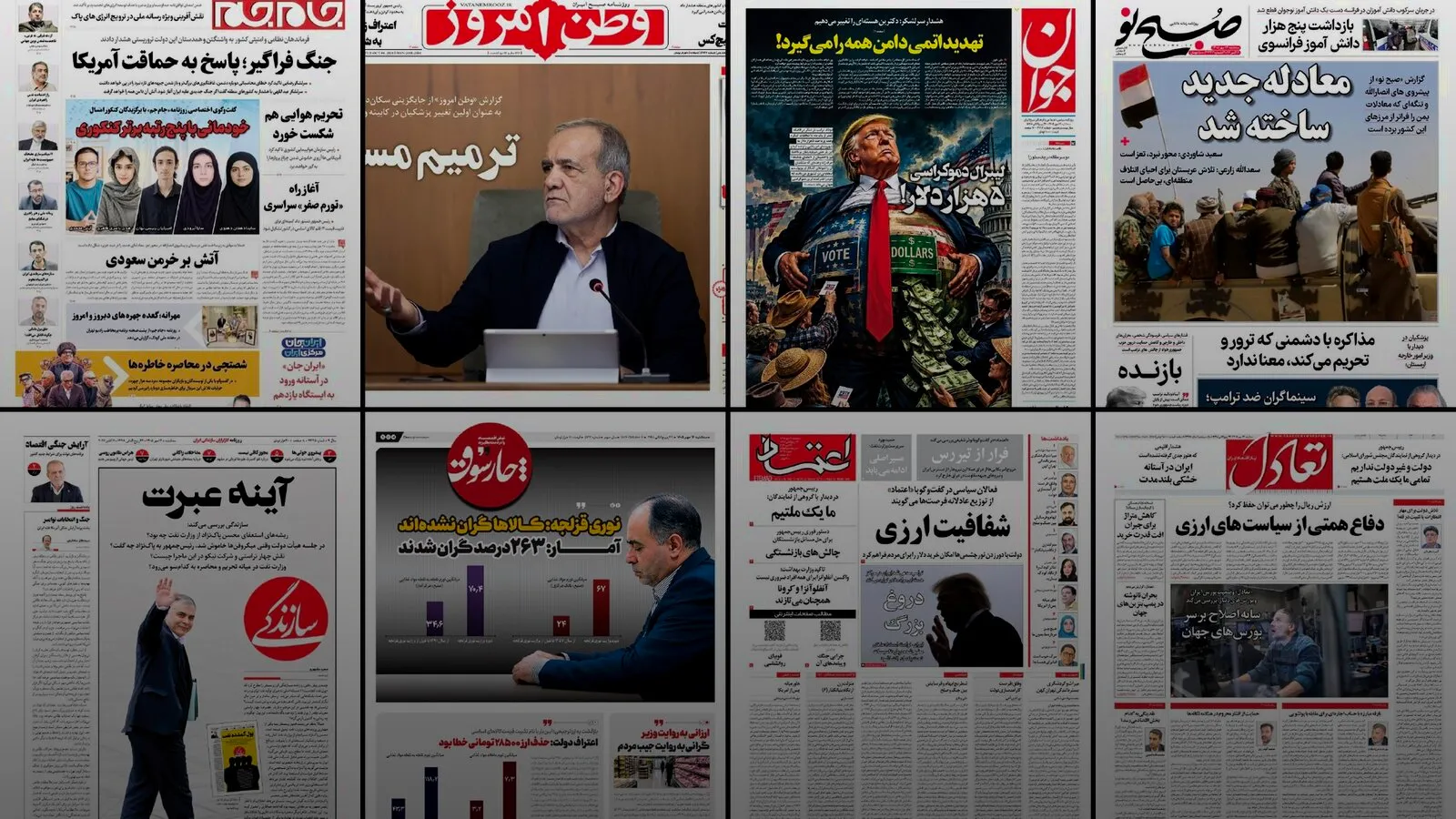
Bottom line: On a morning when five Iranian covers across every faction published Donald Trump as a president running out of time before the November midterms, the Chief of the General Staff told the states that host American forces that Iran has not been and is not waiting for that result, and the Guard-affiliated daily rendered his remarks as a first-person promise to change the nuclear doctrine.
Executive Summary
The lead judgment of this edition is that the Iranian press published two incompatible clocks on one morning and did not reconcile them. The first clock is American and electoral. Sobh-e No printed a monochrome Trump under «بازنده», loser, with a deck listing political pressure, personal exhaustion, domestic and foreign crises and declining support inside his own party. Vatan-e Emrooz printed «اعتراف زودهنگام به شکست», an early confession of defeat, charging that falling popularity has driven him to restrict voters and allege fraud. Javan gave its entire cover to a painted Trump straddling a ballot box and a crate of dollars under «لیبرال دموکراسی ۵ هزار دلار!», liberal democracy at five thousand dollars, with a deck noting that the promise was revived less than a month before the congressional elections. Kayhan’s front-page list carries «تقلاهای ترامپ برای جلوگیری از شکست در انتخابات», Trump’s struggles to avert electoral defeat. Sazandegi’s note of the day is titled «جنگ و انتخابات نوامبر», the war and the November elections. Hardline, principlist and reformist titles have reached the same conclusion about the same man in the same week, which is the widest cross-factional agreement on a single foreign figure this file has logged since the Farhadi convergence of 5 October.
The second clock is Iranian and explicitly refuses the first. Major General Ali Abdollahi, Chief of the General Staff of the Armed Forces, said on 5 October that if a new war against Iran begins its fire will engulf everyone, that the main cause of the region’s insecurity is the presence of American forces, and, in the formulation Iranian outlets carried verbatim, that the Islamic Republic has not been and is not waiting for the results of the American congressional elections. Four Persian covers carried the warning: Jam-e Jam gave it the banner «جنگ فراگیر؛ پاسخ به حماقت آمریکا», all-out war, the answer to America’s folly, with both named generals in sequence; Vatan-e Emrooz headlined it «امنیت همه یا هیچکس», security for all or no one; Jomhouri Eslami printed the widest and most accurate addressee set, «کشورهای میزبان آمریکا و سازمانهای بینالمللی», the states hosting America and international organisations; and Iran Daily, the English-language title almost no Iranian reads, gave it the full width of the page. That asymmetry is the inference mechanism rather than the conclusion: a deterrent message is placed where the deterred party will see it, and the livelihood message is placed where the governed will.
The edition’s highest-significance item is Javan’s banner. On 5 October this file recorded that the same paper had put withdrawal from the Non-Proliferation Treaty above its own masthead as a demand belonging to unnamed elites, with the decision assigned to unnamed competent bodies, and judged that the construction kept an escalation option visible at zero political cost. Today the paper prints «هشدار سرلشکر: دکترین هستهای را تغییر میدهیم», a Major General’s warning, we will change the nuclear doctrine, in the first person plural and under a uniformed rank. The independent record of the same remarks runs in the opposite direction: Abdollahi rejected as delusion the claim that Iran’s programme has entered a military phase and warned the Atomic Energy Agency against statements about Iranian nuclear sites. Javan has converted a denial into a threat on its own front page. Both halves of that are the finding, and this file reports the divergence rather than choosing between the two renderings.
Three titles from three estates published American repositioning on one morning, and none of them presented it as good news. Etemad, reformist, boxed an interview with the international-relations specialist Nozar Shafiei under «فرار از تیررس», escape from the line of fire, arguing that the American departure from Iraq has in practice taken those forces out of reach of Iran and of the resistance front’s forces there. Vatan-e Emrooz, hardline, reported that the United States has withdrawn its strategic bombers from Fairford in Britain, under «فرار جنگندهها», the flight of the war aircraft. Jomhouri Eslami, clerical establishment, led its banner with the first Iranian aircraft landing at Najaf after the lifting of restrictions. A withdrawal, a redeployment and a reopening, published as flight, flight and vindication. The Chief of the General Staff addressed his warning to the states that still host American forces, which is the same subject handled from the other end.
The domestic story reversed in one cycle. On 5 October this file recorded that an oil minister had resigned in the eighth month of a war about oil and that no cover had converted it into an indictment, and rated the restraint as sequencing rather than retreat. Today two covers from opposite estates have taken the weapon off the ground and used it in opposite directions. Vatan-e Emrooz leads with «ترمیم مسعود», Masoud’s repair, making the resignation the president’s first cabinet change and his problem. Sazandegi gives its whole cover to «آینه عبرت», a cautionary mirror, and prints four specific questions about the roots of Mohsen Paknejad’s departure, including what the president said to him in cabinet once the microphones were off. Jomhouri Eslami closes the file with the presidential decree appointing Hamid Bovard caretaker of the ministry, and adds, in a column almost nobody else carried, that the nominee sent to parliament for the Defence Ministry is a career manager whose record includes running the Aerospace Industries Organisation, the body that builds Iran’s missiles.
The economic argument split inside the principlist estate rather than between estates. Jam-e Jam reported the president ordering a committee to fix the price of twelve basic goods nationally, under «آغاز راه «تورم صفر» سراسری»; Kayhan’s lead analysis named the opponents of the Tehran municipality’s zero-inflation scheme as brokers, hoarders and America’s intellectual servants in a single list, and sourced a seven-member government committee on the president’s direct instruction to the municipality’s own spokesman; Vatan-e Emrooz carried the same scheme as «پاتک به تورم», a counterattack on inflation. Against all three, Charsoogh, a principlist economic daily, printed the agriculture minister saying goods have not become more expensive beside two official inflation series that contradict him, and then put the technical objection on the record: that the scheme is the preferential exchange rate returning under a new name, after a government confession that removing the 28,500-toman rate was a mistake. The two economic dailies also split on one official, with Charsoogh drawing the central bank governor fleeing reporters and Ta’adol printing him defending the currency policy.
Net assessment: this is a deterrence edition with a domestic argument running underneath it, and it is notably thin where the previous edition was thick. The negotiation that occupied four covers on 5 October survives today in a single line, the president telling an Armenian visitor that negotiating with an enemy that assassinates and sanctions is meaningless. The Strait of Hormuz, argued across three covers yesterday, appears on no cover at all today, on the morning a projectile struck a tanker in it and started a fire. Israel reaches the Persian press only as a European petition about settlements. Lebanon reaches it not at all, for the fifth consecutive cycle. What the Iranian reader got this morning instead was a general officer promising that any new war becomes everyone’s war, a cartoon of an American president buying votes, and an argument about the price of bread. That combination is what a government publishes when it wants its public braced rather than mobilised, and it is not what a government publishes on the morning it expects to sign something.
Key Judgments
- KJ-1 [HIGH] The Iranian press and the Iranian armed forces published two incompatible timetables on the same morning, and neither reconciled them. The evidence is five covers against one statement. Sobh-e No printed Trump as «بازنده», loser, with a deck itemising political pressure, personal exhaustion and declining Republican support; Vatan-e Emrooz printed «اعتراف زودهنگام به شکست» and charged voter restriction and fraud allegations; Javan gave its entire cover to «لیبرال دموکراسی ۵ هزار دلار!» with the payment promise dated to less than a month before the congressional elections; Kayhan’s front-page list carried «تقلاهای ترامپ برای جلوگیری از شکست در انتخابات»; Sazandegi’s note of the day, by the former envoy Seyed Jalal Sadatian, is titled «جنگ و انتخابات نوامبر». Against that, Major General Ali Abdollahi, Chief of the General Staff, is recorded on 5 October saying the Islamic Republic has not been and is not waiting for the results of the American congressional elections. The significance is that a press which has spent the week telling its readers the war is on an American electoral clock has been publicly contradicted by the officer who would have to fight the next round, and the contradiction was printed rather than edited out. Confidence is high on the documentary fact of both positions; it is not extended to any judgment about which one reflects Iranian planning, and reading the convergence as instructed would overstate it, since an argument about Trump’s weakness requires no instruction to be popular across Iranian newsrooms.
- KJ-2 [HIGH] The nuclear escalation lever, floated on 5 October with no owner, was published today under a uniformed rank and in the first person, and this is the edition’s highest-significance finding. The evidence is Javan’s banner, set above its cover art: «هشدار سرلشکر: دکترین هستهای را تغییر میدهیم», a Major General’s warning, we will change the nuclear doctrine, with a page-two referral, over the headline «تهدید اتمی دامن همه را میگیرد!». Yesterday the same paper printed «نخبگان خروج از NPT را میخواهند» with the demand assigned to unnamed elites and the decision to unnamed competent bodies, and this file judged that the construction kept the option visible at zero political cost. The countervailing evidence is the independent record of the same 5 October remarks, in which Abdollahi rejected as delusion the claim that Iran’s nuclear programme has entered a military phase and warned the International Atomic Energy Agency against statements about Iranian nuclear facilities. The significance is in the mechanism rather than the content: the Guard-affiliated daily has converted its commander’s denial into a first-person threat on its own front page, which is how an escalation option is kept alive in print after the official line has disowned it. Confidence is high on the publication and on the divergence, and none is placed in the doctrine-change claim itself. The discriminating test is whether a second title or a named office repeats the formulation inside a week.
- KJ-3 [HIGH] The warning that any new war becomes a regional war was issued by name, carried by four Persian covers and given the full page width of the English-language daily, which identifies the intended audience as foreign rather than domestic. The evidence is the distribution. Iran Daily, Vol. 8231, led with «Top commander warns new war will ‘engulf everyone in its flames’ in region» across the full page. Jam-e Jam banded both named generals under «جنگ فراگیر؛ پاسخ به حماقت آمریکا» and printed Abdollahi’s sentence in full. Vatan-e Emrooz headlined «امنیت همه یا هیچکس» over the Chief of the General Staff’s warning to America and the regional states. Jomhouri Eslami printed the widest addressee set, «کشورهای میزبان آمریکا و سازمانهای بینالمللی», the states hosting America and international organisations, which matches the independent record in which the remarks also carried a warning to the Atomic Energy Agency. The significance is that the only title that made the warning its lead is the one printed in English for embassies and foreign newsrooms, while every Persian title led on something domestic and carried the warning in a rail or a band. That is message targeting, not editorial coincidence. Confidence is high: the asymmetry is documentary and is visible in the page architecture itself.
- KJ-4 [MODERATE-HIGH] Three titles from three estates published American force repositioning on one morning, and the reformist version of it is a complaint about lost reach rather than a report of de-escalation. The evidence is three covers. Etemad boxed an interview with the international-relations specialist Nozar Shafiei under «فرار از تیررس», escape from the line of fire, with the deck «خروج آمریکاییها از عراق عملاً این نیروها را از دسترس ایران و نیروهای جبهه مقاومت در عراق خارج کرد», the Americans’ departure from Iraq has in practice taken those forces out of reach of Iran and of the resistance front’s forces in Iraq. Vatan-e Emrooz’s rail reported «آمریکا بمبافکنهای راهبردی خود را از فرفورد انگلیس خارج کرد» under «فرار جنگندهها». Jomhouri Eslami led with the first Iranian aircraft landing at Najaf after restrictions were lifted. The significance is twofold: three estates reached for the same word, فرار, flight, to describe adversary movement they cannot claim credit for, and the one analytic treatment in the batch frames an American withdrawal as a reduction in Iranian leverage, on the same morning the Chief of the General Staff addressed his warning to the states that still host American forces. Confidence is moderate-high on the convergence, which is documentary, and none is placed in the Fairford report, which no other title in the batch carries.
- KJ-5 [MODERATE-HIGH] Negative evidence, filed as a finding: the Leader published nothing for a third consecutive cycle, and the only Leader content on any cover is a hardline daily’s exegesis of a nine-day-old message. The evidence is the absence across ten front pages of 14 Mehr, and its single exception. Vatan-e Emrooz carries a boxed special, «خوانشی از پیام اخیر رهبر انقلاب به مناسبت هفته دفاع مقدس», a reading of the Leader’s recent Sacred Defence Week message, under «از «ایامالله» تا افق پیروزی». The message it reads was issued on 6 Mehr 1405, nine days before this edition. No other cover carries a message, a photograph, a citation or a signature, and Kayhan’s channel carried only a commemorative reposting of an image of «حضرت آیتالله سیدمجتبی خامنهای» from a sermon of 13 Mehr 1403. The significance is specific: a Chief of the General Staff has spent the week issuing war warnings that four covers carried, a nuclear-doctrine line has been printed in the first person on a Guard-affiliated daily, and the office that would have to endorse either has said nothing in public that any Iranian newspaper reader saw this morning. Confidence is moderate-high on the absence, which is documentary across three cycles, and no inference is drawn about the Leader’s own position or condition, which this batch does not support.
- KJ-6 [MODERATE-HIGH] The oil minister’s resignation was converted into an indictment by both estates in the cycle immediately after this file judged it had been left alone, and the revision is explicit. The evidence is two covers and a decree. Vatan-e Emrooz leads with «ترمیم مسعود», Masoud’s repair, over the deck «گزارش «وطن امروز» از جایگزینی سکاندار وزارت نفت به عنوان اولین تغییر پزشکیان در کابینه و پیامهای آن». Sazandegi gives its full cover to «آینه عبرت» and prints four questions, naming Mohsen Paknejad, an exchange in cabinet after the microphones were switched off, and the role of the Niko trading company. Jomhouri Eslami prints the presidential decree appointing Hamid Bovard caretaker of the ministry. On 5 October this file recorded that every title had handled the resignation as administration and rated the restraint as sequencing rather than retreat. The significance is that an administrative fact usable by only one faction is a factional weapon, while one usable by both is a sign that executive protection has lapsed. Confidence is moderate-high; the revision is explicit, and the alternative reading, that two editors independently found the same story newsworthy a day late, is live and would not change the conclusion much.
- KJ-7 [MODERATE-HIGH] The nominee sent to parliament for the Defence Ministry is a former managing director of the missile-industry organisation, and exactly one Iranian cover carried it. The evidence is Jomhouri Eslami’s left column, «وزیر پیشنهادی وزارت دفاع معرفی شد», with the note that the nominee is a long-serving Defence Ministry manager whose record includes the managing directorship of the Aerospace Industries Organisation. The independent record names him as Mehrdad Akhlaghi Ketabchi, submitted by the president under Article 133, and notes that his known career is in the ministry’s industrial structures and that his name has long been tied to the Aerospace Industries Organisation, the body responsible for Iran’s missile production. No other title in the batch carried the nomination. The significance is in the pairing and in the silence: a missile-industry manager was put forward to run the Defence Ministry in the same news cycle in which a Guard-affiliated daily published a nuclear-doctrine threat, and the Iranian press gave the appointment one column on the batch’s least commercial title. Confidence is moderate-high on the facts, which are verified; this file draws no causal line between the nomination and the doctrine language, and notes that a caretaker-ministry appointment has its own ordinary explanation.
- KJ-8 [MODERATE-HIGH] The principlist estate split against itself on the price-control programme, and the dissent came from a principlist economic daily rather than from the reformists. The evidence is four titles on one scheme. Jam-e Jam printed «آغاز راه «تورم صفر» سراسری» with the president ordering a committee to fix the price of twelve basic goods nationally. Kayhan’s lead analysis described the Tehran municipality entering «جبهه جنگ اقتصادی», sourced a seven-member government committee including the interior minister and the mayor to the municipality’s spokesman Abdolmotahhar Mohammadkhani, and sorted the scheme’s opponents into brokers, overchargers and «غربزدگان و نوکران فکری آمریکا». Vatan-e Emrooz carried it as «پاتک به تورم». Charsoogh printed the agriculture minister Gholamreza Nouri Ghezeljeh saying «کالاها گران نشدهاند» beside two official food-inflation series running from 34.6 to 70.4 and from 24 to 67, and charged that the scheme is the preferential exchange rate returning under a new name after «اعتراف دولت: حذف ارز ۲۸۵۰۰ تومانی خطا بود». The significance is that an economic dispute has been given a loyalty framing by the Leader’s own newspaper and rejected on technical grounds by a paper of the same estate on the same morning. Confidence is moderate-high; Charsoogh’s 263 percent headline figure is the paper’s own arithmetic and is attributed to neither agency on its page.
- KJ-9 [MODERATE] Negative evidence, filed as a finding: the first kinetic event in the Strait of Hormuz on this file’s record reached the wires and no front page, on the morning after three covers had argued about the chokepoint’s conditions. The evidence is a wire item and a complete silence. Defa Press carried, at 18:57 UTC on 5 October, that the British maritime trade operations authority had received a report of an unidentified projectile striking a tanker in the Strait of Hormuz and starting a fire, with vessels advised to transit with caution and authorities investigating. Kayhan’s channel separately carried the Wall Street Journal citing the International Chamber of Commerce on Hormuz disruption turning an energy crisis into a global food crisis. Across all ten covers there is no Hormuz item of any kind, and Ta’adol, which on 5 October was the only title to ask what was happening in the Strait, dropped the question. The significance is that the pattern this file logged on 4 October now has its strongest instance: the Iranian press publishes the Strait as a condition it imposes and withholds it as an event that occurs. Confidence is moderate. The event arrived roughly eight hours before the Persian batch was posted, so a print-deadline explanation is available and is not excluded; the discriminating test is whether the tanker reaches any cover on 7 October.
- KJ-10 [MODERATE] The negotiation thread that occupied four covers on 5 October survives today as a single refusal, and the live mediation track reached three channels and no cover. The evidence is the contraction. The only negotiation reference on any Persian cover is Sobh-e No’s «مذاکره با دشمنی که ترور و تحریم میکند، معنا ندارد», attributed to the president in his meeting with the Armenian foreign minister. Meanwhile three outlet channels, Vatan-e Emrooz, Jam-e Jam and Iran, carried the United Nations Secretary-General arriving in Islamabad for a three-day official visit whose stated agenda includes diplomatic and mediation efforts between Tehran and Washington, and none of the ten covers took it. On 5 October this file judged that the press was preparing its readership for a settlement rather than a victory, and named the sequencing question as the remaining obstacle. The significance is that the same press spent this morning on deterrence, electoral schadenfreude and bread prices instead. Confidence is moderate and deliberately held low: one cycle is not a reversal, the batch is missing Tehran Times, which is the title that would normally carry the Foreign Ministry’s handling of the track, and the Foreign Ministry spokesman’s comments on complicity in the aggression reached only Sobh-e No’s channel. The thread stays open at reduced weight.
- KJ-11 [MODERATE] Negative evidence, filed as a finding: Lebanon reached no Iranian front page for a fifth consecutive cycle, and Israel reached one as a European petition. The evidence is the absence across ten covers, with two exceptions that prove the shape of it. Jomhouri Eslami’s rail carries «۵۰۰ نظامی و دیپلمات سابق اروپا خواستار اقدام اتحادیه اروپا علیه شهرکسازی رژیم اسرائیل شدند», which treats Israel as the subject of a European legal complaint about settlements rather than as an active military adversary. Vatan-e Emrooz’s channel separately carried an Israeli raid on Salfit in the West Bank and the arrest of the local Fatah secretary, and no cover took it. Of Lebanon there is nothing at all, on the covers or in the batch’s own channels. The significance compounds with the edition’s lead: a Chief of the General Staff published a warning that any new war becomes everyone’s war, and the Iranian reading public was given no information this morning about either of the two fronts on which such a war would most obviously open. Confidence is moderate. Five cycles establish a practice, and this file still cannot distinguish between a decision not to publicise the northern front and an absence of Iranian-attributable activity on it.
- KJ-12 [MODERATE] The Yemen file advanced on the wires from claimed territory to a claimed strike on a Saudi capital’s airport, and the covers carried only the doctrine. The evidence is a split between print and channel. On the covers, Sobh-e No led with «معادله جدید ساخته شد» and tied Ansar Allah’s advances to a strait that carries Yemen’s equations beyond its borders, with Taiz named as the axis of battle; Kayhan’s front page carried «یمن: حتی یکی از تاسیسات نفتی عربستان را هم سالم نخواهیم گذاشت». On the channels overnight, Fars News, Sobh-e No and Etemad each posted footage described as a fire at Riyadh international airport after a Yemeni ballistic missile strike, Etemad adding that most flights were halted because landing and take-off had become impossible; Defa Press reported loud explosions in Riyadh without prior warning, citing Al-Masirah and Agence France-Presse; and an adviser to the Yemeni defence minister told Defa Press that Sanaa would not hesitate to close Bab al-Mandab if it served the resistance axis and would strike Aramco facilities, refineries, power stations and decision-making centres. Kayhan separately carried Senator Chris Murphy saying he had personally seen damage to the United States embassy in Riyadh. The significance is that the reciprocal-targeting doctrine this file logged on 4 October has now produced a claimed strike on a Gulf capital’s civil aviation infrastructure. Confidence is moderate on the convergence of reporting and none at all on the strike itself, which rests entirely on Iranian and Yemeni sources and had no independent confirmation at compile time.
Macro Trends
- Five covers across every faction wrote Trump off before the midterms, and the armed forces said Iran is not watching that calendar. Sobh-e No printed «بازنده», loser. Vatan-e Emrooz printed «اعتراف زودهنگام به شکست», an early confession of defeat. Javan gave its cover to «لیبرال دموکراسی ۵ هزار دلار!» with a deck dating the payment promise to less than a month before the congressional elections. Kayhan listed «تقلاهای ترامپ برای جلوگیری از شکست در انتخابات». Sazandegi’s note of the day is «جنگ و انتخابات نوامبر», behind the curtain of America’s war formation against Iran, by the former envoy Seyed Jalal Sadatian. Against all five, the Chief of the General Staff said on 5 October that the Islamic Republic has not been and is not waiting for the results of the American congressional elections. The press is telling its readers the American clock is running; the armed forces are telling the Americans that Iran is not reading it. Both statements cannot be operative, and the gap between them is the most useful thing in this edition.
- The nuclear escalation lever acquired an owner in uniform. On 5 October Javan put «نخبگان خروج از NPT را میخواهند» above its masthead, with the demand belonging to unnamed elites and the decision to unnamed competent bodies, and this file noted that no office was exposed. Today the same paper prints «هشدار سرلشکر: دکترین هستهای را تغییر میدهیم», a Major General’s warning in the first person plural. The independent record of the same remarks has the Chief of the General Staff rejecting as delusion the claim that Iran’s programme has entered a military phase and warning the Atomic Energy Agency against statements about Iranian nuclear sites. A denial has been published as a threat on the Guard-affiliated daily’s banner. The discriminating test is whether a second title, or any named office, repeats the doctrine-change formulation within the week; if none does, this is one editor’s rendering rather than a line.
- American repositioning reached three covers from three estates, and all three called it flight. Etemad boxed Nozar Shafiei under «فرار از تیررس» arguing that the American departure from Iraq has taken those forces out of reach of Iran and of the Iraqi resistance front. Vatan-e Emrooz reported American strategic bombers withdrawn from Fairford in Britain under «فرار جنگندهها». Jomhouri Eslami led with the first Iranian aircraft landing at Najaf after restrictions were lifted. The vocabulary is uniform across the factional range, فرار, flight, which is how a press reports an adversary’s movement it cannot otherwise claim credit for. The analytically interesting part is Etemad’s, because a reformist daily is simultaneously reporting de-escalation and complaining about the loss of targets within reach, and because the Chief of the General Staff spent the same cycle addressing the states that still host the forces that remain.
- The oil minister’s resignation became a weapon in one cycle, and both estates picked it up. This file recorded on 5 October that the resignation had been handled everywhere as administration and that the campaign against the president had not been renewed. Vatan-e Emrooz now leads with «ترمیم مسعود», making the departure the president’s first cabinet change and his responsibility. Sazandegi gives its whole cover to «آینه عبرت» and asks four pointed questions, including what the president said to Mohsen Paknejad in cabinet after the microphones were switched off and what the role of the Niko trading company was. Jomhouri Eslami prints the decree appointing Hamid Bovard caretaker. One hardline and one reformist title converting the same administrative fact into opposite indictments on the same morning is a sharper domestic signal than either would be alone: the resignation is now usable by anyone, which is what happens when a government’s protection lapses rather than when a single faction attacks.
- The price-control line split the principlist estate against itself. Jam-e Jam printed the president ordering a committee on twelve basic goods under «آغاز راه «تورم صفر» سراسری». Kayhan’s analysis sourced a seven-member government committee to the Tehran municipality’s spokesman and sorted the scheme’s critics into brokers, hoarders and America’s intellectual servants. Vatan-e Emrooz carried it as «پاتک به تورم». Charsoogh, principlist and economic, printed the agriculture minister Gholamreza Nouri Ghezeljeh saying goods have not become more expensive, set two official inflation series beside him showing food inflation running from the mid-thirties to seventy and from the mid-twenties to sixty-seven, and then made the technical charge that the scheme is the preferential exchange rate returning under a new name. The dissent is inside the estate, not between estates, which is where economic policy disputes in Iran become politically consequential.
- Yemen stayed on the covers as doctrine and left the covers as event. Sobh-e No led with «معادله جدید ساخته شد», a new equation has been built, and tied Ansar Allah’s advances to a strait that carries Yemen’s equations beyond its own borders, with Saeed Shavardi naming Taiz as the axis of battle and Saadollah Zarei calling the Saudi effort to revive a regional coalition fruitless. Kayhan’s front page carried «یمن: حتی یکی از تاسیسات نفتی عربستان را هم سالم نخواهیم گذاشت». Sazandegi carried the Houthi advance only as a page-three referral. What no cover carried is what actually happened overnight: Iranian channels reported a fire at Riyadh international airport after a Yemeni ballistic missile strike, with Etemad’s channel adding that most flights were halted because landing and take-off were impossible, and Defa Press reporting loud explosions in the Saudi capital. The strike arrived after the presses closed, so the lag is mechanical rather than editorial, but it means the Iranian reader got the doctrine this morning and will get the event tomorrow.
- The Strait of Hormuz went kinetic on the wires and vanished from the covers. This file has run a standing thread, from 4 and 5 October, that the chokepoint was argued everywhere and enforced nowhere. Half of that has now changed and the other half has hardened. Defa Press carried, at 18:57 UTC on 5 October, the British maritime trade operations authority reporting that an unidentified projectile struck a tanker in the Strait of Hormuz and started a fire, with vessels advised to transit with caution. Kayhan’s channel carried the Wall Street Journal on Hormuz disruption turning an energy crisis into a global food crisis through fertiliser supply. Across ten front pages there is no Hormuz item at all, not a condition, not a claim and not the tanker. Ta’adol, which on 5 October was the only title to ask «در تنگه هرمز چه میگذرد؟», dropped the question. The pattern logged on 4 October holds in its strongest form yet: maritime events reach the Iranian reading public only when they can be captioned as something done to Iran.
- The negotiation left the front pages in a single cycle. On 5 October four covers published the Iran-United States sequencing problem, and this file judged that the press was preparing its readership for a settlement rather than a victory. Today the only negotiation reference on any Persian cover is Sobh-e No’s «مذاکره با دشمنی که ترور و تحریم میکند، معنا ندارد», the president telling the visiting Armenian foreign minister that negotiating with an enemy that assassinates and sanctions is meaningless. The mediation track itself is live on the wires: three outlet channels carried the United Nations Secretary-General arriving in Islamabad for a three-day visit whose stated agenda includes diplomatic efforts and mediation between Tehran and Washington. None of the ten covers carried it. This file does not read one cycle as a reversal, and notes that the absence of Tehran Times removes the check that would usually settle the question; but a diplomacy thread that filled four covers and now fills one line is a change worth logging at the time it happens.
- Lebanon is absent for a fifth consecutive cycle, and Israel reaches the covers only as a European petition. Across ten front pages of 14 Mehr there is no Lebanon item of any kind. This file rated the northern front a live flashpoint and has now recorded five consecutive cycles in which no Iranian cover addresses it, which is past the point where a print-deadline artefact or a one-cycle propagation lag can account for it. Israel fares little better: the single reference on any Persian cover is Jomhouri Eslami’s rail item that five hundred former European military officers and diplomats have called for European Union action against the Israeli regime’s settlement construction, which treats Israel as a diplomatic defendant rather than as an active adversary. Vatan-e Emrooz’s channel separately carried the arrest of a Fatah official in Salfit during a West Bank raid, and no cover took it. On a morning when the armed forces published a regional war warning, the two fronts a regional war would most obviously open on were given to the Iranian reader as nothing at all.
Front-Page Snapshot
- Iran Daily - “Top commander warns new war will ‘engulf everyone in its flames’ in region” (English-language state daily, IRNA) - The general staff’s warning given the full page width in the only title written for foreign readers; Pezeshkian’s unity and livelihood appeal below it [HIGH]
- Javan - “The nuclear threat will engulf everyone!” (Hardline, IRGC-affiliated) - A Major General’s warning rendered as a first-person promise to change the nuclear doctrine; a full-cover caricature of American democracy priced at five thousand dollars [SEVERE]
- Jam-e Jam - “All-out war: the answer to America’s folly” (State broadcaster daily, IRIB) - Both named generals under one banner, addressed to Washington and its regional accomplices; the zero-inflation scheme taken national by presidential order [HIGH]
- Vatan-e Emrooz - “Masoud’s repair” (Hardline principlist) - The oil ministry change made the president’s problem; the general staff’s warning banded above it; American strategic bombers reported out of Britain [HIGH]
- Jomhouri Eslami - “Judiciary chief: in issuing rulings we do not fear manufactured atmospherics” (Traditional clerical establishment) - The widest version of the general staff’s warning, to host states and international organisations; a missile-industry manager nominated for the defence ministry; the first Iranian aircraft into Najaf [MODERATE-HIGH]
- Kayhan - “The government’s welcome and the Westernisers’ anger at the Tehran municipality’s effort to rein in prices” (Hardline, published under the Supreme Leader’s office) - Price control framed as a loyalty test with America’s intellectual servants listed among its opponents; Yemen threatening every Saudi oil facility; no chokepoint item for a sixth cycle [MODERATE-HIGH]
- Sobh-e No - “A new equation has been built” (Principlist) - Ansar Allah’s advances and a strait that carries Yemen’s equations beyond its borders; Trump as a loser; the batch’s only negotiation reference, which is a refusal [HIGH]
- Etemad - “Currency transparency” (Reformist) - The American departure from Iraq reported as the loss of targets within reach of Iran and the Iraqi resistance front; foreign-exchange access framed as fairness [MODERATE]
- Sazandegi - “A cautionary mirror” (Reformist, Executives of Construction party) - Four unanswered questions about the oil minister’s resignation; the note of the day arguing the next war is scheduled around the November midterms [MODERATE]
- Charsoogh - “Nouri Ghezeljeh: goods have not become more expensive / The statistics: they rose 263 percent” (Economic daily, principlist editorial line) - A minister’s denial set against two official inflation series; the price-stabilisation scheme called a preferential exchange rate under a new name [LOW-MODERATE]
- Ta’adol - “Hemmati’s defence of the currency policies” (Economic daily) - The central bank governor given space to answer the question Charsoogh says he is fleeing; long-term drought; the Hormuz question dropped [LOW]
- Tehran Times - “Not available this cycle” (English-language state daily) - The paper could not be reached during the compilation window, which removes this file’s usual second English-language check on the diplomatic track [LOW]
Full report
The complete edition - per-paper front-page analysis and full translation appendices - is available as a PDF: Download the full report.
Compiled from Iranian front pages and outlet channels via open-source monitoring. Translations are editorial; named-figure attributions are verified against the source pages where possible.