Iranian Press Monitor - Tuesday, 29 September 2026 (Day 210)
Tuesday, 29 September 2026 · سهشنبه ۷ مهر ۱۴۰۵ · 7 Rabi’ al-Thani 1448 - Nine Persian front pages and one English front page of 7 Mehr 1405, read alongside six outlet channels and three agency wires; Kayhan is reconstructed from its own channel, and Tehran Times was not available at the time of compilation.
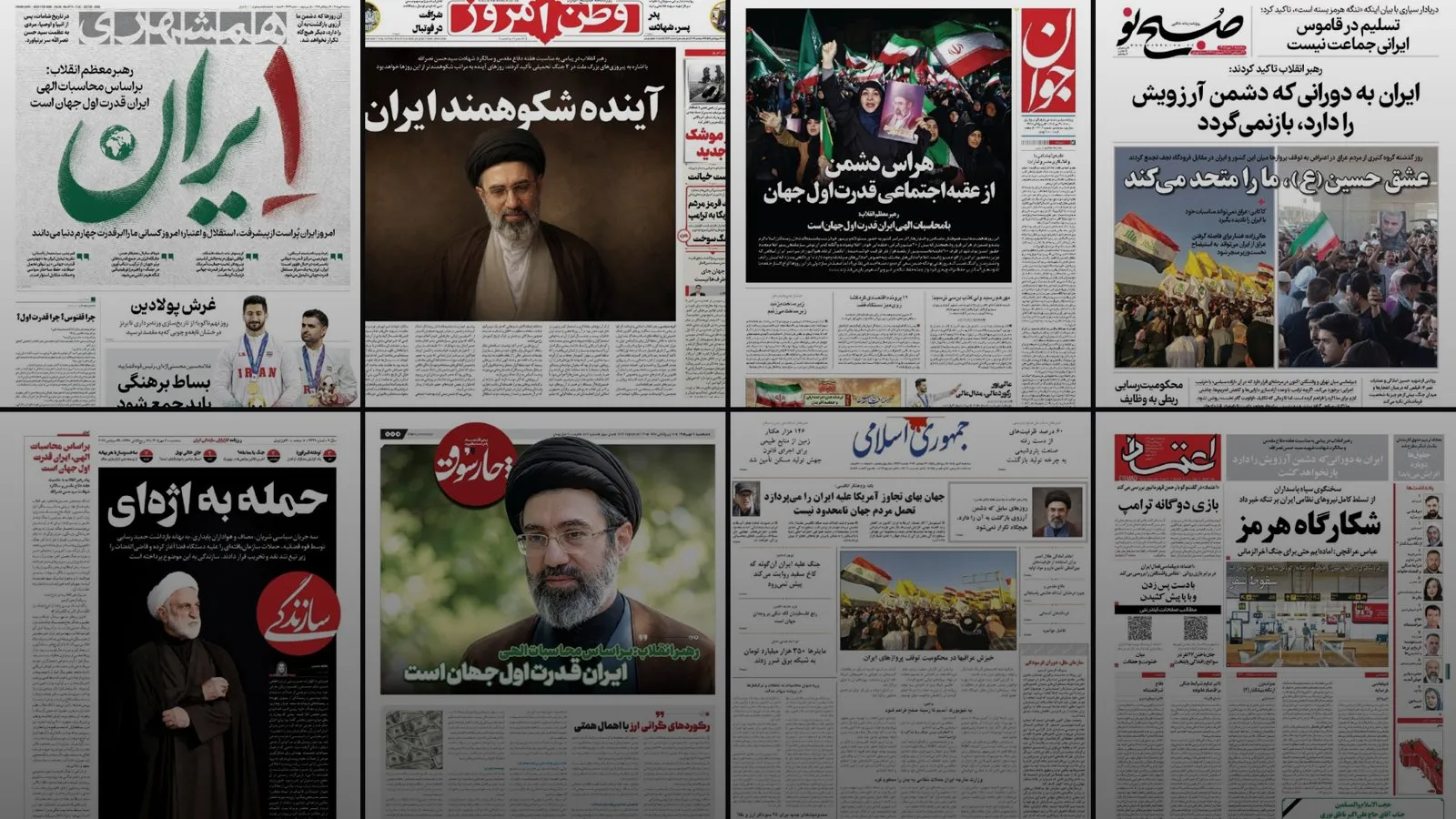
Bottom line: On the morning the serving Leader’s photograph appeared on six Iranian front pages, twenty-four hours after his own foreign minister said American threats were what prevented it, the same batch published four incompatible descriptions of who controls the Strait of Hormuz, and the most operationally specific of them, from the foreign minister himself, said the Strait is now the only file left and its reopening is conditional on terms a Qatari mediator is carrying to Washington.
Executive Summary
The lead judgment of this edition is that the Iranian state reversed its own stated constraint on the serving Leader’s visibility inside a single news cycle, and did so without acknowledging the reversal. On 28 September the foreign minister told reporters in New York that «ملاحظات امنیتی و تهدیدات مستقیم آمریکا», security considerations and direct American threats, were why the Leader’s image was not published. On 29 September Vatan-e Emrooz gave its entire front page to a studio portrait of him, Charsoogh printed a large outdoor colour photograph, Jomhouri Eslami and Ta’adol each ran a formal inset, Iran Daily carried a profile shot captioned in English, and Javan printed a crowd photograph in which a member of the public holds his portrait aloft. Identification does not rest on the images. Sazandegi prints «آیتالله سیدمجتبی حسینیخامنهای، رهبر انقلاب و فرمانده کل قوا»; the Kayhan channel prints «حضرت آیتاللهالعظمی امام سیّد مجتبی حسینی خامنهای»; Iran Daily’s caption names him in English. The occasion is Sacred Defence Week and the second anniversary of Sayyed Hassan Nasrallah’s killing, and the message itself is a phoenix allegory ending in the declaration that «آن روزهای سابق که دشمن ما آرزوی بازگشت به آن را دارد، گذشت و دیگر هیچگاه تکرار نخواهد شد».
The second finding is that on the same morning the Iranian press published four mutually incompatible accounts of the Strait of Hormuz, and that the accounts do not sort by faction. Etemad, a reformist daily, leads «شکارگاه هرمز» over the IRGC spokesman’s claim of «تسلط کامل نیروهای نظامی ایران بر تنگه», complete military domination of the waterway. Sobh-e No’s banner has Rear Admiral Sayyari stating flatly that «تنگه هرمز بسته است», the Strait is closed. Iran Daily, the state’s English-language paper, tells its foreign readers in its own standfirst that the United States has been imposing a sea blockade on Iran’s southern ports for months, and builds a trade-logistics interview on that premise. And Kayhan’s channel carries the foreign minister saying the Strait’s reopening is conditional on Iran’s announced terms and that at present it is the only issue on the table. Absent from all ten covers is the account Hamshahri gave its entire front page to twenty-four hours earlier: a functioning licence regime of seventeen ships a day. That framing was not defended, corrected or repeated. It was dropped.
The third finding is that the negotiation acquired a date. In a video statement at the end of his New York trip, carried within the hour by the Kayhan, Vatan-e Emrooz, Jam-e Jam and Sobh-e No channels, Abbas Araghchi rejected foreign reporting of Iranian nuclear flexibility, said «شروط ما برای بازگشایی تنگه مشخص است» and «درحال حاضر فقط موضوع تنگه هرمز است», and then supplied the mechanism: «طرح ما که به طرح هفتمادهای معروف شد، از طریق واسطه قطری به آمریکاییها منتقل شد», a Qatari mediator met the Iranian delegation again that day, ideas were discussed for how Iran’s conditions might be met, and the American side’s final answer is to come back through Qatar, hoped for by the following day, whereupon «در تهران تصمیمگیری خواهد شد». Independent reporting describes the same proposal as a seven-day roadmap trading the reopening of the Strait and a return to nuclear talks against an end to the American blockade, waivers on oil sales and a ceasefire extending to Lebanon. This is the narrowest and best-dated decision window this file has recorded in the war.
The fourth finding is a campaign rather than a story. Iraq occupies more front-page space in this batch than Israel does. Sobh-e No and Jomhouri Eslami both run the same photograph of a crowd outside Najaf airport protesting the halt of Iran flights; Sobh-e No adds an analyst line that pressure to distance Baghdad from Tehran could end in the prime minister’s impeachment; Iran Daily reports Tehran filing an ICAO complaint; and Hossein Shariatmadari’s signed Kayhan column, back after two cycles without one, names Prime Minister Ali al-Zaidi and calls his compliance with the American Treasury’s flight ban «همسوئی با یزید زمان», alignment with the Yazid of our time. What none of this acknowledges is that Sobh-e No’s own channel reported the previous evening that Iraqi sources said flights to Iran had resumed from Najaf. The pressure continued after its stated trigger had been at least partly removed, which is what distinguishes a campaign from coverage.
Net assessment. This is the most internally coherent edition this file has read in a fortnight and simultaneously the least consistent on the one question an external reader most needs answered. The coherence is on leadership: a commemorative week has been used to put the serving Leader’s face, name, title and voice on the front pages at once, and Kayhan has escalated his style to «امام». The inconsistency is on the Strait, where an admiral, a spokesman, a state English daily and the foreign minister gave four different answers in one cycle. The resolution is not a matter of choosing between them: a closed waterway and a blockaded coast are both true and are each other’s causes, and the Iranian press simply tells one of them in Persian and the other in English. What the file takes forward is the foreign minister’s version, because it is the only one that describes the Strait as something Iran intends to trade rather than something Iran has won.
Key Judgments
- KJ-1 [HIGH] KJ-1: The Iranian state’s public explanation for the serving Leader’s invisibility was contradicted by its own press within twenty-four hours, and the contradiction is documented rather than inferred. The evidence is a dated pair: the foreign minister in New York on 28 September attributing the absence of the Leader’s image to «ملاحظات امنیتی و تهدیدات مستقیم آمریکا», and on 29 September his photograph on six of the ten pages read for this edition, identified in print by Sazandegi as «آیتالله سیدمجتبی حسینیخامنهای، رهبر انقلاب و فرمانده کل قوا» and by the Kayhan channel as «امام سیّد مجتبی حسینی خامنهای». The significance is that statements by Iranian officials explaining the leadership’s conduct should be treated as positioning rather than as description of an operational constraint: this one was falsified by the next morning’s newsstand. Calibration runs both ways. Overstating it would read a commemorative-week publication decision as a succession crisis resolving; understating it would miss that the state offered the world a security rationale that its own newspapers did not observe for a single cycle.
- KJ-2 [HIGH] KJ-2: The Iranian state has no single published account of the Strait of Hormuz, and the divergence is institutional rather than factional. The evidence is four accounts in one batch: the IRGC spokesman’s «تسلط کامل نیروهای نظامی ایران بر تنگه» on Etemad’s front page, Rear Admiral Sayyari’s «تنگه هرمز بسته است» on Sobh-e No’s banner, Iran Daily’s own standfirst describing a months-long American sea blockade of Iran’s southern ports, and Araghchi’s statement that reopening is conditional on Iran’s announced terms. A reformist daily printed the maximal military claim and the state’s English-language daily printed the admission of injury, so the split does not follow factional lines; it follows audience. The significance is that Iranian statements about the Strait should be read as addressed to a specific reader rather than as reports of a maritime situation, and that the two facts an external reader needs, an Iranian closure and an American blockade, are each being told to a different public.
- KJ-3 [HIGH] KJ-3: A decision point on the war’s central file was placed within one day, by the Iranian official who would take it. The evidence is Araghchi’s own video statement, published by four Iranian channels between 03:52 and 04:39 UTC: the seven-point plan was conveyed to the Americans through a Qatari mediator; a Qatari mediator met the Iranian delegation again on 28 September and discussed ideas for meeting Iran’s conditions; those ideas go back to Washington; the American final answer returns through Qatar, hoped for the following day; and «براساس آن در تهران تصمیمگیری خواهد شد». Independent reporting of the same proposal describes reopening the Strait within seven days and resuming nuclear talks against an end to the blockade, oil-sale waivers and a ceasefire including Lebanon. The significance is that the file now has a testable near-term indicator rather than a trend: either the 30 September or 1 October batch reports an answer, or the silence is itself the answer. Confidence is high on the existence and terms of the channel and is deliberately not extended to the likelihood of agreement.
- KJ-4 [MODERATE-HIGH] KJ-4: An Iranian front page built its assessment of the negotiation on a report the American president had denied hours earlier, and the denial was in the same batch. The evidence is Sobh-e No’s kicker to «در نیویورک چه خبر است؟», which states that Trump «با وعده آزادسازی داراییها و کاهش تحریمها، چاشنی لازم برای مذاکره را فراهم کرده است», set against the Vatan-e Emrooz channel’s own post carrying Trump’s statement that the Axios report of an offer to lift sanctions and release frozen assets «صحت ندارد» and that he offered them nothing. The significance is methodological and should be applied forward: Iranian front-page characterisations of American concessions are frequently second-hand renderings of a single Western report, and the underlying report must be recovered before the characterisation is read as evidence of the American position. Calibration: a denial is not a disproof, and the possibility that an offer exists and is being publicly disowned is live; what is established is that Sobh-e No printed as settled a premise that was contested in its own news cycle.
- KJ-5 [MODERATE-HIGH] KJ-5: The succession’s legitimation has moved inside the Leader’s own institutional press, reversing the pattern this file recorded over the previous two cycles. The evidence is threefold. Kayhan’s signed front-of-book column returned after two cycles of absence. Kayhan alone in the batch styles the serving Leader «حضرت آیتاللهالعظمی امام سیّد مجتبی حسینی خامنهای», the first use of «امام» for him that this file has recorded. And the Iran newspaper channel published a personal letter written by him in adolescence to his brother Mostafa at the Sacred Defence fronts, signed «والسلام. سیّدمجتبی», in which the writer describes registering at the combatants’ complex. On 27 September this file recorded Kayhan filling the Leader’s commemorative slot from the 2024 archive under «رهبر شهید انقلاب»; on 28 September it recorded Kayhan declining to print Naim Qassem’s endorsement of the serving Leader by name. The significance is that the legitimation deficit this file has tracked since the succession is now being addressed from Tehran rather than from Beirut, and that the chosen instruments are honorific escalation and wartime biography. Confidence is held below high because a single commemorative week is a weak base for a judgment about a durable shift.
- KJ-6 [MODERATE-HIGH] KJ-6: Iranian press pressure on Iraq is a directed campaign against a named head of government and it outlasted its stated trigger. The evidence: Shariatmadari’s column names Prime Minister Ali al-Zaidi four times and casts his compliance with the American Treasury’s flight ban as «همسوئی با یزید زمان»; Sobh-e No and Jomhouri Eslami both give front-page space to the same Najaf airport protest; Sobh-e No’s analyst line raises the prime minister’s impeachment; Iran Daily reports an ICAO complaint. Against this, the Sobh-e No channel itself reported on the evening of 28 September that Iraqi sources said flights to Iran had resumed from Najaf International Airport, and no front page in the batch carried that. The significance is that the object of the pressure is the composition of the Iraqi government rather than the flight schedule, and the indicator to watch is whether the campaign continues once flights are fully restored. Calibration: a partial resumption reported by unnamed Iraqi sources is thin evidence on which to judge that the trigger was removed, which is why this sits below high confidence.
- KJ-7 [MODERATE] KJ-7: On the second consecutive cycle, the Iranian press has declined to contest the RAF Fairford allegation on its merits, and has now also declined to carry its own government’s denial. The evidence: the allegation reaches exactly one cover, Sazandegi’s rail item «توطئه فیرفورد» kickered «یک گزارش مشکوک از لندن», which makes the London report rather than the accusation the object of suspicion; Rubio’s Fox News remark calling the British events a very serious threat is carried by the Defa Press and Vatan-e Emrooz channels and framed there as anti-Iranian media construction; and Iran’s official denial of involvement, issued on 28 September and reported externally, appears on no front page in the batch. External reporting has the five arrested men as British nationals from London in their twenties, released on bail on 28 September, with Iranian, Russian and non-state links all still under investigation. The significance is that this file’s 28 September prediction is answered: the near-silence is now a two-cycle pattern rather than a one-day gap, and the handling differs sharply from the detailed rebuttals the same press gives to maritime and nuclear allegations. Calibration: an unproven allegation is a thin thing to demand coverage of, and the judgment is about the asymmetry in handling, not about the allegation’s merits.
- KJ-8 [MODERATE] KJ-8: A Gulf and Israeli coordination track on Iran is forming in parallel with the Qatari mediation track, and the Iranian press is treating it as betrayal rather than as an input to its own negotiation. The evidence: Netanyahu’s confirmed 27 September visit to Abu Dhabi at the UAE president’s invitation, with the national security adviser and the Mossad chief in the delegation and Israeli broadcast reporting placing senior Gulf officials in Iran-focused talks around it; the Saudi foreign ministry’s readout of a Faisal bin Farhan and Rubio discussion of shipping security in the Strait of Hormuz and Bab al-Mandab, reported by Defa Press; and the Etemad channel’s report of the first Emirati vice-presidential visit to Saudi Arabia since the two governments fell out over Yemen. Vatan-e Emrooz’s rail files the Abu Dhabi visit under «نشست خیانت». The significance is that Iran is negotiating through one Gulf state while several others coordinate with its adversary on the same waterway, and that its press is scoring the second track morally rather than analytically. Confidence is moderate because the content of the Gulf talks is reported second-hand.
- KJ-9 [MODERATE] KJ-9: Yemen has entered the Iranian press’s own threat accounting, bringing a second maritime chokepoint with it. The evidence: Iran’s foreign ministry condemnation of military strikes on Yemeni territory occupies front-page space on Jomhouri Eslami, citing an air strike on a market it says killed 45 and wounded 150 and further strikes on two localities the scan does not render legibly; Defa Press reports Saudi Arabia activating an early warning in the Najran region; and the Saudi and American foreign ministers are reported discussing Bab al-Mandab alongside Hormuz. The significance is that an Iranian file which has been single-chokepoint since the ceasefire memorandum may be widening, and that Bab al-Mandab would change the economics of any Hormuz bargain. Confidence is moderate: this is one front page on one cycle, the casualty figures are the ministry’s and are not independently established here, and the strikes’ authorship is not stated in terms this file can verify from the scan.
- KJ-10 [LOW-MODERATE] KJ-10: Negative evidence, filed as a finding. Five things this file expected to see did not appear on any cover. Hamshahri’s licence regime of seventeen ships a day, which was its entire front page on 28 September, is absent from every page including its own, neither defended nor corrected. The Majlis Strait of Hormuz security bill, recorded here on 28 September as the cycle’s most durable act, reached no cover for a second consecutive morning. Iran’s own official denial of involvement in the Fairford matter reached no cover. The resumption of Najaf flights, reported by the Sobh-e No channel the previous evening, reached no cover, including Sobh-e No’s own. And the American Treasury Secretary’s approach to Lebanon’s prime minister and finance minister on disrupting Iran- and Hezbollah-linked financial networks, the cycle’s only Lebanon policy item, reached only the Vatan-e Emrooz channel and no front page, on the morning after the second anniversary of Nasrallah’s killing filled the commemorative space instead. Confidence is deliberately low: each absence has an innocent explanation, and the set is filed to be tested against the next three cycles rather than relied on now.
Macro Trends
- The stated reason for the Leader’s invisibility did not survive one cycle. On 28 September the foreign minister attributed the absence of the Leader’s image to «ملاحظات امنیتی و تهدیدات مستقیم آمریکا». On 29 September his photograph appears on six of the ten pages read for this edition, in four distinct formats: a full-cover studio portrait on Vatan-e Emrooz, a large outdoor colour photograph on Charsoogh, formal insets on Jomhouri Eslami and Ta’adol, a profile shot on Iran Daily captioned to Ayatollah Seyyed Mojtaba Khamenei, and a printed portrait held above a crowd on Javan. No outlet notes the change. Either the security rationale was not the operative constraint, or it was set aside for a commemorative week; the file records which of those it is as the thing to establish over the next cycles.
- Four incompatible descriptions of the Strait, published the same morning. The IRGC spokesman claims «تسلط کامل» over the waterway (Etemad). Rear Admiral Sayyari says «تنگه هرمز بسته است» (Sobh-e No). Iran Daily tells foreign readers the United States has blockaded Iran’s southern ports for months. Araghchi says reopening is conditional on Iran’s terms and is the only file left. These are not four versions of one claim; they are a claim of control, a claim of closure, an admission of injury and a negotiating position. Hamshahri’s licence regime of seventeen ships a day, its whole front page the previous morning, appears on no cover at all.
- The negotiation now has a mechanism, a mediator and a deadline. Araghchi’s end-of-trip statement names the instrument, «طرح هفتمادهای», the channel, a Qatari mediator, the sequence, ideas discussed on 28 September and carried back to Washington, and the timing, an American final answer hoped for the following day with the decision then taken in Tehran. Independent reporting adds the terms: reopening within seven days and a return to nuclear talks against an end to the blockade, oil waivers and a ceasefire including Lebanon. The hardest-line paper in the country published this without editorial comment, one day after attacking the same delegation for signalling weakness.
- Iraq is where Iranian press pressure is actually being applied. Two front pages carry the Najaf airport protest, one analyst line raises the prime minister’s impeachment, Iran Daily reports an ICAO complaint, and Shariatmadari’s signed column names Ali al-Zaidi and casts him as aligned with Yazid. Israel, by contrast, appears on the covers mainly through a secret Abu Dhabi visit and a former Shin Bet chief’s lawsuit. The campaign continued after Sobh-e No’s own channel reported flights resuming from Najaf on the evening of 28 September, a fact no front page carried.
- A Gulf and Israeli coordination track is forming beside the Qatari mediation track. Netanyahu flew to Abu Dhabi on 27 September at the UAE president’s invitation, accompanied by the national security adviser and the Mossad chief, and Israeli broadcast reporting places senior officials of several Gulf states in talks centred on Iran. Separately, Defa Press reports the American and Saudi foreign ministers discussing shipping security in the Strait of Hormuz and Bab al-Mandab, and Etemad’s channel reports the first Emirati vice-presidential visit to Saudi Arabia since the two fell out over Yemen. Vatan-e Emrooz files all of this under «نشست خیانت», the summit of betrayal, which is a verdict on the hosts rather than an assessment of what was agreed.
- The judiciary is now a front in the intra-establishment fight, and both sides printed it. Sazandegi’s whole front page reports organised attacks on the chief justice by hardline currents over Hamid Rasaei’s detention. Sobh-e No, for a second consecutive cycle, defends the sentence and insists it had nothing to do with parliamentary duties. Hamshahri prints Mohseni-Ejei on enforcing public modesty, and the Sobh-e No channel carries him saying that wartime conditions are no reason to neglect the fight against economic corruption. A reformist and a principlist daily are reporting the same conflict from opposite ends, which is how this file has been able to track it at all.
- Escalation doctrine was restated without an occasion. Javan prints «زیرساخت بزنید زیرساخت میزنیم», hit infrastructure and we hit infrastructure, as a standing formulation rather than a response to any named incident or official. Vatan-e Emrooz’s rail carries an ABC-sourced account of eight American marines wounded in an earlier Iranian strike on a vessel in the Strait, and a Washington Post analysis relayed on its channel says American forces fired sixty to seventy Patriot interceptors and more than twelve THAAD rounds against a single Iranian drone attack on a base in Jordan. None of these are Iranian operational statements; all are renderings of Western reporting selected for what they say about American cost.
- Yemen entered the register, and the second chokepoint came with it. Jomhouri Eslami’s front page carries Iran’s foreign ministry condemning military strikes on Yemeni territory as a violation of sovereignty, citing an air strike on a market it says killed 45 and wounded 150. Defa Press reports Saudi Arabia activating an early warning in the Najran region and the American and Saudi foreign ministers discussing Bab al-Mandab alongside Hormuz. This is the first cycle in which a second maritime chokepoint appears in the Iranian press’s own threat accounting rather than in external commentary.
- The economic covers disagree about the trajectory and agree about the level. Ta’adol reads decelerating liquidity growth as the turn, «مهار خلق پول، افزایش امید به ثبات». Charsoogh reads the exchange rate as the verdict and prints 244,900 toman to the dollar against a central bank series, having printed 335,000 toman a day earlier without reconciling the two. What neither disputes is the level: Ta’adol’s own page carries a 40 percent livelihood gap for wage earners and Tehran rental deposits of 1.2 to 2.9 billion toman for a 75 square metre flat, and its rail headline «دارو در محاصره», medicine under siege, is where a maritime blockade shows up in civilian life first.
Front-Page Snapshot
- Vatan-e Emrooz - “Iran’s Glorious Future” (Hardline principlist) - Leader’s message and the batch’s first full-cover portrait [MODERATE-HIGH]
- Kayhan - “Iran is the world’s foremost power; glorious days lie ahead” (Hardline, published under the Leader’s office) - Leader styled «امام»; Araghchi’s Hormuz conditions and the Qatari channel [MODERATE-HIGH]
- Etemad - “The Hormuz Hunting Ground” (Reformist) - IRGC claims complete domination of the Strait [HIGH]
- Sobh-e No - “Iran will not return to the era the enemy wishes for” (Principlist) - Admiral declares the Strait closed; Iraq flight ban; New York talks on a denied premise [HIGH]
- Iran Daily - “FM warns Iran to fight back any aggression, even an ‘apocalyptic war’” (State English-language daily) - American sea blockade of Iranian ports acknowledged to foreign readers [MODERATE-HIGH]
- Javan - “The enemy’s dread of the social depth of the world’s first power” (Hardline, IRGC-affiliated) - Mobilisation framing and reciprocal infrastructure targeting [HIGH]
- Jomhouri Eslami - “The world is paying the price of America’s aggression against Iran” (Traditional clerical establishment) - Third-party legitimation, Araghchi on US television, Yemen condemnation [MODERATE]
- Sazandegi - “Attack on Ejei” (Reformist, Kargozaran party) - Hardline assault on the judiciary; the only front-page Fairford item [MODERATE]
- Hamshahri - “By divine calculation, Iran is the world’s foremost power” (Tehran municipality, centrist) - Leader’s message read as a superpower ranking; yesterday’s Hormuz licence regime dropped [MODERATE]
- Charsoogh - “By divine calculation, Iran is the world’s foremost power” (Economic, principlist framing) - Clearest published portrait of the Leader; currency collapse blamed on the economic team [LOW-MODERATE]
- Ta’adol - “Curbing money creation, rising hope of stability” (Economic) - Liquidity optimism against housing costs, a wage gap and medicine under siege [LOW]
Full report
The complete edition - per-paper front-page analysis and full translation appendices - is available as a PDF: Download the full report.
Compiled from Iranian front pages and outlet channels via open-source monitoring. Translations are editorial; named-figure attributions are verified against the source pages where possible.