Iranian Press Monitor - Thursday, 24 September 2026 (Day 205)
Thursday, 24 September 2026 · پنجشنبه ۲ مهر ۱۴۰۵ · 12 Rabi’ al-Thani 1448 - Nine Persian front pages and one English front page of 2 Mehr 1405, read alongside six outlet channels and three agency wires; Tehran Times was not available at the time of compilation.
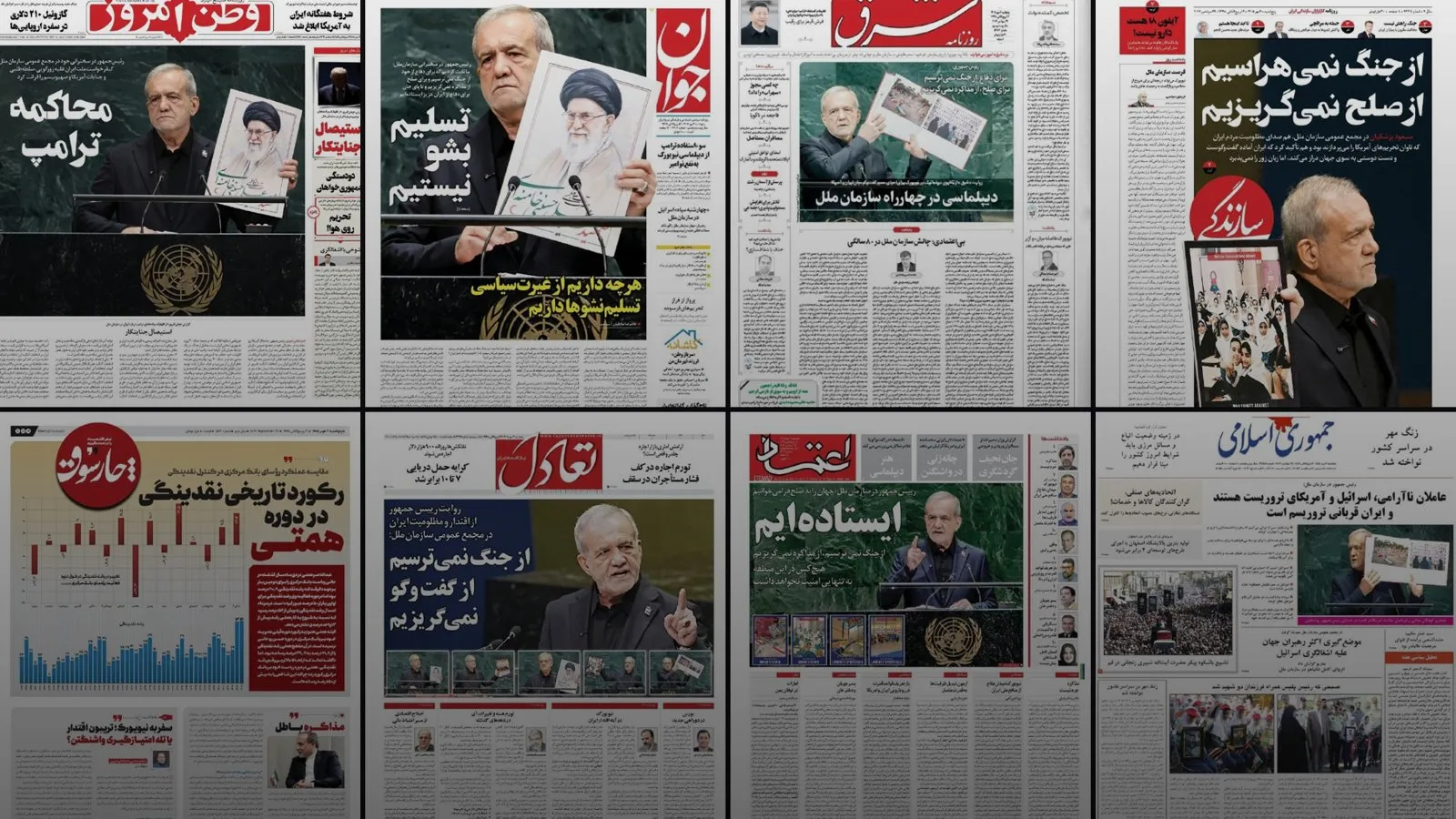
Bottom line: On the morning after Iran’s president read a photographic indictment of the United States from the General Assembly rostrum, the Iranian front pages printed the indictment and, for the first time in this file, printed the negotiation alongside it: a hardline masthead carried the count of Iran’s conditions as conveyed to Washington and two reformist covers named the three-hour channel and its participants, which indicates that the terms are being staged for a domestic audience rather than withheld from it.
Executive Summary
The lead judgment of this edition is that the negotiation reached the front pages. On 23 September this monitor recorded that Iran’s foreign minister had met the American envoy in New York with Qatari mediation and conveyed three conditions, that four Iranian channels carried it, and that eleven front pages carried none of it; the file set the following cycle as the test of whether deadline or policy explained the gap. Deadline explained it. Vatan-e Emrooz, a hardline daily, prints above its own masthead that the Secretary of the Supreme National Security Council has explained the New York negotiations and that «شروط هفتگانه ایران به آمریکا ابلاغ شد», Iran’s sevenfold conditions have been conveyed to America. Etemad prints «“اعتماد” از رایزنی سهساعته ایران و آمریکا گزارش میدهد» over the single word «چانهزنی», bargaining. Sazandegi names both participants, reporting «واکنش تندروها به دیدار عراقچی و ویتکاف». Three papers from three different factions, on one morning, have told Iranian readers that their government is negotiating and roughly on what terms.
The second finding is the instrument the whole batch was built around. Every one of the ten covers leads on the president’s address to the 81st General Assembly, and nine of them lead on a photograph of him holding something up: a framed portrait of the assassinated predecessor on Vatan-e Emrooz, Javan and Hamshahri, and placards reading WAR CRIMES AGAINST MINAB’S SCHOOL and LAMERD’S SPORTSHALL on Sazandegi, Etemad, Ta’adol, Hamshahri, Jomhouri Eslami and Iran Daily. Jomhouri Eslami’s caption names both sites. This is the Minab material this monitor identified on 23 September as the strongest the Iranian press has deployed in the series, and it has been carried from the school-year anniversary to the General Assembly rostrum in one cycle. The analytic caution is unchanged and remains the opposite of the usual one: the underlying facts are sound, documented in external reporting and in a United Nations report of 18 September, and the inference the covers build on them, that no settlement can be discussed, does not follow from them and is in any case contradicted by three of the covers carrying them.
The third finding concerns what nine titles did with one sentence. The president’s operative formula divides at a seam, «از جنگ نمیترسیم» and «از مذاکره نمیگریزیم», we do not fear war and we do not flee negotiation, and the Iranian press has split along exactly that seam. Javan prints the first half alone and adds a red strap converting it into a rebuke of the settlement camp. Shargh, Ta’adol, Etemad and Sazandegi print both halves, Sazandegi substituting «صلح», peace, for negotiation. Hamshahri prints neither and prints «زنده باد» instead, over four institutional endorsements, from the Speaker of Parliament, the mayor of Tehran, the IRGC spokesman and the head of the Islamic Development Organization, all four of which use the same two nouns, «اقتدار» and «مظلومیت». A formula that both blocs can print, quoted by both blocs to opposite ends, is what centrally distributed language looks like when it is working.
The fourth finding is an absence and it is abrupt. Yesterday a message in the name of «حضرت آیتالله سید مجتبی حسینی خامنهای» ran on every cover in the batch, and this file recorded the end of an eight-cycle silence. Today not one of the nine Persian covers, the English cover, or the nine channels read for this edition carries any message, speech or quoted remark from him. The paper that buries a grand ayatollah on its front page, Jomhouri Eslami, has no message from the serving Leader to print alongside the funeral photograph and fills the clerical space with a quotation from Ayatollah Beheshti. The khamenei.ir site was not reachable at the time of compilation, so the absence is established for the Iranian press surface examined here and not for every possible surface; on that surface, the return recorded yesterday lasted one cycle.
Net assessment. This is the most internally consistent edition of the series and the most revealing for that reason. A state that intends to refuse a settlement does not publish the count of its conditions on a hardline masthead, and a state that intends to accept one does not open an armed training centre for a new volunteer formation on the same morning, as Hamshahri reports it has. Both are running. The edition’s rhetorical energy is spent on an adversary whose actual threat is still not quoted on any Iranian cover, its evidentiary energy is spent on two strikes that happened seven months ago and are externally documented, and its operational content, five named conditions with a named mediator and a claimed total of seven, sits in the top strip above the masthead where a casual reader will not look for it. The war’s next phase is being negotiated in the margins of pages whose centres are given to a speech.
Key Judgments
- KJ-1 [HIGH] The negotiation has moved from the Iranian channels onto the Iranian front pages, and the hardline press moved it there. On 23 September this file recorded eleven front pages carrying nothing about the envoy-level meeting in New York and set the following cycle as the test of whether deadline or policy explained the silence. Today Vatan-e Emrooz prints above its masthead «توضیحات دبیر شورای عالی امنیت ملی درباره مذاکرات نیویورک» over «شروط هفتگانه ایران به آمریکا ابلاغ شد»; Etemad prints «“اعتماد” از رایزنی سهساعته ایران و آمریکا گزارش میدهد» over «چانهزنی»; Sazandegi prints «واکنش تندروها به دیدار عراقچی و ویتکاف». The American president’s own New York account describes a three-hour meeting between his envoy, his son-in-law and an Iranian delegation, which matches Etemad’s duration. The significance is that the silence was a deadline artefact and not a policy of concealment, and that the surface which published the count of Iran’s terms is the one most invested in refusing them, which is the behaviour of a press preparing a domestic audience for an outcome rather than one campaigning against it.
- KJ-2 [HIGH] Iran’s published conditions have grown from three to five with a named spokesman and a named mediator, and a front page now asserts the total is seven. The Foreign Ministry spokesman, Esmail Baghaei, is carried on the Sobh-e No channel (post 116195) and in near-identical wording on the Vatan-e Emrooz channel (post 26154) describing a two-hour exchange of messages through Qatar and listing: an end to economic terrorism, a halt to the naval blockade, an end to the wars on all fronts, release of frozen assets, and maritime safety established on a bilateral basis. On 23 September this file recorded three. Vatan-e Emrooz’s masthead states the conditions are sevenfold and attributes the account to the Secretary of the Supreme National Security Council, an office held by Mohsen Rezaei since 9 August 2026; external reporting carries Rezaei announcing seven conditions from about 20 September. The significance is the shape of the list rather than its length: three of the five are about ending a state of siege, one is about money, and the fifth, bilateral maritime safety, is the only one that describes an arrangement rather than a cessation, which makes it the clause on which any agreement would actually have to be written.
- KJ-3 [HIGH] The serving Leader’s return to public life lasted exactly one cycle. On 23 September a message in the name of «حضرت آیتالله سید مجتبی حسینی خامنهای» for the opening of schools and universities ran on every cover in the batch, together with a condolence message for Grand Ayatollah Shobeiri Zanjani, ending an eight-cycle silence. Today not one of the nine Persian front pages, the English front page, or the nine outlet and agency channels read for this edition carries any message, speech or quoted remark from him. Jomhouri Eslami, which gives its front page to the grand ayatollah’s funeral procession in Qom, has no message from him to print beside the photograph and uses a quotation from Ayatollah Beheshti in the clerical slot. The khamenei.ir site was not reachable at compile time, so this is established for the Iranian press surface examined here. The significance is that the pattern on that surface is now eight cycles absent, one cycle present on a civilian subject, one cycle absent again, which is consistent with an office that can be made to appear when a safe occasion is available and is not otherwise being used.
- KJ-4 [HIGH] One presidential sentence was drafted with a seam in it and the Iranian press split along that seam on the same morning. The formula is «از جنگ نمیترسیم، از مذاکره نمیگریزیم», we do not fear war, we do not flee negotiation. Javan prints the first half as its headline, «تسلیم بشو نیستیم», and adds a red strap reading «هرچه داریم از غیرت سیاسی تسلیمنشوها داریم», everything we have we owe to the political zeal of those who will not surrender. Shargh prints both halves and headlines the page «دیپلماسی در چهارراه سازمان ملل». Ta’adol prints both with «گفتوگو» for negotiation; Sazandegi prints both with «صلح», peace; Etemad prints both plus the regional-security clause. The significance is methodological and extends beyond today: the state did not have to impose a line, it had to supply a sentence that each bloc could quote as its own, which achieves the same convergence at none of the cost and leaves no fingerprints on any single outlet.
- KJ-5 [HIGH] The Minab and Lamerd material has been converted from a domestic commemoration into a diplomatic instrument in one cycle, and it is the strongest instrument in the Iranian inventory because none of it is fabricated. Six of the ten covers photograph the president holding English-language placards reading WAR CRIMES AGAINST MINAB’S SCHOOL and LAMERD’S SPORTSHALL; Jomhouri Eslami’s caption names both sites; Iran Daily’s English caption dates the school strike to February. The external record establishes both strikes on 28 February 2026, the war’s first day, and a United Nations report published on 18 September 2026 found that the United States may have committed war crimes at the Minab school. The significance is that this file’s standing caution about Iranian evidentiary claims does not apply here and the opposite caution does: the facts will survive verification, the placards were made in English for a non-Iranian audience, and the conclusion being built on them, that no settlement can be discussed, is contradicted by three of the same morning’s covers reporting the negotiation.
- KJ-6 [MODERATE-HIGH] A public American document has been converted into a casualty claim by the change of a single word, on two Iranian surfaces. The Kayhan channel (post 84852) runs «خودکشی ۸ خدمه ناو هواپیمابر «لینکلن»», the suicide of eight crew of the carrier Lincoln, and the Sobh-e No channel (post 116201) runs the same as a CNN report of eight sailors who committed suicide. The document is a letter from the acting Secretary of the Navy to Senator Kirsten Gillibrand, reported on 23 September, stating that eight sailors in the Abraham Lincoln strike group attempted suicide during the deployment and that no service member died by suicide; two sailors went overboard, as previously reported, and the attempt rate was roughly consistent with the active-duty Navy’s 2024 rate. The significance is that this is the cheapest technique in the repertoire this file has been cataloguing, cheaper than the assembled isolation lists of 20 and 21 September and than the statement-partitioning of 23 September, and also the most fragile, because the original is a named official’s letter in the public record and the alteration is one verb.
- KJ-7 [MODERATE-HIGH] The American annihilation threat has still not been quoted on any Iranian front page, but the American speech is now covered, which narrows the gap this file recorded yesterday without closing it. On 22 September the American president told the General Assembly he faces a decision whether to make a deal or to annihilate the Islamic Republic and drive it into hell, and predicted a deal after the November midterms. Today Vatan-e Emrooz gives its right rail to «گزارش وطن امروز از اظهارات و ادعاهای ترامپ درباره ایران در سازمان ملل» under «استیصال جنایتکار», the criminal’s desperation, beside a photograph of him with his head lowered; Javan files the same speech as «سوءاستفاده ترامپ از دیپلماسی نیویورک به نفع نوامبر», exploitation of New York diplomacy for November’s benefit; the Kayhan channel headlines the Iranian reply «پاسخ دندانشکن رئیس جمهور به اراجیف ترامپ». All three cover the speech as a psychological or electoral condition. None reproduces the sentence. The significance is unchanged from 23 September: the population being asked to endorse refusal has been told the adversary is desperate and not told what he said the alternative was, and the electoral framing supplies a reason to discount an offer without ever stating the offer.
- KJ-8 [MODERATE-HIGH] The naval blockade has become the object on which a reformist party daily, an economic daily and the Foreign Ministry converged within one cycle, each in a different register. Sazandegi’s «یادداشت روز», «فرصت سازمان ملل» by the retired diplomat Fereydoun Majlesi, defines New York as «دریچهای برای خروج از محاصره», a window for getting out of the siege. Ta’adol prints «نفتکشها روزانه ۹۰۰ هزار دلار اجاره میشوند» over «کرایه حمل دریایی ۷ تا ۱۰ برابر شد» above its masthead; external maritime data put Hormuz transit spot rates near $1 million a day on 11 September, with traffic far below baseline. The spokesman’s second condition is a halt to the naval blockade. The significance is that the Iranian argument for a settlement now has a number, a name and an official demand attached to the same object, which is the configuration in which domestic pressure to settle usually becomes measurable; it is also the configuration the Assembly of Experts moved against on 23 September by criminalising the category of speech rather than contesting the object.
- KJ-9 [MODERATE] Domestic armed mobilisation advanced a concrete step on the morning the diplomats were bargaining, and the two tracks are complementary rather than contradictory. Hamshahri reports «اولین مرکز آموزش نظامی جانفدای ایران افتتاح شد» under «جانفدا دست به اسلحه شد», Janfada has taken up arms, over a photograph of two women in chador carrying rifles; the Fars News channel (post 464084) announces a 40,000-motorcyclist Janfada exercise for Friday from Imam Hossein Square to Azadi Square. A volunteer formation that acquires a training pipeline and stages a mass public exercise inside 24 hours is producing visible manpower at low cost. The significance is that this is leverage of a kind that a negotiation does not remove and a ceasefire does not dissolve: it is cheap to build, expensive to stand down, and it gives the bloc arguing against settlement an asset on the ground rather than only an argument on a page. Track whether the training centres multiply or the exercise is repeated.
- KJ-10 [MODERATE] Negative evidence: Lebanon and the Strait of Hormuz have both completed the conversion from theatres into clauses, and today neither reaches a front page in any form. For the fourth time in five cycles no cover in the batch carries a Lebanon item; Lebanon exists on the Jam-e Jam channel (post 28805) and on the Nour News channel as Israeli artillery striking Mansouri in the south, and in the third of the conditions conveyed through Qatar, an end to the wars on all fronts. The Strait is in the same condition: the Jam-e Jam channel (post 28792) posts video of a vessel struck by at least one projectile while transiting what it describes as an unauthorised route, no cover carries it, and Ta’adol prices the consequence without naming the cause. The significance is that a state whose two active military theatres appear in its own press only as wire items and negotiating terms is not preparing its population for escalation in either, which is itself a datum about intent, and a change in that pattern would be the earliest available warning of a change in policy.
- KJ-11 [MODERATE] The Iranian press argued that sanctions are failing on the morning a Gulf central bank cut off an Iranian state bank, and no front page carried the second fact. Vatan-e Emrooz’s «ویژه» item, «تحریم روی هوا!», reports the continuation of Iran’s foreign and international projects «با وجود تحریمهای جدید و تهدیدات وزارت خزانهداری آمریکا». The Emirati central bank barred Bank Melli Iran, which has seven branches in the country, from all financial transactions on 23 September, citing regulatory breaches, following the Emirates’ August suspension of trade and financial dealings with Iran. The story is carried on the Vatan-e Emrooz channel (post 26152) sourced to Reuters, and on no front page in the batch, including its own. The significance is the direction of the contradiction: this is not the press exaggerating an Iranian success, it is the press advancing a claim its own newsroom had already disproved on another surface the same day, which indicates the front page is being written to a position rather than to the wire.
- KJ-12 [MODERATE] Israel’s isolation at the General Assembly is the one construction the Iranian press did not have to manufacture this week, and two covers handled it with unusual discipline. Javan runs «چهارشنبه سیاه اسرائیل در سازمان ملل» over a line about world leaders turning the hall into an arena of critical attack; Jomhouri Eslami runs «موضعگیری اکثر رهبران جهان علیه اشغالگری اسرائیل» and attributes the isolation claim to a named Iranian agency rather than asserting it. The external record supports the substance: 77 delegations left the hall before the Israeli prime minister spoke on 23 September, and the Qatari emir had called the Israeli government a rogue government the previous day. The significance is comparative. On 20 and 21 September this file recorded isolation claims assembled from unrelated fragments; today, offered a real one, the same press sourced it and dated it. That is evidence that the earlier assemblies were choices rather than the only technique available, and it raises the value of the distinction for future cycles.
- KJ-13 [MODERATE] Two covers in the same batch make opposite claims about medicine, and the disagreement is checkable. Hamshahri, owned by the Tehran municipality, runs «کمبود دارو در کشور نصف شد», the country’s medicine shortage has been halved, attributed to the Health Ministry’s account of measures taken during the war. Sazandegi runs «آیفون ۱۸ هست دارو نیست!», there is an iPhone 18 but there is no medicine, framed around what importers can and cannot bring in. Both are front-page items on 2 Mehr; neither engages the other. The significance is that pharmaceutical availability is the one blockade effect with an administrative paper trail inside Iran, which makes it the most likely place for the argument over the naval blockade to become a domestic factual dispute rather than a rhetorical one, and the reformist framing has already chosen the comparison, consumer electronics against medicine, that would make it politically expensive.
Macro Trends
- The negotiation surfaced, and the hardliners surfaced it first. Yesterday the envoy-level meeting lived on four channels and on no front page. Today Vatan-e Emrooz prints the count of Iran’s conditions above its own masthead and attributes it to the Supreme National Security Council; Etemad reports the three-hour consultation and calls it bargaining; Sazandegi names Araghchi and Witkoff in the same line while reporting the hardline attack on the meeting. The Foreign Ministry spokesman’s list, carried on the Sobh-e No and Vatan-e Emrooz channels, has five items: an end to economic terrorism, a halt to the naval blockade, an end to the wars on all fronts, release of frozen assets, and bilaterally established maritime safety. The count printed on the front page is seven. The gap between five published and seven claimed is now the specific thing to watch.
- One speech, ten covers, and a formula built to divide. Every cover leads on the same event and nine reproduce the same presidential formula, but the formula has a seam and the press has split along it. Javan prints only «از جنگ نمیترسیم» and adds a strap making it a verdict on those who would settle; Shargh, Etemad, Ta’adol and Sazandegi print the negotiating half too. Hamshahri replaces the formula with four institutional endorsements that all use «اقتدار» and «مظلومیت». Uniform display type across nine competing titles indicates a distributed text; a distributed text that both blocs can quote to opposite ends indicates that the drafting anticipated the split.
- The rostrum was used as an evidence exhibit. Nine of the ten covers photograph the president holding something up. The portrait of the assassinated predecessor appears on three; the Minab school and Lamerd sports hall placards, in English, appear on six, and Jomhouri Eslami’s caption names both sites. Defa Press reports that the president also handed world leaders a photographic book documenting what it calls American and Israeli crimes. This is the Minab material converted from a school-year anniversary into a diplomatic instrument within one cycle, and it works precisely because it is not manufactured: both strikes of 28 February are documented outside the Iranian press, and a United Nations report of 18 September found the United States may have committed war crimes at the school.
- The Leader’s return lasted one cycle. On 23 September a message in his name ran on every cover in the batch and this file recorded the end of an eight-cycle silence. Today no cover and no channel read for this edition carries a message, a speech or a quoted remark from him. Jomhouri Eslami runs the Qom funeral of Grand Ayatollah Shobeiri Zanjani on its front page with no accompanying message from the serving Leader and quotes Ayatollah Beheshti in the clerical slot instead. The khamenei.ir site was not reachable, so this is an absence on the Iranian press surface rather than a global one, but on that surface the pattern is now eight cycles silent, one cycle present, one cycle silent.
- The blockade is now the economic press’s lead, and it has a number. Ta’adol runs «نفتکشها روزانه ۹۰۰ هزار دلار اجاره میشوند» over «کرایه حمل دریایی ۷ تا ۱۰ برابر شد» above its masthead, and titles a lower section New York in the mirror of Iran’s economy. External maritime data put spot rates for Hormuz transits at about $1 million a day on 11 September, so the Iranian figure sits inside the range the outside record supports. Sazandegi’s «فرصت سازمان ملل» defines the purpose of the New York trip as getting out of «محاصره», the siege. A reformist party daily, an economic daily and a Foreign Ministry briefing converged on the naval blockade as the object in one cycle, each in its own register.
- A checkable distortion, and the reason it matters. The Kayhan channel and the Sobh-e No channel both report that eight crew of the carrier Abraham Lincoln killed themselves during the Iran deployment, the latter citing CNN. The source document, a letter from the acting Secretary of the Navy to Senator Gillibrand reported on 23 September, states that eight sailors in the strike group attempted suicide and that no service member died by suicide during the deployment. One word has been changed and the item becomes a casualty claim. This is a cheaper technique than the assembled isolation lists this file recorded on 20 and 21 September and than the statement-partitioning recorded on 23 September, and it is the easiest to catch, because the original is a public letter from a named official.
- Israel’s isolation is the only foreign story the covers share besides the speech. Javan runs «چهارشنبه سیاه اسرائیل در سازمان ملل», Israel’s Black Wednesday at the United Nations, under a line about world leaders turning the hall into an arena of criticism. Jomhouri Eslami runs «موضعگیری اکثر رهبران جهان علیه اشغالگری اسرائیل» over an agency-attributed report of Netanyahu’s complete isolation. Unlike the assembled lists of earlier cycles, this one is supported: 77 delegations left the General Assembly hall before the Israeli prime minister spoke. A construction the Iranian press has repeatedly manufactured has, on this occasion, been handed to it.
- Domestic militarisation advanced on the morning the diplomats were bargaining. Hamshahri reports the opening of the first Janfada military training centre over a photograph of two women in chador carrying rifles, and the Fars News channel announces a 40,000-motorcyclist Janfada exercise for Friday between Imam Hossein Square and Azadi Square. A volunteer formation acquiring a training pipeline and a mass public exercise in the same 24 hours is a mobilisation step, and it runs alongside, not instead of, the negotiation the front pages are now reporting. The two tracks should be read as complementary rather than contradictory: the formation is leverage that costs nothing to build and something to disband.
- Lebanon and the Strait survive only below the fold of the internet. For the fourth time in five cycles no front page in the batch carries a Lebanon item. Lebanon exists today on the Jam-e Jam and Nour News channels as Israeli artillery striking the village of Mansouri, and in the third of the conditions conveyed through Qatar. The Strait is in the same position: the Jam-e Jam channel posts video of a vessel hit by at least one projectile while transiting what it calls an unauthorised route, and no cover mentions it, while Ta’adol prices the consequences without describing the cause. The theatre-to-clause conversion this file first recorded on 21 September is now stable across five cycles.
- The sanctions claim and the regional fact printed on the same morning. Vatan-e Emrooz’s «تحریم روی هوا!», sanctions up in the air, argues that Iran’s international projects continue despite new sanctions and United States Treasury threats. On the same morning its own Telegram channel carried the Reuters report that the Emirati central bank had barred Bank Melli Iran from all financial transactions, following the Emirates’ August suspension of trade with Iran. No front page in the batch carries it. A cover claiming that sanctions are not landing, published the day after a neighbouring central bank cut off a state bank with seven branches on its territory, is the clearest instance in this edition of the gap between what the Iranian press argues and what its own channels report.
Front-Page Snapshot
- Vatan-e Emrooz - “Trump on trial” (Hardline / principlist) - The speech as a charge sheet; Iran’s sevenfold conditions printed above the masthead [HIGH]
- Javan - “We are not the surrendering kind” (Hardline, IRGC-affiliated) - The president’s words turned against negotiation; Israel’s Black Wednesday at the UN [MODERATE-HIGH]
- Hamshahri - “Pezeshkian became Iran’s voice - Long live” (Centrist, Tehran municipality) - Four institutions, one vocabulary; the Janfada formation takes up arms [MODERATE-HIGH]
- Jomhouri Eslami - “The agents of unrest are Israel and terrorist America, and Iran is the victim of terrorism” (Traditional establishment) - The terrorism inversion in full; the Qom funeral with no message from the serving Leader [MODERATE]
- Ta’adol - “We do not fear war, we do not flee dialogue” (Economic daily) - Tanker charter at $900,000 a day; the blockade priced on the front page [MODERATE-HIGH]
- Charsoogh - “A historic liquidity record in the Hemmati period” (Economic daily, principlist register) - The only cover not led by the speech; the delegation’s walkout redrawn as reluctance [MODERATE]
- Etemad - “We are standing” (Reformist) - The three-hour Iran-United States consultation reported above the masthead as bargaining [LOW-MODERATE]
- Sazandegi - “We do not fear war, we do not flee peace” (Reformist, Kargozaran party) - Araghchi and Witkoff named; the siege defined as the thing to negotiate out of [LOW-MODERATE]
- Shargh - “Diplomacy at the United Nations crossroads” (Reformist) - The rostrum as an opening; Washington and Beijing over the Iran file [LOW-MODERATE]
- Iran Daily - “Pezeshkian: ‘Either we will build security together, or we will endure insecurity together’” (English-language government daily) - Shared regional security offered abroad; Europe charged with appeasement [LOW-MODERATE]
- Sobh-e No (channel) - “Baghaei: Iran’s conditions were conveyed to Washington through Qatar in a two-hour message exchange” (Principlist) - Five conditions published with a named spokesman and a named mediator [HIGH]
- Kayhan (channel) - “Suicide of eight crew of the carrier Lincoln” (Hardline, supervised by the Leader’s office) - A public American letter on attempted suicides reported as eight deaths [MODERATE]
- Jam-e Jam (channel) - “Israeli artillery strikes Mansouri in southern Lebanon; a vessel hit in the Strait of Hormuz” (State broadcaster (IRIB)) - Both live theatres surviving as wire items and on no front page [MODERATE]
- Vatan-e Emrooz (channel) - “Reuters: the Emirati central bank bars Bank Melli Iran from operating” (Hardline) - The regional banking cut-off carried on the channel and on no cover, including its own [MODERATE]
- Fars News (channel) - “A 40,000-motorcyclist Janfada exercise on Friday from Imam Hossein Square to Azadi Square” (IRGC-affiliated agency) - Mass mobilisation staged alongside the New York bargaining [MODERATE]
Full report
The complete edition - per-paper front-page analysis and full translation appendices - is available as a PDF: Download the full report.
Compiled from Iranian front pages and outlet channels via open-source monitoring. Translations are editorial; named-figure attributions are verified against the source pages where possible.